
Many English learners get confused about your vs you’re because these two words sound exactly the same. They are common in everyday English, but they have different meanings. If you understand the difference between your vs you’re, you will write more clearly and avoid one of the most common English mistakes.
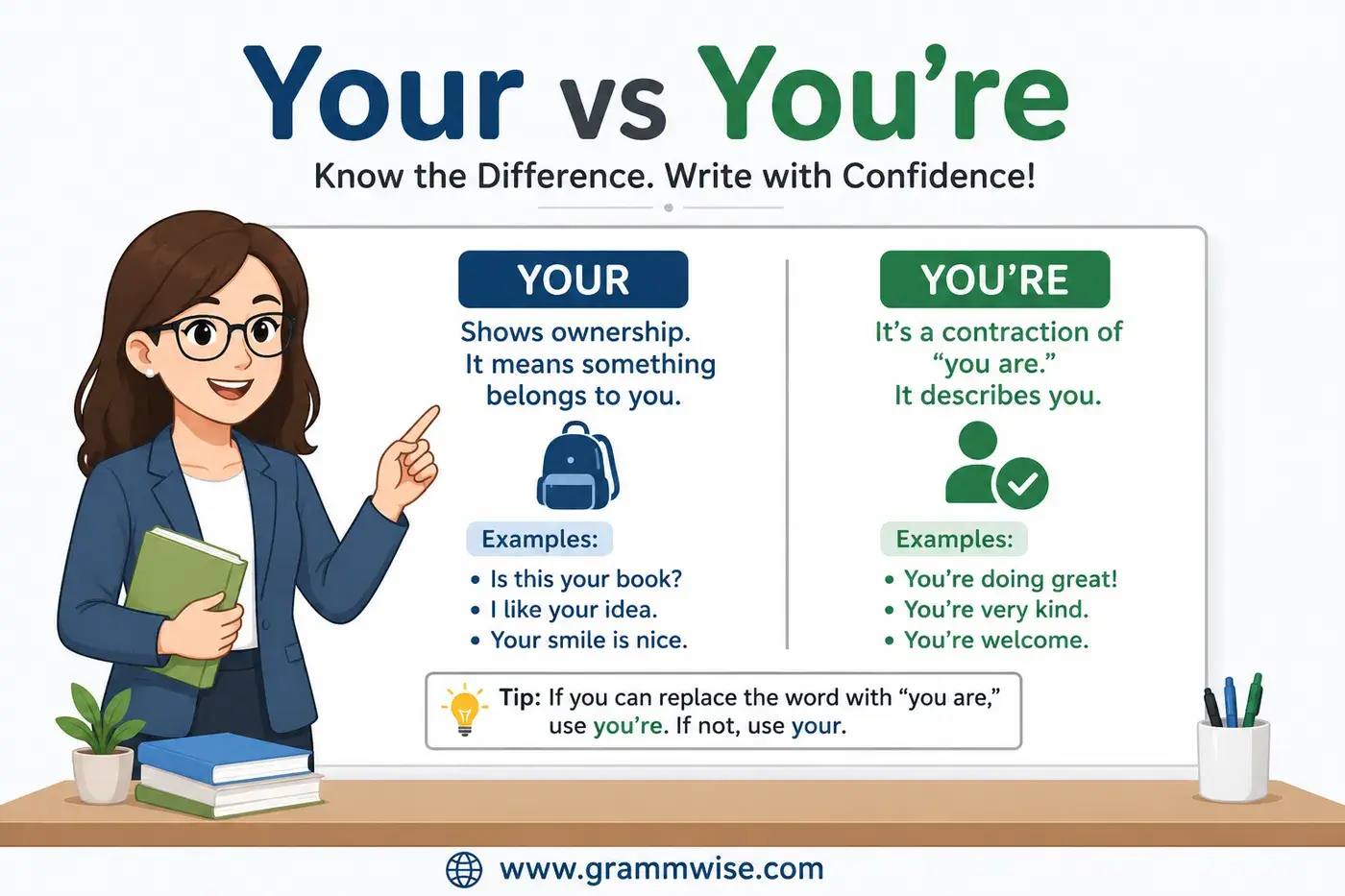
The simple answer is easy. Your shows that something belongs to someone. You’re is a short form of you are. Even though they sound alike, they cannot be used in the same place. Learning this one small rule will help you speak and write with confidence.
This guide explains your vs you’re step by step using simple words, clear examples, and easy memory tricks. By the end, you will know exactly which one to use every time.
Browse related articles for more grammar help.
Simple Answer in One Look
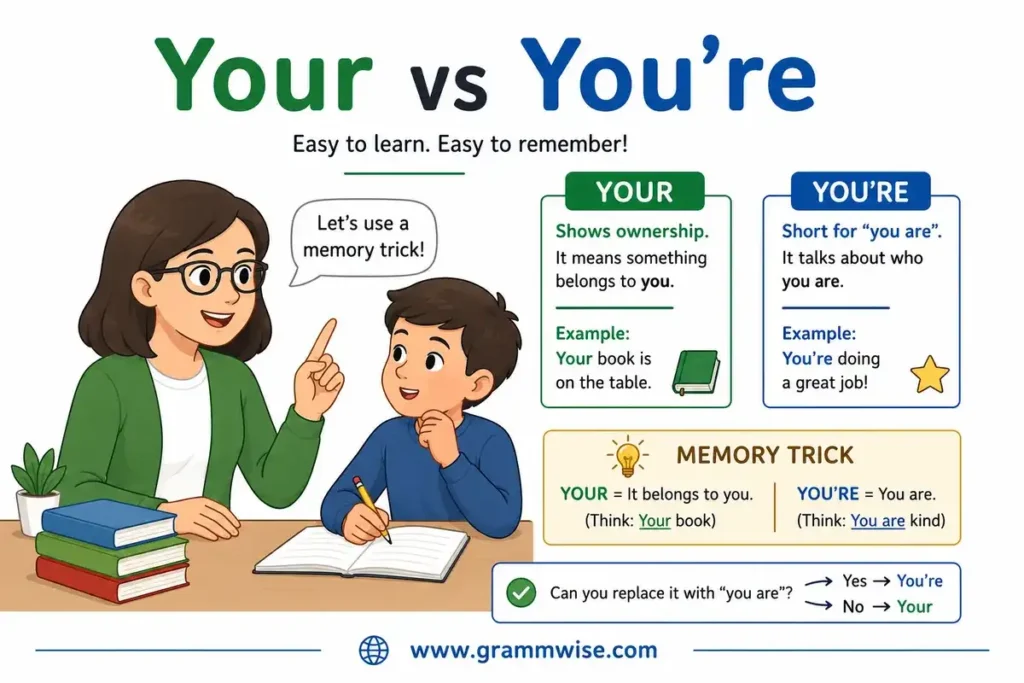
Your shows ownership.
You’re means you are.
If you can replace the word with you are, then you’re is correct.
Meaning of “Your vs You’re” in Simple English
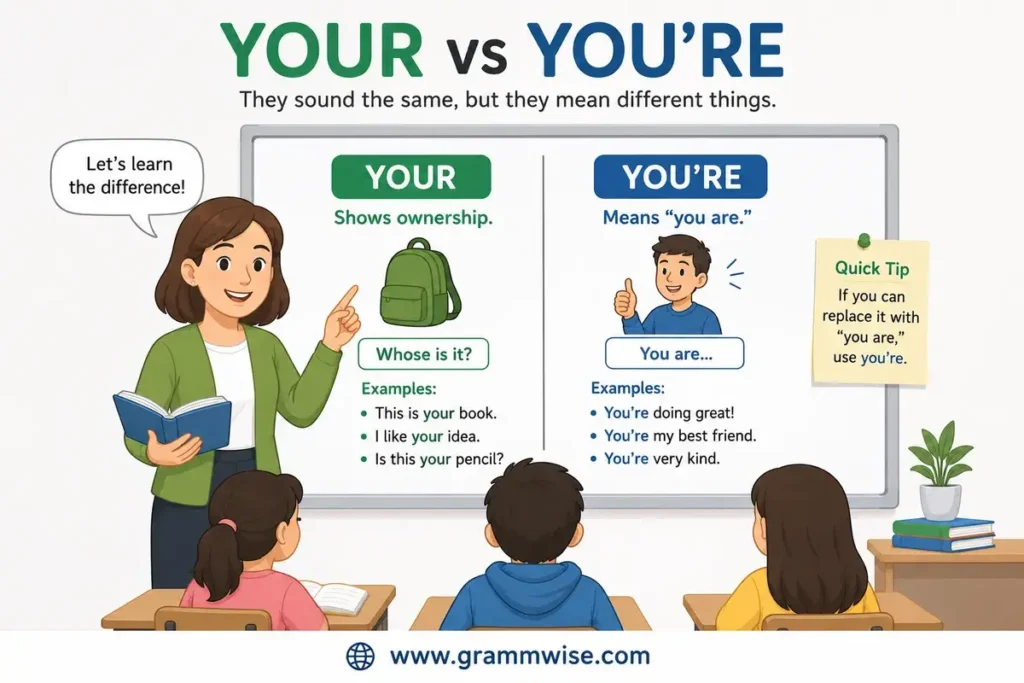
To understand your vs you’re, first learn what each word means.
What does “your” mean?
The word your tells us that something belongs to another person.
It answers the question:
Whose is it?
Examples:
- Your book is on the table.
- I like your shoes.
- Is this your backpack?
- Your family is very kind.
- Wash your hands before dinner.
In every example, something belongs to the person being spoken to.
Think of your as a word that shows ownership.
What does “you’re” mean?
The word you’re is simply a shorter way to say you are.
Instead of writing two words, English often joins them together.
Examples:
- You’re very helpful.
- You’re my best friend.
- You’re going to love this movie.
- I think you’re right.
- You’re late for class.
If you write you are instead of you’re, the sentence still makes sense.
Example:
- You’re happy.
- You are happy.
Both sentences mean the same thing.
Your vs You’re: Why People Mix These Words?
Many people confuse your vs you’re because they sound exactly alike. Words that sound the same but have different meanings are often confusing.
Another reason is that people type quickly. Sometimes they know the correct word but accidentally choose the wrong spelling.
Here are some examples.
Wrong:
- Your very smart.
Correct:
- You’re very smart.
Why?
Because the sentence means:
“You are very smart.”
Now look at another example.
Wrong:
- I like you’re new jacket.
Correct:
- I like your new jacket.
Here, the jacket belongs to someone.
So we use your.
Many students also rely on spell check. Spell check often misses this mistake because both words are spelled correctly. The computer cannot always understand which meaning you want.
That is why knowing the rule yourself is important.
Clear Difference of “Your vs You’re” Explained Simply
The easiest way to remember your vs you’re is to ask one simple question.
Does something belong to someone?
Use your.
Examples:
- Your phone.
- Your homework.
- Your teacher.
- Your lunch.
- Your house.
Can you replace it with “you are”?
Use you’re.
Examples:
- You’re funny.
- You’re busy.
- You’re welcome.
- You’re learning English.
- You’re ready.
Quick Comparison of “Your vs You’re”
Your
- Shows ownership.
- Means something belongs to someone.
- Always comes before a noun.
Examples:
- Your bag
- Your pencil
- Your car
You’re
- Means “you are.”
- Talks about a person.
- Describes someone or tells what they are doing.
Examples:
- You’re excited.
- You’re smiling.
- You’re studying.
A simple memory trick is this:
If you can say you are, write you’re.
If you cannot, write your.
Your vs You’re: Which Form Should You Use?
Most mistakes disappear if you check your sentence first.
Ask yourself this question.
Can I replace the word with “you are”?
If yes, use you’re.
Example:
- You’re doing a great job.
- You are doing a great job.
The sentence still works.
Now try another one.
- I like your dog.
Can you say:
- I like you are dog?
No.
That makes no sense.
So your is correct.
Here is another easy trick.
Look at the word after it.
If the next word is usually a thing, use your.
Examples:
- Your phone
- Your idea
- Your room
- Your homework
If the next word describes someone or shows an action, use you’re.
Examples:
- You’re happy.
- You’re running.
- You’re amazing.
- You’re learning.
This simple habit helps you make the right choice almost every time.
Easy Real-Life Sentences on “Your vs You’re”
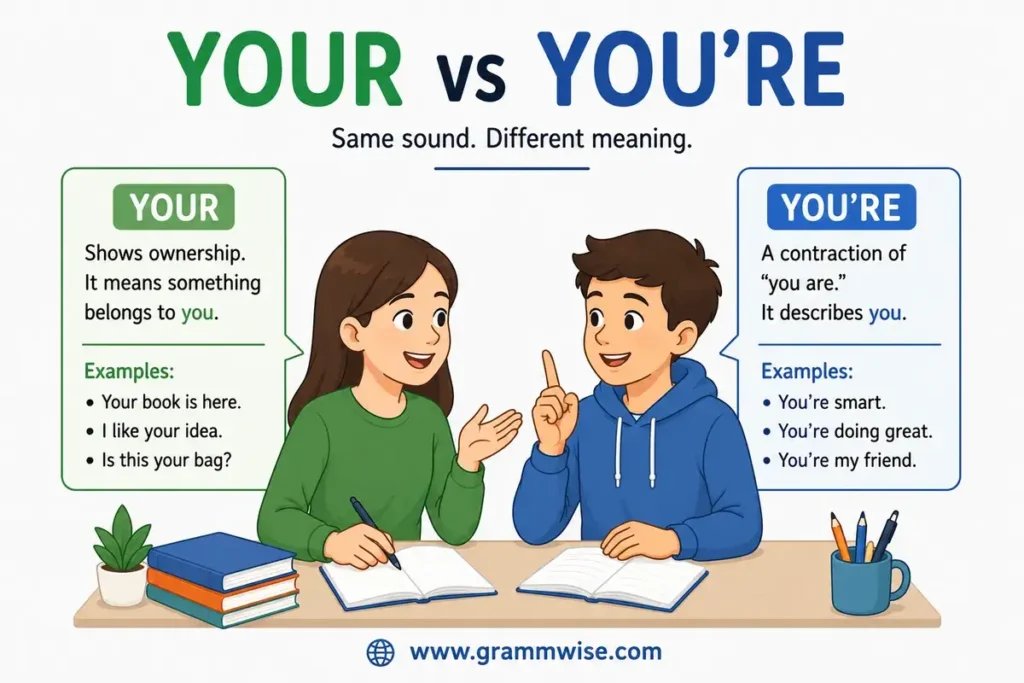
Here are some everyday examples using your.
- Your coffee is ready.
- I found your keys.
- Is this your seat?
- Your brother is waiting.
- Don’t forget your jacket.
- Your answer is correct.
- Your dog is very friendly.
- Please finish your homework.
Now look at examples using you’re.
- You’re doing great.
- You’re very kind.
- You’re early today.
- You’re making good progress.
- You’re my best friend.
- You’re welcome.
- You’re almost finished.
- You’re going to enjoy this book.
Reading these examples out loud helps you remember the difference.
Your vs You’re: Where This Word Comes From?
The word your has been part of English for hundreds of years. It comes from very old English words that showed ownership. People have used your for a long time to talk about things that belong to someone else.
The word you’re came later. It is called a shortened form because two words join together. The apostrophe replaces the missing letter.
You are
↓
You’re
English has many short forms like this.
For example:
- I’m = I am
- They’re = They are
- We’re = We are
- He’s = He is
- She’s = She is
- It’s = It is
These shorter forms make speaking and writing faster and more natural.
That is why you see you’re so often in conversations, messages, emails, and social media posts.
Even though your and you’re sound exactly the same, they have always had different jobs in English. One shows ownership, while the other simply means you are.
How “Your vs You’re” Is Understood in Culture and Stories
When people learn English, your vs you’re is one of the first word pairs they hear about. Teachers, parents, and writers often use this example because it shows how one small mark, the apostrophe, can completely change the meaning of a sentence.
The word your appears in stories every day because characters often talk about things that belong to someone.
For example:
- Your hat looks nice.
- Your horse is waiting.
- Your family loves you.
These sentences sound warm and friendly because they talk about personal things.
The word you’re also appears in stories, but it has a different job. It tells us something about a person.
Examples:
- You’re very brave.
- You’re my best friend.
- You’re ready for the adventure.
Many children’s books use you’re to encourage characters and make conversations feel natural.
Parents also use these words every day.
- Your dinner is ready.
- You’re doing a great job.
- Your room looks clean.
- You’re growing so fast.
You can hear these expressions almost anywhere. Because both words sound exactly the same, they remind us that English spelling does not always match pronunciation.
Learning the difference between your vs you’re helps readers understand sentences faster and writers avoid common mistakes.
Biblical and Mythological Meaning of “Your vs You’re”
The words your and you’re do not have special Biblical or mythological meanings.
However, both words appear often in modern English Bible translations because they are common everyday words.
For example:
- Love your neighbor.
- You’re welcome among us.
In these examples, the words simply follow their normal meanings.
The Bible uses your to show ownership.
It uses you’re only in modern translations where contractions are allowed.
There is no special symbolic meaning attached to either word. They are simply part of everyday English.
Symbolism of “Your vs You’re” Explained in Simple Words
Although your and you’re are grammar words, they can still create different feelings in writing.
What “Your” Represents?
The word your often represents:
- Ownership
- Responsibility
- Care
- Personal connection
- Belonging
For example:
- Your dreams matter.
- Your future is bright.
- Your family loves you.
These sentences feel personal because they speak directly to someone.
What “You’re” Represents?
The word you’re usually represents:
- Identity
- Feelings
- Actions
- Encouragement
- Confidence
Examples:
- You’re amazing.
- You’re learning every day.
- You’re stronger than you think.
These sentences tell someone who they are or what they are doing.
A simple way to remember this is:
Your points to something you have.
You’re talks about who you are.
Related Words You Should Know
Learning a few related words makes your vs you’re even easier.
You
The person being spoken to.
Example:
“You are my friend.”
Yours
Shows ownership without naming the object again.
Example:
“The blue bag is yours.”
Yourself
Means the same person.
Example:
“Believe in yourself.”
You’d
A short form of you would or you had.
Example:
“You’d enjoy this movie.”
You’ll
A short form of you will.
Example:
“You’ll understand soon.”
You’ve
A short form of you have.
Example:
“You’ve done great work.”
Our
Shows something belongs to us.
Example:
“Our school is nearby.”
Their
Shows something belongs to them.
Example:
“Their house is beautiful.”
These words often appear in the same kinds of sentences, so learning them together is helpful.
Use of “Your vs You’re” in Daily English
Native English speakers use your and you’re every single day.
Here are some common examples.
- Your phone is ringing.
- You’re late for school.
- Your lunch is on the table.
- You’re doing really well.
- I like your new haircut.
- You’re always so helpful.
- Don’t forget your homework.
- You’re my favorite teammate.
- Is this your notebook?
- You’re going to have fun today.
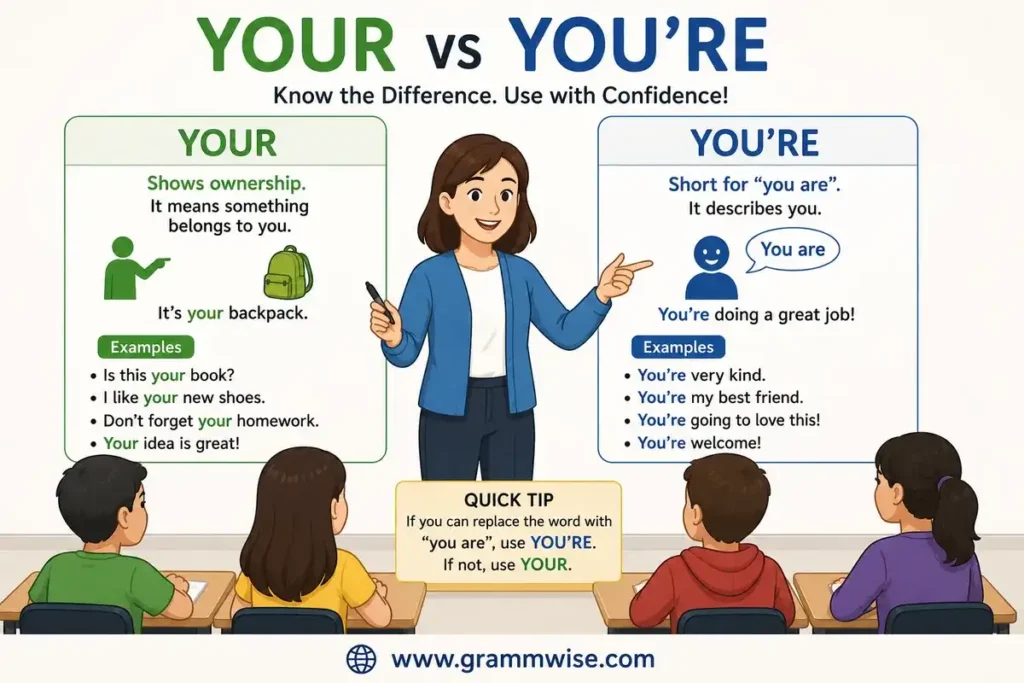
Notice that every sentence with your talks about something that belongs to someone.
Every sentence with you’re can also be read as you are.
That simple check works almost every time.
Common Mistakes People Make About “Your vs You’re”
Many learners make the same mistakes with your vs you’re.
The good news is that they are easy to fix.
Mistake 1: Using “your” instead of “you’re”
❌ Your very kind.
✅ You’re very kind.
Why?
Because the sentence means:
“You are very kind.”
Mistake 2: Using “you’re” instead of “your”
❌ I love you’re new shoes.
✅ I love your new shoes.
The shoes belong to someone, so your is correct.
Mistake 3: Forgetting to test with “you are”
Whenever you are unsure, replace the word.
Example:
You’re happy.
↓
You are happy.
It works.
Now try another.
Your backpack.
↓
You are backpack.
That does not work.
So choose your.
Mistake 4: Forgetting the apostrophe
The apostrophe in you’re replaces the missing letter a in are.
You are
↓
You’re
Without the apostrophe, the meaning changes completely.
Mistake 5: Relying only on spell check
Many computers accept both words because they are both real English words.
That is why reading your sentence carefully is always a good idea.
Final Teacher Explanation
Imagine you are sitting in class and ask me,
“Teacher, how do I remember your vs you’re forever?”
I would give you one easy rule.
Ask yourself this question.
“Can I replace this word with you are?”
If the answer is yes, write you’re.
If the answer is no, write your.
That is all you need to remember. You do not need long grammar rules. Just think about the meaning.
If something belongs to someone, use your.
If the sentence means you are, use you’re.
Practice with simple sentences every day. Soon, choosing the correct word will feel natural. Even many native English speakers make this mistake sometimes.
The difference is that good writers always check their work before they finish.
Your vs You’re: Quick Recap
The difference between your vs you’re is simple. Your shows that something belongs to someone, while you’re means you are. If you can replace the word with you are, choose you’re. If not, use your.
Conclusion
Understanding your vs you’re is simple once you remember what each word does. Your shows that something belongs to someone, while you’re means you are. Using this easy rule will help you avoid common writing mistakes and make your English clearer.
Whenever you are unsure, replace you’re with you are and see if the sentence still makes sense. If it does, use you’re. If not, choose your. With regular practice, picking the correct word will soon become a natural habit.
Frequently Asked Questions (FAQs)
What is the difference between your and you’re?
Your shows ownership. You’re is the short form of you are.
Is “your welcome” correct?
No. The correct sentence is You’re welcome because it means you are welcome.
When should I use your?
Use your when something belongs to the person you are talking to.
When should I use you’re?
Use you’re when you mean you are.
Why do people confuse your vs you’re?
They sound exactly the same, so many people choose the wrong spelling while writing.
Can I replace you’re with you are?
Yes. If the sentence still makes sense, you’re is correct.
Is your a contraction?
No. Only you’re is a contraction because it comes from you are.
What is the easiest way to remember your vs you’re?
Use this simple trick: Your = belongs to you. You’re = you are. If you remember that one rule, you’ll make far fewer mistakes.