
Many English learners struggle with its vs it’s because these two words look almost the same. The only difference is one small apostrophe, but that tiny mark changes the meaning completely. Once you learn one easy rule, you will know which word to use every time.
The confusion between its vs it’s is one of the most common writing mistakes in English. Students, professionals, and even native English speakers sometimes choose the wrong word. The good news is that the rule is simple and easy to remember.
This guide explains its vs it’s in very easy English. You will learn the meaning of each word, when to use it, why people confuse them, and how to avoid common mistakes in everyday writing.
Check related grammar articles to strengthen your English writing skills.
Simple Answer in One Look
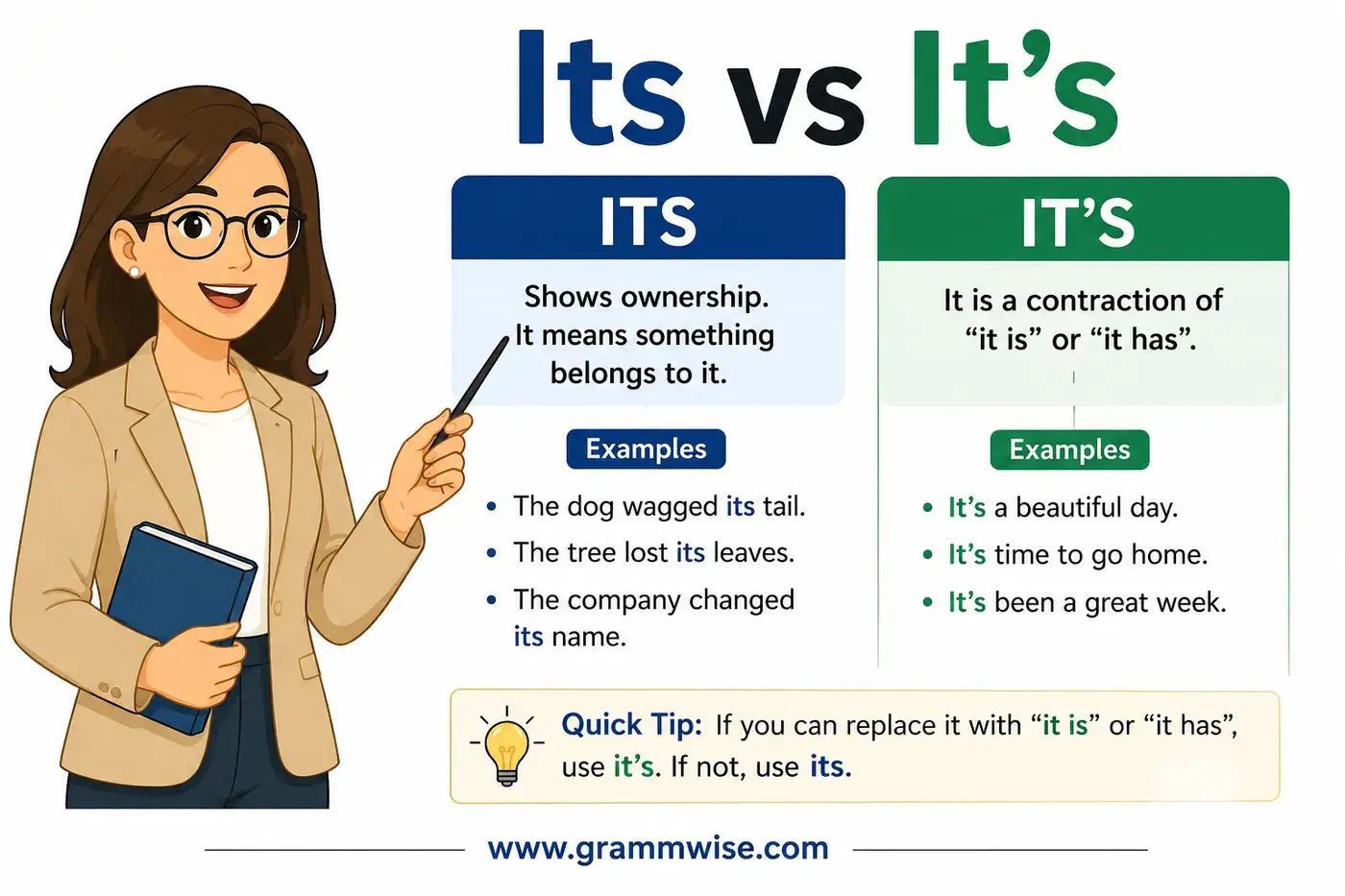
- Its shows that something belongs to an animal, object, or thing.
- It’s is the short form of it is or it has.
If you can replace the word with it is or it has, use it’s. Otherwise, use its.
Meaning of “Its vs It’s” in Simple English
Think of these two words as having different jobs.
What does its mean?
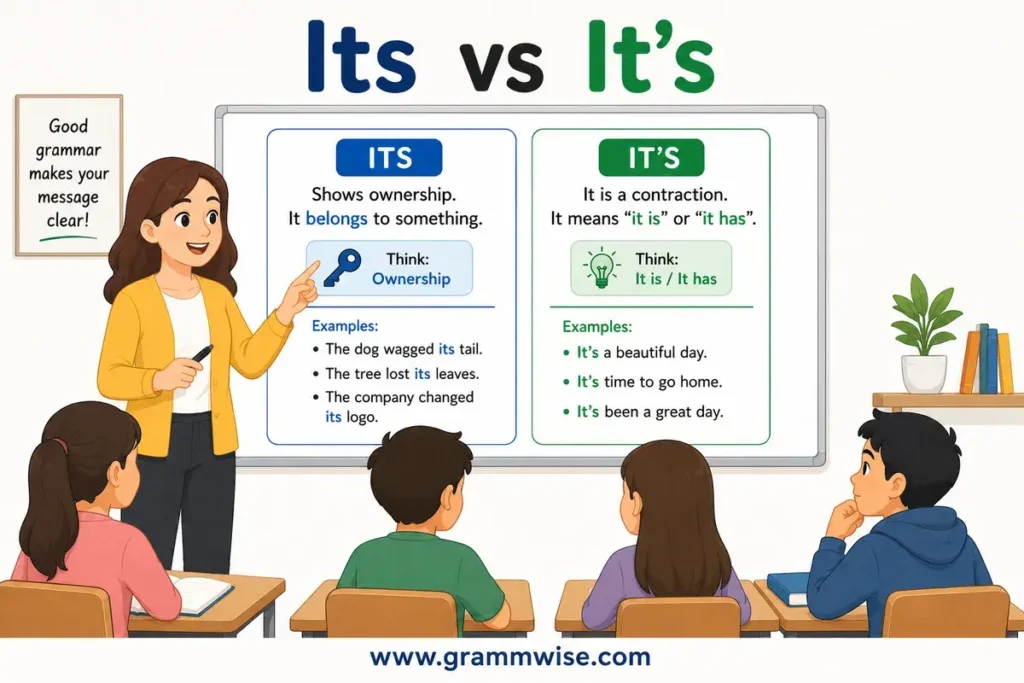
Its tells us that something belongs to an animal, object, or thing.
Examples:
- The dog wagged its tail.
- The tree lost its leaves.
- The company changed its name.
- The phone needs its charger.
In each sentence, something belongs to the dog, tree, company, or phone.
What does it’s mean?
It’s is simply a shorter way of writing it is or it has.
Examples:
- It’s raining outside.
- It’s my favorite movie.
- It’s been a long day.
- It’s time to go home.
Try replacing it’s with it is.
- It is raining outside.
- It is my favorite movie.
The sentence still makes sense.
Sometimes it’s also means it has.
Example:
- It’s been fun.
This means:
- It has been fun.
Its vs It’s: Why People Mix These Words?
People often confuse its vs it’s because the words sound exactly the same.
When speaking, you cannot hear the apostrophe. Both words have the same pronunciation.
Another reason is that many English words use an apostrophe to show ownership.
For example:
- Sarah’s book
- John’s car
- Emma’s backpack
Because of this, many people think it’s should show ownership too.
But English has one special rule.
Its shows ownership without an apostrophe.
That surprises many learners.
People also make mistakes because they write quickly. Spell check may not notice the error because both its and it’s are real English words.
For example:
❌ The cat cleaned it’s paws.
The computer may not mark this as wrong.
The correct sentence is:
✅ The cat cleaned its paws.
Understanding the meaning instead of guessing the spelling is the best way to avoid mistakes.
Clear Difference of “Its vs It’s” Explained Simply
Here is the easiest way to remember its vs it’s.
Use its when:
- Something belongs to an animal.
- Something belongs to an object.
- Something belongs to a company.
- Something belongs to a country or place.
- Something belongs to anything that is called “it.”
Examples:
- The bird spread its wings.
- The baby drank its milk.
- The school opened its new library.
- The robot moved its arm.
Use it’s when:
- It means it is.
- It means it has.
Examples:
- It’s very cold today.
- It’s easy to understand.
- It’s been a busy week.
- It’s almost lunchtime.
Quick Comparison
| Word | Meaning | Easy Memory Trick |
|---|---|---|
| Its | Belongs to something | Think “ownership.” |
| It’s | It is or it has | Expand it to check. |
Its vs It’s: Which Form Should You Use?
Ask yourself one simple question.
Can I replace the word with it is or it has?
If the answer is yes, write it’s.
Example: It’s sunny today.
Replace it: It is sunny today.
The sentence still makes sense. So it’s is correct.
Now look at another example.
The dog wagged its tail.
Replace it: The dog wagged it is tail.
That sounds wrong. So its is correct.
This one test works almost every time. Another easy trick is to ask yourself whether something belongs to someone or something.
If the answer is yes, choose its.
If not, see whether it is or it has fits the sentence.
Easy Real-Life Sentences on “Its vs It’s”
Here are some everyday examples.
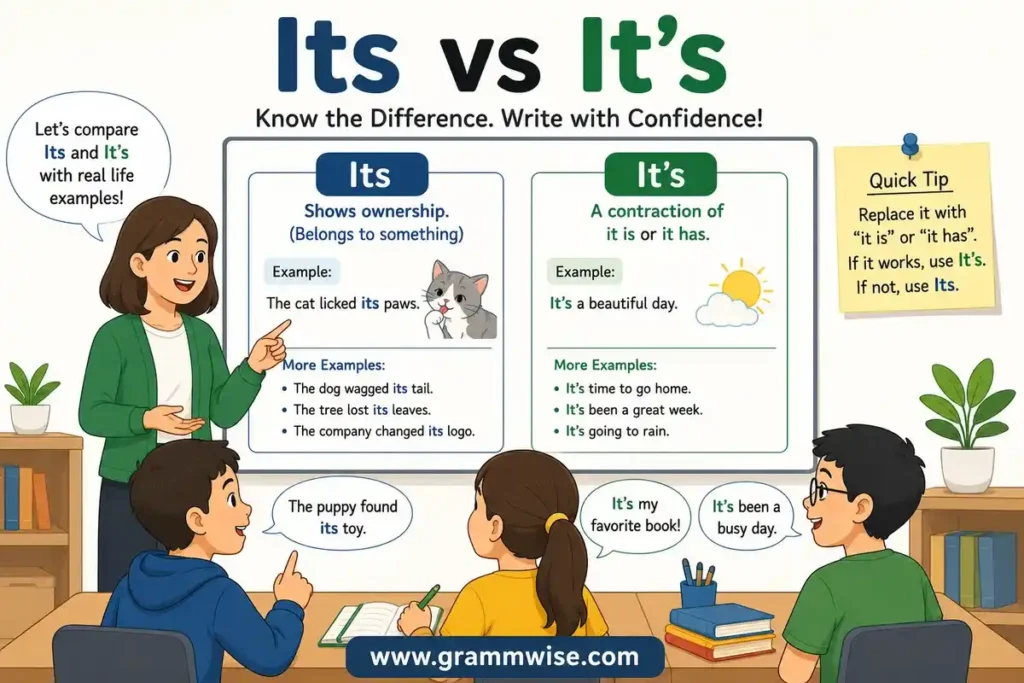
- The cat is licking its paws.
- It’s a beautiful morning.
- The tree lost its leaves.
- It’s almost dinner time.
- The computer needs its update.
- It’s raining again.
- Every car has its own color.
- It’s nice to meet you.
Read each sentence aloud.
Then replace it’s with it is.
If the sentence still sounds right, you know you picked the correct word.
Its vs It’s: Where This Word Comes From?
The word it has been part of English for hundreds of years.
As English changed over time, people began writing shorter forms like:
- I’m = I am
- You’re = You are
- He’s = He is
- She’s = She is
- It’s = It is
These shorter forms make speaking and writing faster.
The word its became the standard way to show ownership.
Unlike many other words, English does not use an apostrophe in its. This special spelling has been used for a long time and is now the accepted rule.
That is why its and it’s look different even though they come from the same word.
How “Its vs It’s” Is Understood in Culture and Stories
The difference between its vs it’s is mostly about writing clearly. These words do not have special cultural meanings, but they appear in almost every kind of English writing.
You will see its and it’s in children’s books, newspapers, websites, school lessons, and everyday conversations.
Writers use its when they talk about something that belongs to an animal, object, place, or idea.
Examples:
- The lion protected its cubs.
- The old house lost its roof.
- The company changed its logo.
These sentences show ownership.
Writers use it’s when they mean it is or it has.
Examples:
- It’s a wonderful story.
- It’s getting late.
- It’s been a great year.
Using the correct word helps readers understand your meaning right away. A small apostrophe can completely change what your sentence says.
That is why teachers spend time explaining its vs it’s in school.
Biblical and Mythological Meaning of “Its vs It’s”
Neither its nor it’s has a special meaning in the Bible or in mythology. These words simply help form clear English sentences. Modern English Bible translations often use its to show ownership.
Example:
- The tree produced its fruit.
You may also see it’s in modern English writing outside the Bible because it is a common short form of it is or it has.
In myths and legends, these words are used just like they are in everyday English. They help tell the story but do not carry any special symbolic meaning.
Symbolism of “Its vs It’s” Explained in Simple Words
Although these words are not symbols, people often connect them with simple ideas because of how they are used.
What Its Represents?
The word its often represents:
- Ownership
- Care
- Identity
- Belonging
- Connection
Examples:
- A bird protects its nest.
- A flower opens its petals.
- A country has its own traditions.
The word reminds us that something belongs to something else.
What It’s Represents?
The word it’s often represents:
- A statement
- A description
- Time
- Weather
- A simple fact
Examples:
- It’s a sunny day.
- It’s my turn.
- It’s time to leave.
One easy way to remember this is:
Its shows ownership.
It’s starts a statement using it is or it has.
Related Words You Should Know
Learning these words will make its vs it’s even easier.
It
It refers to an animal, object, place, or idea.
Example:
- It is raining.
It Is
This is the full form of it’s.
Example:
- It is cold today.
It Has
This is another meaning of it’s.
Example:
- It has been a busy week.
Their
Their shows that something belongs to people.
Example:
- Their house is beautiful.
His
His shows that something belongs to a man or boy.
Example:
- His bike is new.
Her
Her shows that something belongs to a woman or girl.
Example:
- Her backpack is heavy.
Your
Your means something belongs to you.
Example:
- Your homework is finished.
Whose
Whose asks who owns something.
Example:
- Whose notebook is this?
Learning these ownership words together helps you remember when to use its.
Use of “Its vs It’s” in Daily English
You will hear and read its and it’s every day.
Here are some natural examples.
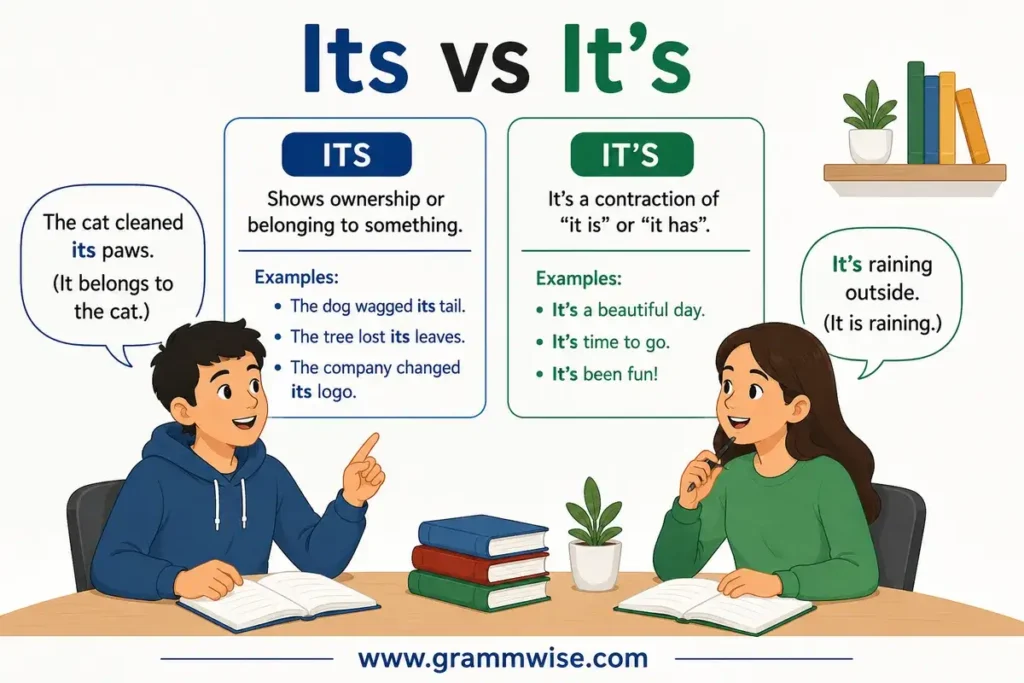
- The cat cleaned its paws.
- It’s almost bedtime.
- The phone needs its charger.
- It’s easy to understand.
- Every plant needs its own space.
- It’s too hot outside.
- The school changed its schedule.
- It’s my favorite season.
- The puppy found its toy.
- It’s been a wonderful vacation.
Here are a few short conversations.
Conversation 1
A: Is the dog hungry?
B: Yes. It’s eating its food.
Conversation 2
A: What time is it?
B: It’s almost three o’clock.
Conversation 3
A: Why is the phone not working?
B: I think its battery is dead.
Conversation 4
A: How’s the weather?
B: It’s beautiful today.
Conversation 5
A: Did the bird return?
B: Yes. It’s back in its nest.
These are the kinds of sentences English speakers use every day.
Common Mistakes People Make About “Its vs It’s”
Many learners make the same mistakes when writing its vs it’s.
Here are the most common ones.
Mistake 1
❌ The dog wagged it’s tail.
✅ The dog wagged its tail.
The tail belongs to the dog, so use its.
Mistake 2
❌ Its raining today.
✅ It’s raining today.
This means it is raining, so use it’s.
Mistake 3
❌ The company changed it’s name.
✅ The company changed its name.
The name belongs to the company.
Mistake 4
❌ Its been a long day.
✅ It’s been a long day.
This means it has been a long day.
Mistake 5
Using an apostrophe every time.
Many people believe every ownership word needs an apostrophe.
That is not true.
Remember these examples:
- His book
- Her bag
- Its tail
None of these ownership words need an apostrophe.
Final Teacher Explanation
Imagine we are sitting together in class.
I write two sentences on the board.
It’s raining outside.
The cat cleaned its paws.
Now I ask one simple question.
Can you replace the word with it is or it has?
If yes, choose it’s.
If the answer is no, ask another question.
Does something belong to an animal, object, place, or thing?
If yes, choose its.
That is all you need to remember.
You do not have to memorize long grammar rules.
Just remember these two ideas:
Its = ownership.
It’s = it is or it has.
Practice this simple test whenever you write. Soon, choosing between its vs it’s will become easy and natural.
Even experienced writers check these words sometimes. A quick review helps you avoid one of the most common English writing mistakes.
Its vs It’s: Quick Recap
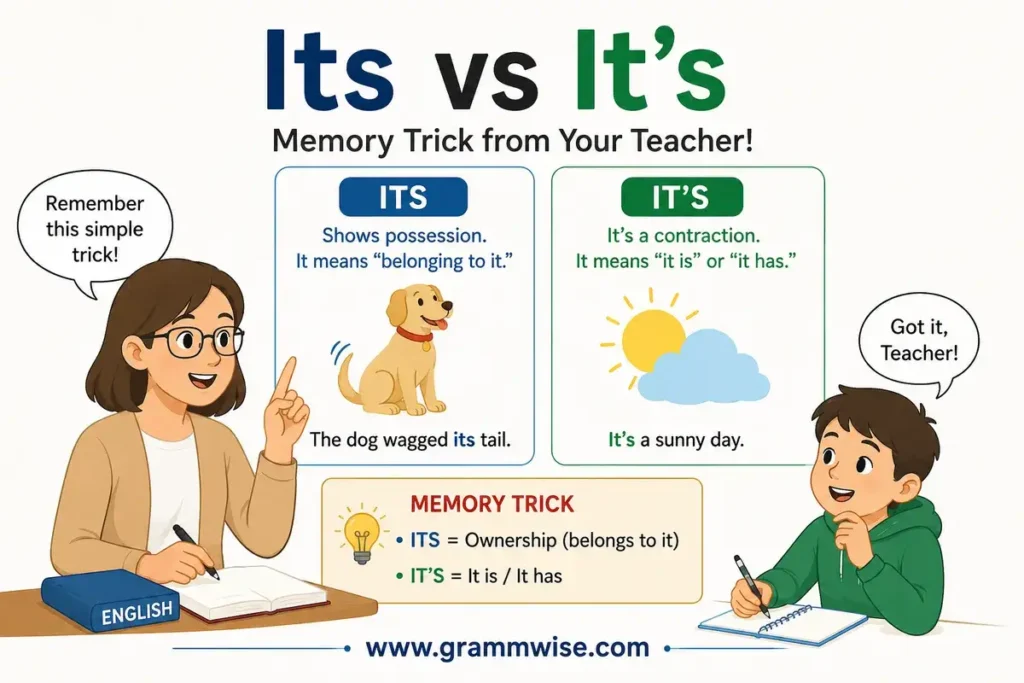
The difference between its vs it’s is simple.
Use its when something belongs to an animal, object, place, or thing.
Use it’s whenever you mean it is or it has. If you can expand the word, the apostrophe belongs there.
Conclusion
Understanding its vs it’s is easy once you remember one simple rule. Use its to show ownership, and use it’s when you mean it is or it has. This small difference will help you write more clearly and avoid one of the most common English mistakes.
Keep practicing with short sentences and use the replacement test whenever you are unsure. With a little practice, choosing the correct word will become natural, and your English writing will be more accurate and confident.
Frequently Asked Questions (FAQs)
What does its mean in simple words?
Its shows that something belongs to an animal, object, place, or thing.
What does it’s mean?
It’s is the short form of it is or it has.
Why do people confuse its vs it’s?
Both words sound the same, and many people think all ownership words use an apostrophe.
How can I remember the difference?
Replace it’s with it is or it has. If the sentence still makes sense, it’s is correct. Otherwise, use its.
Can I use both words in the same sentence?
Yes.
Example: It’s funny that the dog lost its ball.
Which is correct: “Its raining” or “It’s raining”?
It’s raining is correct because it means it is raining.
Is its ever a short form?
No. Its only shows ownership. It is never a contraction.
What is the easiest trick for learning its vs it’s?
Remember this simple rule: its means ownership, while it’s always means it is or it has. If you can expand the word, use the apostrophe.