
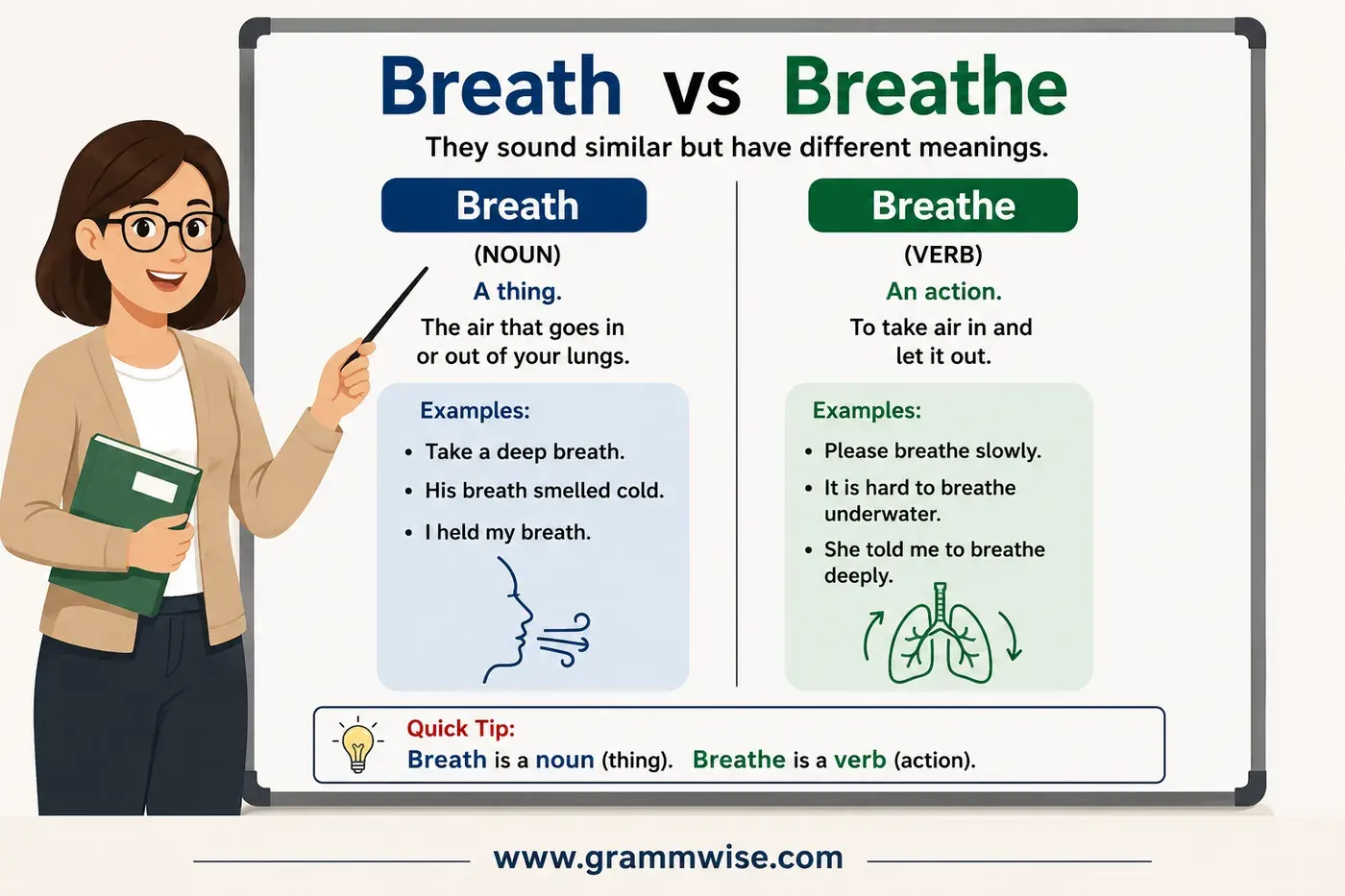
Many English learners get confused about breath vs breathe because these two words look almost the same. They both relate to air and breathing, but they do not mean the same thing. The main difference is simple: one is a thing, and the other is an action.
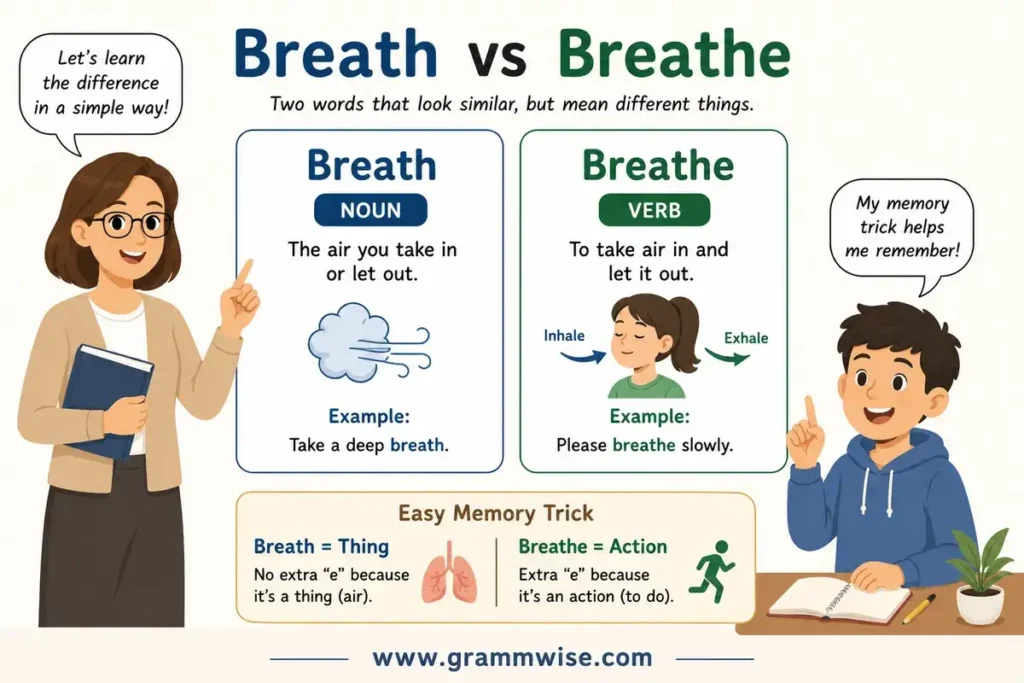
If you are wondering about breath vs breathe, here is the quick answer: breath is the air you take in or let out, while breathe means to inhale and exhale air. One is a noun, and one is a verb.
This small spelling difference causes a lot of mistakes in writing, speaking, and daily communication. Once you understand one easy rule, you will rarely mix them up again.
You might also find our comparison of similar confusing word pairs useful like eminent vs imminent.
Simple Answer in One Look
- Breath = the air coming in or out of your body
- Breathe = the action of taking air in and out
Very simple rule:
Breath is a thing. Breathe is an action.
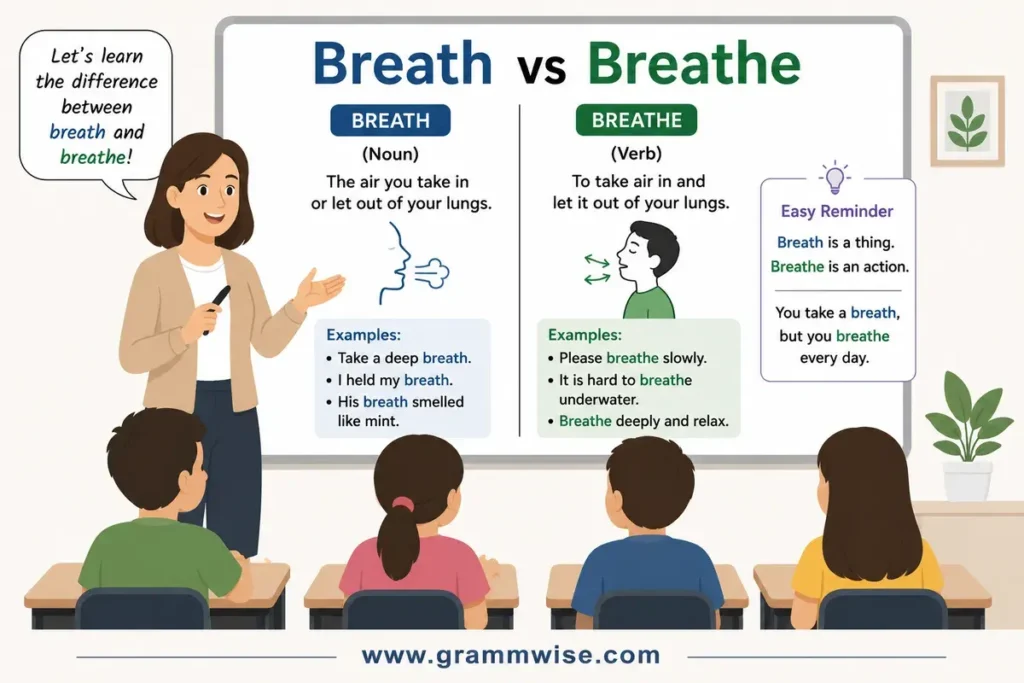
Meaning of Breath vs Breathe in Simple English
Think about what happens when you are alive. Your body takes air in and pushes air out. That process helps you live.
Now split that idea into two parts.
What is Breath?
Breath means the air itself.
When you blow air from your mouth, that air is your breath.
Examples:
- Your breath smelled like coffee.
- I could see my breath in the cold weather.
- Take a deep breath.
In all these examples, breath refers to air.
You can think of it as something you have.
You have breath.
What is Breathe?
Breathe means the action of taking air into your lungs and letting it out.
Examples:
- Please breathe slowly.
- It is hard to breathe underwater.
- Breathe deeply and relax.
In these examples, breathe is something you do.
You do breathe.
That makes remembering easier.
- You have a breath
- You breathe every day
Breath vs Breathe: Why People Mix These Words?
Many people confuse breath vs breathe because the words look nearly identical.
The only spelling difference is the extra e at the end of breathe.
That tiny letter changes pronunciation and meaning.
Compare them:
- Breath → ends with th
- Breathe → ends with the
When spoken quickly, many learners do not hear the difference clearly.
That causes confusion.
Here are common mistakes:
❌ I cannot breath properly.
✅ I cannot breathe properly.
❌ Take a deep breathe.
✅ Take a deep breath.
These mistakes happen because people know the meaning but choose the wrong spelling.
Another reason is autocorrect.
Phones and computers sometimes fail to catch this mistake because both are real English words.
That makes careful writing important.
Clear Difference of Breath vs Breathe Explained Simply
Here is the easiest way to understand breath vs breathe.
| Word | Meaning | Type | Example |
|---|---|---|---|
| Breath | Air from lungs | Noun | Take a breath |
| Breathe | Action of breathing | Verb | Breathe slowly |
Use this memory trick:
Breath = Short Word = Thing
No extra e.
Short word.
A thing you have.
Example:
- His breath smelled minty.
Breathe = Longer Word = Action
Extra e at the end.
Longer word.
An action you do.
Example:
- You should breathe slowly.
Another Easy Memory Trick for Breath vs Breathe
Think about other action words.
Many verbs in English have a softer ending sound.
Examples:
- bathe
- soothe
- breathe
That final e often helps show action.
This trick helps many students.
Breath vs Breathe: Which Form Should You Use?
Use breath when talking about air.
Ask yourself:
Can I count it, describe it, or talk about it like a thing?
If yes, use breath.
Examples:
- Her breath was warm.
- I lost my breath while running.
- One deep breath helped me relax.
Use breathe when talking about action.
Ask yourself:
Am I describing something someone is doing?
If yes, use breathe.
Examples:
- Try to breathe slowly.
- He could not breathe well.
- Babies breathe naturally.
Here is a fast test.
Sentence:
“I need to ___ after running.”
Are you talking about air or action?
It is an action.
Correct word:
✅ breathe
Another sentence:
“Take a deep ___.”
Here you need a thing.
Correct word:
✅ breath
This rule works almost every time.
Easy Real-Life Sentences on Breath vs Breathe
Here are everyday examples of breath vs breathe.
Using Breath
- Take a deep breath before speaking.
- My breath became fast after running.
- I held my breath during the movie.
- Cold air made my breath visible.
Using Breathe
- Please breathe slowly.
- I cannot breathe through my nose.
- She told me to breathe deeply.
- Relax and breathe for ten seconds.
Practice reading them aloud.
Hearing both words helps your brain remember the difference.
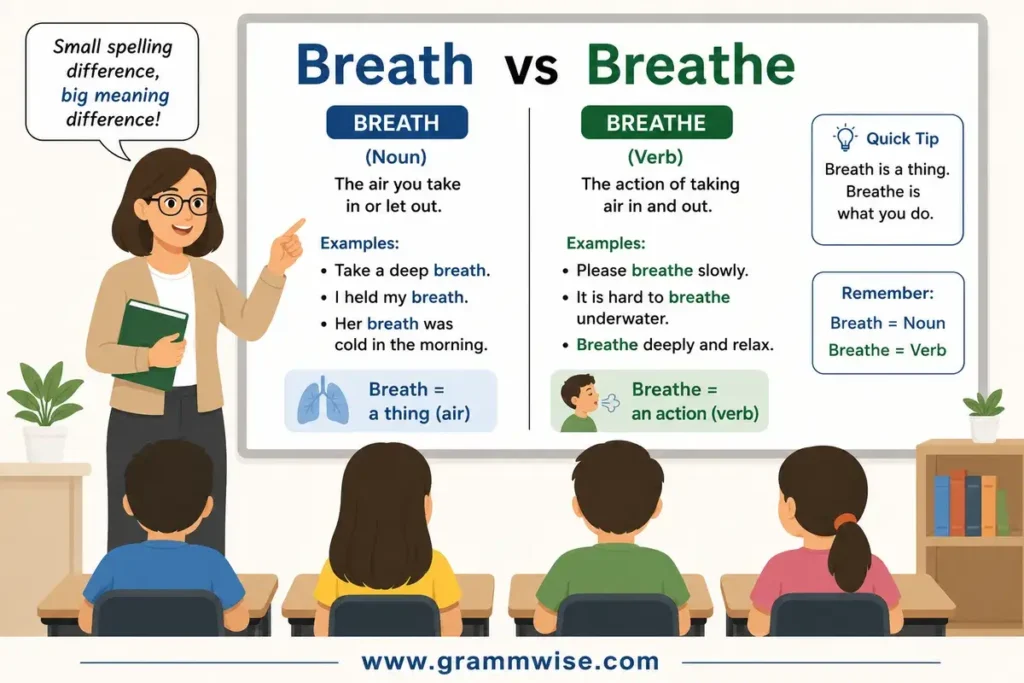
Use of Breath vs Breathe in Daily English
You will often see breath in common expressions.
Take a breath
This means pause and relax.
Example:
- Take a breath before answering.
Catch your breath
This means rest until breathing becomes normal.
Example:
- I climbed the stairs and needed to catch my breath.
Out of breath
This means breathing hard.
Example:
- I was out of breath after jogging.
These phrases are very common in spoken English.
Breathe deeply
Used for calmness or exercise.
Example:
- Breathe deeply during yoga.
Breathe easily
Means feel relief.
Example:
- We can finally breathe easily now.
Breathe in / Breathe out
Very common in meditation.
Example:
- Breathe in slowly and breathe out gently.
These expressions are useful in both speaking and writing.
Breath vs Breathe: Where This Word Comes From?
The words breath and breathe come from old English roots connected to air and life.
Long ago, English speakers used similar words for breathing and spirit. That makes sense because breathing is part of living. Many cultures connect breath with life itself. If breathing stops, life stops. Over time, English kept both forms.
One became the noun: breath
The other became the verb: breathe
That difference stayed in modern English. Even today, both words remain closely connected.
Common Sentence Patterns of Breath vs Breathe
Learning sentence patterns helps avoid mistakes.
Breath Patterns
- take a breath
- hold your breath
- lose your breath
- deep breath
Examples:
- Take a breath.
- I lost my breath.
Breathe Patterns
- breathe slowly
- breathe deeply
- breathe in
- breathe out
Examples:
- Breathe slowly.
- Breathe in deeply.
Notice the pattern.
Breath often comes after verbs.
Breathe is often the main verb.
This helps when writing quickly.
Quick Practice Check for Breath vs Breathe
Choose the correct word.
- Take a deep ___
- Please ___ slowly
- I lost my ___
- It is hard to ___
Answers:
- breath
- breathe
- breath
- breathe
If you got them right, great job.
You already understand the core rule.
How “Breath vs Breathe” Is Understood in Culture and Stories
In many cultures, breath is more than just air. People often connect breath with life, energy, calmness, and spirit. When a baby is born, one of the first important signs of life is the first breath. That is why breath often symbolizes life itself.
You may also hear people say things like, “He took his last breath.” This means someone has died. Here, breath represents the start and end of life.
Stories, movies, and books also use breathing to show emotions. Fast breathing can show fear, stress, or excitement. Slow breathing can show peace, sleep, or relaxation.
Think about scary movies. When a character hides from danger, you often hear heavy breathing. That sound builds tension. In peaceful scenes, characters may close their eyes and breathe slowly to calm down.
This shows us something important. Breath tells us how a person feels, even without words.
That is why breath and breathe have strong meaning in daily life and storytelling.
Biblical and Mythological Meaning of Breath vs Breathe
In many religious and old cultural stories, breath is connected to life and spirit.
In the Bible, breath is often shown as something given by God. Breath represents life, soul, and divine power. When God gives breath, life begins. This teaches a simple idea: without breath, there is no life.
In old myths from different cultures, breath also had special meaning. Some stories describe gods creating humans by giving them breath. Others connect breath with spirit or energy inside the body.
Many ancient traditions believed breathing was not just physical. They believed it also affected the mind and soul. Even today, this idea remains in meditation, prayer, and relaxation practices.
People often use breathing exercises to feel calm and centered.
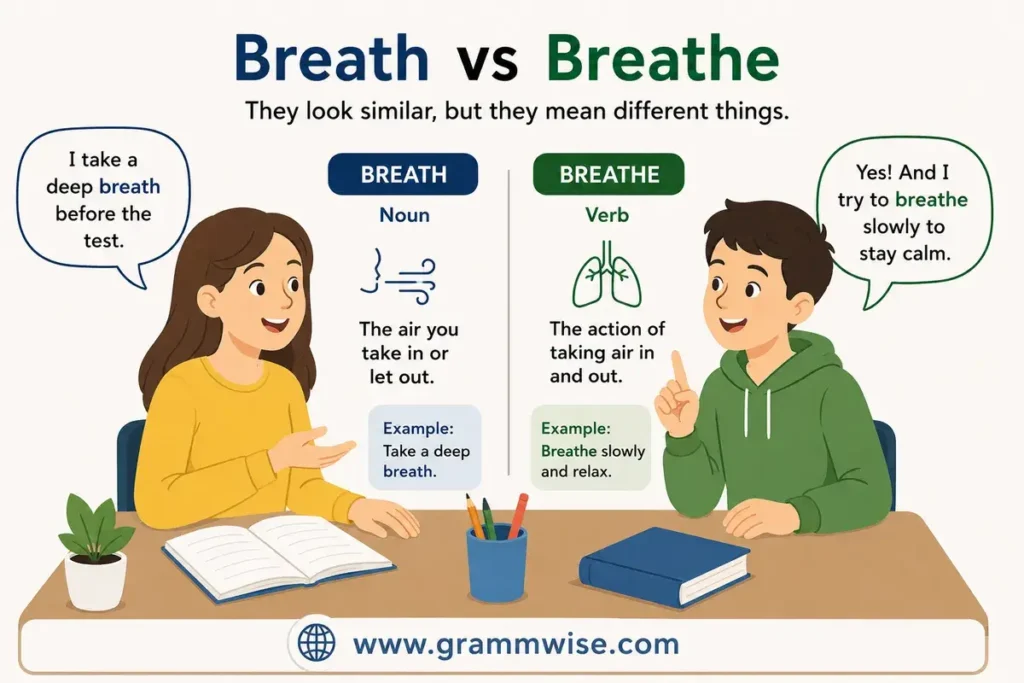
Symbolism of Breath vs Breathe Explained in Simple Words
What Breath Represents?
Breath often represents something precious and essential.
It can symbolize:
- Life
- Energy
- Presence
- Calmness
- Survival
When someone says, “I held my breath,” it may mean waiting with suspense or fear.
When someone says, “Take a deep breath,” it often means relax and regain control.
So breath is not only air. It can also symbolize emotional balance.
Breath feels like something valuable because every living person depends on it.
What Breathe Represents?
Breathe usually represents action and movement.
It can symbolize:
- Living fully
- Staying calm
- Recovery
- Letting go of stress
- Continuing forward
When people say, “Just breathe,” they usually are not giving a science lesson. They are offering comfort.
It means:
- Slow down
- Calm yourself
- Keep going
That makes breathe a powerful emotional word.
Breath is the thing.
Breathe is the action that keeps life moving.
Related Words to Breath vs Breathe You Should Know
Here are helpful related words connected to breath vs breathe.
Breathing
This means the process of taking air in and out of the body.
Example:
Breathing slowly can help reduce stress.
Inhale
This means breathing air in.
Example:
Inhale deeply through your nose.
Exhale
This means breathing air out.
Example:
Exhale slowly through your mouth.
Respiration
This is a more formal word for breathing.
Example:
Respiration helps the body get oxygen.
Oxygen
This is the gas your body needs to survive.
Example:
Humans need oxygen to live.
Pant
This means breathing quickly, often after exercise.
Example:
The dog began to pant after running.
Sigh
A sigh is a long breath out, often showing emotion.
Example:
She sighed with relief.
Knowing these words improves vocabulary and makes your English stronger.
Use of Breath vs Breathe in Daily Conversation
People use breath and breathe all the time in normal conversations.
Here are real examples.
- Take a deep breath before the interview.
- I could barely breathe after running upstairs.
- Her breath smelled like mint.
- Please breathe slowly during the exercise.
- I was out of breath after soccer practice.
- Breathe in and count to five.
- Hold your breath for a moment.
- The cold air took my breath away.
- He stopped to catch his breath.
- Just breathe and relax.
These examples show how common these words are.
You will hear them in schools, hospitals, gyms, yoga classes, and everyday conversations.
Common Mistakes People Make About Breath vs Breathe
The biggest mistake is using breath and breathe in the wrong place.
Wrong: I cannot breath properly.
Correct: I cannot breathe properly.
Why? Because this sentence needs an action word.
Another mistake:
Wrong: Take a deep breathe.
Correct: Take a deep breath.
Why? Because this sentence needs a noun.
Many learners also mispronounce them.
Remember:
- Breath sounds short
- Breathe has a longer ending sound
Another mistake is typing too fast and missing the extra e. That tiny letter matters a lot.
A simple trick:
If the sentence needs an action, choose breathe.
If the sentence needs a thing, choose breath.
Final Teacher Explanation
Here is the easiest classroom rule to remember.
Breath is something you have.
You can take a breath, hold a breath, or lose your breath.
Breathe is something you do.
You breathe when you sleep, walk, run, or rest.
That extra e changes everything.
Many students confuse these words because they look almost identical. But once you remember thing vs action, the confusion becomes much easier to solve.
Whenever you feel unsure, ask yourself one question:
“Am I talking about air, or the act of breathing?”
That question will guide you to the correct word.
Final Thought Breath vs Breathe
The difference between breath vs breathe is simple.
Breath is a noun that means air from your lungs.
Breathe is a verb that means taking air in and out.
Easy memory tip:
You take a breath, but you breathe every day.
Conclusion
Understanding breath vs breathe becomes easy when you remember one is a noun and the other is a verb. This small spelling difference changes meaning, usage, and word choice in English.
Good vocabulary improves communication. When you know the right spelling and context, your writing sounds clearer and more natural.
Frequently Asked Questions (FAQs)
What does breath mean in simple words?
Breath means the air that goes in and out of your lungs.
What does breathe mean?
Breathe means the action of taking air in and letting it out.
Is it correct to say take a deep breath?
Yes. That is correct because breath is a noun.
Why do people confuse breath and breathe?
They look very similar and differ by only one letter.
Is breathe a verb?
Yes. Breathe is an action word.
Can I use both forms in writing?
Yes, but only in the correct context. Use breath for the thing and breathe for the action.
How can I remember the difference?
Use this rule:
Breath = thing
Breathe = action