
Many people get confused about broth vs stock because they look similar and are often used in the same recipes. You may see both words on soup cartons at the grocery store or in cooking instructions. Because they are closely related, many people wonder if they mean the same thing.
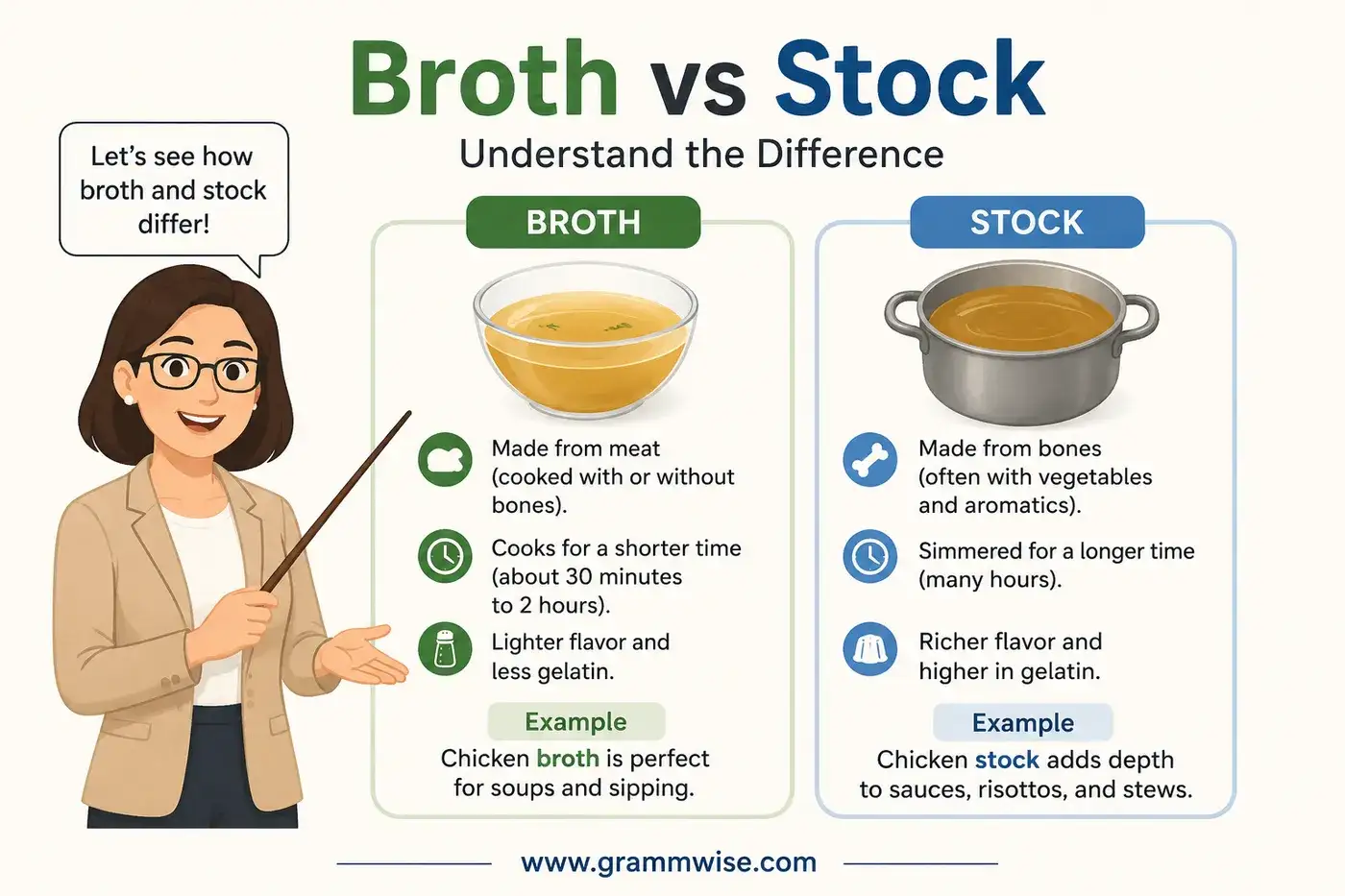
The simple answer is that broth is usually made by cooking meat with a few vegetables and seasonings, while stock is mainly made by simmering bones with vegetables for a longer time. They can sometimes be used in place of each other, but they are not exactly the same.
In this guide, you will learn the difference between broth vs stock in very simple English. We will explain what each one means, why people confuse them, when to use each one, and easy examples that make everything clear.
English has many word pairs with subtle differences in meaning and usage.
Simple Answer in One Look
Broth is a flavorful liquid usually made by cooking meat, vegetables, and seasonings.
Stock is a rich liquid mainly made by simmering bones with vegetables.
Easy rule:
- Broth = Meat + flavor
- Stock = Bones + richness
Meaning of “Broth vs Stock” in Simple English
The easiest way to understand broth vs stock is to think about what goes into the pot.
What Is Broth?
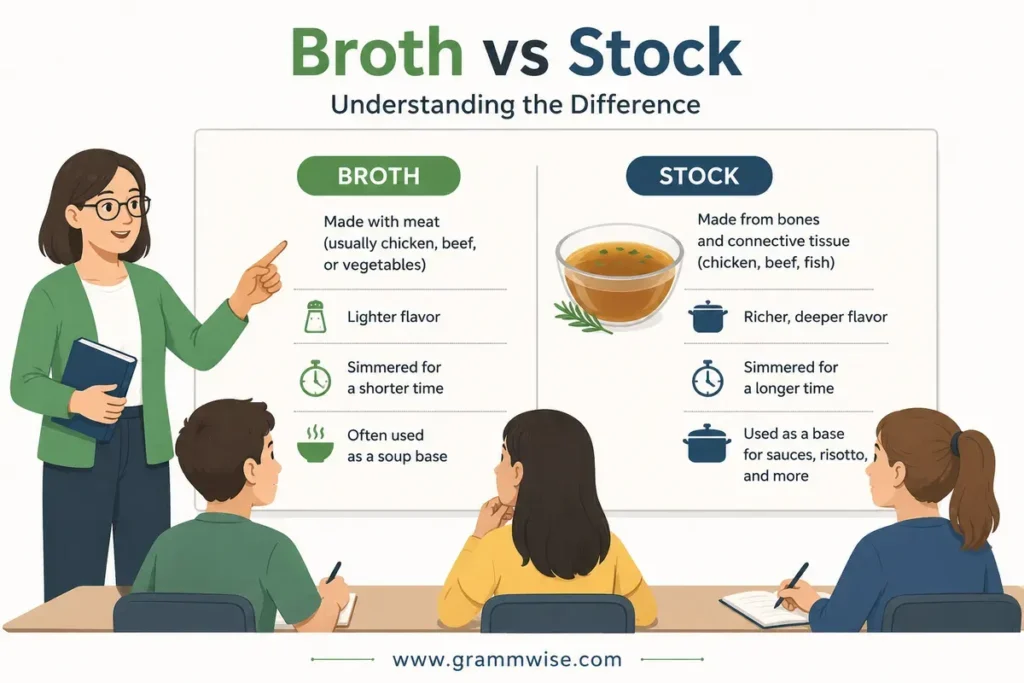
Broth is a light, tasty liquid made by cooking meat with water, vegetables, and simple seasonings. The meat gives the liquid its flavor. People often drink broth by itself because it already tastes good.
Simple meaning:
Broth is a ready-to-eat cooking liquid made mostly from meat.
Examples:
- Chicken broth
- Beef broth
- Vegetable broth
You can enjoy a warm cup of broth on a cold day.
Many people also use broth to make:
- soups
- noodles
- rice
- sauces
- gravies
What Is Stock?
Stock is made differently. Instead of using mostly meat, cooks use bones. The bones slowly cook in water for several hours. During this time, they release minerals and natural gelatin into the liquid.
Simple meaning:
Stock is a rich cooking liquid made mostly from bones.
Stock is not usually served by itself because it often has little or no seasoning.
Instead, it becomes the base for many dishes.
People use stock to make:
- soups
- sauces
- stews
- gravies
- casseroles
The Main Difference
Here is the easiest way to remember broth vs stock.
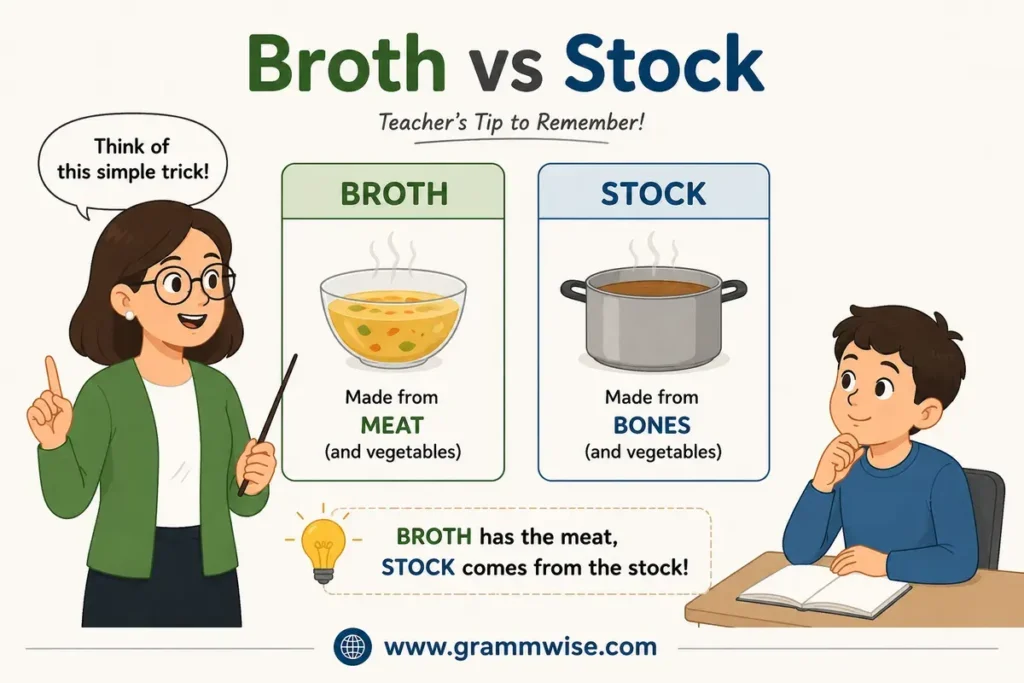
Broth comes mainly from meat.
Stock comes mainly from bones.
That is the biggest difference.
Everything else becomes much easier once you remember this simple rule.
Broth vs Stock: Why People Mix These Words?
Many people think broth and stock mean the same thing.
There are several reasons for this confusion.
They Look Similar in Stores
Visit any grocery store, and you will see cartons labeled:
- Chicken Broth
- Chicken Stock
- Beef Broth
- Beef Stock
The packaging often looks almost identical.
Many brands even place them on the same shelf.
This makes people believe they are exactly the same.
They Can Be Used in the Same Recipes
Many recipes say:
“Use chicken broth.”
Another recipe may say:
“Use chicken stock.”
Both recipes may turn out well.
Because they often replace each other, people think there is no difference.
Both Are Used for Cooking
Broth and stock both help add flavor to food.
People use both when making:
- soup
- rice
- pasta
- gravy
- stew
Since they have many of the same uses, the names become easy to mix up.
The Difference Is Small
Unlike many confusing English words, broth and stock are closely related.
- They are both cooking liquids.
- They are both made with water.
- They are both cooked slowly.
The biggest difference is simply what gives them most of their flavor and texture.
Many People Use the Words Casually
In everyday conversation, many home cooks say “broth” and “stock” without worrying too much about the difference.
Professional chefs are usually more careful because each one gives food a slightly different result.
Clear Difference of “Broth vs Stock” Explained Simply
Here is an easy comparison of broth vs stock.
| Broth | Stock |
|---|---|
| Made mostly from meat | Made mostly from bones |
| Usually seasoned | Usually lightly seasoned or unseasoned |
| Can be served as a drink | Usually used for cooking |
| Lighter texture | Richer texture |
| Great for soups | Great for sauces and stews |
Think About a Chicken
Imagine you have a whole chicken.
If you cook the meat with vegetables, you make broth.
If you save the bones and cook them for many hours, you make stock.
The ingredients change the final result.
Taste Comparison of Broth vs Stock
Broth usually tastes richer right away because it already has seasonings.
Stock has a deeper flavor but often needs salt and spices before serving.
Texture Comparison
Broth is usually thinner.
Stock often feels slightly thicker because the bones release gelatin during cooking.
When cold, homemade stock may even become soft like jelly.
That is completely normal.
Cooking Comparison
Use broth when you want food to taste good immediately.
Use stock when you want to build flavor while cooking.
Broth vs Stock: Which Form Should You Use?
Choosing between broth vs stock is easier than many people think.
Ask yourself one simple question.
Do You Want to Drink It?
If yes, broth is usually the better choice.
Broth already has seasoning and is pleasant to drink.
Examples:
- Chicken broth
- Beef broth
- Vegetable broth
Are You Making a Rich Sauce or Stew?
If yes, stock is often the better choice.
The bones create a richer cooking base.
Examples:
- Beef stock for gravy
- Chicken stock for soup
- Vegetable stock for sauces
Can You Replace One with the Other?
Yes, in many recipes you can.
Most home cooks use broth instead of stock or stock instead of broth without problems.
The final flavor may change a little, but the recipe usually still works well.
Which Is Better?
Neither one is better.
Each has its own purpose.
Choose broth when you want a flavorful liquid that is ready to enjoy.
Choose stock when you want a rich base for cooking.
Easy Real-Life Sentences on “Broth vs Stock”
Reading simple examples helps you remember the difference between broth vs stock.
Here are some everyday sentences.
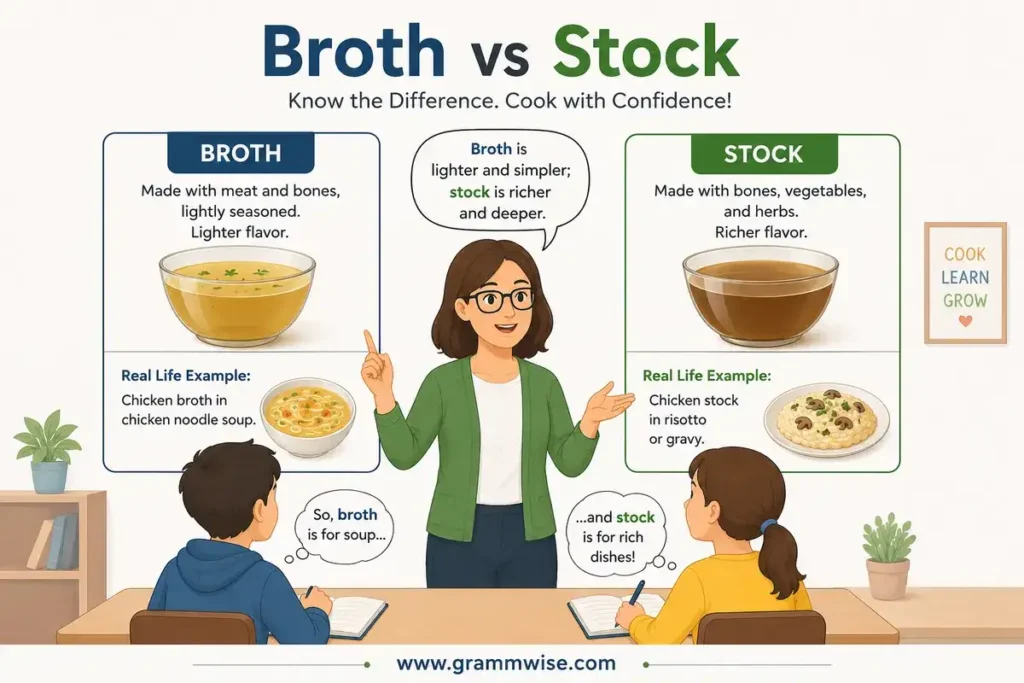
- I used chicken broth to make noodle soup.
- The recipe asks for beef stock.
- Grandma always makes homemade chicken broth.
- The chef cooked the bones to make rich stock.
- Vegetable broth tastes great with noodles.
- We added stock to the gravy.
- This soup is made with chicken broth.
- Homemade beef stock gives the stew a deep flavor.
Everyday Conversations
Friend:
“What are you cooking?”
Answer:
“I’m making chicken broth for soup.”
Mother:
“Don’t throw away the bones.”
Child:
“Why not?”
Mother:
“We can make chicken stock tomorrow.”
Cook:
“This sauce needs beef stock.”
Assistant:
“I’ll get it from the refrigerator.”
Customer:
“Can I drink this?”
Chef:
“Yes, it’s chicken broth.”
Mini Practice
Choose the correct word.
- I cooked chicken and vegetables to make ______.
- Answer: broth
- The chef simmered bones all day to make ______.
- Answer: stock
- This soup uses vegetable ______.
- Answer: broth
- Beef ______ makes the gravy richer.
- Answer: stock
- I like drinking warm chicken ______.
- Answer: broth
- Homemade ______ becomes thicker after cooling.
- Answer: stock
Broth vs Stock: Where This Word Comes From?
Learning where words come from can help you remember them.
The Story Behind “Broth”
The word broth is very old.
It comes from ancient Germanic languages and has been used in English for hundreds of years.
People used it to describe the liquid made by boiling meat in water.
Over time, the meaning stayed almost the same.
Today, broth still means a flavorful liquid made from meat or vegetables.
The Story Behind “Stock”
The word stock has a different history.
It originally meant a supply or foundation.
In cooking, chefs began using the word because stock became the basic foundation for soups and sauces.
Even today, many chefs call stock the “base” of a recipe.
That is why the word fits so well.
Why Their History Helps
The history of these words matches their modern meanings.
Broth has always been known as something people can enjoy as food.
Stock has long been seen as the cooking foundation for many dishes.
Remembering this makes the difference between broth vs stock much easier.
How “Broth vs Stock” Is Understood in Culture and Stories
Food is an important part of every culture. Around the world, people make broth and stock in different ways, but the basic idea stays the same. Both are used to create warm, comforting meals that bring families together.
How Broth Is Seen?
Broth is often connected with comfort and care.
When someone has a cold or feels tired, many families prepare a bowl of warm chicken broth or vegetable broth. It is easy to drink and gentle on the stomach.
People often think of broth as:
- comfort food
- home cooking
- family meals
- simple nourishment
Many grandparents have their own special broth recipe that is passed down through generations.
How Stock Is Seen?
Stock is usually connected with cooking skills.
Professional chefs often spend hours making homemade stock because they believe it creates richer soups and sauces.
Stock is often seen as:
- the foundation of cooking
- careful preparation
- rich flavor
- traditional cooking
Many cooking schools teach students how to make stock before they learn more advanced recipes.
Why Both Matter?
Although broth and stock are different, both help create delicious meals.
One is often enjoyed on its own.
The other helps build the flavor of many favorite dishes.
That is why both are important in kitchens around the world.
Biblical and Mythological Meaning of “Broth vs Stock”
The words broth and stock do not have special meanings in the Bible or in mythology. They are everyday cooking terms.
However, food prepared with broth has appeared in many historical and religious settings because simple soups have been eaten for thousands of years.
In ancient times, people often cooked meat, vegetables, and herbs together to make nourishing meals for families and travelers.
Stock, as we know it today, became more common as cooking methods developed over time.
There is no symbolic or religious difference between broth vs stock. Their meanings remain practical and connected to cooking.
Symbolism of “Broth vs Stock” Explained in Simple Words
Sometimes food represents ideas and feelings beyond its ingredients.
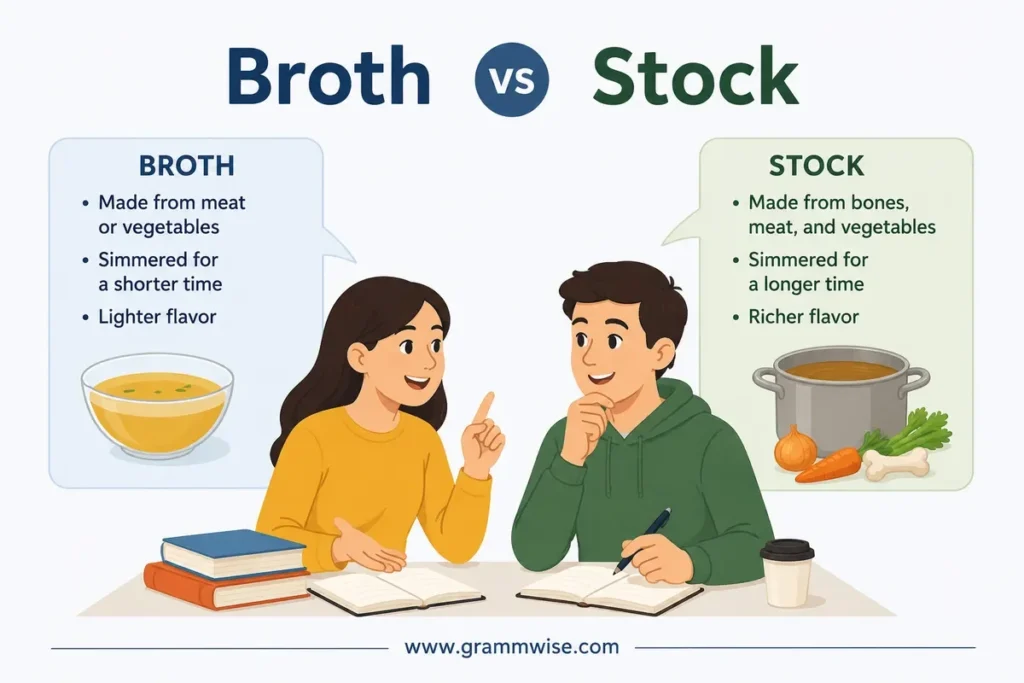
Broth and stock can remind us of different parts of cooking and family life.
What Broth Represents?
Broth often represents:
- comfort
- care
- warmth
- healing
- family
- simple meals
A bowl of warm broth often reminds people of being cared for when they are sick or spending time with loved ones.
What Stock Represents?
Stock often represents:
- preparation
- patience
- strong foundations
- careful cooking
- rich flavor
Making stock takes time. That is why many people connect it with patience and planning ahead.
An Easy Way to Remember
Think of broth as the meal you can enjoy today.
Think of stock as the strong base that helps tomorrow’s meal become even better.
One is ready to enjoy.
The other helps create something delicious.
Related Words You Should Know
Learning related cooking words makes it easier to understand recipes.
Soup
A cooked dish made with broth or stock and other ingredients like vegetables, meat, or noodles.
Bouillon
A concentrated cube, powder, or paste that is mixed with water to make a broth-like liquid.
Consommé
A very clear soup made by carefully preparing broth or stock.
Gravy
A flavorful sauce often made with stock, meat juices, and seasonings.
Stew
A dish made by slowly cooking meat and vegetables in broth or stock.
Sauce
A liquid added to food for extra flavor. Many sauces begin with stock.
Simmer
To cook a liquid gently without boiling hard.
Both broth and stock are usually simmered for a long time.
Gelatin
A natural protein released from bones while making stock.
It gives homemade stock a richer texture.
Seasoning
Salt, herbs, spices, and other ingredients that add flavor.
Broth is usually more seasoned than stock.
Base
The starting point for a recipe.
Stock is often called the base for soups and sauces.
Use of “Broth vs Stock” in Daily English
Even if you do not cook often, you will hear these words in recipes, grocery stores, and cooking shows.
Here are some natural examples.
- “I’m making chicken broth for dinner.”
- “This recipe tastes better with homemade stock.”
- “Can I use broth instead of stock?”
- “The soup needs another cup of chicken broth.”
- “I froze some beef stock for later.”
- “The chef recommends homemade vegetable stock.”
- “We cooked the bones to make rich stock.”
- “I drink warm broth when I have a sore throat.”
- “This sauce starts with chicken stock.”
- “The recipe works with either broth or stock.”
You may also hear these common phrases:
- chicken broth
- beef broth
- vegetable broth
- homemade stock
- chicken stock
- beef stock
- vegetable stock
- rich stock
- flavorful broth
- soup stock
These expressions are very common in recipes and cooking videos.
Common Mistakes People Make About “Broth vs Stock”
Many people misunderstand broth vs stock, especially when they are new to cooking.
Mistake 1: Thinking They Are Exactly the Same
Many people believe broth and stock are identical. They are similar, but they are different.
Broth is mainly made from meat.
Stock is mainly made from bones.
Mistake 2: Believing You Can Never Replace One with the Other
Some people think recipes will fail if they use broth instead of stock. That is usually not true. Most everyday recipes still taste good with either one.
The flavor and texture may change a little, but the meal will usually turn out well.
Mistake 3: Thinking Stock Is Ready to Drink
Homemade stock often has little or no seasoning. It is meant for cooking. If you want to drink it, you may need to add salt and other seasonings.
Mistake 4: Thinking Broth Is Always Better
Broth is great for many recipes. Stock is also great for many recipes. Neither one is better. The right choice depends on what you are cooking.
Mistake 5: Ignoring the Recipe
Some recipes specifically ask for stock because they need a richer cooking base. Others ask for broth because they want a lighter, seasoned flavor. Reading the recipe carefully helps you get the best results.
Easy Memory Trick for “Broth vs Stock”
Remember this simple sentence:
Broth feeds the meal. Stock builds the meal.
Broth is ready to enjoy. Stock helps create something richer.
Final Teacher Explanation
Imagine you are standing in your kitchen and holding two cartons.
One says Chicken Broth.
The other says Chicken Stock.
How do you choose?
First, think about what you are making.
If you want a warm, flavorful drink or a simple soup, broth is often the best choice because it is already seasoned and tastes good by itself.
If you are making gravy, stew, or a rich sauce, stock is usually the better choice because the bones give it a deeper flavor and a fuller texture.
Do not worry if you sometimes use one instead of the other.
Many home cooks do that every day.
The most important thing is to remember the basic difference.
Broth comes mainly from meat.
Stock comes mainly from bones.
Once you remember that simple rule, choosing between broth vs stock becomes much easier.
The more recipes you read and the more meals you cook, the more natural these words will become.
Final Thought “Broth vs Stock”
The difference between broth vs stock is simple.
- People usually make broth from meat and season it, so it is ready to enjoy.
- People mainly make stock from bones and use it as a rich base for soups, sauces, stews, and many other recipes.
Remember this easy rule: Broth is for flavor. Stock is for foundation.
Conclusion
Understanding broth vs stock is simple once you know what each one is made from and how it is used. Broth is usually made from meat and is ready to enjoy because it is seasoned, while stock is mainly made from bones and serves as a rich base for soups, sauces, and stews.
The next time you cook, think about what your recipe needs. If you want a light, flavorful liquid, choose broth. If you want a deeper flavor and a stronger cooking foundation, choose stock. With this easy rule, you can confidently use both in everyday cooking.
Frequently Asked Questions (FAQs)
What is the difference between broth vs stock?
Broth is usually made from meat and is seasoned. Stock is mainly made from bones and is used as a cooking base.
Can I use broth instead of stock?
Yes. In many recipes, broth can replace stock. The final flavor may be a little different, but the recipe usually still works well.
Is stock healthier than broth?
Both can be healthy. It depends on the ingredients, the amount of salt, and how they prepared.
Can you drink stock by itself?
Yes, but homemade stock is often not seasoned. Many people add salt and spices before drinking it.
Which is better for soup, broth or stock?
Both work well. Broth gives a lighter, ready-to-eat flavor, while stock creates a richer soup.
Why is stock thicker than broth?
Stock is often thicker because bones release natural gelatin during slow cooking.
Is vegetable stock the same as vegetable broth?
They are very similar. Vegetable broth is usually more seasoned, while vegetable stock is often made as a cooking base with lighter seasoning.
How can I remember the difference between broth vs stock?
Use this simple memory trick: Broth = meat and ready to enjoy. Stock = bones and rich cooking base.