
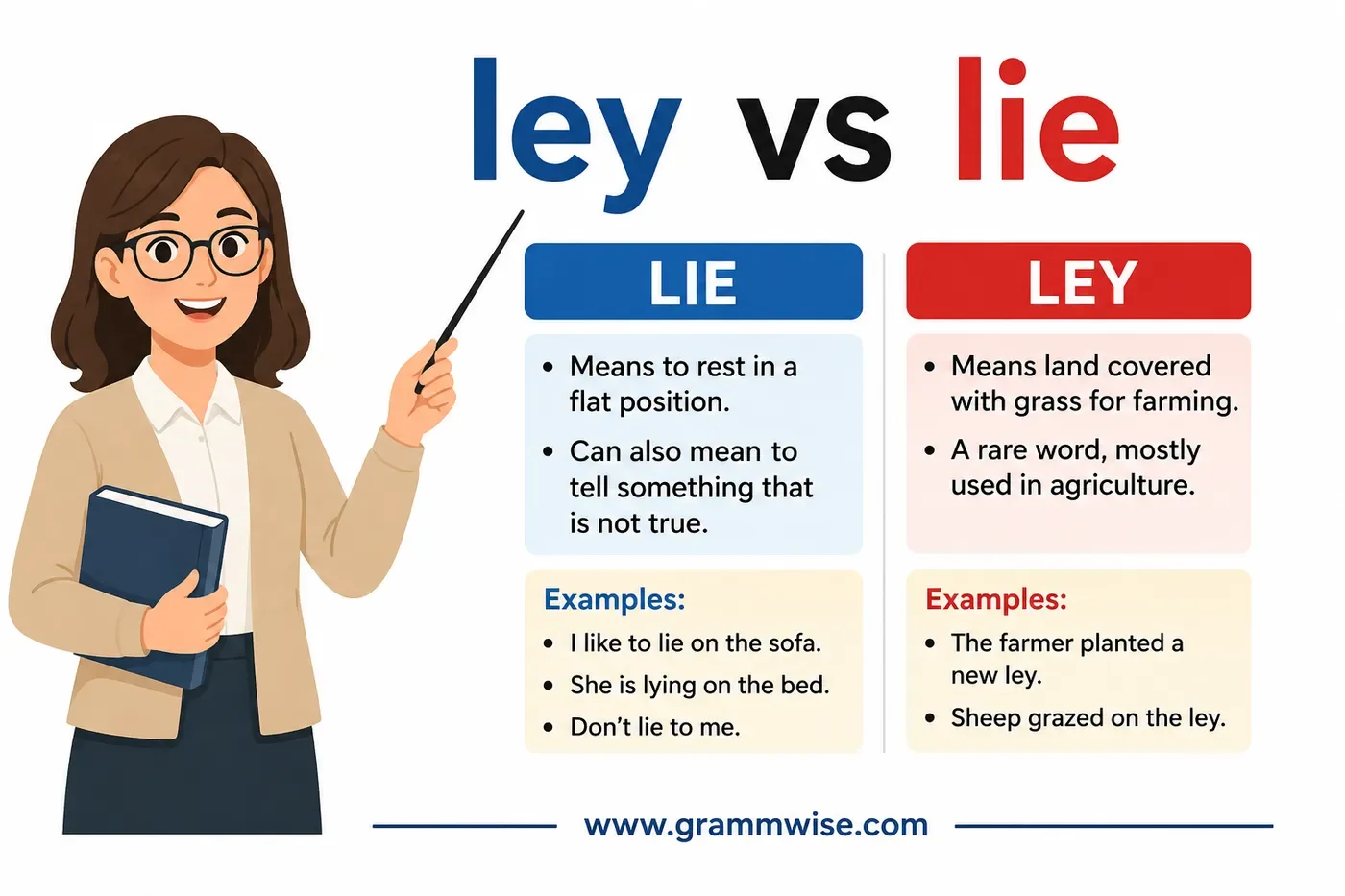
Many English learners get confused about ley vs lie because the two words look similar. They sound close, but they do not mean the same thing. If you know when to use each one, your English becomes much clearer.
The short answer is simple. “Lie” is a real English word that means to rest on a surface or to say something that is not true. “Ley” is a real word too, but it is very rare and has a special meaning in farming and place names. That is why most people who search for ley vs lie really want to know if they should write lay or lie.
This guide explains everything in very simple English. By the end, you will know the difference, remember the easy rules, and feel confident every time you write or speak.
Understanding word differences improves writing clarity and communication.
Simple Answer in One Look
Lie is the word most people need.
Ley is a rare word that usually means land covered with grass for farming.
If you mean resting on a bed, sofa, or floor, use lie, not ley.
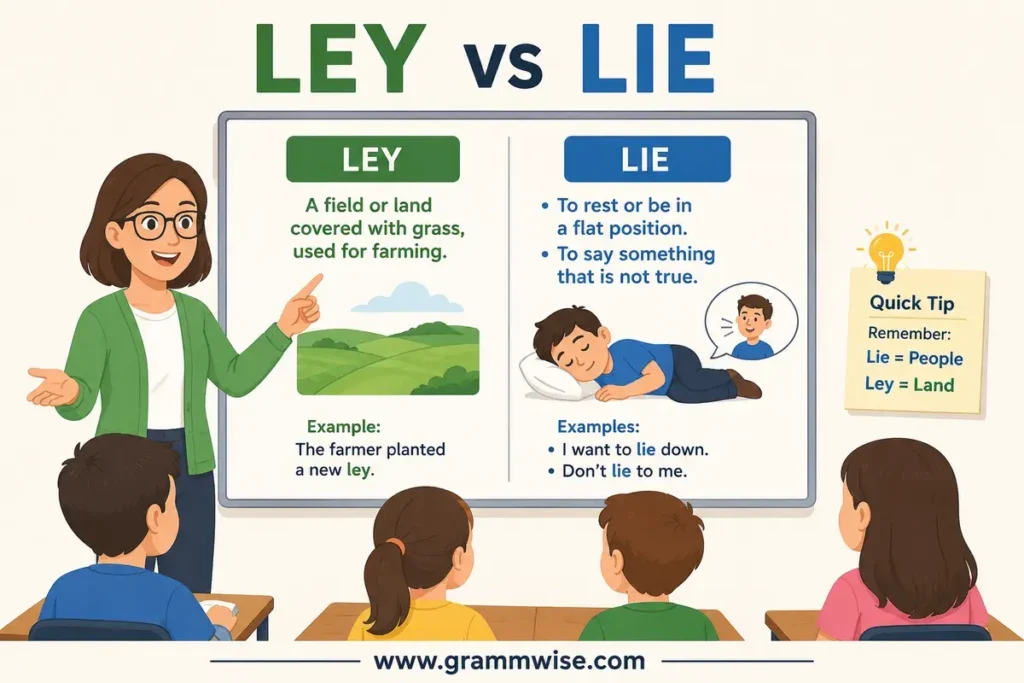
Meaning of “Ley vs Lie” in Simple English
To understand ley vs lie, start with the meaning of each word.
What does “lie” mean?
The word lie has two common meanings.
Meaning 1: To rest in a flat position
This is the meaning people use every day.
Examples:
- I want to lie on the couch.
- The cat likes to lie in the sun.
- Please lie down if you feel sick.
- The baby is lying in the crib.
Here, lie means resting your body.
Meaning 2: To say something that is not true
Sometimes lie means telling something false.
Examples:
- Don’t lie to your parents.
- He lied about his homework.
- She never lies.
The meaning changes based on the sentence, but the spelling stays the same.
What does “ley” mean?
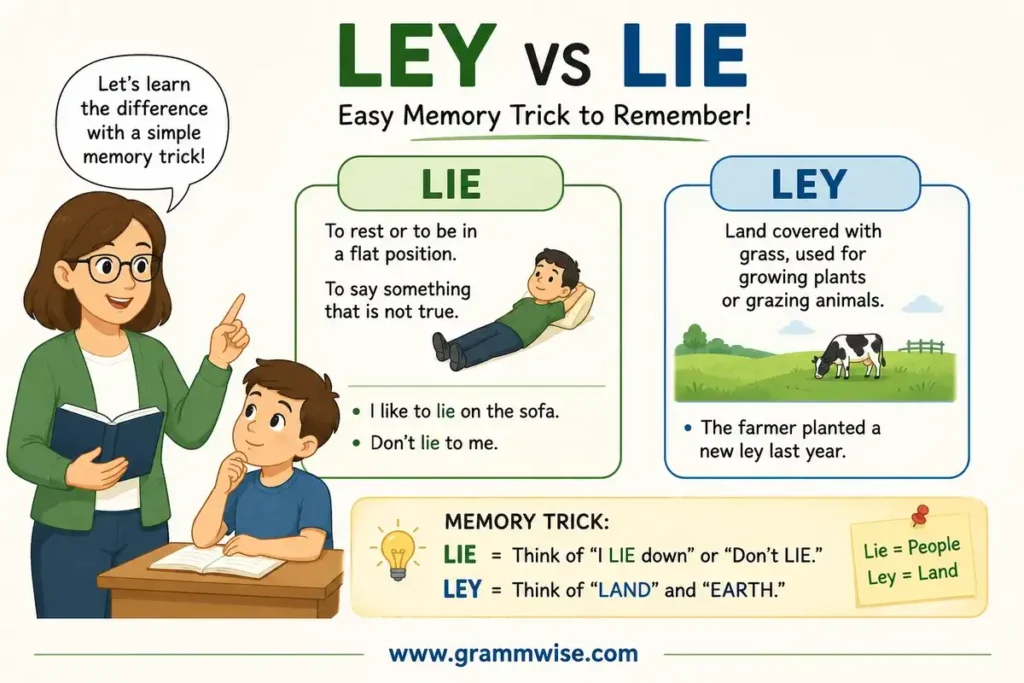
The word ley is much less common. A ley is land that is covered with grass or plants for a period of time before farmers grow other crops there.
You may also see ley in old English place names.
Examples:
- The farmer planted a new ley.
- The sheep grazed on the ley.
Most students will almost never need this word in everyday conversation.
Ley vs Lie: Why People Mix These Words?
People confuse ley vs lie for several simple reasons.
First, they sound somewhat alike.
Second, English has many words with similar spellings.
Third, people often hear the word lie but have never seen ley before.
Another reason is that many learners are actually thinking about lay instead of ley. The words lay, lie, and ley look very similar, so typing mistakes happen often.
Here are some examples of common mistakes.
Wrong:
- I will ley on the bed.
Correct:
- I will lie on the bed.
Wrong:
- The dog is leying on the floor.
Correct:
- The dog is lying on the floor.
Because ley is so rare, it is almost never the correct choice in normal writing.
Clear Difference of “Ley vs Lie” Explained Simply
Here is an easy way to remember the difference between ley vs lie.
Lie
- Means to rest.
- Can also mean to tell something false.
- Used every day.
- Very common in speaking and writing.
Ley
- Means grassy farmland.
- Mostly used in farming.
- Rare in everyday English.
- Often appears in books about agriculture or old place names.
Think about your sentence.
If you are talking about a person, animal, or object resting somewhere, choose lie.
If you are talking about farmland or grassland, ley may be correct.
Quick comparison
Lie
- I want to lie down.
- The book lies on the table.
- Please don’t lie to me.
Ley
- The cows are grazing on the ley.
- The farmer improved the ley before planting crops.
Notice how different the meanings are.
Ley vs Lie: Which Form Should You Use?
For almost every everyday sentence, you should choose lie.
Use lie when someone is:
- resting
- sleeping
- stretching out
- staying in one place
Examples:
- Lie on the sofa.
- Lie in bed.
- Lie on the beach.
- Lie quietly.
Only use ley if you are writing about farming or land management.
Here is a simple memory trick.
Lie = Life every day.
- You lie in bed.
- You lie on the beach.
- You lie on the floor.
Ley = Land.
Both words start with the letter L, so it can help you remember that ley is about land.
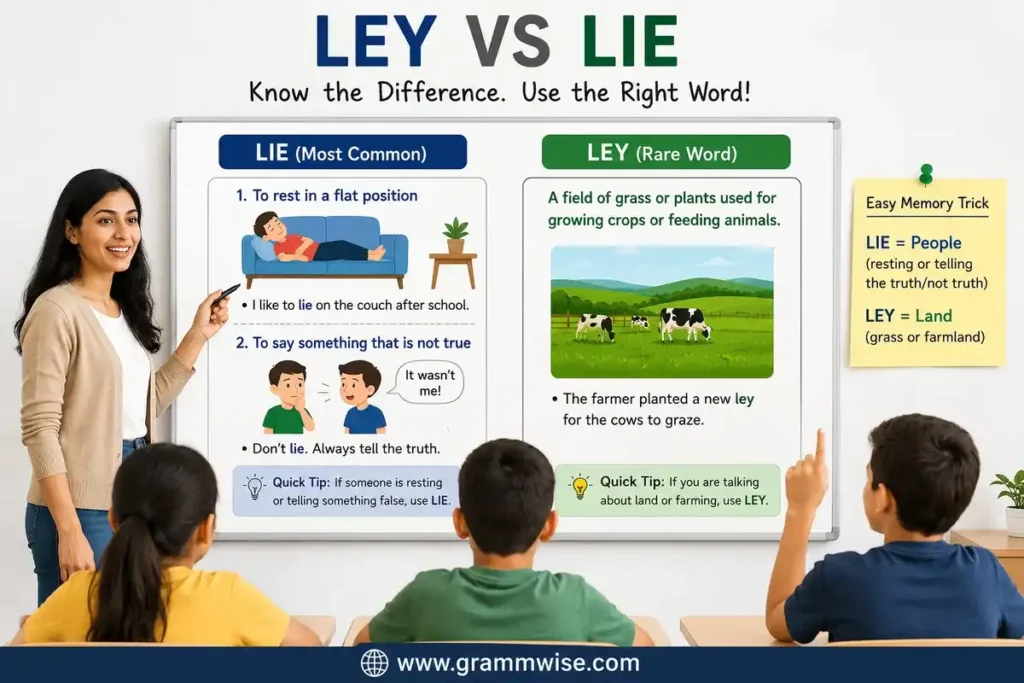
Easy Real-Life Sentences on “Ley vs Lie”
These examples show how lie is used in normal conversations.
- I need to lie down after lunch.
- The baby is lying on the blanket.
- My keys lie on the kitchen table.
- Please don’t lie to your teacher.
- We like to lie on the beach during summer.
- The dog is lying next to the fireplace.
- She told me not to lie.
- I just want to lie here and relax.
Now look at the rare word ley.
- The horses grazed on the ley.
- The farmer left the field as a ley for two years.
Most English learners will rarely use these sentences.
Ley vs Lie: Where This Word Comes From?
The word lie comes from very old English. People have used it for hundreds of years to describe resting or being in a flat position.
The meaning about telling something false also comes from old English and has been part of the language for a very long time.
The word ley also has old roots. It was used by farmers to describe land covered with grass before growing other crops. Today, it is mostly seen in farming books, farming discussions, and some place names.
Because modern English uses lie much more often, many people never learn the farming meaning of ley unless they study agriculture.
As your English grows, you will notice that some words are used every day, while others appear only in special subjects. Lie is an everyday word. Ley is a specialty word.
How “Ley vs Lie” Is Understood in Culture and Stories
Words often become more than just words. They also carry ideas and feelings. When we compare ley vs lie, only one of these words has a strong place in everyday stories and culture.
The word lie appears in books, movies, songs, and daily conversations. Sometimes it means resting. Other times it means saying something that is not true. Because it has two meanings, writers often use it in different ways.
For example, a story may say:
- The hero lay down to rest after a long journey.
- The child learned that one lie can hurt many people.
Both uses are common, but they tell very different stories.
The word ley is different. Most people never hear it unless they study farming or read about the countryside. Farmers may talk about a ley when they discuss healthy fields and growing crops. Outside farming, the word is very uncommon.
In many English-speaking countries, children grow up hearing the word lie almost every day. They hear parents say:
- Don’t lie.
- Go lie down.
- The book is lying on the desk.
Because of this, lie feels like a normal everyday word.
A ley, however, belongs more to farming traditions. It reminds people of green fields, nature, and taking care of the land.
So, if you think about ley vs lie in culture, lie is part of everyday life, while ley belongs mostly to farming and country life.
Biblical and Mythological Meaning of “Ley vs Lie”
The word lie appears many times in the Bible.
When lie means telling something false, it is usually shown as something people should avoid. The Bible teaches people to speak truthfully and honestly.
When lie means resting, it simply describes someone’s position.
For example, people may lie down to sleep, rest, or pray.
The word ley does not have a special Biblical meaning. Although the Bible talks about fields, grass, and farmland, it does not give the farming word ley a special spiritual meaning.
In mythology, there is also no famous meaning connected with ley.
Sometimes people confuse ley with “ley lines,” but that is a completely different idea and has nothing to do with the farming word ley.
Symbolism of “Ley vs Lie” Explained in Simple Words
What “Lie” Represents?
The meaning depends on how the word is used.
If lie means resting, it often represents:
- Peace
- Relaxation
- Sleep
- Comfort
- Quiet time
For example:
“The child lay under the tree.”
This creates a peaceful picture.
If lie means telling something false, it represents:
- Dishonesty
- Broken trust
- Secrets
- Mistakes
People often say:
“A lie can hurt friendships.”
This shows the emotional meaning of the word.
What “Ley” Represents?
A ley usually represents:
- Nature
- Healthy farmland
- Growth
- Fresh grass
- Caring for the earth
Farmers sometimes leave fields as a ley so the soil becomes healthy again.
Because of this, ley can symbolize new growth and fresh beginnings for the land.
Unlike lie, ley is connected with nature instead of human actions.
Related Words You Should Know
Learning related words makes English much easier.
Lie
To rest in a flat position.
Example:
“I want to lie down.”
Lay
To put something somewhere.
Example:
“Please lay the book on the table.”
This is the word people often confuse with lie.
Lying
The present form of lie.
Example:
“The dog is lying on the rug.”
Lied
The past form when someone tells something false.
Example:
“He lied to his friend.”
Lay (Past of Lie)
This surprises many learners.
Example:
“Yesterday I lay on the couch.”
Here, lay is the past tense of lie meaning “to rest.”
Grassland
Land covered with grass.
It has a similar idea to ley, but it is much more common.
Pasture
Land where animals eat grass.
This is another farming word that is easier to see in everyday English than ley.
Field
An open area of land used for farming.
A ley is a special kind of farming field.
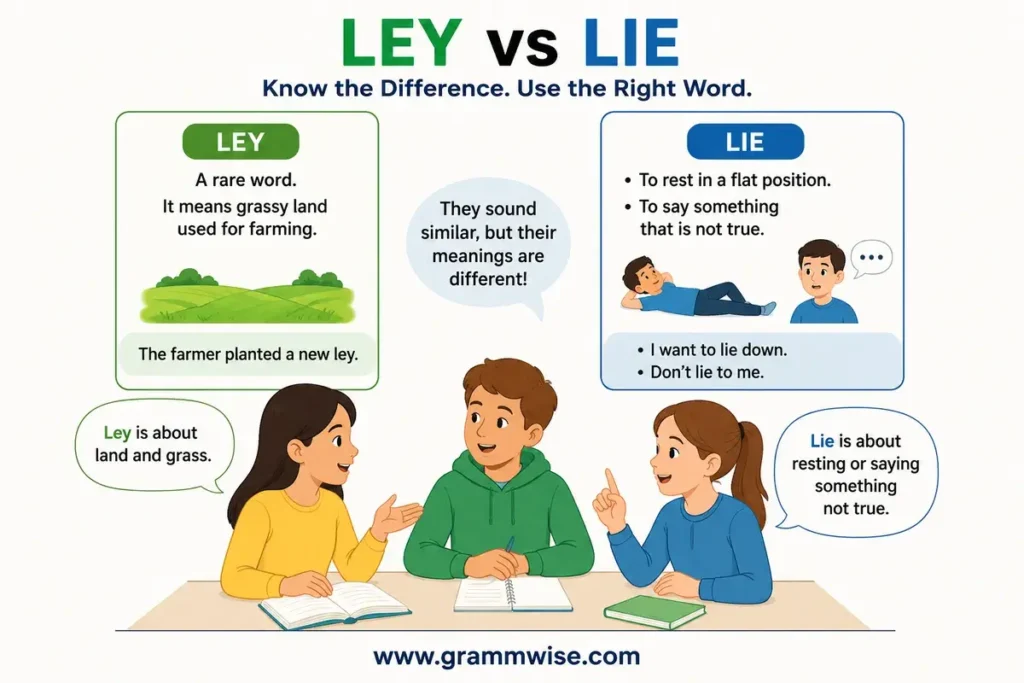
Use of “Ley vs Lie” in Daily English
Almost everyone uses lie every day.
Here are some natural examples.
- I need to lie down for a few minutes.
- My phone is lying on the table.
- Please don’t lie to your parents.
- The kids are lying on the grass.
- We like to lie on the beach during vacation.
- The cat is lying by the window.
- Just lie still for a moment.
- He admitted that he told a lie.
- The baby is lying in the crib.
- I was so tired that I lay down after work.
Now compare these with ley.
- The farmer planted a new ley.
- Sheep grazed on the ley all summer.
These are correct, but most people will never use them in normal conversations.
If you are writing an email, talking to friends, or speaking at school, lie is almost always the word you need.
Common Mistakes People Make About “Ley vs Lie”
Many students make the same mistakes when learning ley vs lie.
Mistake 1: Writing “ley” instead of “lie”
❌ I want to ley down.
✅ I want to lie down.
Remember, lie means resting.
Mistake 2: Thinking “ley” is another spelling of “lie”
Some learners believe both spellings are acceptable.
They are not.
They have different meanings.
Mistake 3: Mixing “lay” and “lie”
❌ I will lay on the bed.
✅ I will lie on the bed.
This is probably the most common mistake in English.
Mistake 4: Forgetting that “lie” has two meanings
Sometimes learners think every sentence about lie means someone is dishonest.
But that’s not true.
Compare these:
“I want to lie down.”
This means rest.
“Don’t lie to me.”
This means don’t tell something false.
Always look at the whole sentence.
Mistake 5: Using “ley” in everyday writing
Many students type ley by mistake because it sounds similar.
Before sending an email or homework, check your spelling carefully.
If you mean resting, always choose lie.
Final Teacher Explanation
Imagine you are sitting in my classroom.
A student raises a hand and asks,
“Teacher, which word should I use—ley or lie?”
My answer would be very simple.
- If you are talking about resting, sleeping, or being in a flat position, use lie.
- If you are talking about telling something that is not true, use lie again.
- If you are talking about farmland covered with grass, use ley.
That is why most people almost never need the word ley.
When you see ley vs lie, remember that they are not two spellings of the same word. They are two different words with different meanings.
A good habit is to ask yourself one question before writing.
“Am I talking about a person resting?”
If the answer is yes, write lie.
“Am I talking about farmland?”
If the answer is yes, ley may be the correct word.
This small question will help you avoid mistakes almost every time.
English becomes much easier when you connect words to real situations instead of trying to memorize long grammar rules.
Ley vs Lie: Quick Recap
The answer to ley vs lie is easy to remember.
Use lie when someone rests or when someone tells something that is not true. Use ley only when talking about grassy farmland or farming. For everyday English, lie is almost always the correct choice.
Conclusion
Understanding ley vs lie is easier once you know that the two words have completely different meanings. Lie is the correct word for resting or telling something that is not true, while ley is a rare farming word that refers to grassy land. In everyday English, you will almost always use lie.
The best way to remember the difference is to think about the meaning before you write. If you are talking about a person resting, choose lie. If you are writing about farmland or grass used in farming, ley is the correct choice. With a little practice, using the right word will become natural.
Frequently Asked Questions (FAQs)
Is “ley” a real English word?
Yes. It is a real word, but it is rare and mostly used in farming.
Should I write “ley down” or “lie down”?
Write lie down. This is the correct everyday expression.
Why do people confuse ley vs lie?
The words look and sound similar, and many people accidentally type ley instead of lie.
Can I use both words in normal conversation?
Usually, no. Most conversations only need lie. Ley is used mainly in farming.
Does “lie” always mean telling something false?
No. It can also mean resting in a flat position. The sentence tells you which meaning is correct.
Is “ley” another spelling of “lie”?
No. They are different words with different meanings.
Which word should English learners remember?
Remember lie first because it is used every day. Learn ley as a special farming word.
How can I remember the difference between ley vs lie?
Think of this simple trick: Lie = people resting or telling the truth/not truth. Ley = land and grass. This easy memory tip helps you choose the right word every time.