
Many English learners get confused about worse vs worst because both words talk about something that is bad. They look similar, sound similar, and are often used in the same kinds of sentences. This makes it easy to choose the wrong one.
The good news is that the difference between worse vs worst is simple. Once you understand one easy rule, you will know when to use each word with confidence. You do not need to memorize long grammar rules.
In this guide, you will learn the meaning of worse vs worst in very simple English. You will also see easy examples, helpful tips, and a memory trick that makes these words much easier to remember.
Many English learners mix up similar-looking words such as Peak, Peek, Pique.
Simple Answer in One Look
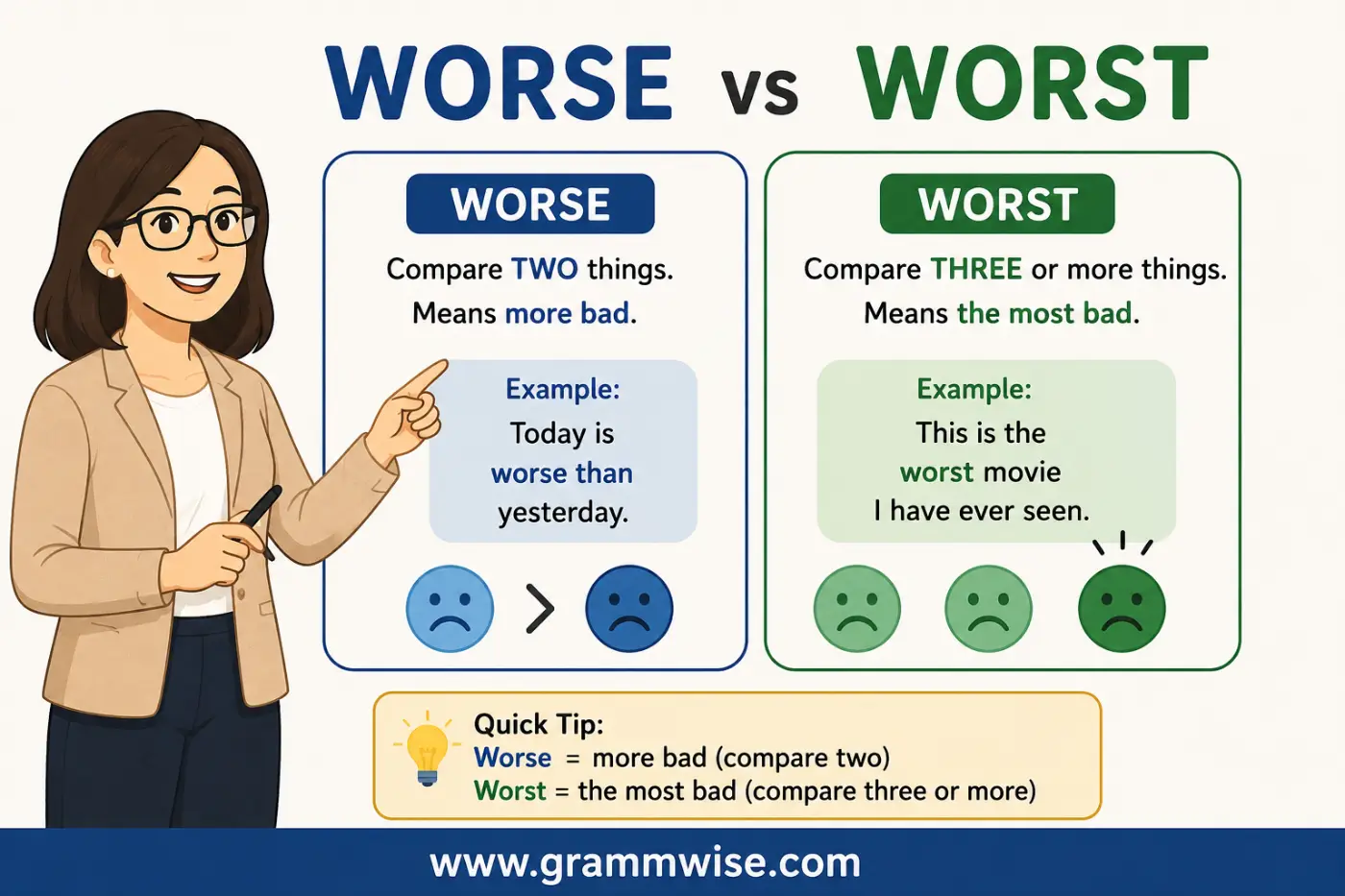
Worse means more bad when comparing two people, things, or situations.
Worst means the most bad among three or more people, things, or situations.
Quick tip: If something is bad, it is bad. If it is more bad than another thing, it is worse. If it is more bad than everything else, it is worst.
What does Worse vs Worst Means in Simple English?
The easiest way to understand worse vs worst is to think about levels.
Imagine you have three apples.
- One apple is bad.
- The second apple is worse than the first.
- The third apple is the worst of all.
That is the basic idea.
What Does “Worse” Mean?
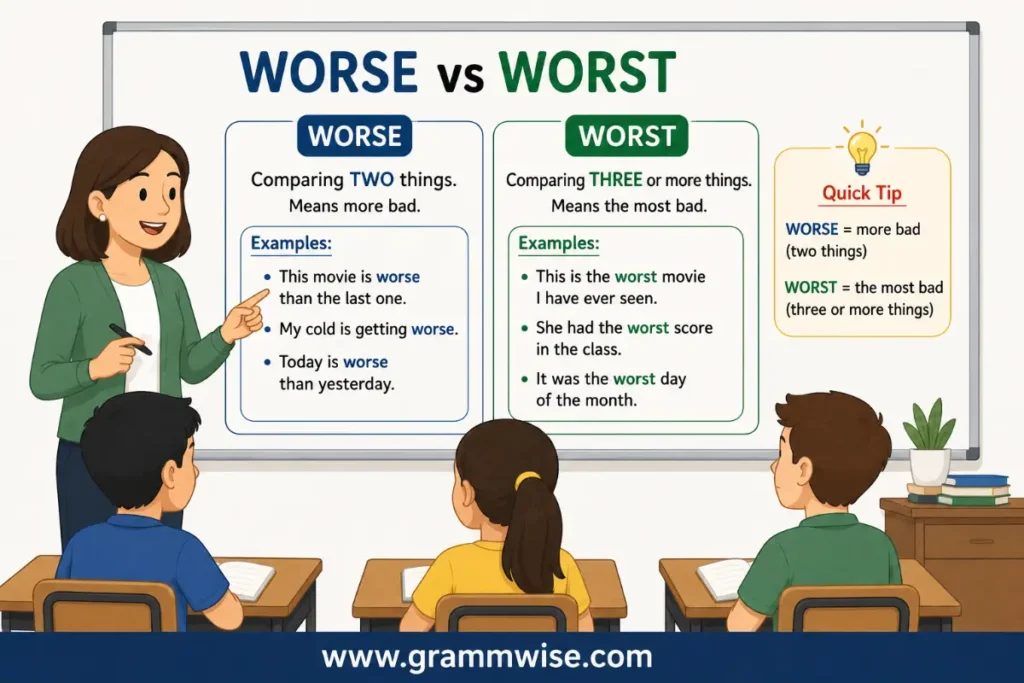
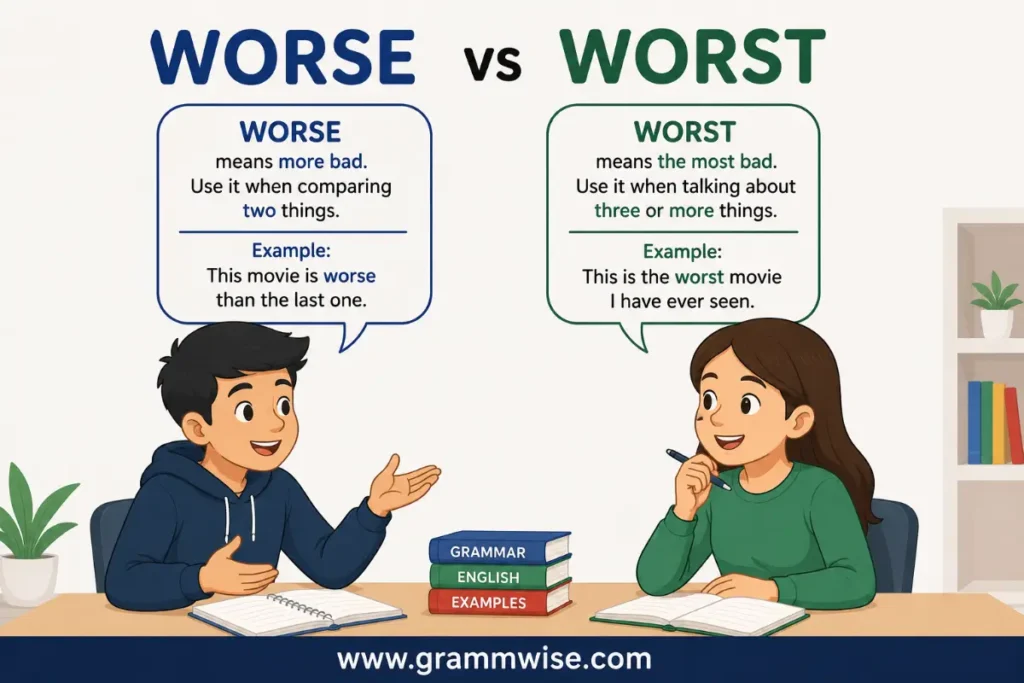
Worse means something is more bad than another thing.
You use it when comparing two people, places, ideas, or situations.
Examples:
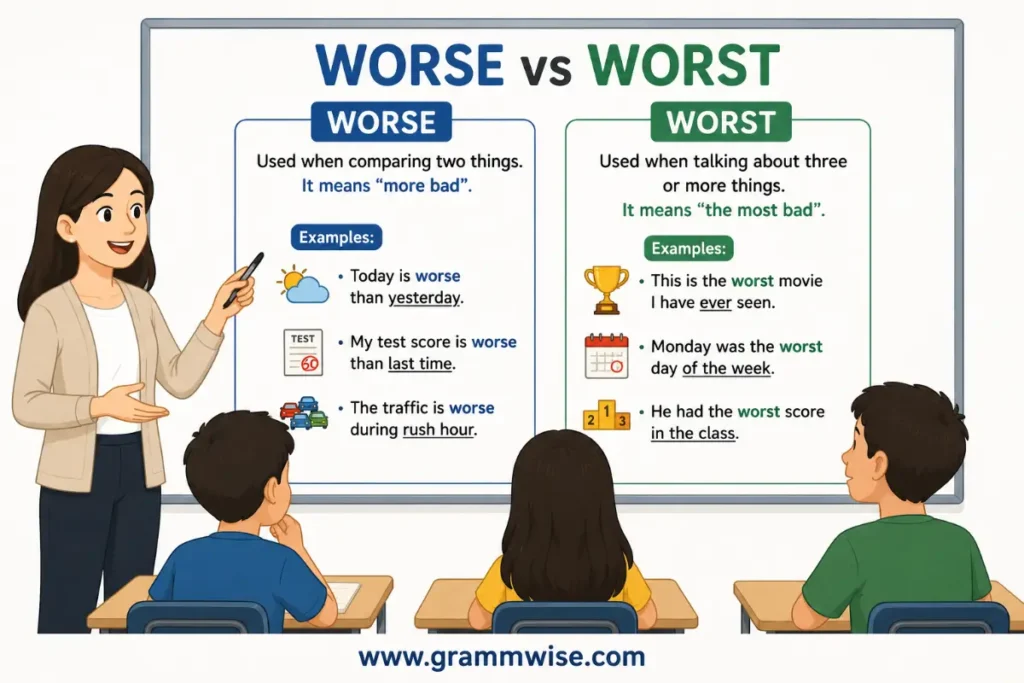
- Today is worse than yesterday.
- This movie is worse than the last one.
- My headache is getting worse.
- His grades are worse than mine.
- The traffic is worse this morning.
Each sentence compares one thing with another.
What Does “Worst” Mean?
Worst means something is the most bad.
You use it when talking about the lowest or most negative one in a group.
Examples:
- This is the worst day of my life.
- That was the worst movie I have ever seen.
- Winter is the worst season for my allergies.
- She had the worst score in the class.
- It was the worst storm of the year.
Here, one thing is being compared with many others.
Worse vs Worst: Why People Mix These Words?
Many learners confuse worse vs worst because both come from the word bad.
Another reason is that both words describe something negative.
For example:
- This pizza is worse than yesterday’s.
- This is the worst pizza I have ever eaten.
Both sentences talk about bad pizza, but the comparison is different.
People also forget how many things they are comparing.
Look at these examples.
❌ This is worse movie I have ever seen.
✅ This is the worst movie I have ever seen.
The sentence compares one movie with every movie the speaker has watched.
Now look at another example.
❌ My phone is worst than yours.
✅ My phone is worse than yours.
Only two phones are being compared.
A simple way to avoid mistakes is to count.
- Comparing two things? Use worse.
- Comparing one with all the others? Use worst.
Clear Difference Between Worse vs Worst Explained Simply
Here is an easy comparison of worse vs worst.
| Worse | Worst |
|---|---|
| Means more bad | Means the most bad |
| Usually compares two things | Usually compares three or more things |
| Often comes before than | Often comes before of or follows the |
| Shows a lower level | Shows the lowest level |
| Example: Today is worse than yesterday. | Example: Today is the worst day this week. |
Think About the Comparison
Ask yourself one question.
Am I comparing two things or choosing the lowest from a group?
If you compare two things, choose worse.
If one thing is at the very bottom of a group, choose worst.
This simple question will help you almost every time.
Worse vs Worst: Which Form Should You Use?
Here is an easy rule you can remember.
Use “Worse” When…
- Comparing two people.
- Comparing two places.
- Comparing two days.
- Comparing two ideas.
- Comparing two situations.
Examples:
- My cold is worse today.
- This road is worse than the other one.
- The weather became worse after lunch.
- His answer was worse than mine.
- Driving at night is worse than driving during the day.
Use “Worst” When…
- Talking about the lowest point.
- Choosing the most negative one.
- Comparing one thing with many others.
Examples:
- This is the worst mistake I have made.
- That was the worst game this season.
- She had the worst luck of anyone.
- It is the worst restaurant in town.
- Yesterday was the worst day of the month.
Easy Memory Trick
Think about the word worst.
It ends with -st, just like first and last.
These words often show the beginning or the end of a group.
So worst means the one at the very bottom.
Now think about worse.
It ends with -er, just like:
- taller
- faster
- stronger
- smaller
These words compare two things.
So worse also compares two things.
This is one of the easiest memory tricks for remembering worse vs worst.
Easy Real-Life Sentences on Worse vs Worst
Here are everyday examples that show how native speakers use worse and worst.
Sentences with “Worse”
- My cough is worse today.
- This coffee tastes worse than yesterday’s.
- The traffic is worse on Fridays.
- His handwriting is worse than mine.
- The weather became worse during the afternoon.
- My phone battery is getting worse.
- Things became worse after the meeting.
- This chair feels worse than the old one.
Sentences with “Worst”
- This is the worst meal I have ever eaten.
- Today has been the worst day this month.
- That was the worst joke ever.
- She had the worst score in the class.
- It was the worst decision we could make.
- Winter is the worst season for my allergies.
- He is the worst driver I know.
- That was the worst experience of my holiday.
Read these examples several times. Soon you will notice that worse often appears with than, while worst usually appears with the.
Worse vs Worst: Where This Word Comes From?
The words bad, worse, and worst have been part of English for hundreds of years.
Long ago, people needed a way to compare things that were not good.
Instead of saying more bad or most bad, English developed the special words worse and worst.
That is why these words do not follow the normal pattern like:
- small → smaller → smallest
- fast → faster → fastest
Instead, they change completely:
- bad → worse → worst
This is why many English learners find them difficult at first.
The good news is that people use these words every day, so you will learn them quickly with practice.
How This Word Worse vs Worst Is Understood in Culture and Stories?
People use worse and worst every day, but these words also appear in stories, movies, books, and songs. They help people describe problems, difficult times, or challenges.
The word worse often shows that a situation is getting more difficult. A story might begin with a small problem, but then things become worse. This builds excitement because readers want to know what will happen next.
For example:
- The weather became worse before the rescue team arrived.
- His health grew worse every day.
- The team’s chances became worse after losing their best player.
The word worst usually describes the lowest point in a story. It tells readers that the biggest challenge has arrived. After the worst moment, many stories begin to improve.
For example:
- It was the worst day of her life.
- The village faced its worst storm in many years.
- That was the worst mistake the hero ever made.
Because of this, writers often use worst to create strong emotions. Readers understand that something very serious has happened.
In everyday life, people also use these words to share feelings.
Someone may say:
- Today is worse than yesterday.
- This is the worst week I’ve had all year.
These sentences help others understand how the speaker feels.
Biblical and Mythological Meaning of Worse vs Worst
The words worse and worst do not have special biblical or mythological meanings. They simply describe different levels of difficulty or bad situations.
However, many religious stories teach that hard times can become worse before they become better. These stories encourage people to stay hopeful even during difficult moments.
For example, many people believe that patience, faith, and kindness help them during their worst days.
Mythological stories also include heroes who face worse problems as their journeys continue. Before winning, they often experience their worst challenge.
So while worse and worst are not special religious words, they are often used to describe the ups and downs found in many famous stories.
Symbolism of Worse vs Worst in Simple Words
What “Worse” Represents?
The word worse often represents change in the wrong direction.
It may suggest:
- More difficulty
- Bigger problems
- Less success
- Declining health
- Growing stress
- New challenges
When someone says,
“My headache is getting worse.”
it tells us the problem has increased.
When someone says,
“The weather became worse.”
it means conditions changed for the bad.
The word reminds us that situations can change over time.
What “Worst” Represents?
The word worst represents the lowest point.
It often suggests:
- The biggest problem
- The hardest time
- Maximum difficulty
- Greatest disappointment
- Lowest quality
- Strongest negative feeling
When someone says,
“This is the worst day of my life.”
they are saying no other day has been as bad.
Because of this meaning, worst often carries stronger emotions than worse.
People usually save worst for very serious situations.
Related Words You Should Know
Learning related words makes worse vs worst much easier to remember.
Bad: Something that is not good.
Example: The food tasted bad.
Poor: Not good in quality or condition.
Example: He gave a poor presentation.
Terrible: Very bad.
Example: We had terrible weather yesterday.
Awful: Extremely bad or unpleasant.
Example: That movie was awful.
Negative: Showing something bad or unpleasant.
Example: She received negative comments.
Better: More good than before.
Example: I feel better today.
Best: The highest or most good.
Example: She is my best friend.
Improve: To become better.
Example: Your English will improve with practice.
Decline: To become worse over time.
Example: His health began to decline.
Comparison: Looking at two or more things to see their differences.
Example: This comparison helps explain worse and worst.
How People Actually Use It in Daily English
Here are some natural examples that show how people use worse and worst every day.
- “My cold is worse today.”
- “The traffic is worse after work.”
- “This pizza tastes worse than yesterday’s.”
- “My phone battery keeps getting worse.”
- “Things became worse after the heavy rain.”
- “That was the worst movie I’ve ever watched.”
- “This is the worst seat in the stadium.”
- “He had the worst score in the class.”
- “Today has been the worst day this month.”
- “This is the worst traffic we’ve seen all year.”
You will notice that worse often compares one thing with another, while worst points to the lowest point in a larger group.
Listening to native speakers is another good way to learn. Movies, TV shows, podcasts, and conversations use these words naturally, helping you remember the correct choice.
Common Mistakes People Make
Many learners make the same mistakes when using worse vs worst. Once you know these mistakes, they are easy to avoid.
Mistake 1
❌ This is worse movie I’ve ever seen.
✅ This is the worst movie I’ve ever seen.
The sentence compares one movie with every movie the speaker has watched.
Mistake 2
❌ My headache is worst today.
✅ My headache is worse today.
The headache has become more serious than before, so worse is correct.
Mistake 3
❌ He is worse student in the class.
✅ He is the worst student in the class.
The sentence talks about one student compared with the whole class.
Mistake 4
❌ This road is the worst than that one.
✅ This road is worse than that one.
The word than usually goes with worse, not worst.
Mistake 5
❌ This is the worse day of my life.
✅ This is the worst day of my life.
The speaker is talking about the lowest point, so worst is needed.
A simple check can help before you finish writing.
Ask yourself:
Am I comparing two things?
Choose worse.
Am I talking about the lowest one in a group?
Choose worst.
This simple habit prevents most mistakes.
Final Teacher Explanation
Imagine we are finishing today’s English lesson together.
The easiest way to remember worse vs worst is to think about comparison.
If one thing is more bad than another, use worse.
If one thing is the most bad in a group, use worst.
You do not need difficult grammar rules. Just ask yourself how many things you are comparing. If there are only two, worse is usually the right choice. If one thing stands at the very bottom of a larger group, choose worst.
Keep reading English books, watching videos, and making your own sentences. The more you practice, the faster these words will become part of your everyday English.
Quick Recap Worse vs Worst
The difference between worse vs worst is easy to remember. Worse compares two things and means more bad, while worst means the most bad in a group of three or more. Remember this simple rule, and you will choose the correct word with confidence every time.
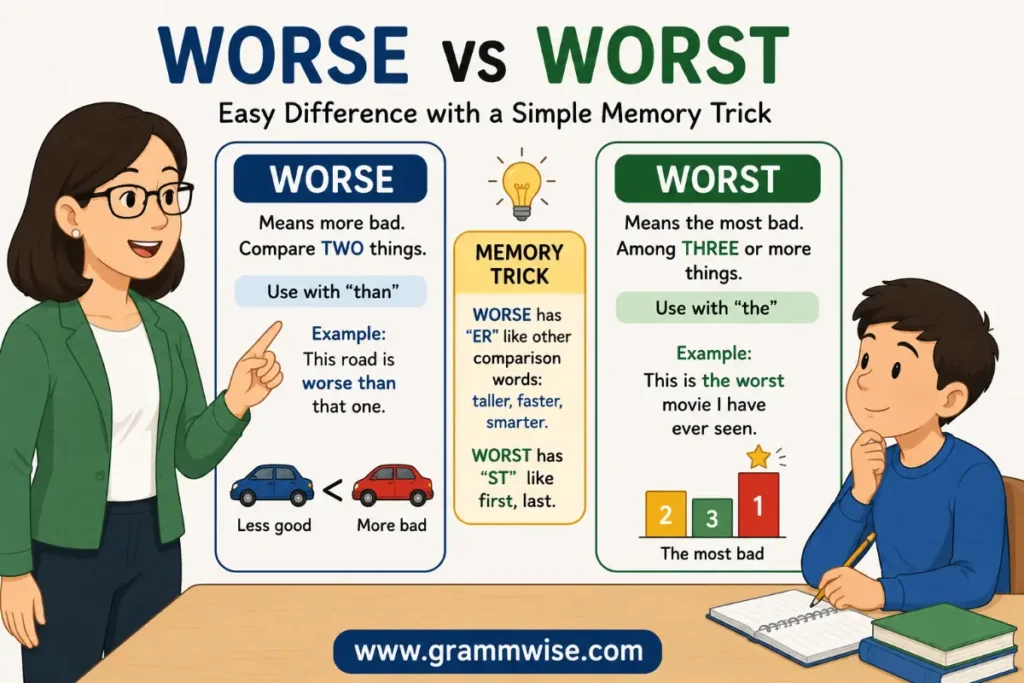
Conclusion
Understanding worse vs worst becomes simple when you remember one easy rule. Worse compares two things and means more bad, while worst describes the most bad in a group of three or more. Keep this rule in mind, and choosing the correct word will become much easier.
The more you read, write, and practice these words in real-life sentences, the more natural they will feel. With a little practice, you will confidently use worse and worst correctly in everyday English without stopping to think.
Frequently Asked Questions (FAQs)
What does worse mean in simple words?
Worse means more bad than something else. It compares two people, things, or situations.
What does worst mean in simple words?
Worst means the most bad. It describes the lowest or most negative one in a group.
What is the difference between worse vs worst?
Worse compares two things. Worst compares one thing with three or more and shows the lowest level.
Is it “worse than” or “worst than”?
Use worse than. The word worst is not followed by than in this type of comparison.
Can I say “the worse”?
Usually, no. In most cases, you should say the worst when talking about the lowest in a group.
Why do people confuse worse and worst?
They look and sound similar because both come from the word bad, but they are used in different types of comparisons.
Can worse and worst be used in speaking and writing?
Yes. Both words are very common in everyday conversations, schoolwork, books, emails, and professional writing.
How can I remember worse vs worst?
Remember that worse ends in -er, like many words that compare two things. Worst ends in -st, like first and last, which help you think of the end or final position in a group.