
Many English learners get confused about raising vs rising because the words look and sound very similar. You may hear people say, “The sun is rising,” but “She is raising her hand.” Both words talk about something moving up, yet they are not used in the same way.
The good news is that the difference is easy to learn. Once you know one simple rule, you will be able to choose the correct word in everyday speaking and writing.
In this lesson, I will explain raising vs rising in very simple English. You will learn the meanings, the differences, easy memory tricks, real-life examples, and common mistakes so you can use both words with confidence.
Confused by similar words? Our grammar guides explain them clearly.
Simple Answer in One Look
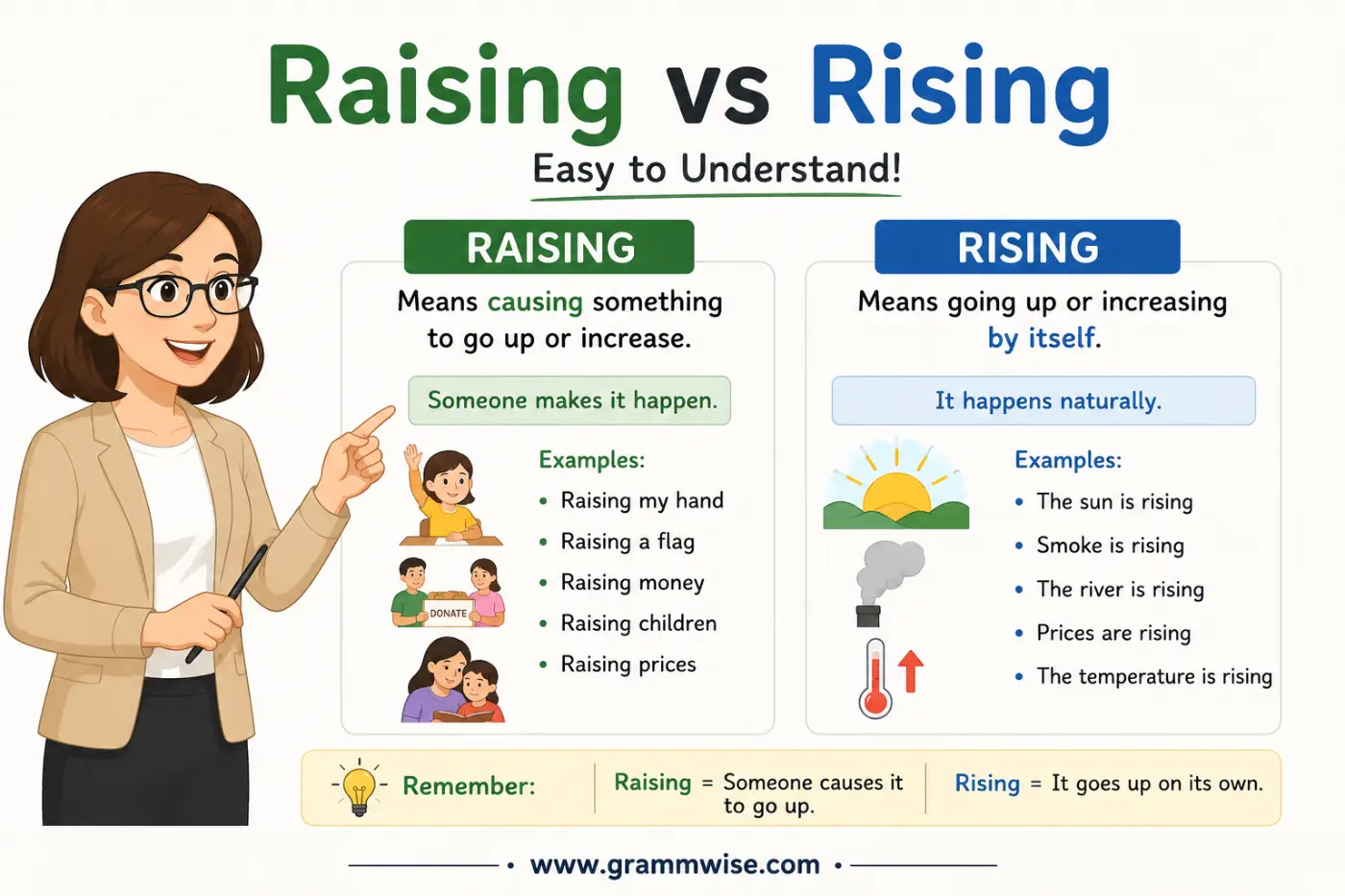
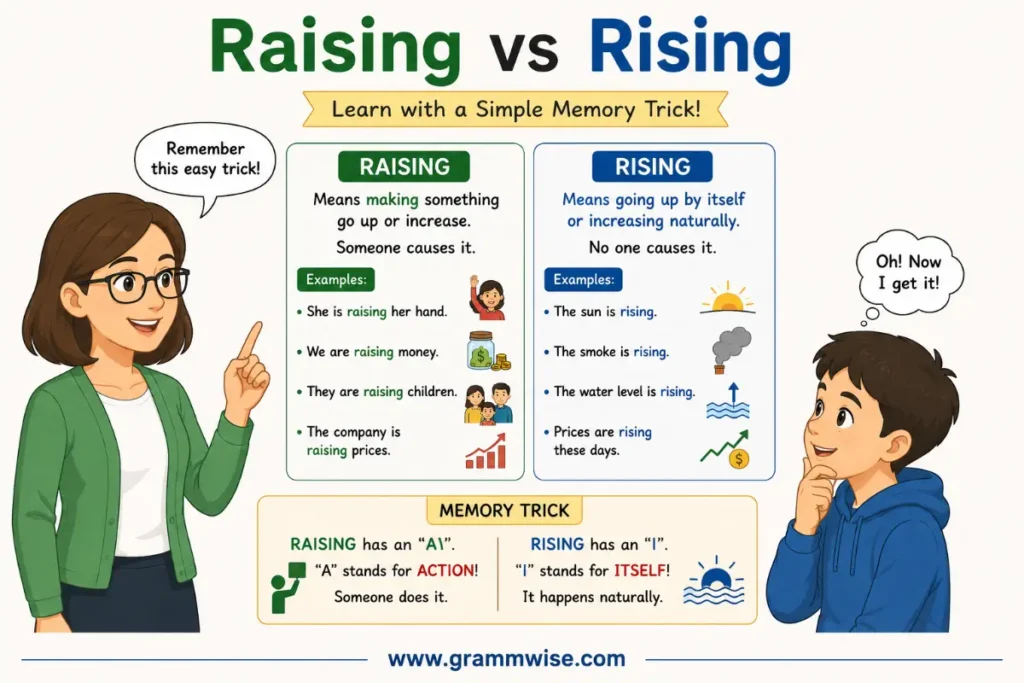
Raising means lifting or moving something up.
Rising means going up by itself.
A simple way to remember it is:
- Raising = Someone causes it to go up.
- Rising = It goes up on its own.
What Does Raising vs Rising Mean in Simple English?
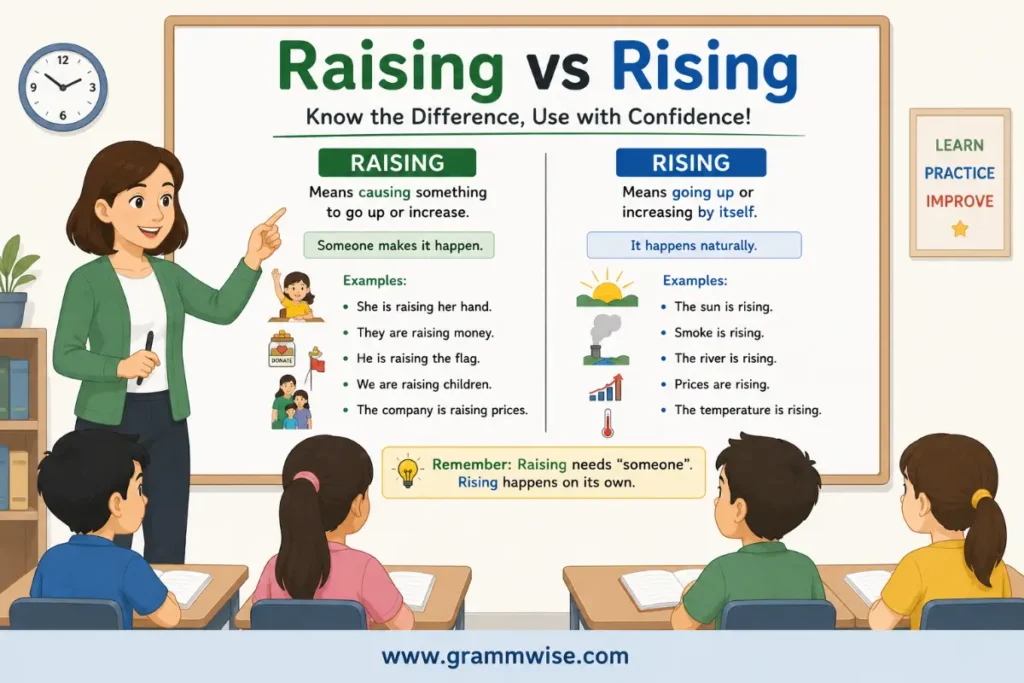
Imagine you are in a classroom. The teacher asks a question. You lift your hand. You are raising your hand because you are making it go up.
Now imagine the sun early in the morning. No one lifts the sun. It moves upward by itself. The sun is rising.
That is the biggest difference between raising vs rising.
What Does Raising Mean?
Raising means causing something to move higher or become greater.
A person or thing is doing the action.
Examples:
- She is raising her hand.
- Dad is raising the flag.
- They are raising money for a charity.
- We are raising vegetables in our garden.
- The company is raising prices.
In every example, someone is making something happen.
What Does Rising Mean?
Rising means moving upward or becoming higher without someone directly lifting it.
Examples:
- The sun is rising.
- Smoke is rising into the sky.
- Water is rising after the heavy rain.
- The temperature is rising.
- Bread is rising in the oven.
The subject changes by itself.
Why Do People Mix These Words Raising vs Rising?
Many learners think these words mean exactly the same thing because both involve something going up.
They also look almost identical.
The only difference is one letter.
Another reason is that both words come from the verb rise.
But they are used in different ways.
Think about these two sentences.
- The balloon is rising.
- The child is raising the balloon.
The balloon rises.
The child raises it.
This small difference changes the whole sentence.
People also become confused because many languages use only one word for both ideas.
English uses two different forms to show who or what causes the action.
Clear Difference Between Raising vs Rising Explained Simply
Here is an easy comparison of raising vs rising.
| Raising | Rising |
|---|---|
| Someone causes something to go up. | Something goes up by itself. |
| Needs someone or something to do the action. | Does not need anyone to lift it. |
| Often has an object after it. | Usually does not have an object. |
| Think: lift or increase. | Think: move upward naturally. |
Look at these examples.
Example 1
Sarah is raising her hand.
Sarah makes her hand go up.
Example 2
The hot air balloon is rising.
The balloon moves upward.
Example 3
The farmer is raising chickens.
The farmer takes care of the chickens.
Example 4
The river is rising after the storm.
The water level goes up naturally.
Raising vs Rising: Which Form Should You Use?
Ask yourself one simple question.
Is someone making something happen?
If yes, use raising.
Examples:
- She is raising the window.
- Dad is raising the flag.
- We are raising funds.
- The teacher is raising the question.
Now ask another question.
Is it happening by itself?
If yes, use rising.
Examples:
- The moon is rising.
- The water is rising.
- The smoke is rising.
- Prices are rising.
This simple rule works in almost every situation.
Easy Memory Trick for Raising vs Rising
Here is a memory trick that students remember very well.
Think of the word “raising”.
It has the word “A” in the middle.
Remember:
A = Action by someone.
Someone causes the action.
Now think of “rising”.
Picture the sun.
Nobody pushes the sun into the sky.
It rises naturally.
So remember:
Raising = You lift it.
Rising = It lifts itself.
Another easy trick is:
Raising needs help.
Rising happens by itself.
Can Both Words Raising vs Rising Talk About an Increase?
Yes.
Both words can describe something becoming greater.
The difference is who causes the increase.
Raising
Someone causes the increase.
Examples:
- The company is raising salaries.
- The government is raising taxes.
- The school is raising money.
Rising
The increase happens naturally or is simply occurring.
Examples:
- Salaries are rising.
- Prices are rising.
- Interest rates are rising.
- The number of students is rising.
Notice the difference.
Someone raises prices.
Prices rise.
Common Situations Where We Use Raising
English uses raising in many everyday situations.
Raising a Hand
Students raise their hands to answer questions.
Example:
Please stop talking and raise your hand.
Raising Children
Parents raise children.
Example:
They are raising three children.
Raising Money
Schools and charities often raise money.
Example:
Our class is raising money for new books.
Raising Animals
Farmers raise cows, chickens, and sheep.
Example:
My uncle raises horses.
Raising a Flag
People raise a flag during special events.
Example:
The soldiers are raising the national flag.
Raise a Question
Ask or introduce a question.
Example:
She raised an interesting question.
Common Situations Where We Use Rising
Now look at common examples of rising.
The Sun
The sun rises every morning.
Example:
The sun is rising over the mountains.
Water
Water rises after heavy rain.
Example:
The river is rising quickly.
Smoke
Smoke rises into the air.
Example:
Smoke is rising from the chimney.
Bread
Bread rises before baking.
Example:
The dough is rising nicely.
Temperature
Temperatures often rise in summer.
Example:
The temperature is rising every afternoon.
Rising Prices
Prices that are increasing.
Example:
Everyone is worried about rising food prices.
Rising Star
A person becoming successful.
Example:
She is a rising star in music.
Easy Real-Life Sentences Raising vs Rising
These simple examples show the difference clearly.
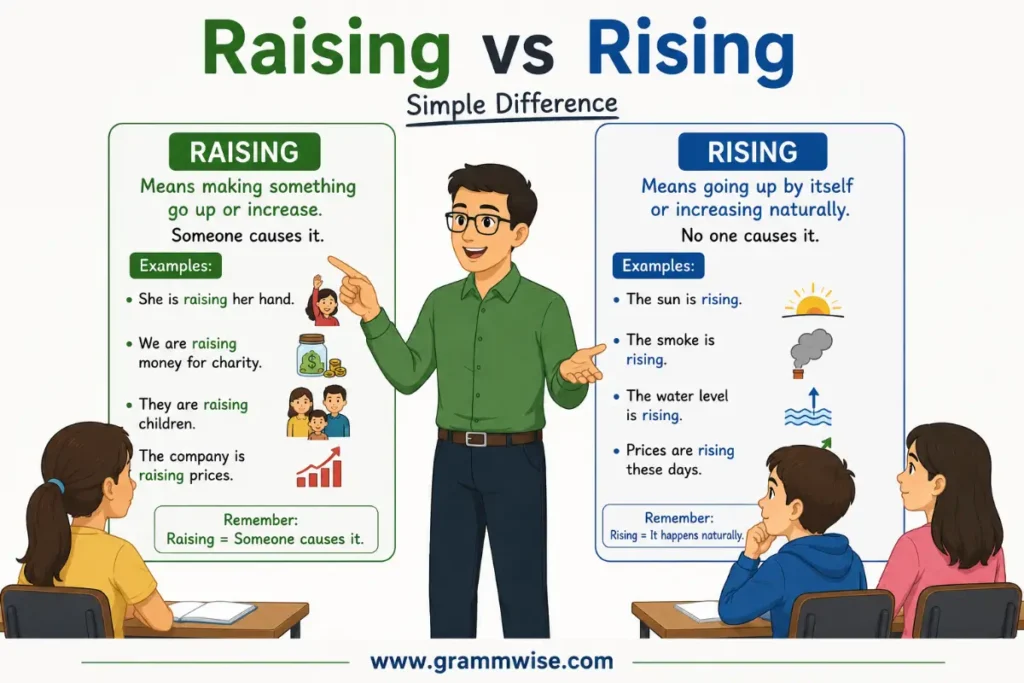
- She is raising her hand.
- The teacher is raising an important question.
- We are raising money for the hospital.
- My grandparents are raising chickens.
- Dad is raising the garage door.
- The sun is rising behind the trees.
- The river is rising after two days of rain.
- Smoke is rising from the campfire.
- Prices are rising again this month.
- The bread is rising in the oven.
Practice reading these sentences aloud.
You will quickly notice the pattern.
Raising vs Rising: Where These Words Come From?
The words raising and rising come from two closely related Old English verbs.
The verb rise has been part of English for hundreds of years. It meant “to move upward” or “to get up.” Later, English developed the verb raise, which means “to cause something to rise.”
Over time, people began using both words in different situations. That is why English now has two useful verbs instead of one.
Think about these examples.
- The sun rises.
- People raise a flag.
- The water rises.
- Workers raise a building.
- The leaves rise in the wind.
- Parents raise children.
The meanings have stayed almost the same for many centuries.
How Raising vs Rising Are Understood in Culture and Stories?
The difference between raising vs rising is not only found in grammar books. These words also appear in stories, movies, songs, and everyday conversations. They often describe growth, hope, success, and change.
Think about a movie where a family works hard to raise money to save their home. They are taking action to reach a goal.
Now think about the ending of the movie. The sun is rising, showing a new beginning and a brighter future. No one makes the sun rise. It happens naturally.
Stories often use raising to show effort.
For example:
- Raising a child
- Raising a family
- Raising money
- Raising a flag
- Raising a voice
These actions require someone to do something.
Stories often use rising to show natural change.
For example:
- Rising hope
- Rising water
- Rising smoke
- Rising stars
- Rising temperatures
These things happen or grow without someone directly lifting them.
Many cultures connect the rising sun with hope and a fresh start. People wake up, begin a new day, and believe tomorrow can be better.
At the same time, raising a child is seen as one of life’s biggest responsibilities. Parents teach, protect, and guide their children as they grow.
These simple examples help us remember the difference between raising vs rising.
Biblical and Historical Meaning of Raising vs Rising
The Bible uses both ideas, although not always with the exact words raising and rising.
The word rising often describes new life, hope, and God’s power. One of the best-known examples is the resurrection of Jesus Christ. Christians believe Jesus rose from the dead, so the idea of rising became a symbol of victory, hope, and new life.
The Bible also speaks about people raising things.
- People raised altars to worship God.
- Leaders raised armies to protect their people.
- Parents raised children to follow God’s teachings.
In each case, someone actively caused something to happen.
History books also use these words differently.
- A king might raise an army.
- A nation might experience rising prices.
- Workers might raise a bridge.
- The river might be rising after heavy rain.
These examples show that English has followed the same pattern for hundreds of years.
Symbolism of Raising vs Rising in Simple Words
What Raising Represents?
Raising usually represents action.
It reminds us of:
- Helping others
- Building something
- Teaching children
- Solving problems
- Creating change
- Taking responsibility
When someone raises something, they are making a difference.
- Parents raise children.
- Teachers raise good questions.
- Communities raise money for people in need.
These actions require effort.
What Rising Represents?
Rising usually represents natural growth.
It often stands for:
- New beginnings
- Hope
- Success
- Progress
- Recovery
- Change
Think about the sunrise.
Every morning the sun rises without anyone pushing it.
That is why many writers use the rising sun as a symbol of hope.
A person’s confidence can also rise.
A team’s score can rise.
A business can become a rising company.
These changes happen over time.
Related Words You Should Know
Learning related words makes raising vs rising even easier.
Raise: To lift something or make something higher.
Example: Please raise your hand.
Rise: To move upward naturally.
Example: The balloon began to rise.
Raised: Past tense of raise.
Example: She raised the window.
Rose: Past tense of rise.
Example: The sun rose at 6:00 a.m.
Risen: Past participle of rise.
Example: The water has risen since yesterday.
Increase: To become greater.
Example: Sales increased this month.
Lift: To move something upward.
Example: Please lift the box.
Grow: To become bigger over time.
Example: The tree is growing quickly.
Develop: To improve little by little.
Example: His English skills are developing every day.
Climb: To move upward step by step.
Example: The hikers climbed the mountain.
How People Actually Use Raising vs Rising in Daily English?
Native speakers use these words every day.
Here are some natural examples.
- “We’re raising money for the school library.” The people are collecting money.
- “The cost of gas is rising.” The price is going up.
- “Please raise your hand before speaking.” Someone lifts their hand.
- “The bread is rising in the bowl.” The dough becomes bigger by itself.
- “They are raising two children.” The parents are taking care of them.
- “The smoke is rising into the sky.” The smoke moves upward naturally.
- “Our neighbors are raising chickens.” They care for the chickens.
- “The number of visitors is rising every year.” More people are coming each year.
- “The company is raising employee salaries.” The company causes the increase.
- “Interest rates are rising again.” The rates are increasing.
Notice the simple pattern.
Someone raises something.
Something rises by itself.
Common Mistakes People Make About Raising vs Rising
Many learners make the same mistakes when studying raising vs rising.
Here are the most common ones.
Mistake 1: Using Raising Without an Object
Incorrect:
She is raising.
Better:
She is raising her hand.
Raising usually needs something after it.
Mistake 2: Using Rising for Something a Person Lifts
Incorrect:
He is rising the flag.
Correct:
He is raising the flag.
People raise flags.
Flags rise after someone raises them.
Mistake 3: Forgetting the Memory Rule
Students often remember the meanings but forget when to use each word.
Keep this simple rule in mind.
Someone does it? Use raising.
It happens naturally? Use rising.
Mistake 4: Confusing Raise and Rise
Many learners also confuse the base verbs.
Remember these pairs.
- Raise → Raising
- Rise → Rising
Learning the base verbs first makes everything easier.
Mistake 5: Translating Directly From Another Language
Some languages use one verb for both ideas.
English does not.
Instead of translating word for word, think about who causes the action.
That will help you choose correctly.
Final Teacher Explanation
Imagine we are finishing today’s lesson together.
I write two simple sentences on the board.
The teacher is raising the flag.
Who is doing the action?
The teacher.
Now I write another sentence.
The sun is rising.
Who is lifting the sun?
Nobody.
It rises by itself.
That is the easiest way to understand raising vs rising.
Whenever you feel confused, ask one question.
Is someone making it happen?
If yes, choose raising.
Is it happening naturally?
If yes, choose rising.
You do not need to memorize long grammar rules.
Just think about who causes the action.
That simple habit will help you use these words correctly in almost every situation.
Quick Recap Raising vs Rising
The difference between raising vs rising is simple.
Raising means making something go up or increase.
Rising means going up naturally without someone causing it.
Remember this easy rule:
People raise things. Things rise by themselves.
Conclusion
Understanding raising vs rising becomes easy when you focus on one simple idea. If a person or thing causes something to move upward or increase, use raising. If something moves upward or becomes greater on its own, use rising. This one rule will help you choose the correct word with confidence.
Keep practicing with real-life examples like raising your hand, raising money, the sun rising, and prices rising. The more you see these words in everyday English, the more natural they will become in your speaking and writing.
Frequently Asked Questions
What is the difference between raising vs rising?
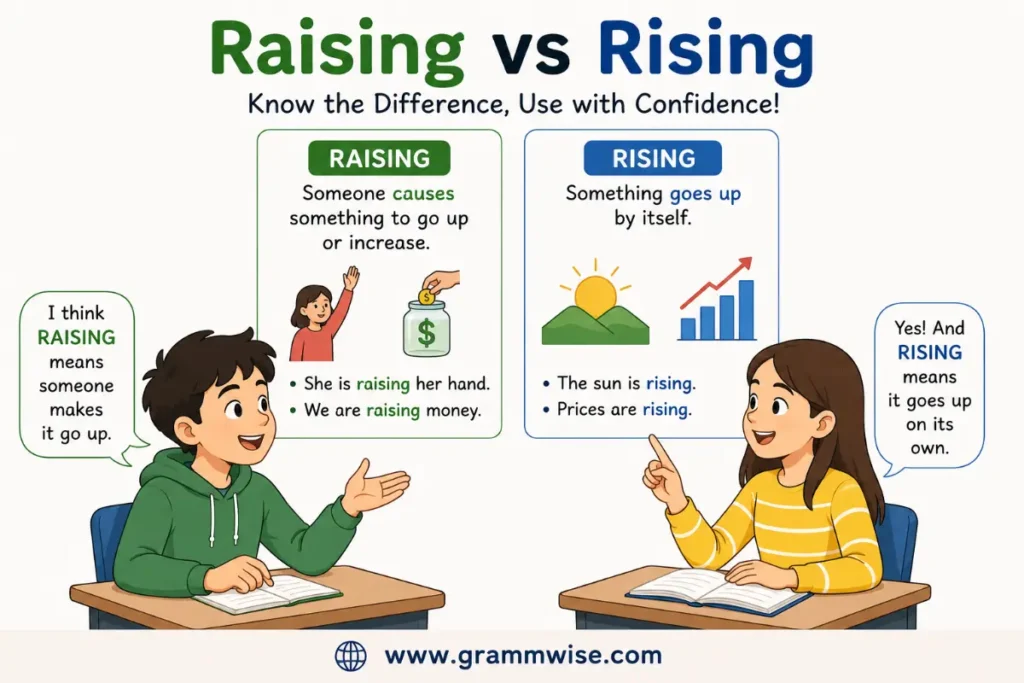
Raising means causing something to go up. Rising means something goes up by itself.
When should I use raising?
Use raising when a person or thing is making something happen, such as raising a hand, raising money, or raising children.
When should I use rising?
Use rising when something naturally moves upward or increases, such as the sun rising or prices rising.
Why do people confuse raising and rising?
The words look and sound similar, and both describe something going up. The difference is whether someone causes the action.
Can I say “the sun is raising”?
No. The correct sentence is “The sun is rising.” The sun moves upward naturally.
Is it correct to say “raising prices”?
Yes. A company or government can raise prices because it causes the increase.
What is an easy way to remember raising vs rising?
Remember this simple trick:
Someone causes it = Raising.
It happens naturally = Rising.