
Many English learners get confused about peak, peek, pique because these three words sound exactly the same. They are homophones, which means they have the same pronunciation but different meanings and spellings. If you use the wrong one, your sentence can quickly become confusing.
The good news is that learning peak, peek, pique is easier than you might think. Each word has its own meaning, and a simple memory trick can help you remember which one to use. Once you understand the difference, you will feel more confident in speaking and writing English.
In this guide, you will learn the meaning of each word, see real-life examples, discover why people confuse them, and find easy tips to remember the correct spelling every time.
Small spelling changes can create big meaning differences such as Raising vs Rising.
Simple Answer in One Look
Here is the quick answer.
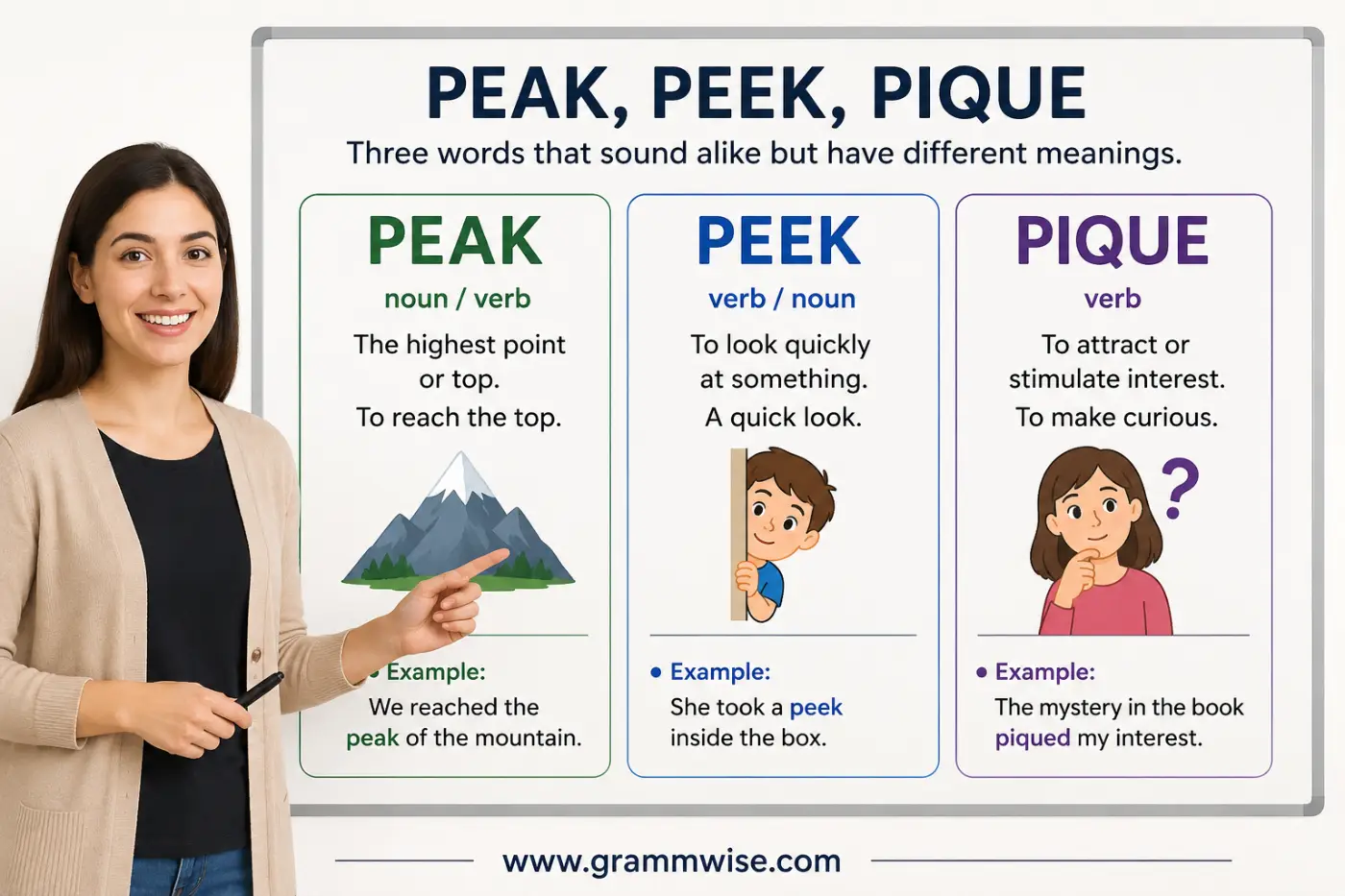
- Peak = the highest point or best level.
- Peek = to take a quick look.
- Pique = to arouse interest or feelings.
Examples
- She reached the peak of the mountain.
- Don’t peek at your birthday gift.
- The book title piqued my curiosity.
The words sound the same, but their meanings are completely different.
What Do Peak, Peek, and Pique Mean in Simple English?
Let’s learn each word one by one.
What Does “Peak” Mean?
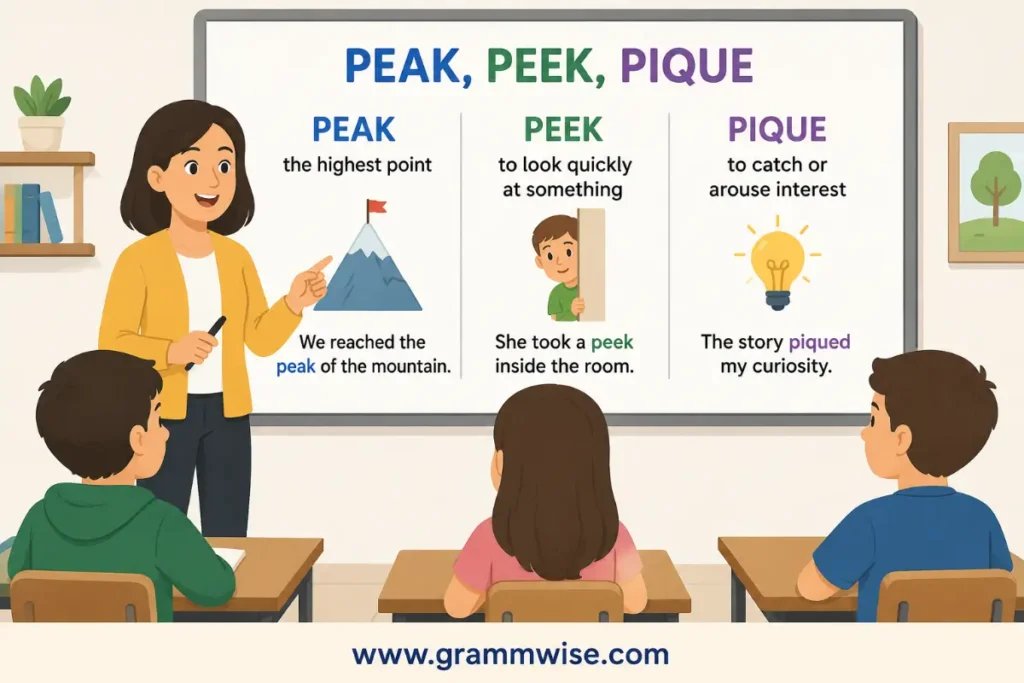
Peak means the highest point of something.
It can describe a mountain, a number, a career, or even someone’s performance.
Think of a mountain.
The very top is called the peak.
Examples:
- We finally reached the mountain’s peak.
- Sales reached their peak in December.
- She is at the peak of her career.
- Summer heat usually reaches its peak in July.
Sometimes peak is also used as an adjective.
Examples:
- Peak travel season is very busy.
- Avoid driving during peak hours.
As a verb, peak means to reach the highest level.
Example:
- Demand peaked last weekend.
In most everyday situations, people use peak to talk about the highest point or best stage.
What Does “Peek” Mean?
Peek means to look quickly or secretly.
Usually, the look is short.
Sometimes it is done because someone is curious.
Examples:
- I took a peek inside the box.
- Don’t peek at the answers.
- The child peeked through the window.
- She peeked around the corner.
People often use peek when talking about surprises.
For example:
- No peeking before your birthday.
- Can I have a quick peek?
Remember that peek is always connected with looking.
What Does “Pique” Mean?
Pique is the least common of the three words.
It means to create interest or to cause a strong feeling.
The most common expression is:
Pique someone’s interest
Examples:
- The story piqued my interest.
- His question piqued everyone’s curiosity.
- The news piqued her attention.
Sometimes pique also means to make someone feel slightly annoyed.
Example:
- His rude comment piqued her.
However, this meaning is less common in everyday English.
Most people use pique when talking about interest or curiosity.
Why Do People Mix These Words Peak, Peek, Pique?
Many learners struggle with peak vs peek vs pique for several simple reasons.
They Sound Exactly the Same
All three words are pronounced:
/piːk/
When you hear them, they sound identical.
Only the spelling changes.
The Spellings Look Similar
Compare them.
- Peak
- Peek
- Pique
The spellings are close enough to confuse many writers.
They Are Used in Different Situations
Each word belongs to a different idea.
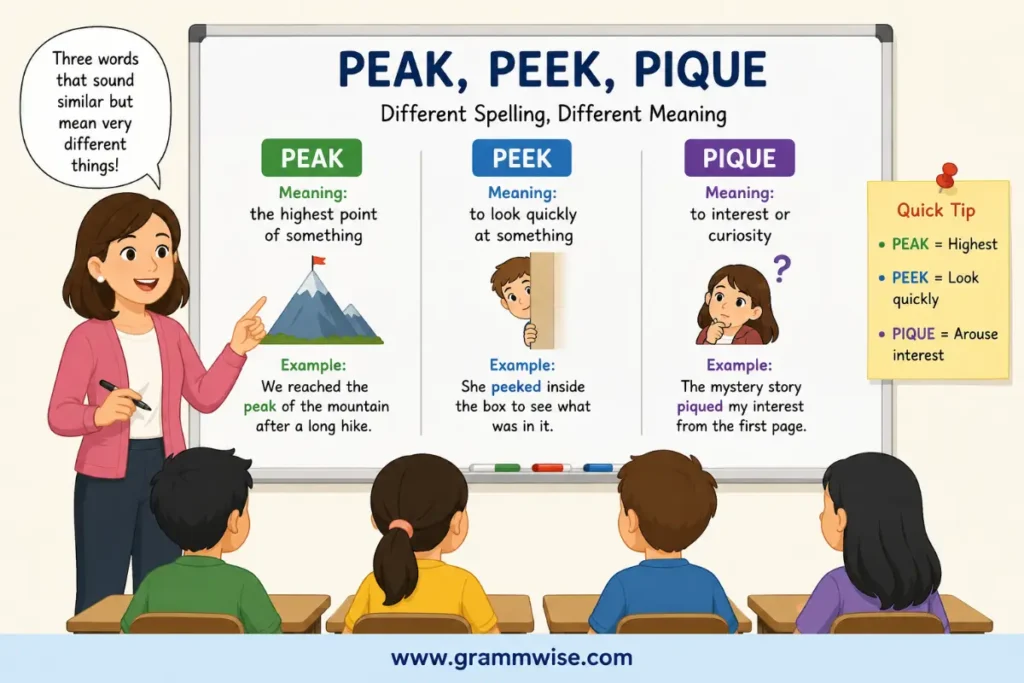
- Peak → highest point
- Peek → quick look
- Pique → create interest
If you forget the meaning, choosing the right spelling becomes difficult.
Autocorrect Does Not Always Help
Your phone or computer may accept all three spellings because each is a real English word.
That means spelling checkers may not catch your mistake.
For example:
❌ The movie title really peeked my interest.
The spelling is wrong, but many spell checkers will not notice.
Correct:
✅ The movie title really piqued my interest.
Learners Memorize Sound Instead of Meaning
Many students remember only how the word sounds.
Since all three sound alike, they accidentally choose the wrong spelling.
Learning the meaning is much more helpful than memorizing pronunciation.
Clear Difference Between Peak, Peek, Pique
Here is the easiest comparison.
| Word | Meaning | Easy Memory | Used for | Examples |
|---|---|---|---|---|
| Peak | Highest point | Think of a mountain peak. | Mountains Success Numbers Performance Highest level | We climbed to the peak. Business is at its peak. She reached peak fitnes |
| Peek | Quick look | Two “e”s look like two eyes. | Looking quickly Looking secretly Taking a short glance | Take a peek. Don’t peek yet. She peeked through the door. |
| Pique | Create interest | Think of “pique my curiosity.” | Curiosity Interest Attention Feelings | The article piqued my curiosity. His speech piqued my interest. |
Peak, Peek, Pique: Which Form Should You Use?
The correct word depends on your meaning.
Ask yourself one question.
Are You Talking About the Highest Point?
Use peak.
Examples:
- The mountain has a snowy peak.
- Electricity use reaches its peak at night.
- This athlete is in peak condition.
Are You Talking About Looking?
Use peek.
Examples:
- Can I peek inside?
- She peeked under the blanket.
- He took a quick peek.
Are You Talking About Interest or Curiosity?
Use pique.
Examples:
- The mystery piqued my interest.
- The headline piqued my curiosity.
- The new game piqued children’s excitement.
Memory Tricks for Peak, Peek, Pique That Really Work
These tricks make remembering peak vs peek vs pique much easier.
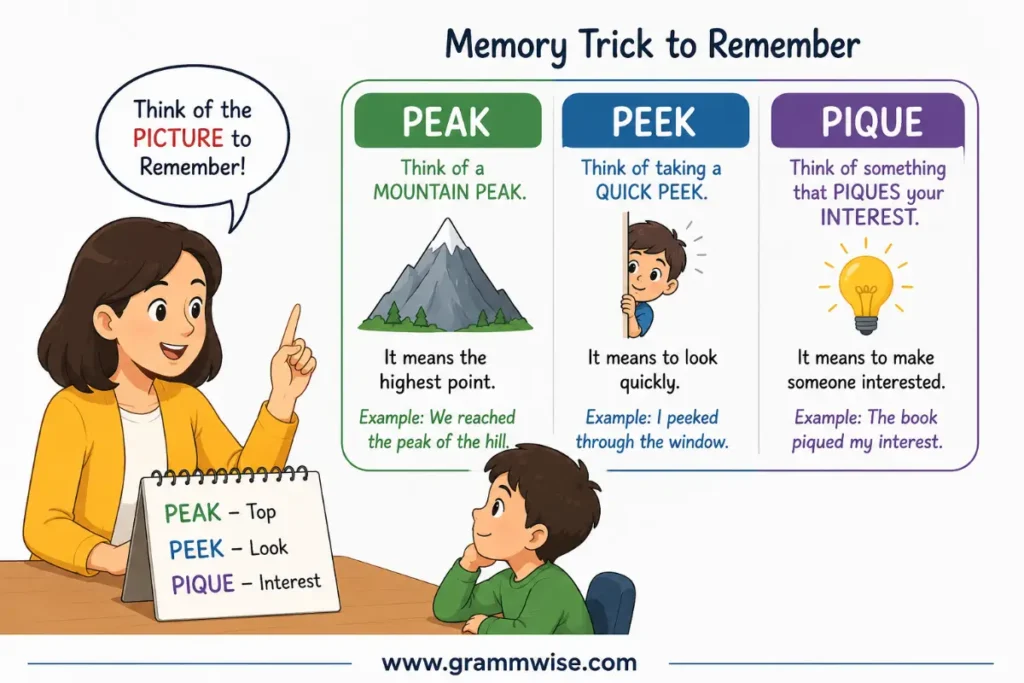
Peak = Mountain Top
Picture a tall mountain.
The pointed top is the peak.
Whenever you think about the highest point, choose peak.
Peek = Two Eyes
Notice the two “e”s.
They look like two eyes looking.
That makes it easy to remember.
Peek = Look
Pique = Curiosity
Most people know this phrase:
Pique my curiosity.
If something makes you curious, use pique.
Common Expressions Using Peak, Peek, Pique
Learning common expressions helps you remember each word naturally.
Common Expressions with Peak
- Peak season
- Peak hours
- Peak performance
- Peak experience
- Peak condition
- Peak demand
Examples:
- Hotels cost more during peak season.
- Avoid driving during peak hours.
Common Expressions with Peek
- Sneak peek
- Quick peek
- Peek inside
- Peek through
- No peeking
Examples:
- We got a sneak peek at the new movie.
- Can I have a quick peek?
Common Expressions with Pique
- Pique curiosity
- Pique interest
- Pique attention
Examples:
- The advertisement piqued my interest.
- The new invention piqued everyone’s curiosity.
Easy Real-Life Sentences on Peak, Peek, Pique
These examples show how native speakers naturally use each word.
Peak Examples
- The sun reached its peak at noon.
- She climbed to the highest peak.
- Winter tourism reaches its peak in December.
- He is at the peak of his career.
- Our team played at peak performance.
Peek Examples
- Don’t peek at the test answers.
- I took a peek outside.
- She peeked through the curtains.
- Can I peek inside your bag?
- The puppy peeked from behind the chair.
Pique Examples
- The documentary piqued my curiosity.
- Her idea piqued everyone’s interest.
- The headline piqued my attention.
- The mystery piqued our imagination.
- His question piqued the class’s curiosity.
Peak, Peek, Pique: Where These Words Come From?
The three words have different histories even though they sound alike today.
Peak
The word peak has been used in English for hundreds of years.
It originally described the pointed top of a mountain.
Later, people began using it for the highest level of almost anything, such as success, sales, or performance.
Peek
The word peek comes from an older English word meaning to look quickly or secretly.
Its meaning has stayed almost the same for many years.
Today, people still use it when talking about taking a quick look.
Pique
The word pique came into English from French.
It originally meant to prick or stimulate.
Over time, English speakers began using it to mean creating curiosity or interest.
That is why we often hear:
- Pique someone’s interest
- Pique someone’s curiosity
Quick Comparison Chart Peak, Peek, Pique
| Feature | Peak | Peek | Pique |
|---|---|---|---|
| Meaning | Highest point | Quick look | Create interest |
| Part of speech | Noun, adjective, verb | Noun, verb | Verb, noun |
| Common phrase | Peak season | Sneak peek | Pique curiosity |
| Easy memory | Mountain top | Two eyes | Curiosity |
Peak, Peek, Pique: How These Words Are Understood in Culture and Stories?
Words often become easier to remember when you connect them to stories. The same is true for peak vs peek vs pique. Each word creates a different picture in your mind.
Peak in Stories
In many stories, the peak of a mountain is where something important happens.
A hero may climb to the highest peak to complete a mission.
A traveler may reach a snowy peak after a long journey.
Sometimes peak is not about a mountain. It can describe the best or most exciting moment in a story.
For example:
- The movie reached its peak during the final battle.
- Her happiness reached its peak on graduation day.
In these examples, peak means the highest point.
Peek in Stories
Writers often use peek to build suspense.
A character may take a quick peek behind a door.
A child may peek at birthday presents before the party.
Someone may peek through a window to see what is happening outside.
These little moments make readers curious because they know the character is looking at something important.
Pique in Stories
The word pique often appears when something catches a character’s attention.
For example:
- An old map piqued the explorer’s curiosity.
- A strange sound piqued the detective’s interest.
- A mysterious letter piqued everyone’s imagination.
The word helps explain why a character decides to learn more.
Why Authors Use These Words
Good writers want readers to picture the scene clearly.
They choose peak to show the highest point, peek to show a quick look, and pique to show growing curiosity.
Each word adds a different feeling to the story.
Biblical and Mythological Meaning of Peak, Peek, Pique
The words peak, peek, and pique do not have special biblical meanings. They are normal English words. However, they may appear in English translations or books about faith.
For example:
- A prophet may stand on a mountain peak.
- Someone may peek into a room.
- A miracle may pique people’s curiosity.
The meaning comes from the story, not from the words themselves.
The same is true in mythology. Many myths describe heroes climbing high peaks. Characters sometimes peek into magical places. A mysterious object may pique the interest of a hero before an adventure begins.
These words simply help describe actions and feelings.
They do not carry special religious or mythical meanings by themselves.
Symbolism of Peak, Peek, Pique in Simple Words
What Peak Represents?
The word peak often symbolizes success.
It reminds people of reaching the top after working hard.
Examples include:
- Winning a championship.
- Graduating from school.
- Achieving a dream.
- Reaching your best performance.
People often say:
- She reached the peak of success.
- He is in peak condition.
Symbolically, peak represents:
- Success
- Achievement
- Growth
- Excellence
- Reaching your goal
It reminds us that hard work can lead to great results.
What Peek Represents?
The word peek often symbolizes curiosity.
People peek because they want to know something.
Children peek at presents.
Readers peek at the last page of a book.
Friends may peek through a window.
Symbolically, peek represents:
- Curiosity
- Wonder
- Discovery
- Small adventures
- Learning something new
It reminds us that people naturally enjoy discovering new things.
What Pique Represents?
The word pique symbolizes interest.
Something unexpected catches your attention.
A great idea can pique your imagination.
An interesting question can pique your curiosity.
A beautiful place can pique your desire to travel.
Symbolically, pique represents:
- Interest
- Curiosity
- Inspiration
- Motivation
- Excitement
It often marks the beginning of learning something new.
Simple Comparison
Imagine visiting a beautiful mountain.
You finally reach the peak.
Then you take a peek over the edge.
The amazing view piques your curiosity to explore even more.
One short story helps connect all three meanings.
Related Words You Should Know
Learning related words helps you remember peak vs peek vs pique.
Summit: The highest point of a mountain.
Example: We finally reached the summit.
Top: The highest part of something.
Example: Put the box on the top shelf.
Height: The distance from bottom to top.
Example: The tree has an impressive height.
Glance: A quick look.
Example: She gave me a quick glance.
Glimpse: A short or incomplete look.
Example: We caught a glimpse of the rainbow.
Stare: To look at something for a long time.
Example: Don’t stare at people.
Curiosity: A strong desire to learn something.
Example: Curiosity helps children learn.
Interest: Wanting to know more about something.
Example: Science has always interested me.
Fascinate: To make someone very interested.
Example: Space exploration fascinates many people.
Inspire: To fill someone with new ideas or excitement.
Example: Great teachers inspire students.
Knowing these related words makes your vocabulary stronger and helps you understand peak vs peek vs pique more naturally.
How People Actually Use Peak, Peek, Pique in Daily English
Native English speakers use these words in different situations every day.
At School
- My grades reached their peak this semester.
- Can I take a peek at your project?
- Your science experiment really piqued my interest.
At Work
- Sales reached their peak before the holidays.
- I took a quick peek at my emails.
- The new job advertisement piqued my curiosity.
While Traveling
- We climbed to the mountain peak.
- I peeked through the train window.
- The travel video piqued my interest in Japan.
During Sports
- She is in peak physical condition.
- The coach took a peek at the practice field.
- The final match piqued everyone’s excitement.
While Shopping
- Can I have a sneak peek at the new collection?
- Holiday shopping reaches its peak in December.
- The advertisement piqued my interest.
At Home
- Don’t peek before opening your gift.
- The baby peeked from behind the sofa.
- The family vacation photos piqued my curiosity.
These are natural examples that you can use in your own conversations and writing.
Common Mistakes People Make About Peak, Peek, Pique
Even experienced English learners sometimes confuse these words.
Mistake 1: Writing “Peek My Interest”
❌ The article peeked my interest.
✅ The article piqued my interest.
Remember, interest is piqued, not peeked.
Mistake 2: Writing “Mountain Peek”
❌ We reached the mountain peek.
✅ We reached the mountain peak.
The highest point is always a peak.
Mistake 3: Writing “Quick Peak”
❌ Can I have a quick peak?
✅ Can I have a quick peek?
A quick look is always a peek.
Mistake 4: Using Peak for Curiosity
❌ The mystery peaked my curiosity.
✅ The mystery piqued my curiosity.
This is one of the most common spelling mistakes in English.
Mistake 5: Forgetting the Meaning
Some learners choose a spelling because it sounds correct.
Instead, ask yourself one simple question.
What am I talking about?
- The highest point? → Peak
- Looking quickly? → Peek
- Interest or curiosity? → Pique
Thinking about the meaning first will help you choose the correct spelling.
Final Teacher Explanation
Imagine we are finishing today’s English lesson.
I write three words on the board:
Peak
Peek
Pique
Then I ask three simple questions.
Are you talking about the highest point?
Choose peak.
Are you talking about taking a quick look?
Choose peek.
Are you talking about creating curiosity or interest?
Choose pique.
That is the easiest way to remember peak vs peek vs pique.
Do not focus only on the pronunciation because all three words sound exactly the same. Instead, focus on the meaning.
- Picture a mountain for peak.
- Picture two eyes taking a peek.
- Picture a curious student whose interest is piqued.
These simple pictures will help you remember the correct spelling whenever you read or write English.
Practice using these words in everyday sentences, and they will soon become a natural part of your vocabulary.
Quick Recap Peak, Peek, Pique
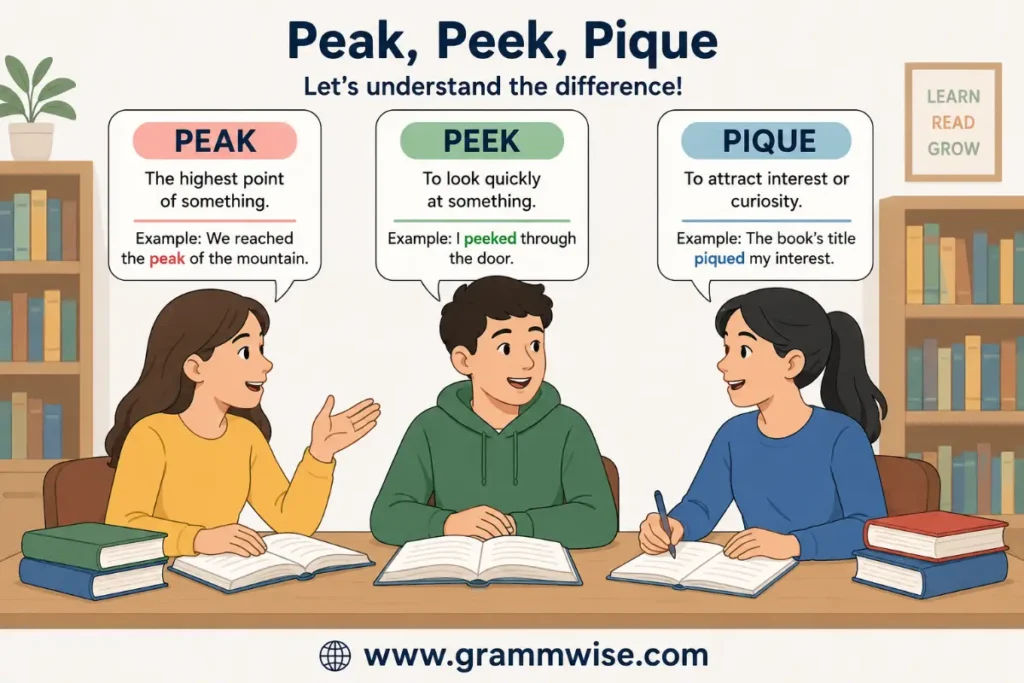
The difference between peak, peek and pique is simple. Peak means the highest point, peek means a quick look, and pique means to create interest or curiosity.
Remember this easy rule: Peak = top. Peek = look. Pique = interest. If you remember the meaning first, you will almost always choose the correct spelling.
Conclusion
Understanding peak, peek, pique is easy once you connect each word with its meaning. Peak means the highest point, peek means a quick look, and pique means to create interest or curiosity. Remembering these simple meanings will help you choose the correct spelling every time.
Keep practicing with real-life examples and common phrases to build your confidence. The more you read and use these words, the more natural they will become, making your English clearer, stronger, and more accurate.t4
Frequently Asked Questions
What does peak mean in simple words?
Peak means the highest point or the best level of something, such as the top of a mountain or the busiest time of the year.
What does peek mean?
Peek means to take a quick or secret look at something.
What does pique mean?
Pique means to create interest, curiosity, or another strong feeling.
Why do peak, peek, pique sound the same?
They are homophones, which means they have the same pronunciation but different spellings and meanings.
Is it “peek my interest” or “pique my interest”?
The correct phrase is pique my interest because pique means to create curiosity or interest.
What is the difference between peak and summit?
Both can mean the highest point of a mountain, but peak is also used for the highest level of success, performance, or activity.
Can peak be used as a verb?
Yes. For example, Sales peaked in July means sales reached their highest level in July.
How can I remember peak, peek, pique?
Use this memory trick: Peak = mountain top. Peek = quick look. Pique = curiosity or interest. This simple rule makes it much easier to choose the correct word every time.