
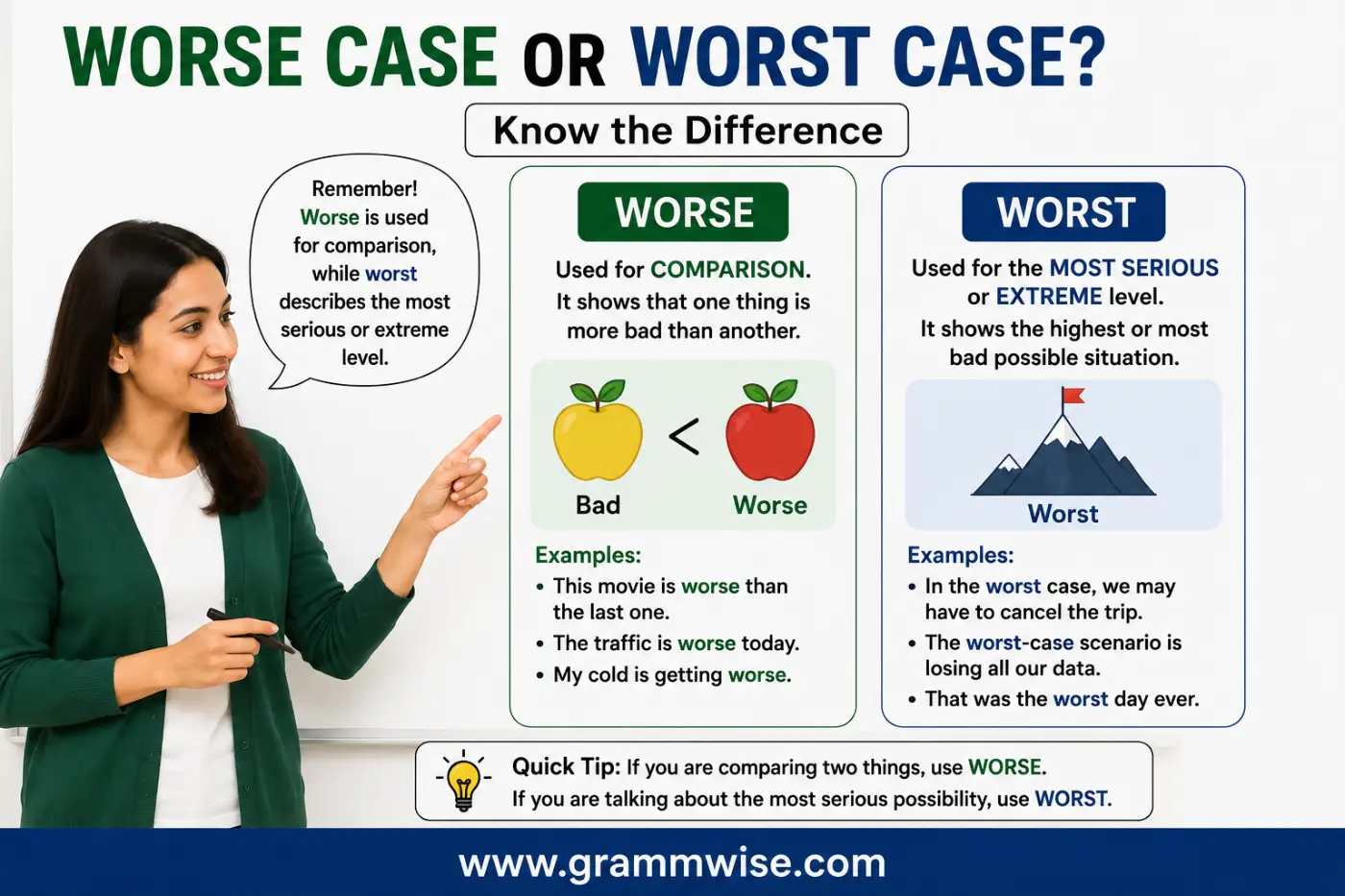
Many English learners confuse worse case or worst case because the words worse and worst are very similar. They both come from the word bad, but they are used in different ways. This is why people sometimes write worse case when they actually mean worst case.
The simple answer is: “Worst case” is the correct phrase when you mean the most serious or unpleasant possible situation. The word worse is normally used when comparing two things. The word worst is used for the highest or most extreme level.
For example, in the worst case means that you are thinking about the most difficult thing that could happen. But if you compare two situations, you would use worse. Once you understand this simple difference, choosing between worse case or worst case becomes much easier.
If you enjoy learning word differences, you may also like our guide on sooner or later.
Simple Answer in One Look
Worst case means the most serious or unpleasant possible situation.
Worse means more bad when two things are compared.
So:
- ✅ Worst case
- ❌ Worse case when you mean the most serious possibility
A quick example:
In the worst case, we may have to cancel the trip.
Here, worst is correct because the speaker is talking about the most difficult possible result.

What Does “Worst Case” Mean in Simple English?
Worst case means the most difficult, serious, or unpleasant situation that could happen.
People use this phrase when they are thinking about possible problems.
Imagine you are planning a trip.
There are several things that could go wrong. You could be late, miss the bus, lose your ticket, or even have to cancel the trip.
If you ask about the worst case, you are asking about the most serious possibility.
The phrase is often used when people are making plans or preparing for problems.
You may hear it when people talk about:
- travel
- school
- work
- money
- weather
- business
- accidents
- technology
- emergencies
- personal plans
For example, a family planning a vacation might think about what could happen if their flight is canceled.
A company might think about what could happen if a project fails.
A student might think about what could happen if they do not pass an exam.
In each situation, worst case points to the most serious possibility.
What Does “Worse” Mean in Simple English?
Worse means more bad, more difficult, or less good than something else.
It is usually used when making a comparison.
For example, imagine you have two tests.
The first test was difficult.
The second test was even more difficult.
You can say the second test was worse than the first one.
Here are some simple examples:
- My headache is getting worse.
- The weather is worse today.
- This problem is worse than the last one.
- The traffic is worse in the morning.
- His condition became worse.
- The second movie was worse than the first.
The important idea is comparison.
Something can be worse than something else.
Why Do People Confuse “Worse” and “Worst”?
The confusion is easy to understand because worse and worst are closely related.
They both come from the basic word bad.
Think about these three levels:
Bad → Worse → Worst
Here is how they work:
Bad means not good.
Worse means more bad when compared with something else.
Worst means the most bad or the most serious.
For example, imagine three problems.
- Problem A is bad.
- Problem B is worse.
- Problem C is the worst.
The word worse helps us compare.
The word worst shows the highest level.
That is why we say worst case.
We are talking about the most serious possible case.
Worse Case or Worst Case: Clear Difference Explained Simply
The easiest way to remember the difference is this:
| Worse | Worst |
|---|---|
| Means more bad | Means most bad |
| Usually used for comparison | Used for the highest level |
| Often followed by “than” | Often used with “the” |
| Compares situations | Describes the extreme situation |
| Example: worse than before | Example: the worst possible result |
Look at the difference:
This situation is worse than yesterday.
Here, two situations are being compared.
But:
This is the worst situation possible.
Here, the speaker is talking about the most serious situation.
So when you mean the most serious possible result, use worst.
Worse Case or Worst Case: Which Form Should You Use?
Use worst case when you mean:
the most serious thing that could happen.
Use worse when you are comparing one thing with another.
Ask yourself these two questions:
Am I comparing two things?
If yes, worse is often the correct choice.
Am I talking about the most serious possibility?
If yes, use worst.
For example:
- This problem is worse than the previous one.
- In the worst case, we may need to start again.
The first sentence compares two problems.
The second sentence talks about the most serious possibility.
What Does “In the Worst Case” Mean?
In the worst case means if the most serious possible situation happens.
It does not mean that the bad result will definitely happen. It simply means you are thinking about the most difficult possibility.
For example, a student might worry about failing a test.
The worst case could be having to take the test again.
A traveler might worry about missing a flight.
The worst case could be staying at the airport and taking another flight the next day.
A business might worry about losing a customer.
The worst case could be losing a large part of its income.
The phrase helps people prepare for possible problems.
What Is a “Worst-Case Scenario”?
You may also see the phrase worst-case scenario. A worst-case scenario is the most serious situation that could happen. This phrase is very common in everyday English.
For example, when people make plans, they may ask about the worst-case scenario before making a decision.
It can be used at home, at school, or at work.
- A family might discuss the worst-case scenario before taking a long trip.
- A teacher might consider the worst-case scenario if a school event is canceled.
- A company might prepare for the worst-case scenario if an important computer system stops working.
The phrase simply means:
the most difficult possible situation.
Easy Memory Trick for Worse and Worst
Here is a simple classroom trick.
Remember:
Worse = Compare
Worst = Most
Think of worse as being between two things.
For example:
This book is worse than that book.
You are comparing two books.
Now think of worst as reaching the top level of bad.
For example:
This is the worst book I have ever read.
You are saying that no other book in your experience was as bad.
So remember:
Worse = comparison.
Worst = the most serious or extreme.
Now connect that rule to the main phrase:
Worst case = the most serious case.
That is the memory trick you can keep in your mind.

Easy Real-Life Sentences on Worse Case or Worst Case
Here are some natural examples with worst case:
- In the worst case, we may have to cancel the event.
- The worst case would be losing all the files.
- We should prepare for the worst-case scenario.
- In the worst case, I can ask for help.
- What is the worst-case scenario?
- The worst case is that we arrive late.
- In the worst case, we can try again tomorrow.
- We need a plan for the worst case.
These examples all refer to a very serious or difficult possibility.
Now look at some examples with worse:
- My cold is getting worse.
- The traffic is worse today.
- This problem is worse than I expected.
- The weather became worse during the afternoon.
- My headache feels worse now.
- This test was worse than the last one.
- The situation is getting worse.
- His injury became worse after the accident.
Here, worse describes something that is more bad or has become more bad.
Worse Case or Worst Case in School
Students may use these words when talking about tests, homework, projects, or school events.
Imagine that a class project is due tomorrow. The students may think about the most serious problem that could happen. They might need to prepare for the worst case, such as not finishing the project on time.
But if a student compares two tests, the student should use worse.
For example:
- The second test was worse than the first.
- In the worst case, I may need to retake the test.
The first sentence compares two tests.
The second sentence describes the most serious possibility.
This is a very useful difference for students to remember.
Worse Case or Worst Case at Work
The phrase worst-case scenario is especially common at work.
People often make plans by thinking about possible problems.
For example, a team may discuss what will happen if a project is delayed.
The worst-case scenario might be that the project has to be canceled.
A company may also prepare for problems with computers, money, customers, or deadlines.
However, worse is used when comparing situations.
For example:
- The new plan is worse than the old plan.
- This month’s sales are worse than last month’s.
- The traffic is worse today.
So the same simple rule works at work:
Worse = compare.
Worst = most serious.
Worst Case in Travel
Travel is another situation where people often think about the worst case.
You may worry about:
- missing a flight
- losing your passport
- getting stuck in traffic
- bad weather
- losing your luggage
- missing a train
A traveler might prepare for these problems.
For example;
- Keeping a copy of important documents can help if the originals are lost.
- Arriving early can reduce the risk of missing a flight.
- Checking the weather can help with travel plans.
Thinking about the worst case can therefore help people prepare. But it should not make you panic. The purpose of planning is to be ready, not afraid.
Worse Case or Worst Case in Daily Conversation
You do not need to be in a business meeting to use worst case. People use it in normal conversations all the time.
Imagine your friend is worried about arriving late to a movie. You might tell your friend that the worst case is missing the beginning.
Or imagine you are planning a picnic. You may think about what to do if it rains. The worst case might be moving the picnic indoors.
The phrase is useful because it helps people think calmly about problems.
Instead of only worrying, they can ask:
What is the worst thing that could happen?
Then they can make a backup plan.
Common Expressions with “Worst”
You will often see worst in these expressions:
- worst case
- worst-case scenario
- worst possible outcome
- worst possible situation
- at worst
- the worst part
- the worst time
- the worst mistake
- the worst day
- the worst experience
Examples:
At worst, we will be a little late.
The worst part was waiting for two hours.
That was the worst experience of my trip.
These expressions use worst because they refer to the highest or most extreme level.
Common Expressions with “Worse”
You will often see worse in these expressions:
- worse than
- getting worse
- becoming worse
- feel worse
- look worse
- much worse
- even worse
- far worse
- a little worse
Examples:
The weather is getting worse.
This problem is much worse than we expected.
I feel worse today.
These expressions usually show comparison or a change toward a more difficult condition.
Where Do “Worse” and “Worst” Come From?
The words worse and worst have been part of English for a very long time. They are related to the basic word bad. English uses these forms to show different levels:
bad → worse → worst
This pattern is still used today.
Bad describes something that is not good.
Worse describes something that is more bad than another thing.
Worst describes the most bad or extreme level.
That is why the phrase worst case developed naturally.
It means the case at the most serious level.
How Is “Worst Case” Understood in Culture and Stories?
The idea of a worst case appears in many stories, movies, and everyday situations. Characters often face a difficult problem and must think about what could happen next.
A story may show a person losing a job, missing a train, getting lost, or facing a dangerous situation. The character may then think about the most serious possible result.
This is the basic idea behind a worst-case scenario.
In stories, thinking about the worst case does not always mean giving up. Sometimes it helps a character make a better plan.
For example, a traveler may carry extra food because getting lost is a possibility. A student may save a copy of an important school project. A family may keep emergency supplies at home.
These actions show a simple idea:
Prepare for the worst, but do not assume the worst will happen.
The phrase can also represent fear.
When people worry too much, they may imagine the worst possible result even when there is little reason to expect it.
So worst case can be connected with both preparation and worry.
Biblical and Mythological Meaning of Worse Case or Worst Case
The exact phrase worst case does not have a special biblical or mythological meaning. However, many religious and mythological stories include difficult situations where characters face serious problems.
People in these stories may lose homes, face danger, experience failure, or go through long journeys. The important idea is not the phrase itself. The idea is about facing difficulties and deciding what to do next.
Many stories show that a difficult situation does not always lead to a bad ending.
A character may experience a serious problem but later find a solution.
This gives us a useful lesson for everyday English:
The worst possible situation is not always the final situation.
Problems can change.
People can find solutions.
Symbolism Explained in Simple Words
The words worse and worst can also carry simple emotional meanings.
What “Worse” Represents
Worse often represents change.
Something was already bad, but then it became more difficult.
For example:
A small problem becomes a bigger problem.
A person feels sick and then feels even more sick.
The weather changes from bad to worse.
So worse can show that a situation is moving in a negative direction.
Think:
Bad → Worse
What “Worst” Represents
Worst represents the highest level of difficulty or negativity.
It is the point where something cannot reasonably be described as more serious within the comparison being made.
For example:
- the worst mistake
- the worst day
- the worst result
- the worst experience
- the worst possible outcome
Think:
Bad → Worse → Worst
This makes the difference much easier to remember.
Related Words You Should Know
Learning related words can make worse case or worst case easier to understand.
Better
The opposite of worse.
Example: This plan is better than the old one.
Best
The opposite of worst.
Example: This is the best option.
Bad
Something that is not good.
Example: We had a bad experience.
Worse
More bad when comparing things.
Example: The weather is worse today.
Worst
The most bad or serious level.
Example: That was the worst day of my trip.
Possible
Something that can happen.
Example: Rain is possible tomorrow.
Outcome
The final result of something.
Example: We do not know the outcome yet.
Scenario
A possible situation or set of events.
Example: We discussed several possible scenarios.
Risk
The chance that something bad may happen.
Example: There is a risk of missing the deadline.
Problem
Something that needs to be solved.
Example: We have a small problem with the computer.
Worse, Worst, Better, and Best
It is useful to learn these words together.
They form two simple groups.
Bad → Worse → Worst
Good → Better → Best
For example:
- The first plan is bad.
- The second plan is worse.
- The third plan is the worst.
Now look at the positive side:
- The first plan is good.
- The second plan is better.
- The third plan is the best.
This pattern helps you understand why worst case is correct.
The word worst means the highest negative level.
How People Actually Use “Worst Case” in Daily English
The phrase worst case is very common in everyday speech.
People use it when they want to think about possible problems.
Here are some natural examples:
- In the worst case, we will have to wait another day.
- The worst-case scenario is missing the flight.
- In the worst case, we can ask someone for help.
- We should have a backup plan for the worst case.
- What is the worst-case outcome?
- The worst case would be losing the entire project.
- In the worst case, we can cancel the event.
- We need to prepare for the worst-case scenario.
- At worst, the delay will last two hours.
- The worst part is that nobody warned us.
These examples show how common the idea is in real conversations.
How People Actually Use “Worse” in Daily English
Now compare those examples with everyday uses of worse.
- My headache is worse today.
- The traffic is worse than yesterday.
- This problem is getting worse.
- The weather became worse after lunch.
- The second option is worse.
- Things could get worse.
- His situation is worse than mine.
- The movie was worse than I expected.
- I feel worse after staying up all night.
- The noise is getting worse.
Notice the pattern.
Worse often describes something that changes or compares.
That is different from worst, which describes the highest level.

Common Mistakes People Make
Mistake 1: Using “Worse Case” Instead of “Worst Case”
This is the most common mistake.
❌ Worse case, we will have to leave.
✅ Worst case, we will have to leave.
When you mean the most serious possibility, use worst.
Mistake 2: Using “Worst Than”
Another common mistake is using worst before than.
❌ This situation is worst than before.
✅ This situation is worse than before.
The comparison requires worse.
Remember:
worse than
Not:
worst than
Mistake 3: Saying “The Worse”
When you mean the most serious or unpleasant thing, use the worst.
❌ This is the worse part.
✅ This is the worst part.
Mistake 4: Forgetting the Comparison
If you are comparing two things, think about worse.
For example:
- My old phone is worse than my new phone.
- This road is worse than the other road.
- Today’s weather is worse than yesterday’s.
Mistake 5: Thinking “Worst Case” Means a Certain Result
A worst-case scenario is only a possibility.
If someone says the worst case is that the event will be canceled, it does not mean the event will definitely be canceled.
It means cancellation is the most serious result being considered.
Easy Practice Quiz
Choose the correct word: worse or worst.
1. This problem is ______ than the last one.
Answer: worse
2. In the ______ case, we will go home.
Answer: worst
3. The weather is getting ______.
Answer: worse
4. This is the ______ mistake I have ever made.
Answer: worst
5. What is the ______-case scenario?
Answer: worst
6. My second attempt was ______ than my first.
Answer: worse
7. At ______, we may lose one day.
Answer: worst
8. The traffic is much ______ today.
Answer: worse
9. That was the ______ experience of my trip.
Answer: worst
10. This situation is ______ than we expected.
Answer: worse
Final Teacher Explanation
Let us make this very simple.
Imagine three levels written on the board:
BAD → WORSE → WORST
Now remember what each word does.
Bad tells us something is not good.
Worse tells us that something is more bad when compared with another thing.
Worst tells us that something is at the highest negative level.
That is why we say:
worst case
We are talking about the most serious possible situation.
We do not normally say worse case when we mean that.
If you are comparing two things, use worse.
If you are talking about the most serious possibility, use worst.
Here is the easiest memory trick:
Worse = Compare.
Worst = Most.
So remember:
Worst case = the most serious possible case.
Once you remember this rule, you will have very little trouble choosing between worse case or worst case.
Quick Recap Worse Case or Worst Case
The correct phrase is worst case when you mean the most serious or unpleasant possible situation. Worse is used when comparing two things or showing that something has become more difficult.
Remember: Worse = compare. Worst = most. So write “in the worst case”, not “in the worse case,” when talking about the most serious possibility.

Conclusion
Understanding worse case or worst case is simple when you remember that worse is used for comparison, while worst describes the most serious or extreme level. When you mean the most difficult possible situation, the correct phrase is worst case or worst-case scenario.
Here is the easy memory trick: worse = compare, worst = most. So write “in the worst case” when discussing the most serious possibility, and use worse when comparing two situations.
Frequently Asked Questions
Is it worse case or worst case?
The correct phrase is worst case when you mean the most serious possible situation.
Why is “worst case” correct?
Worst means the highest or most serious level. Therefore, worst case means the most serious possible case.
Is “worse case” ever correct?
It can appear in unusual grammatical situations where worse has its normal comparative meaning, but it is not the standard phrase for “the most serious possible situation.” Use worst case for that meaning.
What is the difference between worse and worst?
Worse is normally used for comparison. Worst means the highest or most extreme negative level.
Is it “worst-case scenario” or “worse-case scenario”?
The standard phrase is worst-case scenario.
What does “in the worst case” mean?
It means if the most serious possible situation happens.
What is the opposite of “worst”?
The opposite of worst is best.
How can I remember worse vs. worst?
Use this simple trick: Worse = compare. Worst = most. Think bad → worse → worst.