
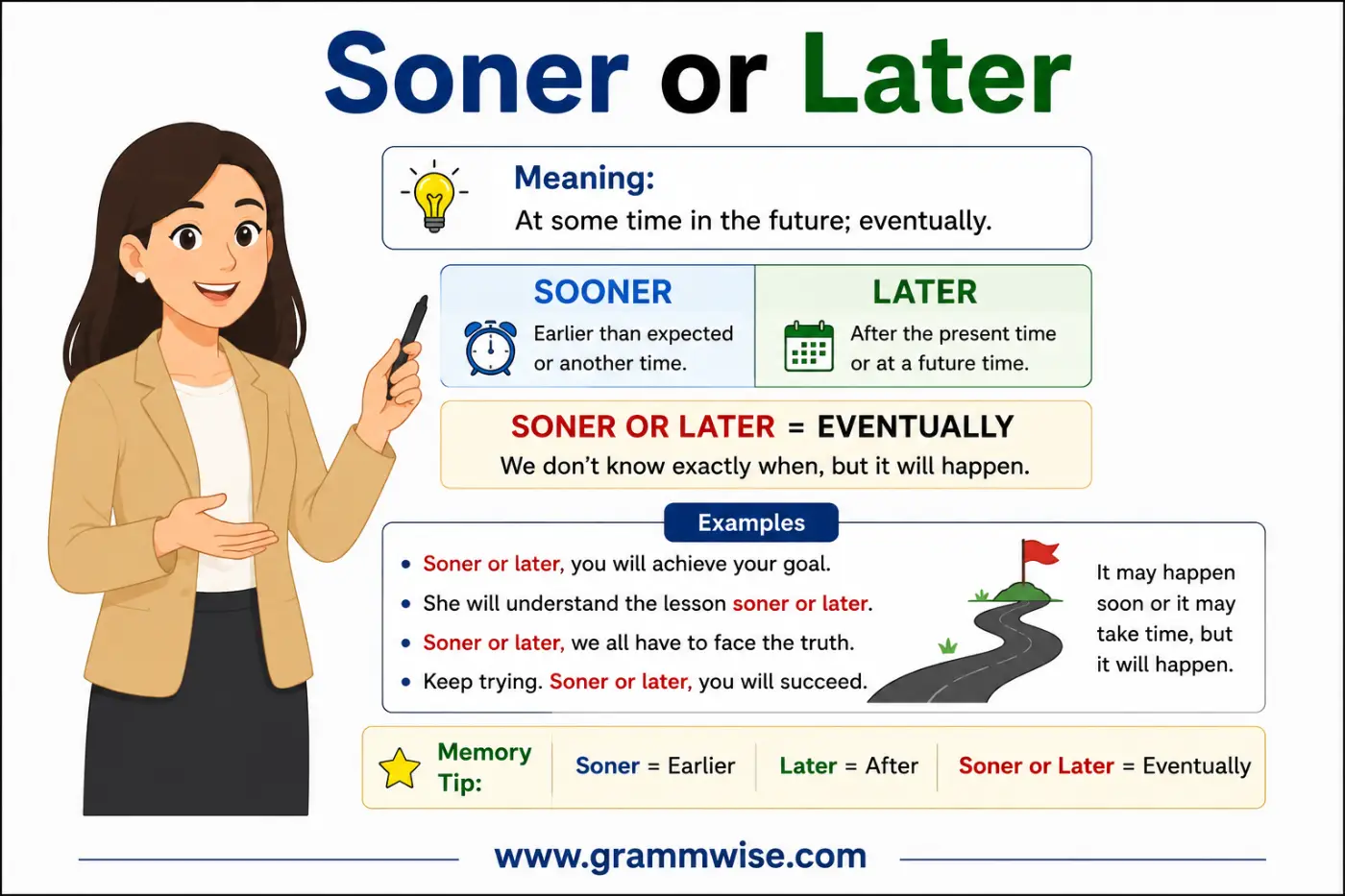
The phrase sooner vs later is a common English expression. It means that something will happen at some time in the future, even if we do not know exactly when. For example, if you keep practicing English, you will sooner or later become more confident.
The words sooner and later talk about time. Sooner means earlier than expected or earlier than another time. Later means after the present time or at a time farther in the future. When we put them together as sooner or later, the phrase means eventually.
You can use sooner vs later in everyday conversations, stories, advice, and writing. It often suggests that something is likely or certain to happen. The exact time does not matter. The main idea is that it will happen eventually.
Similar confusion happens in other word pairs such as smelled or smelt.
Simple Answer in One Look
Sooner or later means eventually or at some time in the future.
Example:
“Sooner or later, you will understand the lesson.”
This means:
“You will understand the lesson eventually.”

What Does Sooner vs Later Mean in Simple English?
Imagine your friend is learning how to ride a bicycle.
At first, your friend keeps falling.
You say:
“Don’t worry. Sooner or later, you’ll learn.”
You are saying that the person will learn at some point.
You do not know exactly when.
It could happen tomorrow.
It could happen next week.
Or it could happen next month.
The exact time is not important.
The important idea is:
It will happen eventually.
That is the basic meaning of sooner or later.
Sooner
Sooner relates to an earlier time.
For example:
“I finished sooner than I expected.”
This means I finished earlier than I expected.
Later
Later relates to a time after now or after another event.
For example:
“I will call you later.”
This means I will call you at some time in the future.
Sooner or Later
When we combine them, we get a common expression:
“Sooner or later, something will happen.”
The phrase does not tell us exactly when.
It simply says that the event will happen eventually.
Why Do People Use Sooner vs Later?
People use sooner or later when the exact time is unknown or not important.
For example:
“Sooner or later, everyone makes mistakes.”
The speaker is not saying when the mistake will happen. The point is that making mistakes is something people eventually experience.
Another example:
“Sooner or later, you have to make a decision.”
This means you may delay the decision now, but eventually you will need to make it.
The phrase can also sound like friendly advice.
For example:
“Keep practicing. Sooner or later, you will get better.”
It gives the listener hope.
Clear Meaning Explained Simply
Think of a timeline.
NOW → SOONER → LATER → FUTURE
But sooner or later does not choose one exact point.
It means:
At some point in the future.
You can think of it as:
Sooner or later = Eventually
For example:
“Sooner or later, the truth will come out.”
Means:
“Eventually, the truth will come out.”
Both sentences have almost the same meaning.
Is Sooner or Later an Idiom?
Yes.
Sooner or later is commonly treated as an idiomatic expression.
An idiom is a group of words that has a meaning people understand as a whole. The words sooner and later have their own meanings, but together they create the common idea of eventually.
You do not need to understand any complicated grammar rule to use it.
Just remember:
Sooner or later = eventually.
What Is the Difference Between Sooner vs Later?
The difference is about time.
Sooner
Sooner means earlier.
Example:
“Can you come sooner?”
This means:
“Can you come earlier?”
Another example:
“I wish I had arrived sooner.”
This means:
“I wish I had arrived earlier.”
Later
Later means after now or after another time.
Example:
“I’ll finish it later.”
This means:
“I’ll finish it at a future time.”
Another example:
“She arrived later than me.”
She arrived after me.
Sooner or Later
When the two words are joined with or, the meaning changes slightly.
Sooner or later means:
At some point.
Example:
“Sooner or later, you will need to replace your old phone.”
The speaker does not know when. Maybe soon. Maybe much later. But the replacement will eventually happen.
Which Form Should You Use Sooner vs Later?
The standard expression is:
sooner or later
Use the three words together.
Examples:
- Sooner or later, you will understand.
- She will find out sooner or later.
- Sooner or later, we all need help.
- He will have to apologize sooner or later.
- You’ll get used to it sooner or later.
Do not change the expression to:
soon or late
That is not the standard English expression.
Incorrect:
“Soon or late, he will understand.”
Correct:
“Sooner or later, he will understand.”
The comparative forms sooner and later are part of the fixed expression.
Sooner vs Later vs Eventually
These two expressions are very close in meaning.
Sooner or Later
“Sooner or later, you will find the right job.”
Eventually
“Eventually, you will find the right job.”
Both mean that the event will happen at some future point. There is a small difference in feeling.
Sooner or later often sounds more conversational and can suggest that something is unavoidable.
Eventually is more neutral.
Compare:
“Sooner or later, you’ll have to tell him.”
This sounds like telling him is unavoidable.
“Eventually, you’ll have to tell him.”
This sounds more neutral.
Both are correct.
Sooner vs Later vs Someday
These expressions are also similar.
Someday means at some unknown time in the future.
Example:
“Someday, I want to visit Japan.”
This expresses a future wish.
Sooner or later often suggests that something is expected or likely to happen.
Example:
“Sooner or later, you will need to make a choice.”
The second sentence sounds more certain.
So remember:
Someday = an unknown future time
Sooner or later = eventually, often with a sense that it will happen

Easy Real-Life Sentences on Sooner vs Later
Here are some simple examples.
Example 1
Sooner or later, you will need to make a decision.
You cannot avoid the decision forever.
Example 2
She will learn the truth sooner or later.
She will eventually learn it.
Example 3
Sooner or later, everyone needs help.
At some point, everyone may need help.
Example 4
Keep trying. Sooner or later, you will succeed.
Your success will eventually come.
Example 5
He will understand the problem sooner or later.
He may not understand now, but he will eventually understand.
Example 6
Sooner or later, winter will end.
Winter will eventually finish.
Example 7
You’ll get used to your new school sooner or later.
You will eventually become comfortable there.
Example 8
Sooner or later, we all have to grow up.
Growing up is unavoidable.
Where Should You Put Sooner or Later in a Sentence?
You can usually put sooner or later at the beginning or end of a sentence.
At the Beginning
Sooner or later, you will understand.
This is very common.
When the phrase comes at the beginning, a comma is normally used after it.
At the End
You will understand sooner or later.
This is also natural.
The meaning stays almost the same.
Compare:
Sooner or later, he will call.
He will call sooner or later.
Both mean that he will eventually call.
Can Sooner or Later Be Used in Questions?
Yes, but it is less common.
For example:
“Will you tell her sooner or later?”
This asks whether the person will eventually tell her.
You can also ask:
“When will you do it?”
But sooner or later is useful when the exact time is not the main concern.
Can Sooner or Later Be Used in Negative Sentences?
Yes.
For example:
“You can’t avoid the problem forever. Sooner or later, you have to deal with it.”
Here, the phrase emphasizes that something cannot be avoided forever.
Another example:
“Sooner or later, the truth cannot stay hidden.”
The speaker believes the truth will eventually become known.
Can Sooner or Later Be Used in Formal Writing?
Yes.
Sooner or later is a normal English expression and can appear in both casual and formal writing.
However, the tone is usually conversational.
In very formal writing, you might use:
- Eventually
- At some point
- In due course
- In time
For example:
Casual:
“Sooner or later, the company will need to change.”
More formal:
“Eventually, the company will need to change.”
Both are understandable.
Common Mistakes With Sooner vs Later
Mistake 1: Saying “Soon or Late”
This is one of the most common mistakes.
Incorrect:
“Soon or late, he will understand.”
Correct:
“Sooner or later, he will understand.”
Remember that the expression uses:
sooner + or + later
Mistake 2: Thinking It Means “Soon”
It does not.
Soon means in a short time.
Sooner or later means at some point, which could be much later.
For example:
“I’ll call you soon.”
This suggests a relatively short wait.
But:
“I’ll call you sooner or later.”
This does not promise a quick call. It only suggests that the call will eventually happen.
Mistake 3: Thinking It Means “Immediately”
It does not mean immediately.
Example:
“Sooner or later, we need to talk about this.”
This means the conversation needs to happen at some point.
It does not mean:
“We need to talk right now.”
Mistake 4: Confusing Sooner With Soon
Soon means in a short time.
Sooner means earlier in comparison with another time or expectation.
Example:
“Please come soon.”
The speaker wants you to come quickly.
Example:
“Please come sooner.”
The speaker wants you to come earlier than another expected time.
But in the expression:
sooner or later
the word sooner is part of the complete phrase.
A Simple Memory Trick
Here is an easy way to remember sooner or later.
Imagine a road. You are standing at the beginning. There are two possible points ahead:
SOONER → LATER
You do not know exactly where the event will happen. But you know it is somewhere in the future.
So remember:
Sooner or later = It will happen eventually.
Another simple trick is:
Sooner = earlier
Later = after
Together:
Sooner or later = at some future time
Is Sooner vs Later Positive or Negative?
It can be either.
The phrase itself is neutral.
The sentence gives it a positive or negative feeling.
Positive Example
“Sooner or later, you will achieve your goal.”
This sounds hopeful.
Negative Example
“Sooner or later, the problem will get worse.”
This sounds worrying.
Neutral Example
“Sooner or later, we need to replace this computer.”
This is simply a practical statement.
So do not think that sooner or later is always positive or always negative.
Sooner vs Later: Where Does the Expression Come From?
The exact history of the modern expression is not something you need to memorize to use it correctly.
The phrase is built from two ordinary time words:
sooner and later.
English speakers have long used these words to compare times.
The expression developed the simple idea that something may happen either earlier or later, but eventually it will happen.
Today, sooner or later is a well-established English expression.
It is common in speech, books, articles, movies, and everyday writing.
A Quick Classroom Test
Let’s check your understanding.
Question 1
Your friend has not learned how to swim yet.
You tell your friend:
“Keep practicing. ________, you’ll learn.”
The answer is:
Sooner or later
Question 2
Which sentence is correct?
A. Soon or late, she will understand.
B. Sooner or later, she will understand.
The correct answer is:
B. Sooner or later, she will understand.
Question 3
What does the sentence mean?
“He will find out sooner or later.”
It means:
He will eventually find out.
If you understand these three points, you already know the main rule.
How Sooner or Later Is Understood in Culture and Stories?
The expression sooner or later is common in stories, movies, songs, conversations, and everyday advice. People use it when they believe something will happen eventually.
A character in a story may say:
“Sooner or later, everyone learns from their mistakes.”
The character is not talking about one exact day. The message is that learning from mistakes is something that happens with time.
The phrase can also show patience.
For example:
“Keep working hard. Sooner or later, people will notice your effort.”
This sentence gives hope. It tells someone not to give up just because success has not come yet.
At other times, sooner or later can sound like a warning.
For example:
“Sooner or later, you have to face the problem.”
This means the person may avoid the problem for now, but they cannot avoid it forever. That is one reason the expression is so useful. It can carry different feelings depending on the sentence.
It can suggest:
- Hope
- Patience
- Confidence
- Warning
- Certainty
- Acceptance
The main idea stays the same:
Something will happen eventually.
Sooner or Later in Everyday Advice
Parents, teachers, coaches, and friends often use this phrase when giving advice.
A teacher might tell a student:
“Keep practicing. Sooner or later, the answer will become easier.”
A coach might say:
“Don’t give up. Sooner or later, your hard work will pay off.”
A parent might say:
“Sooner or later, you have to learn to do things on your own.”
In these examples, the phrase connects the present with the future.
The person may be struggling now.
But the speaker believes something will change with time.
Biblical and Mythological Meaning of Sooner vs Later
Sooner or later does not have a special biblical or mythological meaning. It is an ordinary English expression about time. However, the basic idea behind the phrase appears in many religious and traditional stories.
Many old stories teach that actions eventually have results.
A person may make a choice today and face its result later.
A person may work patiently for a long time and eventually see success.
These ideas are similar to the feeling behind sooner or later.
For example, the general lesson of a story might be:
“Sooner or later, actions have consequences.”
That is not a special religious definition of the phrase. It is simply a way of expressing a common life lesson. The expression itself should not be treated as a biblical phrase.
Symbolism Explained in Simple Words
What Sooner Represents
The word sooner represents an earlier time.
Think of two possible times:
Earlier → Later
If something happens sooner, it happens earlier than expected or earlier than another time.
Example:
“She arrived sooner than I expected.”
She arrived earlier than expected.
In sooner or later, however, sooner does not mean that the event will definitely happen soon.
That is a very important point.
What Later Represents
The word later represents a time farther ahead.
Example:
“I’ll finish my homework later.”
This means the work will be done at a future time.
In sooner or later, the word later gives the idea that the event may take more time.
So the expression covers a range:
Sooner → or → Later
The exact time is unknown.
What Sooner or Later Represents Together
Together, the phrase represents eventuality.
In simple words:
It will happen at some point.
For example:
“Sooner or later, you will need a new phone.”
The speaker does not know whether that will happen next month or next year. The important idea is that the change will eventually happen.
Related Words You Should Know
Knowing similar words can make the meaning of sooner or later even clearer.
Eventually
Means at some time in the future, after some time has passed.
Example:
“Eventually, she found the answer.”
Someday
Means at an unknown time in the future.
Example:
“Someday, I want to travel around the world.”
In Time
Means before it is too late or after enough time has passed.
Example:
“You will understand in time.”
At Some Point
Means at an unspecified time.
Example:
“We need to discuss this at some point.”
One Day
Means at an unknown future time.
Example:
“One day, I hope to become a writer.”
Before Long
Means soon or after a short amount of time.
Example:
“Before long, the children were asleep.”
In the Long Run
Means when we think about the future over a longer period.
Example:
“Saving money will help you in the long run.”
Eventually
This is one of the closest replacements for sooner or later.
Example:
“Eventually, he understood the lesson.”
At Last
Means finally, after waiting for some time.
Example:
“At last, the bus arrived.”
In Due Time
Means when the appropriate time comes.
Example:
“You will receive an answer in due time.”

How People Actually Use Sooner or Later in Daily English?
Here are natural examples you can use in real conversations.
Example 1: Learning English
“Keep practicing your English. Sooner or later, you will become more confident.”
The person will eventually improve.
Example 2: Making a Decision
“Sooner or later, we have to decide.”
The decision cannot be avoided forever.
Example 3: Learning From Mistakes
“Sooner or later, everyone makes a mistake.”
Making mistakes is a normal part of life.
Example 4: Finding the Truth
“She will find out the truth sooner or later.”
She will eventually discover the truth.
Example 5: Getting Used to Change
“You’ll get used to your new job sooner or later.”
The person will eventually become comfortable with the job.
Example 6: Saving Money
“Sooner or later, you’ll be glad you started saving.”
The speaker believes saving money will benefit the person in the future.
Example 7: A Difficult Problem
“We can’t ignore this problem forever. Sooner or later, we have to solve it.”
The problem must eventually be handled.
Example 8: Practice
“Keep trying. Sooner or later, you’ll get it right.”
The speaker encourages the person not to give up.
Example 9: Growing Up
“Sooner or later, children learn to become more independent.”
The change happens as they grow.
Example 10: Technology
“Sooner or later, we’ll need to replace this old computer.”
The computer will eventually need to be replaced.
Can Sooner or Later Be Used for the Past?
Usually, sooner or later is used when talking about an event that will happen or is expected to happen in the future. However, you can sometimes use related ideas when describing how something eventually happened in the past.
For example:
“Sooner or later, he realized that he was wrong.”
Here, the phrase is used in a story about the past. It means that after some time, he eventually realized his mistake.
So the expression can work in different time settings when the meaning of eventual change is clear.
Can You Use Sooner or Later With People?
Yes.
You can use it with people when talking about something they will eventually do, learn, understand, or experience.
Examples:
“You’ll understand sooner or later.”
“She’ll call sooner or later.”
“He’ll learn the lesson sooner or later.”
“Everyone needs help sooner or later.”
The expression works naturally with people.
Can You Use Sooner or Later With Things?
Yes.
You can also use it with objects, events, changes, and situations.
Examples:
- “Sooner or later, the old car will break down.”
- “Sooner or later, the weather will change.”
- “Sooner or later, the building will need repairs.”
The phrase works whenever you are talking about something expected to happen at an unknown future time.
Sooner or Later vs In the End
These expressions are sometimes confused.
In the end often focuses on the final result of a situation.
Example:
“In the end, we chose the blue car.”
This tells us what happened after considering different choices.
Sooner or later focuses on the fact that something will happen at some point.
Example:
“Sooner or later, we will need a new car.”
The first phrase looks at the final result.
The second looks toward an eventual future event.
Sooner or Later vs Sooner Than Later
You may sometimes hear:
“Sooner rather than later.”
This is different.
Sooner or Later
Means:
Eventually, at some unknown future time.
Example:
“Sooner or later, you will need to replace it.”
Sooner Rather Than Later
Means:
It is better to do something soon instead of waiting.
Example:
“You should see a doctor sooner rather than later.”
The second expression encourages action sooner.
So do not confuse them.
Sooner or later = eventually
Sooner rather than later = preferably soon
A Simple Memory Trick
Here is the easiest classroom trick.
Imagine a clock.
You do not know exactly when something will happen.
It could happen:
SOONER
or
LATER
But the important part is:
IT WILL HAPPEN.
So remember:
Sooner or Later = Eventually
If you can replace the phrase with eventually and the sentence still makes sense, you are probably using it correctly.
For example:
“Sooner or later, she will understand.”
Replace it:
“Eventually, she will understand.”
The meaning stays almost the same.
Final Teacher Explanation
Imagine I am writing on the classroom board:
SOONER OR LATER = EVENTUALLY
That is the main rule.
If something will happen at some unknown point in the future, you can use sooner or later.
For example:
“Sooner or later, you will learn this.”
You may not learn it today. You may not learn it tomorrow. But the speaker believes that you will learn it eventually.
Now remember the difference between the two words.
Sooner = earlier
Later = after
When they join together with or, they give us the useful expression:
Sooner or later = eventually.
Do not write soon or late.
Do not write sooner and later.
The correct expression is:
sooner or later
You can put it at the beginning:
“Sooner or later, you’ll understand.”
Or at the end:
“You’ll understand sooner or later.”
Both are correct.
Quick Recap
Sooner or later means eventually or at some time in the future.
It does not tell us exactly when something will happen. It simply says that something is expected to happen at some point.
Remember:
Sooner or later = Eventually.

Conclusion
Sooner or later means eventually. It tells us that something will happen at some point in the future, even though we do not know exactly when. The phrase is useful for giving advice, showing hope, or explaining that something cannot be avoided forever.
The easiest way to remember sooner vs later is to connect it with eventually. Remember that sooner means earlier, later means after, and together they create the common expression sooner or later. Use the complete phrase in your everyday English, and avoid incorrect forms such as “soon or late.”
Frequently Asked Questions
What does sooner or later mean?
Sooner or later means eventually or at some unknown time in the future.
Is sooner or later an idiom?
Yes. It is a common English expression with the meaning eventually.
What is the difference between sooner vs later?
Sooner means earlier, while later means at a time after now or farther in the future.
Can I use sooner or later at the beginning of a sentence?
Yes. For example: “Sooner or later, you will understand.”
Is sooner or later the same as eventually?
They have almost the same meaning. Sooner or later is often more conversational.
What is the difference between sooner vs later and sooner rather than later?
Sooner or later means eventually. Sooner rather than later means that something should happen fairly soon.
Is “soon or late” correct?
No. The standard expression is sooner or later.
Can sooner or later describe something positive?
Yes. It can describe positive, negative, or neutral events depending on the sentence.