
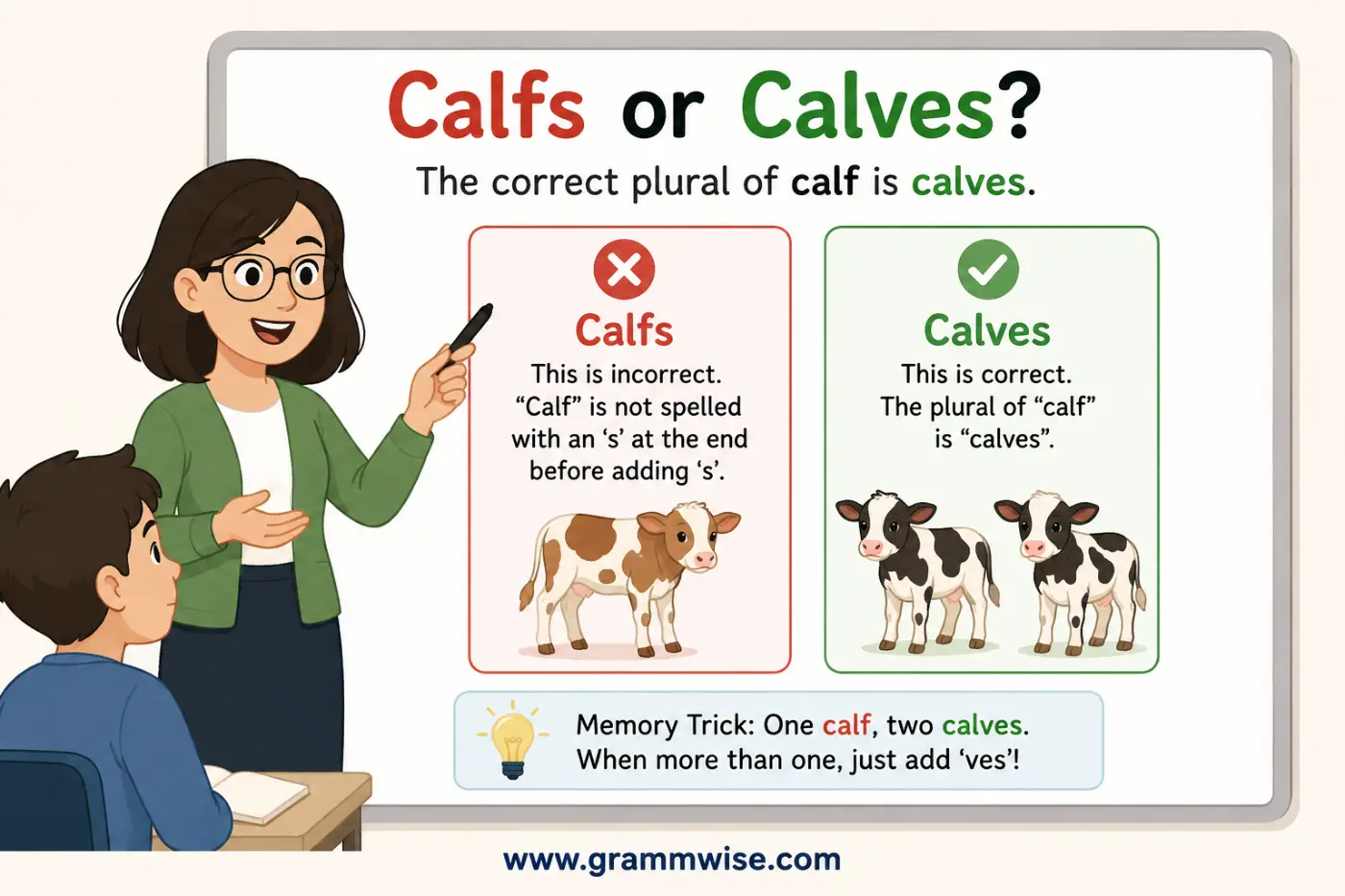
Many people wonder whether the correct plural is calfs or calves. The answer is simple: calves is the correct spelling. The word calfs is generally incorrect when you mean more than one calf. This small spelling change can confuse English learners because most English nouns simply add -s to become plural.
The word calf can have two common meanings. It can mean a young animal, such as a young cow, elephant, whale, or giraffe. It can also mean the back part of the lower leg. In both meanings, the plural is usually calves.
If you have ever searched for the difference between calfs and calves, this guide will make the answer easy. You will learn why the f changes to v, how to use calves in real-life sentences, and how to remember the spelling without guessing.
Many English learners mix up similar-looking words like Worse case or Worst case.
Simple Answer in One Look
Calves is the correct plural form of calf.
Calfs is generally incorrect.
Easy rule:
calf → calves
The f changes to v, and then we add -es.

Meaning of Calfs or Calves in Simple English
First, let’s understand the word calf.
A calf is a young animal.
For example:
The cow has a calf.
Here, calf means one young cow.
If there are two or more young cows, we say:
The cows have two calves.
The spelling changes:
calf → calves
The word can also describe a part of your body.
The calf is the soft, muscular area at the back of your lower leg.
For example:
My calf hurts after running.
If both legs hurt, you can say:
My calves hurt after running.
Again:
calf → calves
So the same plural form is used for both meanings.
Simple meaning
Calf = one young animal or one lower-leg muscle.
Calves = more than one calf or more than one lower-leg muscle.
Why People Mix These Words Calfs or Calves?
People often get confused because the normal English plural rule is easy:
book → books
car → cars
dog → dogs
chair → chairs
So learners may think:
calf → calfs
That seems logical.
But English has many older words that do not follow the simple add -s rule.
Calf is one of them.
Instead of adding only -s, the f changes to v.
Then we add -es.
So:
calf → calves
This type of spelling change has developed over the long history of English.
You do not need to memorize the history to use the word correctly.
Just remember the pattern.
Clear Difference Explained Simply
Look at this comparison.
| Word | Correct? | Meaning |
|---|---|---|
| Calf | ✅ Yes | One young animal or one lower-leg muscle |
| Calves | ✅ Yes | More than one calf |
| Calfs | ❌ Generally incorrect | Incorrect plural spelling |
One or more than one
One calf
Two calves
Three calves
Many calves
Never write:
❌ two calfs
Write:
✅ two calves
Calfs or Calves: Which Form Should You Use?
Use calf when you are talking about one.
The farmer saw a calf.
Use calves when you are talking about more than one.
The farmer saw three calves.
The same rule works when talking about your legs.
My left calf is sore.
Both of my calves are sore.
Quick rule
Remember:
One = calf
More than one = calves
This is true whether you are talking about animals or body parts.
Why Does the F Change to V?
This is the part that causes the most confusion.
The plural of calf is not made by simply adding -s.
Instead:
f → v
Then:
add -es
So:
calf → calves
You can think of it as a small spelling change that happens in some older English words.
Other words show a similar pattern.
For example:
leaf → leaves
knife → knives
wolf → wolves
life → lives
These words can help you see the pattern.
But remember that not every word ending in f changes to v.
For example:
roof → roofs
chief → chiefs
So it is better to learn common words one at a time.
For calf, the correct plural is always:
calves
Easy Real-Life Sentences on Calfs or Calves
Here are simple sentences with calf and calves.
The calf is sleeping beside its mother.
The farmer feeds the calves every morning.
We saw a small calf at the farm.
The cows and their calves were in the field.
The calf followed its mother.
The farmer checked all the calves.
Now look at the body-part meaning:
My calf hurts after the race.
Both calves feel tired after hiking.
She stretched her calves before running.
The exercise worked my calf muscles.
These examples show why context matters.
The same word can describe an animal or a part of the leg.
Calf as an Animal
A calf is a young animal.
The word is commonly used for young cows, but it can also be used for some other large mammals.
Young cow
The calf stayed close to its mother.
Young elephant
The elephant calf walked beside its mother.
Young whale
The whale and her calf swam together.
Young giraffe
The giraffe calf stood beside its mother.
So calf is not only used for cows.
The exact animal can be understood from the sentence.
Calf as a Body Part
The word calf has another very common meaning.
It is the back part of your lower leg.
For example:
My calf is sore after playing soccer.
If you talk about both legs:
My calves are sore after playing soccer.
Notice the spelling again.
One calf
Two calves
The plural does not become calfs.

Common Phrases With “Calf” or “Calves”
Here are some useful phrases.
- calf muscle
- calf muscles
- calf pain
- calf exercise
- calf stretch
- young calf
- newborn calf
- baby calf
- dairy calf
- elephant calf
- whale calf
- giraffe calf
- a herd of calves
Example sentences
She stretched her calf muscles before the race.
The farmer watched the young calves.
The elephant calf stayed close to its mother.
These phrases are natural in everyday English.
Synonyms and Related Words
There is no exact synonym for calf in every situation, but several related words can help.
Young animal
This is a general phrase for an animal that is not fully grown.
The farm has several young animals.
Baby cow
This is a simple phrase that means a young cow.
The baby cow followed its mother.
Offspring
This means an animal’s or person’s young.
The animal protected its offspring.
Young
This can describe a young animal in general.
The mother stayed close to her young.
Leg muscle
When calf means the body part, leg muscle is a simple way to explain it.
The calf is a muscle in the lower leg.
Opposites and Related Ideas
A calf is a young animal, so related words include:
- adult
- mature animal
- cow
- bull
- parent animal
For body parts, related words include:
- thigh
- ankle
- knee
- foot
- leg
For example:
The calf is between the knee and ankle.
Is “Calves” Formal?
Yes.
Calves is a standard English plural and can be used anywhere.
You can use it in:
- school writing
- exams
- books
- newspapers
- farming articles
- science writing
- everyday conversations
- medical or fitness discussions
For example:
The farmer raised several calves.
This sentence is completely natural.
You can also write:
The athlete stretched both calves.
That is also correct.
Is “Calfs” Ever Correct?
For standard English, you should use calves as the plural of calf.
The spelling calfs is generally treated as incorrect when referring to more than one calf.
You may occasionally see it online because people make spelling mistakes.
Seeing a word online does not always mean the spelling is correct.
If you are writing an essay, homework, article, email, or exam answer, choose:
✅ calves
Avoid:
❌ calfs
Word Family
Learning related forms can make the word easier to remember.
| Word | Meaning |
|---|---|
| calf | One young animal or one lower-leg muscle |
| calves | More than one calf |
| calf’s | Something belonging to one calf |
| calves’ | Something belonging to several calves |
Examples
The calf’s mother is nearby.
The apostrophe shows that something belongs to one calf.
The calves’ food was ready.
The apostrophe after calves shows that something belongs to several calves.
This is a useful spelling pattern to notice.
Calfs or Calves: Where This Word Comes From?
The word calf is very old.
English has used forms of this word for many centuries. Its plural form developed from older forms of English, which is one reason the plural does not simply add -s.
Over time, the spelling became:
calf → calves
English has several old plural patterns like this.
That is why some words do not follow the simple rule of adding -s.
You do not need to know the history to use the word correctly.
The easiest thing to remember is:
calf → calves
A Quick Look at Similar Words
The calf → calves pattern is easier to remember when you compare it with other familiar words.
| Singular | Plural |
|---|---|
| calf | calves |
| leaf | leaves |
| knife | knives |
| wolf | wolves |
| life | lives |
| wife | wives |
These words change f to v in their common plural forms.
But be careful.
Some words simply add -s:
| Singular | Plural |
|---|---|
| roof | roofs |
| chief | chiefs |
| belief | beliefs |
| chef | chefs |
This is why you should not use one spelling rule for every word ending in f.
Quick Comparison Table
| Question | Answer |
|---|---|
| Which spelling is correct? | Calves |
| Is calfs correct? | No, generally not |
| What is the singular? | Calf |
| What is the plural? | Calves |
| Can calf mean a young cow? | Yes |
| Can calf mean a part of the leg? | Yes |
| What happens to the F? | It changes to V |
| Do we add ES? | Yes |
| Correct pattern | calf → calves |
Easy Memory Trick
Here is the easiest trick to remember.
Imagine a little calf standing beside a big letter V.
The calf says:
“When I become many, my F becomes V!”
So:
CALF → CALVES
You can also remember a short sentence:
One calf, two calves.
Say it out loud a few times.
One calf.
Two calves.
The change will start to feel natural.
Another useful memory line is:
F becomes V, then add ES.
For this word:
calf → calv + es → calves
That is all you need to remember.
Calfs or Calves: How This Word Is Understood in Culture and Stories?
The word calf has been used in stories, farming, nature writing, and everyday speech for a very long time. When people hear calf, they often picture a young animal standing close to its mother.
A young calf can represent something small, young, and still growing. This is why stories about farms often show a calf learning to walk, following its mother, or exploring a field.
The plural calves simply means more than one calf.
For example:
The farmer watched the calves playing in the field.
The word can also appear in wildlife stories.
We can talk about:
- elephant calves
- whale calves
- giraffe calves
- buffalo calves
- deer calves
The exact animal changes, but the basic idea is the same: a calf is a young animal of certain species.
The other meaning of calf is the lower-leg muscle. This meaning is common in sports stories, fitness articles, and everyday conversations.
For example:
The runner stretched her calves before the race.
So, when you see calf or calves, always look at the sentence. The context tells you whether the writer means an animal or a part of the body.
Biblical and Mythological Meaning of Calfs or Calves
The word calf has a special place in some religious stories.
One well-known biblical story involves the golden calf. In that story, a golden image of a calf becomes an object of worship. The story is usually understood as a warning about worshiping an idol instead of God.
This gives the image of a calf a symbolic meaning in that particular story.
However, this does not change the everyday meaning or spelling of the word.
In normal English:
one calf → two calves
The word calves is simply the plural form.
Mythology
Calves also appear in the stories and traditions of different cultures because cattle and other animals have been important to people for thousands of years.
Animals may represent ideas such as:
- strength
- growth
- life
- fertility
- farming
- family
The exact meaning depends on the culture and story.
For everyday English, though, you do not need to know these cultural meanings to use calf and calves correctly.
Symbolism Explained in Simple Words
What One Calf Represents
A single calf can represent:
- youth
- growth
- innocence
- new life
- dependence on a parent
A young calf is still growing and needs care from its mother.
That is why stories may use a calf to show something young or inexperienced.
For example:
The little calf stayed close to its mother.
This sentence gives us a simple picture of safety and care.
What Calves Represent
When there are several calves, the image can suggest:
- new life
- a growing herd
- family
- community
- farming
- abundance
For example:
The calves ran across the green field.
The plural form creates a picture of several young animals moving together.
Again, these are cultural or story ideas. The normal dictionary meaning remains simple.
Calf = one.
Calves = more than one.

How People Actually Use Calfs or Calves in Daily English?
The word calf is used in two very different situations: animals and the human body.
Here are natural examples.
Talking about animals
The calf is drinking milk.
The farmer has five calves.
The calves are following their mother.
We saw two calves on the farm.
The cow stayed close to her calf.
Talking about body parts
My calf hurts after running.
Both calves are tired after the hike.
She stretched her calves before exercising.
The soccer player injured his calf.
These exercises strengthen your calf muscles.
Notice the important spelling:
one calf
but:
two calves
The spelling stays the same no matter which meaning you use.
More Everyday Examples
Here are some simple sentences you can use.
The farmer feeds the calves every morning.
The calf is standing beside the cow.
The elephant calf stayed with its mother.
We watched the whale and her calf from the boat.
My left calf feels sore today.
Both of my calves hurt after the long walk.
The runner stretched his calves before the race.
The calves were sleeping in the barn.
These sentences show how naturally the word appears in everyday English.
Common Mistakes People Make
Mistake 1: Writing “calfs”
This is the most common mistake.
❌ The farmer has three calfs.
✅ The farmer has three calves.
Remember:
calf → calves
Mistake 2: Using “calves” for one
❌ I saw one calves.
✅ I saw one calf.
Use calf for one.
Use calves for two or more.
Mistake 3: Writing “calvs”
Some people remember that the f changes to v but forget the e.
❌ calvs
✅ calves
The complete spelling is:
C-A-L-V-E-S
Mistake 4: Thinking the plural is “calve”
The word calve can exist as a verb, but it is not the plural of calf.
For example:
The cow will calve soon.
Here, calve is a verb meaning to give birth to a calf.
But:
The cow has two calves.
Here, calves is the plural noun.
Mistake 5: Confusing calf and calves when talking about legs
For one leg:
My calf hurts.
For both legs:
My calves hurt.
This small difference is easy to remember.
Calf vs. Calves vs. Calve
These three words look similar, but they do different jobs.
| Word | Meaning | Example |
|---|---|---|
| calf | One young animal or one leg muscle | The calf is sleeping. |
| calves | More than one calf | The calves are sleeping. |
| calve | To give birth to a calf | The cow may calve soon. |
This is a useful distinction for English learners.
Remember
Calf = one
Calves = more than one
Calve = a verb related to giving birth
Why Does “F” Change to “V”?
The spelling calves may look strange because the word changes from f to v.
This comes from older patterns in English.
English has kept several older plural forms.
For example:
leaf → leaves
knife → knives
wolf → wolves
life → lives
wife → wives
calf → calves
But English is not perfectly consistent.
For example:
roof → roofs
chef → chefs
chief → chiefs
So you should not assume that every word ending in f changes to v.
For calf, simply remember the correct pair:
calf → calves
Practice Test
Choose the correct answer for each sentence.
1. The farmer has three _____.
A. calfs
B. calves
Answer: B. calves
2. The _____ is standing beside its mother.
A. calf
B. calves
Answer: A. calf
3. My _____ hurts after running.
A. calf
B. calves
Answer: A. calf
4. Both of my _____ are sore.
A. calf
B. calves
Answer: B. calves
5. Which spelling is correct?
A. calfs
B. calves
C. calvs
Answer: B. calves
6. Which sentence is correct?
A. We saw two calfs.
B. We saw two calves.
Answer: B. We saw two calves.
7. What is the plural of “calf”?
A. calfs
B. calves
C. calvez
Answer: B. calves
If you got all seven correct, you have mastered the basic spelling rule.
Final Teacher Explanation
Imagine we are back in the classroom.
A student writes on the board:
One calf → two calfs
I would stop and say:
“Almost! There is one small spelling change.”
The correct form is:
One calf → two calves
The f changes to v, and we add -es.
So remember:
CALF → CALVES
The same rule works for both meanings.
If you are talking about animals:
The farmer has four calves.
If you are talking about legs:
My calves hurt after running.
The word calfs should not be used as the normal plural spelling.
You may also remember the pattern by comparing it with words such as:
leaf → leaves
knife → knives
wolf → wolves
But do not assume every word ending in f works this way. English has exceptions.
For this word, there is no need to guess.
Just remember:
One calf. Two calves.
Quick Recap
The correct plural of calf is calves, not calfs. Use calf for one and calves for two or more, whether you are talking about young animals or lower-leg muscles.
The easiest memory trick is: calf → calves. The f changes to v, and -es is added.

Conclusion
When choosing between calfs or calves, always use calves as the standard plural of calf. Calf means one young animal or one lower-leg muscle, while calves means more than one. The spelling changes from f to v, followed by -es.
The easiest way to remember it is simple: one calf, two calves. Practice this pair in real sentences, and you will quickly stop confusing calves with the incorrect spelling calfs.
Frequently Asked Questions
Is it “calfs” or “calves”?
Calves is the correct plural of calf. Calfs is generally incorrect.
What is the plural of calf?
The plural of calf is calves.
Why does calf become calves?
The f changes to v, and -es is added: calf → calves.
Can calf refer to a body part?
Yes. A calf is also the back part of the lower leg.
Is “calves” used for both animals and legs?
Yes. You can say three calves for young animals and both calves for the muscles in your legs.
Is “calve” the plural of calf?
No. Calve is a verb. Calves is the plural noun.
How do I remember the spelling of calves?
Remember: One calf, two calves. The f changes to v.
Are all words ending in “f” changed to “v” in the plural?
No. Some words use -s, such as roofs and chiefs. You need to learn the common patterns for each word.