
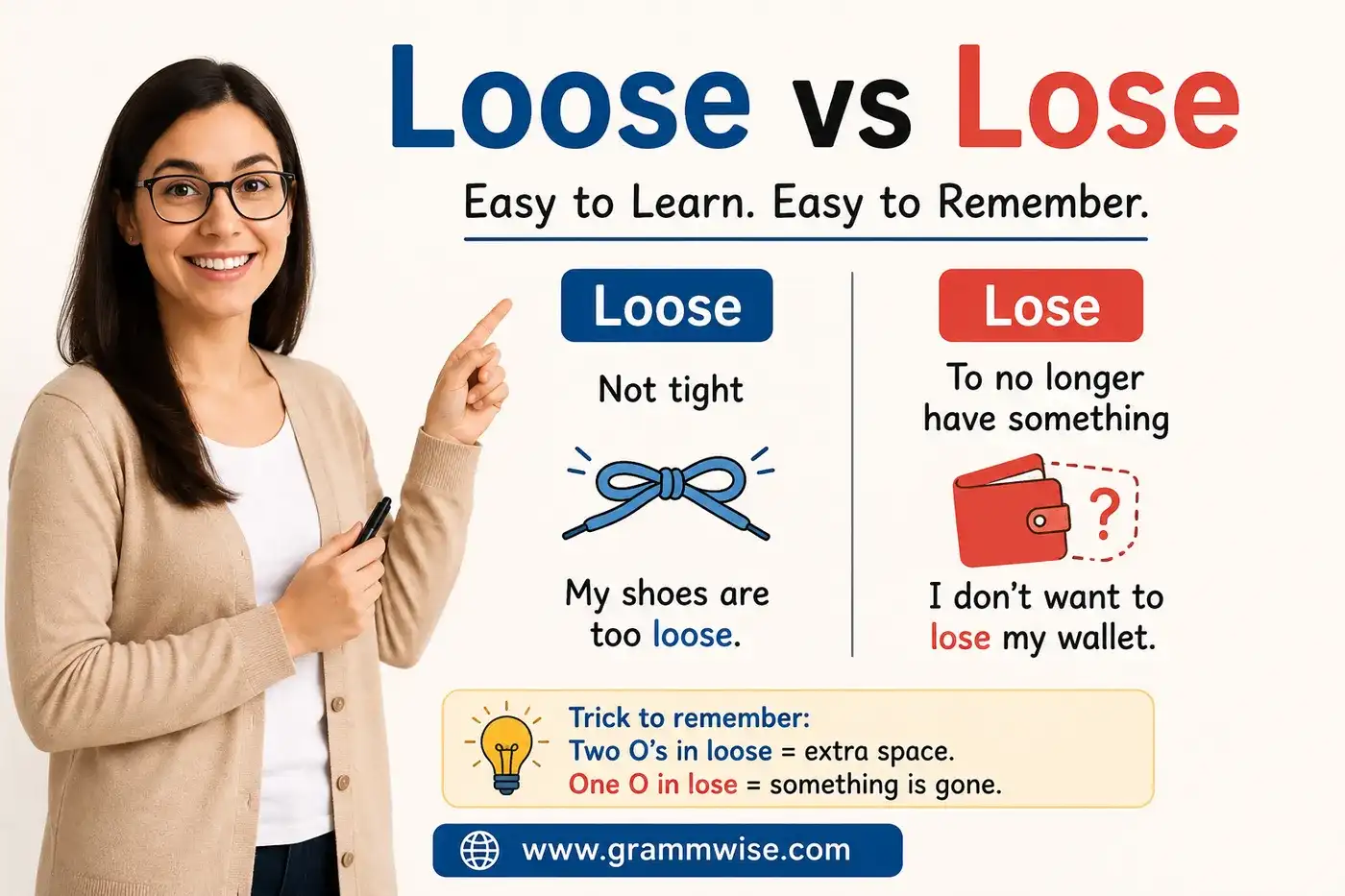
Many English learners confuse Loose vs Lose because the two words look almost the same. They have similar spelling, but they do not have the same meaning. Using the wrong one can completely change your sentence.
The good news is that learning the difference between Loose vs Lose is much easier than most people think. Once you know what each word means and remember one simple trick, you will rarely make this mistake again.
In this guide, I will explain everything in very simple English. You will learn the meanings, pronunciation, examples, common mistakes, and an easy memory trick that you can use every day.
English has many word pairs with subtle differences in meaning and usage.
Simple Answer in One Look Loose vs Lose
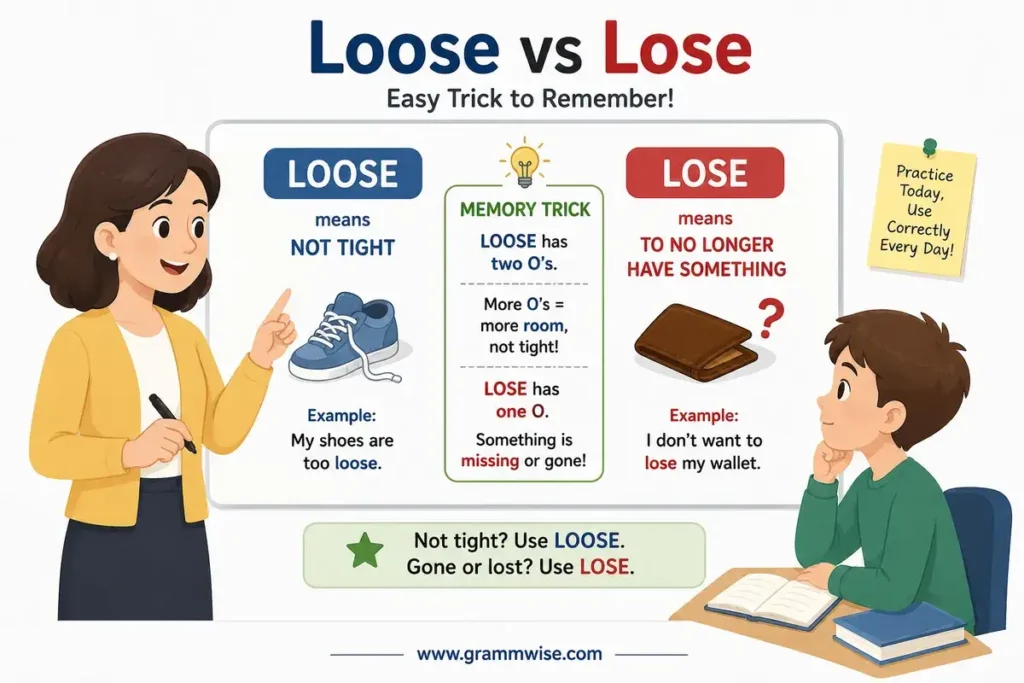
- Loose = not tight
- Lose = to no longer have something
Example:
- My shoes are loose.
- I don’t want to lose my keys.
That is the biggest difference between Loose vs Lose.
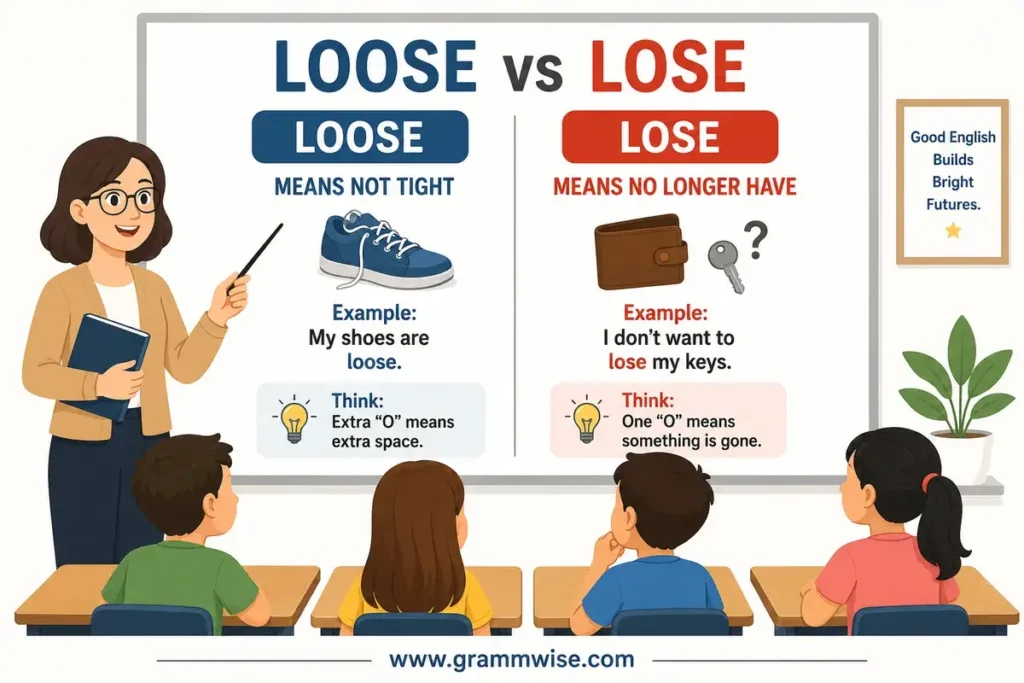
Meaning of Loose vs Lose in Simple English
Imagine you are getting ready for school.
Your backpack strap feels too big. It hangs down because it is not tight. That means it is loose.
Now imagine you leave your backpack on the bus and cannot find it anymore. You lose your backpack.
See the difference?
- Loose talks about how something fits.
- Lose talks about not having something anymore.
Here is another easy way to think about it.
If something can be tightened, it may be loose.
If something disappears or is gone, you lose it.
These two words have different jobs in English, even though they look very similar.
Why People Mix These Words Loose vs Lose
Many people write loose when they mean lose, and they write lose when they mean loose.
There are three simple reasons.
They look almost the same.
The only spelling difference is one extra o.
- lose
- loose
That tiny change makes a big difference.
They sound similar. Loose vs Lose
Some learners hear the words quickly in conversation and think they are pronounced the same.
They are not.
- Loose has a long s sound.
- Lose ends with a z sound.
Fast typing causes mistakes.
When people type quickly, they often add an extra o without noticing.
That is why you may see mistakes like:
❌ I don’t want to loose my phone.
The correct sentence is:
✅ I don’t want to lose my phone.
Clear Difference of Loose vs Lose Explained Simply
Here is the easiest way to compare Loose vs Lose.
| Loose | Lose |
|---|---|
| Not tight | No longer have something |
| Describes something | Shows an action |
| Can describe clothes, screws, ropes, shoes | Can describe keys, games, money, time, friends |
| Think “too big” | Think “gone” |
Think about shoes.
If your shoes move around your feet, they are loose.
If you leave your shoes somewhere and cannot find them, you lose your shoes.
Think about a game.
Your shirt may be loose.
But you can lose a soccer game.
Think about money.
Money cannot be loose unless you mean loose coins.
But you can lose money if you spend it or someone steals it.
Loose vs Lose: Which Form Should You Use?
Ask yourself one simple question.
Is it talking about something that is not tight?
If yes, use loose.
Examples:
- My belt is loose.
- This screw is loose.
- His shirt feels loose.
- The dog’s collar is loose.
Is it talking about something disappearing or not winning?
If yes, use lose.
Examples:
- Don’t lose your wallet.
- We might lose the game.
- She doesn’t want to lose her job.
- I always lose my sunglasses.
This simple question helps almost every time.
Easy Real-Life Sentences on Loose vs Lose You Can Use
Here are everyday examples.
With Loose
- My pants are too loose.
- This button is loose.
- The rope became loose.
- Your shoelaces are loose.
- His watch feels loose today.
- My tooth feels loose.
- The dog has a loose collar.
With Lose
- Please don’t lose your phone.
- I never want to lose my best friend.
- We may lose the match.
- She doesn’t want to lose her keys.
- Don’t lose hope.
- I always lose my pen.
- They could lose a lot of money.
Loose vs Lose: Origin of This Word
The words loose and lose have been part of English for hundreds of years.
Loose came from an old word that meant “free” or “not tied.”
Lose came from another old word that meant “to be destroyed” or “to no longer have something.”
Over time, both words kept different meanings even though their spelling became very similar. That is why English learners still confuse them today.
Common Mistakes People Make About Loose vs Lose
Here are mistakes you may see online.
Wrong
I don’t want to loose my wallet.
Correct
I don’t want to lose my wallet.
Wrong
My shoes are lose.
Correct
My shoes are loose.
Wrong
We might loose the game.
Correct
We might lose the game.
Wrong
Your shirt is lose.
Correct
Your shirt is loose.
Reading these examples helps your brain notice the difference faster.
Easy Memory Trick
This trick works for many students.
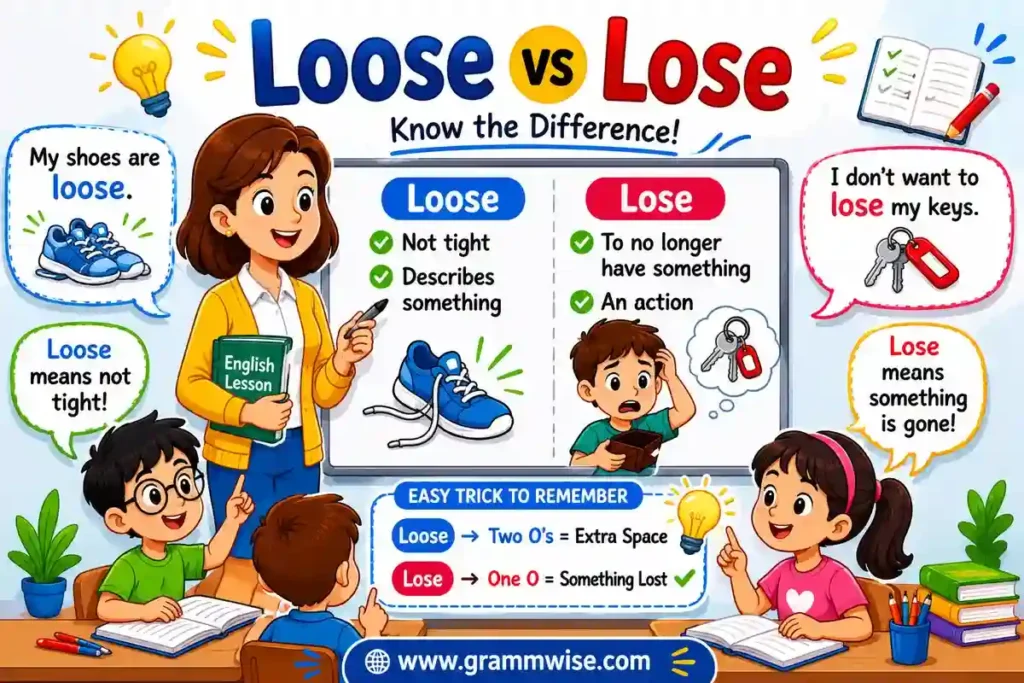
Loose has two O’s.
Those two O’s look big and wide.
Something that is loose is also wide or not tight.
Lose has only one O.
When you lose something, one thing is missing.
So remember:
- Two O’s = loose = extra space
- One O = lose = something is gone
Many learners remember the words this way for years.
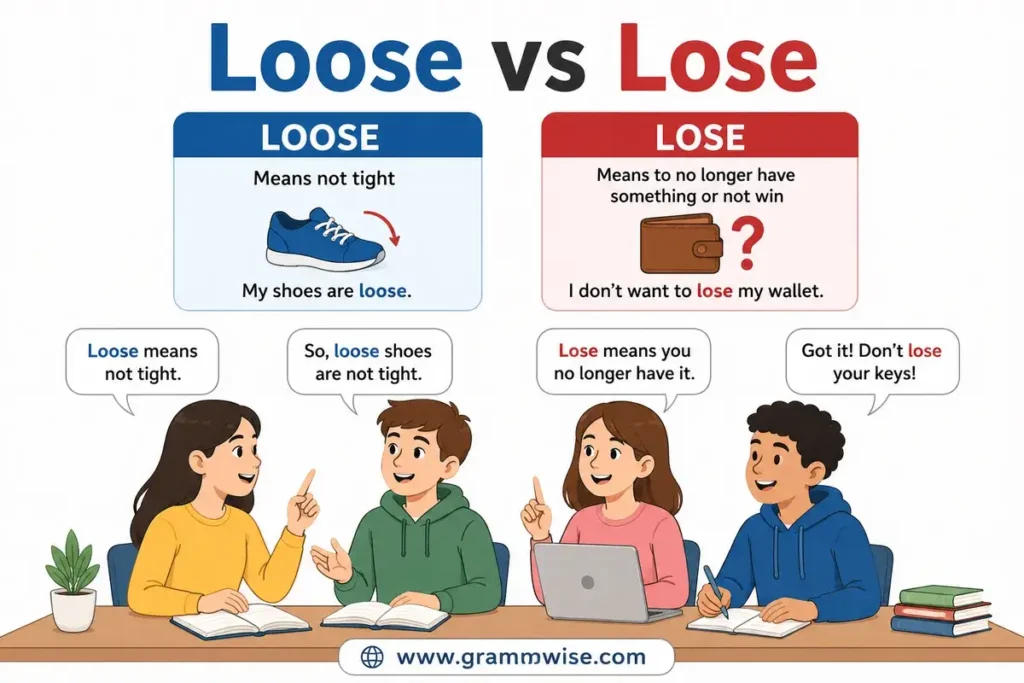
Quick Pronunciation Tip About Loose vs Lose
These words are not pronounced the same.
Loose
Sounds like “looss.”
The last sound is S.
Lose
Sounds like “looz.”
The last sound is Z.
Try saying them slowly.
- loose
- lose
- loose
- lose
Soon your ears will hear the difference.
Mini Quiz Loose vs Lose
Choose the correct word.
- My jacket is too _____.
- Don’t _____ your passport.
- The wheel is _____.
- We don’t want to _____ the game.
- My shoelaces are _____.
Answers
- loose
- lose
- loose
- lose
- loose
Quick Review
Remember these simple ideas.
- Loose means not tight.
- Lose means no longer have something.
- Clothes can be loose.
- Games can be lost.
- Belts become loose.
- Keys can be lost.
Once you remember this rule, choosing between Loose vs Lose becomes much easier.
Loose vs Lose: How This Word Is Understood in Culture and Stories
The difference between Loose vs Lose is not only about grammar. These words also appear in everyday life, books, movies, songs, and stories.
The word lose often talks about something valuable. A person may lose a game, lose money, lose a friend, or lose hope. Because of this, the word usually carries feelings. Sometimes those feelings are sadness, disappointment, or even fear.
For example:
- A team loses the championship after a close game.
- A child loses a favorite toy.
- A traveler loses a map.
- Someone loses confidence before giving a speech.
In stories, losing something often teaches an important lesson. A character may lose something at the beginning of the story but become wiser by the end. They may lose a race but learn never to give up. They may lose money but discover that family is more important.
The word loose has a very different feeling.
It usually describes something that is free, open, or not held tightly.
For example:
- A loose rope.
- A loose tooth.
- A loose button.
- Loose clothing on a hot day.
Sometimes people even like things to be loose because they are more comfortable. Loose clothes can help people stay cool in warm weather. A loose blanket can feel soft and cozy.
So although these words look alike, they create very different pictures in our minds.
- Lose often talks about something being gone.
- Loose usually talks about something not being tight.
Understanding these different ideas makes it easier to remember which word you need.
Biblical and Mythological Meaning of Loose vs Lose
The words lose and loose both appear in some English Bible translations, but they do not mean the same thing.
The word lose is often used when someone gives something up or no longer has it.
For example, a person may lose wealth, lose their way, or lose something valuable. In many Bible stories, people are reminded that money and possessions are less important than kindness, faith, and love.
The word loose is often used with the meaning of set free or untie.
For example, chains may be loosed, animals may be loosed, or someone may be set loose from something that held them.
This is an older style of English, so you may not hear it often in everyday conversation today.
In mythology and old stories, heroes sometimes lose battles, treasures, or magical objects before finding them again. At other times, someone may loose an arrow or loose an animal. In old English, loose could also be used as a verb meaning “release,” but this use is much less common today.
Today, most English learners only need to remember these meanings:
- Lose = no longer have.
- Loose = not tight.
Symbolism of Loose vs Lose Explained in Simple Words
What Loose Represents?
The word loose often makes people think about freedom, comfort, and space. Something loose is not being squeezed or held tightly.
Examples include:
- Loose clothing feels comfortable.
- Loose hair moves in the wind.
- A loose rope hangs freely.
- A loose knot is easy to untie.
Sometimes “loose” can also suggest carelessness.
For example:
- A loose screw can cause problems.
- Loose rules may create confusion.
So the meaning depends on the situation.
What Lose Represents?
The word lose often represents change. When people lose something, they may also learn something.
Examples include:
- Losing a game teaches teamwork.
- Losing money teaches careful spending.
- Losing your way teaches better planning.
- Losing fear can help you become brave.
Even though losing often sounds negative, many stories show that people grow stronger after they lose something.
This is why the word appears so often in books, movies, and speeches.
Related Words to Loose vs Lose You Should Know
Learning a few related words will make Loose vs Lose even easier to understand.
Tight
The opposite of loose.
Example: Tight shoes hurt my feet.
Fit
Describes whether clothes are the right size.
Example: This jacket fits perfectly.
Missing
Something cannot be found.
Example: My keys are missing.
Drop
To let something fall.
Example: I dropped my phone.
You may drop something before you lose it.
Win
The opposite of lose in games and competitions.
Example: Our team hopes to win tonight.
Find
The opposite of losing something.
Example: I found my wallet under the chair.
Secure
Means safely fixed or protected.
Example: Make sure the lid is secure.
Fasten
Means to close or tighten something.
Example: Fasten your seat belt.
Untie
Means to open a knot.
Example: Untie the rope before moving it.
Relaxed
Sometimes describes clothing that is loose and comfortable.
Example: I like relaxed-fit jeans.
Use of Loose vs Lose in Daily English
Here are examples you will hear every day.
- Don’t lose your homework.
- I always lose my TV remote.
- We may lose if we don’t practice.
- My backpack straps are loose.
- These socks are too loose.
- The dog has a loose collar.
- I don’t want to lose my job.
- Check the loose screw before using the chair.
- You’ll lose your chance if you wait too long.
- My favorite sweater became loose after washing.
Notice that lose usually talks about actions, while loose usually describes things.
That simple idea helps in almost every sentence.
Common Mistakes People Make About Loose vs Lose
Here are the mistakes English learners make most often.
Mistake 1: Adding an extra “o”
❌ I don’t want to loose my phone.
✅ I don’t want to lose my phone.
Remember:
If something disappears, use lose.
Mistake 2: Forgetting the second “o”
❌ My shoes are lose.
✅ My shoes are loose.
If something is not tight, use loose.
Mistake 3: Thinking the words sound exactly the same Loose vs Lose
They are close, but not identical.
- Loose ends with an S sound.
- Lose ends with a Z sound.
Listening carefully will help you hear the difference.
Mistake 4: Using one rule for every sentence
Instead of memorizing spelling alone, ask yourself:
Am I talking about something that is not tight?
Use loose.
Am I talking about something being gone?
Use lose.
This simple question solves most problems.
Mistake 5: Forgetting to check your writing
Many people know the correct word but type the wrong one because they are writing quickly.
Before sending an email, homework, or social media post, read your sentence one more time.
That small habit can remove many spelling mistakes.
Final Teacher Explanation
Imagine I am standing in front of a classroom.
I write two words on the board.
Loose
Lose
Then I ask one question.
“Is something too big or not tight?”
If the answer is yes, we choose loose.
Next I ask another question.
“Did something disappear or was it no longer yours?”
If the answer is yes, we choose lose.
That is the whole lesson.
You do not need difficult grammar rules. You only need to remember two simple ideas.
- Loose means not tight.
- Lose means no longer have something.
Whenever you are unsure, picture a loose shoe and a lost wallet. Those two pictures are easy to remember. With a little practice, you will stop confusing these words.
Final Thought Loose vs Lose
The difference between Loose vs Lose is simple.
Loose means not tight.
Lose means to no longer have something or not win.
Remember this easy trick:
Two O’s in “loose” leave extra space. One O in “lose” means something is missing.
Conclusion
Understanding Loose vs Lose is easier once you remember one simple rule. Loose means not tight, while lose means to no longer have something or to fail to win. Keep this difference in mind, and you’ll avoid one of the most common English spelling mistakes.
The best way to remember these words is through daily practice. Read real examples, say the words aloud, and check your writing before you send it. With a little practice, choosing the correct word will soon become natural and automatic.
Frequently Asked Questions (FAQs)
What does loose mean in simple words?
Loose means something is not tight. It has extra space or moves easily.
What does lose mean?
Lose means you no longer have something or you do not win.
Is it “lose weight” or “loose weight”?
The correct phrase is lose weight because the weight is going away.
Is it “loose change” or “lose change”?
The correct phrase is loose change because the coins are not kept together.
Why do people confuse Loose vs Lose?
They look almost the same, but they have different meanings and different pronunciations.
Can I use loose as a verb?
In modern everyday English, it is rare. Most of the time, loose is used as an adjective meaning “not tight.”
Which word should I use when talking about a game?
Use lose.
Example: Our team may lose the game.
How can I remember the difference of Loose vs Lose forever?
Think of this easy rule:
- Loose has two O’s, just like something has extra room.
- Lose has one O, because something is gone.
This simple memory trick helps many English learners choose the correct word every time.