
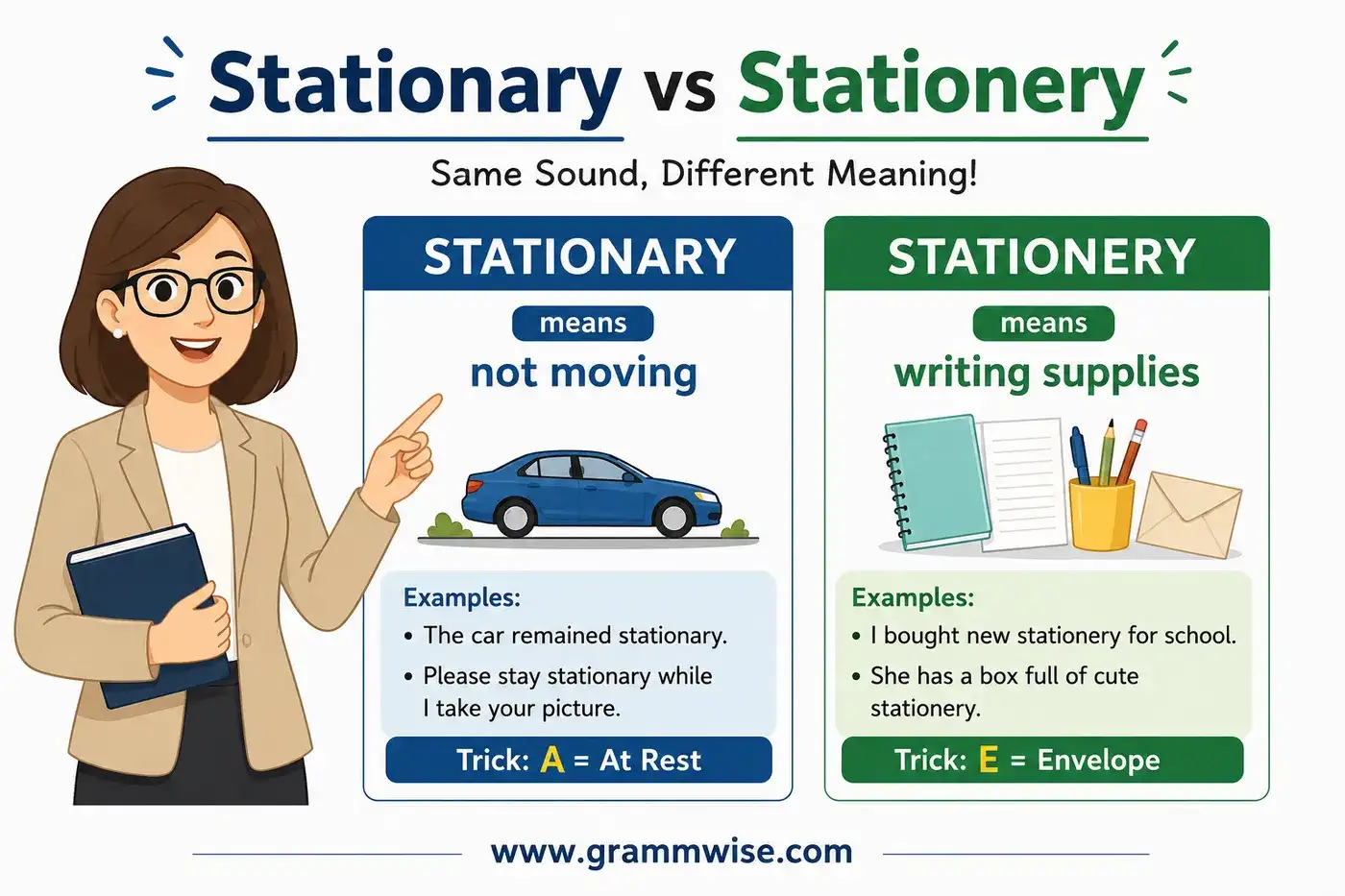
Many English learners get confused about Stationary vs Stationery because the two words look almost the same. They sound exactly alike, but they have very different meanings. One word talks about not moving, while the other word means writing supplies like paper, pens, and notebooks.
If you have ever wondered which spelling is correct, you are not alone. This is one of the most common spelling mistakes in English. The good news is that it is easy to learn once you know a simple trick.
In this guide, I will explain Stationary vs Stationery in very simple English. You will learn what each word means, why people mix them up, and how to use the correct spelling every time.
If homophones confuse you, explore more examples in our grammar guides.
Stationary vs Stationery: Simple Answer in One Look
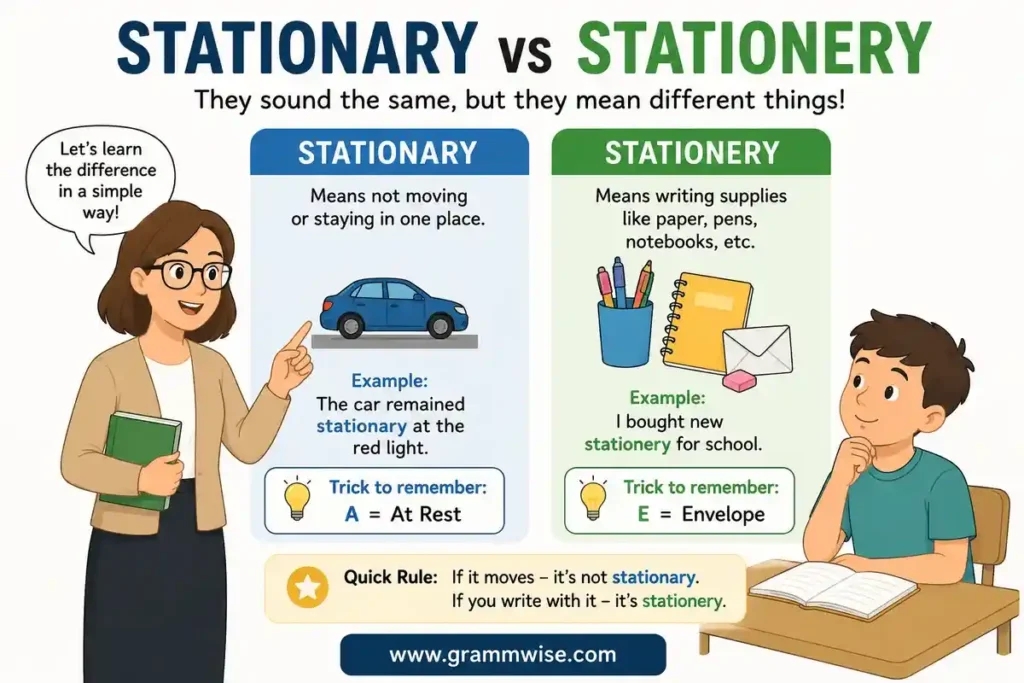
- Stationary means not moving or staying in one place.
- Stationery means paper, envelopes, pens, notebooks, and other writing supplies.
Easy rule:
- The “a” in stationary reminds you of at rest.
- The “e” in stationery reminds you of envelope.
Meaning of Stationary vs Stationery in Simple English
These two words sound exactly the same. Words like this are called homophones. They have the same pronunciation but different spellings and meanings.
Think of them like two twins with different jobs.
What does “stationary” mean?
Stationary means something does not move. It stays where it is. You can use this word for people, cars, trains, animals, or objects that are not changing their place.
For example:
- The bus stayed stationary during the storm.
- The bike remained stationary in the garage.
- Everyone stood stationary while the picture was taken.
In all of these examples, nothing is moving.
What does “stationery” mean?
Stationery means the things you use for writing.
This includes:
- paper
- pens
- pencils
- notebooks
- envelopes
- sticky notes
- greeting cards
- writing pads
- folders
For example:
- I bought new stationery for school.
- She loves colorful stationery.
- The office ordered more stationery last week.
Here, the word is talking about writing materials, not movement.
Why People Mix These Words Stationary vs Stationery?
Many people spell these words the wrong way.
There are three simple reasons.
1. They sound exactly the same “Stationary vs Stationery”
When you hear someone say the word, you cannot tell which spelling they mean.
For example:
“I need some stationery.”
“I need some stationary.”
Both sound the same when spoken. Only the spelling tells you the meaning.
2. Only one letter is different.
Look closely.
Stationary
Stationery
Only the middle letter changes. That small change makes a big difference.
3. Both words come from the same older root.
Long ago, both words were connected to the idea of a station, which means a place. Over many years, English gave each word its own meaning.
Today:
- stationary means staying in one place
- stationery means writing supplies
Because they have a shared history and almost the same spelling, many writers still confuse them.
Clear Difference of Stationary vs Stationery Explained Simply
Here is the easiest way to remember the difference.
| Stationary | Stationery |
|---|---|
| Means not moving | Means writing supplies |
| Used for people or things that stay still | Used for paper, pens, notebooks, and envelopes |
| Describes movement | Names objects |
| Example: The train was stationary. | Example: I bought new stationery. |
Think about this question.
Can it move?
If you are talking about movement or staying still, choose stationary.
If you are talking about school or office supplies, choose stationery.
A quick comparison for Stationary vs Stationery
Stationary
- parked car
- standing person
- still train
- waiting bus
- frozen image
Stationery
- notebook
- pen
- paper
- envelope
- diary
- greeting card
- writing pad
Stationary vs Stationery: Which Form Should You Use and When?
Ask yourself one simple question.
Are you talking about movement?
If yes, use stationary.
Examples:
- The car remained stationary.
- The boat stayed stationary.
- The helicopter was stationary for a few seconds.
Are you talking about writing supplies?
If yes, use stationery.
Examples:
- I need stationery for my new class.
- My teacher gave us beautiful stationery.
- The office keeps extra stationery in the cabinet.
Easy Real-Life Sentences on Stationary vs Stationery
Here are some simple examples you may hear every day.
Using “stationary”
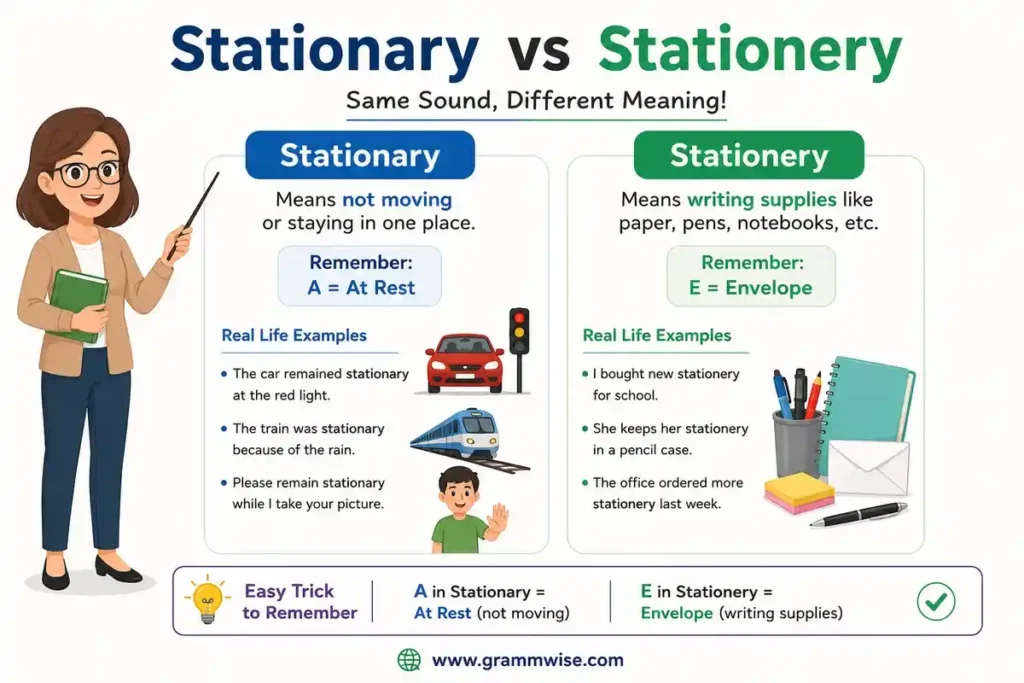
- The car stayed stationary at the traffic light.
- Please remain stationary while I take your picture.
- The bicycle was stationary outside the house.
- The train was stationary because of heavy rain.
- The dog stood stationary and watched the cat.
- The helicopter remained stationary in the air for a short time.
- Everyone stayed stationary during the safety check.
Using “stationery”
- I bought new stationery before school started.
- My favorite stationery store sells colorful notebooks.
- She keeps her stationery in a small box.
- We need more stationery for the office.
- The children decorated their stationery with stickers.
- My friend gave me beautiful stationery for my birthday.
- The teacher handed out fresh stationery before the test.
Origin of The Words “Stationary vs Stationery”
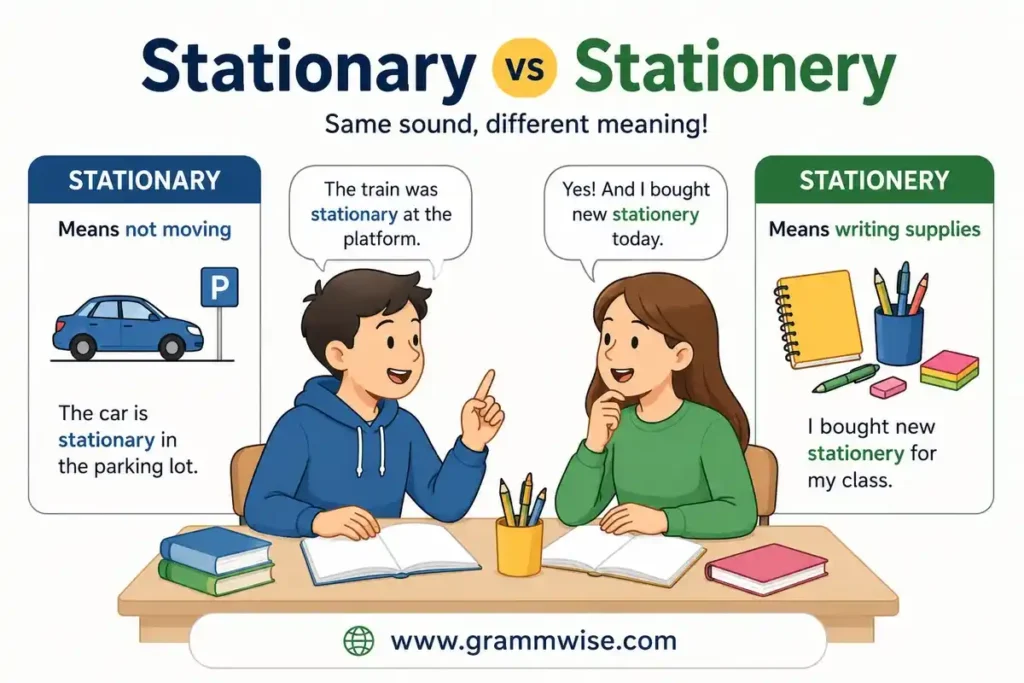
These two words have an interesting history. Long ago, both words came from the idea of a station, which meant a place or position. Later, English gave each word a different job.
Stationary became the word for something that stays in one place or does not move.
Stationery became connected with the paper and writing supplies sold by people who worked at fixed shops, called stationers. Over time, the meaning changed to include all kinds of writing materials.
Even though the spellings are almost the same, each word now has its own clear meaning. That is why choosing the correct spelling matters.
Learning the difference between Stationary vs Stationery is easier than it first seems. Once you remember that stationary means “not moving” and stationery means “writing supplies,” you will make fewer mistakes in school, at work, and in everyday writing.
Stationary vs Stationery: How This Word Is Understood in Culture and Stories?
The words stationary and stationery are not just used in grammar lessons. People also use them in everyday life, stories, books, and conversations.
The word stationary often gives the idea of being calm, quiet, or waiting. Imagine a train standing at a station before it leaves. It is stationary for a short time. People also use this word when talking about traffic, nature, or someone standing still.
For example:
- The lake was so peaceful that the water looked stationary.
- Everyone remained stationary during the ceremony.
- The horse stood stationary beside the fence.
In stories, being stationary can sometimes show patience. A character may stop moving to think before making an important decision.
The word stationery brings different ideas to people’s minds. It reminds many people of school, learning, creativity, and writing letters. Colorful notebooks, pretty pens, and handmade cards are all types of stationery.
Many people enjoy collecting stationery because it inspires them to write, draw, or stay organized.
For children, stationery often means the excitement of starting a new school year. For adults, it may remind them of office work, journals, or personal letters.
Both words have different meanings, but each is connected to everyday life.
Biblical and Mythological Meaning of Stationary vs Stationery
There is no special Biblical meaning for stationary or stationery. These words are mainly modern English words. However, the ideas behind them can appear in many stories.
Being stationary can remind people of waiting with patience. Many people in the Bible waited quietly before important events happened. Waiting often showed trust, peace, or careful thinking.
Writing on stationery can remind us of letters, messages, and communication. Many books of the Bible were first written as letters to different groups of people.
In mythology, there is also no direct meaning for these words. Still, stories often include people who stop moving before making a brave choice or writing an important message that changes someone’s life.
These are simple connections, not official meanings.
Symbolism of Stationary vs Stationery in Simple Words
What “Stationary” Represents?
The word stationary often represents:
- patience
- calmness
- waiting
- peace
- balance
- self-control
- careful thinking
When something is stationary, it is not rushing. Sometimes stopping is a good thing because it gives people time to think before acting.
For example, a driver may stay stationary at a red light. Waiting keeps everyone safe.
In stories, a hero may stand stationary for a moment before making a difficult decision.
What “Stationery” Represents?
The word stationery often represents:
- learning
- creativity
- communication
- education
- organization
- new ideas
- personal expression
People use stationery to write stories, homework, thank-you notes, birthday cards, and business letters. A simple notebook can become the place where someone writes their dreams, plans, or favorite memories.
Good stationery often makes writing feel more enjoyable.
Related Words to Stationary vs Stationery You Should Know
Here are some related words that can help you understand this topic even better.
Station
A place where trains or buses stop.
Stationer
A person or business that sells stationery.
Notebook
A book with blank pages used for writing notes.
Envelope
A paper cover used to mail letters.
Letterhead
Special paper with a company’s name and logo.
Journal
A notebook where people write about their thoughts or daily life.
Office Supplies
Items used in an office, including stationery.
School Supplies
Items students use for learning, such as notebooks, pencils, rulers, and erasers.
Motion
Movement from one place to another.
Still
Not moving.
These words often appear in the same situations as stationary or stationery.
Use of Stationary vs Stationery in Daily English
Here are some examples of how native English speakers use these words every day.
- I need to buy some stationery before school starts.
- Our office ordered new stationery this morning.
- The train stayed stationary because of the heavy rain.
- Please remain stationary until the nurse finishes checking you.
- She loves collecting cute stationery from different countries.
- The car remained stationary at the red light.
- My favorite gift was a box of beautiful stationery.
- The helicopter stayed stationary in the air for a few seconds.
- The teacher asked us to bring our own stationery tomorrow.
- The police told everyone to stay stationary during the safety check.
These are natural sentences that you may hear at school, at work, or in everyday conversations.
Common Mistakes People Make About Stationary vs Stationery
Many people make the same mistakes because these words sound exactly alike.
Mistake 1
❌ I bought new stationary for class.
✅ I bought new stationery for class.
The sentence is talking about school supplies.
Mistake 2
❌ The truck remained stationery.
✅ The truck remained stationary.
The truck is not moving.
Mistake 3
❌ Our company needs more stationary.
✅ Our company needs more stationery.
The company needs paper, pens, and envelopes.
Mistake 4
❌ Please stay stationery while I take the picture.
✅ Please stay stationary while I take the picture.
The person should not move.
The best way to avoid these mistakes is to ask yourself one simple question.
Am I talking about movement or writing supplies?
The answer will tell you which spelling to choose.
Memory Tricks That Really Work
Many students remember the difference by using simple word tricks.
Trick 1: Envelope Has an E
Look at the word envelope.
It starts with the letter E.
The word stationery also has an E.
Since an envelope is a writing supply, this helps you remember the correct spelling.
Envelope → E → Stationery
Trick 2: At Rest Has an A
The phrase at rest has the letter A.
The word stationary also has an A.
If something is at rest, it is not moving.
At Rest → A → Stationary
Trick 3: Picture the Object
Imagine someone asks you to spell the word.
Think about the object first.
If you see a notebook, pen, or envelope, write stationery.
If you see a parked car or a waiting train, write stationary.
Making a picture in your mind often helps you remember faster than trying to memorize spelling rules.
Stationary vs Stationery in Everyday Life
You can hear or read these words in many places.
At School
Students often need:
- notebooks
- pens
- pencils
- rulers
- folders
These are all stationery.
Example:
“My mom bought new stationery before the first day of school.”
At the Office
Businesses use lots of stationery every day.
Examples include:
- printer paper
- envelopes
- business cards
- sticky notes
- letterheads
Example:
“The company ordered more stationery for the office.”
While Traveling
When talking about buses, trains, cars, or airplanes, you may need stationary.
Examples:
“The plane remained stationary before takeoff.”
“The bus stayed stationary because of traffic.”
At Home
You may have a small box filled with stationery.
Or you may leave your bicycle stationary in the garage.
The meaning changes completely depending on what you are talking about.
Can “Stationary” and “Stationery” Ever Replace Each Other?
No.
These words cannot replace each other because they have completely different meanings.
Compare these examples.
“I bought beautiful stationery.”
This means writing supplies.
“I bought beautiful stationary.”
This sentence is incorrect because “stationary” cannot mean paper or notebooks.
Now look at another example.
“The truck remained stationary.”
This means the truck did not move.
“The truck remained stationery.”
This is incorrect because trucks are not writing supplies.
Changing just one letter changes the whole meaning of the sentence.
Quick Quiz
Choose the correct word.
1. I need new ______ for my classroom.
Answer: stationery
2. The car stayed ______ for five minutes.
Answer: stationary
3. She bought colorful ______ online.
Answer: stationery
4. The train remained ______ during the repair work.
Answer: stationary
5. Our office ordered more ______ this week.
Answer: stationery
If you answered all five correctly, you already understand the difference well.
Stationary vs Stationery: Side-by-Side Comparison
| Feature | Stationary | Stationery |
|---|---|---|
| Meaning | Not moving | Writing supplies |
| Part of speech | Adjective | Noun |
| Used for | People, vehicles, objects | Paper, pens, envelopes, notebooks |
| Easy memory trick | A = At Rest | E = Envelope |
| Example | The bus was stationary. | I bought new stationery. |
This table gives you a quick answer whenever you forget which spelling to use.
Final Teacher Explanation
Imagine I am standing in front of a classroom. I would tell my students this. These two words are easy once you stop looking at the spelling and start thinking about the meaning.
If something is not moving, use stationary.
If you are talking about paper, pens, notebooks, or envelopes, use stationery.
Do not worry that they sound the same. English has many words like this. Instead, remember two small clues.
- Envelope has an E. So does stationery.
- At Rest has an A. So does stationary.
Whenever you forget, ask yourself one question.
“Is it staying still, or is it something I write with?”
That simple question will help you choose the correct word almost every time. The more you read, write, and practice, the easier these words will become.
Soon, you will use Stationary vs Stationery correctly without even thinking about it.
Quick Recap Stationary vs Stationery
The difference between Stationary vs Stationery is easy to remember.
Use stationary when something is not moving.
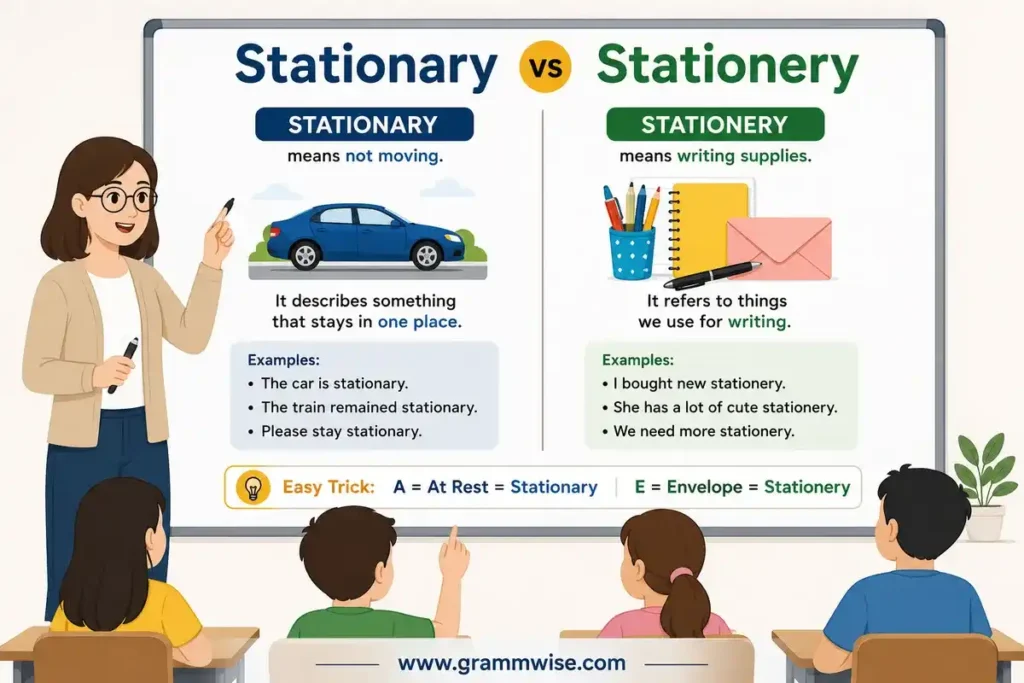
Use stationery when you mean writing supplies like paper, pens, notebooks, and envelopes.
Just remember:
A = At Rest = Stationary
E = Envelope = Stationery
Conclusion
The difference between Stationary vs Stationery is simple once you know what each word means. Although they sound exactly the same, they are used in completely different situations. Use stationary when something is not moving or stays in one place. Use stationery when you are talking about writing supplies such as paper, pens, notebooks, envelopes, and other office or school materials.
A quick memory trick makes this easy to remember. Think of Envelope with an E, so stationery also has an E. Think of At Rest with an A, so stationary also has an A. With a little practice, you will stop confusing these two words. Soon, choosing the correct spelling will become a natural part of your everyday English writing.
Frequently Asked Questions (FAQs)
What does stationary mean in simple words?
Stationary means not moving or staying in one place.
What does stationery mean?
Stationery means writing supplies like paper, pens, notebooks, folders, and envelopes.
Which is correct, stationary or stationery?
Both are correct. Choose stationary for something that is not moving and stationery for writing materials.
Why do people confuse stationary and stationery?
They sound exactly the same but have different spellings and meanings.
Is a notebook stationery?
Yes. A notebook is a piece of stationery.
Is a parked car stationary?
Yes. A parked car is stationary because it is not moving.
How can I remember the difference between stationary and stationery?
Think of Envelope with an E for stationery and At Rest with an A for stationary.
Can I use both words in the same sentence?
Yes. For example:
“The bus remained stationary while I bought some stationery from the shop.”
This sentence uses both words correctly because each has a different meaning.