
Many students feel confused about complement vs compliment. You are not alone. These two words look almost the same. They sound almost the same. But their meanings are very different.
As a teacher, I hear this question often: “Which one is correct?” The answer depends on what you want to say. One word is about finishing or matching something. The other word is about saying something nice to a person.
In this lesson, I will explain complement vs compliment in very simple English. I will explain it the same way I do in class. Step by step. Short and clear. By the end, you will know the difference and use both words with confidence.
Learning these differences helps avoid mistakes in formal writing. Learn more.
Simple Answer in One Look
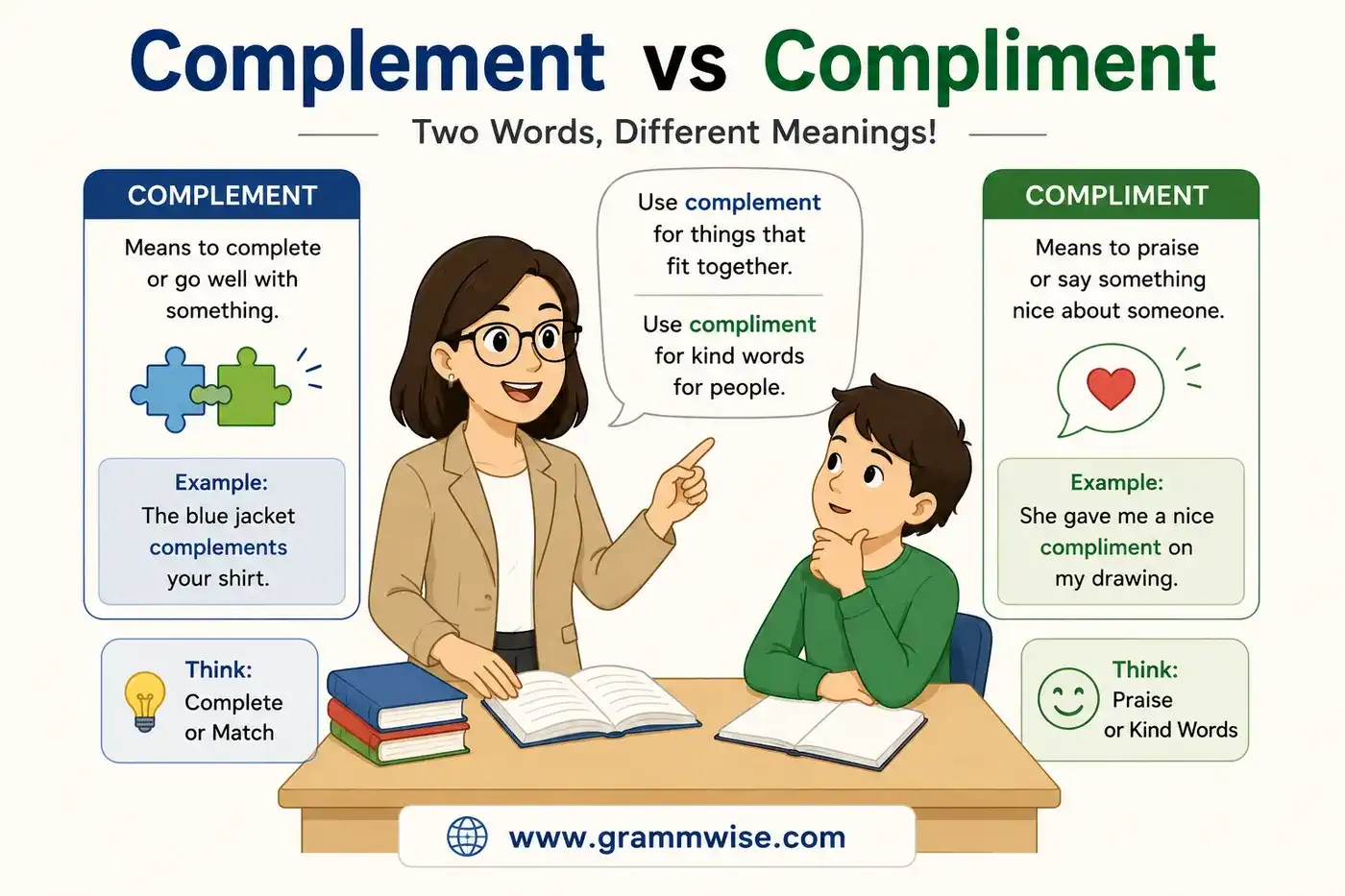
Complement means to complete or go well with something.
Compliment means to praise or say something nice.
Meaning of Complement vs Compliment in Simple English
Let’s slow down and understand each word clearly.
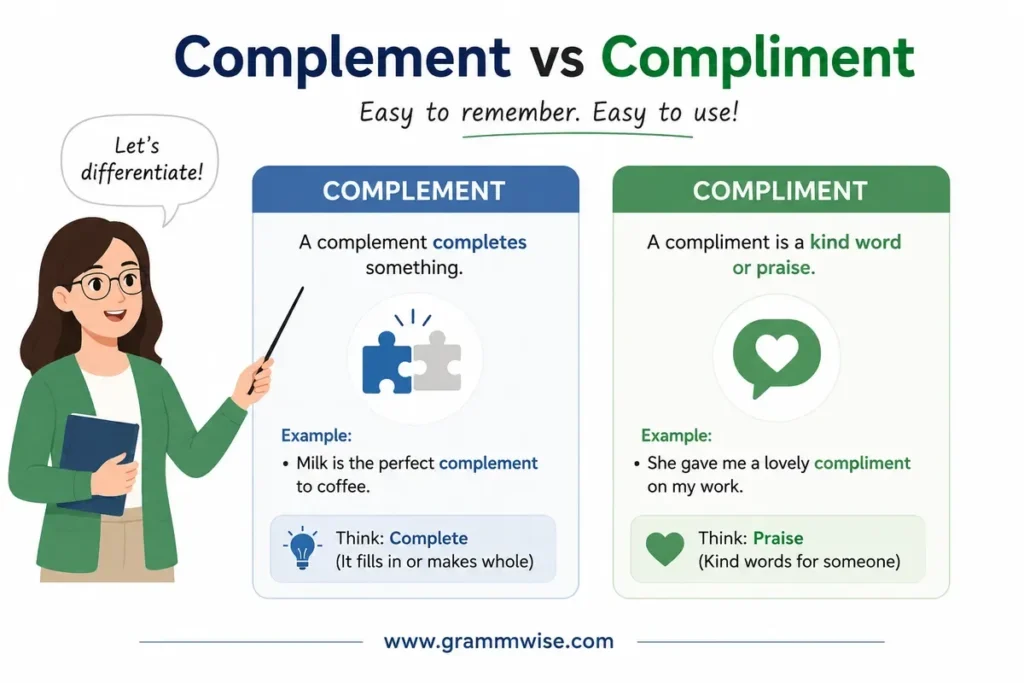
The word complement is used when two things fit well together. One thing makes the other better or complete.
- For example, shoes can complement an outfit.
- Milk can complement cookies.
- Good music can complement a movie scene.
Here, nothing is being praised. The things just work well together.
Now look at the word compliment.
A compliment is a kind word. It is something nice you say to a person. When you tell someone they look good or did a great job, you are giving a compliment.
For example, “Your dress looks beautiful.”
That sentence is a compliment.
So in complement vs compliment, one word is about things matching, and the other word is about kind words.
Why People Mix These Words Complement vs Compliment?
People mix up complement vs compliment for very simple reasons.
First, they sound almost the same when spoken. In fast speech, it is hard to hear the difference.
Second, only one letter is different in spelling. When typing quickly, people often choose the wrong word.
Third, both words are used in daily life. We talk about clothes, food, people, and feelings. This makes confusion more common.
Here is a common mistake:
“This color really compliments the room.”
This is wrong because the color is not praising the room. It is matching it.
The correct sentence is:
“This color really complements the room.”
Small mistakes like this happen often, but they are easy to fix.
Clear Difference of Complement vs Compliment Explained Simply
Here is a clear and easy way to see the difference between complement vs compliment.
Complement:
- Means to complete or match
- Used for things, ideas, or actions
- Answers the question: Do these go well together?
Compliment:
- Means praise or kind words
- Used for people
- Answers the question: Am I saying something nice?
Easy memory tip:
Complement has “complete” inside it.
Compliment has “I like it” feeling inside it.
This small trick helps many students remember the right word.
Complement vs Compliment: Which Form Should You Use?
Ask yourself one simple question.
Am I talking about things matching or completing each other?
If yes, use complement.
Am I talking about praise or saying something nice to a person?
If yes, use compliment.
You do not need grammar rules. Just think about meaning.
If the sentence is about style, taste, or balance, it is complement.
If the sentence is about feelings or kindness, it is compliment.
Easy Real-Life Sentences on Complement vs Compliment You Can Use
Here are simple sentences you can use in daily English.
- This scarf complements your jacket.
- The sauce complements the pasta perfectly.
- She gave me a kind compliment.
- Your smile is a lovely compliment.
- The painting complements the room.
- He complimented her on her hard work.
- These colors complement each other well.
Read them slowly and notice the meaning.
Complement vs Compliment: Origin of This Word Pair
Both words come from Latin, but their meanings changed over time.
The word complement comes from a Latin word that means “to complete.” That is why it is about finishing or matching something.
The word compliment comes from a Latin word that means “kind expression.” That is why it is about praise and polite words.
Even though they look similar today, their meanings followed different paths.
How This Word Is Understood in Culture and Stories
In stories, movies, and daily life, complement vs compliment shows two very different ideas.
When writers use complement, they usually talk about balance. Two things come together and feel right. In stories, this can be colors in a room, music in a scene, or even two people whose skills fit well together. One thing makes the other feel complete.
For example, a calm character may complement a brave one. A quiet setting may complement a serious moment. Nothing is being praised. The idea is harmony.
When writers use compliment, they talk about kindness. Compliments are spoken words. They show care, respect, or love. In stories, a compliment can change how a character feels. One kind sentence can give confidence or heal sadness.
So in culture and stories, complement is about how things fit together, and compliment is about how words make people feel.
Biblical Meaning of Complement vs Compliment
In religious and mythological writing, compliment appears more in meaning than in spelling.
Old stories often focus on kindness, respect, and honor. Praising someone for good actions is close to giving a compliment. Speaking kindly is seen as good behavior.
The idea behind complement also appears, but in a different way. Many religious texts talk about balance and completeness. Light and dark. Good and justice. These ideas complement each other to make the world whole.
So even if the exact words are not used often, the meanings are there.
- Complement relates to completeness and balance.
- Compliment relates to kind speech and respect.
Both ideas are important in moral stories.
Mythological Meaning of Complement vs Compliment
In mythology and old stories, these two ideas appear in different ways, even though the words sound alike.
Complement in mythology is linked to completion and balance.
Many myths talk about the world being whole only when two parts come together.
For example, sky and earth, light and dark, hero and helper.
These pairs complement each other. One part is not complete alone.
So in myths, complement means two forces working together to make balance.
Compliment in mythology is linked to honor and praise.
Gods and heroes are often praised for bravery, wisdom, or kindness.
This praise is spoken aloud as respect.
That spoken respect works like a compliment.
So in myths, compliment means words that honor someone’s actions.
Simple Mythology Difference Complement vs Compliment
- Complement → Completing the world or a role
- Compliment → Honoring someone with words
Easy Example
- The sun and moon complement each other to keep balance.
- The hero receives a compliment for courage.
Final Thought
In mythology, complement is about balance and completion, while compliment is about praise and honor spoken aloud.
Symbolism of Complement vs Compliment Explained in Simple Words
What Complement Represents?
Complement represents balance and completion.
It shows how parts come together to make something better. One part fills a gap in another part. Together, they feel right.
Emotionally, complement feels calm and steady. It feels like harmony. Nothing is extra. Nothing is missing.
In simple words, complement means “this fits.”
What Compliment Represents?
Compliment represents kindness and care.
It shows how words can lift someone up. A compliment makes people feel seen and valued.
Emotionally, compliment feels warm and positive. It feels like encouragement.
In simple words, compliment means “this makes you feel good.”
So the heart of complement vs compliment is this:
One is about fitting things together.
The other is about lifting people up with words.
Related Words You Should Know
Here are some helpful related words that connect to complement vs compliment.
Match
Things that go well together.
Balance
When parts fit without feeling too much or too little.
Praise
Kind words said to a person.
Appreciation
Showing thanks or value.
Harmony
A peaceful mix of parts.
Flatter
To praise someone, sometimes too much.
Enhance
To make something better.
These words help you understand how both ideas work in real English.
Use of Complement vs Compliment in Daily English
Here are real-life examples people use every day.
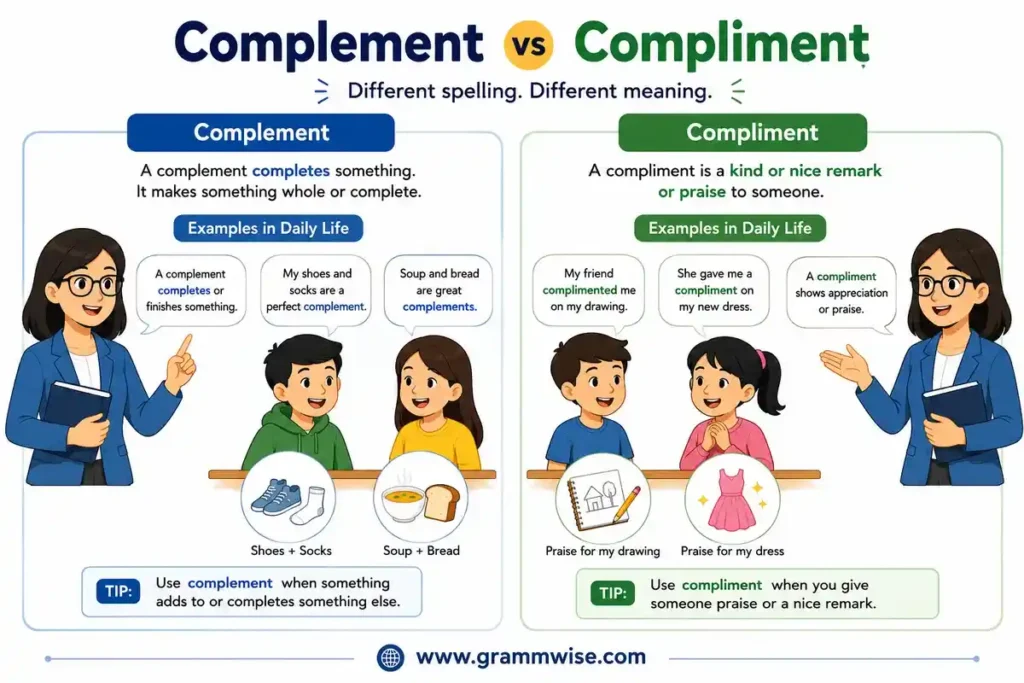
- That tie complements your suit.
- The music complements the scene nicely.
- She gave me a sweet compliment.
- He complimented her cooking.
- These shoes complement the dress.
- Your words were a nice compliment.
- The colors complement each other.
- She smiled after the compliment.
- This sauce complements the meal.
Listen to meaning, not sound. That is how native speakers choose the right word.
Clear Comparison Table: Complement vs Compliment
| Feature | Complement | Compliment |
|---|---|---|
| Main meaning | Completes or matches | Praises someone |
| Focus | Function and balance | Feelings and kindness |
| Part of speech | Noun / Verb | Noun / Verb |
| Used for | Things, roles, skills | People, looks, actions |
| Example | Shoes complement the outfit | She gave a nice compliment |
| Emotion involved | No | Yes |
| Easy memory tip | Complete | Praise |
Common Mistakes People Make About Complement vs Compliment
Many people make the same mistakes with complement vs compliment.
Mistake 1
“You compliment my style.”
Correction:
“You complimented my style.”
(Use past tense when needed.)
Mistake 2
“This painting compliments the room.”
Correction:
“This painting complements the room.”
(The painting is not speaking.)
Mistake 3
Using compliment for objects.
Correction:
Compliments are for people, not things.
Mistake 4
Using complement for praise.
Correction:
Praise is always compliment.
The fix is simple. Ask what the sentence is doing.
Practice Test: Complement vs Compliment
Fill in the blanks:
- She gave me a kind __________ about my work.
- This jacket __________ your shoes well.
- He smiled after hearing the __________.
- These two skills __________ each other.
- Thank you for the lovely __________.
- The music __________ the scene perfectly.
- Her words were a beautiful __________.
Answers
- compliment
- complements
- compliment
- complement
- compliment
- complements
- compliment
Final Teacher Explanation
Let me explain this one last time like I would in class.
If something fits, matches, or completes, use complement.
If someone says something kind, use compliment.
Do not rush. Read the sentence. Feel the meaning.
English becomes easy when you listen to what the sentence wants to say.
Once you understand the idea, spelling is no longer a problem.
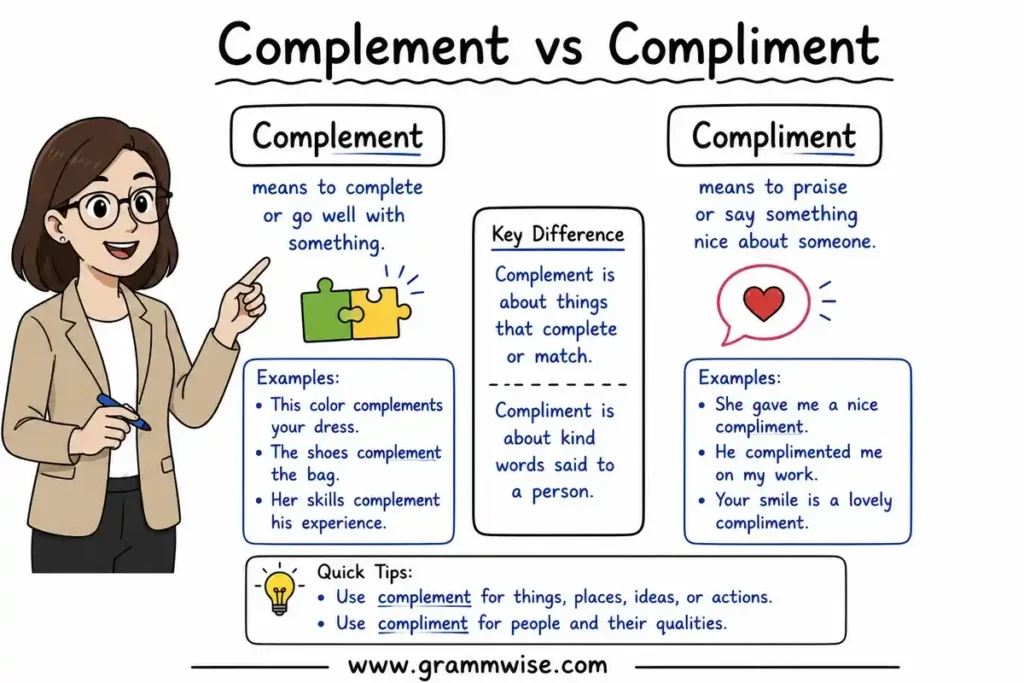
Quick Recap Complement vs Compliment
Complement means to complete or go well with something.
Compliment means praise or kind words.
That is the clear and simple difference.
Conclusion
The confusion between complement vs compliment is very common, but it becomes easy once you focus on meaning. One word is about praise and kind words, while the other is about things working well together. When you stop guessing and start thinking about purpose, the right choice comes naturally.
As a teacher would say, always ask yourself a simple question before choosing the word. Am I praising someone, or am I showing how things complete each other? That one question will help you use both words correctly and confidently every time.
Frequently Asked Questions
What does complement mean in simple words?
It means something fits or completes another thing.
What does compliment mean in simple words?
It means saying something nice to a person.
Which is correct: complement vs compliment?
Both are correct. Use the one that matches your meaning.
Why do people confuse these words?
They look and sound almost the same.
Can I use both in writing?
Yes, if the meaning is correct.
Is compliment always about people?
Yes, compliments are kind words for people.
Is complement used for things?
Yes, it is used for things that match or complete each other.
How can I remember the difference easily?
Complement completes. Compliment is kind.