
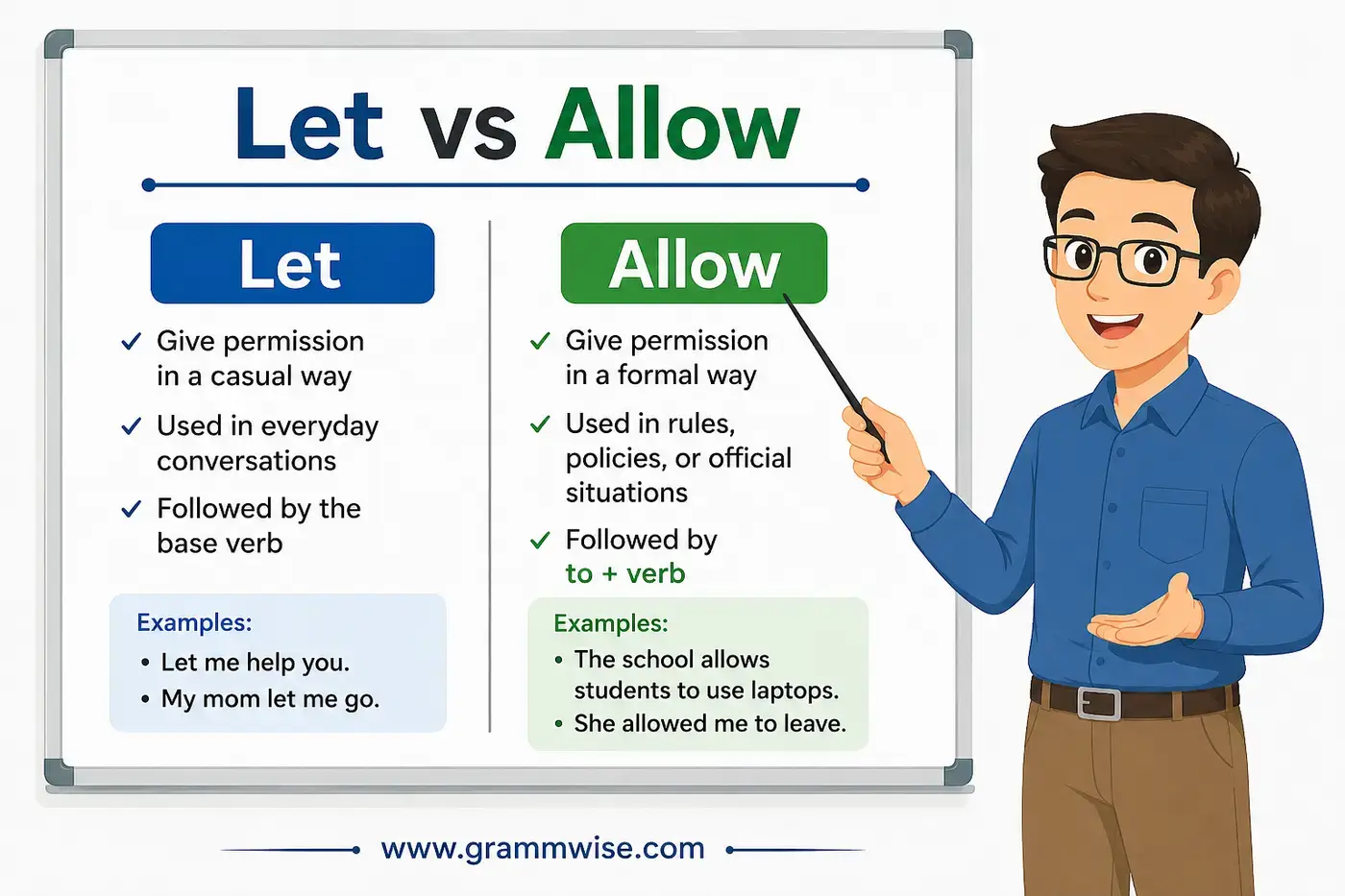
Many English learners get confused about let vs allow because both words give someone permission to do something. They have similar meanings, but they are not always used in the same way. Knowing the difference will help you speak and write more natural English.
The short answer is simple. Let is more common in everyday conversations. Allow is more formal and often appears in schools, workplaces, rules, and official writing. Learning when to use each word will make your English sound clearer and more natural.
In this guide, you will learn the meaning of let vs allow, the difference between them, when to use each one, easy grammar rules, real-life examples, and simple memory tips. By the end, you will know which word fits every situation.
Check related grammar articles to strengthen your English writing skills like Enough vs Too much.
Simple Answer in One Look
Let means to give someone permission in a casual way.
Allow also means to give permission, but it is more formal and is often used in rules, policies, and official situations.
What Does Let vs Allow Mean in Simple English?
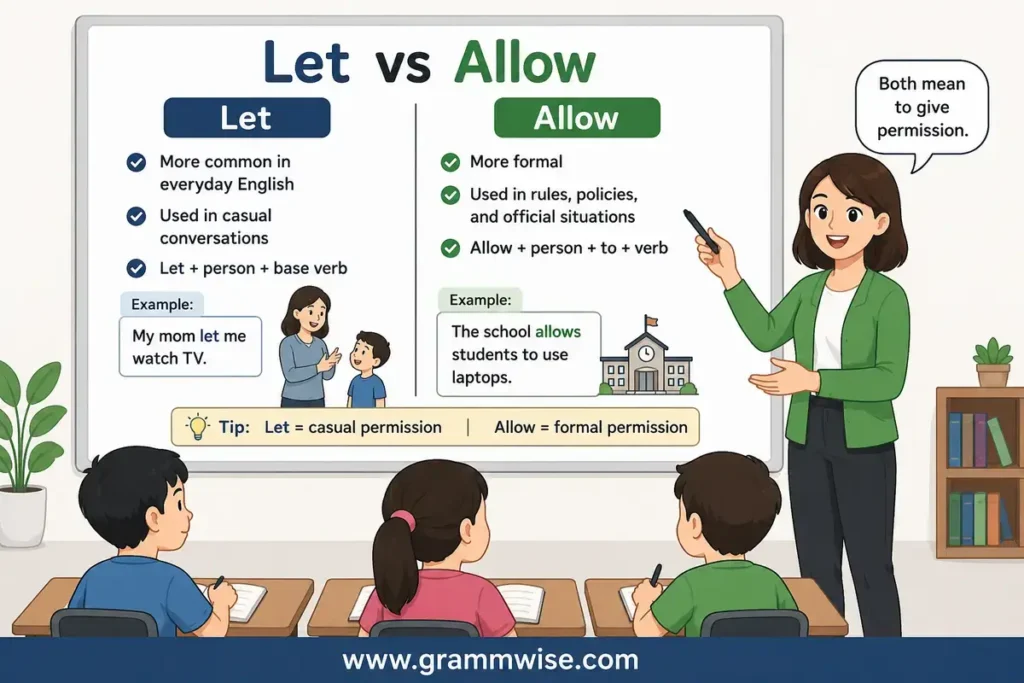
Both let and allow mean that someone gives permission for another person to do something.
Think of them as two different ways to say give permission.
Imagine your parents say you can stay up late on Friday.
They might say:
- My parents let me stay up late.
- My parents allow me to stay up late.
Both sentences have the same basic meaning. Your parents gave you permission.
The difference is mainly the style.
Let sounds friendly, natural, and relaxed.
Allow sounds more careful and formal.
That is why people usually say let when talking with friends or family.
People often use allow in schools, offices, businesses, laws, signs, and official announcements.
For example:
- My mom lets me play outside after homework.
- The school allows students to use calculators during the test.
- The hotel allows pets.
- My teacher let us leave early.
Each sentence gives permission, but the situation changes which word sounds better.
Why Do People Mix These Words “Let vs Allow”?
Many learners confuse let vs allow because both words mean permission. When translating from another language, they often look exactly the same.
Another reason is that dictionaries sometimes give each word as the meaning of the other.
This makes people think they are always interchangeable. They are not. The biggest difference is how they are used in a sentence.
For example:
✅ My father let me go.
❌ My father let me to go.
Many learners accidentally add to after let, but this is incorrect.
Now look at allow.
✅ My father allowed me to go.
❌ My father allowed me go.
Here, to is necessary.
This small grammar difference causes many mistakes.
The level of formality also confuses learners.
Imagine these situations.
Your friend asks if you can borrow a bike.
You naturally say:
“Sure, I’ll let you use it.”
It sounds warm and friendly.
Now imagine a museum sign.
It says:
“Visitors are not allowed to touch the paintings.”
Using let here would sound strange because the situation is formal.
So even though the meanings are similar, the situations are different.
Clear Difference Explained Simply
Here is an easy comparison.
| Let | Allow |
|---|---|
| More common in daily conversation | More common in formal English |
| Friendly and natural | Professional and official |
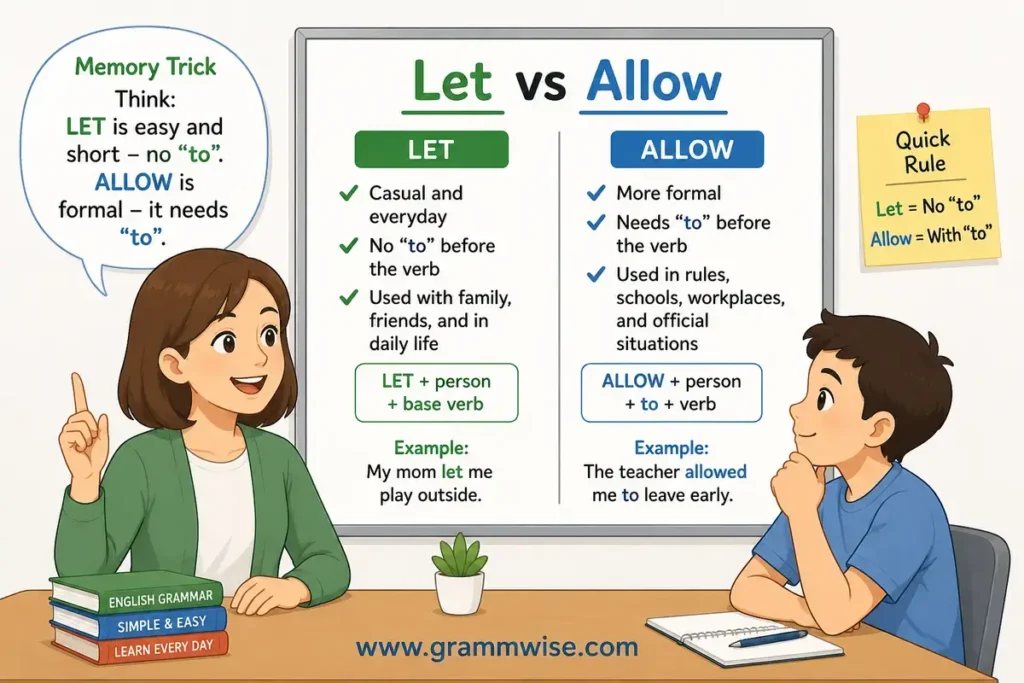
| Followed by the base verb | Followed by to + verb |
| Used with family and friends | Used in schools, workplaces, rules, and policies |
| Short and simple | Slightly more formal and polite |
Remember this simple rule.
Let = casual permission.
Allow = formal permission.
Which Form Should You Use “Let vs Allow”?
The answer depends on the situation.
Use let when talking naturally with friends, family, classmates, or people you know.
Examples:
- My parents let me drive the car.
- Please let him finish.
- She lets her children watch cartoons.
Use allow when talking about rules, laws, official decisions, company policies, or formal writing.
Examples:
- The library allows quiet study.
- The company allows remote work.
- The doctor allowed him to leave the hospital.
Also remember these grammar patterns.
Let + person + base verb
Examples:
- Let me help.
- She let us play.
- They let him stay.
Allow + person + to + verb
Examples:
- She allowed us to play.
- The manager allowed him to leave.
- My parents allowed me to travel.
This is one of the easiest ways to remember the difference.
If you see allow, expect to see to before the next verb.
If you see let, do not use to.
Easy Real-Life Sentences on “Let vs Allow”
Here are some everyday examples.
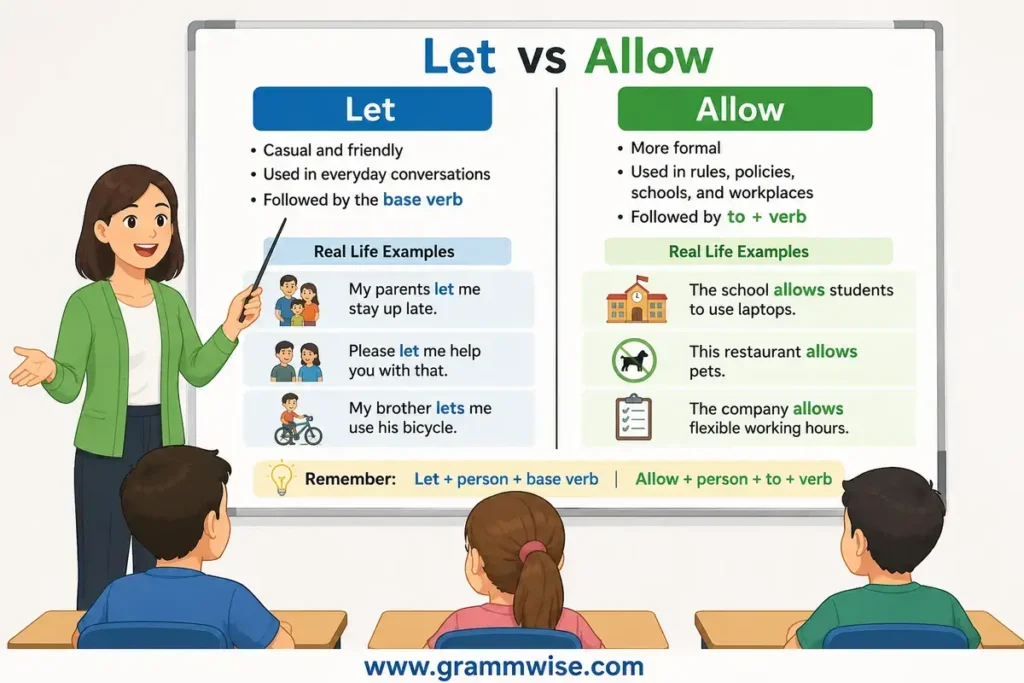
- My parents let me stay up late on weekends.
- Our teacher let us ask extra questions.
- Please let me explain my idea.
- My brother lets me use his bicycle.
- The coach let the players rest after practice.
- The school allows students to bring water bottles.
- This restaurant allows outdoor seating.
- The company allows flexible working hours.
- The museum does not allow photography.
- The hospital allows only two visitors at a time.
Notice how let appears in friendly, personal situations, while allow often appears in places with rules or policies.
Where Do These Words “Let vs Allow” Come From?
The word let is very old. It comes from Old English and has been used for hundreds of years. It originally meant to permit or to allow, and people still use it every day in spoken English.
The word allow came into English from Old French. It later became common in legal writing, business documents, and official communication. Over time, it also became part of everyday English, but it still sounds more formal than let.
Even though both words have different histories, they now share one main idea: giving permission. The difference is mostly in tone, grammar, and the situations where they are used.
How These Words Are Understood in Culture and Stories
The words let and allow are more than grammar words. They also show ideas about freedom, trust, kindness, and responsibility. When someone lets or allows another person do something, they are giving permission or showing confidence in that person.
In many stories, a parent may let a child try something new. A teacher may allow students to work together on a project. These moments often show that a character is growing, learning, or becoming more responsible.
You will also hear these words in movies and TV shows.
For example:
- “Please let me explain.”
- “My parents won’t let me go.”
- “The manager allowed us to leave early.”
These sentences sound natural because they are used in real-life situations. Native English speakers use let much more often in daily conversations, while allow is common in formal settings.
Biblical and Mythological Meaning of “Let vs Allow”
The words let and allow appear in many English translations of the Bible because they express permission or willingness.
For example, Jesus often invited people to come to Him with words like, “Let the little children come to me.” Here, let means to allow or not stop someone.
Many Bible stories teach that people have the freedom to make choices. God allows people to choose between right and wrong. This idea of permission and free will is connected to the meaning of both let and allow.
In mythology, kings, queens, and gods often allowed heroes to begin important journeys or complete difficult tasks. Permission was often the first step before a great adventure could begin.
Although let and allow are ordinary English words, they can represent trust, opportunity, and responsibility in many stories.
Symbolism of “Let vs Allow” in Simple Words
What “Let” Represents?
The word let often represents trust, kindness, freedom, and everyday permission.
When someone says, “I’ll let you help,” they are showing trust. When parents let their children make decisions, they are helping them become more independent.
Because let sounds warm and friendly, it often represents close relationships between family members, friends, and classmates.
What “Allow” Represents?
The word allow often represents rules, authority, fairness, and official permission.
Schools allow students to use certain materials. Companies allow employees to work from home. Governments allow or do not allow certain activities.
Because allow is more formal, it often reminds people of rules, policies, and responsibilities rather than casual conversations.
Related Words You Should Know
Learning related words will help you understand let vs allow even better.
Permit – A formal word that means to give permission.
Authorize – To officially give someone permission to do something.
Approve – To agree that something is acceptable.
Consent – To give permission willingly.
Accept – To receive or agree to something.
Refuse – To say no or not give permission.
Forbid – To officially say that something is not allowed.
Prohibit – A very formal word meaning to stop or ban something.
Enable – To make it possible for someone to do something.
Encourage – To give someone confidence or support to do something.
Knowing these words will improve your vocabulary and help you choose the right word in different situations.
How People Actually Use Let vs Allow in Daily English?
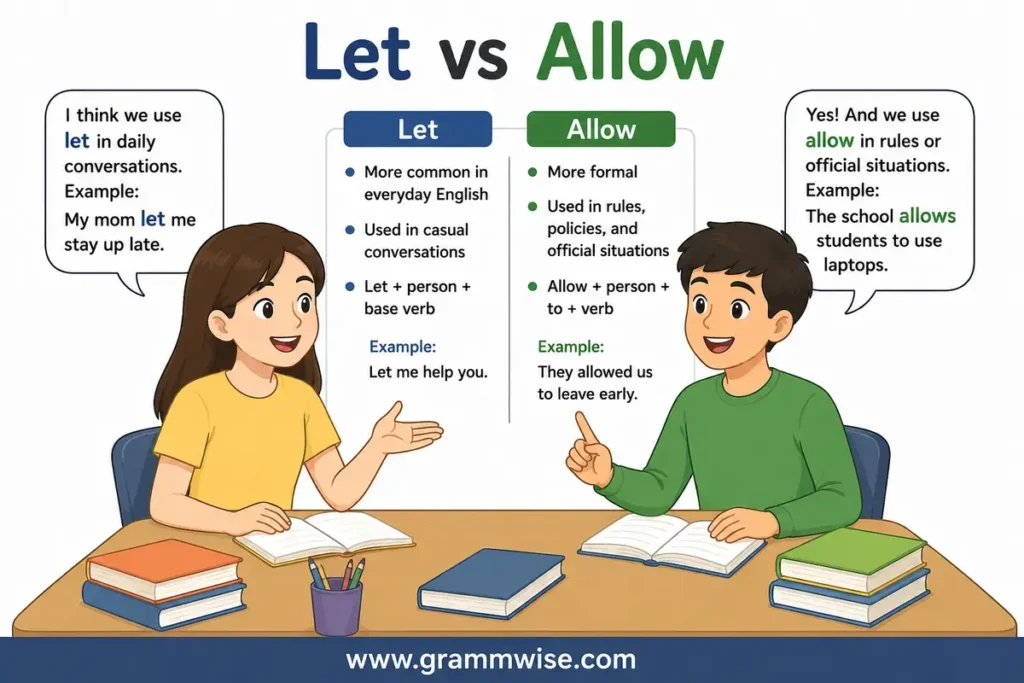
Native English speakers use let much more often than allow in everyday conversations.
For example:
- Let me help you.
- Please let me know.
- My parents let me drive.
- She lets her brother borrow her bike.
- They let us stay longer.
- Let him finish speaking.
- I’ll let you decide.
- My friend let me use her laptop.
In formal situations, allow is more common.
For example:
- The school allows students to use laptops.
- This hotel allows pets.
- The museum does not allow food inside.
- Our company allows flexible working hours.
- The teacher allowed us to retake the test.
- The airport allows one carry-on bag.
- The hospital allows visitors until 8 p.m.
- The coach allowed the team to take a short break.
As you can see, let sounds friendly and personal, while allow sounds more official.
Common Mistakes People Make About “Let vs Allow”
Many English learners make the same mistakes with let and allow. Here are the most common ones.
Mistake 1: Adding “to” after let
❌ She let me to go.
✅ She let me go.
Always use the base verb after let.
Mistake 2: Forgetting “to” after allow
❌ She allowed me go.
✅ She allowed me to go.
Always use to after allow before another verb.
Mistake 3: Using allow in casual conversations
Although correct, allow can sound too formal when talking with friends.
Natural:
✅ My mom let me stay out late.
More formal:
✅ My mom allowed me to stay out late.
Both are correct, but let is more common in everyday speech.
Mistake 4: Thinking let and allow are always interchangeable
Both words mean permission, but they do not always sound natural in the same situation.
For example:
Natural:
- Let me see.
- Let me think.
- Let me explain.
Using allow in these expressions would sound unusual.
Final Teacher Explanation
Remember one simple idea. Both let and allow mean giving permission, but they are used differently. Let is the word you will hear most often in conversations with family, friends, and classmates. It sounds friendly, simple, and natural.
Allow is the better choice when talking about rules, laws, schools, workplaces, or official situations. Also remember the grammar rule: let + person + base verb, but allow + person + to + verb. If you remember this one pattern, you will avoid one of the most common English mistakes.
Quick Recap “Let vs Allow”
If you are choosing between let vs allow, both words mean to give permission. The difference is that let is more casual, while allow is more formal.
Use let in everyday conversations and allow in formal situations. Remember the grammar pattern, and you will use both words correctly and confidently.
Conclusion
Understanding let vs allow is simple once you know that both words mean to give permission. The main difference is that let is common in everyday conversations, while allow is more formal and often used for rules, policies, and official situations. Remember the grammar patterns, and choosing the correct word will become easy.
The more you read, listen, and practice, the more natural these words will feel. Keep using real-life examples to improve your English vocabulary, grammar, word choice, and communication skills. With regular practice, you will confidently use both words in speaking and writing.
Frequently Asked Questions (FAQs)
What is the difference between let and allow?
Let is casual and common in everyday English. Allow is more formal and often used in rules or official writing.
Is let or allow more common?
Let is much more common in everyday conversations.
Do both words mean the same thing?
Yes. Both mean to give permission, but they differ in tone and grammar.
Can I say “let me to go”?
No. Say let me go. Do not use to after let.
Why do we use “to” after allow?
Because the correct pattern is allow + person + to + verb.
Can I use allow in casual conversations?
Yes, but let usually sounds more natural.
Is permit the same as allow?
They have similar meanings, but permit is even more formal than allow.
How can I remember the difference?
Think of this easy rule: Let = casual permission. Allow = formal permission.