
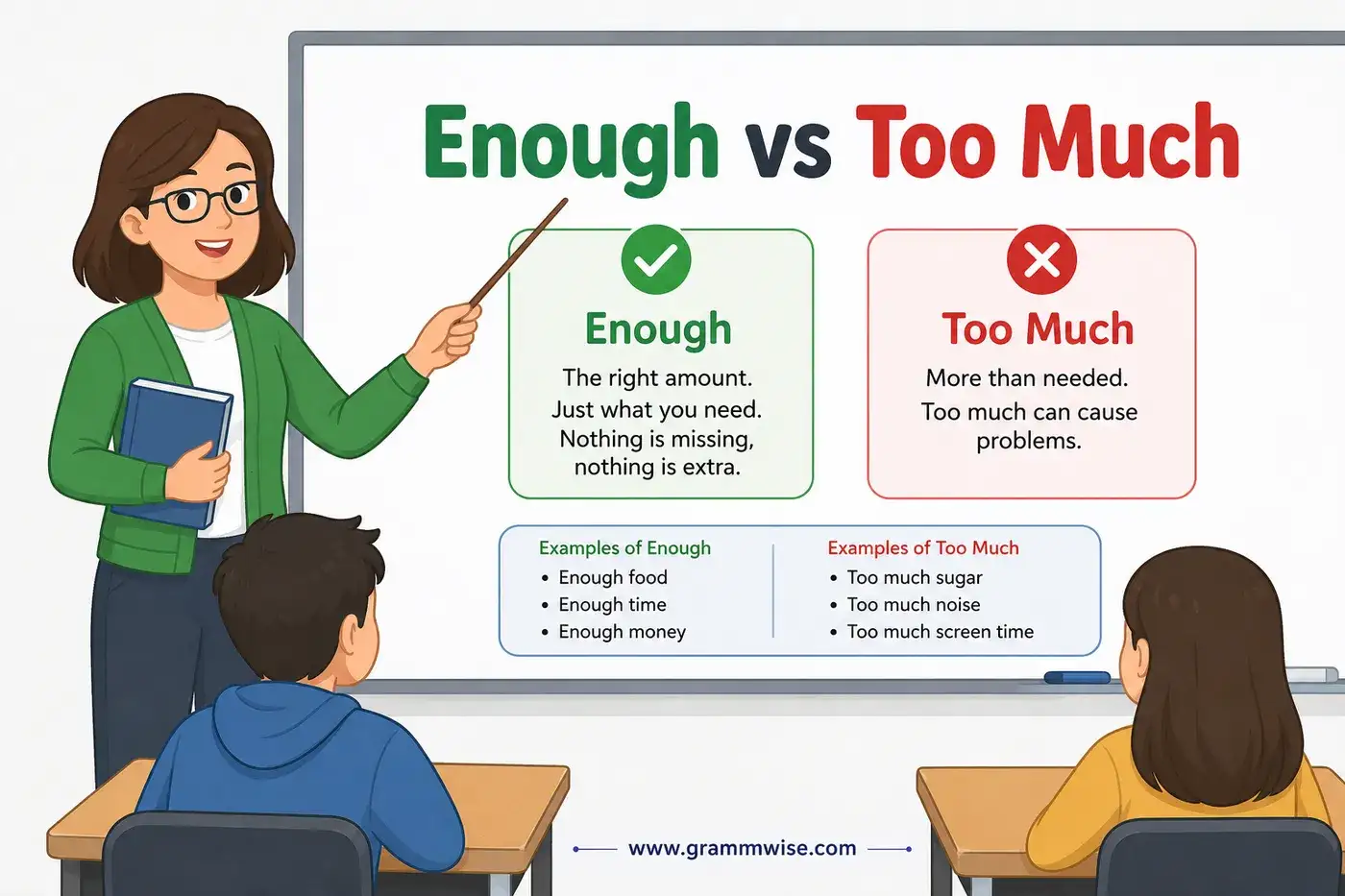
Many English learners get confused about Enough vs Too Much because both words talk about quantity or amount. They are often used in everyday conversations, but they do not mean the same thing. One means you have the right amount, while the other means you have more than you need.
If you have ever wondered which one is correct, you are not alone. People use these expressions when talking about food, money, time, work, water, and many other things. Once you understand the difference, using them becomes easy.
In this guide, I will explain Enough vs Too Much in simple English. You will learn what each expression means, why people confuse them, how to use them correctly, and simple tricks to remember the difference.
Want to improve your grammar further? Explore more guides on Grammwise.
Simple Answer in One Look
- Enough means the right amount or as much as needed.
- Too much means more than needed or more than is good.
Easy rule:
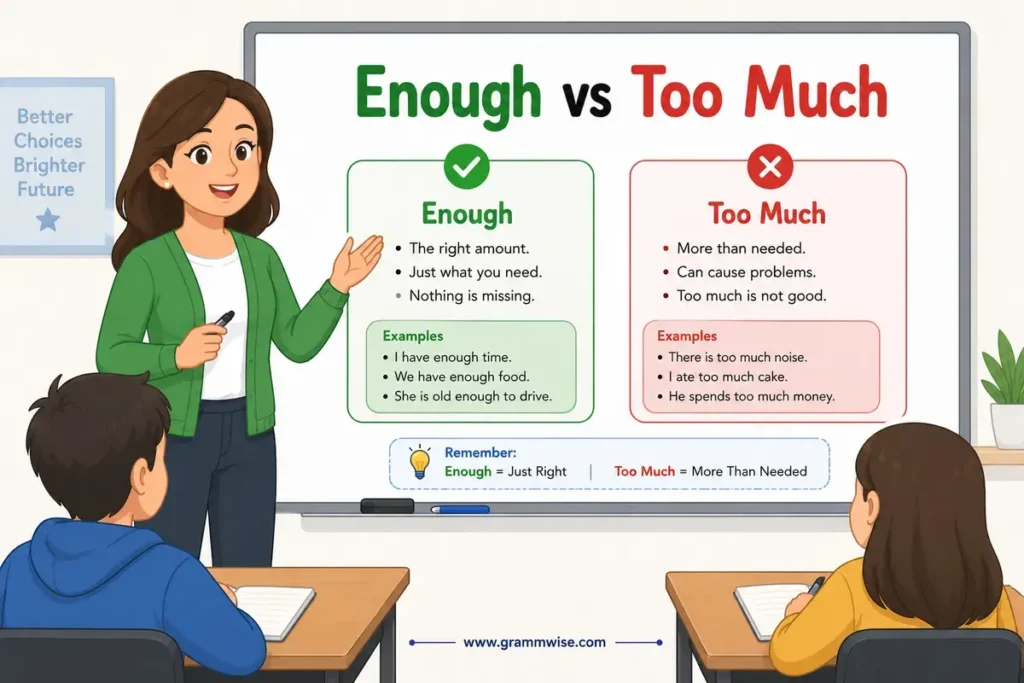
- Enough = Just the right amount
- Too much = More than needed
Meaning of “Enough vs Too Much” in Simple English
These two expressions both talk about amount, but they give very different ideas.
What does “enough” mean?
Enough means you have all that you need.
Nothing is missing.
Nothing is extra.
For example:
- I have enough money to buy lunch.
- We have enough chairs for everyone.
- She is old enough to drive.
In these examples, the amount is just right.
What does “too much” mean?
Too much means there is more than needed.
The extra amount may cause a problem.
For example:
- There is too much sugar in this tea.
- He spends too much money.
- We have too much homework today.
In these examples, the amount is greater than needed.
Why People Mix These Words “Enough vs Too Much”?
Many learners confuse in Enough vs Too Much for a few simple reasons.
1. Both talk about amount.
They both describe how much of something there is.
This makes people think they have similar meanings.
2. They often appear in the same situations.
You can talk about food, money, water, or time using either expression.
For example:
- We have enough water.
- We have too much water.
The topic is the same, but the meaning changes.
3. Both are common in daily English.
Native English speakers use these expressions every day.
Because they are heard so often, learners sometimes choose the wrong one.
4. Many languages use different sentence patterns.
Some languages express these ideas differently.
When learners translate directly into English, they may mix up enough and too much.
Clear Difference Between “Enough vs Too Much”
The easiest way to understand the difference is to think about the amount.
| Enough | Too Much |
|---|---|
| The right amount | More than needed |
| Positive or neutral | Usually negative |
| Nothing is missing | There is extra |
| Comfortable amount | Excessive amount |
Think about these questions.
Do you have what you need?
If yes, use enough.
Do you have more than you need?
If yes, use too much.
A quick comparison
Enough
- enough food
- enough money
- enough time
- enough sleep
- enough water
- enough space
Too Much
- too much food
- too much money to carry
- too much noise
- too much sugar
- too much traffic
- too much rain
Enough vs Too Much, Which Form Should You Use?
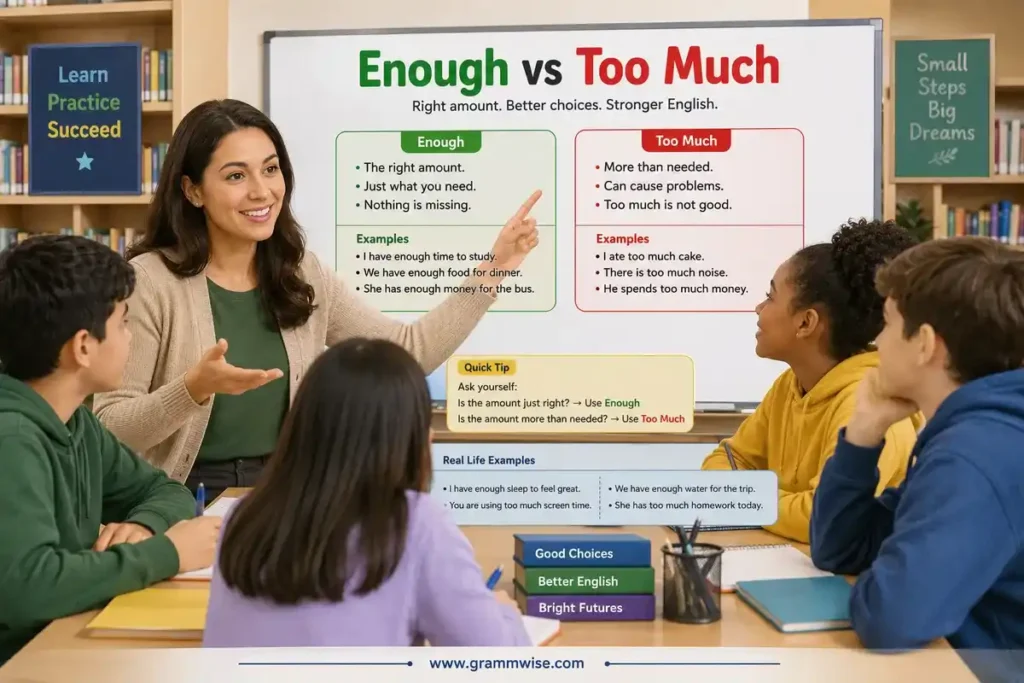
Ask yourself one simple question.
Is the amount just right?
If yes, choose enough.
Examples:
- I have enough time.
- She has enough experience.
- We bought enough food.
Is the amount more than needed?
If yes, choose too much.
Examples:
- I ate too much cake.
- There is too much salt in the soup.
- He watches too much television.
Can both be used with the same noun?
Yes.
For example:
- We have enough water.
- We have too much water.
The noun stays the same.
Only the meaning changes.
The first sentence means the amount is correct.
The second sentence means there is more water than needed.
A Simple Memory Trick for “Enough vs Too Much”
Here is an easy way to remember.
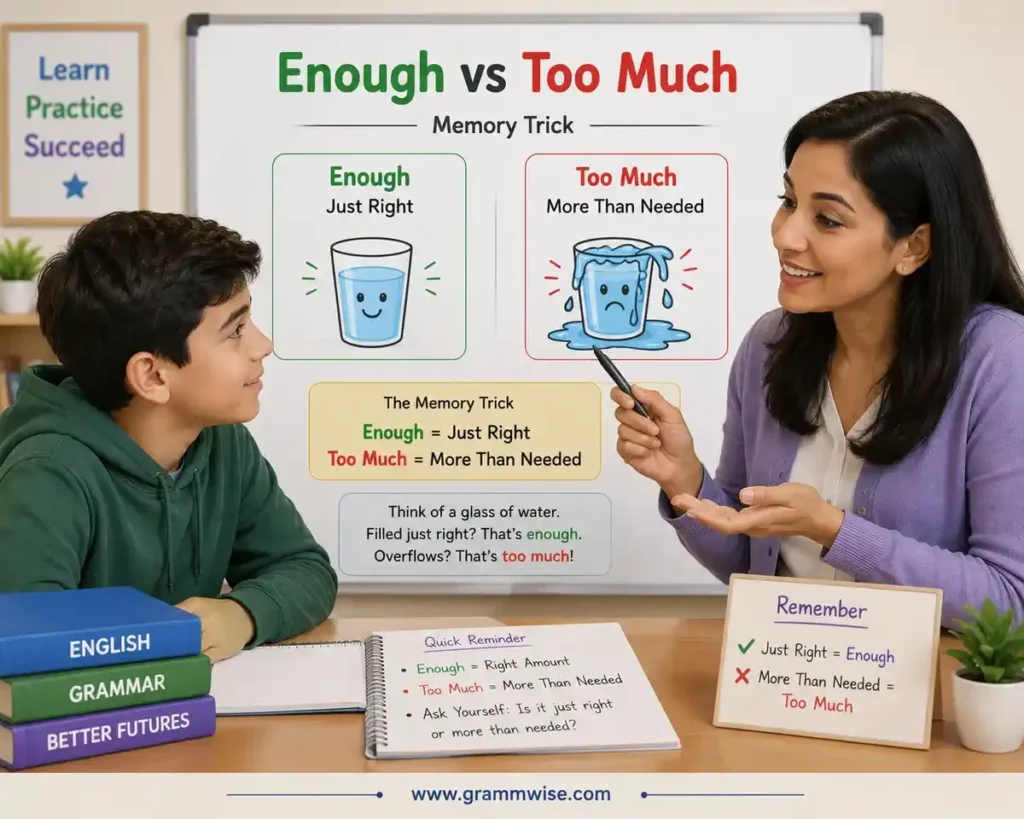
Think of a glass of water.
If the glass is filled just enough, it is perfect.
That is enough.
Now imagine pouring more water until it spills over the edge.
That is too much.
Remember these simple ideas.
Enough = Just Right
Too Much = More Than Needed
This picture in your mind can help you remember the difference every time.
Easy Real-Life Sentences on “Enough vs Too Much”
Here are some natural examples.
Using “Enough”
- We have enough food for dinner.
- I saved enough money for a new bike.
- She is strong enough to carry the box.
- Do you have enough time to help me?
- There are enough seats for everyone.
- He drank enough water today.
- We have enough pencils for the class.
Using “Too Much”
- I ate too much pizza.
- There is too much noise outside.
- He spends too much money.
- We watched too much television yesterday.
- She put too much sugar in the coffee.
- There is too much traffic this morning.
- They have too much work to finish today.
Everyday Conversation Examples
Correct
“I have enough money to buy the book.”
“There is too much milk in my cereal.”
“We have enough time to catch the bus.”
“You are using too much salt.”
“She has enough experience for the job.”
These examples show that enough means the amount is correct, while too much means the amount is greater than needed.
Where These Expressions “Enough vs Too Much” Come From?
The word enough has been part of English for hundreds of years. It has always meant having as much as you need. People have used it when talking about food, money, time, strength, and many other things.
The phrase too much is made from two simple English words. The word too means more than is wanted or needed. The word much means a large amount. Together, too much means having an amount that is greater than necessary.
Today, both expressions are among the most common in English.
You will hear them at home, at school, at work, in stores, and in everyday conversations.
Once you remember that enough means the right amount and too much means more than needed, choosing the correct expression becomes easy.
How These Expressions Are Understood in Culture and Stories?
The expressions enough and too much are used every day in many cultures. They are not only about food or money. They also help people talk about balance in life.
The word enough often gives a positive feeling. It means having what you need without wasting anything. Many parents teach their children to be thankful when they have enough food, enough clothes, and enough time to rest.
Many stories teach that having enough is better than always wanting more. A character who is happy with enough often enjoys a peaceful life. These stories remind us that we do not always need more to be happy.
The expression too much usually has a negative meaning. It often shows that something has gone beyond a healthy or comfortable limit.
For example:
- too much noise
- too much stress
- too much screen time
- too much junk food
Many books and movies show that having too much of something can create problems. Even good things can become bad if there is too much of them.
These expressions help people talk about making wise choices and finding balance.
Biblical and Mythological Meaning of “Enough vs Too Much”
The Bible often teaches people to be thankful for having enough.
Many stories encourage people to trust that their daily needs will be provided. They also teach people not to be greedy or always want more than they need.
The idea of too much appears in many Bible stories as a warning against excess. Pride, wealth, or power without wisdom can lead to trouble.
In mythology, many characters also suffer because they want too much. Some heroes become successful when they learn to be thankful for what they already have.
These ideas are about life lessons rather than the meanings of the words themselves.
Symbolism of “Enough vs Too Much” in Simple Words
What “Enough” Represents?
The word enough often represents:
- balance
- contentment
- gratitude
- satisfaction
- peace
- wisdom
- self-control
When people have enough, they feel comfortable because their needs are met.
It reminds us that happiness does not always come from having more.
What “Too Much” Represents?
The expression too much often represents:
- excess
- waste
- overload
- stress
- greed
- imbalance
- problems
When something becomes too much, it often creates difficulty instead of helping.
Finding the right balance is usually the best choice.
Related Words You Should Know
Learning these related words will help you understand Enough vs Too Much even better.
Enough: As much as needed.
Too Many: More than needed with countable nouns.
Example:
- too many books
- too many cars
Too Little: Less than needed.
Example:
- too little water
- too little sleep
Plenty: More than enough in a positive way.
Example:
- We have plenty of food.
Sufficient: A more formal word that means enough.
Excess: More than what is needed.
Limit: The highest amount that is acceptable.
Balance: Having the right amount of something.
Moderate: Not too much and not too little.
Quantity: The amount of something.
These words often appear in conversations about amounts and measurements.
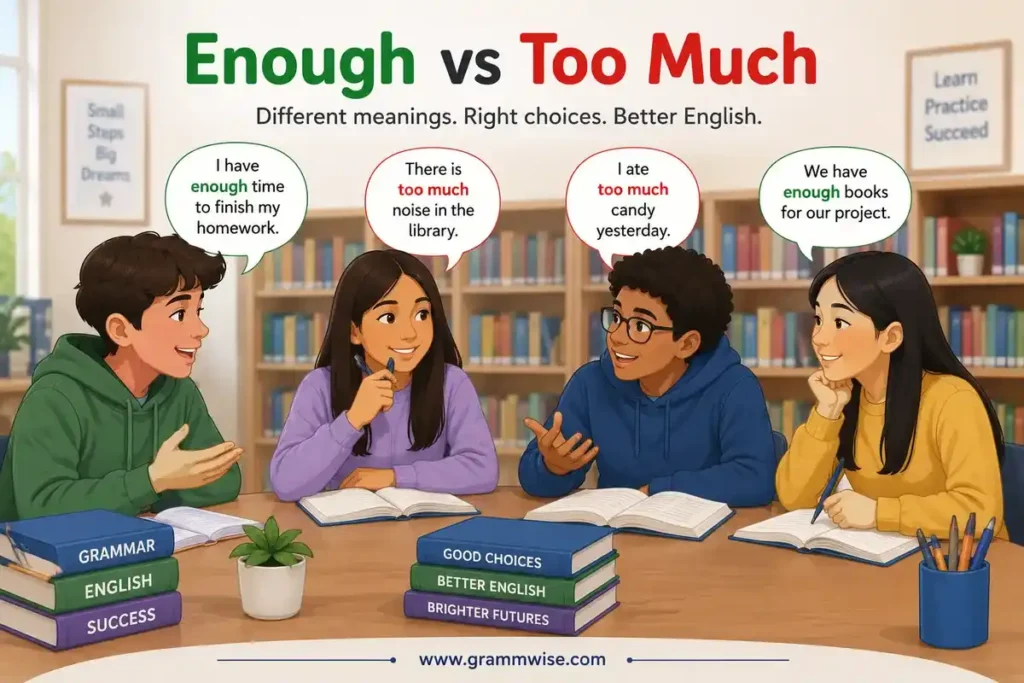
How People Actually Use “Enough vs Too Much” in Daily English?
Here are some natural examples.
Using “Enough”
- I have enough money for lunch.
- We brought enough chairs for everyone.
- She has enough experience to do the job.
- There is enough milk in the fridge.
- They have enough time to finish the project.
Using “Too Much”
- There is too much sugar in this cake.
- I spent too much money yesterday.
- He talks too much during class.
- We have too much homework tonight.
- She drinks too much coffee.
Everyday Conversations
“I don’t have enough time today.”
“There is too much traffic this morning.”
“Do we have enough food for everyone?”
“You are watching too much television.”
“We saved enough money for our vacation.”
These examples show how often native English speakers use these expressions in daily life.
Common Mistakes People Make About “Enough vs Too Much”
Many learners make small mistakes because both expressions talk about amount.
Here are some common examples.
Mistake 1
❌ I have too much friends.
✅ I have too many friends.
Use too many with countable nouns like friends, books, and cars.
Mistake 2
❌ There is enough many food.
✅ There is enough food.
Do not use many after enough in this sentence.
Mistake 3
❌ I don’t have too much money to buy it.
✅ I don’t have enough money to buy it.
The problem is having less than needed, not more than needed.
Mistake 4
❌ There are too much apples.
✅ There are too many apples.
Use too many with countable nouns like apples.
The easiest way to avoid mistakes is to ask yourself one simple question.
Is the amount correct or greater than needed?
If it is the right amount, use enough.
If it is more than needed, use too much.
Final Teacher Explanation
Now imagine we are finishing today’s English lesson.
Here is the easiest way to remember Enough vs Too Much.
If you have the amount you need, use enough.
If you have more than you need, use too much.
Think about eating dinner.
If your plate has enough food, you can enjoy your meal without feeling hungry.
If your plate has too much food, you may not be able to finish it.
That simple picture can help you remember the difference every day.
One more thing is important.
Use too much with uncountable nouns like water, milk, sugar, money, and time.
Use too many with countable nouns like books, chairs, people, and apples.
Remember this simple rule.
Enough = The right amount
Too Much = More than needed
If you ask yourself whether the amount is “just right” or “more than needed,” you will choose the correct expression every time.
Quick Recap “Enough vs Too Much”
The difference between Enough vs Too Much is very simple.
Use enough when the amount is just right.
Use too much when there is more than needed.
Just remember:
Enough = Just Right
Too Much = More Than Needed
Conclusion
Understanding Enough vs Too Much is simple once you know the difference. Enough means having the right amount, while too much means having more than you need. Learning this simple rule will help you use both expressions correctly in everyday English.
Keep practicing these expressions in daily conversations and writing. Remember this easy trick: Enough = Just the Right Amount and Too Much = More Than Needed. With regular practice, you will avoid common mistakes and speak English with more confidence.
Frequently Asked Questions (FAQs)
What does enough mean in simple words?
Enough means having the amount that is needed. It is not too little or too much.
What does too much mean?
Too much means having more than you need or more than is good.
What is the difference between enough vs too much?
Enough means the right amount. Too much means more than the right amount.
Can I use enough and too much with the same noun?
Yes. For example, you can say enough water or too much water. The meaning changes depending on the amount.
When should I use too many instead of too much?
Use too many with countable nouns like books, students, or apples. Use too much with uncountable nouns like water, money, or sugar.
Is enough a positive word?
Usually, yes. It means your needs have been met.
Why do people confuse enough vs too much?
Both expressions describe amount, so learners sometimes forget that one means the right amount and the other means more than needed.
How can I remember the difference between enough and too much?
Think of a full glass. If it is filled just right, it is enough. If it overflows, it is too much.