
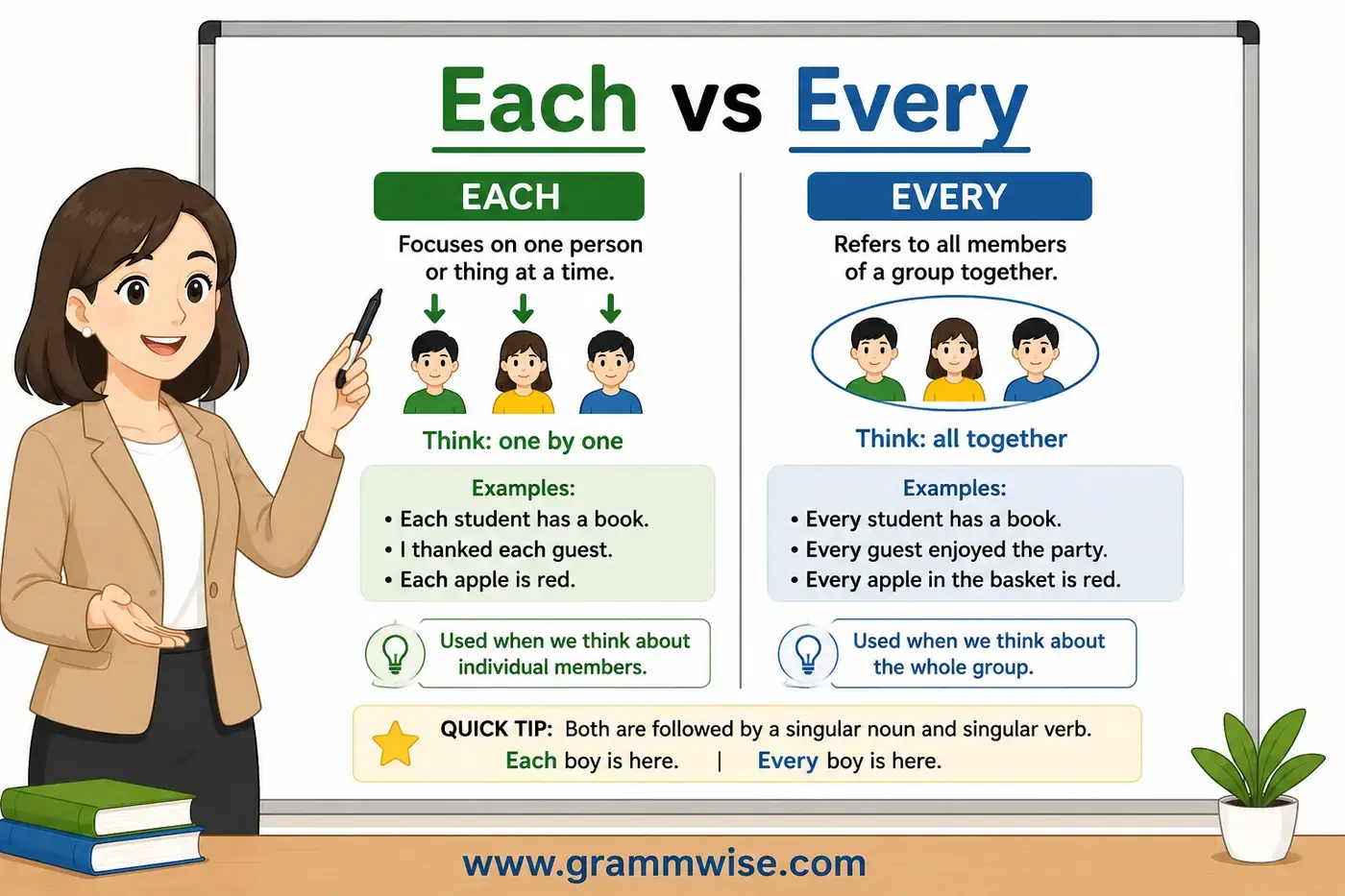
Many English learners get confused about each vs every because both words talk about people or things one by one. They seem to have the same meaning, but they are not always used in the same way. Knowing the difference between each vs every will help you speak and write more naturally.
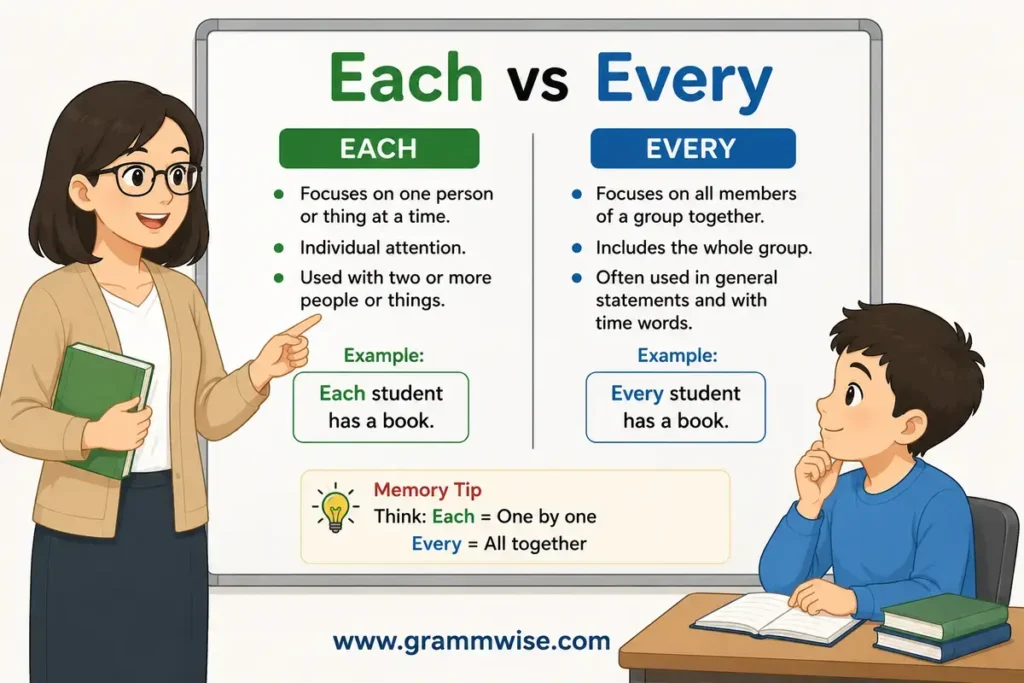
The short answer is simple. Each focuses on one person or thing at a time. Every talks about all members of a group as a whole. In many sentences, you can use either word, but sometimes only one is correct.
In this guide, you will learn the meaning of each and every, the difference between them, when to use each one, common mistakes, easy examples, and simple memory tips. By the end, you will know exactly which word to choose in everyday English.
Check related grammar articles to strengthen your English writing skills such as Let vs Allow.
Simple Answer in One Look
Each means every person or thing is considered one at a time.
Every means all members of a group are included together.
Easy rule: Think one by one = each and all together = every.
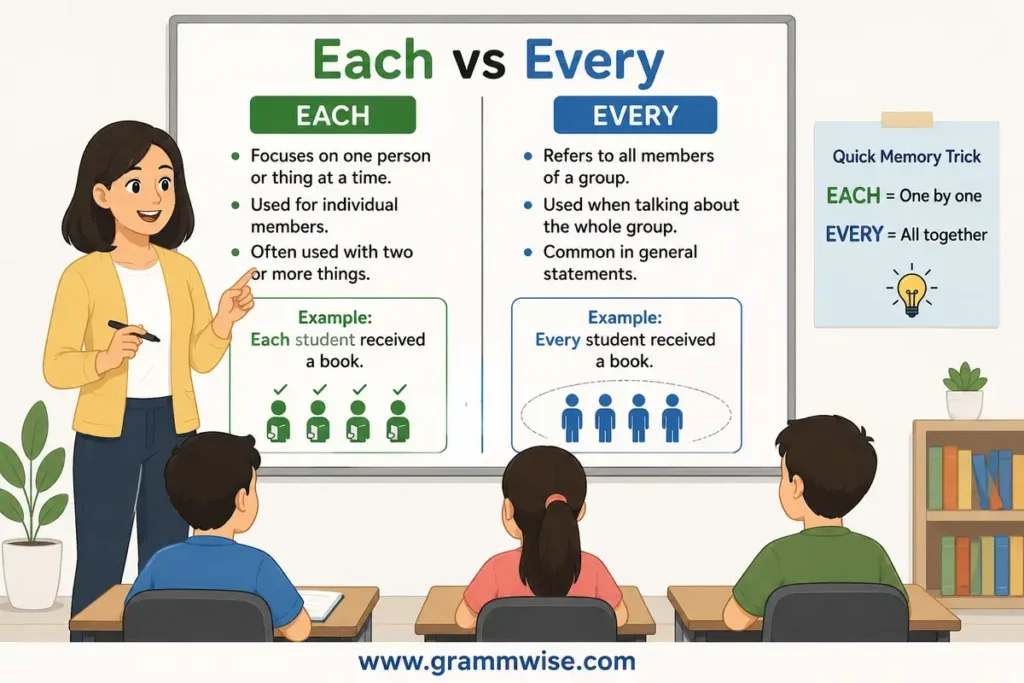
What Do Each vs Every Mean in Simple English?
Both each and every are words that help us talk about all the people or things in a group. The difference is how we think about that group.
What Does “Each” Mean?
Each focuses on one person or one thing at a time.
Even though you are talking about a group, you are thinking about every member separately.
Examples:
- Each student received a book.
- Each flower has a different color.
- Each child smiled at the teacher.
- I checked each answer carefully.
- Each player wore a team shirt.
In every example, the attention is on individual people or things.
What Does “Every” Mean?
Every includes all members of a group together.
Instead of thinking about one person at a time, you think about the whole group.
Examples:
- Every student passed the test.
- Every house has a garden.
- Every morning I drink coffee.
- Every car needs fuel.
- Every child deserves respect.
Here, the speaker is talking about the complete group.
Why Do People Mix These Words Each vs Every?
Many people confuse each and every because both can often fit into the same sentence.
Look at these examples:
- Each student received a certificate.
- Every student received a certificate.
Both sentences are correct.
The meaning is almost the same, but the focus changes.
The first sentence makes you think about students one by one.
The second sentence makes you think about the whole class.
This small difference is why learners often become confused.
Another reason is that many languages use only one word for both meanings, while English uses two different words.
Clear Difference Between Each vs Every
Here is an easy comparison.
| Each | Every |
|---|---|
| Focuses on one person or thing at a time | Focuses on the whole group |
| Shows individual attention | Shows all members together |
| Often used with two or more people or things | Usually used with three or more people or things |
| Common when talking about separate actions | Common when making general statements |
| Can come after a noun in some expressions | Normally comes before a singular noun |
Think about handing out pencils.
If you give one pencil to one student, then another pencil to another student, you are thinking about each student.
If you simply say that all students received pencils, you are talking about every student.
Which Form Should You Use “Each vs Every”?
Choosing between each and every becomes easy when you remember a few simple rules.
Use “Each” When You Think About Individuals
Choose each when every person or thing is important by itself.
Examples:
- Each answer was different.
- Each team member had a job.
- Each cookie was decorated by hand.
- I spoke to each guest.
- Each child received a prize.
Use “Every” When Talking About the Whole Group
Choose every when you mean all members together.
Examples:
- Every classroom has windows.
- Every employee attended the meeting.
- Every book on the shelf is new.
- Every family has traditions.
- Every student must bring a notebook.
Use “Each” with Two Things
When there are only two people or things, each is usually the better choice.
Correct:
- Each hand has five fingers.
- Each side of the road has trees.
Less natural:
- Every hand has five fingers.
Use “Every” for Regular Events
Every is commonly used with time expressions.
Examples:
- Every day
- Every week
- Every month
- Every year
- Every morning
- Every evening
- Every weekend
These expressions are very common in spoken and written English.
Easy Real-Life Sentences on Each vs Every
These examples show how native English speakers use each and every in daily life.
Examples with “Each”
- Each student brought a notebook.
- Each player shook hands after the game.
- I thanked each guest before they left.
- Each room has a large window.
- She gave each child a balloon.
- We looked at each picture carefully.
- Each question has only one correct answer.
- Each worker received a safety helmet.
Examples with “Every”
- Every morning I go for a walk.
- Every seat was taken.
- Every family needs food and water.
- Every child loves a good story.
- Every house on this street looks different.
- Every weekend we visit our grandparents.
- Every lesson teaches something new.
- Every person has unique talents.
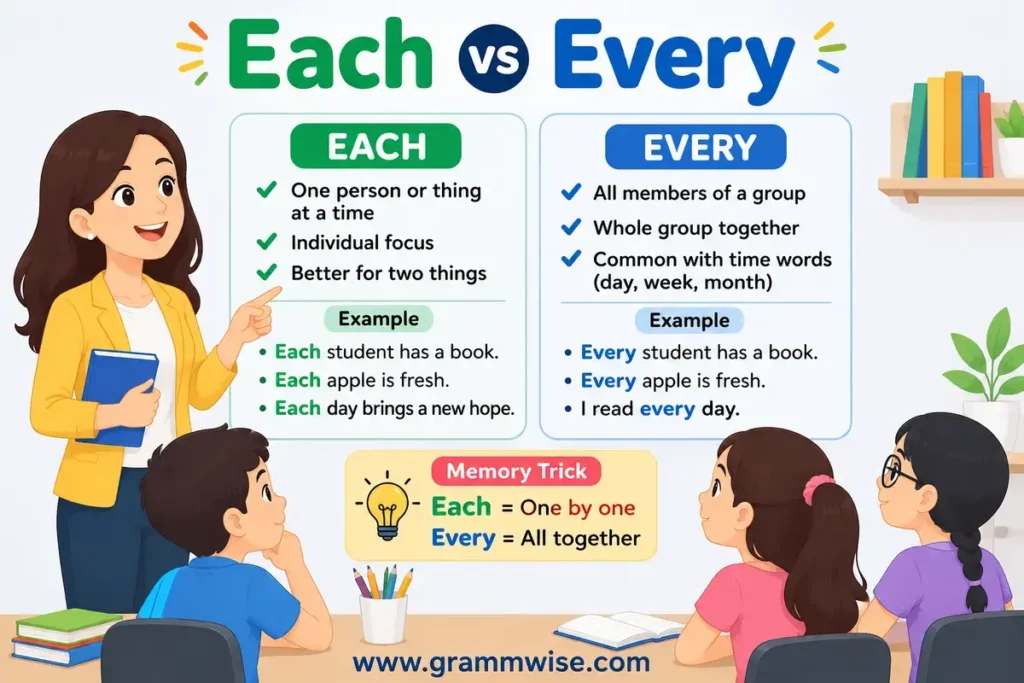
Where Do Each vs Every Come From?
The words each and every have been part of English for hundreds of years.
The word each comes from very old English. It originally meant every one or one by one. Its meaning has stayed almost the same over time.
The word every also comes from Old English. It developed from words that meant all together or every single one.
Although both words are very old, people still use them every day because they clearly express two different ideas. One focuses on individuals, while the other focuses on the whole group.
Both words remain an important part of everyday English and appear in conversations, books, newspapers, schools, and workplaces around the world.
How These Words Are Understood in Culture and Stories
The words each and every do more than explain grammar. They also show two different ways of thinking. One focuses on individuals, while the other focuses on the whole group. This idea appears in stories, classrooms, families, and everyday life.
When a story says each child received a gift, it helps readers picture every child one by one. It gives personal attention to everyone. The writer wants us to think about each person as an individual.
When a story says every child smiled, it creates a picture of the whole group smiling together. The focus is not on one child but on everyone at the same time.
This difference is often used in books, movies, and speeches. Writers choose each when individual people matter. They choose every when they want to describe the entire group.
Biblical and Mythological Meaning of Each vs Every
The Bible often uses ideas that are similar to each and every, even though different translations may use different wording.
For example, many Bible verses teach that God knows each person personally. This shows individual care and love.
Other verses speak about every nation, every believer, or every living thing. Here, the meaning includes everyone together.
In mythology, heroes often receive individual tasks. Each hero has a different journey. At the same time, stories may describe every warrior joining a battle or every citizen celebrating a victory.
These examples show how English uses each for individual attention and every for complete groups.
Symbolism of “Each vs Every” in Simple Words
What “Each” Represents?
The word each represents individuality, personal care, uniqueness, and attention to detail.
When teachers help each student, they focus on one learner at a time. When parents spend time with each child, they show personal care for every member of the family.
The word reminds us that every individual matters.
What “Every” Represents?
The word every represents unity, completeness, fairness, and inclusion.
When a school says every student is welcome, it includes the whole student body. When people say every vote counts, they mean all votes are important together.
The word reminds us to think about everyone as one complete group.
Related Words You Should Know
Learning related words makes it easier to understand each vs every.
All – Refers to the whole group together.
Both – Refers to two people or things together.
Either – Refers to one of two choices.
Neither – Means not one and not the other.
Any – Refers to one or more without being specific.
Everybody – Means every person.
Everyone – Another word for every person.
Everything – Means all things.
Individual – One single person or thing.
Whole – Means complete or entire.
Knowing these words will help you choose the correct expression in different situations.
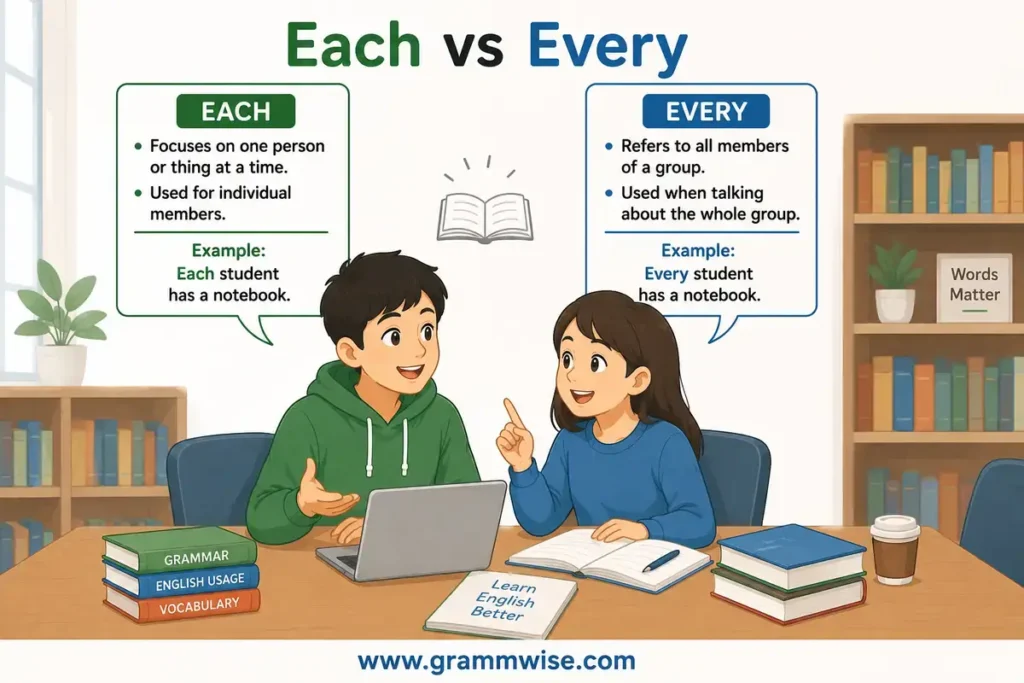
How People Actually Use Each vs Every in Daily English?
Native English speakers use both words every day, but they choose them based on what they want to emphasize.
Examples with each:
- Each student answered the question.
- Each team member received a medal.
- I thanked each guest personally.
- Each box contains ten pencils.
- Each employee has a different schedule.
- The teacher checked each notebook.
- We visited each room in the museum.
- Each friend brought a gift.
Examples with every:
- Every student needs a pencil.
- Every Monday we have a meeting.
- Every family celebrates holidays differently.
- Every classroom has a whiteboard.
- Every person deserves respect.
- Every week I call my grandparents.
- Every country has its own traditions.
- Every morning she drinks tea.
These examples show that each sounds more personal, while every sounds broader and includes the whole group.
Common Mistakes People Make
Many English learners confuse each and every because their meanings are very close.
Mistake 1: Using “every” for only two things
❌ Every side of the paper.
✅ Each side of the paper.
When there are only two people or things, each is usually the better choice.
Mistake 2: Thinking the words always mean exactly the same
Although many sentences allow both words, the focus changes.
Example:
- Each student received a certificate.
- Every student received a certificate.
Both are correct, but each highlights individual students, while every highlights the whole class.
Mistake 3: Using a plural noun after each or every
❌ Each students received a prize.
✅ Each student received a prize.
❌ Every books are interesting.
✅ Every book is interesting.
Both each and every are followed by a singular noun.
Mistake 4: Forgetting the singular verb
❌ Every student are ready.
✅ Every student is ready.
❌ Each child have a ticket.
✅ Each child has a ticket.
Remember that both words normally take singular verbs.
Final Teacher Explanation
The easiest way to remember each vs every is to think about your point of view. If you are looking at people or things one by one, choose each. If you are looking at the whole group together, choose every.
Also remember that both words are followed by singular nouns and usually singular verbs. With a little practice, you will quickly know which word sounds more natural in every situation.
Quick Recap “Each vs Every”
If you are choosing between each vs every, remember this simple rule: each focuses on one person or thing at a time, while every includes all members of a group together.
Use each for individual attention and every for general statements. This easy rule will help you use both words correctly in speaking and writing.
Conclusion
Understanding each vs every becomes easy when you remember the main idea. Each focuses on one person or thing at a time, while every refers to all members of a group together. Knowing this simple difference will help you choose the right word in both speaking and writing.
The best way to master these words is through regular practice and real-life examples. As your English vocabulary and grammar improve, using each and every correctly will become natural, making your communication clearer, more accurate, and more confident.
Frequently Asked Questions (FAQs)
What is the difference between each and every?
Each focuses on individuals one at a time, while every refers to all members of a group together.
Can I use each and every in the same sentence?
Yes. In many sentences, both are correct, but they give a slightly different focus.
Is each used with singular or plural nouns?
Each is followed by a singular noun.
Is every followed by a singular verb?
Yes. Every usually takes a singular noun and a singular verb.
Which is better for two people or things?
Each is usually the correct choice when talking about two people or two things.
Why do people confuse each and every?
They have similar meanings and are often correct in the same sentence, but they emphasize different ideas.
Can I say every day and each day?
Yes. Both are correct. Every day is more common, while each day gives slightly more emphasis to individual days.
How can I remember the difference?
Use this memory trick: Each = one by one. Every = all together.