
Have you ever wondered about i.e. vs e.g.? Many people mix these two short forms because they look almost the same. They both appear in books, emails, school work, and business writing. Because of that, it is easy to think they mean the same thing. But they do not.
The good news is that learning i.e. vs e.g. is much easier than most people think. You only need to remember one simple idea. One gives more details, and the other gives examples. Once you know this, you will feel much more confident when writing.
In this guide, I will explain everything in very simple English. You will see clear meanings, easy rules, real-life examples, and simple tips that you can remember every day.
Understanding word differences improves writing clarity and communication.
Simple Answer in One Look i.e. vs e.g.
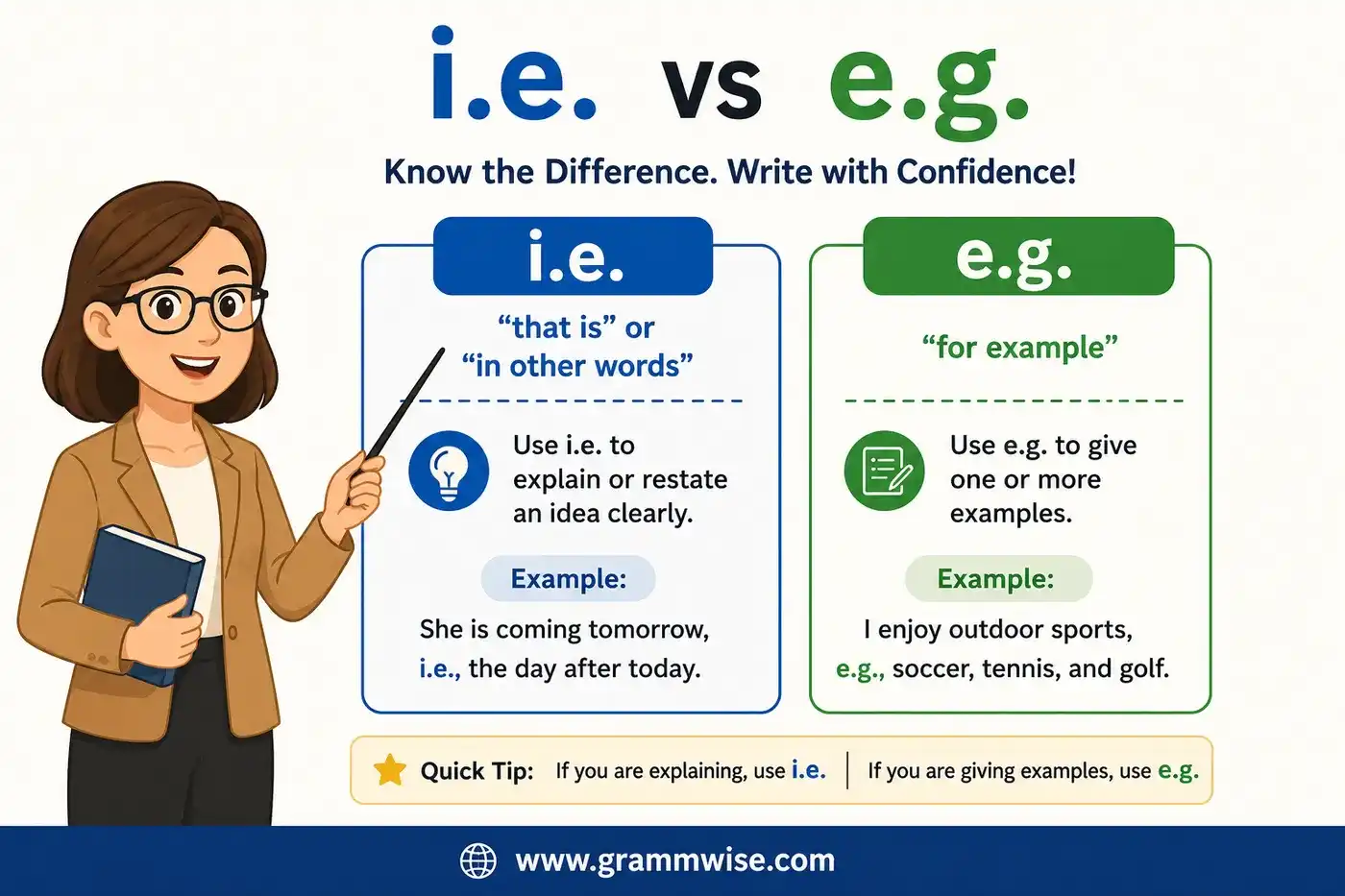
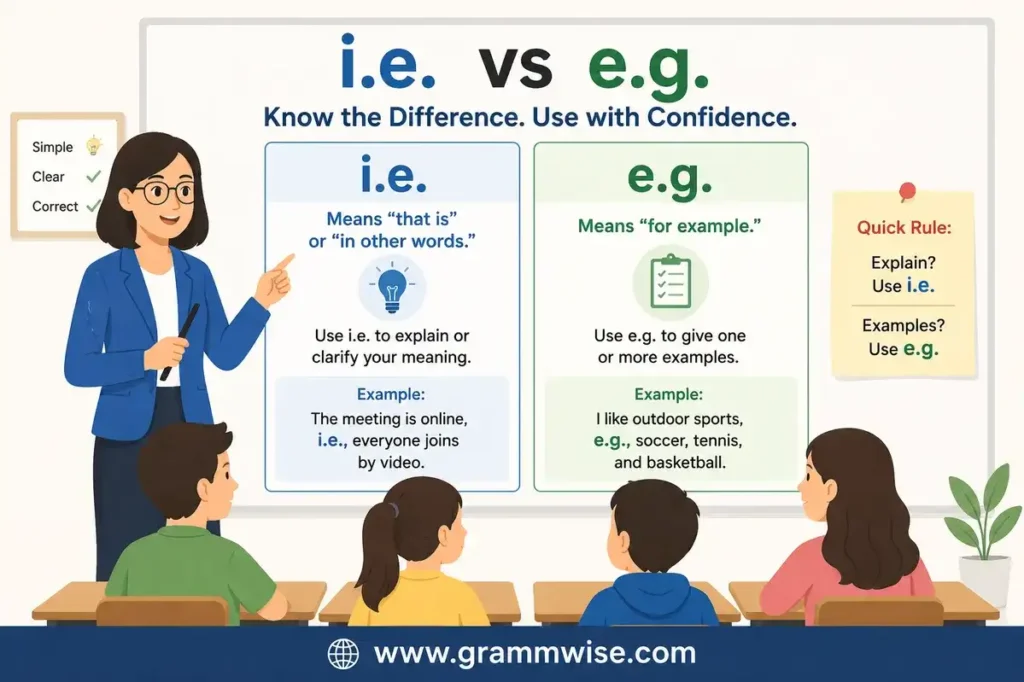
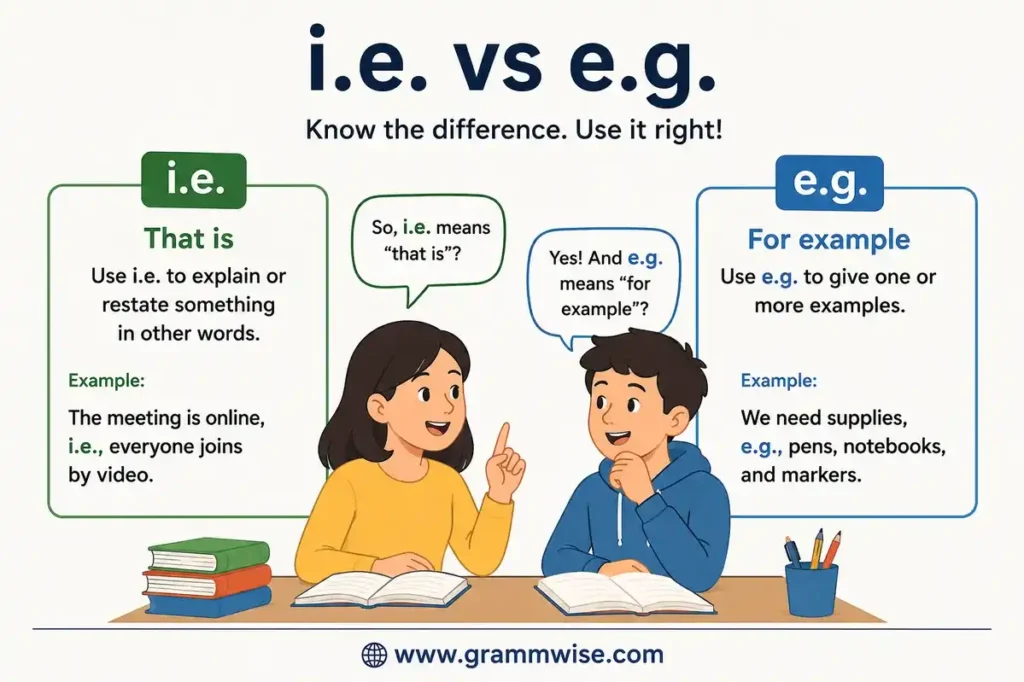
i.e. means “that is” or “in other words.”
e.g. means “for example.”
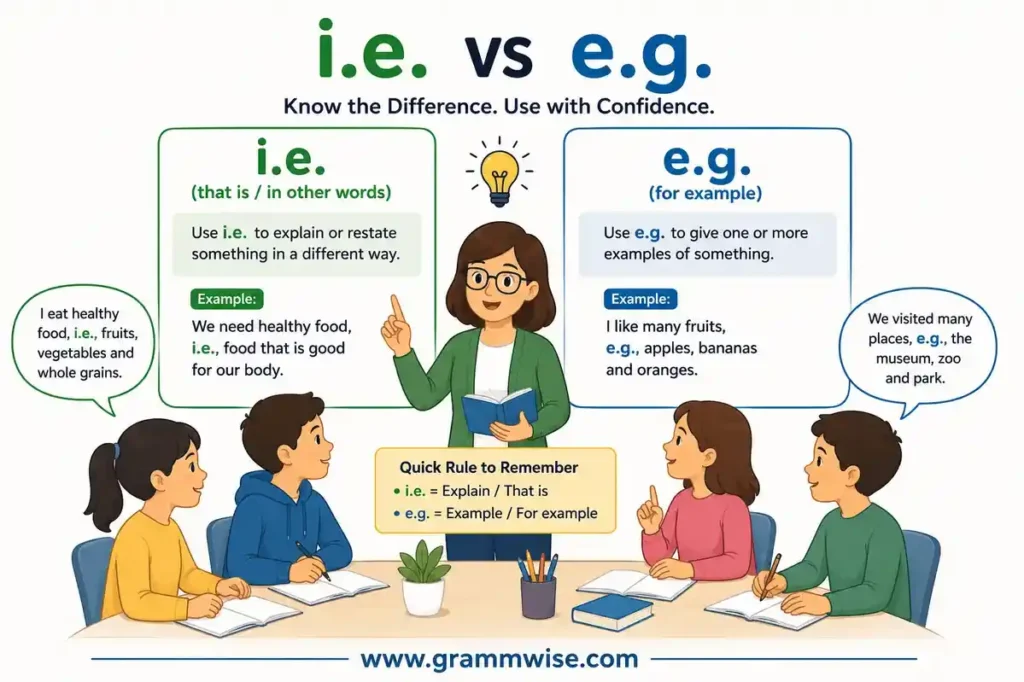
Use i.e. to explain something in a different way.
Use e.g. to give one or more examples.
Means of i.e. vs e.g. in Simple English
Think about talking to a friend.
Sometimes you say something, and then you explain it more clearly.
Other times, you say something and then give a few examples.
That is the difference between i.e. and e.g.
What does i.e. mean?
i.e. tells the reader:
“This is another way to say the same thing.”
It does not add new ideas. It simply explains the first idea more clearly.
For example:
I wake up early, i.e., before 6:00 every morning.
The second part explains what “early” means.
Another example:
She is my oldest cousin, i.e., the first grandchild in our family.
The words after i.e. explain the first statement.
What does e.g. mean?
e.g. tells the reader:
“Here are some examples.”
The examples are only part of the whole group.
For example:
I enjoy outdoor sports, e.g., soccer and tennis.
There are many outdoor sports. Soccer and tennis are only two examples.
Another example:
Bring something to read, e.g., a magazine or a novel.
The magazine and novel are just examples. You could bring something else instead.
Why People Mix These Short Forms i.e. vs e.g.
Many students ask why these two expressions cause so much confusion.
There are several simple reasons.
They look almost the same. i.e. vs e.g.
Both are very short.
Both use periods.
Both usually appear inside a sentence.
When people read quickly, they often confuse them.
Both add extra information.
After both expressions, you see more words.
Because of this, people think they have the same job. But they do different jobs.
One explains.
One gives examples.
Many people never learn the difference i.e. vs e.g.
Schools sometimes mention them only once. People copy what they see online without checking if it is correct. As a result, the mistake spreads.
They come from another language.
Both expressions came from Latin many years ago. Today, most English speakers only remember what they mean in English. Because the letters are unusual, they are easy to mix up.
Clear Difference of i.e. vs e.g. Explained Simply
Imagine you have a box of fruit.
If you say:
I bought fruit, e.g., apples and bananas.
You are showing two examples.
There may also be oranges, grapes, and pears.
Now imagine you say:
I bought citrus fruit, i.e., fruit like oranges and lemons only.
Now you are explaining exactly what kind of fruit you mean.
That is the easiest way to remember the difference.
Quick comparison i.e. vs e.g.
Use i.e. when:
- You explain your meaning.
- You say the same idea in another way.
- You make your sentence clearer.
- The second part replaces the first idea.
Use e.g. when:
- You give examples.
- You list one or more items.
- Other examples are also possible.
- The list is not complete.
Easy memory trick
Think like this:
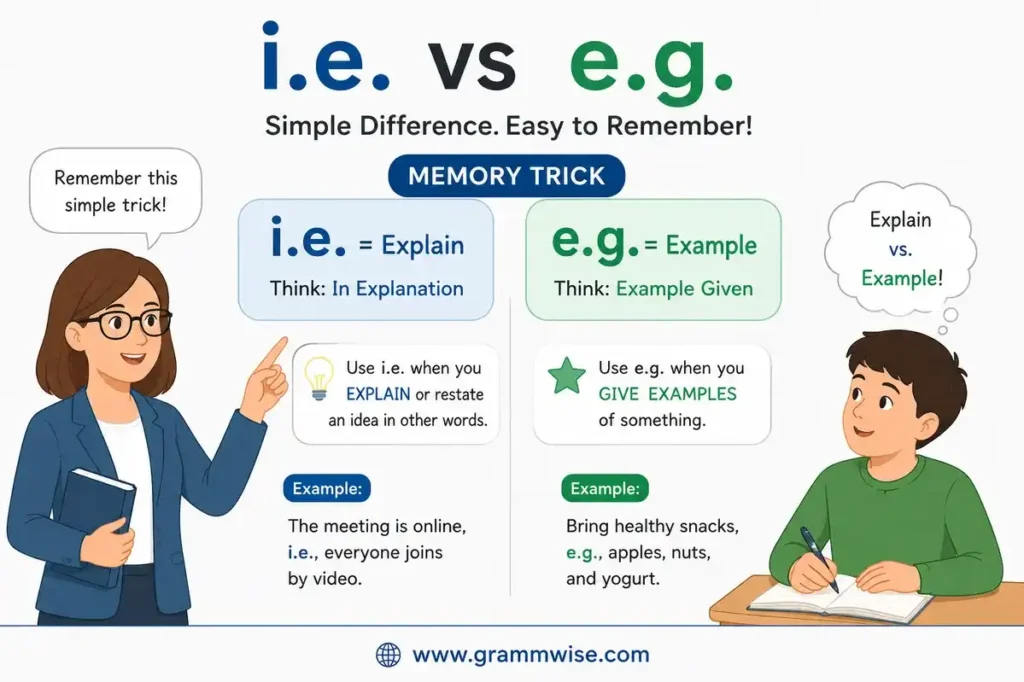
i.e. = In Explanation
Even though the letters do not actually stand for those words, this trick helps many students remember its job.
e.g. = Example Given
Again, this is just a memory trick.
Whenever you see e.g., think about examples.
Which Form Should You Use i.e. vs e.g.?
Ask yourself one simple question.
Are you explaining?
Use i.e.
Example:
We will meet after lunch, i.e., around 1:00 p.m.
The time explains what “after lunch” means.
Are you giving examples?
Use e.g.
Example:
We need office supplies, e.g., pens, paper, and folders.
These are examples.
The office may also need tape or markers.
A simple rule
If you can replace the abbreviation with “that is,” use i.e.
If you can replace it with “for example,” use e.g.
This quick test works almost every time.
i.e. vs e.g.: Difference Table
| Feature | i.e. | e.g. |
|---|---|---|
| Meaning | That is | For example |
| Purpose | Explains or restates an idea | Gives one or more examples |
| Use When | You want to make something clearer | You want to show sample items |
| Example Sentence | The meeting is online, i.e., everyone joins by video. | Bring snacks, e.g., fruit, crackers, and nuts. |
Easy Real-Life Sentences In Which We Use i.e. vs e.g.
Here are simple examples you can use in everyday writing.
Examples with i.e.
- The store opens early, i.e., at 8:00 every morning.
- He lives nearby, i.e., only two blocks away.
- We need one volunteer, i.e., one person to help.
- The meeting is online, i.e., everyone joins by computer.
- She is bilingual, i.e., she speaks two languages.
Examples with e.g.
- I enjoy sweet fruits, e.g., peaches and mangoes.
- We visited several cities, e.g., Boston and Chicago.
- Please bring school supplies, e.g., notebooks and pencils.
- Some pets, e.g., rabbits and hamsters, are easy to care for.
- Healthy snacks, e.g., apples and yogurt, are great after school.
Where This Expression i.e. vs e.g. Comes From?
Both i.e. and e.g. have been used for hundreds of years. They come from Latin, an ancient language that influenced English.
- i.e. comes from id est, which means “that is.”
- e.g. comes from exempli gratia, which means “for example.”
Today, you do not need to remember the Latin words. You only need to remember their English meanings. When you write in English, think:
- i.e. = that is
- e.g. = for example
That is enough for almost every situation.
How This Form i.e. vs e.g. Is Understood in Culture and Stories
Most people use i.e. and e.g. because they make writing shorter and clearer. They are common in books, newspapers, school papers, business emails, websites, and even social media posts.
You will probably not hear people say “i.e.” or “e.g.” when talking with friends. Instead, they usually say the full phrases.
For example, someone might say:
“In other words, we need to leave now.”
Instead of saying:
“I.e., we need to leave now.”
The same is true for e.g. People usually say:
“For example…”
instead of saying the letters aloud.
In writing, however, these short forms save space and help readers understand your meaning quickly. Many teachers, editors, and professionals use them every day because they make writing neat and organized.
You may also notice that some writers spell out “for example” instead of using e.g. This is also correct, especially when writing for young readers or a general audience. Likewise, many writers prefer “that is” instead of i.e. because it sounds more natural.
The important thing is not whether you use the abbreviation or the full phrase. The important thing is choosing the correct one.
Biblical and Mythological Meaning of i.e. vs e.g.
Unlike many English words, i.e. and e.g. do not have special meanings in the Bible or in mythology.
They are simply writing abbreviations. You will not find them used as symbols in famous Bible stories. You will not see them connected with Greek or Roman myths either. Their job is only to help explain ideas or give examples.
Even though they come from Latin, they were created to make writing clearer. Because of this, there are no hidden religious or mythological meanings behind them.
Symbolism of i.e. vs e.g. Explained in Simple Words
Although i.e. and e.g. are not symbols, you can think of them as doing two different jobs.
What i.e. Represents?
Think of i.e. as a teacher standing beside you.
You say something.
The teacher smiles and says,
“Let me explain that another way.”
That is exactly what i.e. does.
It makes your meaning clearer.
It removes confusion.
It helps readers understand exactly what you mean.
You can think of it as a small flashlight that shines on one idea.
What e.g. Represents?
Now imagine a teacher opening a box full of objects.
Instead of explaining everything, the teacher picks out two or three items.
Those items are examples.
That is the job of e.g.
It says,
“Here are a few examples.”
It does not show everything.
It only gives enough examples to help readers understand.
A simple way to picture them is this:
- i.e. points to one clear meaning.
- e.g. points to several possible examples.
Related Words to i.e. vs e.g. You Should Know
Learning a few related words will make i.e. vs e.g. even easier to remember.
That is
This has the same meaning as i.e.
You can often replace i.e. with that is.
Example:
The meeting starts early, that is, at 8:00 a.m.
In other words
This is another simple replacement for i.e.
It explains the first idea.
Example:
She passed the test. In other words, she can move to the next class.
For example
This has the same meaning as e.g.
Many teachers prefer writing it in full.
Example:
Bring fruit, for example, apples or grapes.
Such as
This also introduces examples.
Example:
I like winter sports such as skiing and skating.
Including
This word introduces examples that belong to a larger group.
Example:
Many countries, including Canada and Japan, have beautiful national parks.
Namely
This word is close to i.e.
It tells readers exactly which people or things you mean.
Example:
Two students won the prize, namely Emma and Noah.
Specifically
This word gives more exact information.
It works much like i.e.
Example:
We need one volunteer, specifically someone with computer skills.
How People Actually Use i.e. vs e.g. in Daily English?
Although these abbreviations appear more often in writing than in speaking, they are used every day.
Here are some natural examples.
At school
Please bring writing supplies, e.g., pencils, markers, and notebooks.
At work
The meeting is virtual, i.e., everyone joins online.
In an email
Please attach the required files, e.g., your resume and cover letter.
On a website
We sell outdoor gear, e.g., tents, backpacks, and hiking boots.
In cooking
Add fresh herbs, e.g., parsley or basil.
During travel
Visit famous landmarks, e.g., museums and historic buildings.
In healthcare
Drink healthy liquids, e.g., water and milk.
While shopping
We need dairy products, e.g., cheese and yogurt.
In business writing
Sales increased last quarter, i.e., the company earned more money than before.
In homework
Use transition words, e.g., however, therefore, and finally.
These examples show how useful these abbreviations are in everyday writing.
Common Mistakes People Make About i.e. vs e.g.
Even experienced writers sometimes confuse i.e. vs e.g.
Here are the mistakes you should avoid.
Mistake 1: Using i.e. instead of e.g.
❌ I like sports, i.e., soccer and basketball.
This sounds like soccer and basketball are the only sports.
✅ I like sports, e.g., soccer and basketball.
Now they are simply examples.
Mistake 2: Using e.g. when explaining
❌ The meeting starts after lunch, e.g., at 1:00 p.m.
This is not giving examples.
It is giving the exact meaning.
✅ The meeting starts after lunch, i.e., at 1:00 p.m.
Mistake 3: Thinking they mean the same thing
They do not.
Remember:
- i.e. explains.
- e.g. gives examples.
Mistake 4: Giving a complete list after e.g.
The list after e.g. should usually be examples.
If you are naming every item, i.e. or another phrase may fit better.
Mistake 5: Forgetting punctuation
In American English, writers often place a comma after the abbreviation.
Example:
Bring snacks, e.g., fruit and crackers.
Some style guides are different.
The most important thing is to stay consistent throughout your writing.
Mistake 6: Saying the letters in conversation
Most native English speakers simply say:
- “for example”
- “that is”
- “in other words”
instead of reading the letters aloud.
Mistake 7: Trying to sound more formal
Some people think using i.e. and e.g. always makes writing better. That is not true. Sometimes writing the full phrases is easier for readers. Choose whichever makes your writing the clearest.
Final Teacher Explanation
Imagine I am standing in front of a classroom.
I write two small abbreviations on the board.
i.e.
e.g.
Then I ask one question.
“Are you explaining, or are you giving examples?”
That single question tells you which one to choose.
If you are explaining exactly what you mean, use i.e. If you are showing one or more examples, use e.g. That is the whole lesson. You do not need to memorize Latin words. You do not need difficult grammar rules. Just remember the job each one does.
Whenever you write, stop for one second and ask yourself:
Am I explaining?
Use i.e.
Am I giving examples?
Use e.g.
The more you practice, the more natural it will become. Soon, you will choose the correct abbreviation without even thinking about it. That is how good writing habits grow.
Quick Recap i.e. vs e.g.
The difference between i.e. vs e.g. is simple.
- Use i.e. when you mean “that is” or “in other words.”
- Use e.g. when you mean “for example.”
If you remember explain vs. example, you will almost always choose the correct one.
Conclusion
Understanding i.e. vs e.g. is easier when you remember one simple rule. Use i.e. when you want to explain your meaning, and use e.g. when you want to give examples. This small difference can make your writing clearer, more accurate, and easier for every reader to understand.
The more you practice these two expressions, the more natural they will become. Before you write, ask yourself one question: Am I explaining something or giving examples? That simple habit will help you choose the correct expression with confidence every time.
Frequently Asked Questions (FAQs)
What does i.e. mean in simple words?
It means “that is” or “in other words.” Use it to explain your first idea more clearly.
What does e.g. mean in simple words?
It means “for example.” Use it when you want to give one or more examples.
Which is correct: i.e. vs e.g.?
Both are correct. The right choice depends on what you want to say. Use i.e. for explanations and e.g. for examples.
Why do people confuse i.e. vs e.g.?
They look very similar, and both add extra information. The difference is that one explains, while the other gives examples.
Can I use i.e. and e.g. in formal writing?
Yes. Both are common in academic, business, and professional writing. Just make sure you use the correct one.
Should I write the full phrases instead?
You can. Writing “that is” or “for example” is often easier for general readers. Both styles are correct.
Do I need to remember the Latin words?
No. It is enough to remember that i.e. means “that is” and e.g. means “for example.”
What is the easiest way to remember i.e. vs e.g.?
Ask yourself one question:
Am I explaining something or giving examples?
If you are explaining, use i.e.
If you are giving examples, use e.g.