
People often confuse empathy and sympathy because both words relate to caring about someone else’s feelings. They may seem alike, but they are not the same. Knowing the difference helps you speak and write more clearly. It also helps you better understand other people.
Many students ask about empathy and sympathy because they hear both words in daily conversations, books, movies, and school. The good news is that the difference is easy to learn. One word means you feel with someone, while the other means you feel sorry for someone.
This guide explains empathy and sympathy in very simple English. You will learn what each word means, why people mix them up, when to use each one, and how to remember the difference with easy examples.
Understanding word differences improves writing clarity and communication.
Simple Answer in One Look
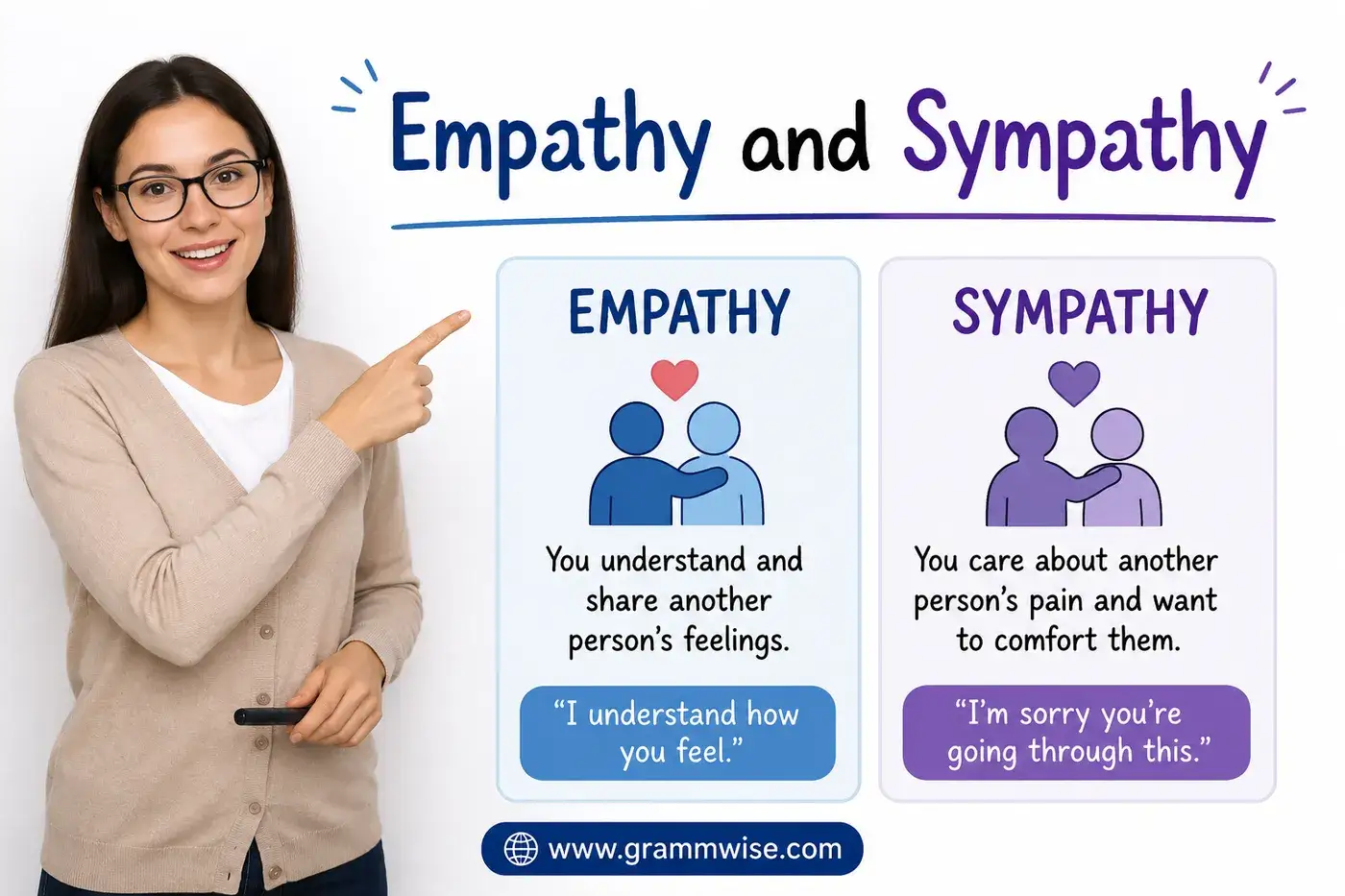
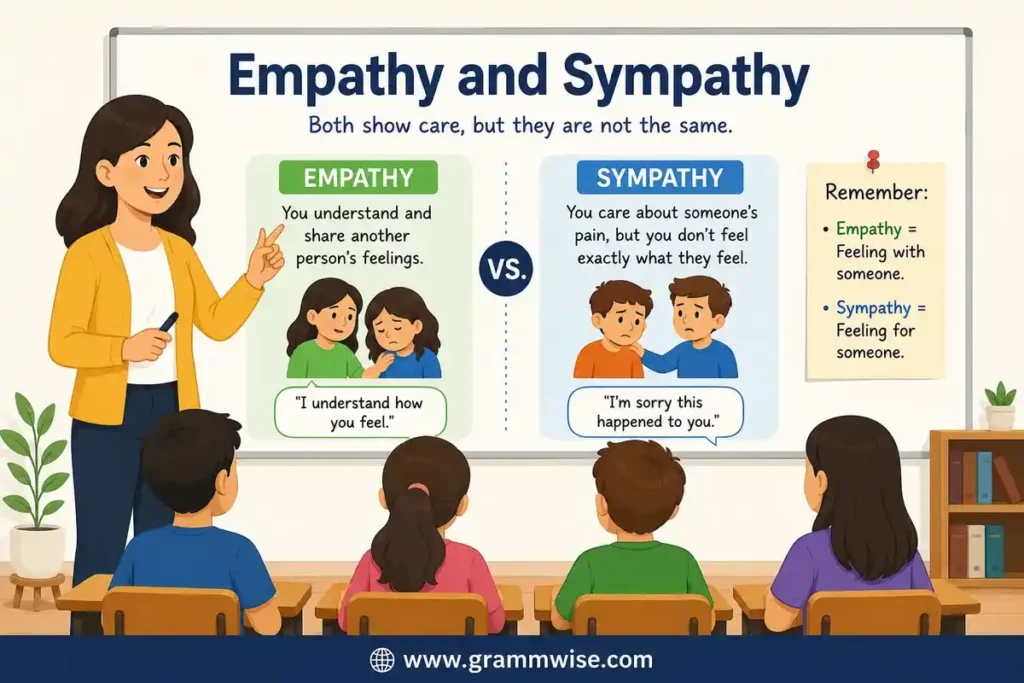
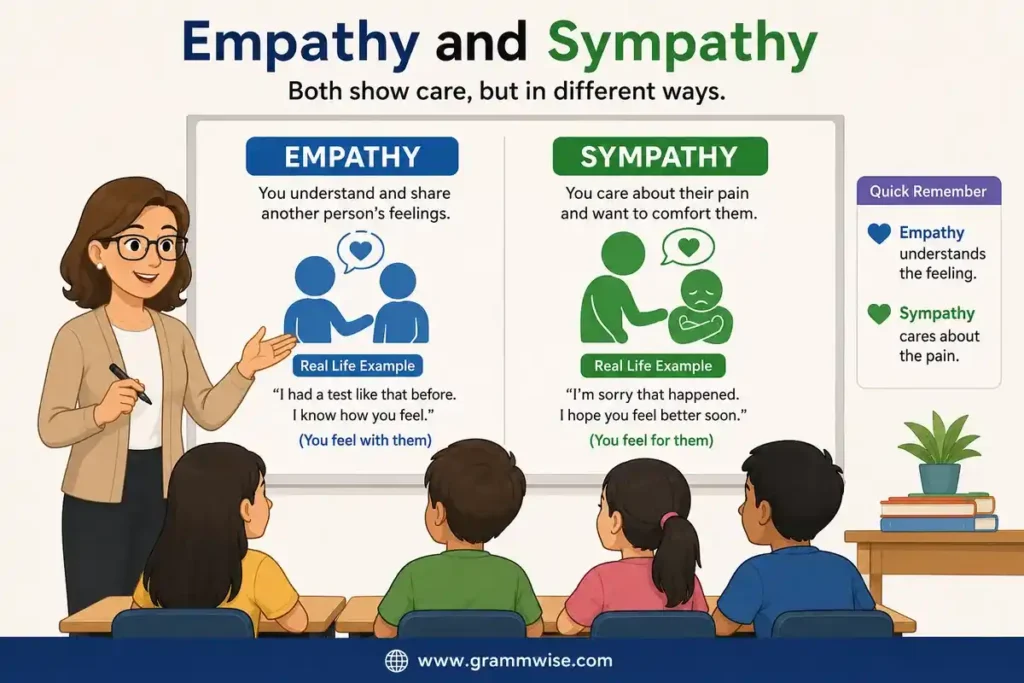
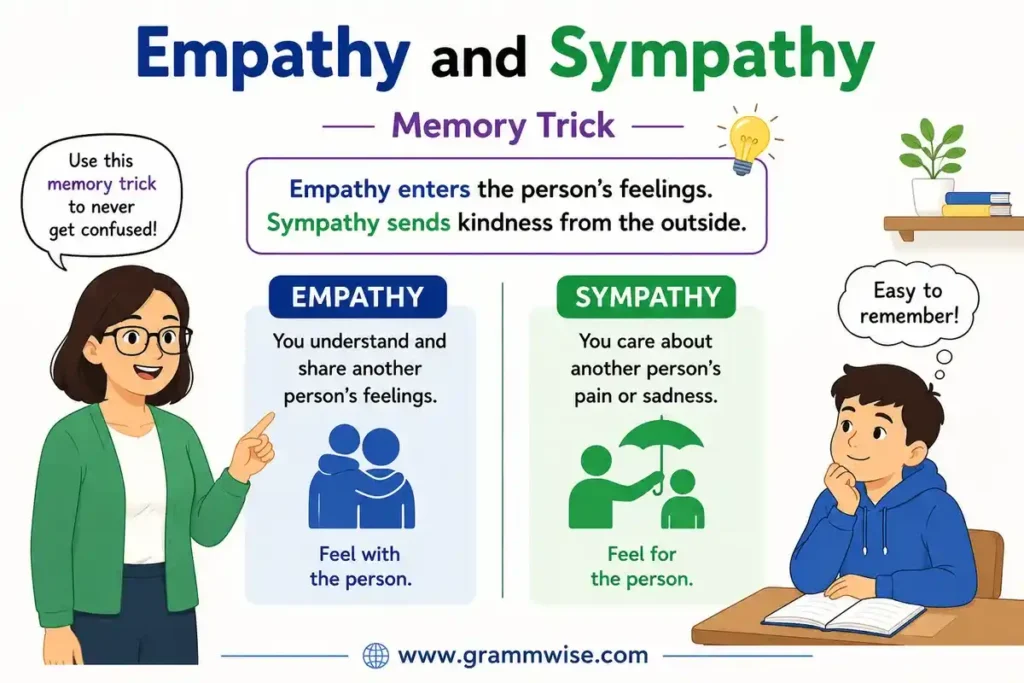
Empathy means you understand and share another person’s feelings.
Sympathy means you care about someone’s pain or sadness, but you do not feel exactly what they feel.
Meaning Empathy and Sympathy in Simple English
Think about a friend who failed an important test.
If you say, “I know how you feel because I went through the same thing,” you are showing empathy. You understand their feelings because you can imagine them or have felt them yourself.
If you say, “I’m sorry that happened to you,” you are showing sympathy. You care about your friend and want them to feel better, even if you have never had the same experience.
Here is another simple way to remember it:
- Empathy = Feeling with someone
- Sympathy = Feeling for someone
Both are kind. Neither is wrong. They simply show care in different ways.
Easy Example
Imagine your friend loses a pet.
With empathy, you might say:
“I lost my dog last year. I know how painful that feels.”
With sympathy, you might say:
“I’m so sorry for your loss. I hope you feel better soon.”
Both responses are caring, but they are different.
Why People Mix These Words Empathy and Sympathy
Many people think empathy and sympathy mean exactly the same thing because both involve kindness and caring.
Here are the main reasons people get confused.
Both Are About Feelings
When someone is sad, you may show empathy or sympathy. Since both are kind responses, people often use the words as if they mean the same thing.
They Are Used in Similar Situations
You may hear both words when someone:
- Loses a family member
- Gets sick
- Fails an exam
- Has a hard day
- Faces a difficult problem
Because the situations are the same, the words are easy to mix up.
They Sound Similar Empathy and Sympathy
Both words end with -pathy, so they look and sound related. The ending comes from a Greek word that means feeling. The beginning of each word changes the meaning.
- Em- means “within” or “inside.”
- Sym- means “together” or “with.”
That small change creates two different ideas.
Movies and Social Media
Sometimes people use these words incorrectly in videos, posts, or conversations. When enough people repeat the mistake, others begin using it too.
Clear Difference of Empathy and Sympathy Explained Simply
Here is the easiest way to compare empathy and sympathy.
| Empathy | Sympathy |
|---|---|
| You understand another person’s feelings. | You care about another person’s pain. |
| You try to see life from their point of view. | You offer kindness and support. |
| You feel with the person. | You feel for the person. |
| Often comes from shared understanding. | Can happen even if you have never had the same experience. |
Picture Empathy and Sympathy Like This
Imagine someone falls into a deep hole.
Empathy says:
“I understand how hard this is. I’m here with you.”
Sympathy says:
“I’m sorry you’re down there. I hope things get better.”
Both people are caring.
The difference is how closely they connect with the other person’s feelings.
Quick Memory Trick
Remember this sentence:
Empathy enters the person’s feelings. Sympathy sends kindness from the outside.
Which Form Should You Use Empathy and Sympathy?
Choose empathy when you want to show that you understand another person’s emotions.
Use empathy if you:
- Understand their feelings
- Can imagine their experience
- Want to connect deeply
Examples:
- Show empathy to a friend after a hard day.
- A good teacher has empathy for students.
- Doctors often need empathy when caring for patients.
Choose sympathy when you want to show care or concern.
Use sympathy if you:
- Want to comfort someone
- Feel sorry for their loss
- Wish them well
Examples:
- Send sympathy after someone loses a loved one.
- Offer sympathy during difficult times.
- Write a sympathy card.
Which Is More Common?
Both words are common.
- People often use sympathy in formal situations like funeral messages or condolence cards.
- People often use empathy when talking about relationships, parenting, teaching, leadership, or mental health.
Neither word is better than the other. The right choice depends on what you want to express.
Easy Real-Life Sentences of Empathy and Sympathy You Can Use
These simple examples show how each word is used.
Empathy
- My teacher showed empathy when I felt nervous.
- I have empathy because I faced the same problem.
- Parents should listen with empathy.
- She spoke with empathy and kindness.
- Good friends often show empathy.
- His empathy helped me feel understood.
Sympathy
- I want to express my sympathy for your loss.
- We sent flowers to show our sympathy.
- She thanked everyone for their sympathy.
- The whole class showed sympathy after the accident.
- He spoke with sympathy and care.
- Please accept my deepest sympathy.
Mixed Examples
- You can have sympathy without empathy.
- You can show empathy by listening carefully.
- Both empathy and sympathy make relationships stronger.
Origin Of Empathy and Sympathy
The words empathy and sympathy have different histories.
Sympathy is the older word. It comes from Greek words that mean feeling together. English speakers have used it for hundreds of years to describe sharing concern for another person.
Empathy is newer. It came into English in the early 1900s. At first, people used it when talking about art and how someone connects with what they see. Later, its meaning grew to include understanding another person’s emotions.
Today, both words are used in everyday English. Even though they share part of the same history, they now have different meanings.
Role of Words Empathy and Sympathy in Culture and Stories
The ideas behind empathy and sympathy appear in many cultures around the world. Even if people speak different languages, they all know what it means to care about others.
Parents teach children to be kind when a friend is sad. Teachers encourage students to understand how others feel. Friends support each other during hard times. All of these actions show either empathy, sympathy, or both.
Many stories also teach these values.
A caring neighbor may help an older person carry groceries. A classmate may comfort a student who failed a test. A stranger may offer kind words after someone has a bad day. These simple acts remind us that kindness makes people feel less alone.
In many children’s books, the main character learns to think about another person’s feelings before making a choice. This lesson is often about empathy because the character learns to see life from someone else’s point of view.
Stories about helping people after a loss often show sympathy. A person may send flowers, write a kind note, or visit someone who is grieving. These actions do not remove the pain, but they show care and support.
Movies also use these ideas. When two friends sit together after one of them is upset, they may not even say much. Just listening quietly can show empathy. Saying, “I’m sorry this happened to you,” shows sympathy.
Neither response is better than the other. Both help people feel cared for.
Across many cultures, kindness is seen as a strength. Whether you show empathy or sympathy, your goal is the same—to bring comfort and support.
Biblical and Mythological Meaning of Empathy and Sympathy
The Bible does not use the English word empathy very often, but it teaches people to love, care for, and help one another.
Many Bible stories encourage people to notice another person’s pain and respond with kindness.
For example, people are taught to:
- Love their neighbors.
- Help those in need.
- Comfort people who are hurting.
- Be patient and forgiving.
These ideas are closely connected to both empathy and sympathy.
The story of the Good Samaritan is a simple example. A traveler was hurt, and many people walked past him. One man stopped to help. He cared about the injured man and took action. This story teaches compassion, kindness, and caring for others.
In mythology from different cultures, heroes often help people who are weak, lost, or suffering. Sometimes they understand another person’s struggle. Other times they simply offer help because it is the right thing to do.
These stories remind us that caring for others has always been an important part of human life.
Symbolism of Empathy and Sympathy Explained in Simple Words
What Empathy Represents?
Empathy often represents:
- Deep understanding
- Listening without judging
- Emotional connection
- Patience
- Trust
- Walking beside someone through hard times
People with empathy try to imagine another person’s feelings instead of making quick judgments. Empathy reminds us that everyone has struggles we cannot always see. It encourages people to listen first and speak second.
What Sympathy Represents?
Sympathy often represents:
- Kindness
- Comfort
- Care
- Support
- Respect
- Gentle encouragement
Sympathy reminds people that they are not alone during difficult times. Even if you do not fully understand someone’s experience, you can still offer caring words and helpful actions.
Simple Comparison Between Empathy and Sympathy
Think of it this way.
Empathy says:
“I understand how this feels.”
Sympathy says:
“I care that you are hurting.”
Both messages are warm and thoughtful. The difference is how closely you connect with another person’s emotions.
Related Words You Should Know
Learning a few related words makes empathy and sympathy even easier to understand.
Compassion
Compassion means caring about someone’s pain and wanting to help them.
It often includes both understanding and action.
Kindness
Kindness means treating people with care and respect.
Small acts of kindness can make someone’s day better.
Caring
Caring means showing concern for another person’s well-being.
It can be shown through words or actions.
Understanding
Understanding means knowing why someone feels a certain way.
It is an important part of empathy.
Support
Support means helping someone through a difficult time.
Support can be emotional, practical, or both.
Comfort
Comfort means helping someone feel safer or less sad.
A hug, kind words, or simply listening can bring comfort.
Respect
Respect means treating people’s feelings as important.
Even if you disagree with someone, you can still respect their emotions.
Encouragement
Encouragement means giving someone hope or confidence.
Simple words like “You can do this” often encourage people.
Use of Empathy and Sympathy in Daily English
Native English speakers use empathy and sympathy in many everyday situations.
Here are some common examples.
- “Thank you for showing so much empathy.”
- “She listened with real empathy.”
- “Good leaders need empathy.”
- “Teachers should have empathy for students.”
- “I have sympathy for everyone affected by the storm.”
- “Please accept my deepest sympathy.”
- “He sent a sympathy card after her father passed away.”
- “I feel sympathy for anyone who loses a pet.”
- “She responded with empathy instead of judging me.”
- “Your empathy helped me feel understood.”
You may also hear these common expressions:
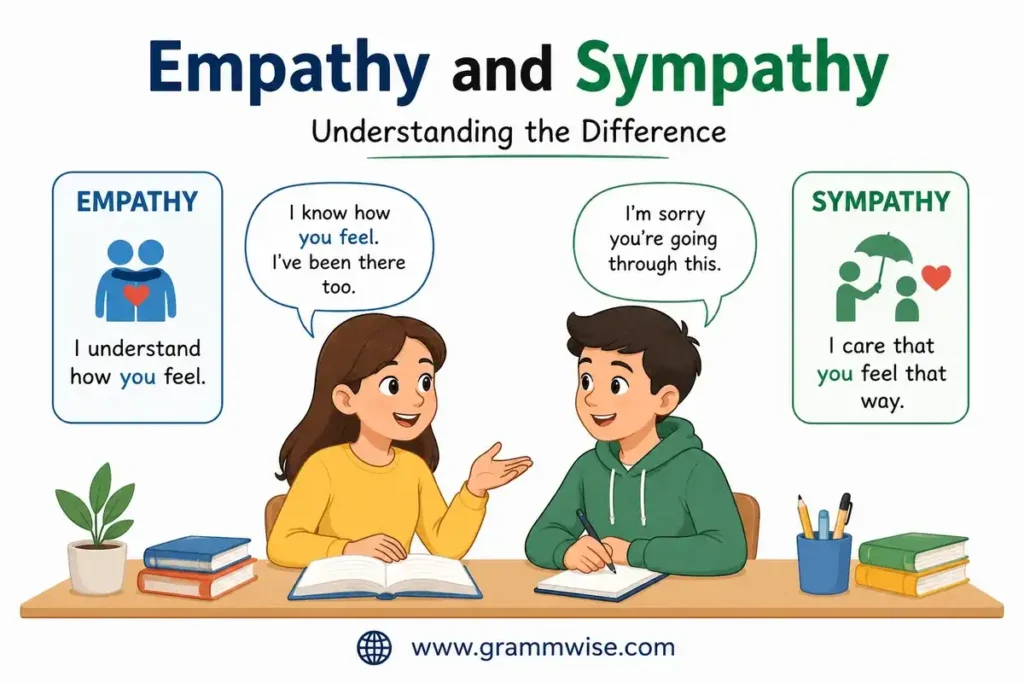
- “I understand how you feel.”
- “I’m sorry you’re going through this.”
- “I’m here if you need me.”
- “That must have been difficult.”
- “I wish I could make things easier.”
These are natural English expressions that show care and concern.
Common Mistakes People Make
Many English learners—and even native speakers—mix up empathy and sympathy.
Here are the most common mistakes.
Mistake 1: Thinking They Mean Exactly the Same Thing
❌ Empathy and sympathy are identical.
✅ They are related, but they have different meanings.
Empathy is about understanding another person’s feelings.
Sympathy is about caring for someone who is hurting.
Mistake 2: Using Empathy When Talking About Condolence Cards
❌ I sent an empathy card.
✅ I sent a sympathy card.
Cards sent after someone’s death are called sympathy cards.
Mistake 3: Believing Sympathy Is Cold or Unkind
Some people think sympathy means you do not care very much. That is not true. Sympathy is still kind and thoughtful. It simply does not require sharing another person’s exact feelings.
Mistake 4: Thinking You Must Have the Same Experience to Show Empathy
You do not have to experience the exact same event. You only need to try to understand another person’s feelings with care and respect.
Mistake 5: Forgetting That Both Are Positive
Some learners think one word is “good” and the other is “bad.”
That is incorrect. Both empathy and sympathy are positive qualities. They simply describe different ways of caring.
Final Teacher Explanation
Imagine you are sitting in a classroom with two students.
One student is crying because they failed a test.
The first student walks over and says,
“I failed my math test last year too. I know how disappointed you feel.”
That student is showing empathy because they understand the feeling.
The second student says,
“I’m really sorry that happened. I hope your next test goes well.”
That student is showing sympathy because they care and want to offer comfort.
Notice something important. Both students are kind. Both students are helping. Neither response is wrong. The only difference is how they connect with the other person’s feelings.
Whenever you forget the difference, remember this easy classroom rule:
Empathy understands the feeling.
Sympathy comforts the person.
If you remember those two simple sentences, you will almost always choose the correct word.
Quick Recap Empathy and Sympathy
The difference between empathy and sympathy is simple.
Empathy means you understand and share another person’s feelings.
Sympathy means you care about someone’s pain and want to comfort them.
Both words show kindness, but empathy focuses on understanding, while sympathy focuses on caring and support.
Conclusion
Understanding empathy and sympathy is easier when you remember one simple idea. Empathy means you understand another person’s feelings, while sympathy means you care about their pain. Both are correct, and both show kindness. The right choice depends on what you want to express.
As you practice English, these words will become more natural to use. Keep listening to real conversations, read different examples, and think about the feeling you want to share. With this simple rule in mind, you can confidently use both words in speaking and writing.
Frequently Asked Questions (FAQs)
What is the difference between empathy and sympathy?
Empathy means you understand another person’s feelings. Sympathy means you care about someone’s pain or sadness.
Which is correct, empathy or sympathy?
Both are correct. Choose empathy when you understand someone’s feelings and sympathy when you want to offer comfort.
Can I use empathy and sympathy in the same situation?
Yes. You can understand someone’s feelings and also comfort them at the same time.
Why do people confuse empathy and sympathy?
People confuse them because both are about caring for others and are often used in similar situations.
Is empathy stronger than sympathy?
Not always. They show care in different ways. One is not better than the other.
When should I use sympathy?
Use sympathy when someone is going through a difficult time, such as losing a loved one, getting sick, or facing a personal challenge.
When should I use empathy?
Use empathy when you want to show that you understand how another person feels and are trying to see things from their point of view.
Can empathy and sympathy make relationships better?
Yes. Both help build trust, kindness, and stronger relationships because they show that you care about other people’s feelings.