
Many learners ask the same question again and again: who vs whom.
These two small words confuse students, writers, and even native speakers.
The good news is this: you do not need to be a grammar expert to use them correctly.
In this lesson, I will explain who vs whom like I explain it in class.
Slow. Clear. Simple.
By the end, you will know which is correct, how to use it, and why people get confused.
Understanding word differences improves writing clarity and communication.
Simple Answer in One Look
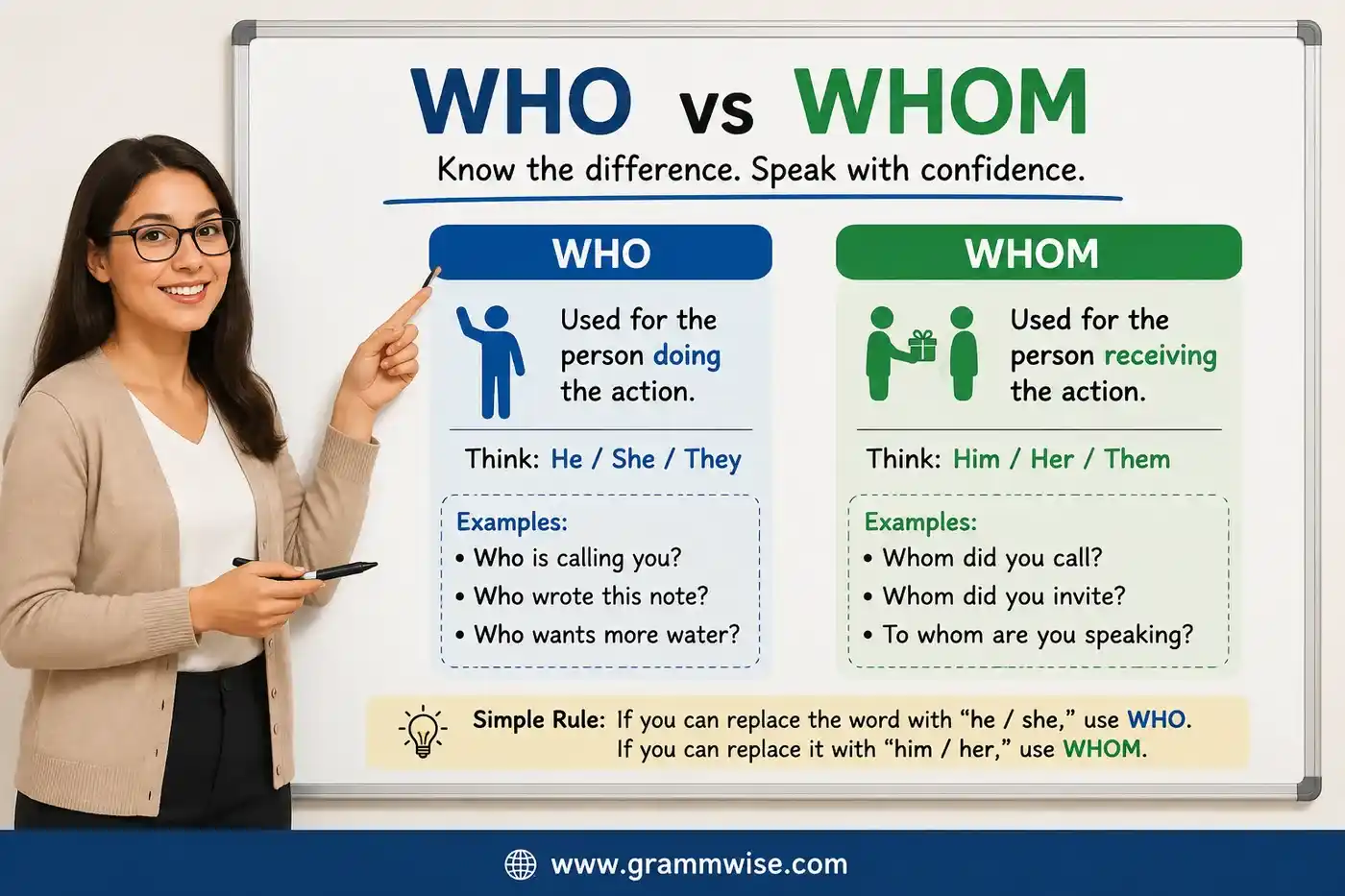
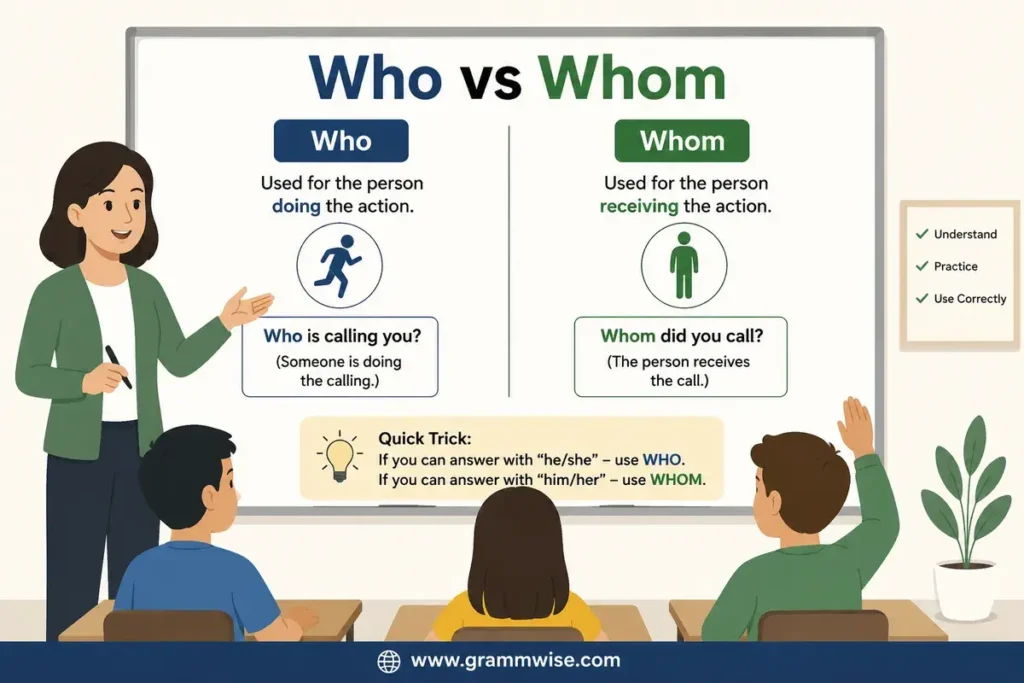
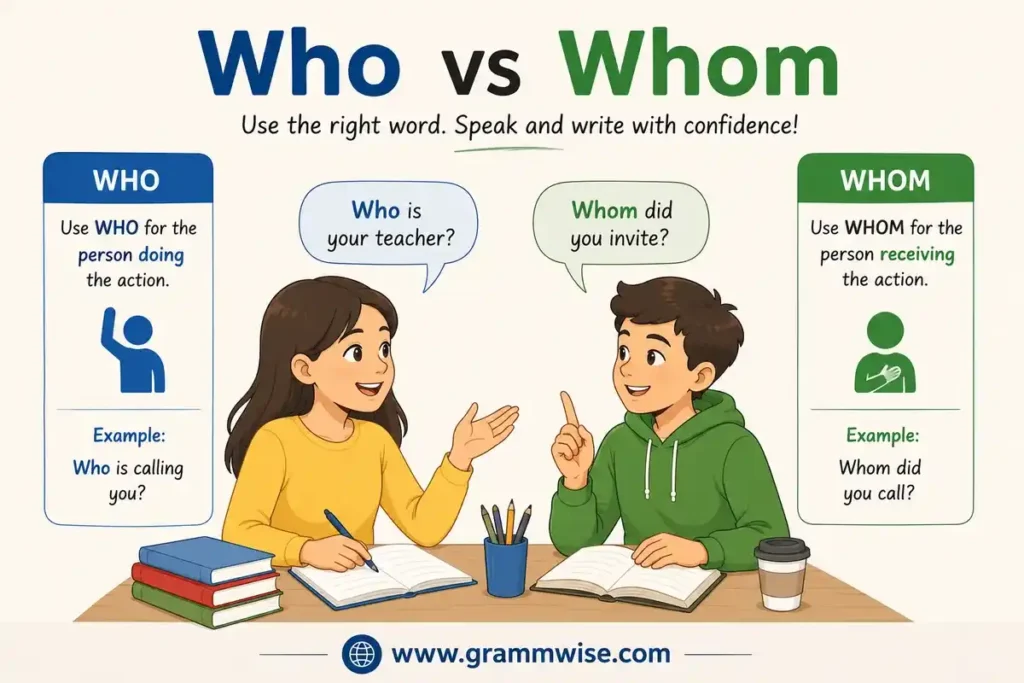
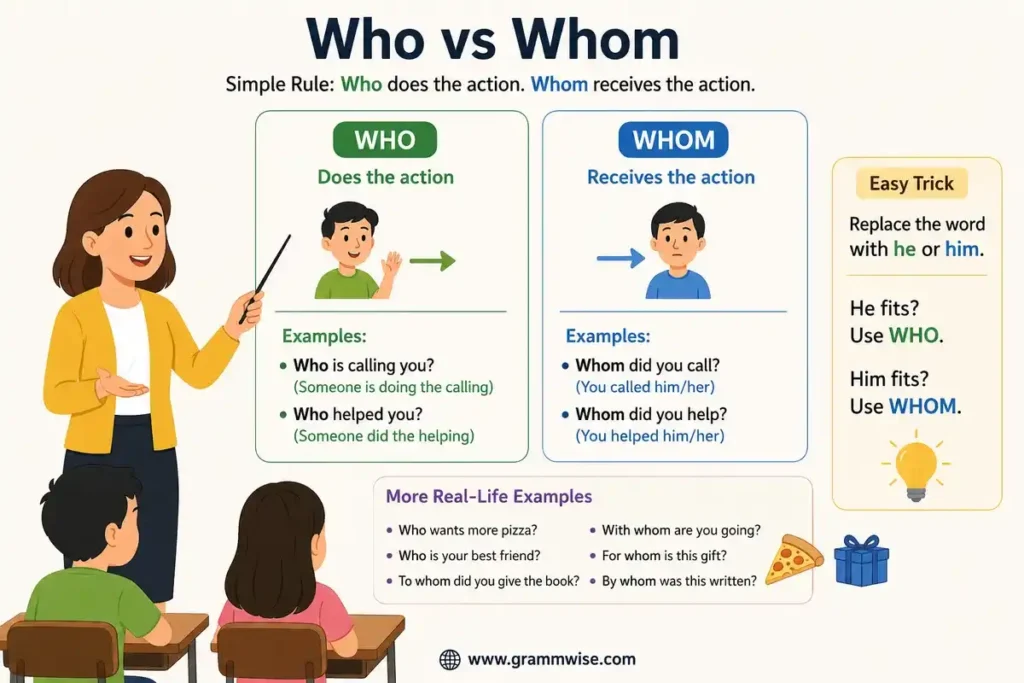
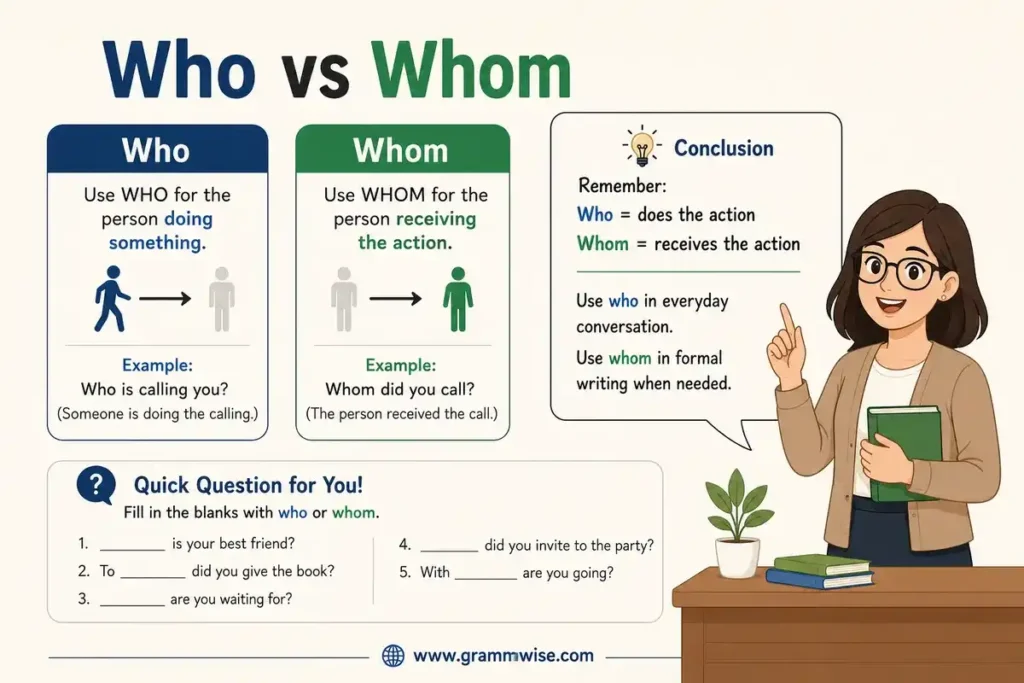
Who is used for the person doing the action.
Whom is used for the person receiving the action.
That is the core idea.
Means of Who vs Whom in Simple English
Let’s make this very easy.
Think about a sentence like a short story.
Every story has an actor and an action.
- The actor does something.
- The action happens to someone.
When to use who?
Use who when the person does something.
Example:
Who called you?
Here, someone did the calling.
When to use whom?
Use whom when something is done to the person.
Example:
Whom did you call?
Here, the person received the call.
So the big idea is simple:
- Who = does the action
- Whom = gets the action
No big grammar words needed.
Why People Mix These Words Who vs Whom?
People mix up who vs whom for many reasons.
Reason 1: They sound formal
The word whom sounds old or fancy.
Many people avoid it because it feels uncomfortable.
Reason 2: We speak faster than we think
In spoken English, people often say who for everything.
Example (spoken English):
Who did you meet?
This sounds normal in daily talk, even if grammar rules say whom.
Reason 3: Schools teach it in a hard way
Many teachers use long grammar rules.
Students memorize rules but do not feel the meaning.
Reason 4: Native speakers also make mistakes
Even native speakers often say who when whom is correct.
So learners copy what they hear.
This confusion is normal. You are not alone.
Clear Difference of Who vs Whom Explained Simply
Let’s make the difference very clear using a small comparison.
Who
- Talks about the doer
- Acts like he / she / they
- Used at the start of questions
Examples:
- Who is knocking?
- Who wrote this note?
Whom
- Talks about the receiver
- Acts like him / her / them
- Often comes after a verb or preposition
Examples:
- Whom did you invite?
- To whom are you speaking?
Easy memory trick
If you can answer with he, use who. Similarly with she.
If you can answer with him, use whom. Similarly with her
Example:
Who called you? → He called me → Who is correct
Whom did you call? → I called him → Whom is correct
Which Form Should You Use Who vs Whom?
Now let me give you a simple rule you can use every day.
Step 1: Answer the question
Ask yourself:
Is this person doing something, or receiving something?
Step 2: Replace the word
Replace the word with he or him.
- If he fits → use who
- If him fits → use whom
Example walk-through
Sentence:
_____ did you trust?
Try answers:
- You trusted him ✔
- You trusted he ✖
Correct word: whom
So the sentence is:
Whom did you trust?
This method works almost every time.
Easy Real-Life Sentences on Who vs Whom You Can Use
Here are simple sentences you can copy and use.
- Who is at the door?
- Who wants more water?
- Whom did you see at the store?
- Whom should I call first?
- Who made this mess?
- Whom are you waiting for?
- Who can help me today?
These sound natural and are easy to remember.
Who vs Whom in Questions
Questions cause the most confusion.
Let’s look at two similar questions.
Example 1
Who is calling you?
Here, someone is doing the calling.
So who is correct.
Example 2
Whom are you calling?
Here, someone receives the call.
So whom is correct.
The word order may change, but the role stays the same.
Who vs Whom After Prepositions
Words like to, for, with, from often come before whom.
Examples:
- To whom did you speak?
- For whom is this gift?
- With whom are you going?
In daily speaking, people often move the preposition to the end.
Example:
- Who did you speak to?
This is common and accepted in spoken English.
Formal English vs Everyday English
This part is important.
In everyday English
Most people say who instead of whom.
Example:
Who did you meet?
This sounds natural in conversation.
In formal writing
Teachers, exams, and formal letters prefer whom when correct.
Example:
Whom did you meet?
So your choice depends on the situation.
Common Mistakes to Avoid About Who vs Whom
Let’s look at mistakes students often make.
Mistake 1
❌ Whom is coming to the party?
✔ Who is coming to the party?
Reason: The person is doing the action.
Mistake 2
❌ Who did you give the book to?
✔ Whom did you give the book to?
Reason: The person receives the book.
Who vs Whom in Relative Clauses
Sometimes these words appear in longer sentences.
Example:
This is the man who helped me.
Here, the man did the helping.
Example:
This is the man whom I helped.
Here, the man received the help.
Same rule. Same logic.
Do You Always Need “Whom”?
Honest teacher answer: No, not always.
In modern spoken English:
- Who is widely accepted.
- Whom is becoming rare in speech.
But for:
- Exams
- Formal writing
- Grammar learning
You should still understand whom.
Where This Word Difference Comes From?
Long ago, English had many case forms.
Different words showed different roles.
- Who came from subject forms.
- Whom came from object forms.
Over time, English became simpler.
Most case endings disappeared.
But who vs whom survived.
That is why it feels confusing today.
Quick Practice Check Who vs Whom
Try these quickly.
- ___ is knocking on the door?
Answer: Who - ___ did you invite to dinner?
Answer: Whom - ___ wants to go first?
Answer: Who - ___ are you talking about?
Answer: Whom
If you got most right, you are doing great.
How This Word Who vs Whom Is Understood in Culture and Stories?
In real life, who vs whom is not just grammar.
It also shows how people see actions and roles.
In stories, movies, and daily talk, English often focuses on who is doing something.
That is why who feels strong and active.
It points to the person making a choice, starting an action, or leading a moment.
Whom, on the other hand, feels quieter.
It points to the person receiving something.
That could be love, help, blame, or attention.
In simple stories:
- Heroes are often shown with who
- Helpers, receivers, or listeners often connect with whom
This is not a rule you must memorize.
It is just how English naturally feels in culture.
That feeling is one reason who is used more often in speech today.
Biblical and Mythological Meaning of Who vs Whom
In old religious and myth stories, English translations used who and whom very carefully.
Simple idea
- Who was used for the one acting with purpose
- Whom was used for the one being guided, judged, or helped
Example idea (not a quote):
- Who shall lead the people?
- Whom shall we serve?
These old texts helped keep the difference alive in formal English.
That is why whom still feels serious or formal today.
But remember:
Modern English is much simpler than old English.
Symbolism of Who vs Whom Explained in Simple Words
Now let’s talk about meaning, not grammar rules.
What “Who” Represents?
Who represents:
- Action
- Control
- Choice
- Responsibility
Emotionally, who feels:
- Strong
- Active
- Clear
Example feeling:
Who made this decision?
It sounds direct.
It sounds confident.
What “Whom” Represents?
Whom represents:
- Receiving
- Being affected
- Being chosen
- Being included
Emotionally, whom feels:
- Polite
- Careful
- Respectful
Example feeling:
Whom did you trust?
It feels thoughtful.
It feels formal.
Simple Comparison Table: Who vs Whom
| Feature | Who | Whom |
| Part of Speech | Subject pronoun | Object pronoun |
| Function in Sentence | Performs the action | Receives the action |
| Replaces | He / She / They | Him / Her / Them |
| Common Question | Who is calling? | Whom did you call? |
- Who = the mover
- Whom = the one moved
That’s all you need to remember.
Related Words You Should Know
These words often appear near who vs whom.
Whose
Shows ownership.
Example: Whose bag is this?
Whoever
Means “any person who.”
Example: Whoever comes first wins.
Whomever
Object form of whoever.
Example: Choose whomever you like.
That
Often replaces who/whom in casual talk.
Example: The person that called me.
Which
Used for things, not people.
Example: Which book do you want?
These words follow similar ideas about doing and receiving.
Use Who vs Whom in Daily English
Now let’s be honest.
This is how people really speak.
Common daily speech examples
- Who did you talk to?
- Who did you invite?
- Who are you waiting for?
- Who should I ask?
- Who did they choose?
- Who are you thinking about?
- Who did you learn this from?
In formal grammar, some of these should use whom.
But in daily life, who is accepted and understood.
Spoken English truth
If you use who, people will understand you.
If you use whom, people may notice your careful English.
Both are okay.
Context matters.
Common Mistakes People Make Who vs Whom
Let’s fix mistakes gently.
Mistake 1: Using “whom” for the doer
❌ Whom is calling me?
✔ Who is calling me?
Why?
The person is doing the calling.
Mistake 2: Using “who” after “to”
❌ To who did you speak?
✔ To whom did you speak?
Tip:
After words like to, for, with, from, think about whom.
Mistake 3: Overthinking in speech
Some learners freeze when speaking.
They stop and think:
“Is it who or whom?”
Teacher advice:
In speech, use who and keep talking.
Fluency matters more than perfection.
Mistake 4: Thinking “whom” is always better
❌ Whom wants ice cream?
✔ Who wants ice cream?
“Whom” is not a fancy version of “who.”
Each has its place.
Final Teacher Explanation
Let me explain this like I do in class.
English wants to know who does something and who receives something.
That is all this topic is about.
- If the person acts, use who
- If the person receives, use whom
Do not fight the language.
Do not panic.
In daily life:
- Who is safe
- Whom is polite and formal
You do not need to sound perfect.
You need to sound clear.
And now, you are clear.
Quick Recap Who vs Whom
Who is for the person doing the action.
Whom is for the person receiving the action.
Use who in speech.
Use whom in formal writing when needed.
That’s the full answer.
If you understand the idea, you win.
Grammar is a tool, not a fear.
You now understand who vs whom better than most people.
Conclusion
Understanding who vs whom becomes easy when you stop thinking about grammar rules and start thinking about actions. One word is for the person doing something, and the other is for the person receiving it. That simple idea clears most confusion.
As a teacher, my advice is this: speak with confidence, write with clarity, and don’t be afraid of mistakes. English is about communication first. When you understand the meaning, the correct word follows naturally.
Frequently Asked Questions (FAQs)
What does “who vs whom” mean in simple words?
It means choosing between the person doing something and the person receiving it.
Is it okay to always use “who”?
Yes, in daily speaking. Most people do.
When should I use “whom”?
Use it in formal writing or after words like “to” and “for.”
Why do people get confused between who vs whom?
Because English speech dropped “whom” but grammar rules kept it.
Can I use “who” instead of “whom” in exams?
No. Exams usually want the correct form.
Does using “whom” make me sound smart?
It makes you sound formal, not smarter.
Is “whom” disappearing from English?
In speech, yes. In writing, it still exists.
What is the easiest trick to remember?
He = who
Him = whom