

Many people get confused about firey or fiery because both words look like they could be correct. You may see one spelling online and another spelling in a book. That makes the choice harder.
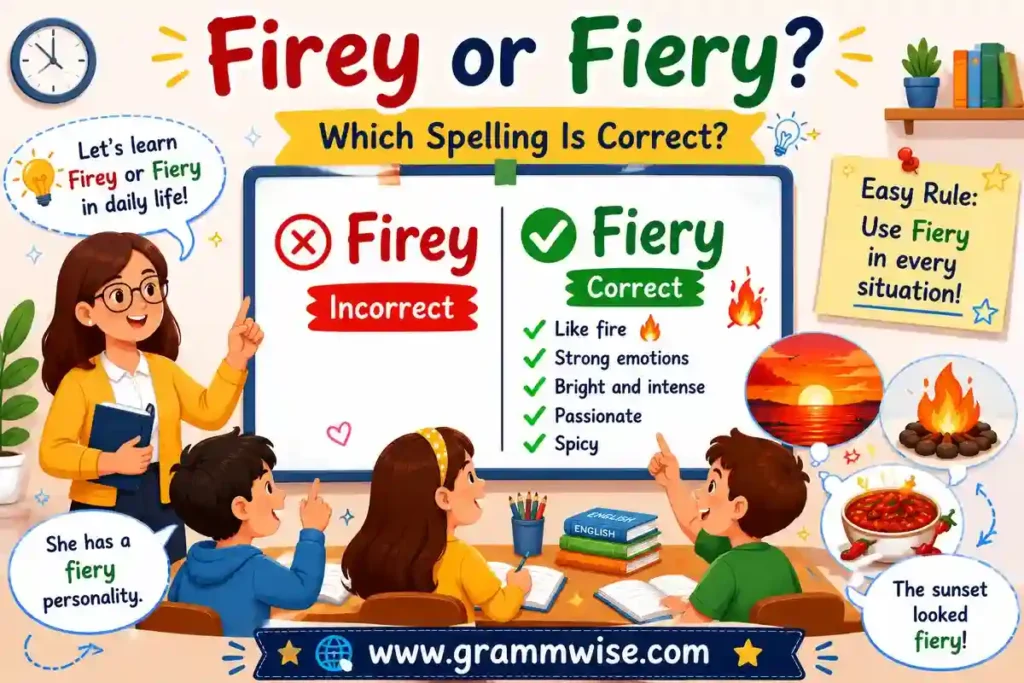
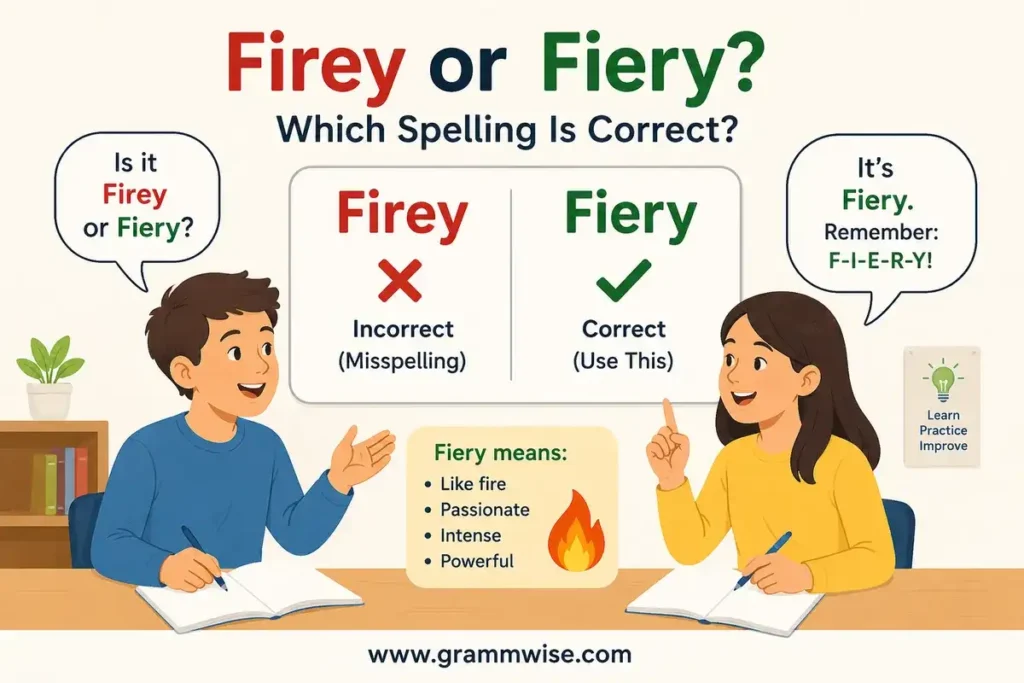
The short answer is simple: when choosing between firey or fiery, only fiery is the correct English spelling. Firey is a common misspelling.
If you have ever wondered about firey or fiery, this guide will explain the difference in very simple English. By the end, you will know which word to use and how to remember it easily.
If spelling mistakes confuse you, our guide on common spelling errors in English can help.
Simple Answer in One Look
Fiery is correct.
Firey is incorrect and is considered a spelling mistake.
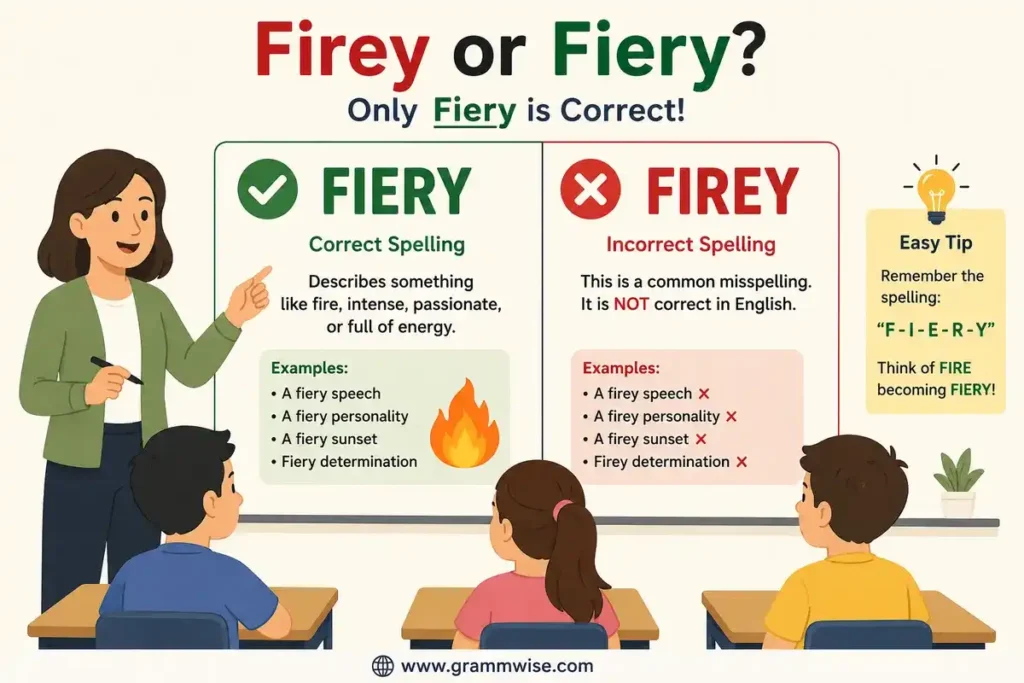
✅ Fiery temper
✅ Fiery speech
✅ Fiery sunset
❌ Firey temper
❌ Firey speech
❌ Firey sunset
Means of Firey or Fiery in Simple English
The word fiery describes something that is connected to fire or has qualities similar to fire. It can describe:
- Real flames
- Strong emotions
- Bright colors
- Powerful personalities
Think about fire. Fire is hot, bright, energetic, and sometimes difficult to control. When we call something fiery, we mean it has one or more of these qualities.
For example:
- A fiery volcano produces hot lava.
- A fiery sunset has bright orange and red colors.
- A fiery person may be very passionate and energetic.
The word does not always mean actual fire is present. Sometimes it simply describes strength, excitement, or intense feelings.
Examples
- The sky looked fiery during sunset.
- She gave a fiery speech.
- The team showed a fiery spirit.
- The dragon had fiery eyes.
- The peppers had a fiery taste.
In all these examples, fiery is the correct spelling.
Why People Mix These Words Firey or Fiery
Many spelling mistakes happen because English does not always follow simple patterns. The confusion between firey or fiery usually comes from the base word fire.
People often think:
- Fire + y = firey
This seems logical. However, English spelling sometimes changes when endings are added. As a result, the correct form became fiery, not firey.
Another reason is pronunciation. When people say the word aloud, it can sound like: “FYE-er-ee”. Because of that sound, some writers guess the spelling and write firey. That guess is understandable, but it is still incorrect.
Why the Mistake Spreads
The internet contains millions of pages. Some writers accidentally use firey. Other people see it and assume it is correct. Then they repeat the mistake. This creates even more confusion.
That is why dictionaries, teachers, and editors recommend using fiery every time.
Clear Difference of Firey or Fiery Explained Simply
Here is the easiest way to understand the difference between firey or fiery.
Fiery
- Correct spelling
- Found in dictionaries
- Used in books and newspapers
- Accepted in school and professional writing
Firey
- Incorrect spelling
- Not accepted as standard English
- Considered a spelling error
- Should be changed to fiery
Quick Comparison Firey or Fiery
| Word | Correct? | Meaning |
|---|---|---|
| Fiery | Yes | Like fire, intense, passionate |
| Firey | No | Misspelling of fiery |
Easy Memory Trick
Look at the middle letters:
fiery
Notice the letters:
i-e-r
Think:
Fire becomes fiery.
The correct spelling keeps the i before the e in this word. Whenever you write it, remember:
✅ fiery
❌ firey
Which Form Should You Use Firey or Fiery?
You should always use fiery. This rule works in:
- School assignments
- Emails
- Stories
- Blogs
- Business writing
- Social media posts
There are no situations in standard English where firey is preferred.
Use Fiery When Describing Fire
Examples:
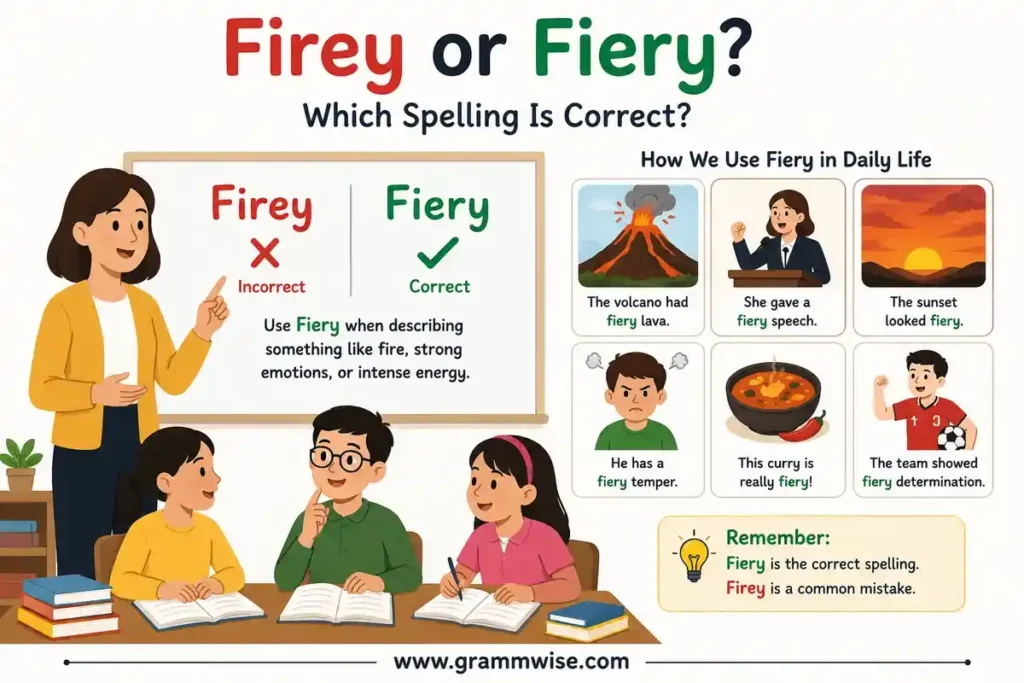
- The fiery flames lit the room.
- The fiery explosion could be seen for miles.
- The fiery lava flowed down the mountain.
Use Fiery When Describing Personality
Examples:
- She has a fiery personality.
- He gave a fiery response.
- The coach is known for his fiery attitude.
Use Fiery When Describing Colors
Examples:
- The sunset looked fiery.
- The clouds turned fiery red.
- The painting showed fiery orange skies.
Use Fiery When Describing Taste
Examples:
- The sauce was fiery.
- The curry had a fiery flavor.
- The peppers were extremely fiery.
No matter the meaning, the spelling remains the same.
Easy Real-Life Sentences on Firey or Fiery You Can Use
Here are simple everyday examples.
- The campfire gave off a fiery glow.
- She made a fiery comment during the meeting.
- The sunset looked fiery and beautiful.
- The dragon breathed fiery flames.
- The soup had a fiery taste.
- The athlete showed a fiery determination to win.
- His fiery speech inspired the crowd.
- The sky turned fiery orange before nightfall.
Notice that every sentence uses fiery, never firey.
Origin of The Word Firey or Fiery
The word fiery has been part of English for hundreds of years. It developed from the word fire. Over time, English speakers created a special adjective form to describe things that were like fire. That adjective became fiery.
Writers used it to describe:
- Flames
- Hot objects
- Strong emotions
- Bright colors
As English grew, the spelling fiery became the accepted standard. Dictionaries recorded this spelling, and it has remained the correct form ever since. The spelling firey never became standard English. That is why modern dictionaries only recognize fiery as the correct spelling.
How This Word Is Understood in Culture and Stories
The word fiery appears in many stories, movies, books, and everyday conversations. People often connect fire with strength, energy, courage, and strong emotions. Because of this, the word fiery is often used to describe characters who stand out.
For example, a hero in a story may have a fiery spirit. This means the person is brave, determined, and full of energy. A fiery character does not give up easily.
In stories, villains can also be described as fiery. In that case, the word may suggest anger, danger, or a strong personality.
Fire catches attention. That is why writers often use fiery to create a powerful image in the reader’s mind.
Here are some common examples:
- A fiery warrior who never quits.
- A fiery dragon breathing flames.
- A fiery leader giving an inspiring speech.
- A fiery athlete competing with passion.
In many cultures, fire represents both creation and destruction. It can warm a home. It can also burn things down.Because of this, the word fiery can have both positive and negative meanings depending on the situation.
A fiery personality may be exciting and passionate. But it may also be quick-tempered. The meaning depends on the context.
Biblical and Mythological Meaning Firey or Fiery
The word fiery appears in many religious and mythological stories. In the Bible, fire is often connected with power, judgment, guidance, and God’s presence. For example, fire sometimes represents something holy or powerful.
In some stories, fire guides people. In others, it symbolizes testing or purification. The word fiery may be used to describe flames, trials, or powerful events.
In mythology around the world, fire often represents special knowledge, strength, or transformation.
Many ancient stories include:
- Fire-breathing dragons
- Fire gods
- Magical flames
- Heroes who control fire
These stories helped make the word fiery feel powerful and dramatic. Today, most people use the word in a simple everyday way, but those older meanings still influence how people understand it.
Symbolism of Firey or Fiery Explained in Simple Words
People often use words as symbols. A symbol is something that stands for a bigger idea. The discussion of firey or fiery is interesting because one spelling is correct and carries meaning, while the other is simply a spelling mistake.
What Fiery Represents?
The correct word fiery often represents:
- Passion
- Energy
- Courage
- Determination
- Strength
- Excitement
- Intense emotions
Examples:
- A fiery speech inspires people.
- A fiery athlete competes with heart.
- A fiery sunset looks bright and powerful.
In many situations, fiery suggests life, action, and strong feelings.
What Firey Represents?
The word firey does not have its own meaning in standard English. It is simply a misspelling of fiery. Because it is not recognized as the correct spelling, it does not carry a separate symbolic meaning.
Whenever you see firey, the writer almost always meant fiery. That is why choosing the correct spelling matters.
Correct spelling helps your writing look clear and professional.
Related Words You Should Know
Learning related words can help you understand fiery even better.
Fire
The basic word. It means flames, heat, and burning.
Example: “The fire kept us warm.”
Flame
The visible burning part of a fire.
Example: “The flame danced in the wind.”
Burning
Something that is on fire or producing heat.
Example: “The wood was burning.”
Passionate
Showing strong feelings about something.
Example: “She is passionate about teaching.”
Intense
Very strong or powerful.
Example: “The game was intense.”
Energetic
Full of energy and activity.
Example: “The children were energetic.”
Hot
Having a high temperature.
Example: “The soup is hot.”
Powerful
Having strength or influence.
Example: “He gave a powerful speech.”
All of these words connect in some way to the idea behind fiery.
Use of Firey or Fiery in Daily English
Native English speakers use fiery in many situations. Most of the time, they are not talking about real flames. They are describing strong feelings, bright colors, or energetic behavior.
Here are some examples you may hear:
- “She has a fiery personality.”
- “The coach gave a fiery speech before the game.”
- “That salsa is really fiery.”
- “The sunset looked fiery tonight.”
- “He made a fiery argument during the debate.”
- “The actress is known for her fiery attitude.”
- “The team showed a fiery determination to win.”
- “The dragon had fiery eyes.”
- “The politician delivered a fiery response.”
- “The sky turned fiery red.”
Notice something important. In every example, the spelling is fiery. Professional writers, teachers, editors, and dictionaries all use this spelling.
Common Mistakes People Make About Firey or Fiery
Many learners make small mistakes when writing fiery. Here are the most common ones;
Mistake 1: Writing Firey
❌ The firey sunset looked beautiful.
✅ The fiery sunset looked beautiful.
This is the biggest mistake people make. Remember that fiery is the correct spelling.
Mistake 2: Assuming Both Spellings Are Correct
Some people think both versions are acceptable. They are not. Only fiery is considered standard English.
Mistake 3: Avoiding the Word Completely
Some learners become unsure and stop using the word. There is no need to avoid it. Once you remember the spelling, you can use it confidently.
Mistake 4: Using It Only for Real Fire
Many students think fiery must involve actual flames. That is not true. You can use it for;
- Emotions
- Speeches
- Personalities
- Colors
- Food
- Attitudes
Example: “She gave a fiery answer.”
No real fire is involved.
Mistake 5: Confusing Meaning with Anger
A fiery person is not always angry. Sometimes fiery means;
- Passionate
- Energetic
- Strong-willed
- Excited
The meaning depends on the situation.
Final Teacher Explanation
Imagine you are sitting in my classroom.
A student raises a hand and asks: “Teacher, which is correct: firey or fiery?”
My answer would be very simple. The correct spelling is fiery. The spelling firey is a mistake. That is the most important thing to remember. The word fiery comes from the idea of fire.
It can describe:
- Flames
- Bright colors
- Strong emotions
- Passionate people
- Powerful speeches
- Spicy food
When you see fiery, think about something strong, energetic, bright, or intense. If you accidentally write firey, just change it to fiery.
A simple memory trick is this:
The dictionary spelling is always:
F-I-E-R-Y
Keep practicing it whenever you write. After a few uses, the correct spelling will become natural.
Quick Recap Firey or Fiery
When choosing between firey or fiery, the correct spelling is fiery. Firey is a common misspelling and should be avoided. Use fiery when talking about fire, strong emotions, bright colors, passionate people, powerful speeches, or spicy food.
Easy rule:
✅ Fiery = Correct
❌ Firey = Incorrect
Conclusion
When choosing between firey or fiery, the correct spelling is always fiery. The word firey is a common misspelling and should be avoided in school writing, professional documents, emails, and everyday English. Whether you are describing a fiery personality, a fiery speech, a fiery sunset, or fiery food, the spelling stays the same.
A simple way to remember it is to think of the dictionary spelling: F-I-E-R-Y. Once you learn this pattern, you can use the word with confidence and avoid one of the most common spelling mistakes in English. Remember: fiery is correct, firey is incorrect.
Frequently Asked Questions (FAQs)
Is Firey or Fiery correct?
Fiery is correct. Firey is a spelling mistake.
What does fiery mean in simple words?
It means like fire, or something strong, passionate, bright, or intense.
Why do people confuse firey and fiery?
People often assume the word comes directly from “fire” and mistakenly spell it as firey.
Can I use firey in school writing?
No. Teachers and editors expect the correct spelling, fiery.
Does fiery always mean actual fire?
No. It can also describe emotions, attitudes, colors, speeches, and food.
Is fiery a positive or negative word?
It can be either. It may describe passion and energy, or anger and intensity, depending on the context.
How can I remember the correct spelling?
Remember this pattern:
F-I-E-R-Y
That is the dictionary spelling.
Can a person be described as fiery?
Yes. A fiery person is often energetic, passionate, determined, or strong-willed.