
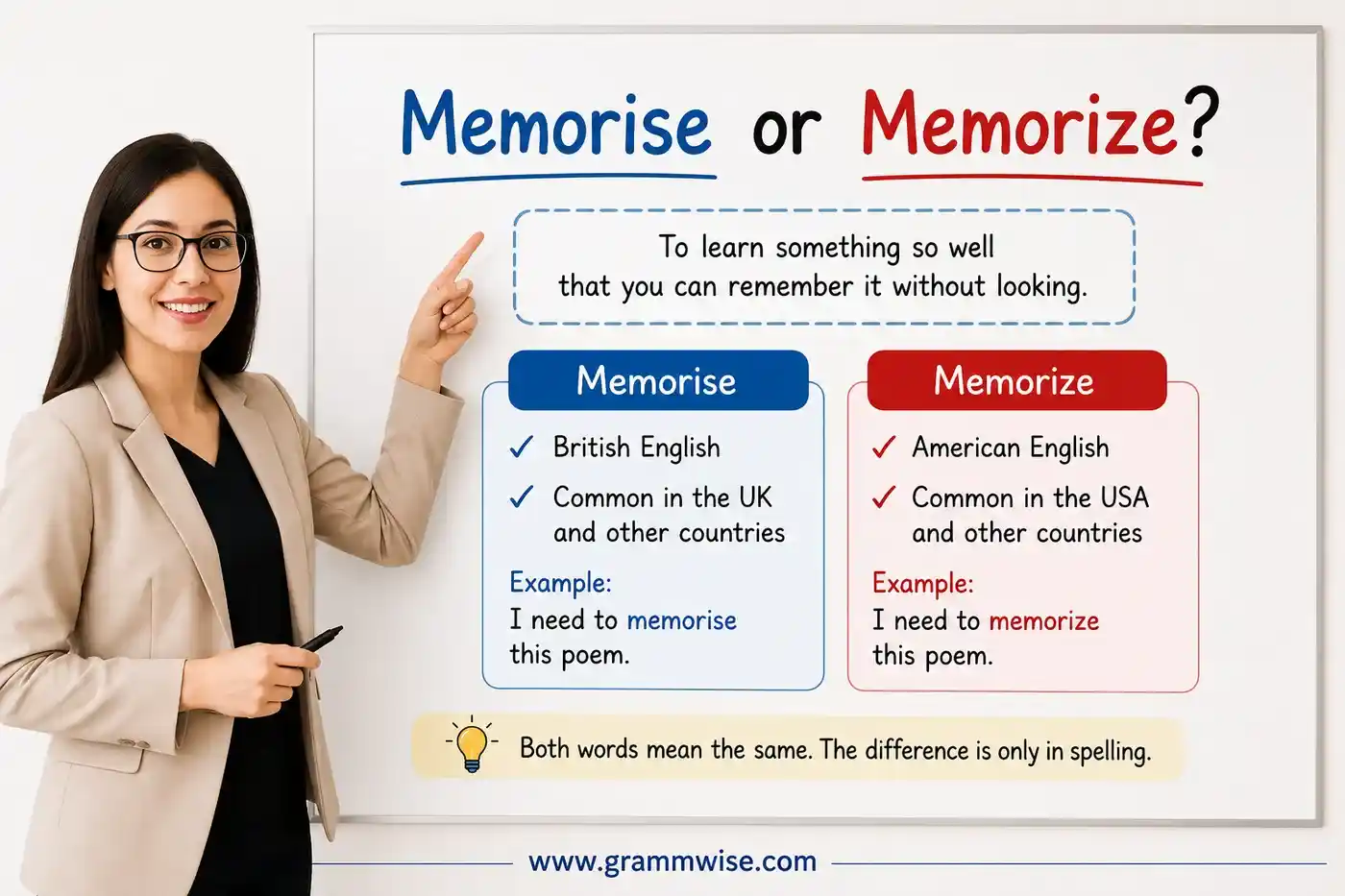
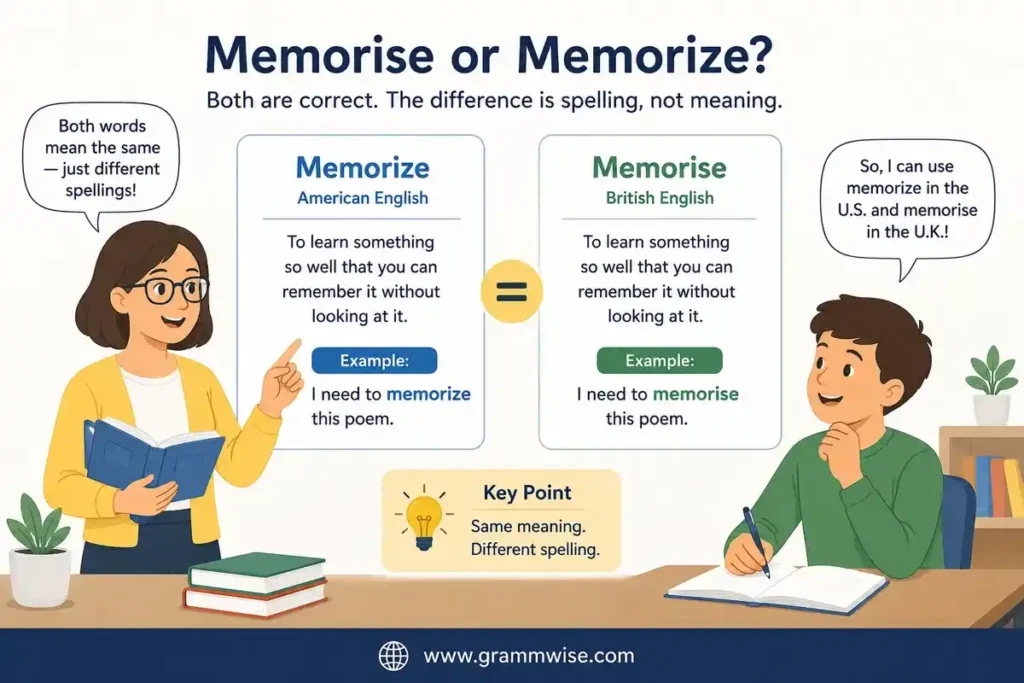
Many English learners get confused about memorise or memorize. The good news is that both words have the same meaning. They simply follow different spelling styles.
If you have ever wondered whether memorise or memorize is correct, the short answer is easy: both are correct. The choice depends on the type of English you use.
In this guide, you will learn the difference between memorise or memorize, when to use each one, and how native speakers use these spellings in daily life.
Confused by similar words? Our grammar guides explain them clearly.
Simple Answer in One Look
- Memorize is the preferred spelling in American English.
- Memorise is the preferred spelling in British English.
Both words mean to learn something so well that you can remember it without looking at it.
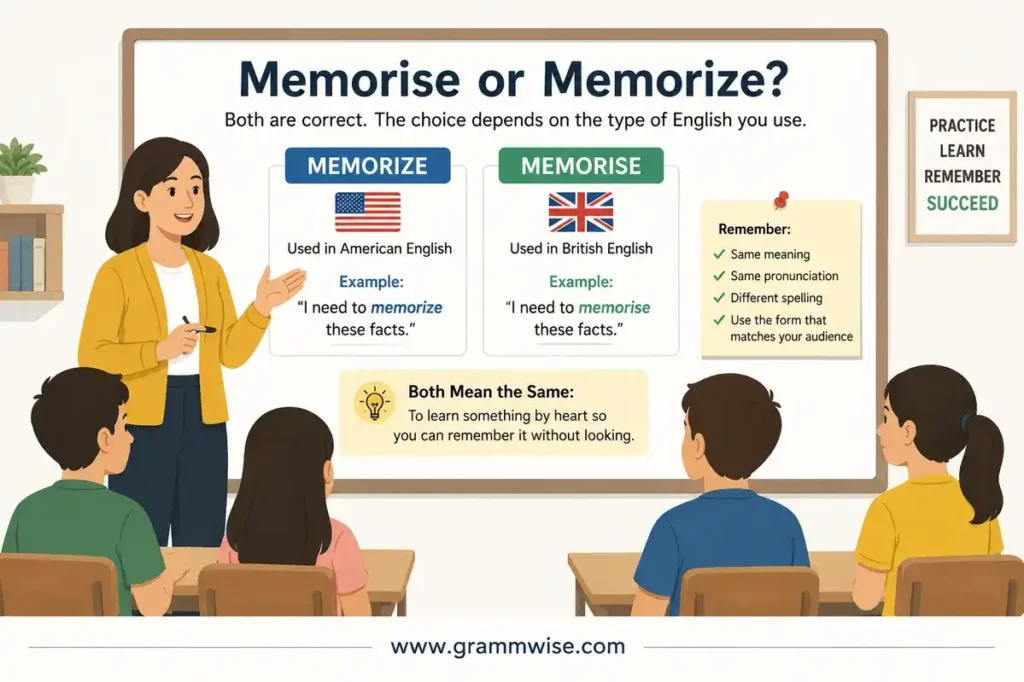
Means of Memorise or Memorize in Simple English
When you memorize or memorise something, you put it into your memory. You learn it so well that you can repeat it later without reading it again.
For example:
- A student memorizes a poem.
- An actor memorizes lines for a movie.
- A singer memorizes song lyrics.
- A child memorizes a phone number.
The action is the same no matter which spelling you use. Think about a multiplication table. At first, you read it from a book. Later, you know the answers without looking. That is memorizing.
Simple Definition
Memorize/Memorise = learn by heart and remember without help.
Why People Mix These Words Memorise or Memorize?
Many people see both spellings online. One website writes memorize. Another writes memorise. This can make learners think one spelling is wrong.
The real reason is that English has different spelling systems.
American English
American English usually uses -ize endings.
Examples:
- organize
- recognize
- realize
- memorize
British English
British English often uses -ise endings.
Examples:
- organise
- recognise
- realise
- memorise
Because people read books, blogs, social media posts, and school materials from different countries, they often see both versions. That is why the confusion happens.
A Real-Life Example
Imagine a student in New York.
- Their textbook says: “Please memorize the vocabulary list.”
Now imagine a student in London.
- Their textbook says: “Please memorise the vocabulary list.”
The meaning is exactly the same. Only the spelling changes.
Clear Difference of Memorise or Memorize Explained Simply
The difference between memorise or memorize is spelling, not meaning.
Memorize
- American English spelling
- Common in the United States
- Uses -ize
Example:
“I need to memorize these science facts.”
Memorise
- British English spelling
- Common in the United Kingdom
- Uses -ise
Example:
“I need to memorise these science facts.”
Quick Comparison Memorise or Memorize
| Feature | Memorize | Memorise |
|---|---|---|
| Meaning | Learn by heart | Learn by heart |
| American English | Yes | Rare |
| British English | Less common | Yes |
| Correct spelling | Yes | Yes |
| Pronunciation | Same | Same |
Easy Way to Remember Memorise or Memorize
- If you write for an American audience, use memorize.
- If you write for a British audience, use memorise.
Which Form Should You Use Memorise or Memorize?
The best choice depends on who will read your writing.
Use Memorize When:
- Writing in American English
- Creating content for U.S. readers
- Following American school rules
- Writing for American companies
Examples:
- Memorize your password.
- Memorize the speech before tomorrow.
- Students should memorize important formulas.
Use Memorise When:
- Writing in British English
- Creating content for UK readers
- Following British school rules
- Using British spelling throughout a document
Examples:
- Memorise the poem for class.
- Try to memorise the new vocabulary.
- She memorised the speech quickly.
Important Tip
Do not mix spellings in the same piece of writing. Choose one style and stay consistent.
For example:
✅ Correct:
- memorize
- organize
- realize
✅ Correct:
- memorise
- organise
- realise
❌ Avoid:
- memorize
- organise
- realize
Mixing styles can look messy.
Easy Real-Life Sentences on Memorise or Memorize You Can Use
Here are simple examples you can use every day.
Using Memorize
- I need to memorize my speech.
- She memorized the phone number.
- We must memorize these rules.
- He memorized all the answers.
- Can you memorize this address?
- The actor memorized his lines.
- Students often memorize vocabulary words.
- I memorized the song after hearing it many times.
Using Memorise
- I need to memorise my speech.
- She memorised the phone number.
- We must memorise these rules.
- He memorised all the answers.
- Can you memorise this address?
- The actor memorised his lines.
- Students often memorise vocabulary words.
- I memorised the song after hearing it many times.
Notice that the meaning never changes. Only the spelling changes.
Origin of This Word Memorise or Memorize
The word comes from the Latin word “memoria.” “Memoria” means memory or remembrance. Over time, English borrowed this idea and created the verb memorize and memorise.
The word became popular in education because students often needed to learn information by heart. Today, people use it in schools, workplaces, music, theater, and everyday life. Even though the spelling changed in different countries, the meaning stayed the same.
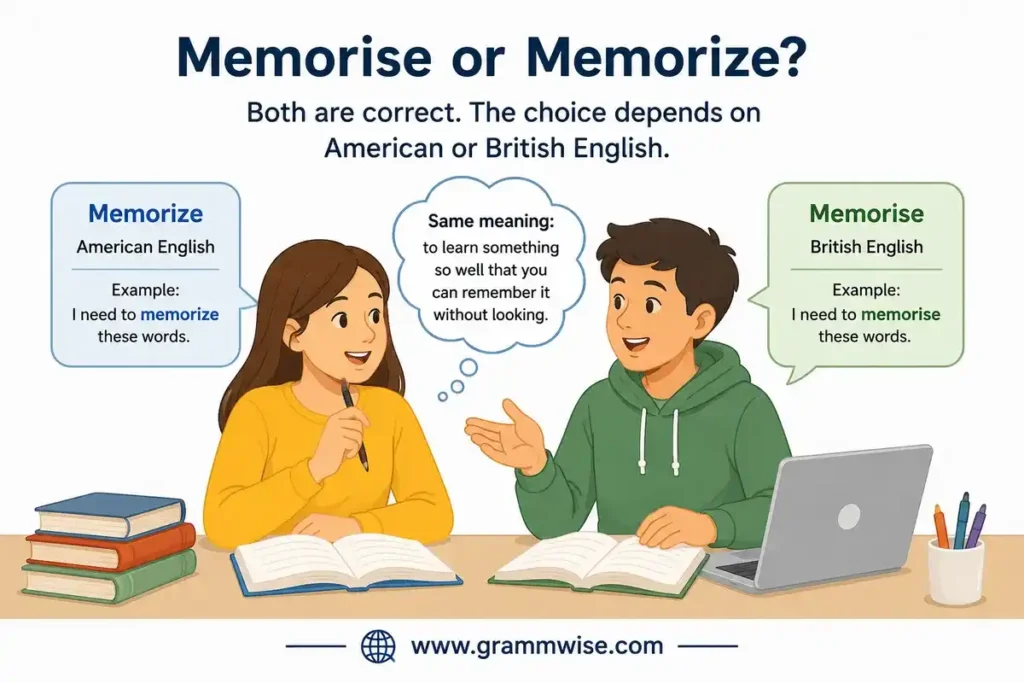
Role of This Word Memorise or Memorize in Culture and Stories
The idea behind memorise or memorize is found in many cultures around the world.
Long ago, people did not always have books, computers, or phones. Because of this, they needed strong memories. Stories, songs, poems, and important lessons were often passed from one person to another by memory.
- A child might learn a family story.
- A student might learn a poem.
- A speaker might learn an important speech.
In many cultures, having a good memory was seen as a useful skill. Even today, people admire someone who can remember facts, names, dates, or long speeches.
When people hear the words memorise or memorize, they often think about learning something carefully and keeping it in their minds. That is why the word is connected to learning, practice, and knowledge.
Many schools still ask students to memorize:
- Poems
- Vocabulary words
- Math facts
- Historical dates
- Speeches
The word often gives the idea of effort and practice. You do not usually memorize something in one minute. You repeat it many times until it stays in your memory. That simple idea appears in stories, classrooms, and daily life all over the world.
Biblical and Mythological Meaning Memorise or Memorize
The words memorise and memorize do not have a special biblical meaning by themselves. However, the idea of remembering is very important in many religious traditions.
In the Bible, people are often encouraged to remember teachings, promises, and lessons. Many believers memorize verses so they can recall them whenever they need guidance. The same idea appears in other faiths as well. People often learn prayers, teachings, or sacred texts by heart.
In mythology and ancient stories, wise characters are often shown as people who remember important knowledge. Their memory helps them solve problems or teach others.
So while memorise or memorize is mainly a modern spelling question, the idea of remembering important things has been valued for thousands of years.
Symbolism of Memorise or Memorize Explained in Simple Words
Sometimes words carry ideas beyond their basic meaning. The same is true for memorise or memorize. The meaning stays the same, but people may connect the word with different ideas.
What Memorize Represents?
In American English, memorize often represents:
- Learning
- Practice
- Education
- Preparation
- Self-improvement
For example, when someone says:
“I memorized my presentation.”
People often think of hard work and preparation. The speaker took time to learn the material well.
What Memorise Represents?
In British English, memorise represents the same ideas:
- Learning
- Knowledge
- Focus
- Preparation
- Remembering
For example:
“She memorised the poem.”
This creates the same image of someone studying and practicing carefully.
Simple Comparison Memorise or Memorize
| Word | Symbolic Idea |
|---|---|
| Memorize | Learning and remembering |
| Memorise | Learning and remembering |
The spelling changes. The deeper meaning does not. Both words suggest effort, study, and keeping knowledge in your mind.
Related Words To Memorise or Memorize You Should Know
Learning related words can help you understand memorise or memorize even better.
Memory
The ability to remember things.
Example: “My memory is getting better.”
Remember
To keep information in your mind.
Example: “I remember her name.”
Recall
To bring information back into your mind.
Example: “Can you recall the answer?”
Learn
To gain new knowledge.
Example: “Children learn new words every day.”
Study
To spend time learning something.
Example: “I need to study for the test.”
Knowledge
Information that a person knows.
Example: “She has a lot of knowledge about science.”
Practice
Doing something again and again to improve.
Example: “Practice helps you memorize faster.”
Recite
To say something from memory.
Example: “He recited the poem perfectly.”
Retain
To keep information in your memory.
Example: “Good notes help students retain information.”
These words often appear in the same conversations as memorise or memorize.
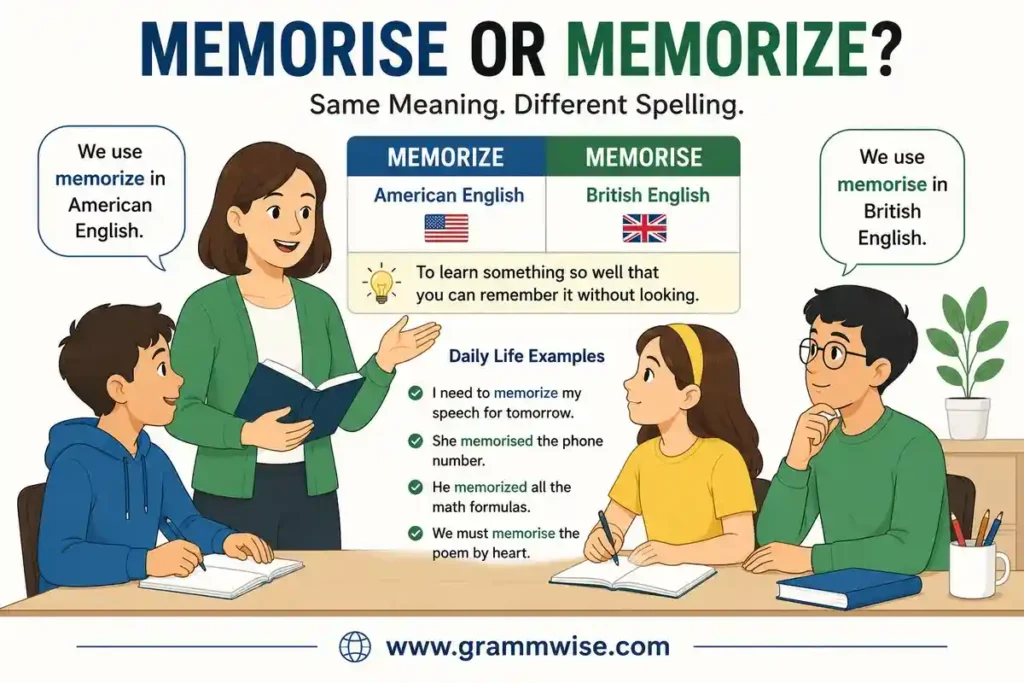
Use of Memorise or Memorize in Daily English
Native speakers use these words in many everyday situations. Here are some common examples;
At School
“I need to memorize these spelling words.”
“We have to memorise the poem before Friday.”
At Work
“She memorized the presentation.”
“He memorised the company’s safety rules.”
Learning a Language
“I memorize five new words every day.”
“Try to memorise common phrases first.”
Music
“The singer memorized all the lyrics.”
“The band memorised the entire song.”
Theater
“The actor memorized his lines quickly.”
Everyday Life
“I memorized my new phone number.”
“Can you memorise this address?”
“I still haven’t memorized my password.”
Sports
“The team memorized the game plan.”
Public Speaking
“She memorized her speech before the event.”
These examples show that memorise or memorize is used whenever someone learns information so well that they no longer need to read it.
Common Mistakes People Make About Memorise or Memorize
Many learners make the same mistakes when using memorise or memorize. Here are the most common ones;
Mistake 1: Thinking One Spelling Is Wrong
❌ Memorise is wrong.
✅ Memorise and memorize are both correct.
The spelling depends on the type of English.
Mistake 2: Mixing British and American Spellings
❌ I memorized the list and organised my notes.
✅ I memorized the list and organized my notes.
✅ I memorised the list and organised my notes.
Stay with one spelling style.
Mistake 3: Confusing Memorize With Remember
Some people think they mean exactly the same thing. They are related, but not identical.
- Memorize means to learn something intentionally.
- Remember means you already know it and can bring it back to mind.
Example:
“I memorized the poem last week.”
“I still remember the poem today.”
Mistake 4: Wrong Verb Form
❌ I memorized it yesterday.
✅ I memorized it yesterday.
❌ She memorise it quickly.
✅ She memorised it quickly.
Always use the correct past-tense form.
Mistake 5: Using It for Things You Never Learned
Memorizing usually involves effort and practice.
Example:
❌ I memorized the rain yesterday.
✅ I remembered the rain yesterday.
Memorizing means you actively learned something.
Final Teacher Explanation Memorise or Memorize
Imagine you are sitting in my classroom.
A student raises a hand and asks: “Teacher, which is correct: memorise or memorize?”
My answer would be very simple.
Both are correct. They mean exactly the same thing. They both mean learning something so well that you can remember it without looking. The only real difference is spelling.
- If you use American English, write memorize.
- If you use British English, write memorise.
That is the rule most writers follow. Do not worry about meaning because there is no difference in meaning. Do not worry about pronunciation because they sound the same.
The biggest thing to remember is consistency. Pick one spelling style and use it throughout your writing. When you do that, your English will look natural and correct.
Quick Recap Memorise or Memorize
Memorize is the American English spelling.
Memorise is the British English spelling.
Both words mean to learn something by heart and remember it without looking at it. Choose the spelling that matches your audience and use it consistently.
Conclusion
When comparing memorise or memorize, remember that both spellings are correct and have the same meaning. They both mean learning something by heart so you can remember it without looking. The only difference is that memorize is used in American English, while memorise is used in British English.
The best choice depends on your audience and writing style. Use one spelling consistently throughout your work, and your writing will look clear, natural, and professional. Once you know this simple rule, choosing the correct form becomes easy.
Frequently Asked Questions (FAQs)
What does memorise or memorize mean in simple words?
It means learning something so well that you can remember it without reading or looking at it.
Is memorize correct?
Yes. Memorize is the standard American English spelling.
Is memorise correct?
Yes. Memorise is the standard British English spelling.
What is the difference between memorise and memorize?
The only difference is spelling. The meaning and pronunciation are the same.
Which form should I use in the United States?
Use memorize because it follows American English spelling rules.
Which form should I use in the United Kingdom?
Use memorise because it follows British English spelling rules.
Why do people get confused between memorise or memorize?
People see both spellings online, in books, and in school materials from different countries.
Can I use both forms in the same article?
It is better not to. Choose one spelling style and use it throughout the entire piece of writing.
Does pronunciation change between memorise and memorize?
No. Native speakers pronounce both words the same way.
Is one spelling more correct than the other?
No. Both are correct. The right choice depends on whether you are using American English or British English.