
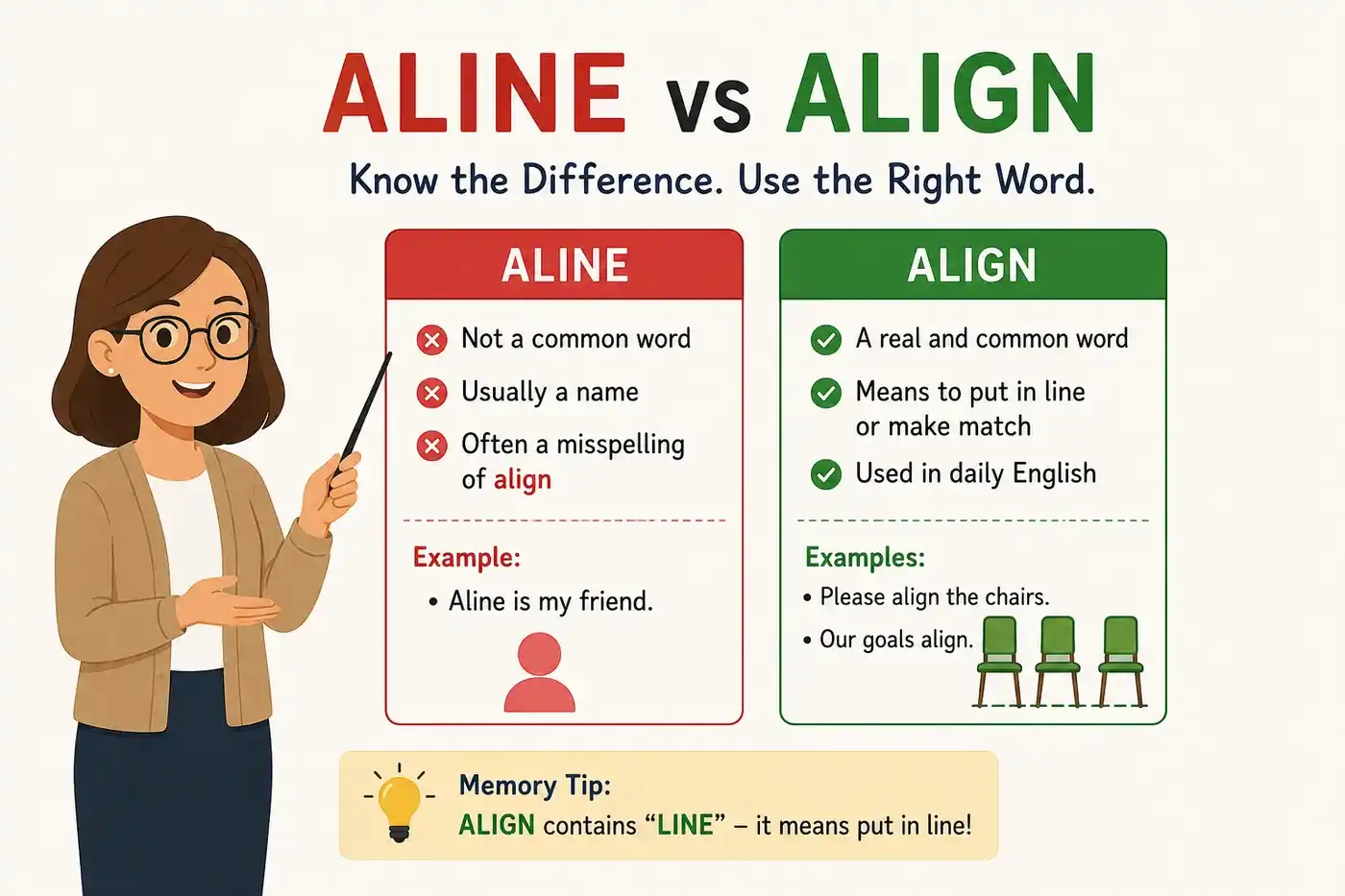
Many people search for aline vs align because the two words look very similar. At first glance, they seem like different spellings of the same word. This makes many writers wonder which one is correct.
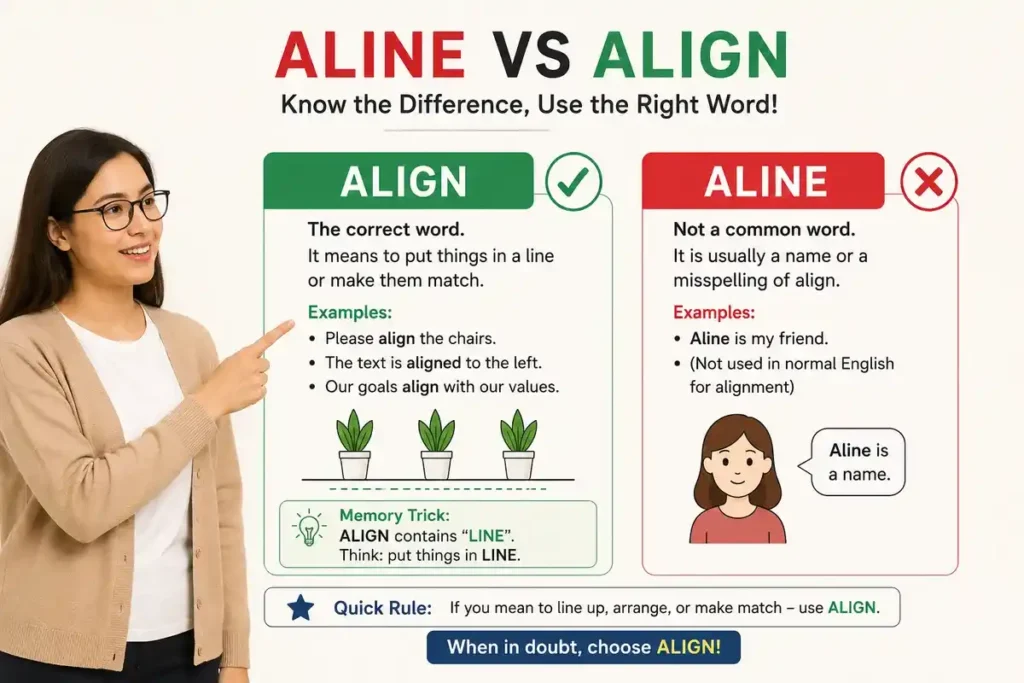
The short answer is simple. In modern English, align is the standard and correct word. It means to put things in a straight line or make them match. Aline is very rare and is usually not used in everyday writing.
If you are unsure about aline vs align, this guide will help you understand the difference in a very easy way. You will learn what each word means, why people confuse them, and which one you should use in daily English.
Many learners struggle with spelling patterns. You may also like our article on Presenter or Presentor.
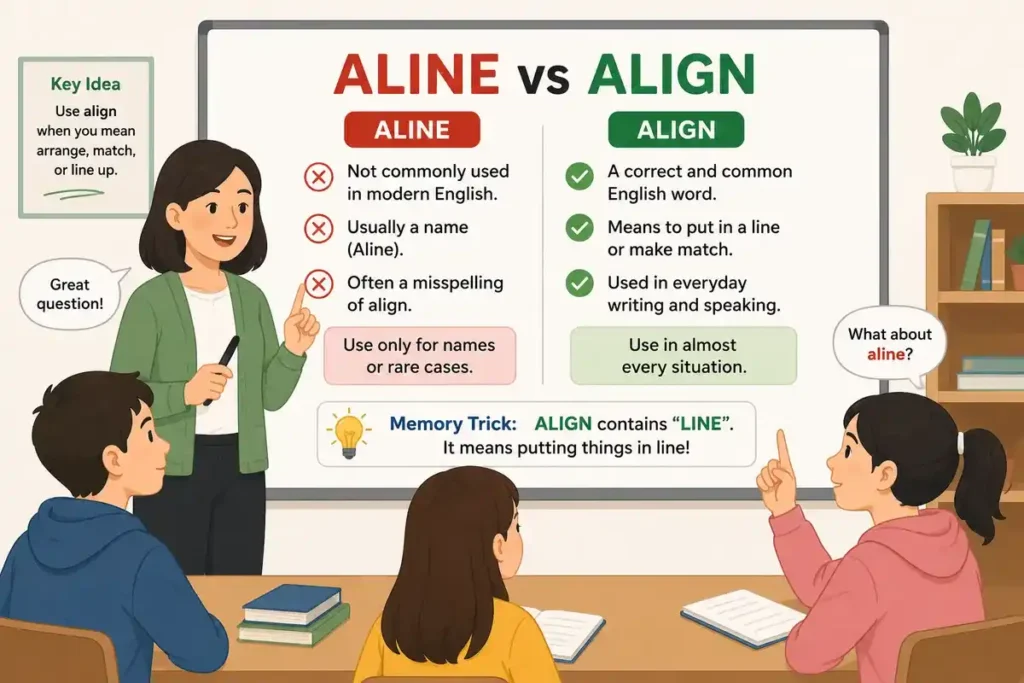
Simple Answer in One Look Aline vs Align
Align is the correct word in almost all modern English writing.
Aline is uncommon and rarely used today. For most situations, use align.
Means of Aline vs Align in Simple English
The word align means to put things in the right line, position, or order.
It can also mean making things agree with each other.
Think of a row of books on a shelf. If all the books are standing neatly in one straight line, they are aligned.
Here are some simple examples:
- Please align the chairs before the meeting.
- The pictures align perfectly on the wall.
- Our goals align with the company’s plans.
- Make sure the text aligns with the margin.
In each example, something is being placed correctly or made to match.
Now let’s look at aline.
Most people never use the word aline in normal conversation or writing. It is considered rare and is not the standard spelling for the meaning above.
That is why when people compare aline vs align, the answer is usually align.
Why People Mix These Words?
There are several reasons people get confused about aline vs align.
Both Aline vs Align Sound Similar
When spoken quickly, the two words can sound almost the same.
For example:
- align
- aline
Because the pronunciation is so close, many people assume either spelling works.
The Letter Pattern of Aline vs Align Looks Familiar
English has many words ending with:
- line
- sign
- mine
- fine
Because of this, some writers naturally type aline when they really mean align.
Spell Check Does Not Always Teach Meaning
Sometimes people focus on spelling but not meaning.
They may see a word that looks right and assume it is correct without checking how English normally uses it.
Typing Mistakes Happen in Aline vs Align
A simple keyboard mistake can turn align into aline.
This is especially common when writing quickly.
Clear Difference of Aline vs Align Explained Simply
Here is the easiest way to understand the difference between aline vs align.
Align
Meaning:
- Put in a straight line
- Arrange properly
- Make things agree or match
Common?
- Yes
- Used every day
- Standard English
Examples:
- Align the desks.
- Align the text.
- Our ideas align.
Aline
Meaning:
- Rare word
- Not commonly used in modern English
Common?
- No
- Rarely seen
- Usually not the word people need
Examples:
- Rare in everyday writing
- Not normally used instead of align
Quick Memory Trick for Aline vs Align
Think of the word sign.
The ending of align follows the same pattern.
- sign
- design
- align
This can help you remember the correct spelling.
Which Form Should You Use Aline vs Align?
For almost every situation, use align.
Use it when talking about:
Straight Lines
- Align the boxes.
- Align the tables.
- Align the photos.
Matching Ideas
- Their opinions align.
- Our plans align.
- The goals align well.
Computer and Design Work
- Align the image to the center.
- Align the text to the left.
- Align the logo properly.
School and Work Writing
Teachers, editors, and employers expect the spelling align.
Using aline instead may look like a spelling mistake.
Simple Rule
If you mean:
- line up
- arrange
- match
- agree
use align.
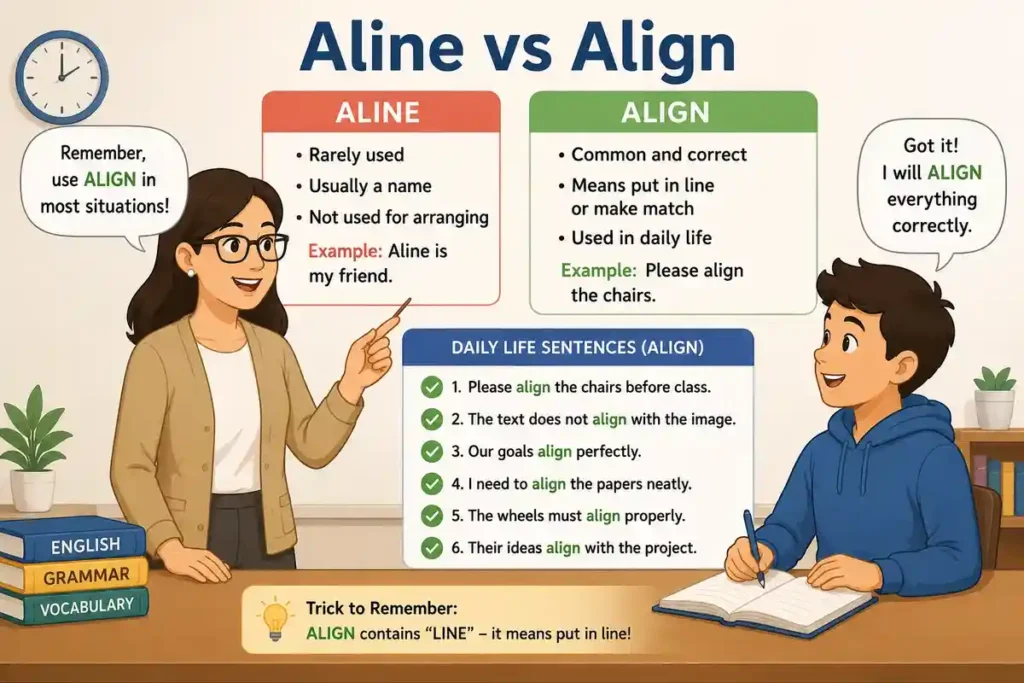
Easy Real-Life Sentences of Aline vs Align You Can Use
Here are some everyday examples.
- Please align the chairs before the guests arrive.
- The picture does not align with the frame.
- Our plans align perfectly.
- Align the books neatly on the shelf.
- The report should align with company goals.
- Make sure the text aligns in the center.
- Their values align with ours.
- The wheels must align correctly.
These are natural sentences that native English speakers use regularly.
Where This Word Aline vs Align Comes From?
The word align has a long history. It comes from older French and Latin words connected to the idea of making something straight or placing it in a line.
Over time, English adopted the spelling align and kept it as the standard form. That is why dictionaries, schools, style guides, and professional writers use align today. The word became popular because people often needed a way to describe putting objects into proper order or making ideas match.
As English developed, align remained the accepted spelling.
The form aline never became the common standard in modern English. Because of that, most English learners only need to remember and use align.
Common Situations Where People Use Align
Understanding real-life situations makes the meaning easier to remember.
In School
Teachers may say:
- Align your text with the margin.
- Align the columns in your chart.
In Offices
Workers often hear:
- We need to align our goals.
- Align the project with company plans.
In Graphic Design
Designers regularly use:
- Align left
- Align right
- Center align
In Construction
Builders may say:
- Align the boards carefully.
- Align the pipes before connecting them.
In Daily Life
People also use it casually:
- Our schedules align.
- Our interests align.
- The dates align perfectly.
In all these situations, the idea is the same: things fit together correctly.
Common Mistakes to Avoid Using Aline vs Align
When dealing with aline or align, watch for these mistakes.
Mistake 1: Using Aline for Everyday Writing
❌ Please aline the chairs.
✅ Please align the chairs.
Mistake 2: Using Aline in Business Writing
❌ Our goals aline with the strategy.
✅ Our goals align with the strategy.
Mistake 3: Using the Wrong Spelling in School Assignments
❌ Aline the text to the center.
✅ Align the text to the center.
These small spelling changes make your writing look more professional.
Mistake 4: Choosing Aline Instead of Align
❌ The goals aline perfectly.
✅ The goals align perfectly.
The standard word is align.
Mistake 5: Forgetting the Meaning of Aline vs Align
Some people think align only means putting objects into a straight line.
Actually, it can also mean agreement.
✅ Our ideas align.
This sentence talks about opinions, not physical objects.
Mistake 6: Using Align in the Wrong Context
Sometimes writers use align when they really mean “match exactly.”
While these meanings are similar, they are not always identical.
Example:
✅ The plans align well.
This means the plans work together.
Mistake 7: Misspelling Related Forms
❌ Alingment
✅ Alignment
❌ Alinged
✅ Aligned
Always remember the base word is align.
Mistake 8: Thinking Both Spellings of Aline vs Align Are Equal
Many learners assume aline and align are interchangeable.
In modern English, they are not.
For almost every situation, use align.
Test Yourself
Choose the correct word.
1. Please _____ the chairs.
A. aline
B. align
Answer: B. align
2. Our goals _____ with the company’s mission.
A. align
B. aline
Answer: A. align
3. Which spelling is standard in modern English?
A. aline
B. align
Answer: B. align
4. Which word means to arrange in a straight line?
A. align
B. aline
Answer: A. align
If you answered all four correctly, you understand the difference very well.
Deep Meaning, Culture, and Practical Use of Aline vs Align
The word align is used far beyond straight lines and neat rows. In everyday culture, people often use it to talk about agreement, balance, and working together.
For example, a sports team succeeds when the players align around the same goal. A family works better when everyone aligns on important decisions. Friends often say their values align when they think about life in similar ways.
Movies, books, and stories also use the idea of alignment. A hero may need to align their actions with their beliefs. A character may struggle because their choices do not align with what they truly want.
Because of this, the word align often carries a positive feeling. It suggests order, teamwork, direction, and harmony.
The word aline does not have this cultural meaning in modern English. Most people do not use it in stories, conversations, or everyday writing.
That is another reason why the question aline vs align has a clear answer for most writers. The word people usually need is align.
Biblical and Mythological Meaning of Aline vs Align
The exact word align does not appear as an important symbolic term in many Bible translations. However, the idea behind it appears often.
In the Bible, people are encouraged to bring their actions into agreement with God’s teachings. In simple words, they are asked to align their lives with what is right.
For example:
- Following God’s guidance
- Living according to good values
- Making choices that match faith
These ideas are very similar to the modern meaning of align.
In mythology and old stories, heroes often seek balance between different forces. They may need to align themselves with a mission, a destiny, or a greater purpose.
So while align is not usually a special religious word, its meaning fits many spiritual and moral lessons about being on the right path.
The word aline has no common biblical or mythological meaning in modern English.
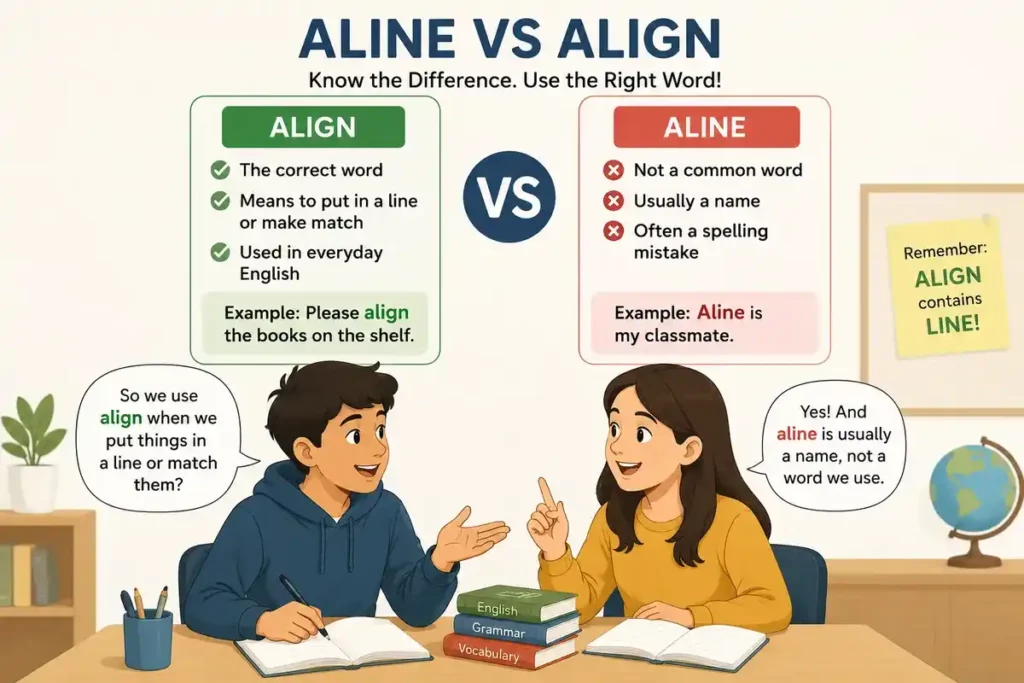
Symbolism of Aline vs Align Explained in Simple Words
Words often carry emotional meanings in addition to their dictionary definitions.
What Align Represents?
The word align often represents:
- Order
- Balance
- Agreement
- Teamwork
- Direction
- Unity
- Purpose
Imagine several arrows pointing toward the same target. They are aligned. This creates a feeling of focus and cooperation.
People also use alignment as a symbol of personal growth.
Examples:
- Align your actions with your goals.
- Align your habits with your dreams.
- Align your choices with your values.
In these examples, alignment means living in a way that supports what matters most to you.
What Aline Represents?
For most English speakers, aline does not carry a special symbolic meaning. Because it is rarely used, people generally do not connect it with cultural ideas, emotions, or life lessons. When readers see aline, they often assume it is a misspelling of align.
Symbolic Comparison Aline vs Align
| Word | Common Symbolic Meaning |
|---|---|
| Align | Balance, agreement, order, purpose |
| Aline | Rarely carries symbolic meaning |
Related Words to Aline vs Align You Should Know
Learning related words can make your vocabulary stronger.
Alignment
The state of being lined up or arranged correctly.
Example: The alignment of the shelves looks perfect.
Aligned
Already arranged or matched properly.
Example: Our goals are aligned.
Aligning
The action of putting something into proper position.
Example: She is aligning the pictures on the wall.
Misaligned
Not lined up correctly.
Example: The wheels are misaligned.
Agreement
When people share the same opinion or plan.
Example: The team reached an agreement.
Harmony
Things working well together.
Example: The group worked in harmony.
Balance
Different parts working together in a healthy way.
Example: Work-life balance is important.
Coordinate
To organize people or things so they work together.
Example: We coordinated the event carefully.
Match
To fit together or agree.
Example: The colors match perfectly.
Arrange
To put things in a specific order.
Example: Arrange the books neatly.
These related words help explain the wider meaning of align in daily English.
Use of Aline vs Align in Daily English
Native English speakers use align in many situations.
Here are some natural examples.
At Work
“Our goals align with the company’s vision.”
In School
“Please align your text before printing.”
During a Meeting
“We need to align on the next steps.”
In Design
“Align the image in the center.”
In Sports
“The whole team must align around the game plan.”
In Relationships
“Our values align really well.”
In Planning
“Let’s align our schedules.”
In Business
“The project aligns with customer needs.”
In Daily Life
“My actions should align with my priorities.”
In Technology
“Align the icons evenly across the page.”
Notice that all these examples involve matching, agreement, organization, or proper positioning.
That is the core idea behind align.
Final Teacher Explanation Aline vs Align
Imagine you are sitting in my classroom and asking, “Which word should I use: aline or align?”
My answer would be simple.
Use align.
It is the standard English word. It means to place things in the correct position, make them match, or bring them into agreement. You can align chairs, pictures, schedules, goals, plans, ideas, and values. The word aline is rare and is not the word most English learners need. In school writing, business writing, emails, articles, and conversations, align is almost always the correct choice.
A good way to remember it is this:
If something lines up, fits together, agrees, or works toward the same goal, use align. That simple rule will help you avoid mistakes every time.
Quick Recap Aline vs Align
When comparing aline vs align, the correct word for modern English is usually align.
Use align when talking about lining things up, organizing them properly, or making ideas agree. The spelling aline is uncommon and rarely needed in everyday writing.
Conclusion
When choosing between aline vs align, the safest and most correct choice is align. It is the standard English word used for arranging things in a straight line, making ideas agree, or bringing goals together. In modern writing, speaking, schoolwork, and business communication, align is the form you should use.
Remember the simple rule: if something matches, fits together, agrees, or lines up properly, use align. This easy guideline will help you write more clearly and confidently every time.
Frequently Asked Questions (FAQs)
Is it aline or align?
In modern English, align is the correct word in almost all situations.
What does align mean in simple words?
It means to line things up, organize them correctly, or make them agree.
Is aline a common English word?
No. It is very rare and not commonly used in everyday writing.
Why do people confuse aline and align?
They look and sound similar, so many people assume both spellings are correct.
Can I use aline instead of align?
Usually no. In normal English writing, use align.
When should I use align?
Use it when talking about arrangement, agreement, organization, or matching goals.
Is align used in business English?
Yes. It is very common in meetings, reports, planning, and teamwork discussions.
How can I remember the correct spelling?
Think of words like sign and design. The spelling pattern is similar to align.