
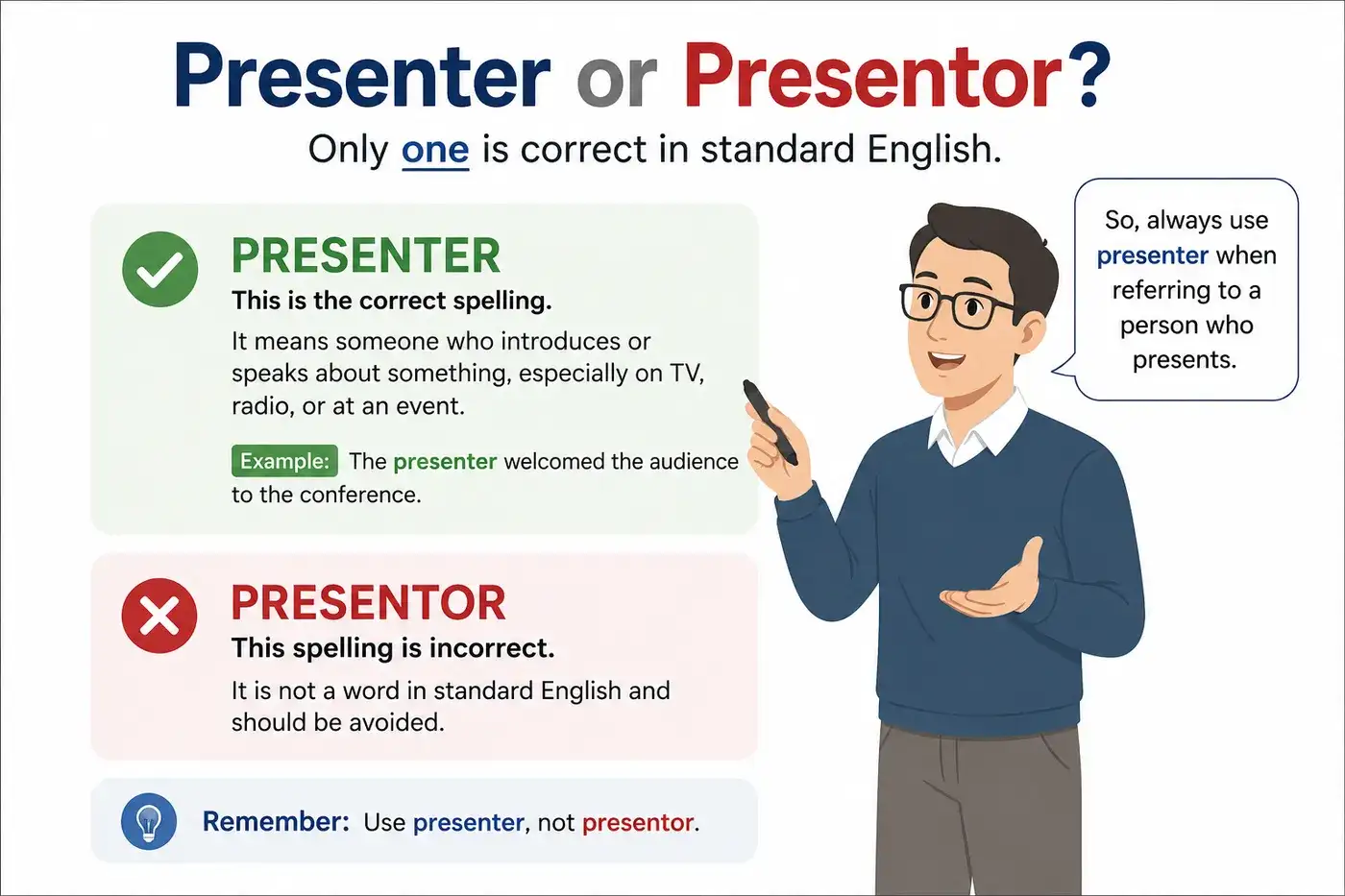
Many English learners get confused about presenter or presentor because both words look correct at first glance. Since both come from the word present, it is easy to think both spellings work in standard English.
The truth is simple. When comparing presenter or presentor, presenter is the correct and widely accepted spelling in modern English. Presentor is rare and is usually considered incorrect in everyday writing.
If you are unsure about presenter or presentor, this guide will help you understand the difference, correct spelling, meaning, usage, and word choice in simple English.
You may also enjoy our detailed comparison of similar words.
Simple Answer in One Look
Presenter is the correct word in standard English.
Presentor is rare and usually treated as a spelling mistake.
Means of Presenter or Presentor in Simple English
Let me explain this like a classroom lesson.
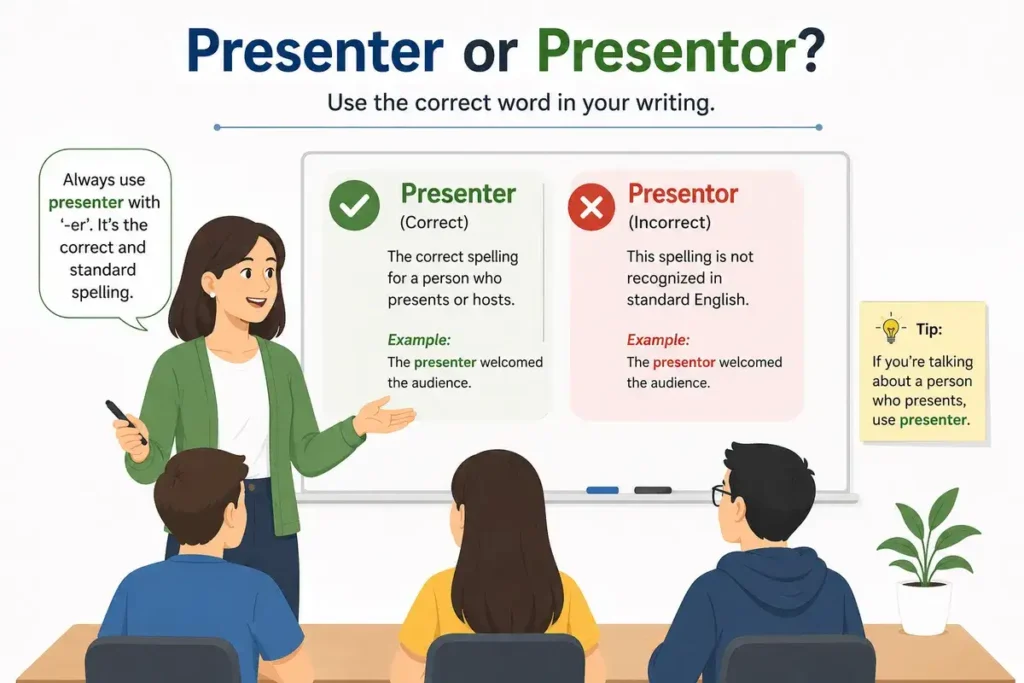
A presenter is a person who presents something.
That means someone who:
- gives a speech
- shows information
- explains ideas
- hosts a program
Think about a teacher giving a lesson.
That teacher is presenting information.
So the teacher can be called a presenter.
Example:
“The presenter explained the topic clearly.”
This means the person speaking explained everything well.
You may hear this word in many places.
For example:
- schools
- meetings
- conferences
- TV shows
- online webinars
Now let us talk about presentor.
In modern English, presentor is not commonly used.
Most dictionaries do not list it as standard usage.
In most cases, presentor is simply a spelling mistake of presenter.
That means if you are writing emails, essays, blog posts, or business documents, you should almost always use presenter.
Why People Mix These Words Presenter or Presentor?
People confuse presenter or presentor for a few simple reasons.
Both Spellings Look Logical
This is the biggest reason.
Many English words end in:
- -er
- -or
Examples:
- teacher
- actor
- editor
- creator
Because English uses both endings, learners may think both spellings are correct.
That creates confusion.
Other Words Influence Spelling
Some words ending in -or affect people’s spelling.
Examples:
- actor
- instructor
- professor
When learners see these words, they may assume presentor follows the same pattern.
But English does not always follow one rule.
That is why spelling must sometimes be memorized.
Fast Typing Causes Errors
Sometimes people know the correct word.
But while typing quickly, they write presentor.
Example:
“The presentor will start now.”
This contains a spelling mistake.
Correct version:
“The presenter will start now.”
Spellcheck Does Not Catch Everything
Some writing tools may not immediately flag rare spellings.
That means errors can stay unnoticed.
Clear Difference of Presenter or Presentor Explained Simply
Here is the easiest comparison.
Presenter
✅ Correct standard English word
✅ Common in speaking and writing
✅ Means a person who presents
✅ Used in formal and informal settings
Examples:
- The presenter spoke confidently.
- Our presenter answered questions.
- The TV presenter welcomed guests.
Presentor
⚠ Rare spelling
⚠ Usually considered incorrect
⚠ Often a typo of presenter
⚠ Not recommended in normal writing
Examples:
- Usually avoided in standard writing
- Often corrected to presenter
Quick Comparison Table Presenter or Presentor
| Word | Correct? | Meaning |
|---|---|---|
| Presenter | Yes | Person who presents |
| Presentor | Usually No | Rare or misspelling |
This makes presenter and presentor easy to understand.
Which Form Should You Use Presenter or Presentor?
The rule is very simple.
Use presenter.
That is the safest and correct choice.
Ask yourself one question:
Are you talking about someone giving information, a speech, or a presentation?
If yes, use presenter.
Examples:
- conference presenter
- TV presenter
- webinar presenter
- event presenter
Use presentor only if:
- a specific organization intentionally uses that spelling
- it appears in rare legal or historical writing
For almost all modern writing, choose presenter.
Easy Memory Trick to Remember Presenter or Presentor
Here is a simple trick.
Think of this:
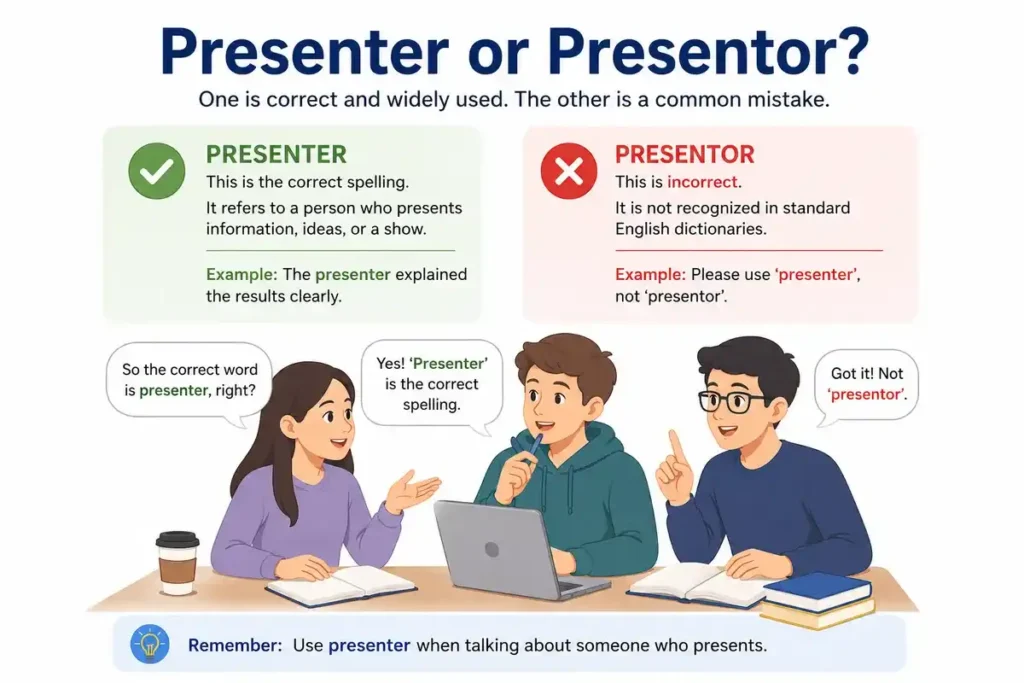
A person who teaches is a teacher.
A person who presents is a presenter.
Both end in -er.
That makes remembering easy.
Easy Real-Life Sentences of Presenter or Presentor
Here are simple examples using presenter.
- The presenter started the meeting on time.
- Our presenter explained the chart clearly.
- She is a great TV presenter.
- The presenter answered every question.
- I liked the presenter’s speaking style.
- The event presenter welcomed everyone.
- The presenter spoke with confidence.
- The workshop presenter gave useful tips.
Notice something important.
All natural English examples use presenter, not presentor.
Origin of This Word Presenter or Presentor
The word presenter comes from the verb present.
Present means:
- to show
- to offer
- to introduce
Over time, English added -er to create a noun.
That noun describes the person doing the action.
Examples:
- teach → teacher
- write → writer
- present → presenter
This pattern is common in English.
That is why presenter became the standard spelling.
The spelling presentor appeared in some rare historical uses, but it never became common modern English.
That is why most people and dictionaries prefer presenter.
Common Places You See “Presenter”
You may hear presenter in many situations.
In Schools
Students may become presenters during projects.
Example:
“Today’s presenter will explain climate change.”
In Business
Meetings often have presenters.
Example:
“The presenter will share quarterly results.”
On Television
TV hosts are often called presenters.
Example:
“She is a news presenter.”
Online Events
Webinars and digital workshops use presenters.
Example:
“The presenter shared useful slides.”
This shows how common the word is in daily English.
The Words Related to Presenter or Presentor
Learning related words improves vocabulary.
Present
To show or give something.
Example:
“She will present the report.”
Presentation
The speech or display itself.
Example:
“His presentation was excellent.”
Host
A person leading an event.
Example:
“The host welcomed guests.”
Speaker
Someone who talks to an audience.
Example:
“The speaker inspired everyone.”
These words help you better understand presenter.
Here are some more related words that help you understand presenter or presentor better:
- Announcer → Someone who gives public news or updates
- Lecturer → A person who teaches in a formal setting
- Reporter → Someone who shares news stories
- Instructor → A person who teaches skills
All these words connect to the idea of sharing or explaining information
Common Mistakes People Make About Presenter or Presentor
Students often make these mistakes.
Mistake 1: Writing Presentor
Wrong:
“The presentor is ready.”
Correct:
“The presenter is ready.”
Mistake 2: Assuming -or Is Always Correct
Not every action word becomes -or.
Some become -er.
That is why memorizing patterns helps.
Mistake 3: Confusing Presenter With Presentation
These are related but different.
- presenter = person
- presentation = event or speech
Example:
“The presenter gave a presentation.”
Both words can appear in one sentence.
Mistake 4: Mixing spelling rules
People think all job words end with “-or,” like actor or doctor.
But English is not always the same. So guessing can lead to mistakes.
Mistake 5: Overthinking the spelling Presenter or Presentor
Some learners pause too long and change it back and forth between:
- presenter
- presentor
Simple rule:
👉 Always trust “presenter” as the correct form.
Role of word Presenter or Presentor in Culture and Stories
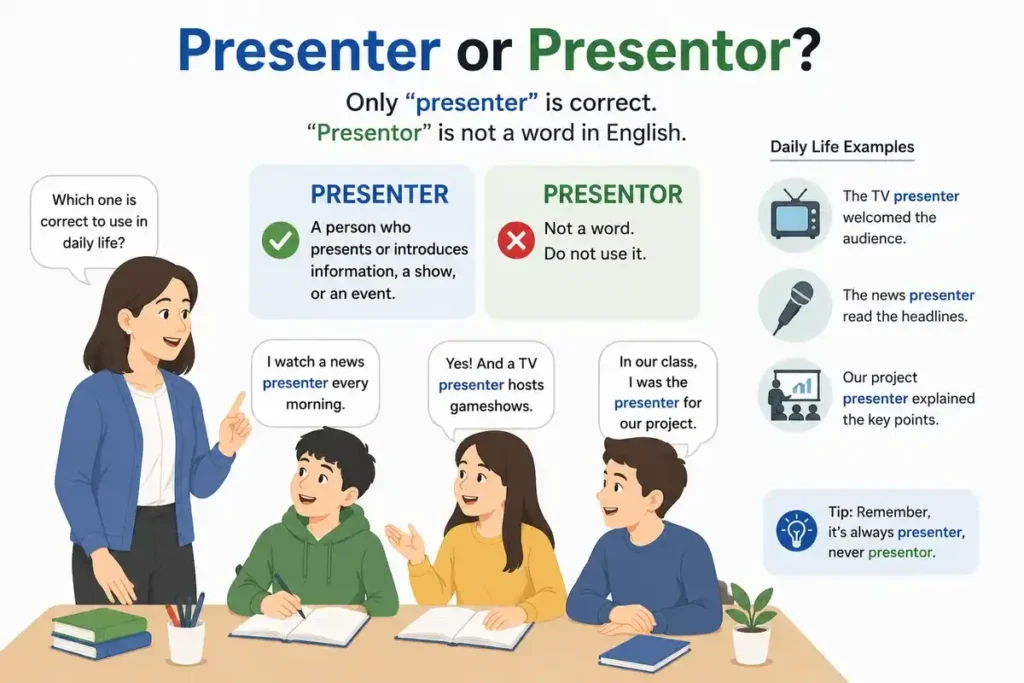
In real life, the word presenter or presentor is mostly understood in modern culture as a person who stands in front of others and shares information. You see this in TV shows, school programs, online videos, and conferences.
In simple culture, a presenter is seen as:
- A confident speaker
- A guide who explains things
- A person who connects with an audience
This role is important in daily life because people trust someone who can explain things clearly. That is why presenters are common in news channels, educational videos, and public events.
When people hear the word, they do not think about spelling first. They think about the person:
- someone speaking clearly
- someone teaching or guiding
- someone leading a program
That is why presenter or presentor is often discussed in writing, but only one form is used in professional English.
Biblical and Mythological Meaning Presenter or Presentor
There is no direct biblical or mythological meaning for presenter or presentor because this is a modern English job-related word.
However, if we understand it in a simple symbolic way from old stories:
- A “presenter” can be seen as a messenger
- Someone who brings information to others
In many old stories, messengers had an important role. They carried messages from kings, gods, or leaders. In that way, a modern presenter is similar—they carry information and share it with people.
But again, this is only a symbolic idea, not a religious rule or belief.
Symbolism of Presenter or Presentor
What Presenter Represents?
The correct form presenter represents:
- Clarity in communication
- Professional and correct English
- A trusted speaker
- Someone who shares knowledge in a clean way
It experienced modern, standard, and widely accepted.
What Presentor Represents?
The form presentor represents:
- Confusion in spelling
- Non-standard English usage
- A mistake made by guessing the ending
It is not commonly used in schools, exams, or professional writing.
So in simple meaning:
- Presenter = correct and confident communication
- Presentor = unclear or incorrect spelling form
This is why choosing the right word also shows how strong your English writing is.
Use of Presenter or Presentor in Daily English
In real life, people use the word presenter in many simple situations:
- She is the main presenter of the school event.
- The TV presenter explained today’s news clearly.
- I saw a YouTube presenter talking about science.
- He became the presenter for the group project.
- The conference presenter answered many questions.
- My friend wants to be a radio presenter.
- The webinar presenter used simple examples.
- Every student took turns as a presenter.
- The workshop presenter spoke slowly and clearly.
- She is a confident presenter in meetings.
These examples show how naturally the word is used in spoken and written English.
Final Teacher Explanation
Let’s make it very clear like a teacher in class.
The word presenter or presentor often confuses students because both look and sound similar. But English has one correct standard form: presenter.
A presenter is a person who shares information with others. It can be in school, on TV, in meetings, or online videos. This word is part of everyday English, and you will see it many times in real life.
The form “presentor” is not accepted in modern English writing. It is usually a spelling mistake made by guessing patterns from other words.
So the simple lesson is:
👉 Learn the correct form once: presenter
👉 Use it everywhere with confidence
👉 Do not switch between two spellings
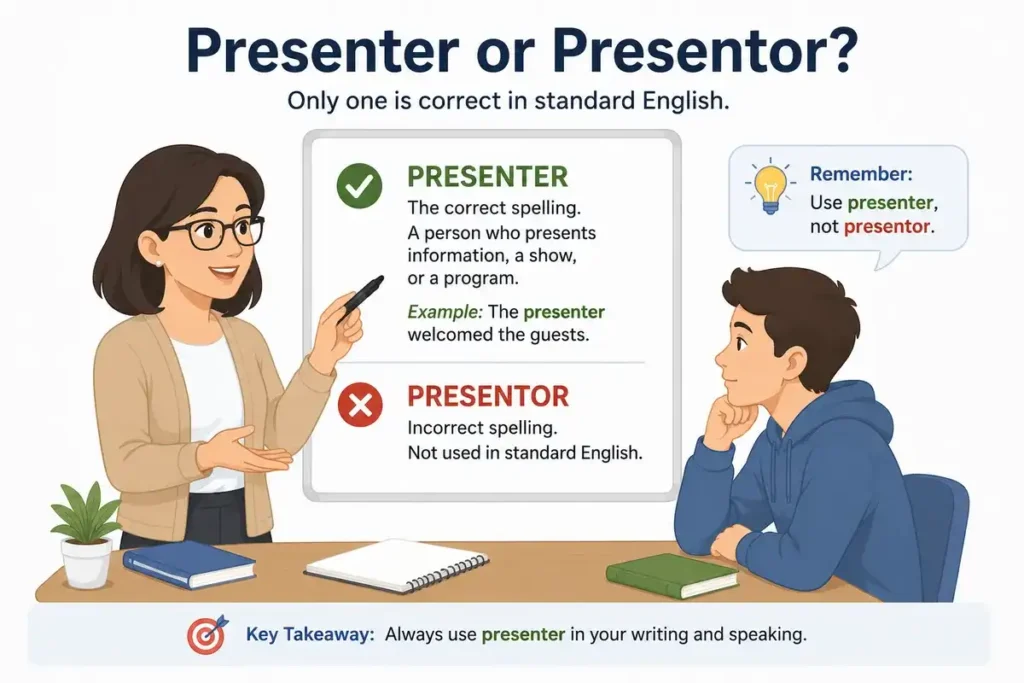
Quick Recap Presenter or Presentor
Presenter or presentor is a common spelling confusion, but only “presenter” is correct in standard English. It means a person who presents information in public or media.
Remember this simple rule: always use “presenter” in writing, speaking, exams, and professional English.
Conclusion
The word presenter or presentor is a simple example of how English spelling can confuse learners. In real usage, only “presenter” is correct and widely accepted. It is used in schools, media, and professional communication to describe someone who shares information clearly.
In the end, presenter or presentor teaches an important lesson in English: always follow standard spelling to sound natural and correct. Once you remember this, your writing becomes clearer, stronger, and more professional.
Frequently Asked Questions (FAQs)
1. What does presenter mean in simple English?
A presenter is a person who shares or explains information to an audience.
2. Is presentor correct in English?
No, “presentor” is not a standard or correct spelling in modern English.
3. Why do people confuse presenter or presentor?
Because both sound similar and follow patterns of other job words like actor or doctor.
4. Can I use presenter in formal writing?
Yes, “presenter” is the correct and formal word for all types of writing.
5. Is presenter used for TV hosts only?
No, it is used for TV hosts, teachers, speakers, and anyone who presents information.
6. What is the difference between presenter and speaker?
A speaker only talks, but a presenter also organizes and explains information clearly.
7. Which spelling should I learn first?
Always learn and use “presenter” because it is the correct form.
8. Can presentor be used in any situation?
No, it is not recommended in exams, writing, or professional English.