
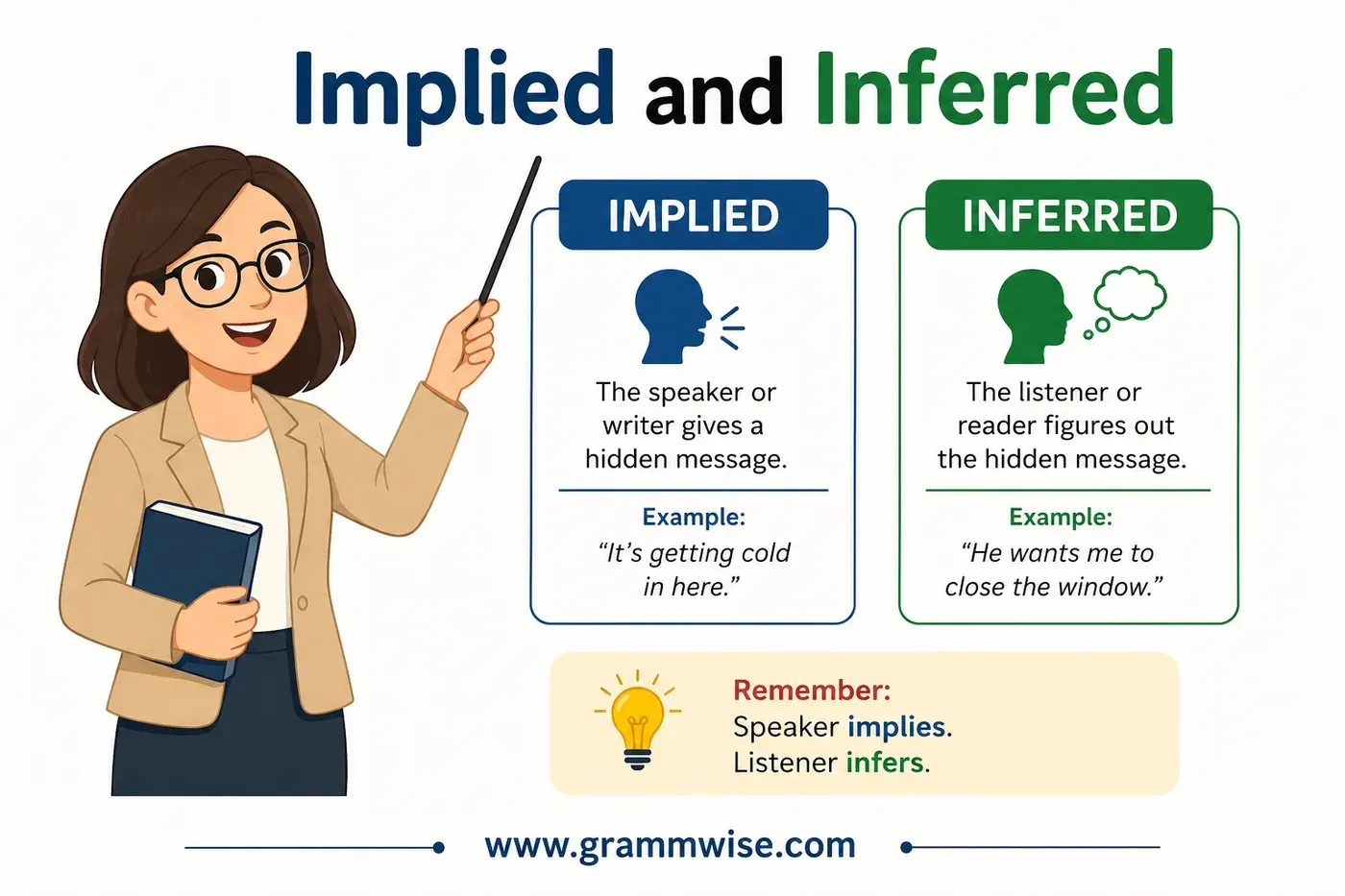
Many English learners confuse implied and inferred because both words deal with hidden meaning. They are closely connected, but they are not the same thing. The biggest difference is simple: the speaker or writer implies, while the listener or reader infers. Once you learn this easy rule, choosing the correct word becomes much easier.
This guide explains implied and inferred in very simple English. You will learn what each word means, why people mix them up, how to use them correctly, and how to remember the difference in everyday conversations.
Understanding word differences improves writing clarity and communication.
Simple Answer in One Look
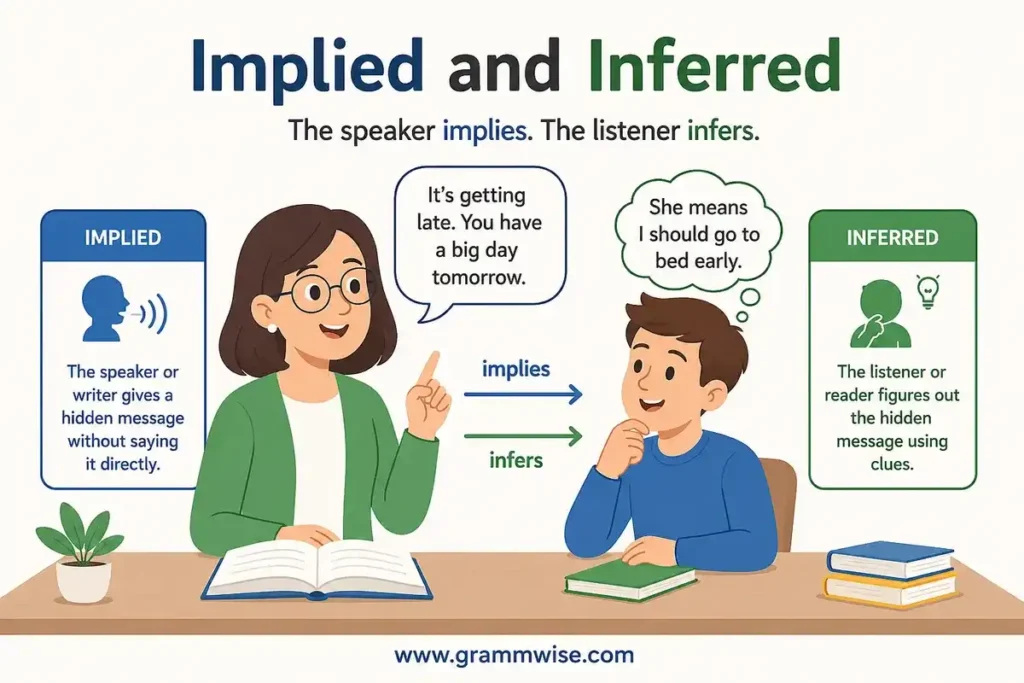
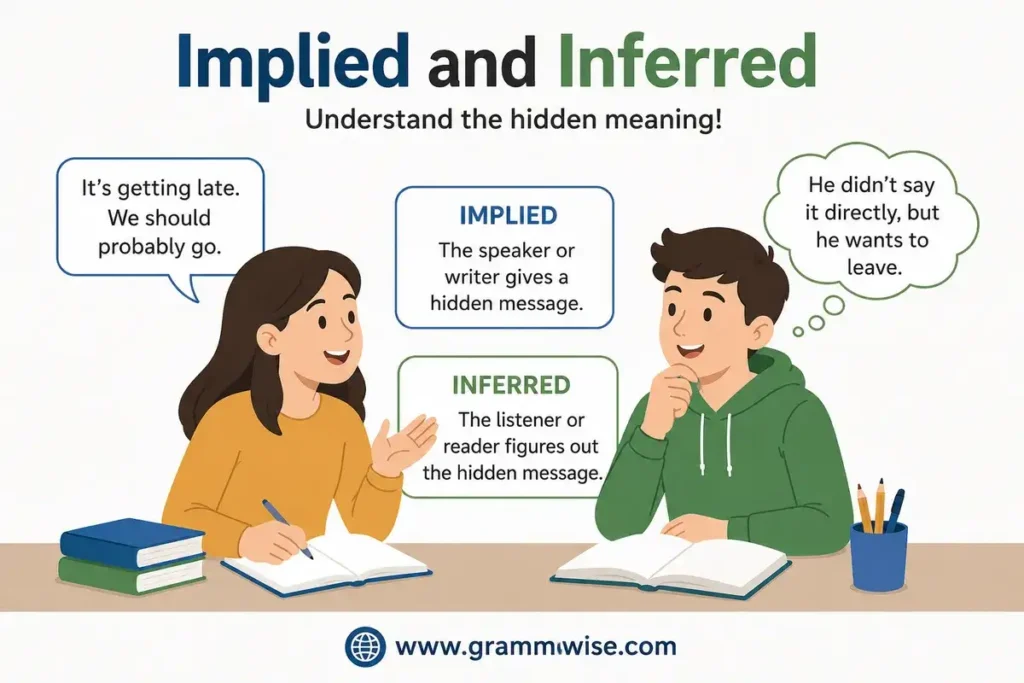
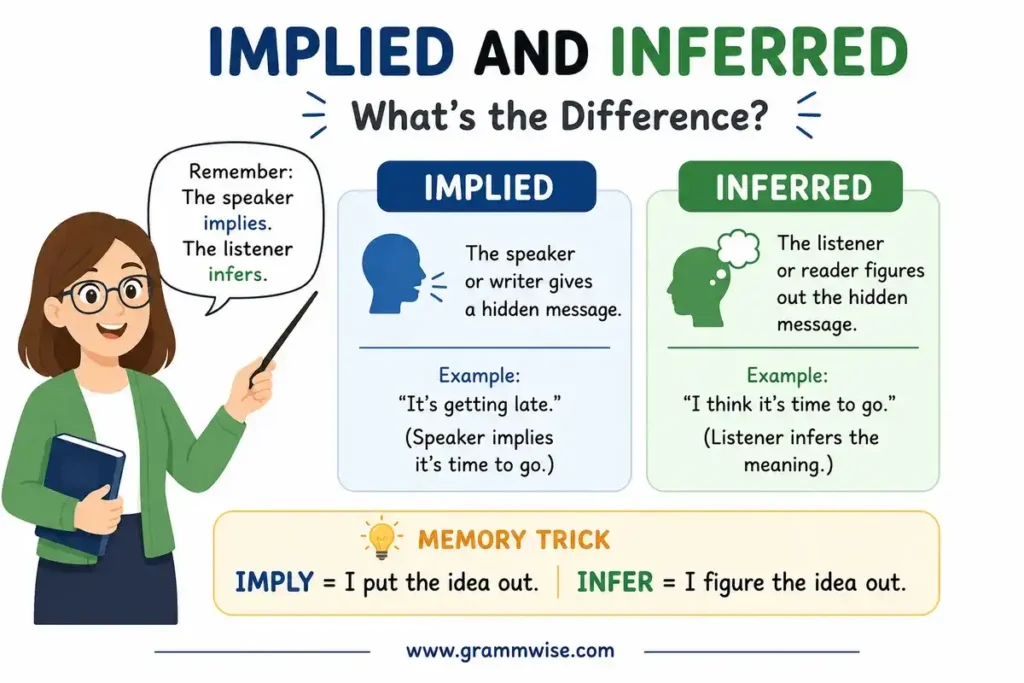
Implied means the speaker or writer gives a hidden message.
Inferred means the listener or reader figures out that hidden message.
Means of Implied and Inferred in Simple English
Think about talking with a friend.
Your friend says:
“It’s getting pretty cold in here.”
Your friend never says, “Please close the window.”
But they may be hoping you will close it.
That hidden message is implied.
When you hear the sentence and decide your friend wants the window closed, you have inferred the meaning.
A simple way to remember it is this:
- The sender implies.
- The receiver infers.
Both actions happen together, but they belong to different people.
Imagine someone says:
“I haven’t eaten all day.”
They do not ask for food directly.
They imply they are hungry.
You infer that they would like something to eat.
This happens every day in conversations, movies, books, school, and work.
Why People Mix These Words Implied and Inferred
Many people think implied and inferred mean exactly the same thing because they both involve ideas that are not spoken directly.
Here are a few reasons people get confused.
Implied and Inferred happen at the same time
One person gives a hidden meaning. Another person understands it. Since these actions are connected, people often switch the words by mistake.
Both deal with hidden meaning
Nothing is said directly. Instead, people read between the lines. That makes the two words seem very similar.
They are often taught together
English teachers explain these words as a pair. Students remember that they are connected but sometimes forget which person does which action.
Everyday speech is not always perfect
You may hear someone say,
“I implied that he was upset.”
when they really mean,
“I inferred that he was upset.”
Native speakers sometimes mix them up too.
Clear Difference Explained Simply
The easiest way to remember implied and inferred is to think about who is doing the action.
Implied
- Done by the speaker or writer.
- Gives a hidden message.
- Does not say everything directly.
Example:
“I guess the trash is still full.”
The speaker is not directly asking someone to take it out.
The request is implied.
Inferred
- Done by the listener or reader.
- Figures out the hidden message.
- Understands what is not directly said.
Example:
You hear the sentence and take out the trash.
You inferred what the speaker wanted.
Quick Comparison Implied and Inferred
| Implied | Inferred |
|---|---|
| Given by the speaker or writer | Understood by the listener or reader |
| Sends a hidden meaning | Finds the hidden meaning |
| Starts the message | Completes the understanding |
| Comes first | Comes second |
A simple memory trick:
Imply = I put the idea out.
Infer = I figure the idea out.
Which Form Should You Use between Implied and Inferred?
Ask yourself one easy question.
Who is giving the hidden message?
Use implied.
Example:
“The teacher implied that the homework would be difficult.”
The teacher gave the hint.
Who is understanding the hidden message?
Use inferred.
Example:
“The students inferred that they should start early.”
The students figured out the meaning.
Easy Rule to Remember Implied and Inferred
If someone is speaking or writing:
✅ Implied
If someone is listening or reading:
✅ Inferred
This rule works in almost every situation.
Easy Real-Life Sentences on Implied and Inferred You Can Use
- Dad implied that we should leave early.
- I inferred that the meeting was canceled.
- Her smile implied that she was happy.
- We inferred the answer from the clues.
- The coach implied we needed more practice.
- The class inferred that the test would be tomorrow.
- His message implied he wanted help.
- I inferred from her face that she was tired.
Notice how the person giving the clue uses implied, while the person understanding the clue uses inferred.
Where These Word Implied and Inferred Comes From?
These two words come from Latin. Imply comes from a word that means to fold into or to include something inside. That fits because a hidden message is folded into the words.
Infer comes from a word meaning to bring in or to draw a conclusion. That matches the idea of finding meaning from clues.
Over many years, English kept both words because they describe two different parts of communication. Even today, they work together but have different jobs.
How This Word Is Understood in Culture and Stories
People often communicate without saying everything directly. This happens in every culture around the world. Parents, teachers, friends, and coworkers all give hints instead of direct commands.
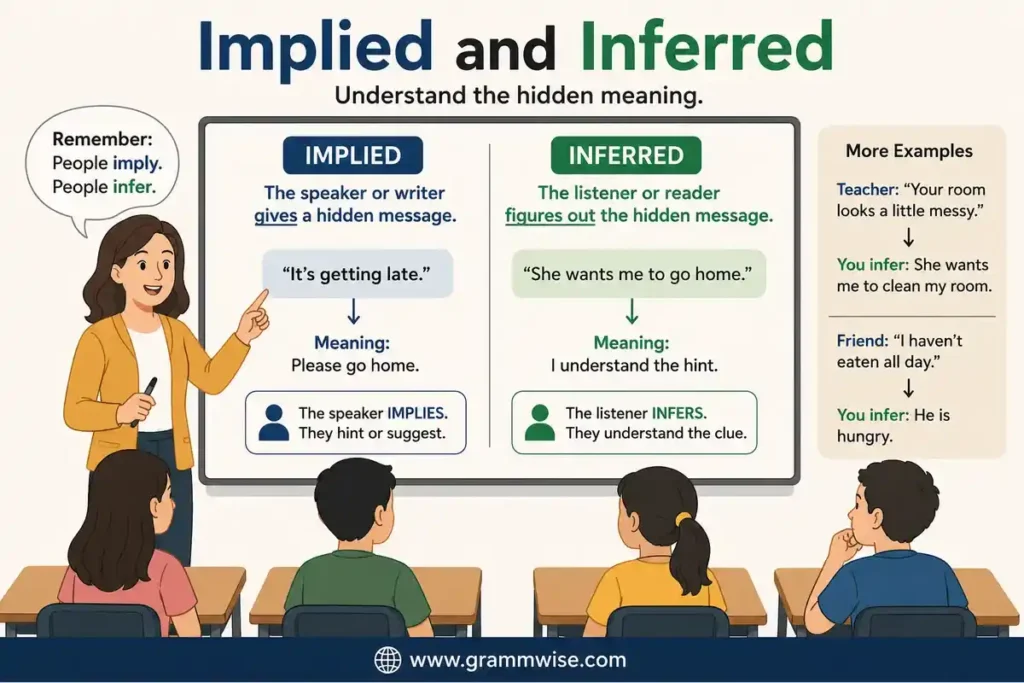
For example, a mother may say,
“Your room looks a little messy.”
She does not actually say,
“Clean your room.”
She has implied what she wants.
The child may understand the message and start cleaning. The child has inferred what the mother meant.
Stories also use this idea all the time. A writer may never say that a character is lonely. Instead, the story shows the character sitting alone every day, avoiding other people, and looking sad. The writer has implied loneliness. The reader infers that the character feels lonely.
Movies work the same way. A character may smile, but their eyes look sad. The audience infers that something is wrong, even though the movie never says it directly. Good storytellers trust readers to infer meaning from clues.
That is why understanding implied and inferred makes reading books and watching movies much easier.
Biblical and Mythological Meaning of Implied and Inferred
The words implied and inferred are not special religious words, but the ideas behind them appear in many religious books and old stories.
In the Bible, people sometimes speak in parables. A parable is a short story that teaches a lesson. The lesson is often implied, not explained word for word. Readers must infer the deeper meaning by thinking about the story.
For example, many of Jesus’ parables teach lessons through everyday examples. People listening to the stories had to think carefully to understand the message behind them.
Many old myths also work this way. Heroes, kings, and wise people often speak in riddles or give hints instead of direct answers. The hidden message is implied. The listener or reader infers the lesson. This makes stories more interesting because readers become part of solving the message.
Symbolism of Implied and Inferred Explained in Simple Words
What Implied Represents?
Implied represents hidden communication.
It reminds us that people do not always say exactly what they mean.
Sometimes they;
- use hints because they want to be polite.
- want others to think for themselves.
- simply expect people to understand the situation.
An implied message often shows trust between people.
What Inferred Represents?
Inferred represents understanding.
It shows careful listening, reading, and thinking.
When someone infers correctly, they connect clues and find the real meaning.
This skill helps people understand books, conversations, movies, and even everyday life.
Simply put:
- Implied is giving a clue.
- Inferred is solving the clue.
Together, they help people communicate without saying every single detail.
Related Words to Implied and Inferred You Should Know
Hint
A small clue that helps someone understand something without saying it directly.
Suggest
To give an idea gently instead of giving an order.
Mean
The real idea someone wants to communicate.
Indicate
To point toward something without fully explaining it.
Conclude
To decide something after looking at facts or clues.
Understand
To know what someone is trying to say.
Interpret
To explain the meaning of words, actions, or signs.
Assume
To believe something without enough proof. This is different from infer, because inference is based on clues.
Clue
A piece of information that helps someone discover an answer.
Evidence
Facts or signs that help people make a good inference.
Learning these related words makes it easier to understand implied and inferred in reading and conversation.
Use of Implied and Inferred in Daily English
People use these ideas every day, even if they never say the words implied or inferred.
Here are some common examples.
- “My boss implied that I should finish the project today.”
- “I inferred that my friend was upset because she stopped replying.”
- “The teacher implied there would be a surprise quiz.”
- “The students inferred they should review the lessons.”
- “His quiet voice implied he was nervous.”
- “We inferred that the store was closed because the lights were off.”
- “My sister implied she wanted pizza for dinner.”
- “I inferred from her smile that she liked the gift.”
- “The weather report implied it might rain later.”
- “We inferred we should bring umbrellas.”
Notice that every example follows the same simple rule.
The person giving the hidden message implies. The person understanding the hidden message infers.
Common Mistakes People Make About Implied and Inferred
Many learners make the same mistakes when using implied and inferred.
Mistake 1: Using the Wrong Person
❌ I implied he was tired after seeing him yawn.
✅ I inferred he was tired after seeing him yawn.
You saw the clue.
You understood the meaning.
So you inferred it.
Mistake 2: Switching the Actions
❌ She inferred that we should leave early.
If she was the one giving the hint, this is incorrect.
✅ She implied that we should leave early.
Mistake 3: Thinking They Mean the Same Thing
Although the words are connected, they describe different actions.
Remember:
- Speakers imply.
- Listeners infer.
Mistake 4: Guessing Implied and Inferred Without Clues
An inference should come from clues. If there are no clues, you are simply guessing.
For example:
“I inferred he was sick because he looked pale and was coughing.”
This is an inference because there are clues.
Saying,
“I inferred he was sick because I felt like it,”
is really just a guess.
Mistake 5: Forgetting the Simple Rule
If you ever feel confused, ask one question.
Who is giving the hidden message?
If it is the speaker or writer, use implied.
If it is the listener or reader, use inferred.
That one question solves most mistakes.
Final Teacher Explanation
Imagine we are in a classroom.
I say,
“Some students may want to check their homework before class ends.”
I never tell you to check your homework. Only give a hint. I have implied the message.
You hear my words. You think,
“My teacher wants us to check our homework now.”
You have inferred the message.
That is the whole difference. You do not need difficult grammar rules. You only need to remember who starts the hidden message and who understands it.
Whenever someone gives a clue, they imply.
Whenever someone figures out the clue, they infer.
This simple idea works in conversations, books, school, movies, emails, and everyday life. Once you practice it a few times, choosing between implied and inferred will become natural.
Practice Test: Implied and Inferred
Choose the correct word (implied or inferred) to complete each sentence.
1. The teacher __________ that the class should study for a quiz tomorrow.
A. implied
B. inferred
Answer: A. implied
2. From the dark clouds, we __________ that it was going to rain soon.
A. implied
B. inferred
Answer: B. inferred
3. Sarah __________ she wanted help by looking at her heavy bags.
A. implied
B. inferred
Answer: A. implied
4. After reading the story, the students __________ that the main character had learned an important lesson.
A. implied
B. inferred
Answer: B. inferred
5. Dad __________ that it was time to leave by picking up the car keys.
A. implied
B. inferred
Answer: A. implied
Quick Recap Implied and Inferred
The difference between implied and inferred is very simple.
- Implied means the speaker or writer gives a hidden message.
- Inferred means the listener or reader understands that hidden message.
Remember this easy rule: People imply. People infer. The speaker gives the clue, and the listener figures it out.
Conclusion
Understanding implied and inferred is easier when you remember one simple rule: the speaker or writer implies, while the listener or reader infers. This small difference helps you choose the correct word in conversations, schoolwork, reading, and everyday writing.
The more you practice finding hidden messages and understanding clues, the more natural these words will become. Keep the simple rule in mind, and you’ll use both terms with confidence and accuracy.
Frequently Asked Questions (FAQs)
What does implied mean in simple words?
Implied means something is suggested but not said directly. It is a hidden message.
What does inferred mean in simple words?
Inferred means you understand a hidden message by using clues.
What is the difference between implied and inferred?
The speaker or writer implies something. The listener or reader infers the meaning.
Why do people confuse implied and inferred?
People confuse them because both deal with hidden meaning. The difference is who is giving the message and who is understanding it.
Can I use implied and inferred in the same sentence?
Yes. For example: The teacher implied that the test would be difficult, and the students inferred that they should study harder.
Is infer the same as guess?
No. An inference is based on clues. A guess may have no evidence.
Which word should I use in writing?
Use implied when talking about the person giving the hint. Use inferred when talking about the person understanding the hint.
How can I remember the difference easily?
Remember this sentence: The speaker implies. The listener infers. This simple rule works in almost every situation.