
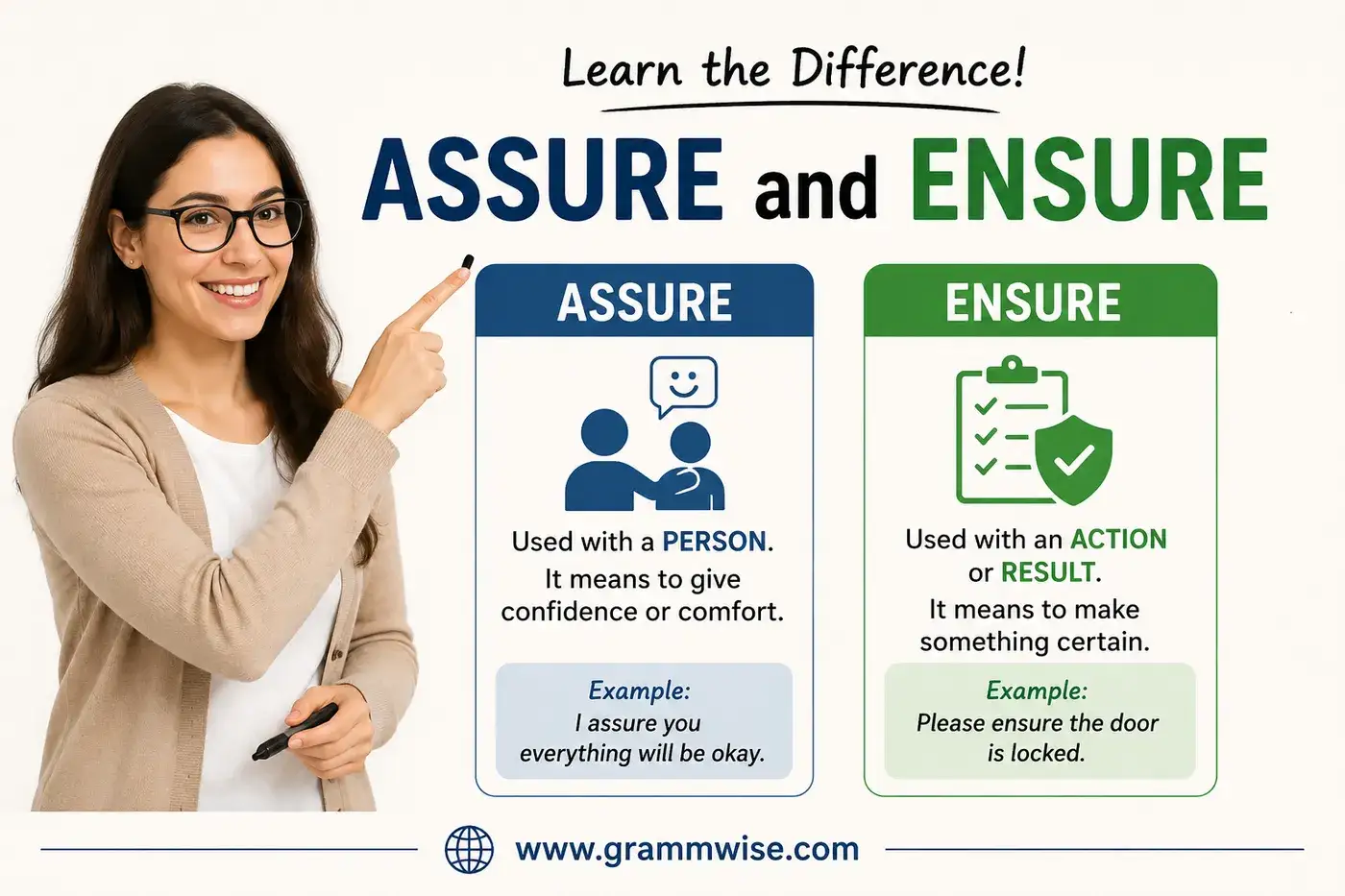
Many English learners get confused about assure and ensure because these two words look and sound very similar. Even some native English speakers use them incorrectly from time to time. The good news is that the difference is simple once you know what each word does.
If you have ever searched for the difference between assure and ensure, you are in the right place. In this lesson, you will learn the meaning of each word in simple English. You will also see easy examples, common mistakes, and simple memory tricks that help you choose the right word every time.
By the end of this guide, you will know when to use assure and when to use ensure in conversations, school assignments, emails, and everyday writing. You will also feel more confident because these two words follow an easy pattern that is simple to remember.
Understanding word differences improves writing clarity and communication.
Simple Answer in One Look
The difference between assure and ensure is easy.
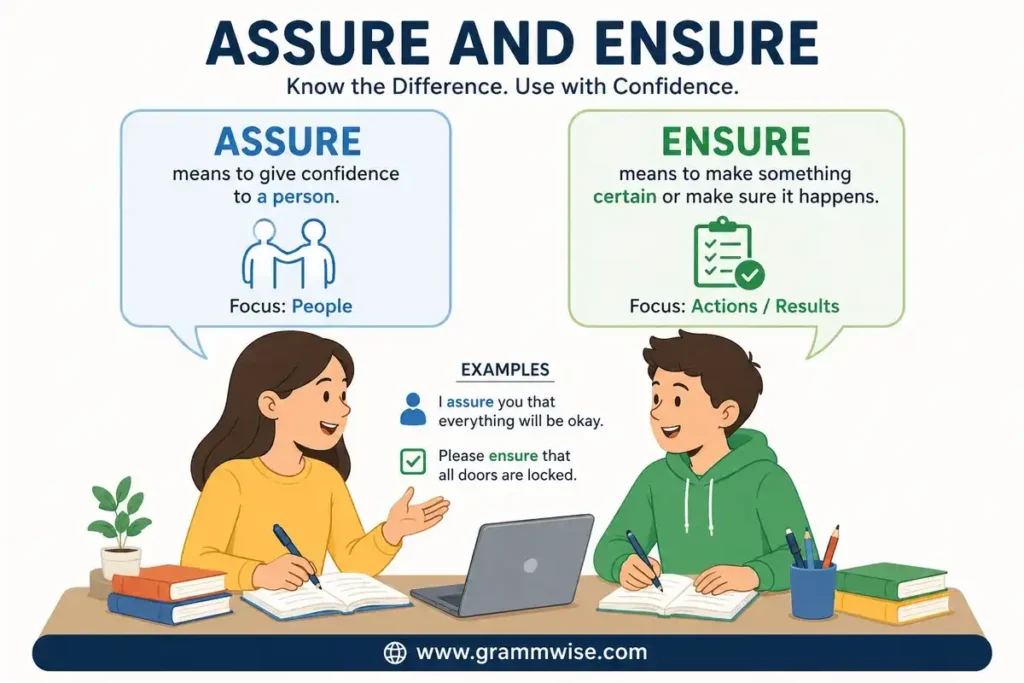
- Assure means to make a person feel confident or less worried.
- Ensure means to make something certain to happen.
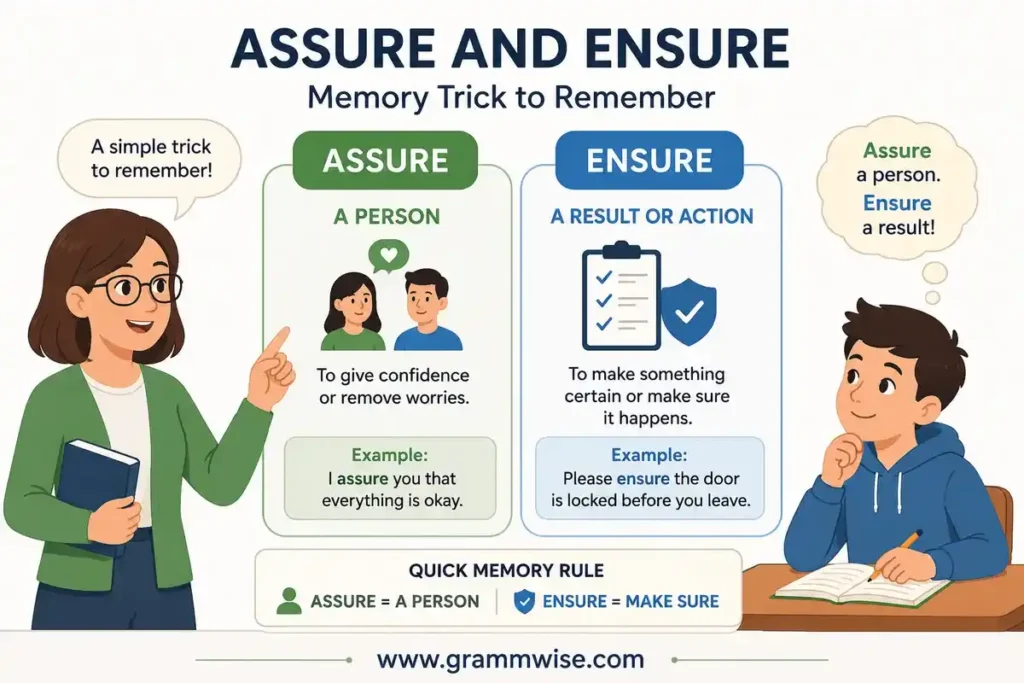
A simple way to remember them is this:
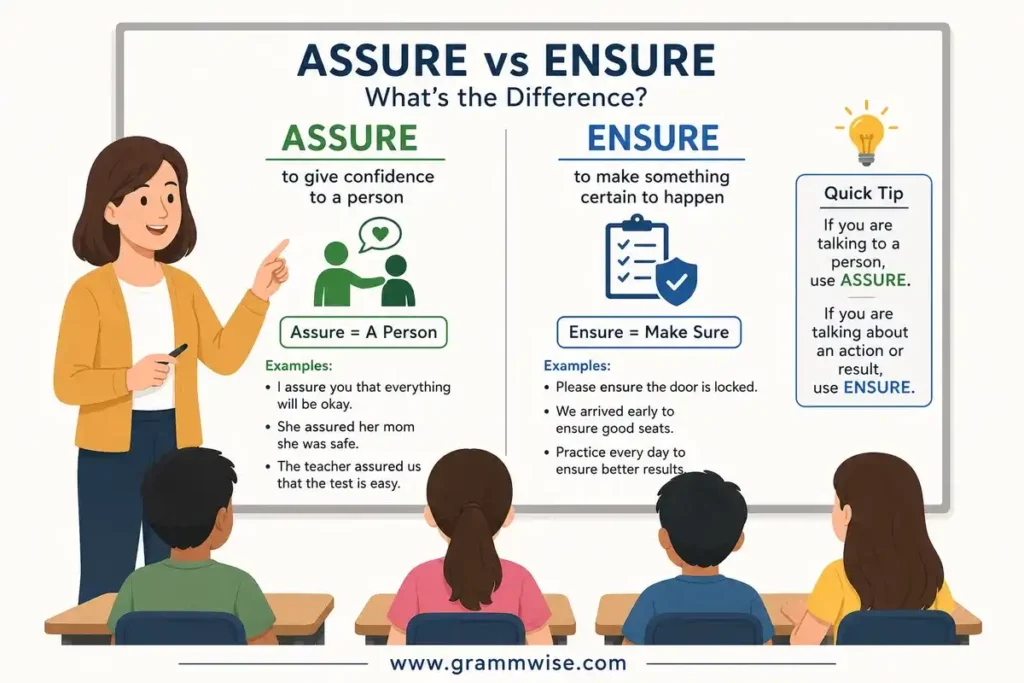
- Assure = A Person
- Ensure = Make Sure
If you remember those two ideas, you will usually choose the correct word.
Meaning of Assure and Ensure in Simple English
Imagine your friend is nervous before an exam.
You smile and say, “Don’t worry. You’ll do great.”
You have just assured your friend.
Now imagine your teacher checks that every student has a pencil before the test begins.
The teacher is making sure everyone is ready.
The teacher ensures the class can start without problems.
See the difference?
One word is about people and feelings.
The other word is about actions and results.
What Does “Assure” Mean?
Assure means to tell someone something that helps them stop worrying.
It gives confidence, comfort and builds trust.
For example:
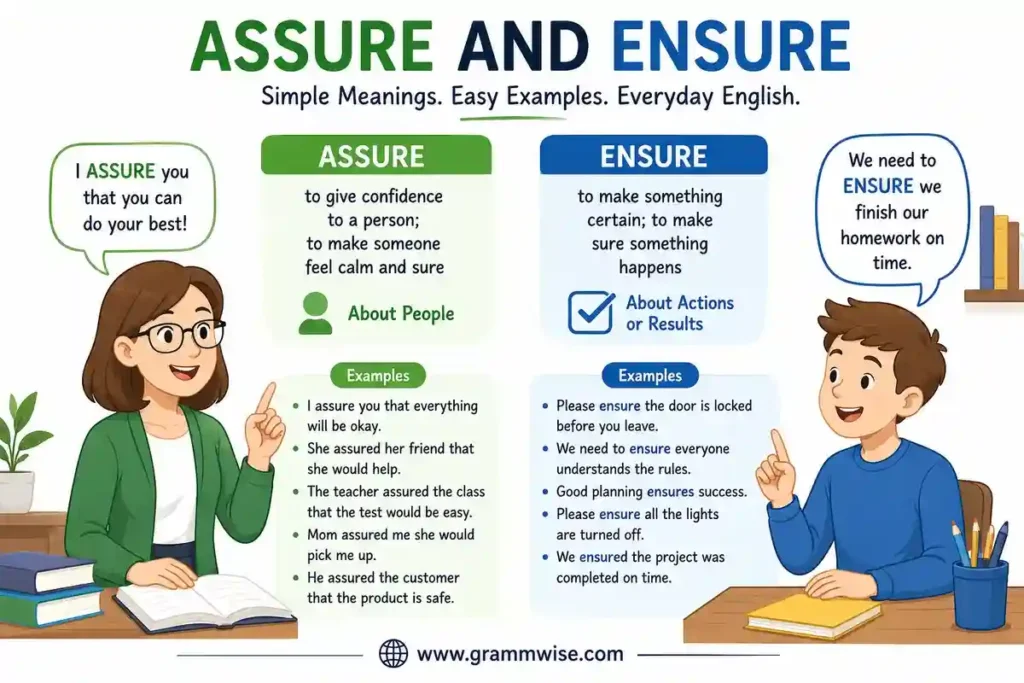
- I assure you that everything is fine.
- She assured her parents that she arrived safely.
- Our teacher assured us that the quiz would be easy.
Notice something important. Every example has a person receiving the assurance. That is the biggest clue.
What Does “Ensure” Mean?
Ensure means to make certain that something happens.
It is almost the same as saying make sure.
You are not calming someone. Instead, you are checking, planning, or doing something so the result is correct.
Examples:
- Please ensure the door is locked.
- Good planning ensures success.
- Double-check your work to ensure there are no mistakes.
In each sentence, the goal is not to comfort someone. The goal is to make something happen.
Why People Mix These Words Assure and Ensure?
Many students ask the same question.
“If these words are different, why do they look almost the same?”
That is a great question.
There are several reasons.
They Sound Similar
When people speak quickly, assure and ensure can sound alike.
This makes it easy to confuse them, especially if English is not your first language.
Assure and Ensure: Both Suggest Safety
Both words have something to do with feeling safe or making things safe.
That is why many learners think they can replace each other. But they cannot.
Think about these two sentences.
“I assure you the bridge is safe.” Here, you are speaking to a person.
Now look at this one.
“We ensured the bridge was safe.” Here, workers checked everything before opening the bridge.
The meanings are close, but they are not the same.
Many Learners Translate from Their First Language
Some languages use one word for both ideas.
When learners translate directly into English, they often pick the wrong word.
That is perfectly normal.
The key is to remember that English separates these ideas into two different words.
Assure and Ensure: Both Share a Similar History
Both words come from the same old language family. Long ago, they both carried the idea of making something secure. Over time, English gave each word a different job.
Today:
- Assure belongs with people.
- Ensure belongs with results.
Everyday Situations That Cause Confusion Between Assure and Ensure
Here are some examples of common mistakes.
Someone writes:
❌ I ensure you everything will be okay.
This sounds strange because you are talking to a person.
The correct sentence is:
✅ I assure you everything will be okay.
Now look at another example.
❌ Please assure all windows are closed.
This is incorrect because windows are not people.
The better sentence is:
✅ Please ensure all windows are closed.
The more examples you read, the easier these choices become.
Clear Difference Between Assure and Ensure Explained Simply
Now you know the basic meaning of assure and ensure. Next, let’s compare them side by side.
| Assure | Ensure |
|---|---|
| Used with a person | Used with a result, action, or situation |
| Means to give confidence | Means to make something certain |
| Helps someone stop worrying | Helps something happen correctly |
| Focuses on feelings | Focuses on actions |
| Often followed by a person | Often followed by “that” or an action |
Another Easy Way to Remember
Imagine two pictures.
In the first picture, someone is smiling because another person comforted them. That is assure.
In the second picture, someone is checking a list before leaving home. That is ensure.
One picture is about feelings.
The other picture is about making sure everything is correct.
A Quick Comparison Between Assure and Ensure
Here are more examples.
Assure
- I assure you I am telling the truth.
- She assured her friend before the interview.
- The nurse assured the patient that the test would be quick.
Ensure
- We ensured the food stayed fresh.
- Reading carefully ensures fewer mistakes.
- Please ensure every student signs the paper.
Notice that assure almost always includes a person.
Ensure usually talks about a task, result, plan, or situation.
Assure and Ensure: Which Form Should You Use?
Many students stop and think before choosing between assure and ensure.
You can make the choice much easier by following three simple steps.
Step 1: Are You Talking to a Person?
If your words are helping someone feel calm, safe, or confident, use assure.
Examples:
- I assure you that I will help.
- She assured her parents that she was fine.
- The guide assured the visitors that the trail was safe.
Every sentence is directed toward a person.
Step 2: Are You Making Something Certain?
If you want to say make sure, use ensure.
Examples:
- Ensure every answer is complete.
- Please ensure the gate is locked.
- We ensured the meeting started on time.
Here, nobody is receiving comfort.
The focus is on getting the right result.
Step 3: Try Replacing It with “Make Sure”
This is one of the easiest grammar tricks.
Read your sentence.
Replace the word with make sure.
If the sentence still makes sense, ensure is probably the right choice.
Example:
Please ensure the report is correct.
Becomes:
Please make sure the report is correct.
The meaning stays the same.
Now try the same trick with assure.
I assure you everything is okay.
Becomes:
I make sure you everything is okay.
That does not sound right.
So the correct word is assure.
Your Fast Memory Rule
Remember these three short lines.
Assure = Someone feels better.
Ensure = Something happens.
Keep repeating them while you practice.
Soon, choosing the right word will feel natural.
Easy Real-Life Sentences on Assure and Ensure You Can Use
The best way to learn new words is by seeing them in everyday situations.
Here are simple examples you can use in daily life.
Sentences with “Assure”
- I assure you that everything is under control.
- She assured me that she would call later.
- Dad assured us the trip would be fun.
- The teacher assured the class that everyone would have enough time.
- My friend assured me that the movie was good.
- The manager assured customers that the problem would be fixed.
- We assured our neighbors that we would help them.
- The doctor assured the family that the patient was improving.
Sentences with “Ensure”
- Please ensure your homework is complete.
- We arrived early to ensure good seats.
- Drink enough water to ensure better health.
- Double-check your answers to ensure they are correct.
- Good planning ensures success.
- They ensured every guest received an invitation.
- Fasten your seat belt to ensure your safety.
- Practice every day to ensure steady progress.
Read these examples several times.
Soon, you will begin to notice the pattern without even thinking.
Assure and Ensure: Where This Word Comes From?
The words assure and ensure have a long history.
Both came from old French words, which were influenced by Latin. Their original meaning was connected to being safe, secure, or certain. Many years ago, people sometimes used these words in similar ways. As English changed over time, each word found its own special job.
Today, assure is mainly used when speaking to people and giving confidence. Ensure is used when making something certain or making sure something happens.
Even though they have different meanings today, their shared history explains why they look so much alike.
Learning this small piece of history also helps you remember that both words are connected to the idea of safety, but they express that idea in different ways.
How Assure and Ensure Are Understood in Culture and Stories
The words assure and ensure are not only used in grammar books. People use them every day when they talk about trust, responsibility, and confidence.
When parents speak to their children, they often use words of assurance. A parent may say, “I promise everything will be okay.” Even if the word assure is not spoken, the idea is the same. The parent is helping the child feel calm and safe.
Teachers also give assurance. Before a difficult test, a teacher might say, “You have studied well. I know you can do it.” These words give students confidence. That is exactly what assure means.
The idea behind ensure appears whenever people make careful plans.
- A pilot checks every part of an airplane before takeoff.
- A chef checks that every meal is cooked properly.
- A coach checks that every player understands the game plan.
These actions help ensure success and safety. Stories often show these ideas too. The hero assures worried friends before a dangerous journey. Later, the hero ensures everyone has enough food, water, and supplies before leaving.
One action comforts people.
The other action prepares for success.
These ideas appear in movies, books, schools, workplaces, and everyday family life. That is why learning assure and ensure helps you understand real English better.
Biblical and Mythological Meaning
The words assure and ensure are not special religious words. However, the ideas behind them appear in many religious stories and old traditions.
In the Bible, people often encourage one another during difficult times. They remind others to trust, stay hopeful, and not be afraid. These messages give assurance.
For example, leaders comfort people before hard journeys or difficult decisions. They help others believe everything will be okay. That matches the meaning of assure.
The idea behind ensure also appears in many stories. Wise leaders prepare carefully before leading people. They gather food, make plans, and organize supplies. Their careful actions help ensure success.
In mythology, heroes often prepare before beginning an adventure. They collect the right tools, learn important lessons, and make careful choices. These actions help ensure they are ready for the challenges ahead.
So while assure and ensure are modern English words, the ideas behind them have been part of human stories for thousands of years.
Symbolism of Assure and Ensure Explained in Simple Words
What Assure Represents?
Assure represents trust and kindness. When you assure someone, you show that you care about their feelings. You help remove fear. You replace worry with hope. A few comforting words can help someone feel stronger.
What Ensure Represents
Ensure represents responsibility. It shows careful planning. It reminds us that good results usually happen because someone prepared well. When you ensure something, you do not simply hope everything goes well.
- You take action.
- You check details.
- You solve problems before they become bigger.
That is why ensure is often connected with careful work, success, and safety.
Together, assure and ensure teach an important lesson.
Kind words help people. Careful actions help results. Both are valuable in everyday life.
Related Words You Should Know
Learning related words makes your vocabulary stronger.
Here are some useful words connected to assure and ensure.
Assurance
This is the noun form of assure.
It means confidence or a promise.
Example:
“Her assurance helped everyone relax.”
Assured
This is the past form used as an adjective.
It describes someone who feels confident.
Example:
“He sounded calm and assured.”
Ensured
This is the past tense of ensure.
It means something was made certain.
Example:
“We ensured everyone received the schedule.”
Certainly
This word means without doubt.
Example:
“I will certainly help you.”
Guarantee
A guarantee is a promise that something will happen or work.
Example:
“This product comes with a two-year guarantee.”
Confidence
Confidence means believing in yourself or someone else.
Example:
“The teacher gave the students confidence before the exam.”
Secure
Secure means safe or protected.
Example:
“Please keep your password secure.”
Confirm
Confirm means to check or prove something is true.
Example:
“Please confirm your booking.”
These related words often appear in conversations about trust, safety, planning, and certainty.
Learning them will make your English sound more natural.
How People Actually Use Assure and Ensure in Daily English?
The best way to learn assure and ensure is to see how people use them in real life.
These words appear in conversations at home, at school, at work, and even while traveling. Once you understand the situation, choosing the correct word becomes much easier.
Here are some everyday examples.
At Home
“I assure you that dinner will be ready soon.”
“Please ensure the front door is locked before you leave.”
“Mom assured the children that everything was okay.”
“Dad ensured everyone had a seat in the car.”
At School
“The teacher assured us that the test was not difficult.”
“Our principal ensured every classroom had enough books.”
“I assure you that asking questions is a good way to learn.”
“The coach ensured every player practiced before the game.”
At Work
“My manager assured me that my work was excellent.”
“We ensured the meeting room was ready before the guests arrived.”
“The company assured its customers that the problem would be fixed.”
“Our team ensured the project finished on time.”
While Traveling
“The guide assured us that the trail was safe.”
“We ensured we had our passports before leaving.”
“The airline assured passengers that the flight would leave soon.”
“We arrived early to ensure we didn’t miss the train.”
In Everyday Conversations
“I assure you I’m telling the truth.”
“Please ensure you turn off the lights.”
“She assured her friend that everything would be fine.”
“Practice every day to ensure better results.”
Common Mistakes People Make
Many learners make the same mistakes when using assure and ensure.
The good news is that these mistakes are easy to fix.
Mistake 1: Using “Ensure” with a Person
❌ I ensure you that everything is okay.
✅ I assure you that everything is okay.
Why?
Because you are speaking directly to a person.
The goal is to give confidence.
Mistake 2: Using “Assure” Instead of “Make Sure”
❌ Please assure the report is complete.
✅ Please ensure the report is complete.
The report is not a person.
You are making something certain.
Mistake 3: Thinking They Mean Exactly the Same Thing
Some learners believe both words can always replace each other.
That is not true.
They are closely related, but they have different jobs.
Using the correct one makes your writing much clearer.
Mistake 4: Forgetting Who Receives the Action
Always ask yourself one simple question.
“Who receives the action?”
If it is a person, choose assure.
If it is a result or action, choose ensure.
Mistake 5: Memorizing Rules Without Practice
Reading grammar rules helps.
But reading real examples helps even more.
Practice writing your own sentences.
Say them out loud.
Soon, using assure and ensure will feel natural.
Final Teacher Explanation
Imagine we are finishing today’s English lesson together.
I write two words on the board.
Assure
Ensure
Then I ask one simple question.
“Who or what am I talking about?”
- If I am speaking to a person and helping them feel calm, I choose assure.
- If I am making something happen correctly, I choose ensure.
That is the whole lesson.
Many students think these words are difficult because they look almost the same. In reality, they become easy once you connect each word with its purpose. You do not need to memorize long grammar rules. You only need to remember one simple idea.
Assure is for people.
Ensure is for results.
Quick Recap: Assure and Ensure
The difference between assure and ensure is simple.
- Use assure when you want to give confidence to a person.
- Use ensure when you want to make something certain or make sure it happens.
Remember this easy rule: People are assured. Results are ensured. If you keep this in mind, you will choose the correct word almost every time.
Conclusion
Understanding assure and ensure is much easier when you remember their main purpose. Use assure when you want to give confidence to a person, and use ensure when you want to make something certain or make sure it happens. This simple rule will help you avoid common mistakes and write with confidence.
Keep practicing these words in everyday conversations, emails, and writing. The more examples you read and use, the more natural they will feel, making your English clearer, more accurate, and easier to understand.
Frequently Asked Questions (FAQs)
What is the difference between assure and ensure?
Assure means to make a person feel confident. Ensure means to make something certain or make sure it happens.
Can I use assure and ensure in the same sentence?
Yes. For example: “I assured my team that our plan would ensure success.”
Is “I ensure you” correct?
Usually, no. The correct phrase is “I assure you.” You assure people, but you ensure results.
Does ensure mean the same as make sure?
Yes. In most situations, ensure and make sure have the same meaning. Ensure is simply a little more formal.
Why do people confuse assure and ensure?
People confuse them because they look alike, sound similar, and both relate to certainty or safety. However, each word has a different purpose.
Which word should I use in formal writing?
Use assure when writing to or about people. Use ensure when describing actions, plans, instructions, or results.
How can I remember the difference between assure and ensure?
Use this simple memory trick:
- Assure = A Person
- Ensure = Make Sure
This easy rule works in almost every situation.
Can native English speakers confuse these words?
Yes. Even native speakers sometimes mix them up. However, following the simple rule of people versus results will help you use them correctly every time.