
Many English learners get confused about all vs whole because both words talk about something complete. They often seem to mean the same thing, but they are not always used in the same way. The good news is that the difference is simple. Once you learn a few easy rules, you will know exactly when to use all and when to use whole.
In this lesson, you will learn the difference between all vs whole with clear explanations, simple examples, and easy memory tips. By the end, you will feel confident using both words in everyday English.
Want to improve your grammar further? Explore more guides on Grammwise.
Simple Answer in One Look
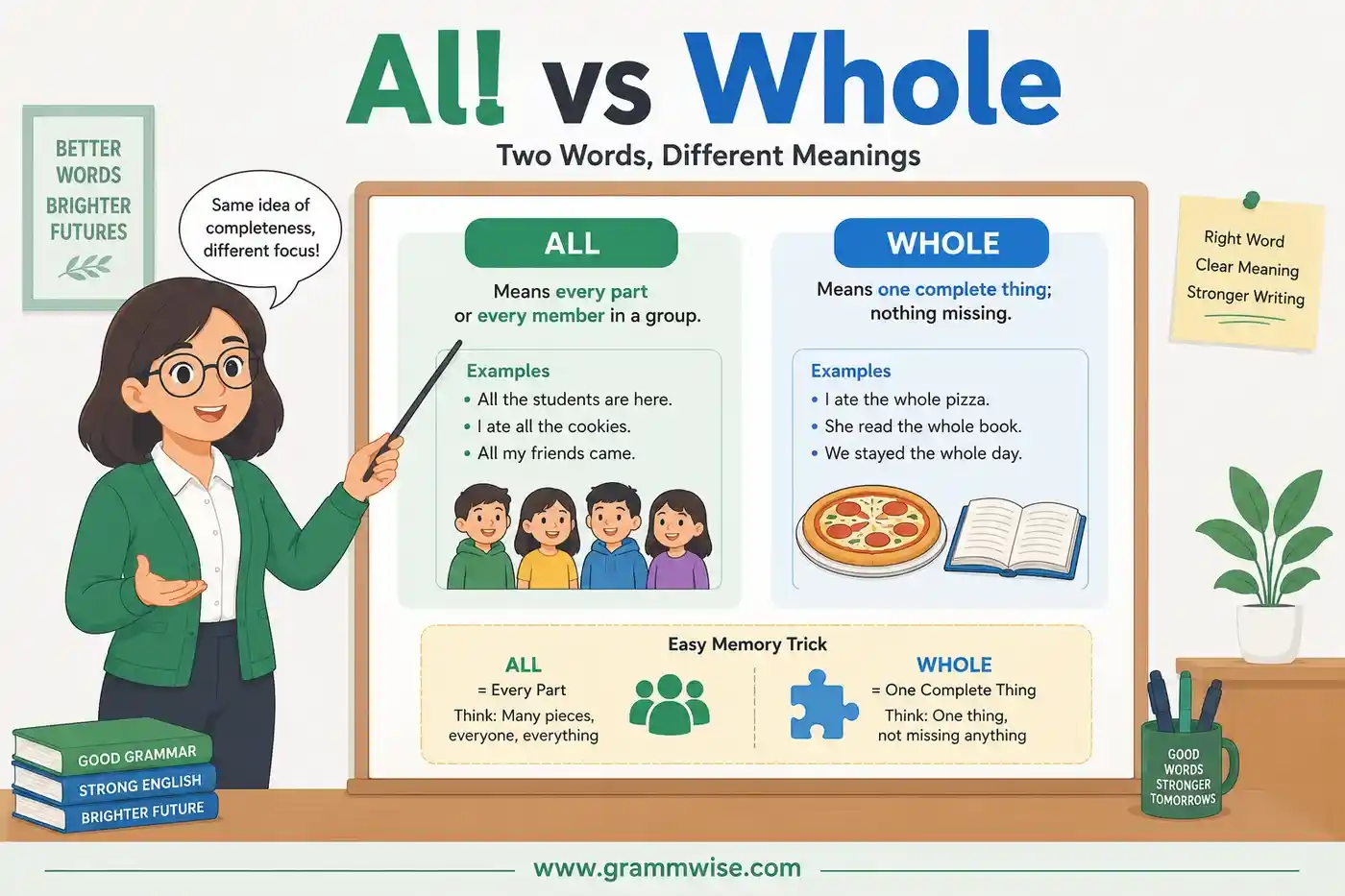
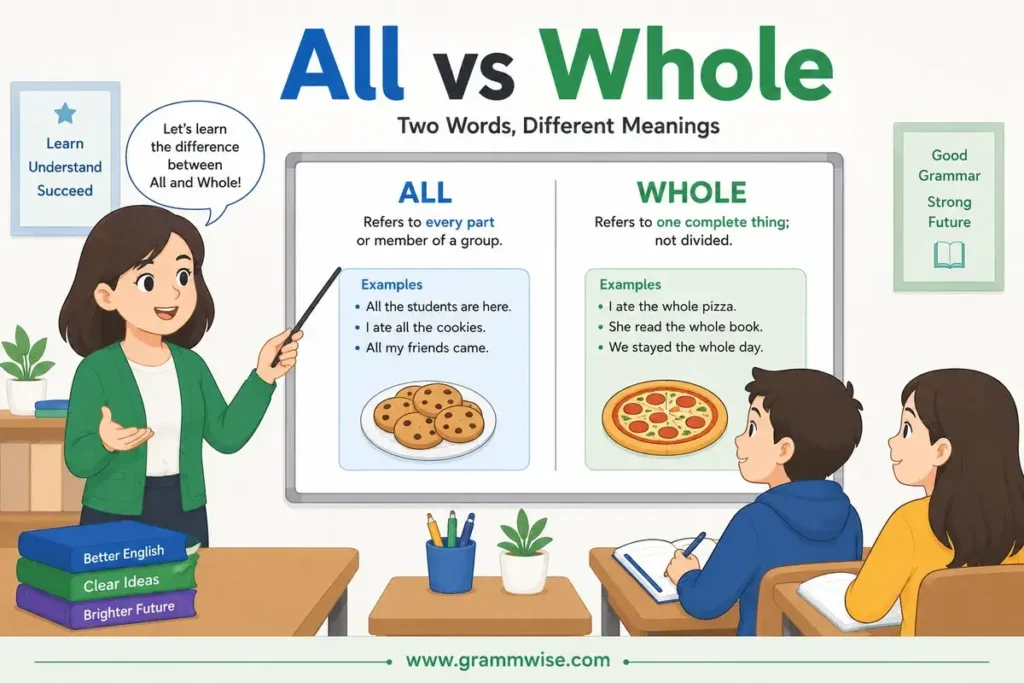
All means every part or every person in a group.
Whole means one complete thing with no part missing.
Meaning of “All vs Whole” in Simple English
The words all and whole both talk about completeness, but they focus on different ideas.
What does all mean?
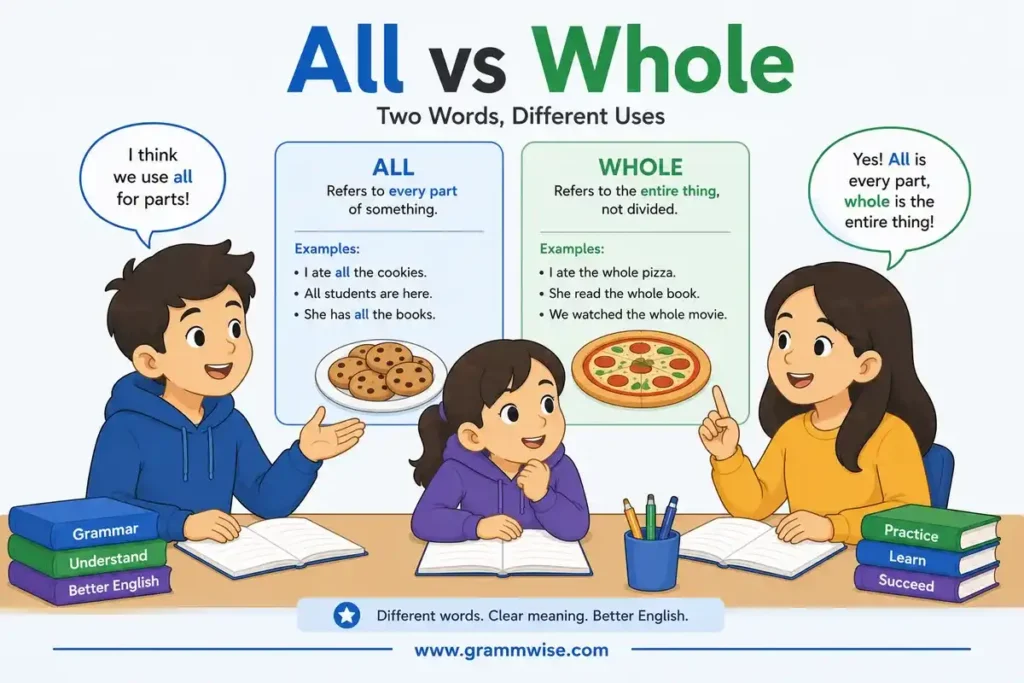
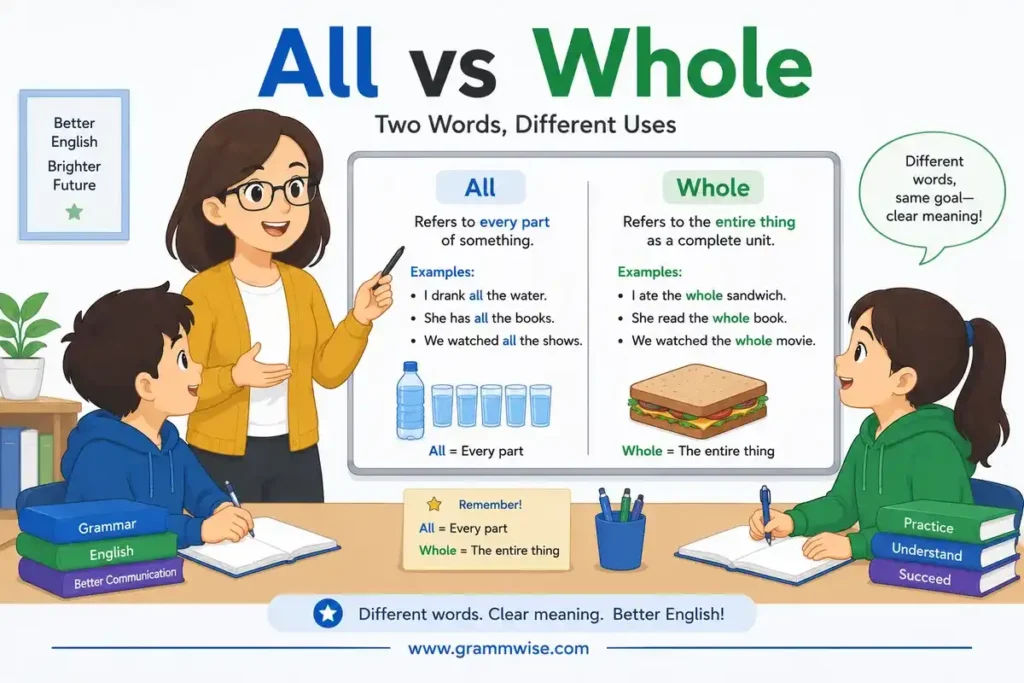
All means every part, every person, or every thing in a group.
Examples:
- All the students are here.
- I ate all the cookies.
- All my friends came to the party.
- She read all the books.
In these examples, all talks about every member or every part of a group.
What does whole mean?
Whole means one complete object, person, or period of time.
Examples:
- I ate the whole pizza.
- He worked the whole day.
- Read the whole book.
- The whole family came.
Here, whole focuses on one complete thing.
When learning all vs whole, remember this simple idea:
- All = every part or every member.
- Whole = one complete thing.
Why People Mix These Words “All vs Whole”?
Many learners think all and whole always mean the same thing.
Sometimes they can both be used.
For example:
- I spent all day reading.
- I spent the whole day reading.
Both sentences are correct.
They have almost the same meaning.
This makes learners think the words are always interchangeable.
But that is not true.
Look at these examples.
Correct:
- I ate the whole cake.
Not natural:
- I ate all cake.
Instead, we say:
- I ate all the cake.
The small word the makes a big difference.
Another example:
Correct:
- All the children laughed.
Not natural:
- The whole children laughed.
The word whole usually describes one complete thing, not a group of separate people.
Understanding these patterns makes all vs whole much easier.
Clear Difference Between “All vs Whole” Explained Simply
Here is the easiest way to compare them.
All
Use all when talking about:
- Every person
- Every item
- Every part
- Groups
Examples:
- All the flowers are beautiful.
- All my classmates passed.
- All the lights are on.
- All the water is gone.
Whole
Use whole when talking about:
- One complete object
- One complete person or family
- One complete period of time
Examples:
- The whole cake disappeared.
- The whole class listened carefully.
- We waited the whole afternoon.
- She cleaned the whole house.
Quick Comparison Table
| All | Whole |
|---|---|
| Every part | One complete thing |
| Often used with groups | Often used with one object |
| All the students | The whole class |
| All the books | The whole book |
| All day | The whole day |
This table makes all vs whole easier to remember.
All vs Whole: Which Form Should You Use?
Ask yourself one simple question.
“Am I talking about every part or one complete thing?”
If you mean every person or every item, use all.
Examples:
- All the children smiled.
- All my homework is finished.
- All the chairs are full.
If you mean one complete object or one complete time, use whole.
Examples:
- The whole sandwich was delicious.
- I watched the whole movie.
- He slept the whole night.
Sometimes both words are correct.
Examples:
- I worked all day.
- I worked the whole day.
Both sound natural.
The meaning is almost the same.
Easy Real-Life Sentences on “All vs Whole”
Here are simple examples you can use every day.
Using all
- All my friends are here.
- All the doors are closed.
- All the food is ready.
- I drank all the milk.
- All the children are playing.
Using whole
- I read the whole story.
- The whole family went shopping.
- She cleaned the whole room.
- We stayed there the whole weekend.
- He watched the whole game.
These are common sentences used by native English speakers.
Where These Words “All vs Whole” Come From?
The word all is one of the oldest words in English.
For hundreds of years, it has meant every person or every part.
The word whole also has a long history.
It originally meant complete, healthy, or not broken.
Over time, it became a common way to describe something complete.
That is why we still say:
- The whole world
- The whole family
- The whole story
Both words have been used in English for many centuries.
Their meanings have stayed almost the same.
Common Situations
When Talking About Food
- I ate all the cookies.
- I ate the whole cake.
Talking About School
- All the students arrived early.
- The whole class was excited.
When Talking About Time
- We worked all morning.
- We worked the whole morning.
Talking About Family
- All my cousins visited us.
- The whole family visited us.
Notice how all often refers to every member, while whole refers to one complete group.
Easy Memory Trick for “All vs Whole”
Here is a classroom trick.
Think about the first letters.
All starts with A.
Think of A for All Members.
Whole starts with W.
Think of W for One Whole Thing.
Another easy trick is this:
If you can count many separate people or things, all is often the better choice.
If you are talking about one complete thing, whole is usually the right word.
Practice Quiz
Choose the correct word.
- I ate the ______ pizza.
- ______ the students finished the test.
- We stayed home the ______ weekend.
- She drank ______ the juice.
- The ______ family came to dinner.
- ______ my friends enjoyed the movie.
Answers
- whole
- All
- whole
- all
- whole
- All
How These Words “All vs Whole” Are Understood in Culture and Stories?
The words all and whole are common in stories, movies, songs, and everyday conversations. They help people talk about something that is complete, but each word gives a slightly different idea.
The word all often focuses on every person or every part of a group.
For example:
- All the villagers helped each other.
- All the children cheered.
- All the stars filled the sky.
These sentences show every member of a group.
The word whole usually focuses on one complete thing.
For example:
- The whole village celebrated together.
- The whole world watched the event.
- The whole story made me smile.
Here, the attention is on one complete unit.
Stories often use whole to make something feel big or complete.
For example:
- The whole kingdom waited for the king.
- The whole town gathered in the square.
At the same time, writers use all when they want readers to think about every person or every object.
Understanding all vs whole helps you enjoy books and understand the writer’s meaning more clearly.
Biblical and Mythological Meaning of “All vs Whole”
The Bible and many old stories use both all and whole.
The word all often means everyone or everything.
Examples include:
- Love all people.
- All nations.
- All your heart.
The word whole often means complete or not broken.
Examples include:
- A whole heart.
- The whole land.
- The whole family.
In many stories and myths, heroes help all the people, while a whole kingdom celebrates peace after a victory.
The spelling is simple, but the meanings help tell powerful stories.
Symbolism of “All vs Whole” in Simple Words
What All Represents?
All represents completeness through every part.
It often symbolizes:
- Everyone
- Everything
- Unity
- Sharing
- Togetherness
Examples:
- All friends
- All people
- All dreams
It gives the feeling that nothing is left out.
What Whole Represents?
Whole represents one complete thing.
It often symbolizes:
- Completeness
- Unity
- Strength
- Nothing missing
- Being complete
Examples:
- A whole family
- A whole life
- A whole journey
When learning all vs whole, remember that all gathers every part together, while whole describes one complete unit.
Related Words You Should Know
Learning related words will improve your English.
Entire: Means complete.
Example: She read the entire book.
Complete: Means having every part.
Example: The project is complete.
Every: Means each person or thing.
Example: Every student passed.
Each: Means one by one.
Example: Each child received a prize.
Total: Means the full amount.
Example: The total cost was fifty dollars.
Full: Means completely filled.
Example: The glass is full.
Together: Means with everyone or everything joined.
Example: We worked together all day.
These words often appear in the same situations as all and whole.
How People Actually Use “All vs Whole” in Daily English?
Here are examples you will hear every day.
- All the lights are on.
- I ate the whole sandwich.
- All my friends came.
- We watched the whole movie.
- All the children laughed.
- The whole team celebrated.
- I worked all afternoon.
- We stayed home the whole weekend.
- All the books are on the shelf.
- The whole room became quiet.
These are natural examples used by native English speakers.
Common Mistakes People Make About “All vs Whole”
Many learners make the same mistakes with all vs whole.
Mistake 1
❌ Whole the students arrived.
✅ All the students arrived.
Use all for groups of people.
Mistake 2
❌ I ate all pizza.
✅ I ate all the pizza.
Or:
✅ I ate the whole pizza.
Remember that all usually needs the before a specific noun.
Mistake 3
❌ The whole books are interesting.
✅ All the books are interesting.
Books are a group, so use all.
Mistake 4
❌ All family came.
✅ The whole family came.
Or:
✅ All the family came. (Less common in American English.)
“The whole family” is the more natural choice.
Mistake 5
Thinking both words always mean exactly the same thing.
Sometimes they do.
For example:
- I studied all day.
- I studied the whole day.
Both are correct.
But many other sentences only work with one of the words.
Final Teacher Explanation
Imagine we are sitting in class.
A student asks,
“Teacher, when should I use all and when should I use whole?”
My answer is very simple.
If you are talking about every person or every part of a group, use all.
If you are talking about one complete thing, use whole.
Think about these examples.
- All the students
- The whole class
- All the cookies
- The whole cake
Both words show completeness, but they look at it in different ways.
You do not need to memorize difficult grammar rules.
Just ask yourself one question.
“Am I talking about every part or one complete thing?”
The answer will help you choose the correct word almost every time.
Quick Recap “All vs Whole”
All means every person, every thing, or every part of a group.
Whole means one complete object, person, place, or period of time.
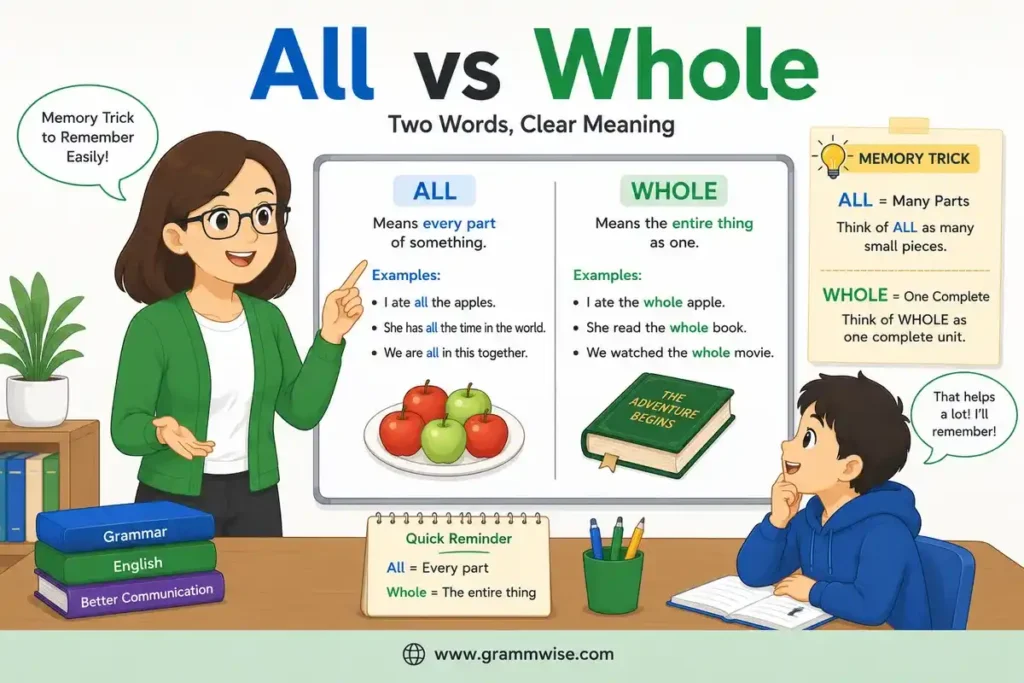
Remember this easy rule: All = every part. Whole = one complete thing.
Conclusion
All vs whole becomes easy once you understand what each word focuses on. Use all when you mean every person or every part of a group, and use whole when you are talking about one complete thing. Knowing this simple difference will help you choose the correct word with confidence.
Keep practicing with real-life sentences and pay attention to how native speakers use these words. The more you read, listen, and write, the more natural using all and whole will become in your everyday English.
Frequently Asked Questions
What is the difference between all vs whole?
All means every member or every part of a group. Whole means one complete thing.
Can all and whole mean the same thing?
Yes. In some expressions like all day and the whole day, both are correct and have almost the same meaning.
Should I say all the cake or the whole cake?
Both are correct, but they focus on the idea differently. All the cake means every bit of the cake. The whole cake means one complete cake.
Why do people confuse all vs whole?
Both words describe completeness, so learners often think they can always replace one with the other.
Can I say the whole students?
No. Say all the students because students are a group of people.
Is the whole family correct?
Yes. The whole family is a very common and natural expression.
Can I say all the family?
Yes, but the whole family is more common, especially in everyday American English.
How can I remember the difference?
Think of this simple rule: All = every part or member. Whole = one complete thing.