
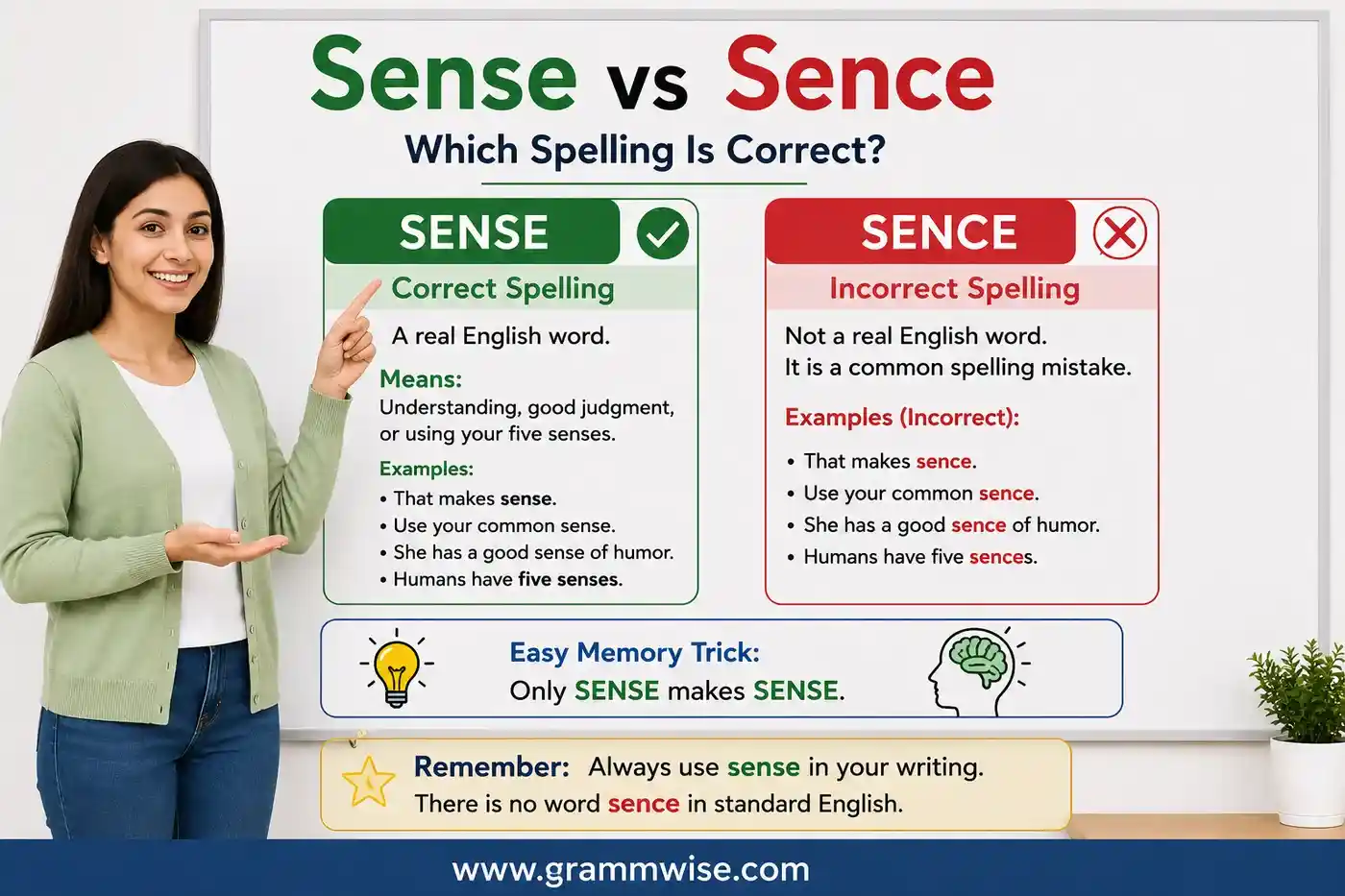
Many English learners search for sense vs sence because the two spellings look very similar. This often causes confusion in writing, schoolwork, emails, and everyday English. The good news is that the answer is simple. Only one of these spellings is correct.
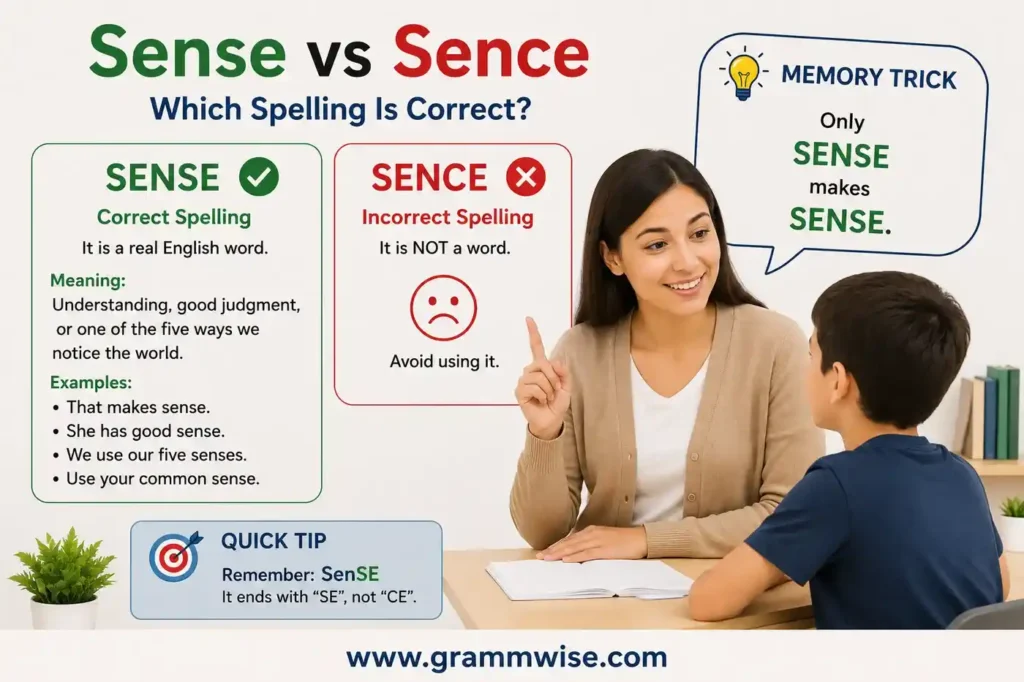
The correct spelling is sense. The word sence is a common misspelling and is not a standard English word. If you want to write correct English, you should always use sense.
In this guide, you will learn the difference between sense vs sence, why people make this spelling mistake, how to remember the correct spelling, and easy examples you can use every day.
Want to improve your grammar further? Explore more guides on Grammwise.
Simple Answer in One Look
Sense is the correct English spelling.
Sence is an incorrect spelling.
Easy rule:
- Sense = Correct
- Sence = Incorrect
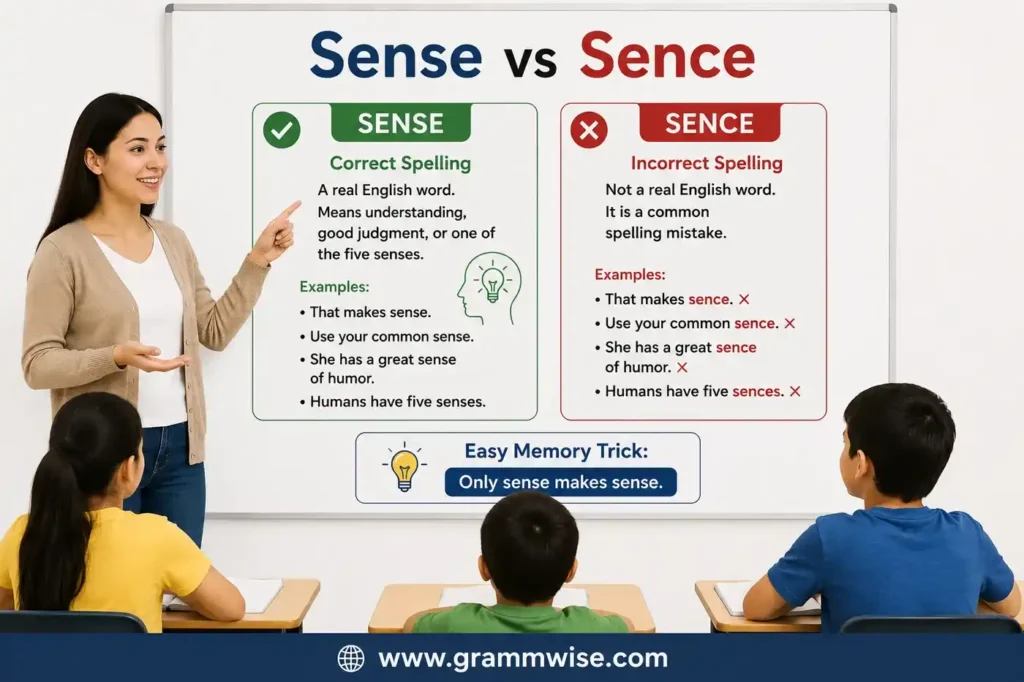
Meaning of “Sense vs Sence” in Simple English
The easiest way to understand sense vs sence is to know that only one word actually exists in English.
What Does “Sense” Mean?
The word sense has several meanings, but they are all related to understanding, feeling, or noticing something.
Simple meaning:
Sense means understanding, good judgment, or one of your body’s ways of noticing the world.
For example:
- I have a sense of humor.
- That idea makes sense.
- She has good sense.
- We use our five senses every day.
- He sensed something was wrong.
The word sense is used in many different situations.
It is a very common English word.
What Is “Sence”?
Sence is not a correct English word.
It is simply a spelling mistake.
Many people accidentally write sence because it sounds similar to sense.
Whenever you see sence, you should replace it with sense.
Why People Mix These Words “Sense vs Sence”?
Many people spell sense incorrectly.
Here are the most common reasons.
The Words Sound the Same “Sense vs Sence”
When you say sense, the ending sounds like “s.”
Because of this, some people think the middle of the word should contain the letter c instead of s.
That creates the incorrect spelling sence.
English Spelling Can Be Tricky
English has many words where the letter c makes the same sound as s.
For example:
- city
- center
- circle
Because of this, learners sometimes guess the spelling.
Sometimes they guess correctly.
Sometimes they write sence instead of sense.
Typing Too Quickly
Many spelling mistakes happen because people type fast.
Even native English speakers sometimes make this mistake.
Spell-check programs usually correct it automatically.
Pronunciation Does Not Help
The pronunciation of sense does not clearly show which letters should be used.
That is why many learners search for sense vs sence online.
Clear Difference Between “Sense vs Sence” Explained Simply
Here is an easy comparison.
| Sense | Sence |
|---|---|
| Correct spelling | Incorrect spelling |
| Real English word | Not an English word |
| Used in speaking and writing | Should not be used |
| Found in dictionaries | Not found in standard dictionaries |
| Safe to use | Avoid using |
Think About a Dictionary
Imagine opening an English dictionary.
You will find:
Sense
You will not find:
Sence
That is one of the easiest ways to remember the correct spelling.
Another Easy Comparison
Correct:
- common sense
- sense of humor
- make sense
- five senses
Incorrect:
- common sence
- sence of humor
- make sence
- five sences
Every example with sence is incorrect.
Easy Memory Trick for “Sense vs Sence”
Look carefully at the correct spelling.
SenSE
It ends with SE.
Now think of this sentence:
Good SENSE helps you make SENSE.
Seeing the correct spelling several times helps your brain remember it.
Another memory trick is this:
The word sense has the word “see” hidden in its idea.
You use your senses to notice the world around you.
Sense vs Sence: Which Form Should You Use?
The answer is simple.
Always choose sense.
Never use sence in school, work, emails, essays, or everyday writing.
Use “Sense” When Talking About Understanding
Examples:
- That makes sense.
- Your answer makes sense.
- The story makes sense now.
Use “Sense” When Talking About Good Judgment
Examples:
- She has good sense.
- He showed common sense.
- Use your common sense.
Use “Sense” When Talking About Your Body
Examples:
- Humans have five senses.
- My sense of smell is strong.
- His sense of hearing is excellent.
Quick Decision Guide
If you are thinking about writing sence, stop for a moment.
Replace it with sense.
That will almost always solve the problem.
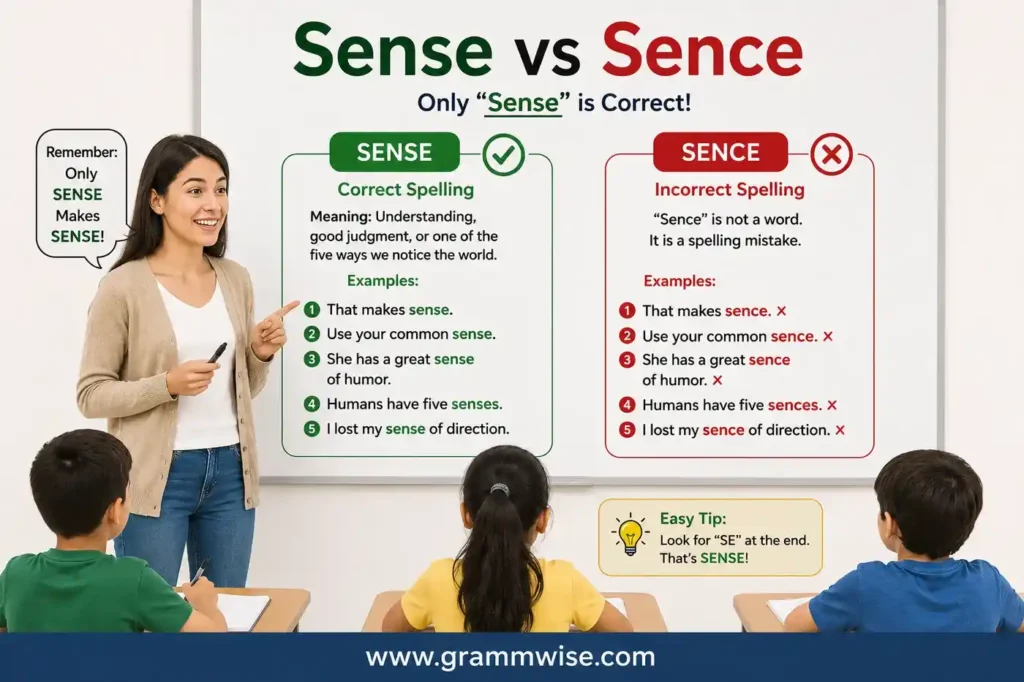
Easy Real-Life Sentences on “Sense vs Sence”
Reading examples helps you remember the correct spelling.
Sentences with “Sense”
- That answer makes sense.
- She has a great sense of humor.
- Please use your common sense.
- My sense of smell is very strong.
- He lost his sense of direction.
- Dogs have a strong sense of smell.
- The teacher explained it in a way that made sense.
- I trust my sense of judgment.
Common Everyday Expressions
These are all correct.
- make sense
- common sense
- sense of humor
- sense of direction
- sense of smell
- sense of taste
- sense of touch
- sense of hearing
You will see these expressions in books, newspapers, and everyday conversations.
Mini Practice
Choose the correct spelling.
- That makes ______.
Answer:
sense
- Use your common ______.
Answer:
sense
- She has a great ______ of humor.
Answer:
sense
- Dogs have a strong ______ of smell.
Answer:
sense
- Which spelling is correct?
- sense ✅
- sence ❌
Sense vs Sence: Where This Word Comes From?
Learning a little history makes spelling easier to remember.
The Story Behind “Sense”
The word sense comes from an old Latin word that means to feel, to notice, or to understand.
Over many hundreds of years, the word entered English.
Its meaning stayed very similar.
Today, sense still refers to understanding, good judgment, or the body’s ability to notice things.
Why “Sence” Does Not Exist?
Unlike sense, the spelling sence has no historical background in English.
It developed only as a spelling mistake.
That is why dictionaries, grammar books, and teachers do not accept it as a correct word.
Why the History Helps?
The history is simple.
Sense is a real English word with a long history.
Sence is only a common misspelling.
Remembering this makes choosing the correct spelling very easy.
How This Word “Sense vs Sence” Is Understood in Culture and Stories
The word sense is used in many books, movies, and everyday conversations. It often describes a person’s ability to understand situations, make good choices, or notice what is happening around them.
How “Sense” Is Used?
People use sense to talk about wisdom and understanding.
For example:
- A wise grandparent gives advice that makes sense.
- A detective uses good sense to solve a mystery.
- A teacher explains a lesson until it makes sense.
- A child learns to use common sense in daily life.
In many stories, characters succeed because they think carefully and use good sense before making a decision.
Why “Sence” Is Not Used?
You will not find sence in books, newspapers, dictionaries, or professional writing because it is not a correct English word.
If you see sence, it is almost always a spelling mistake.
That is why learning the correct spelling early is so important.
Biblical and Mythological Meaning of “Sense vs Sence”
The word sense does not have a special religious meaning, but the idea behind it appears in many religious and historical writings.
For example, many Bible passages encourage people to use wisdom, understanding, and good judgment. These ideas are closely related to the meaning of sense.
The word sence has no biblical or mythological meaning because it is not an English word.
Whether you are reading history, literature, or religious texts, you will only see the correct spelling: sense.
Symbolism of “Sense vs Sence”
Words often represent ideas beyond their dictionary meanings.
The word sense is one of them.
What “Sense” Represents?
Sense often represents:
- wisdom
- understanding
- clear thinking
- good judgment
- awareness
- learning
- careful decisions
When someone says, “Use your common sense,” they are asking you to think carefully before acting.
The word also reminds us of our five senses, which help us understand the world around us.
What “Sence” Represents?
The word sence does not represent any idea because it is not a real English word.
It simply reminds us how easy spelling mistakes can happen.
The good news is that once you learn the correct spelling, you are unlikely to make the same mistake again.
An Easy Way to Remember
Think of sense as something that helps you understand.
Whenever you want to write sence, stop and remember:
Only “sense” makes sense.
This short sentence is one of the easiest memory tricks.
Related Words You Should Know
Learning related words will help you understand sense even better.
Common Sense: The ability to make good, practical decisions.
Example: Always use common sense when crossing the road.
Sensible: Showing good judgment.
Example: She made a sensible decision.
Sensitive: Easily affected by feelings or situations.
Example: He is sensitive to loud noises.
Senseless: Without meaning or good judgment.
Example: The argument was completely senseless.
Sensation: A feeling you notice with your body.
Example: I felt a cold sensation in my hands.
Sensor: A device that notices changes such as light, heat, or movement.
Example: The door opens when the sensor detects movement.
Meaning: The idea behind a word or sentence.
Example: Can you explain the meaning of this word?
Understanding: Knowing what something means.
Example: Reading every day improves your understanding.
Wisdom: The ability to make good decisions based on knowledge and experience.
Example: Her wisdom helped everyone.
Judgment: The ability to decide what is right.
Example: Good judgment comes with practice.
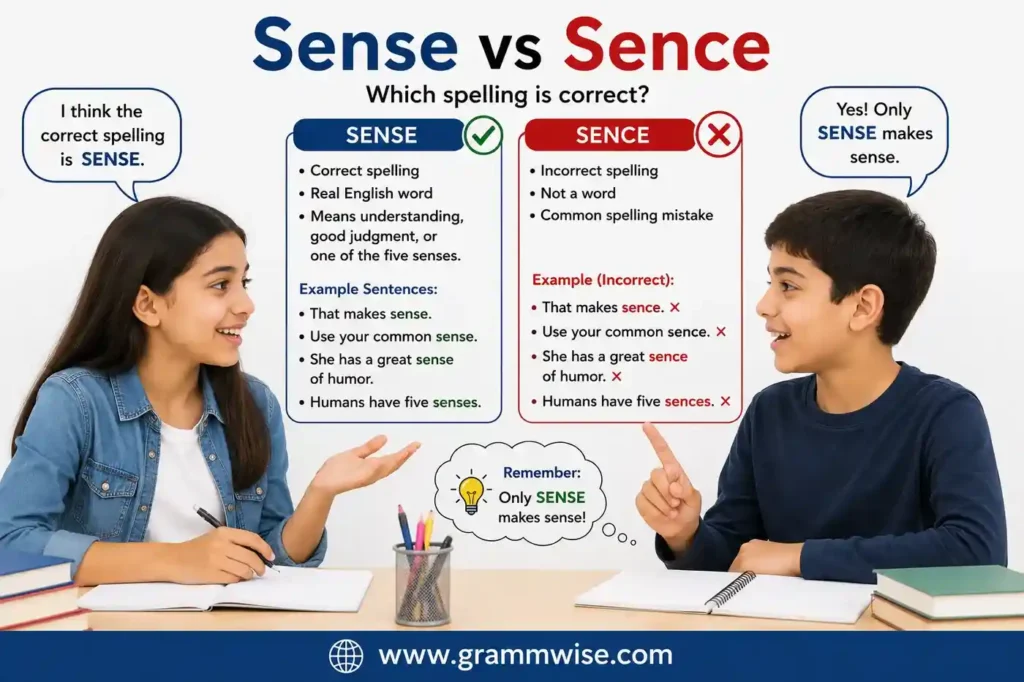
How People Actually Use “Sense vs Sence” in Daily English
The word sense is very common in everyday conversations.
Here are some natural examples.
- “That explanation makes sense.”
- “Please use your common sense.”
- “I have a good sense of direction.”
- “She has a wonderful sense of humor.”
- “My sense of smell is very strong.”
- “The answer finally makes sense.”
- “He trusted his sense of judgment.”
- “Dogs have an amazing sense of smell.”
- “I lost my sense of balance.”
- “Everything makes sense now.”
These expressions are also very common:
- make sense
- common sense
- sense of humor
- sense of direction
- sense of smell
- sense of taste
- sense of hearing
- sense of touch
- sense of balance
- sixth sense
You will hear these expressions in schools, workplaces, books, movies, and everyday conversations.
Common Mistakes People Make About “Sense vs Sence”
Many English learners make similar mistakes when writing sense vs sence.
Mistake 1: Writing “Sence”
Incorrect:
That makes sence.
Correct:
That makes sense.
Always remember that sense is the only correct spelling.
Mistake 2: Using “Sence” in School or Work
Some learners accidentally write sence in homework, emails, or reports.
Most spell-check tools will underline the mistake.
Always replace it with sense before sending your work.
Mistake 3: Thinking Both Spellings Are Correct
Some people believe sense and sence are two different words.
They are not.
Only sense is correct.
Mistake 4: Confusing Pronunciation with Spelling
The pronunciation does not clearly show which letters to use.
That is why many people accidentally write sence.
Instead of spelling by sound, memorize the correct spelling.
Mistake 5: Forgetting the Memory Trick
A simple memory trick helps many students.
Remember this sentence:
Only sense makes sense.
If you can remember that sentence, you will almost never write sence again.
Final Teacher Explanation “Sense vs Sence”
Imagine you are taking an English test.
You want to write:
“That makes sense.”
Suddenly you stop and wonder,
“Should I write sense or sence?”
Here is what I would tell you as your teacher.
Do not worry.
There is only one correct answer.
Choose sense every time.
The spelling sence is simply a mistake.
You do not need to learn two meanings because only one word exists.
Whenever you write about understanding, good judgment, or the five senses, always use sense.
The more you read books, articles, and everyday English, the more familiar this spelling will become.
Soon, you will write sense correctly without even thinking about it.
Quick Recap
The answer to sense vs sence is very simple.
Sense is the correct English spelling.
Sence is an incorrect spelling and should never be used in standard English.
Remember this easy rule:
Only sense makes sense.
Conclusion
Understanding sense vs sence is simple because only one spelling is correct. Sense is the proper English word used to describe understanding, good judgment, or the body’s ability to notice the world, while sence is a common spelling mistake that should always be avoided.
To remember the correct spelling, use the easy memory trick: “Only sense makes sense.” Reading, writing, and practicing this word in everyday sentences will help you avoid mistakes and use sense confidently in school, work, and daily conversations.
Frequently Asked Questions
Which is correct: sense vs sence?
Sense is correct. Sence is a misspelling and is not a standard English word.
What does the word “sense” mean?
Sense can mean understanding, good judgment, or one of the body’s ways of noticing the world, such as sight or hearing.
Is “sence” a real English word?
No. Sence is not found in standard English dictionaries. It is simply an incorrect spelling of sense.
Why do people spell “sense” as “sence”?
Many people spell it that way because the pronunciation can make the middle letters confusing. It is a common spelling mistake.
How can I remember the correct spelling?
Remember this simple sentence: Only sense makes sense.
What are the five senses?
The five senses are sight, hearing, smell, taste, and touch.
What does “common sense” mean?
Common sense means using good judgment to make practical and reasonable decisions.
Can I use “sence” in formal writing?
No. Always use sense in essays, emails, schoolwork, and professional writing.