
Many English learners get confused about Speak vs Talk because both words are about using your voice to communicate. They seem very similar, and in many situations, people use them almost the same way. However, they are not always interchangeable. Each word has its own meaning and is used in different situations.
If you have ever wondered about Speak vs Talk, you are not alone. Students, travelers, and even native English speakers sometimes ask which word is the better choice. The good news is that the difference is easy to understand once you learn a few simple rules.
In this guide, you will learn the difference between Speak vs Talk, when to use each word, simple memory tricks, and real-life examples. By the end, you will know exactly when to say speak and when to say talk.
You may also like our guide on Listen vs Hear.
Simple Answer in One Look
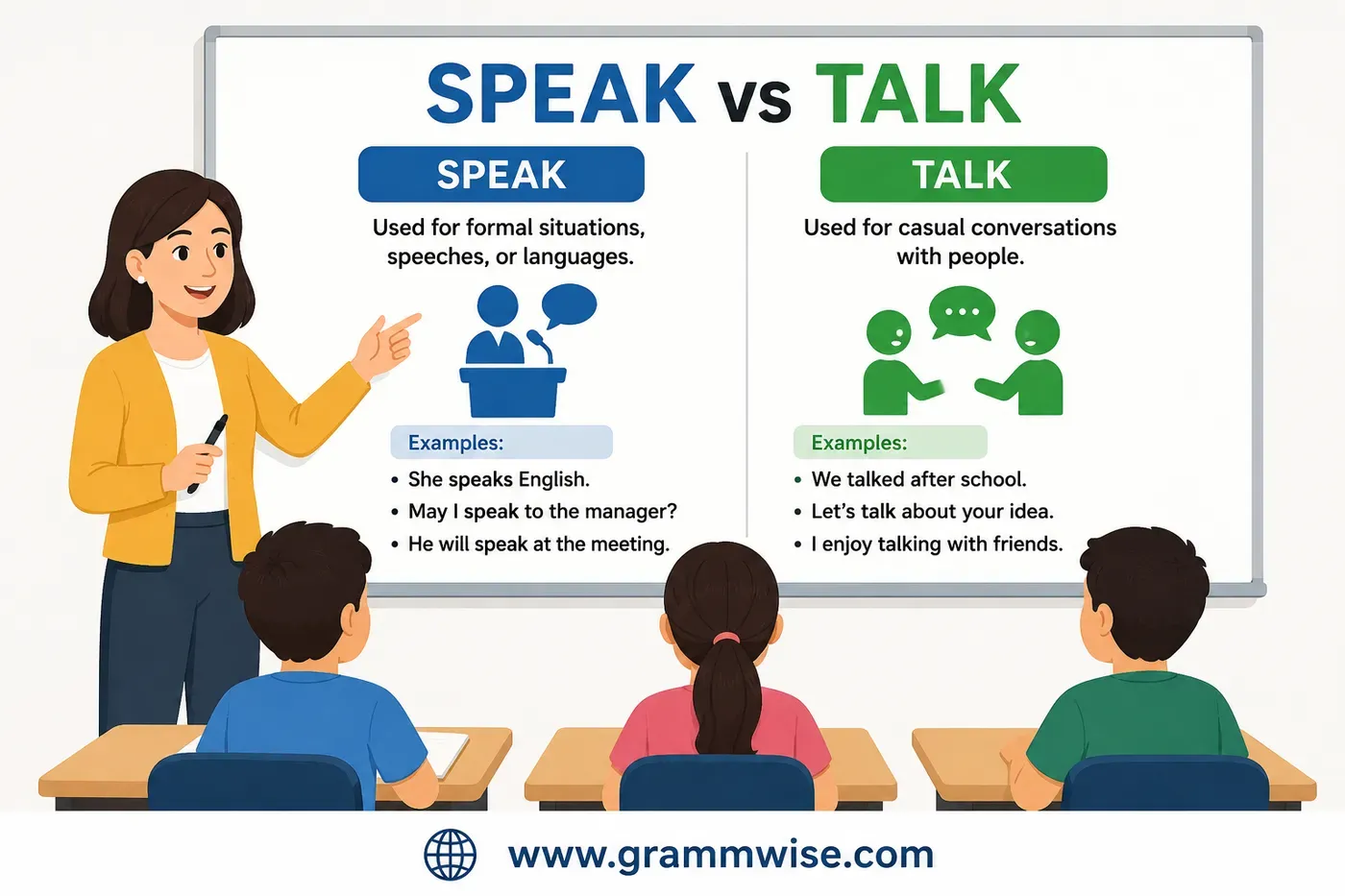
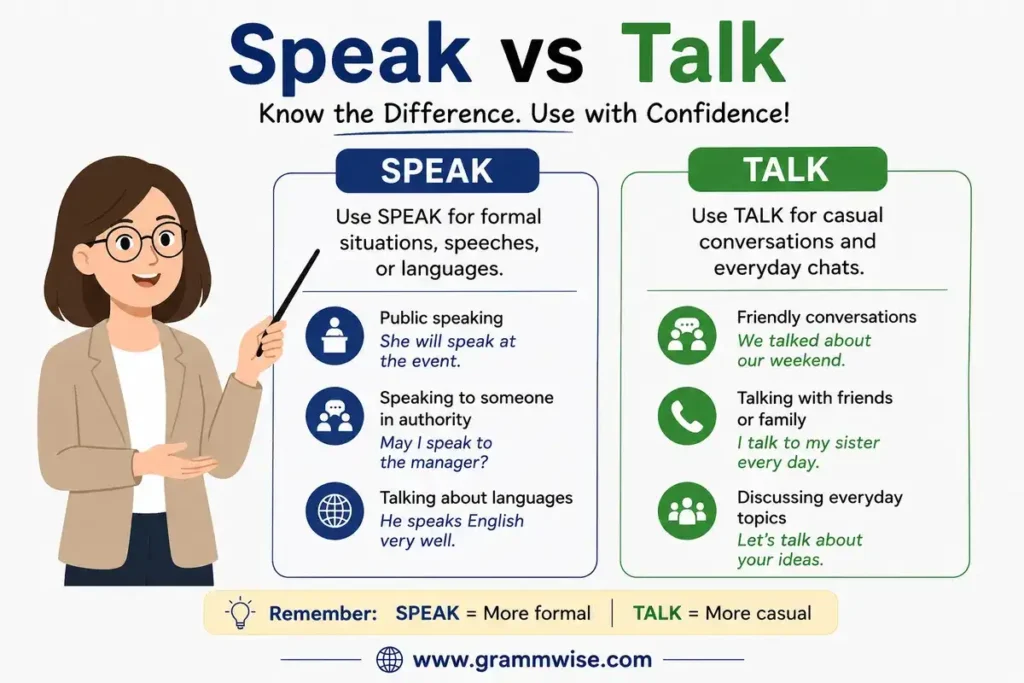
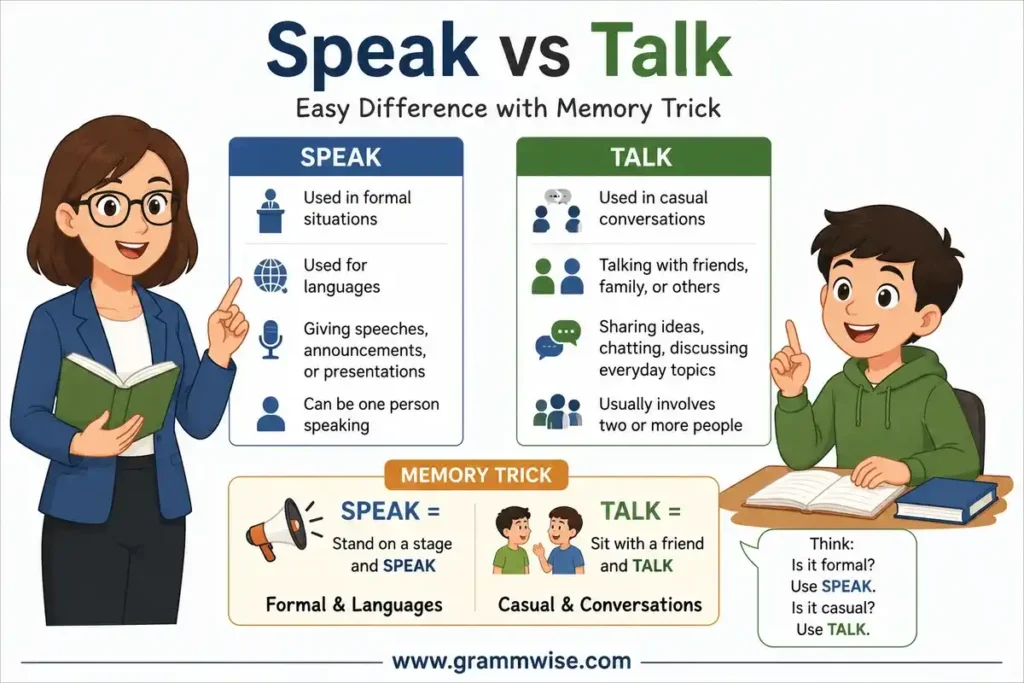
Speak is often used for formal communication or when talking about languages.
Talk is usually used for friendly, casual conversations.
Meaning of “Speak vs Talk” in Simple English
Imagine your teacher asks you to come to the front of the class. You give a short presentation. In this situation, you speak to the class.
Now imagine you are sitting with your best friend during lunch. You chat about your favorite movie. In this situation, you talk with your friend.
Both words mean using your voice.
The difference is how they are usually used.
Speak often sounds more formal.
It is common in:
- School presentations
- Public speeches
- Business meetings
- Phone calls
- Talking about languages
For example:
- She speaks English very well.
- May I speak to the manager?
- He will speak at the meeting.
Talk usually sounds more friendly and relaxed.
People use it in everyday conversations.
For example:
- We talked after school.
- I like talking with my friends.
- Let’s talk about your homework.
Here is a simple way to remember.
Speak = more formal or about languages.
Talk = friendly conversations.
This easy rule works in most situations.
Speak vs Talk: Why People Mix These Words?
People often confuse Speak vs Talk because both words involve communication.
Many dictionaries even give similar meanings.
That makes learners think the words always mean the same thing.
They do not.
Sometimes you can use either word.
For example:
- Can we speak later?
- Can we talk later?
Both sentences sound natural. However, there are many situations where one word sounds much better than the other.
Another reason for the confusion is that different English speakers use these words in slightly different ways.
Some people say “talk to.”
Others say “speak to.”
Both can be correct depending on the situation.
Many learners also translate directly from their own language.
In some languages, there is only one word for both speak and talk.
This makes English seem confusing at first.
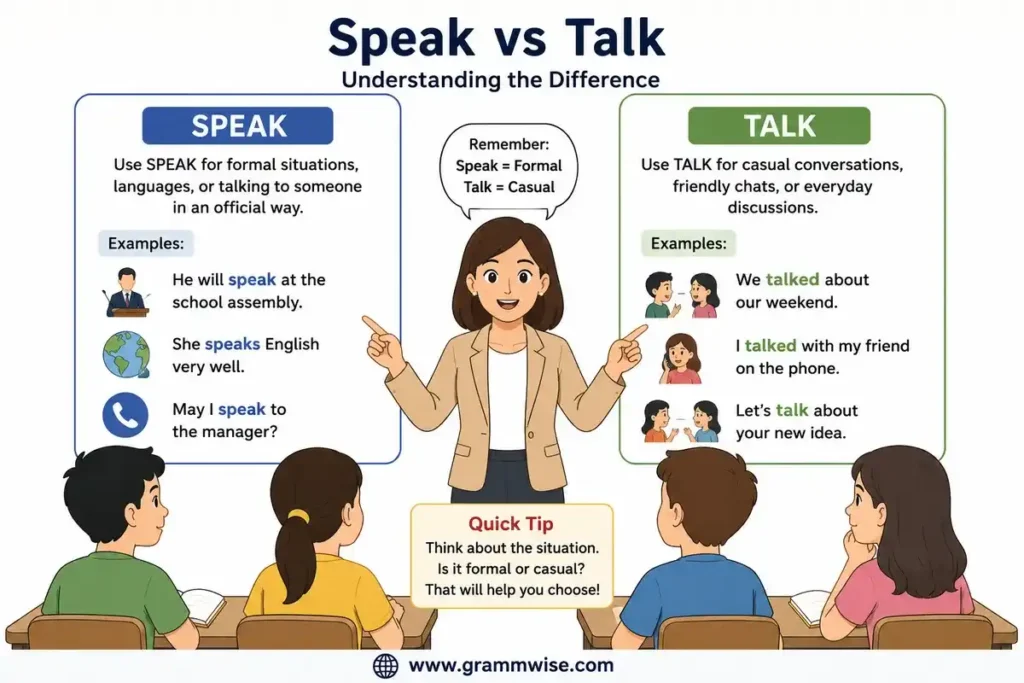
The easiest way to avoid mistakes is to think about the situation.
Ask yourself:
“Is this formal?”
Or ask:
“Is this a friendly conversation?”
Your answer will usually help you choose the right word.
Clear Difference of “Speak vs Talk” Explained Simply
The easiest way to understand Speak vs Talk is to compare them side by side.
Speak
Use speak when talking about:
- Formal communication
- Giving speeches
- Speaking a language
- Asking to speak with someone
- Public speaking
Examples:
- She speaks French.
- May I speak to the doctor?
- He will speak at the event.
- The teacher spoke to the class.
- We need to speak about the problem.
Talk
Use talk when talking about:
- Friendly conversations
- Casual chats
- Everyday discussions
- Sharing ideas
- Talking with friends and family
Examples:
- We talked for two hours.
- Let’s talk after dinner.
- They talked about school.
- I enjoy talking with my grandparents.
- She talked to her best friend.
Easy Comparison Table
| Speak | Talk |
|---|---|
| Usually more formal | Usually more casual |
| Often used for speeches | Often used for conversations |
| Used for languages | Used for chats and discussions |
| Can be one person speaking | Usually involves two or more people |
| Example: “She speaks English.” | Example: “We talked after school.” |
| Common in meetings and presentations | Common in daily life and with friends |
Looking at both words together makes the difference much easier to understand.
Speak vs Talk: Which Form Should You Use?
Choosing between Speak vs Talk is easier than many people think.
Ask yourself one simple question.
Am I talking about a formal situation or a casual conversation?
If it is formal, choose speak.
Examples:
- I need to speak to the principal.
- She speaks three languages.
- The president will speak tonight.
If it is an everyday conversation, choose talk.
Examples:
- Let’s talk after class.
- We talked on the phone yesterday.
- I like talking with my neighbors.
Here is another easy memory trick.
Think of a person standing on a stage.
That person usually speaks.
Now think of two friends sitting together.
They usually talk.
This simple picture can help you remember the difference every time.
Easy Real-Life Sentences on “Speak vs Talk”
One of the best ways to understand Speak vs Talk is to see how people use these words in everyday life. Read these examples carefully and notice the different situations.
Examples Using Speak
- I need to speak to my teacher after class.
- She speaks English and Spanish.
- Can I speak with the manager?
- The doctor spoke to the patient’s family.
- He will speak at the school event.
- Our coach spoke about teamwork.
- Please speak clearly so everyone can hear you.
- My grandmother speaks very softly.
In these examples, speak is used for formal communication, talking about languages, or speaking to someone in an organized way.
Examples Using Talk
- We talked about our weekend plans.
- Let’s talk after dinner.
- I talked with my cousin for an hour.
- They love talking about sports.
- The children talked happily during lunch.
- Can we talk for a few minutes?
- She talks to her best friend every day.
- We were talking when the phone rang.
In these examples, talk is used for friendly conversations and everyday communication.
Sometimes, speak and talk can both be correct.
For example:
- Can I speak to you?
- Can I talk to you?
Both sentences are natural.
However, speak sounds a little more polite or formal, while talk sounds more relaxed.
That is why the situation is important.
Speak vs Talk: Where This Word Comes From?
The words speak and talk have been part of English for hundreds of years.
The word speak comes from an old English word called specan, which meant to say words or to use your voice. Long ago, people used speak when giving important messages or talking in public. Over time, it also became the word people used when talking about languages.
That is why we say:
- She speaks English.
- He speaks Italian.
- They speak Japanese.
The word talk comes from another old English word that meant to chat or to have a conversation. As English changed over time, talk became the common word for friendly conversations between people.
Today, people still use it that way.
When friends meet, they usually talk.
When someone gives a speech, they usually speak.
Both words are correct.
They simply fit different situations.
Here is an easy way to remember their history.
- Speak has long been connected with important or organized communication.
- Talk has long been connected with everyday conversations.
This is why English still uses both words today.
Here is one more memory trick.
Think about a classroom.
When the teacher gives a lesson, the teacher speaks.
When students discuss the lesson together, they talk.
That simple picture makes the difference easy to remember.
How “Speak vs Talk” Is Understood in Culture and Stories
The words speak and talk appear in books, movies, songs, and everyday conversations. Both words are about communication, but they often create different feelings.
When someone speaks, people often think about giving a speech, teaching a class, making an announcement, or sharing important information.
For example, in many stories, a leader stands in front of a crowd and speaks with confidence. The audience listens carefully because the message is important.
- Teachers also speak when explaining a lesson.
- Doctors speak with patients about their health.
- Leaders speak to the public during special events.
These situations feel more formal.
The word talk creates a different picture. When people talk, they usually share ideas in a relaxed way.
- Friends talk after school.
- Families talk during dinner.
- Neighbors talk outside their homes.
- Children talk while playing games.
These conversations help people understand each other and build strong relationships.
Many movies show two best friends sitting together and talking about their dreams.
Parents talk with their children before bedtime.
These simple conversations are an important part of everyday life.
Both words help people communicate.
The difference is the setting.
Speak often sounds more formal or organized.
Talk usually sounds warm, friendly, and natural.
Biblical and Mythological Meaning of “Speak vs Talk”
The words speak and talk are not special religious words, but the idea of speaking appears many times in the Bible.
Many Bible stories describe people speaking to God through prayer. God also speaks to people in different stories to guide or encourage them.
These moments usually involve important messages. That is why the word speak is often connected with respect and careful communication.
The Bible also encourages people to speak kindly and honestly. It teaches that our words should help others instead of hurting them.
The idea of talk also appears in daily life. People talk with family members, friends, and neighbors to build trust and understanding.
In many cultures, open and honest conversations help solve problems and bring people closer together.
In mythology, wise leaders often speak before making important decisions. Heroes also talk with their friends or helpers while planning their next steps.
These stories remind us that both speaking and talking have an important place in communication.
Symbolism of “Speak vs Talk” Explained in Simple Words
What Speak Represents?
The word speak often represents:
- Leadership
- Confidence
- Respect
- Knowledge
- Clear communication
- Public speaking
- Sharing important ideas
When someone speaks, people usually expect them to share information that matters.
Speaking also shows confidence because it often happens in front of other people.
What Talk Represents?
The word talk often represents:
- Friendship
- Sharing ideas
- Everyday communication
- Listening
- Understanding
- Family conversations
- Building relationships
Talking brings people together.
Good conversations help people solve problems, share feelings, and enjoy time with others.
Talking is not only about speaking words. It also includes listening carefully.
That is why talking helps build strong friendships and happy families.
Related Words You Should Know
Learning related words will make Speak vs Talk even easier to understand.
Conversation
A friendly exchange of ideas between two or more people.
People usually have conversations when they talk.
Discussion
A longer conversation about a topic.
Discussions often happen in classrooms and meetings.
Speech
A formal talk given to a group of people.
A person usually speaks during a speech.
Chat
A short and casual conversation.
Friends often chat after school or online.
Communicate
To share ideas or information with others.
Speaking and talking are both ways to communicate.
Language
A system of words people use to communicate.
We usually use speak when talking about languages.
Explain
To make something easy to understand.
Teachers speak to explain lessons.
Listen
To pay attention to what someone says.
Good communication includes both talking and listening.
Use “Speak vs Talk” in Daily English
People use speak and talk every day. You will hear these words at school, at work, at home, and while spending time with friends. Sometimes both words are correct, but one usually sounds more natural depending on the situation.
Here are some real-life examples using speak.
- May I speak to your teacher?
- She speaks English very well.
- The doctor will speak with you soon.
- Our principal spoke at the school event.
- Please speak slowly so I can understand.
- He speaks with confidence during meetings.
- We need to speak about the project.
- My grandfather speaks very softly.
In these examples, speak is used for formal communication, languages, or important conversations.
Now look at examples using talk.
- We talked after school.
- Let’s talk about your new idea.
- I like talking with my grandparents.
- They talked on the phone for an hour.
- Can we talk later today?
- She talks to her neighbors every evening.
- We were talking while walking home.
- The children talked about their favorite games.
These examples show that talk is used for friendly and casual conversations.
When you are not sure which word to use, think about the situation.
If it is formal or about a language, speak is usually the better choice.
If it is a normal conversation with someone, talk often sounds more natural.
Common Mistakes People Make About “Speak vs Talk”
Many learners make small mistakes when choosing between Speak vs Talk.
Here are the most common ones.
Mistake 1: Using talk for languages
❌ She talks English.
✅ She speaks English.
We always use speak when talking about languages.
Mistake 2: Using speak for every conversation
❌ We spoke about movies all afternoon.
✅ We talked about movies all afternoon.
Although spoke is not wrong, talked sounds much more natural for a casual conversation.
Mistake 3: Thinking both words always mean the same thing
Sometimes both words work, but not always.
For example:
- Can I speak to you?
- Can I talk to you?
Both are correct.
However, speak sounds more polite or formal.
Talk sounds more friendly and relaxed.
Mistake 4: Forgetting the situation
Before choosing a word, ask yourself:
“Is this formal or casual?”
Your answer will help you choose the right word.
Mistake 5: Forgetting that communication includes listening
Many people think talking is only about speaking.
Good communication also means listening carefully.
That is why good conversations include both speaking and listening.
Final Teacher Explanation
Imagine we are sitting together in class.
I write two words on the board.
Speak
Talk
Then I ask one simple question.
“Are you giving important information or talking about a language?”
If the answer is yes, choose speak.
Now I ask another question.
“Are you having a normal conversation with someone?”
If the answer is yes, choose talk.
That is the easiest way to remember the difference. You do not need difficult grammar rules.
Just remember these two ideas.
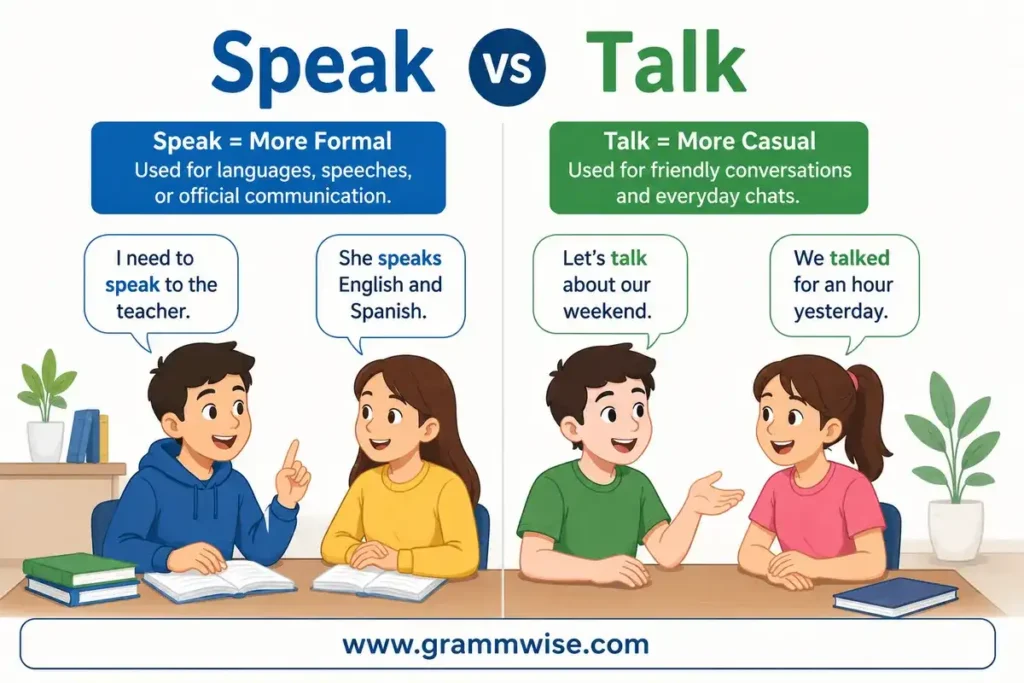
Speak is often more formal.
Talk is usually more casual.
Here is one last memory trick.
Picture a teacher giving a lesson.
The teacher speaks.
Now picture two friends sitting together after school.
They talk.
This simple picture will help you remember the correct word every time.
Final Answer “Speak vs Talk”
If you are choosing between Speak vs Talk, remember this easy rule. Use speak for formal situations, speeches, and languages. Use talk for friendly, everyday conversations. Knowing the situation will help you choose the correct word with confidence.
Conclusion
Understanding Speak vs Talk is much easier when you remember the purpose of each word. Speak is usually used for formal communication and languages, while talk is better for casual, everyday conversations. Keeping this simple rule in mind will help you choose the correct word with confidence.
The best way to remember the difference is to practice using both words in daily conversations and writing. The more you read and use them, the more natural they will become, helping you communicate clearly in every situation.
Frequently Asked Questions (FAQs)
What is the difference between Speak vs Talk?
Speak is usually used for formal communication or languages. Talk is mostly used for casual conversations.
Which is correct: speak or talk?
Both are correct. The right choice depends on the situation and the meaning of your sentence.
When should I use speak?
Use speak when talking about languages, public speaking, or formal communication.
When should I use talk?
Use talk when having a friendly conversation or discussing everyday topics.
Can I say “talk English”?
No. The correct phrase is speak English.
Can speak and talk be used in the same sentence?
Yes. For example: We talked after the meeting, and then the manager spoke to everyone.
Why do people confuse Speak vs Talk?
People confuse them because both words are about communication, and sometimes they can be used in similar situations.
How can I remember the difference between Speak vs Talk?
Remember this simple trick: Speak = formal or languages. Talk = casual conversations with people.