
Many English learners get confused about listen vs hear because both words are connected to sounds. They may seem to mean the same thing, but they are used in different ways. Understanding this small difference will help you speak and write more natural English.
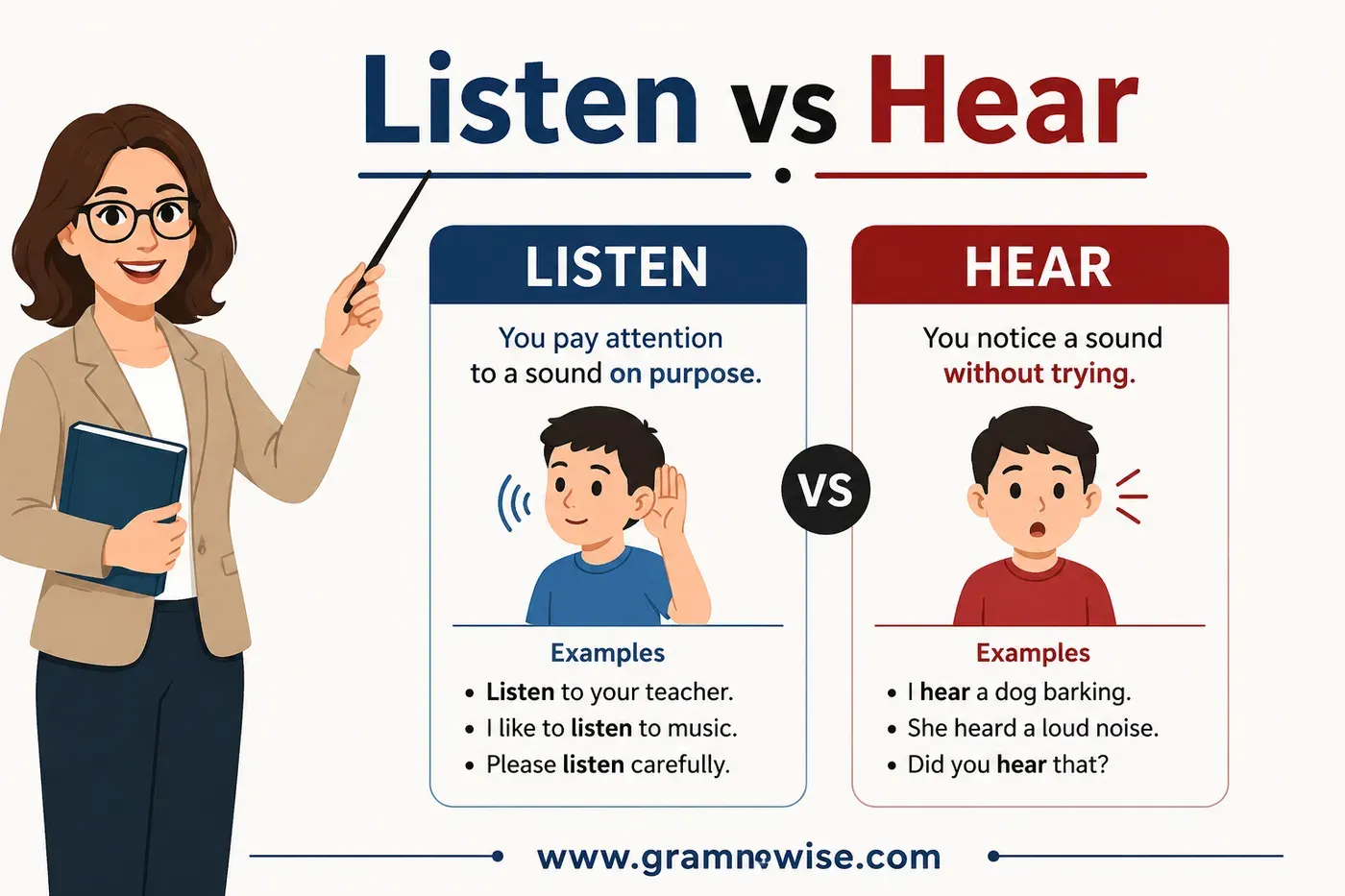
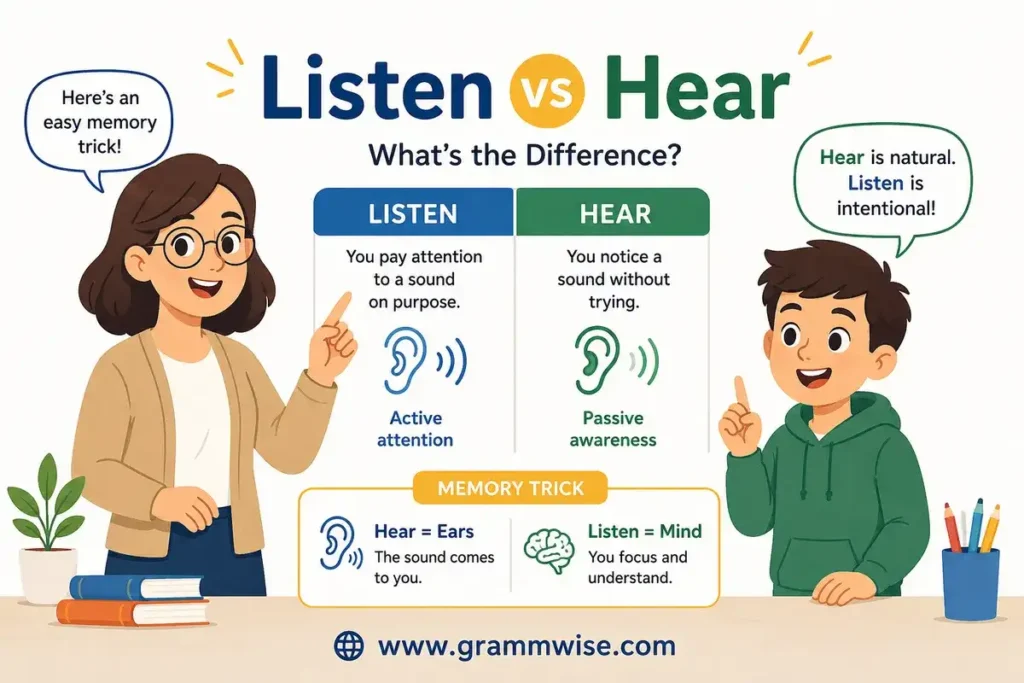
The simple answer is that hear means you notice a sound without trying, while listen means you pay attention to a sound on purpose. One happens naturally, and the other requires your attention.
In this guide, you will learn the difference between listen vs hear in very simple English. We will explain the meaning of each word, why people confuse them, when to use each one, and easy examples you can use every day.
If you enjoy learning word differences, you may also like our guide on Speak vs Talk.
Simple Answer in One Look
Hear means you notice a sound without trying.
Listen means you pay attention to a sound on purpose.
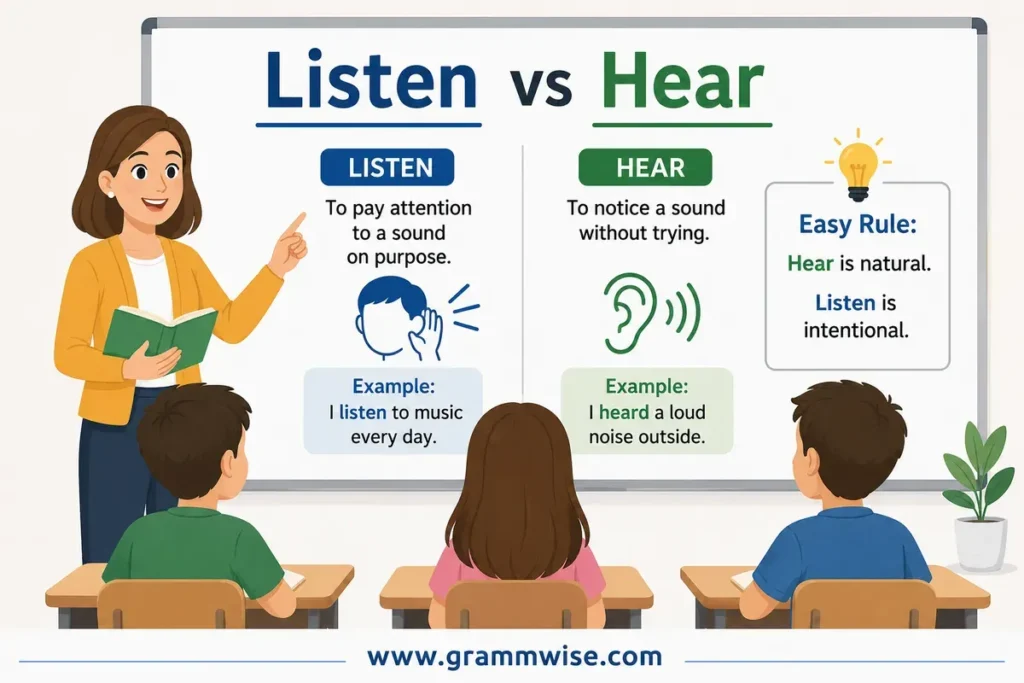
Easy rule:
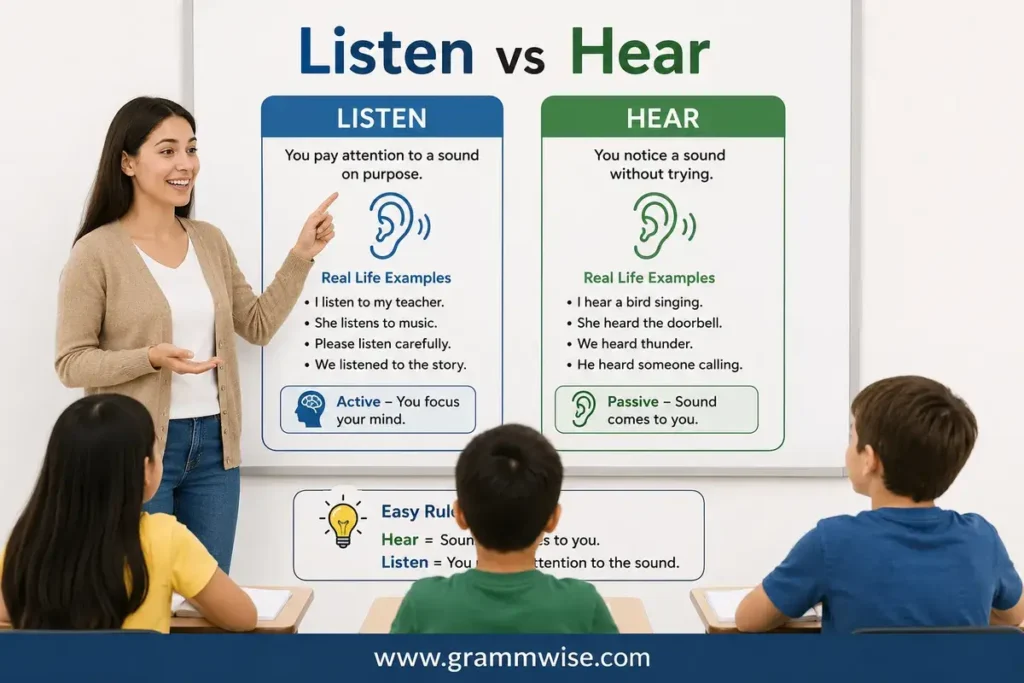
- Hear = Sound comes to you.
- Listen = You pay attention to the sound.
Meaning of “Listen vs Hear” in Simple English
The easiest way to understand listen vs hear is to think about what your ears and your mind are doing.
What Does “Hear” Mean?
You hear something when sound reaches your ears.
You do not have to make any effort.
If someone closes a door loudly, you hear it.
If a bird sings outside your window, you hear it.
Simple meaning:
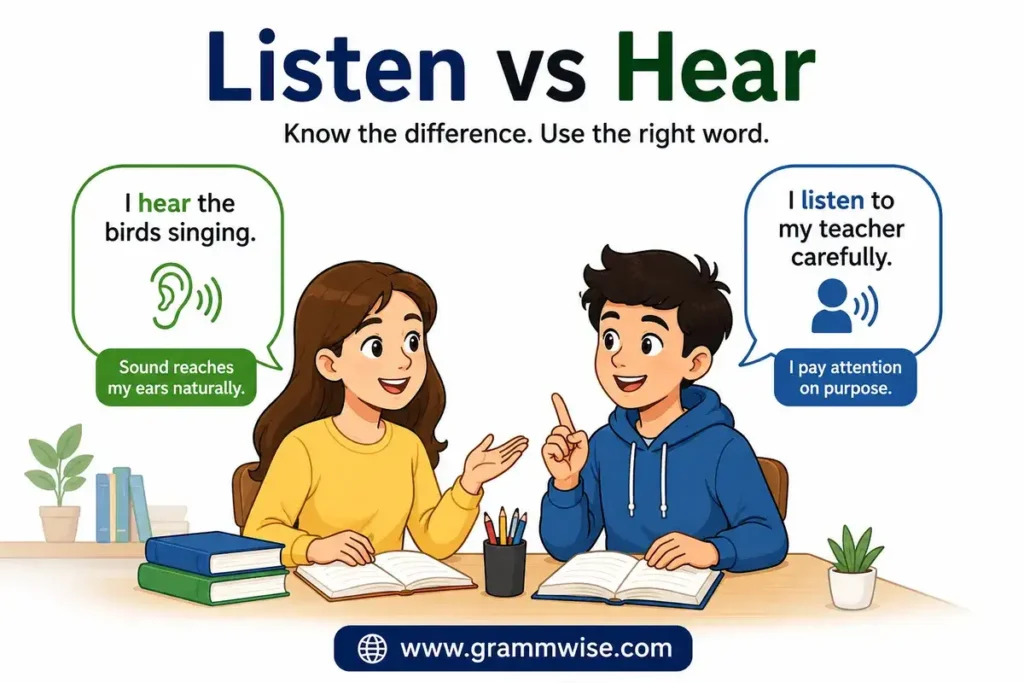
Hear means to notice a sound naturally.
Examples:
- I heard a loud noise.
- She heard the baby crying.
- We heard thunder.
- He heard someone laughing.
- They heard the phone ring.
In all of these examples, the people did not try to hear the sound. It simply reached their ears.
What Does “Listen” Mean?
You listen when you choose to pay attention to a sound, focus your mind and want to understand what you are hearing.
Simple meaning:
Listen means to pay careful attention to a sound.
Examples:
- Please listen to me.
- She likes to listen to music.
- We listened to the teacher.
- He listened carefully.
- They listened to the podcast.
Notice that listen usually shows a choice.
The person wants to hear and understand.
The Main Difference
Here is the easiest way to remember listen vs hear.
You hear sounds automatically.
You listen to sounds intentionally.
That simple idea explains almost every situation.
Listen vs Hear: Why People Mix These Words?
Many learners confuse these two words for several reasons.
Both Are About Sound
Both words involve your ears.
When people first learn English, they think hearing and listening are the same action.
But they are not.
Hearing happens naturally.
Listening requires attention.
Many Languages Use One Word
In some languages, one word can mean both “hear” and “listen.”
Because of this, learners often translate directly into English.
That can lead to mistakes.
Both Can Happen Together
Imagine you are listening to your favorite song.
First, you hear the music.
Then, you listen to the words.
The two actions happen at almost the same time, so they can be easy to confuse.
They Are Used in Similar Situations
You may hear these sentences:
- I hear music.
- I listen to music.
Both are correct.
But they do not mean exactly the same thing.
The first means the music reaches your ears.
The second means you are paying attention to it.
Small Difference, Big Meaning
Only one word changes, but the meaning becomes different.
Compare these sentences.
“I heard you.”
This means your voice reached my ears.
“I listened to you.”
This means I paid attention to what you said.
The second sentence shows more care and attention.
Clear Difference of “Listen vs Hear” Explained Simply
Here is an easy comparison of listen vs hear.
| Hear | Listen |
|---|---|
| Happens naturally | Done on purpose |
| No effort needed | Needs attention |
| Sound reaches your ears | You focus on the sound |
| Passive action | Active action |
| Usually happens first | Usually happens after hearing |
Imagine You Are Walking
You are walking through a park.
A bird begins to sing.
First, you hear the bird.
Then you stop walking.
You pay attention to its beautiful song.
Now you are listening to the bird.
The sound came first.
Your attention came second.
Another Easy Example
Your teacher is speaking.
If you are thinking about something else, you may hear the teacher’s voice.
If you stop thinking and focus on the lesson, you are listening to the teacher.
One Easy Memory Trick
Think about these simple ideas.
Hear = Ears
Your ears notice sounds naturally.
Listen = Learn
When you listen, you are trying to learn or understand.
Another memory trick is this:
You can hear without listening, but you cannot listen without hearing.
This is one of the easiest ways to remember the difference.
Listen vs Hear: Which Form Should You Use?
Choosing between listen vs hear is simple when you ask yourself one question.
Are You Simply Noticing a Sound?
If yes, use hear.
Examples:
- I hear a dog barking.
- She heard the alarm.
- We heard the rain.
- They heard someone singing.
Are You Paying Attention?
If yes, use listen.
Examples:
- Listen to your teacher.
- I like to listen to music.
- Please listen carefully.
- We listened to the instructions.
Remember the Preposition
One important rule is that listen is usually followed by to.
Correct:
- Listen to me.
- Listen to the radio.
- Listen to the teacher.
Incorrect:
- Listen me.
- Listen the radio.
On the other hand, hear usually does not need to.
Correct:
- I heard the music.
- She heard the baby.
Quick Decision Guide
Choose hear when you mean:
- notice a sound
- become aware of a noise
- receive sound naturally
Choose listen when you mean:
- pay attention
- focus on a sound
- try to understand
Easy Real-Life Sentences on “Listen vs Hear”
Reading simple examples is one of the best ways to learn listen vs hear.
Sentences with “Hear”
- I heard a strange noise.
- Did you hear the bell?
- We heard birds this morning.
- She heard someone knocking.
- He heard the news yesterday.
- They heard children playing outside.
- I can hear the wind.
- We heard the train arriving.
Sentences with “Listen”
- Please listen to your parents.
- I listen to music every evening.
- She listened carefully.
- We listened to the story.
- He likes to listen to podcasts.
- They listened to the announcement.
- Listen to the rain.
- The students listened quietly.
“Listen vs Hear” Used in Everyday Conversations
Mother:
“Did you hear the phone?”
Child:
“Yes, but I didn’t answer it.”
Teacher:
“Please listen to today’s lesson.”
Students:
“We’re listening.”
Friend:
“Can you hear the music?”
Answer:
“Yes, and I’m listening to the lyrics.”
Doctor:
“Please listen carefully to these instructions.”
Patient:
“Thank you. I’m listening.”
Mini Practice
Choose the correct word.
- Please ______ to your teacher.
- Answer: listen
- I can ______ the birds singing.
- Answer: hear
- We ______ the thunder last night.
- Answer: heard
- She likes to ______ to classical music.
- Answer: listen
- Did you ______ the doorbell?
- Answer: hear
- Everyone ______ carefully during the meeting.
- Answer: listened
- I can ______ someone calling my name.
- Answer: hear
- Please ______ to what I am saying.
- Answer: listen
Listen vs Hear: Where This Word Comes From?
Learning a little history can make words easier to remember.
The Story Behind “Hear”
The word hear is very old.
It comes from ancient Germanic languages and has been part of English for hundreds of years.
Its meaning has stayed almost the same.
It has always meant receiving sounds through your ears.
The Story Behind “Listen”
The word listen also comes from old Germanic languages.
Long ago, it meant paying attention with your ears.
Over time, the meaning stayed nearly unchanged.
Today, it still means carefully paying attention to sounds or words.
Why Their History Helps
The history of these words matches how we use them today.
Hear is about receiving sound.
Listen is about giving attention.
Remembering this simple idea makes the difference between listen vs hear much easier.
How “Listen vs Hear” Is Understood in Culture and Stories?
People often say that good communication begins with good listening. That is why listen and hear appear in many stories, books, movies, and everyday conversations.
How “Hear” Is Used?
The word hear is often used when someone notices a sound without trying.
For example:
- A child hears thunder outside.
- A family hears a knock at the door.
- Someone hears birds singing early in the morning.
- A driver hears a car horn.
In stories, hearing often tells readers that something has happened.
A character may hear footsteps, hear a voice, or hear someone calling for help.
The sound reaches the person’s ears naturally.
How “Listen” Is Used?
The word listen is often used when someone wants to understand another person.
For example:
- A student listens to the teacher.
- A child listens to a bedtime story.
- Friends listen to each other’s problems.
- A musician listens carefully to every note.
Listening shows care, attention, and respect.
In many stories, a character succeeds because they listen carefully.
Sometimes problems happen because someone hears the words but does not truly listen.
Why Writers Use These Words “Listen vs Hear”
Writers use hear to show that a sound is noticed.
They use listen to show that someone is paying attention.
One word is about receiving sound.
The other is about understanding it.
That is why both words appear so often in books and daily conversations.
Biblical and Mythological Meaning of “Listen vs Hear”
In Bible
The words listen and hear appear many times in English translations of the Bible.
Although they are everyday English words, they often carry different ideas.
The word hear often means receiving a message or becoming aware of God’s words. For example, people hear a voice, hear instructions, or hear good news. Sometimes hearing simply means the message reached them.
The idea of listening often goes one step further. It means paying attention and following what has been heard. Many Bible passages encourage people not only to hear wise words but also to listen and obey them.
In Mythology
In myths and legends, heroes often hear mysterious voices or sounds. The wise heroes usually stop and listen carefully before making an important decision.
No matter if it is in religion or mythology, the difference stays almost the same.
Hear means noticing the message.
Listen means paying attention to it.
Symbolism of “Listen vs Hear” Explained in Simple Words
Sometimes words represent ideas beyond their dictionary meaning.
The same is true for listen and hear.
What “Hear” Represents?
Hear often represents:
- awareness
- noticing
- receiving information
- discovering something
- being informed
When you hear something, your ears receive the sound.
It may happen even when you are busy doing something else.
What “Listen” Represents?
Listen often represents:
- attention
- respect
- learning
- understanding
- patience
- care
When you listen to someone, you show that their words matter.
That is why teachers, parents, and friends often ask people to listen carefully.
An Easy Way to Remember “Listen vs Hear”
Think of hear as opening your ears.
Think of listen as opening both your ears and your mind.
Your ears receive the sound.
Your mind understands it.
Related Words You Should Know
Learning related words will help you build a stronger English vocabulary.
Sound
Something that you hear with your ears.
Example:
I heard a strange sound outside.
Noise
A loud or unwanted sound.
Example:
The noise kept me awake.
Voice
The sound made when someone speaks.
Example:
I recognized her voice immediately.
Attention
Carefully focusing on something.
Example:
Please pay attention to the lesson.
Concentrate
To think carefully without getting distracted.
Example:
I need to concentrate while studying.
Understand
To know the meaning of something.
Example:
I listened carefully so I could understand.
Obey
To do what someone tells you.
Example:
Good students listen to their teachers.
Communicate
To share ideas or information.
Example:
Good communication begins with listening.
Conversation
People talking with each other.
Example:
We had a long conversation after dinner.
Active Listening
Paying full attention to the speaker and trying to understand their message.
This skill is useful at school, work, and home.
Use of “Listen vs Hear” in Daily English
You will hear these words almost every day.
Here are some natural examples.
- “I can hear music from the next room.”
- “Please listen to me for a minute.”
- “I heard the baby crying last night.”
- “My grandfather likes to listen to the radio.”
- “Can you hear the birds outside?”
- “The students listened carefully during class.”
- “I heard someone knocking at the door.”
- “We always listen to our coach before a game.”
- “Did you hear the exciting news?”
- “I enjoy listening to relaxing music before bed.”
You may also hear these common expressions:
- hear the news
- hear a noise
- hear someone calling
- listen carefully
- listen to music
- listen to advice
- listen to your parents
- listen to the teacher
- hear a voice
- hear the alarm
These expressions are used every day in spoken and written English.
Common Mistakes People Make About “Listen vs Hear”
Many English learners make the same mistakes when using listen vs hear.
Mistake 1: Using “Listen” Instead of “Hear”
Incorrect: I listened a loud noise.
Correct: I heard a loud noise.
If the sound simply reached your ears, use hear.
Mistake 2: Forgetting “to” After “Listen”
Incorrect: Please listen me.
Correct: Please listen to me.
Remember that listen is usually followed by to.
Mistake 3: Using “Hear” When Attention Is Needed
Incorrect: Please hear your teacher carefully.
Correct: Please listen to your teacher carefully.
The teacher wants your attention, not just your ears.
Mistake 4: Thinking They Mean Exactly the Same Thing
Many learners believe these words are interchangeable.
They are not.
Compare these sentences.
“I heard her.”
This means her voice reached your ears.
“I listened to her.”
This means you paid attention to what she said.
Mistake 5: Forgetting the Memory Trick
A simple memory trick helps many students.
Hear = Happens naturally.
Listen = Learn by paying attention.
Remembering these two ideas will help you choose the correct word.
Final Teacher Explanation
Imagine you are sitting in my classroom.
I begin speaking.
If my voice reaches your ears, you hear me.
But if you stop talking, look at me, and pay attention to every word, you are listening to me.
That is the whole difference.
Do not make it harder than it needs to be. Whenever you are unsure, ask yourself one simple question.
“Am I only noticing a sound, or am I paying attention?”
If you are only noticing it, use hear.
If you are paying attention, use listen.
The more English you read and hear, the more natural this difference will become.
Soon, choosing between listen vs hear will feel easy.
Final Answer “Listen vs Hear”
The difference between listen vs hear is easy to remember.
Hear means a sound reaches your ears naturally, while listen means you pay attention to that sound on purpose.
Remember this simple rule: You hear with your ears, but you listen with your ears and your mind.
Conclusion
Understanding listen vs hear is easy when you remember one simple idea. Hear means a sound reaches your ears naturally, while listen means you choose to pay attention and understand the sound. Knowing this difference will help you speak and write more natural English.
Keep practicing with everyday conversations, songs, and classroom examples. The more you notice how these words are used, the more confident you will become. Soon, choosing between listen and hear will feel natural in every situation.
Frequently Asked Questions (FAQs)
What is the difference between listen vs hear?
Hear means noticing a sound naturally. Listen means paying attention to a sound on purpose.
Can I hear without listening?
Yes. You may hear music or people talking without paying attention to them.
Can I listen without hearing?
No. You must hear a sound before you can listen to it carefully.
Why does “listen” usually need “to”?
The word listen is normally followed by to because you listen to someone or something.
Which is correct: “listen me” or “listen to me”?
Listen to me is correct. Listen me is not correct in standard English.
Is listening an active skill?
Yes. Listening is active because it requires attention and understanding.
Do native English speakers use both words every day?
Yes. Hear and listen are very common in everyday conversations, schools, workplaces, and media.
How can I remember the difference easily?
Use this simple memory trick: Hear happens automatically. Listen happens intentionally.