
Many English learners get confused about since vs for because both words talk about time. They often appear in the same kinds of sentences, so it is easy to mix them up. The good news is that the rule is simple once you understand it.
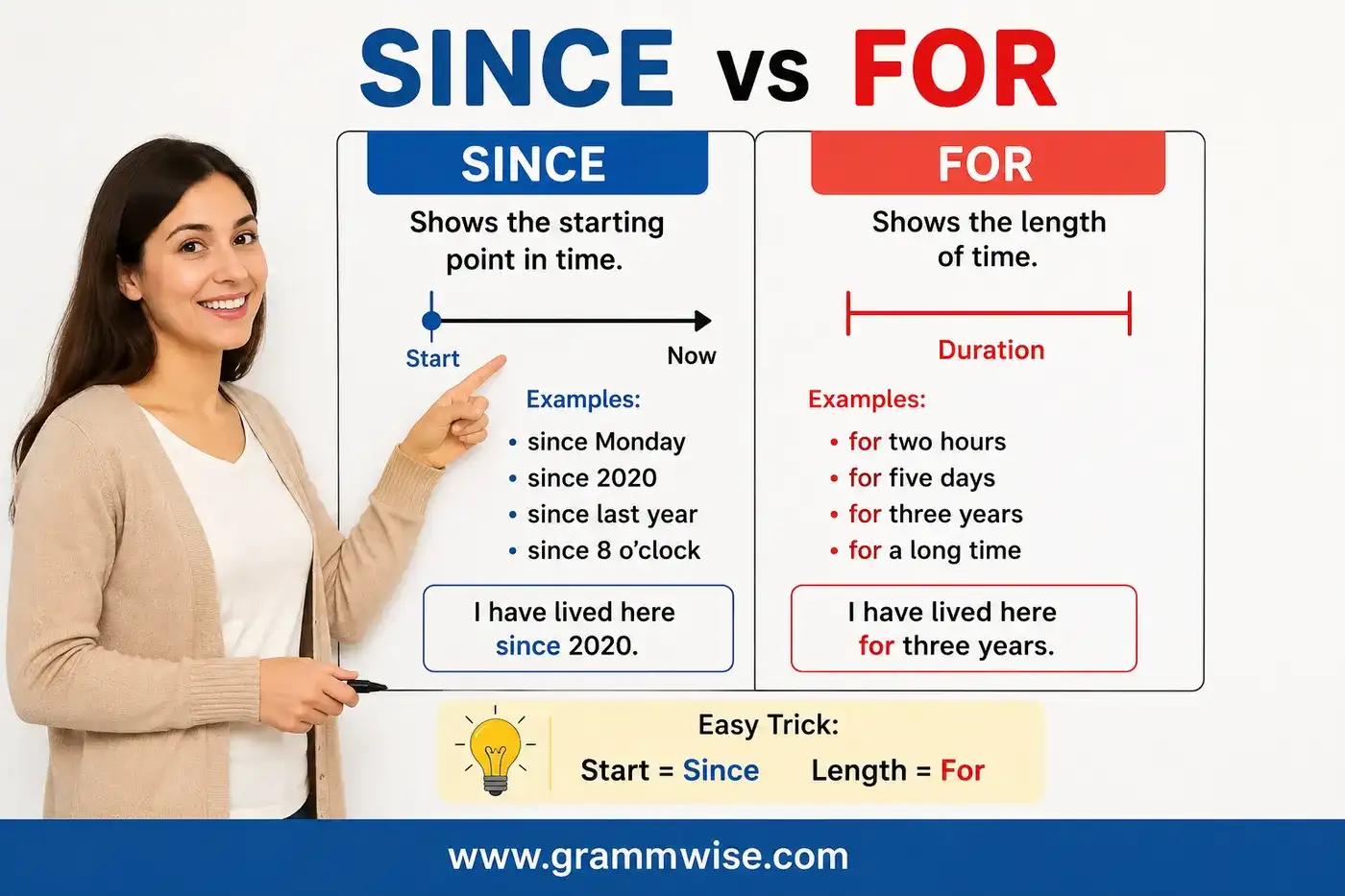
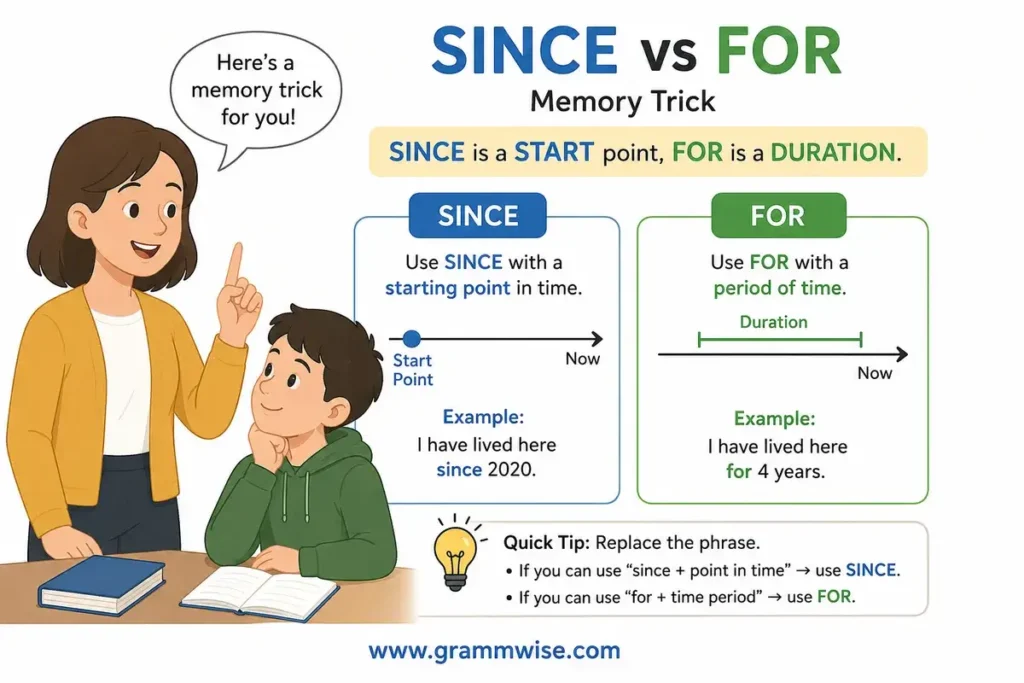
The difference between since vs for is that since tells us the starting point of an action, while for tells us the length of time. When you know whether you are talking about a beginning or a period, choosing the correct word becomes easy.
In this guide, you will learn the meaning of since vs for, why people confuse them, simple rules to remember, and real-life examples that you can use every day.
If you enjoy learning word differences, you may also like our guide on bring vs take.
Simple Answer in One Look
- Since = shows the starting point in time.
- For = shows how long something lasts.
Example:
- I have lived here since 2020.
- I have lived here for four years.
Meaning of “Since vs For” in Simple English
Think about a road trip.
If someone asks:
“When did your trip begin?”
You answer with the starting point.
- Since Monday
- Since 8 a.m.
- Since last year
Now imagine they ask:
“How long have you been traveling?”
You answer with the amount of time.
- For two days
- For three hours
- For one week
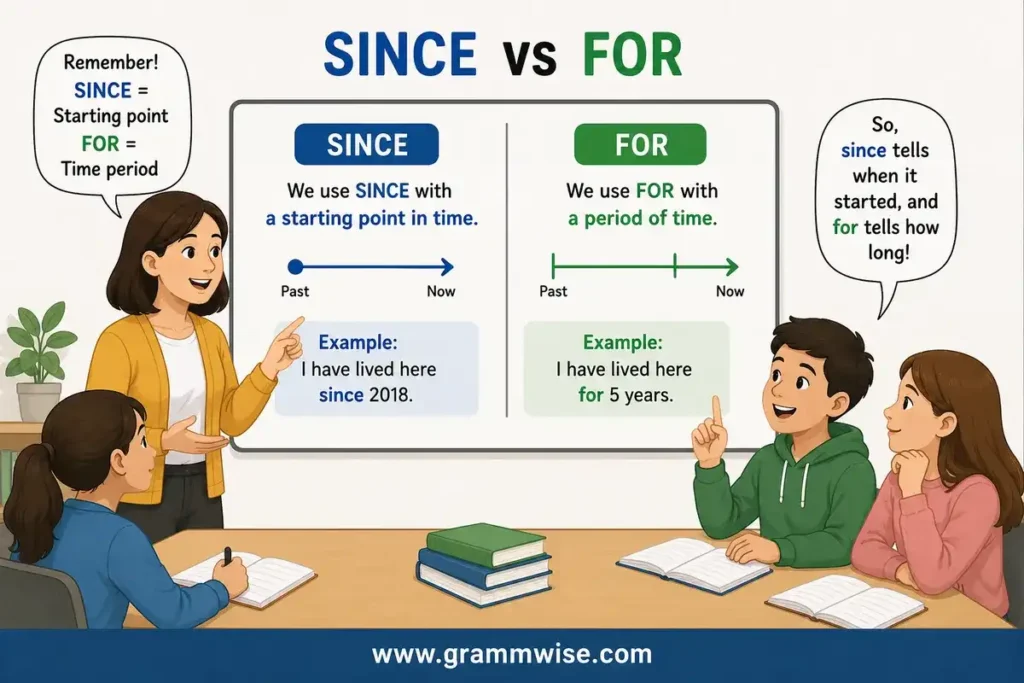
That is the easiest way to remember since vs for.
Since means the beginning.
It tells us exactly when something started.
Examples:
- since Monday
- since January
- since 2022
- since breakfast
- since noon
For means the length of time.
It tells us how long something has continued.
Examples:
- for two hours
- for five days
- for six months
- for ten years
- for a long time
Whenever you ask yourself:
“Am I talking about a starting point or a period?”
You will know which word to choose.
Since vs For: Why People Mix These Words
Many students think since and for have the same meaning because they both talk about time.
For example:
“I have worked here since 2023.”
“I have worked here for three years.”
Both sentences describe the same job.
The difference is only in the kind of time information.
One gives the beginning.
The other gives the duration.
People also become confused because many languages use only one word for both ideas. English separates them into two different words.
Another reason is that learners often translate directly from their first language instead of thinking about the meaning.
Remember this simple question:
Where did it start? → Since
How long? → For
Clear Difference of “Since vs For” Explained Simply
| Since | For |
|---|---|
| Shows the starting point | Shows the length of time |
| Answers “When did it begin?” | Answers “How long?” |
| Used with dates and times | Used with periods of time |
| Since Monday | For two days |
| Since 2021 | For three years |
| Since breakfast | For an hour |
Easy memory trick
Think of S in Since as Start.
Think of F in For as Full length.
Start → Since
Length → For
Since vs For: Which Form Should You Use?
Use since when you mention the exact time something began.
Examples:
- since yesterday
- since April
- since 2020
- since lunchtime
- since childhood
Use for when you mention a period or amount of time.
Examples:
- for two hours
- for five weeks
- for many years
- for a while
- for ten minutes
Ask yourself these questions
Question 1
Am I giving the starting point?
If yes, use since.
Example:
She has lived here since 2018.
Question 2
Am I giving the amount of time?
If yes, use for.
Example:
She has lived here for six years.
Easy Real-Life Sentences on “Since vs For”
Here are simple everyday examples.
Using Since
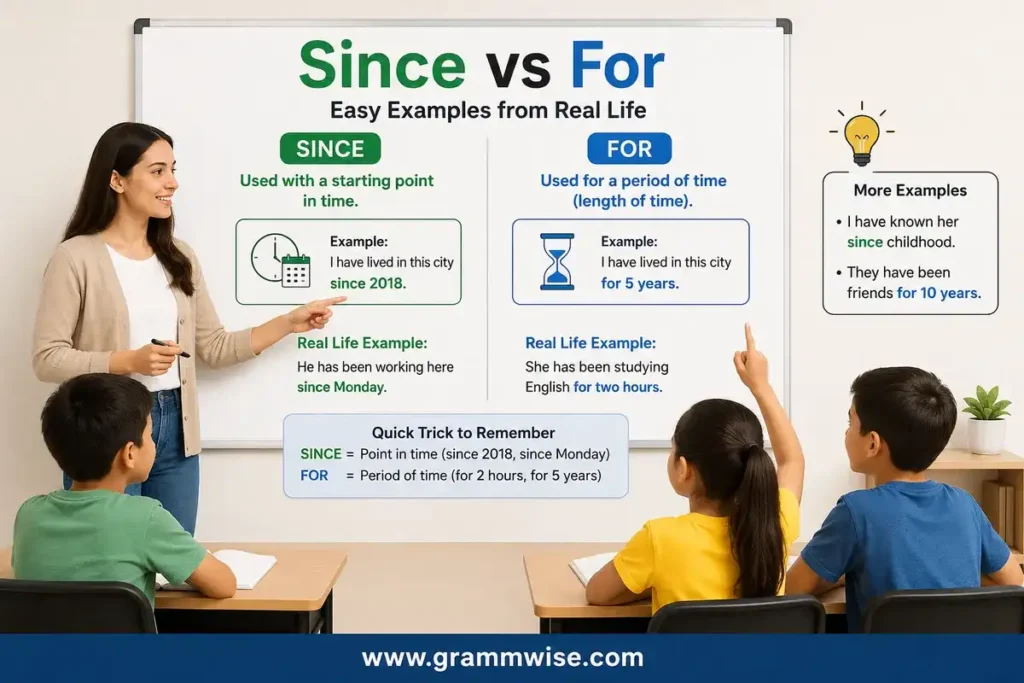
- I have known Mia since elementary school.
- We have lived here since 2019.
- Dad has been busy since this morning.
- It has rained since noon.
- She has studied English since January.
- They have waited here since 8 o’clock.
- I have liked pizza since I was a child.
- He has worked here since last year.
Using For
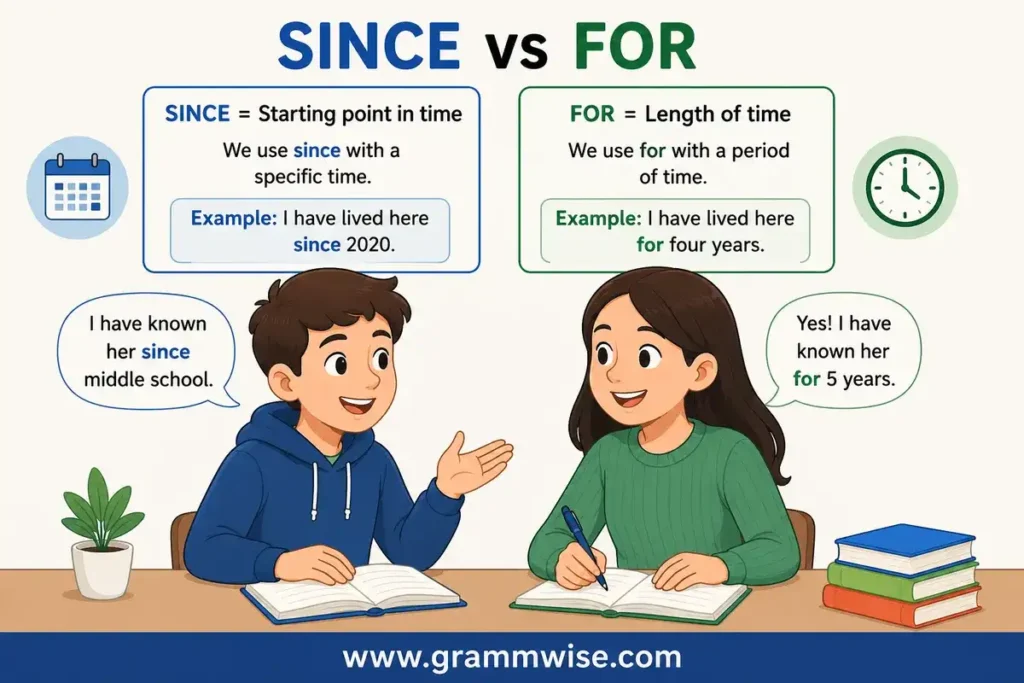
- I have known Mia for ten years.
- We have lived here for five years.
- Dad has been busy for three hours.
- It has rained for two days.
- She has studied English for six months.
- They have waited for thirty minutes.
- I slept for eight hours.
- He worked there for fifteen years.
Since vs For: Where This Expression Comes From?
Both since and for are very old English words.
Since originally meant “from that time.”
People have used it for hundreds of years to show the beginning of an event.
For also comes from Old English.
Over time, one of its meanings became “during a period of time.”
That is why English now uses two different words for two different ideas.
Even though they are old words, the rule has stayed almost the same for many centuries.
Since vs For: How This Word Is Understood in Culture and Stories?
People use since and for every day when they tell stories about their lives. These words help us understand when something began and how long it lasted. Even though they are small words, they make stories much clearer.
Imagine a grandparent telling a family story.
“I have lived in this town since 1975.”
This tells you exactly when that part of the story started.
Now imagine the same person says:
“I have lived in this town for fifty years.”
Now you know the length of time. Both sentences are correct, but each gives different information.
You also hear since and for in movies, books, songs, and conversations.
Someone may say:
- We have been friends since high school.
- I have waited for an hour.
- They have known each other since childhood.
- We stayed there for three weeks.
These words help people describe memories, friendships, jobs, travel, and family life.
That is why learning since vs for is useful. You will hear these words almost every day.
Biblical and Mythological Meaning of “Since vs For”
The words since and for do not have special religious or mythological meanings. They are simple English words that help describe time.
In many Bible translations, you may see sentences like:
- God has been with His people since ancient times.
- The people waited for many years.
Here, since still shows the starting point, and for still shows the length of time.
The same idea appears in old stories and myths. Writers use these words to explain when events began and how long they continued.
The meaning does not change. The grammar rule stays the same.
Symbolism of “Since vs For” Explained in Simple Words
What Since Represents?
The word since often makes people think about beginnings.
It reminds us that every journey starts somewhere.
A friendship starts on one day.
A new job starts on one date.
A happy memory begins at one moment.
When people use since, they point back to that special starting point.
Examples:
- Since my first day at school
- Since we met
- Since last summer
The word helps people remember where something began.
What For Represents?
The word for often makes people think about time passing.
It reminds us that some things continue.
Learning takes time.
Friendships grow over time.
Families stay together for many years.
When people use for, they focus on the journey instead of the beginning.
Examples:
- For two hours
- For six months
- For many years
One word looks back to the start.
The other measures the time in between.
That is the easiest way to understand since vs for.
Related Words You Should Know
Here are some other time words that are often used with since and for.
From
Shows where something begins but is often paired with to.
Example:
The store is open from 9 a.m. to 5 p.m.
Until
Shows when something ends.
Example:
I stayed until midnight.
During
Shows that something happened within a period of time.
Example:
We talked during lunch.
By
Shows a deadline.
Example:
Finish your homework by Friday.
Ago
Talks about how far back something happened.
Example:
She moved here two years ago.
Already
Shows something happened before now.
Example:
I have already eaten.
Yet
Usually appears in questions and negative sentences.
Example:
Have you finished yet?
Still
Shows something continues.
Example:
He is still waiting.
Learning these words will make talking about time much easier.
How People Actually Use “Since vs For” in Daily English
Here are common conversations where people naturally use since and for.
At school:
- “I have studied here since first grade.”
- “I have been here for six years.”
At work:
- “I have worked here since 2022.”
- “I have worked here for four years.”
At home:
- “We have lived here since last summer.”
- “We have lived here for one year.”
Talking to friends:
- “I have known Sarah since college.”
- “I have known Sarah for ten years.”
At the doctor’s office:
- “I have felt sick since Monday.”
- “I have been sick for three days.”
Traveling:
- “We have been in New York since Friday.”
- “We have been in New York for five days.”
Learning English:
- “I have learned English since I was ten.”
- “I have learned English for eight years.”
Waiting:
- “I have waited since 8 o’clock.”
- “I have waited for two hours.”
Playing sports:
- “He has played soccer since childhood.”
- “He has played soccer for fifteen years.”
As you can see, native English speakers use these words naturally. They simply choose the word that matches the meaning.
Common Mistakes People Make About “Since vs For”
Many learners make the same mistakes when using since vs for. Here are the most common ones.
Mistake 1
❌ I have lived here since five years.
✅ I have lived here for five years.
Remember, five years is a length of time.
Mistake 2
❌ I have lived here for 2020.
✅ I have lived here since 2020.
The year 2020 is a starting point.
Mistake 3
❌ She has worked here since three months.
✅ She has worked here for three months.
Three months tells us the duration.
Mistake 4
❌ We have waited for 8 a.m.
✅ We have waited since 8 a.m.
Eight o’clock is when the waiting started.
Mistake 5
❌ They have been friends since ten years.
✅ They have been friends for ten years.
Ten years is a period of time.
Easy trick to avoid mistakes
Ask yourself one question.
Am I talking about the beginning?
Use since.
Am I talking about the length?
Use for.
This simple question will help you choose the correct word almost every time.
Final Teacher Explanation
Think of a timeline. Every timeline has two things. It has a starting point. It also has a length.
That is exactly how since vs for works.
If you point to the place where something started, use since.
If you measure how long it has continued, use for.
You do not need to memorize long grammar rules. Just remember these two questions.
When did it start?
Use since.
How long has it lasted?
Use for.
Keep practicing with real sentences. Soon, choosing between since and for will feel natural.
Quick Recap
The difference between since vs for is simple.
Use since for the starting point of an action. Use for for the length of time. If you remember Start = Since and Length = For, you will use both words correctly in speaking and writing.
Conclusion
The difference between since vs for is easy once you know what each word does. Use since to show when something started, and use for to show how long it has continued. This simple rule will help you speak and write English with more confidence.
Keep practicing with everyday sentences, and soon choosing the correct word will become natural. When you think Start = Since and Length = For, you will remember the correct choice every time.
Frequently Asked Questions (FAQs)
What is the difference between since vs for?
Since shows when something started. For shows how long it has lasted.
Is it correct to say “since two years”?
No. Say for two years because two years is a period of time.
Can I say “since Monday”?
Yes. Monday is a starting point, so since Monday is correct.
When should I use for?
Use for when talking about an amount of time, such as two hours, five days, or ten years.
Why do people confuse since vs for?
Both words talk about time, so many learners think they have the same meaning. The difference is that one shows the beginning and the other shows the duration.
Can I use since and for in the same sentence?
Yes. For example: I have lived here since 2020 for almost five years. The first word gives the starting point, and the second gives the length of time.
Which is correct: since yesterday or for yesterday?
Since yesterday is correct because yesterday is a starting point.
How can I remember since vs for easily?
Remember this simple trick: Since = Start. For = Length. Ask yourself whether you are talking about the beginning or the amount of time, and the correct word becomes easy to choose.