
Many English learners get confused about bring vs take because both words talk about moving something or someone from one place to another. The difference is not difficult once you know one simple rule. You only need to think about the direction of movement.
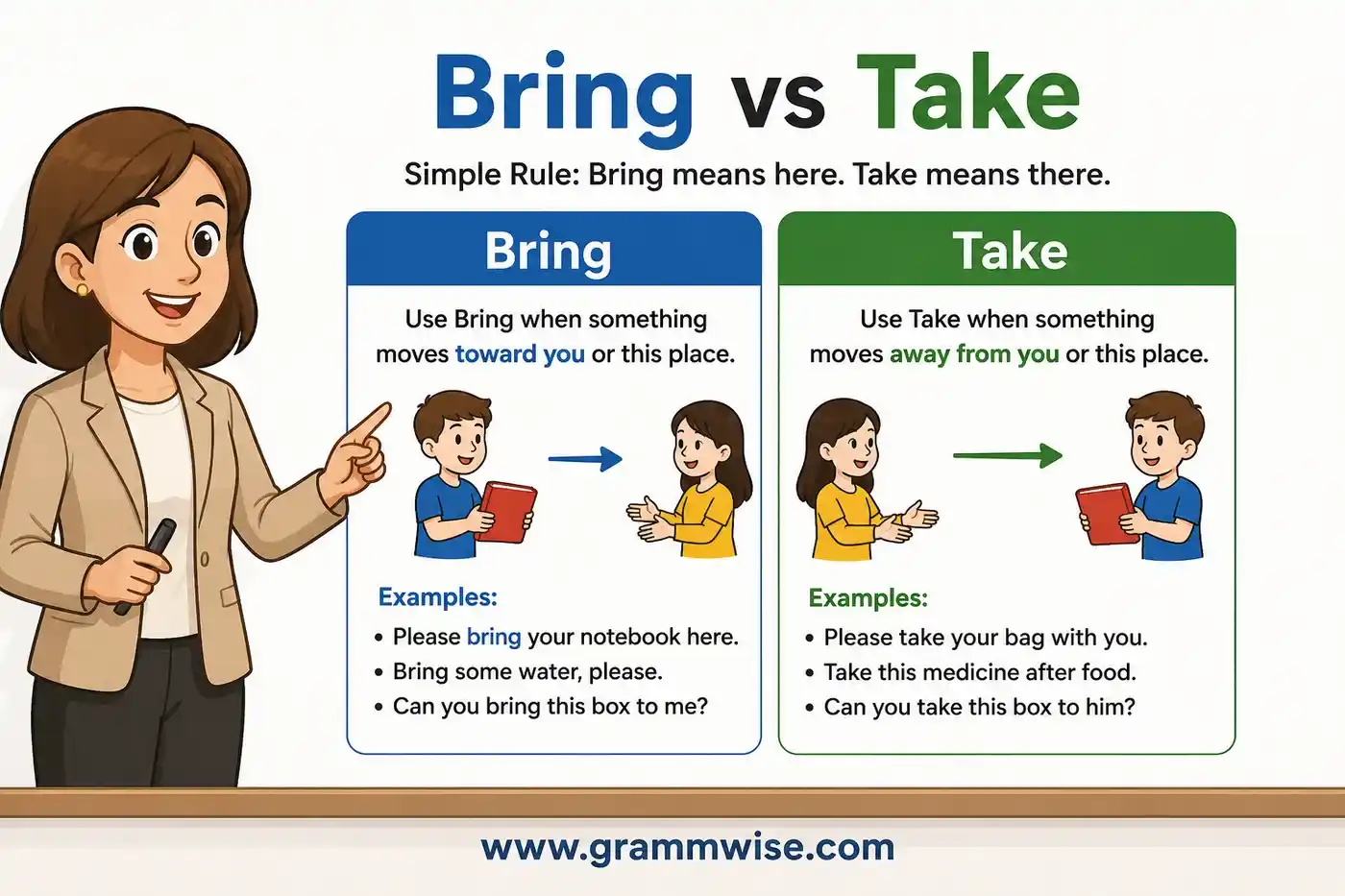
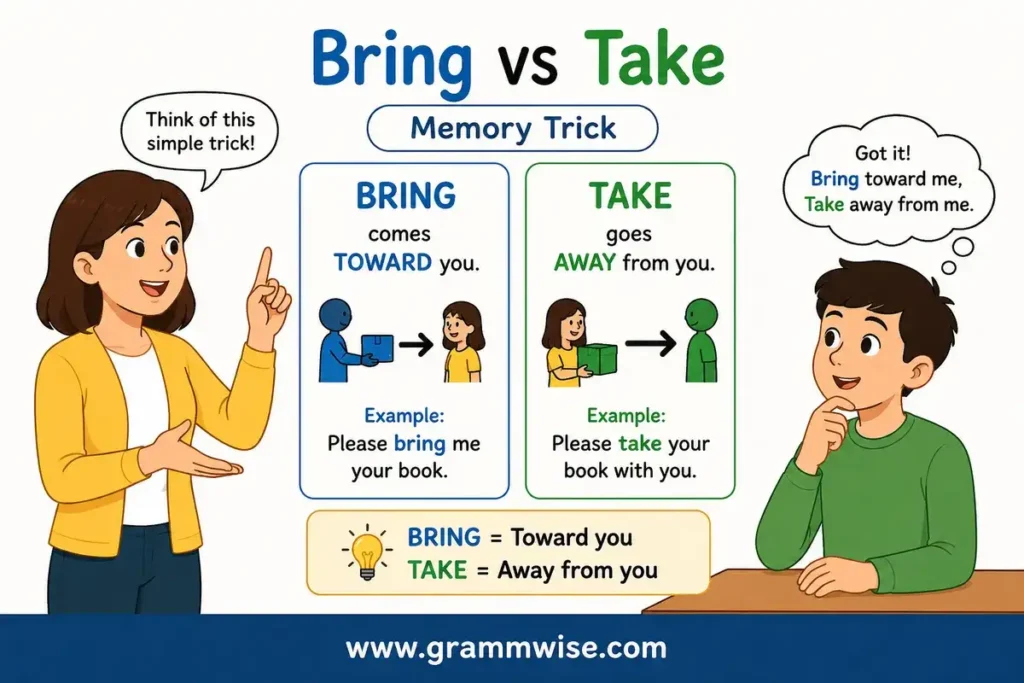
In bring vs take, bring means moving something toward the speaker or the place being talked about. Take means moving something away from the speaker or the place being talked about. This easy idea helps you choose the correct word in most situations.
In this guide, you will learn the difference between bring vs take in very simple English. You will also see easy examples, common mistakes, memory tips, and real-life sentences that you can use every day.
Want to improve your grammar further? Explore more guides on Grammwise.
Simple Answer in One Look
Bring means move something here.
Take means move something there.
Easy rule: If something comes toward you, use bring. If something goes away from you, use take.
| Word | Meaning | Example |
|---|---|---|
| Bring | Move something toward someone or a place | Please bring your notebook to class. |
| Take | Move something away from someone or a place | Please take this book home. |
Meaning of “Bring vs Take” in Simple English
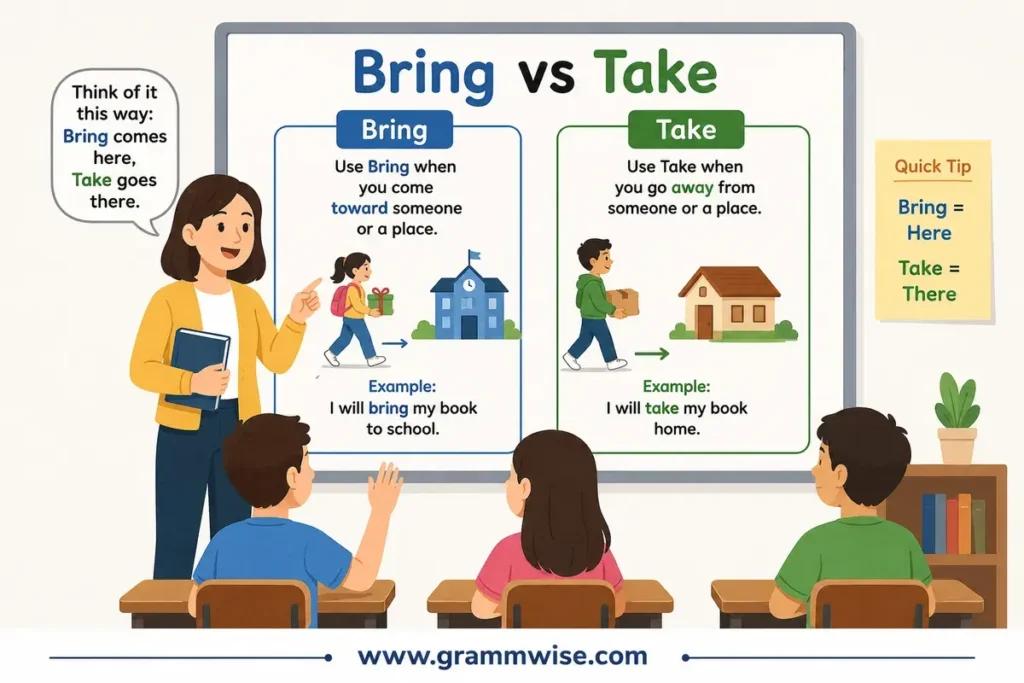
Imagine your teacher is standing in the classroom.
The teacher says, “Please bring your homework.”
The homework is coming to the teacher.
Now imagine the teacher says, “Please take this paper to the office.”
The paper is moving away from the classroom.
This is the easiest way to understand bring vs take.
Think about where the object is going.
If it is coming toward the speaker, use bring.
If it is going away from the speaker, use take.
Here are more simple examples.
“Can you bring me a glass of water?”
The water comes to the speaker.
“Can you take this glass to the kitchen?”
The glass goes away from the speaker.
Notice that the object is the same. Only the direction changes.
This simple idea works in almost every situation.
Bring vs Take: Why People Mix These Words?
Many people confuse bring and take because both involve carrying or moving something.
For example, imagine two friends are talking on the phone.
One friend says, “Can you bring your camera?” The camera is coming to the friend’s location.
Another friend says, “I will take my camera to the park.” The camera is leaving with the speaker.
The action is similar, but the direction is different.
Another reason for the confusion is that many languages use only one word for both ideas. English uses two different words, so learners sometimes choose the wrong one.
People also speak quickly in daily conversations. If you do not think about the direction, it is easy to mix them up.
The good news is that you only need to remember one question.
Is it coming here or going there?
If it is coming here, use bring.
If it is going there, use take.
Clear Difference of “Bring vs Take” Explained Simply
The easiest way to remember bring vs take is to think about arrows.
Bring ⬅️ Coming toward you.
Take ➡️ Going away from you.
Here is a simple comparison.
Use Bring When
- Something comes to you.
- Someone comes to your place.
- An object moves toward the speaker.
- The action ends where the speaker is.
Examples:
- Bring your lunch to school.
- Please bring me my keys.
- Can you bring your sister with you?
- Bring your umbrella tomorrow.
- She brought flowers to the party.
Use Take When
- Something goes away from you.
- Someone leaves your place.
- An object moves to another place.
- The action starts where the speaker is.
Examples:
- Take your bag home.
- Please take this letter to the post office.
- Take your shoes outside.
- He took his bike to the repair shop.
- We will take our dog to the park.
Quick Memory Trick
Bring = Come here.
Take = Go there.
If you remember these four words, choosing the correct word becomes much easier.
Bring vs Take: Which Form Should You Use?
Before choosing bring or take, ask yourself one simple question.
Where is the object going?
If it is coming toward the speaker, use bring.
If it is going away from the speaker, use take.
Look at these examples.
Your mother is at home. She calls you and says, “Please bring some milk.”
The milk is coming to her.
Now you are leaving home. Your mother says, “Please take this umbrella.”
The umbrella is leaving home with you.
Here is another example.
Your teacher says, “Bring your project to class tomorrow.” The project comes to the classroom.
After class, the teacher says, “Take your project back home.” Now the project leaves the classroom.
The object has not changed. Only the direction has changed. This is why understanding direction is the key to mastering bring vs take.
Easy Real-Life Sentences on Bring vs Take
The best way to learn bring vs take is by reading and using simple sentences. These examples sound natural because they are the kinds of sentences people use every day.
Bring examples:
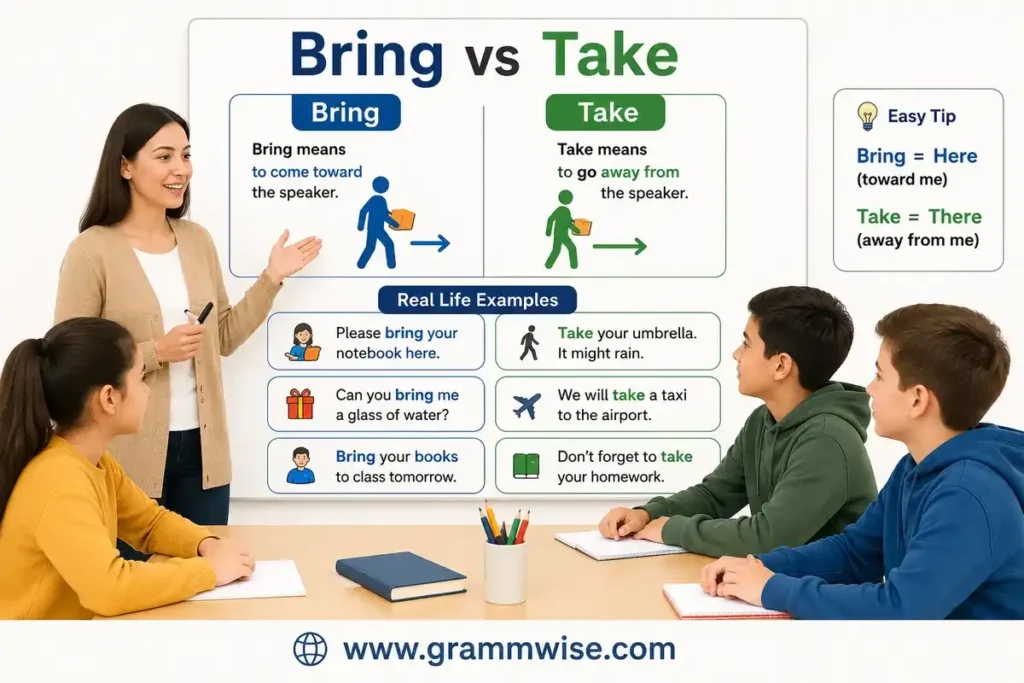
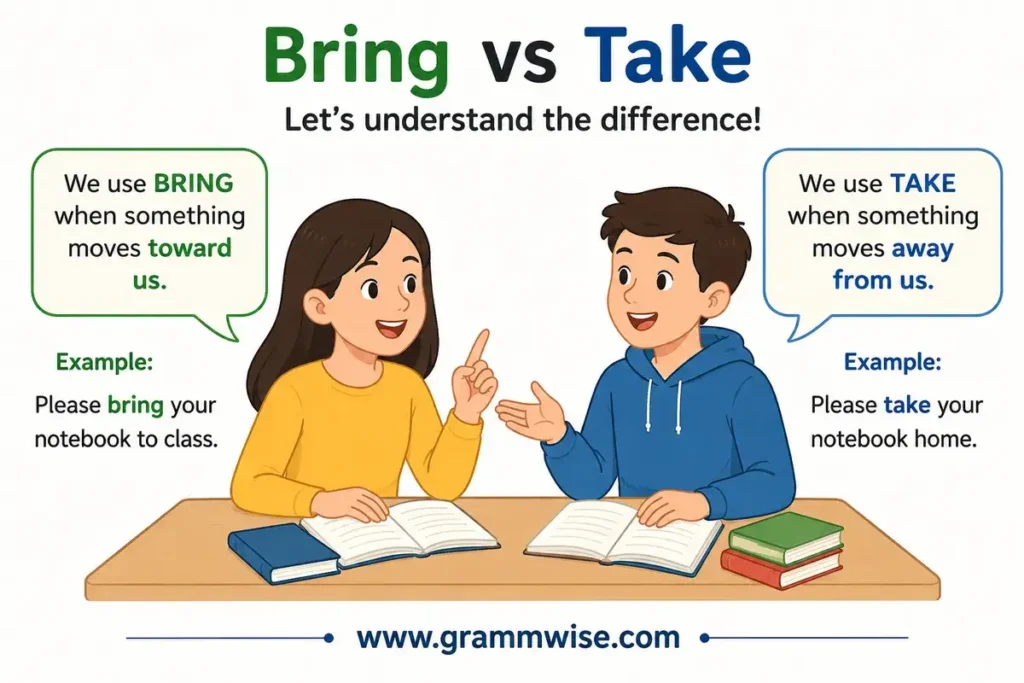
- Please bring your notebook to class tomorrow.
- Can you bring me a glass of water?
- Don’t forget to bring your phone.
- My brother will bring his friend to the party.
- Please bring your ideas to the meeting.
- She brought cookies for everyone.
- Bring your umbrella because it may rain.
- Can you bring your family to the picnic?
Take examples:
- Please take this package to the post office.
- Take your backpack home after school.
- I will take my dog for a walk.
- She took her books to the library.
- Can you take these dishes to the kitchen?
- We are taking our children to the zoo.
- He took his laptop to work.
- Please take your shoes off before coming inside.
Now compare these pairs.
Bring your homework to school. The homework is coming to school.
Take your homework home. The homework is leaving school.
Another pair:
Bring your cup here. The cup comes to the speaker.
Take your cup to the sink. The cup goes away from the speaker.
These small changes make a big difference. When you think about the direction, choosing the right word becomes much easier.
Bring vs Take: Where This Word Comes From?
The words bring and take have been part of English for hundreds of years.
The word bring comes from an Old English word that meant carry something toward someone. Even today, it keeps the same basic meaning.
The word take also comes from old forms of English and other Northern European languages. It meant carry, lead, or move something away. Over time, its meaning stayed almost the same.
Although these words are very old, English speakers still use them every day without changing their basic meanings. That is why the simple rule still works today.
Bring means something comes toward a person or place.
Take means something goes away from a person or place.
Knowing this history can help you remember that these words have always described direction.
Common Expressions with Bring
English has many common expressions with bring. Learning them will help you sound more natural.
Bring your own…
Example:
“Please bring your own water bottle.”
Bring back
Example:
“Please bring back my book tomorrow.”
Bring along
Example:
“You can bring along your brother.”
Bring up
Example:
“He brought up an interesting question.”
Bring home
Example:
“She brought home some fresh fruit.”
These expressions all keep the idea of bringing something toward a person or place.
Common Expressions with Take
The word take is also used in many everyday expressions.
Take care
Example:
“Take care on your way home.”
Take away
Example:
“We ordered take-away food.”
Take out
Example:
“Please take out the trash.”
Take off
Example:
“The plane will take off soon.”
Take part
Example:
“Many students took part in the competition.”
Even though these expressions have special meanings, they still help you become more comfortable with the word take.
Quick Comparison Table “Bring vs Take”
| Situation | Correct Word | Example |
|---|---|---|
| Something comes toward you | Bring | Bring your homework to me. |
| Something goes away from you | Take | Take your homework home. |
| Someone comes to your house | Bring | Bring your cousin with you. |
| Someone leaves your house | Take | Take your bag with you. |
| Giving something to the speaker | Bring | Bring me a chair. |
| Moving something to another place | Take | Take this chair outside. |
One-Minute Memory Trick for “Bring vs Take”
Here is an easy trick that many teachers use.
Imagine you are standing in one place. If something is moving toward you, imagine an arrow pointing at you. That arrow means bring.
If something is moving away from you, imagine an arrow pointing away. That arrow means take.
You can also remember these simple phrases:
Bring = Come here.
Take = Go there.
Repeat them a few times.
Soon, you will remember the difference without thinking.
Practice Quiz
Choose the correct word.
- Please ______ your lunch to school tomorrow.
- Can you ______ this letter to the post office?
- Don’t forget to ______ your camera to the party.
- I need to ______ these books back to the library.
- Please ______ me a cup of coffee.
- She will ______ her children to the museum.
- Can you ______ your friend with you?
- Please ______ these empty boxes outside.
Answers
- Bring
- Take
- Bring
- Take
- Bring
- Take
- Bring
- Take
If you answered most of these correctly, you are already becoming confident with bring vs take.
Bring vs Take: How This Word Is Understood in Culture and Stories?
People have always moved from one place to another. They bring gifts, take food, bring good news, and take messages. That is why bring and take appear in stories from many cultures around the world.
In many family stories, children are asked to bring something to a parent or grandparent.
“Please bring me a glass of water.”
“Bring your little sister inside.”
These sentences show something coming toward the speaker.
The word take often appears when someone leaves for another place.
“Take this letter to your uncle.”
“Take these flowers to your grandmother.”
The object is moving away from the speaker.
You can also hear these words in fairy tales.
A prince may bring a gift to the princess.
A messenger may take an important letter to the king.
Even though the stories are different, the idea stays the same.
Bring means something comes closer.
Take means something goes farther away.
Children also hear these words in bedtime stories.
“A little bird brought food to its babies.”
“The farmer took the vegetables to the market.”
These examples help children understand direction without even thinking about grammar.
Movies use the same pattern. One character says,
“I’ll bring the medicine.” The medicine is coming to another person.
Another character says, “I’ll take the medicine to Grandma.” Now the medicine is leaving with the speaker.
You will notice this pattern in books, cartoons, TV shows, and conversations. Once you understand bring vs take, these sentences become very easy to understand.
People also use these words in celebrations.
- Guests bring gifts to birthday parties.
- Families take leftovers home after the party.
- Students bring projects to school.
- Parents take their children home after class.
The direction always tells you which word is correct.
Biblical and Mythological Meaning of “Bring vs Take”
The Bible uses both bring and take many times. People often bring offerings to God. Visitors bring gifts. Friends bring food to others during difficult times. The idea is always that something is coming to a person or a special place.
The word take is also common. People take messages to others. Leaders take people on journeys. Families take supplies with them when they travel. Again, the direction is easy to see. Something is moving away from where the speaker is.
Many old myths tell similar stories. A hero may bring back a magical object. A king may take an army into battle. A wise person may bring hope to a village. A traveler may take a map on a long journey.
No matter which story you read, the simple rule stays the same.
Bring points toward someone or somewhere.
Take points away from someone or somewhere.
Symbolism of “Bring vs Take” Explained in Simple Words
Words often have meanings beyond their dictionary definitions. Bring and take can also suggest different ideas and feelings.
What Bring Represents?
The word bring often represents giving, kindness, and connection.
- When people bring flowers, they show care.
- When friends bring food, they show love.
- When students bring new ideas, they help everyone learn.
People also use bring in positive expressions.
- “Bring happiness.”
- “Bring peace.”
- “Bring hope.”
These phrases do not mean carrying something with your hands. They mean causing something good to come to people.
That is why bring often makes people think of helping, sharing, and welcoming.
It suggests something good coming closer.
What Take Represents?
The word take often represents moving forward, accepting responsibility, or leaving one place for another.
- People take a journey.
- They take a chance.
- They take a lesson seriously.
- Parents take children to school.
- Doctors take care of patients.
- Teachers take attendance every morning.
Sometimes take can also mean removing something.
- “Take the books off the table.”
- “Take your shoes off.”
In these examples, something moves away from its original place. Because of this, take often represents action, movement, responsibility, and change.
Neither word is better than the other. They simply describe different directions and different situations.
Understanding these simple ideas makes bring vs take much easier to remember.
Related Words to “Bring vs Take” You Should Know
Learning similar words can make your English stronger. These words are closely related to bring and take.
Carry
Carry means to hold something while moving it from one place to another.
Example: “She carried the baby upstairs.”
Move
Move means to change the place of something.
Example: “Please move your chair.”
Deliver
Deliver means to bring something to a person or place.
Example: “The driver delivered the package.”
Transport
Transport means to move people or things over a distance.
Example: “The truck transported the furniture.”
Fetch
Fetch means to go somewhere, get something, and bring it back.
Example: “Please fetch my glasses.”
Send
Send means to make something go to another person.
Example: “I sent my friend a birthday card.”
Receive
Receive means to get something that another person gives or sends.
Example: “She received a gift from her aunt.”
Collect
Collect means to gather or pick up things.
Example: “He collected the books after class.”
Return
Return means to bring or take something back to its original place.
Example: “Please return the library book on time.”
Hand
Hand means to give something directly to another person.
Example: “Please hand me the notebook.”
These words often appear with bring and take, so learning them together will improve your vocabulary and make your everyday English sound more natural.
Use of “Bring vs Take” in Daily English
Native English speakers use bring and take every day. You will hear these words at home, at school, at work, and even while shopping. The more you listen to real conversations, the easier bring vs take becomes.
Here are some natural examples.
- “Can you bring your homework tomorrow?”
- “I’ll take these clothes to the laundry.”
- “Please bring me a bottle of water.”
- “We’re taking the kids to the park.”
- “Don’t forget to bring your ID.”
- “I need to take my laptop to the office.”
- “My sister brought cookies for everyone.”
- “He took the dog to the vet.”
- “Can you bring your charger with you?”
- “We’ll take this gift to Grandma’s house.”
You may also hear both words in the same conversation.
“Are you bringing dessert to the party?”
“Yes, and after the party I’ll take the empty dishes home.”
This sounds natural because the dessert is coming to the party, while the dishes are leaving the party.
At school, a teacher may say, “Bring your science project on Monday.”
At the end of the day, the teacher may say, “Take your project back home.”
The object stays the same. Only the direction changes.
At home, parents often say, “Please bring me the TV remote.”
A few minutes later they might say, “Take the remote back to the living room.”
These everyday situations help you remember the simple rule.
Bring = coming here.
Take = going there.
Common Mistakes People Make About “Bring vs Take”
Many English learners make the same mistakes with bring vs take. Once you know these common errors, they are easy to avoid.
Mistake 1
❌ Bring this package to your friend’s house from here.
✅ Take this package to your friend’s house.
The package is leaving with you, so take is correct.
Mistake 2
❌ I’ll take some snacks to your house tomorrow. (While speaking to the person who lives there.)
✅ I’ll bring some snacks to your house tomorrow.
The snacks are coming to the listener’s house.
Mistake 3
❌ Can you take me a glass of water?
✅ Can you bring me a glass of water?
The water is coming to the speaker.
Mistake 4
❌ Please bring these books back to the library.
✅ Please take these books back to the library.
The books are leaving with the speaker.
Mistake 5
❌ My father brought me to school every morning. (Said by the father while talking.)
✅ My father took me to school every morning.
From the father’s point of view, they were leaving home.
A simple way to avoid these mistakes is to stop and ask yourself one question.
Where is the person or thing going?
If it is coming toward the speaker or listener, choose bring.
If it is moving away, choose take.
That one question will help you make the right choice almost every time.
Final Teacher Explanation “Bring vs Take”
Imagine you are holding a small box.
Now think about where the box is going.
If the box is coming to you, your classroom, or the person you are talking to, use bring.
If the box is leaving you and going somewhere else, use take.
That is the easiest way to remember bring vs take.
You do not need to memorize long grammar rules. Instead, picture the direction in your mind.
English becomes much easier when you think about real-life situations.
People bring birthday gifts to a party.
They take leftovers home.
Students bring their homework to school.
They take their books home after class.
Friends bring smiles when they visit.
Families take photos during vacations.
The same simple rule works in every example.
The more you read, listen, and practice, the more natural these words will feel.
Soon, you will choose the correct word without even thinking about it.
Quick Recap
The difference between bring vs take is based on direction.
Use bring when something moves toward the speaker or the place being discussed. Use take when something moves away from the speaker or to another place.
Remember this easy rule: Bring comes here. Take goes there.
Conclusion
Understanding bring vs take becomes easy when you remember the direction of movement. Use bring when something comes toward a person or place, and use take when something goes away. This simple rule will help you choose the correct word with confidence.
Keep practicing with everyday conversations and real-life examples. The more you read, listen, and speak English, the more natural bring and take will become, making your communication clearer and more accurate.
Frequently Asked Questions (FAQs)
What is the difference between bring and take?
Bring means moving something toward someone or a place. Take means moving something away from someone or a place.
When should I use bring?
Use bring when something is coming to you, the listener, or another destination being talked about.
When should I use take?
Use take when something is leaving your current place and going somewhere else.
Why do people confuse bring vs take?
Both words describe moving something, so they seem similar. The difference is the direction of the movement.
Can I use bring and take in the same conversation?
Yes. Native English speakers often use both words together when talking about things coming to one place and going to another.
Is bring more polite than take?
No. Both words are correct. You simply choose the one that matches the direction.
How can I remember the difference easily?
Think of two simple phrases: Bring comes here. Take goes there. This memory trick works in most situations.
Are bring and take used in both speaking and writing?
Yes. They are common in everyday conversations, emails, books, schoolwork, and professional writing.