
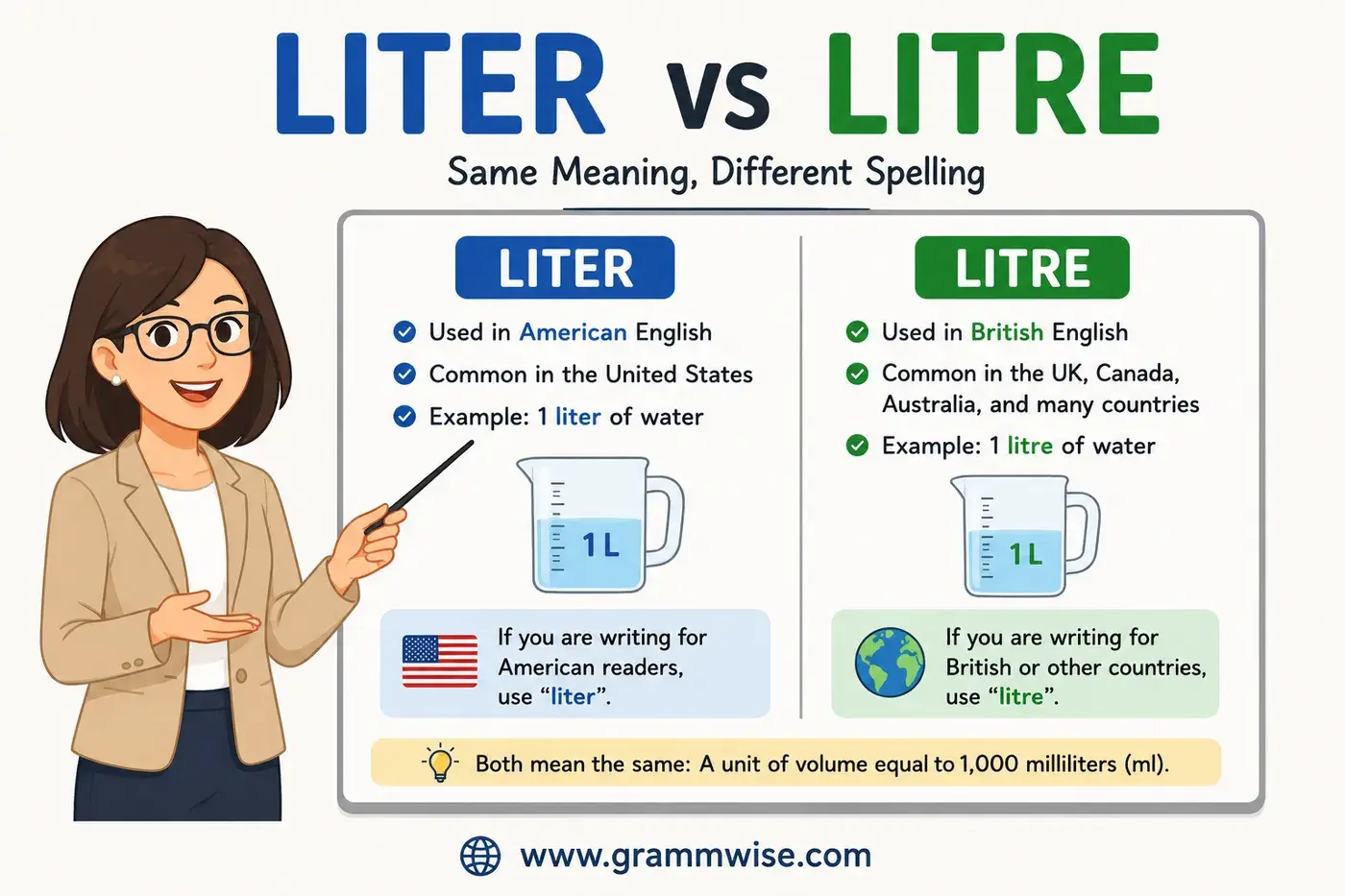
Many English learners wonder about liter vs litre because both spellings appear in books, product labels, websites, and everyday writing. This often leads to one simple question: which spelling is correct? The good news is that both are correct. The only real difference is the type of English you are using.
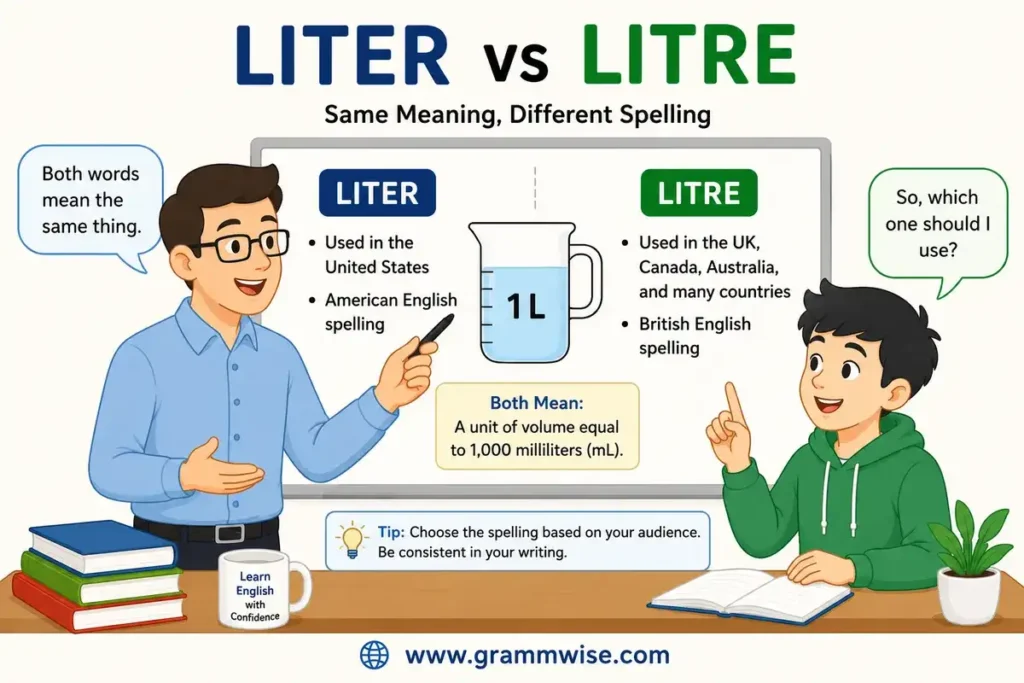
If you write in American English, the correct spelling is liter. If you write in British English, Canadian English, Australian English, or many other forms of English, the correct spelling is litre. They both mean exactly the same thing.
This guide explains liter or litre in very simple English. You will learn the meaning, the difference, when to use each spelling, and easy examples that help you remember the correct choice.
Similar confusion happens in other word pairs such as colour or color.
Simple Answer in One Look
Liter is the American English spelling.
Litre is the British English spelling.
Both words mean the same unit of volume.
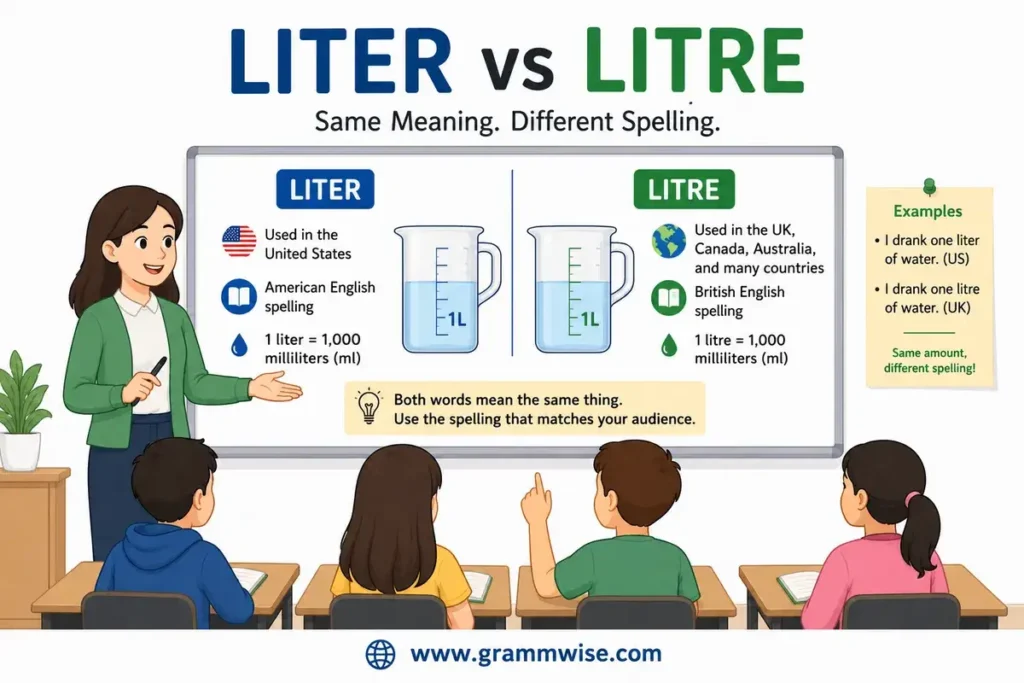
Meaning of “Liter vs Litre” in Simple English
To understand liter vs litre, first learn what the word means.
A liter or litre is a unit used to measure liquids and some gases.
People use it every day to measure things like:
- Water
- Milk
- Juice
- Cooking oil
- Soft drinks
- Fuel
One liter or litre is equal to 1,000 milliliters (mL).
The spelling changes depending on the country, but the amount never changes.
Imagine you buy a bottle of water. If the bottle says 1 liter, it holds the same amount as a bottle that says 1 litre. The spelling is different. The measurement is exactly the same.
This is like the words color and colour.
The spelling changes, but the meaning stays the same.
Liter vs Litre: Why People Mix These Words?
Many people get confused about liter vs litre because they see both spellings online.
There are several simple reasons.
First, different countries use different forms of English.
American English uses liter.
British English uses litre.
Second, many international companies sell products around the world.
One bottle may say liter in the United States but litre in the United Kingdom.
Third, students often read books from different countries. One science book may use liter. Another may use litre. Both books are correct.
Finally, the internet mixes American and British English together. That means you may see both spellings on the same day. This is normal.
Clear Difference of “Liter vs Litre” Explained Simply
The easiest way to understand the difference between liter and litre is to remember that the meaning never changes.
Only the spelling changes.
Liter
- American English spelling
- Used in the United States
- Common in American textbooks
- Used on American product labels
Example:
- I bought two liters of milk.
Litre
- British English spelling
- Used in the United Kingdom
- Used in Canada, Australia, New Zealand, and many other countries
- Common in British books and newspapers
Example:
- I bought two litres of milk.
Quick Comparison
Liter
- American spelling
- Same measurement
- Used in U.S. English
Litre
- British spelling
- Same measurement
- Used in British English
No matter which spelling you choose, the amount of liquid stays exactly the same.
Liter vs Litre: Which Form Should You Use?
The answer depends on who will read your writing.
Use liter if you are writing for:
- American readers
- U.S. schools
- American businesses
- American websites
Use litre if you are writing for:
- British readers
- Canadian readers
- Australian readers
- New Zealand readers
- International readers who follow British English
If you are writing for school or work, follow the style your teacher, company, or organization uses.
The most important rule is simple.
Be consistent.
Do not switch between liter and litre in the same article unless you are explaining the difference.
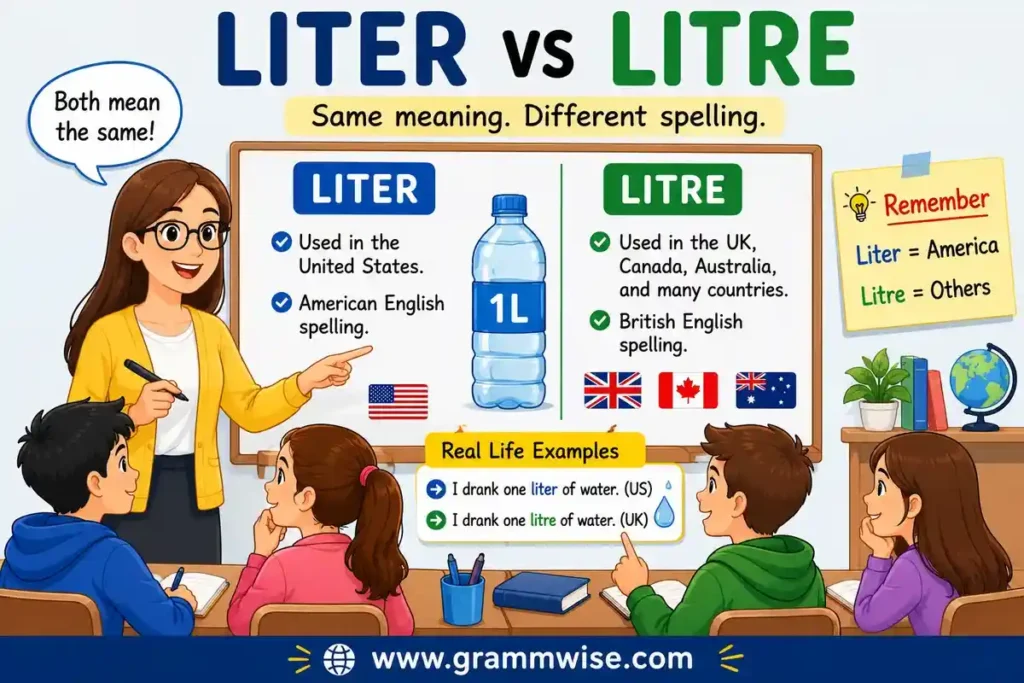
Easy Real-Life Sentences on “Liter vs Litre”
Here are some simple examples using liter.
- I drank one liter of water today.
- This bottle holds two liters.
- The recipe needs one liter of milk.
- My car used five liters of fuel.
- We bought three liters of juice.
Now look at examples using litre.
- I drank one litre of water today.
- The bottle holds two litres.
- Please buy one litre of milk.
- The car used five litres of fuel.
- We need three litres of paint.
Notice that only the spelling changes.
The meaning stays exactly the same.
Liter vs Litre: Where This Word Comes From?
The word liter vs litre comes from the French word litre. It became part of the metric system more than 200 years ago. The metric system was created to make measurements simple and consistent.
Later, American English changed the spelling to liter, while British English kept the original spelling litre.
This is the same reason we have other spelling differences like:
- Color and colour
- Center and centre
- Meter and metre
These words have the same meanings. Only the spelling changes depending on the country. That is why both liter and litre are correct.
The best choice depends on the type of English you are using.
How “Liter vs Litre” Is Understood in Culture and Stories?
The words liter and litre are used all over the world. Even though the spelling changes, the meaning stays exactly the same. This is why liter vs litre is not really about right or wrong. It is about where the English comes from.
In the United States, people grow up seeing liter on water bottles, milk cartons, science books, and grocery store shelves.
In the United Kingdom, Canada, Australia, New Zealand, and many other countries, people usually see litre instead.
If you read books from different countries, you may notice both spellings.
For example, an American story may say:
- She drank one liter of water after the race.
A British story may say:
- She drank one litre of water after the race.
Both sentences mean exactly the same thing.
Children learn the spelling that matches their country. Because of this, neither spelling feels strange to native speakers.
You may also notice both spellings in international sports, cooking shows, travel guides, and science programs. The audience often decides which spelling is used.
Understanding liter or litre also helps you become a better reader because you know that different spellings can still have the same meaning.
Biblical and Mythological Meaning of “Liter vs Litre”
The words liter and litre do not have special meanings in the Bible or in mythology.
The Bible was written long before the modern metric system was created. Instead of liters or litres, older Bible translations often mention cups, jars, pitchers, and other ancient units of measurement.
In mythology, there is also no special meaning connected with liter or litre.
Today, these words are simply modern ways to measure liquids and other substances.
Symbolism of “Liter vs Litre” Explained in Simple Words
Although liter and litre are measurement words, they can still represent useful ideas.
What “Liter” Represents?
The American spelling liter often represents:
- American English
- Science
- Measurement
- Everyday life
- Modern learning
Students in the United States learn this spelling from an early age.
It is common in classrooms, science labs, and stores.
What “Litre” Represents?
The British spelling litre often represents:
- British English
- International communication
- Global measurement
- Daily life in many countries
Many countries that follow British English use litre in schools, businesses, and official documents. The important thing to remember is that these spellings do not represent different measurements. They simply represent different styles of English.
Related Words You Should Know
Learning related words helps you understand liter vs litre even better.
Milliliter (Millilitre)
One thousand milliliters make one liter.
Example:
- This medicine contains 250 milliliters.
Metric System
A system used to measure length, weight, and volume.
Most countries use the metric system.
Volume
The amount of space that a liquid or object takes up.
A liter measures volume.
Capacity
The amount something can hold.
Example:
- This bottle has a capacity of two liters.
Gallon
A larger unit of liquid measurement.
It is mostly used in the United States and a few other countries.
Cup
A smaller unit often used in cooking.
Recipes may use cups instead of liters.
Pint
Another unit used for measuring liquids.
Some countries use pints for milk or drinks.
Meter and Metre
These words show the same spelling difference as liter and litre.
- Meter = American English
- Metre = British English
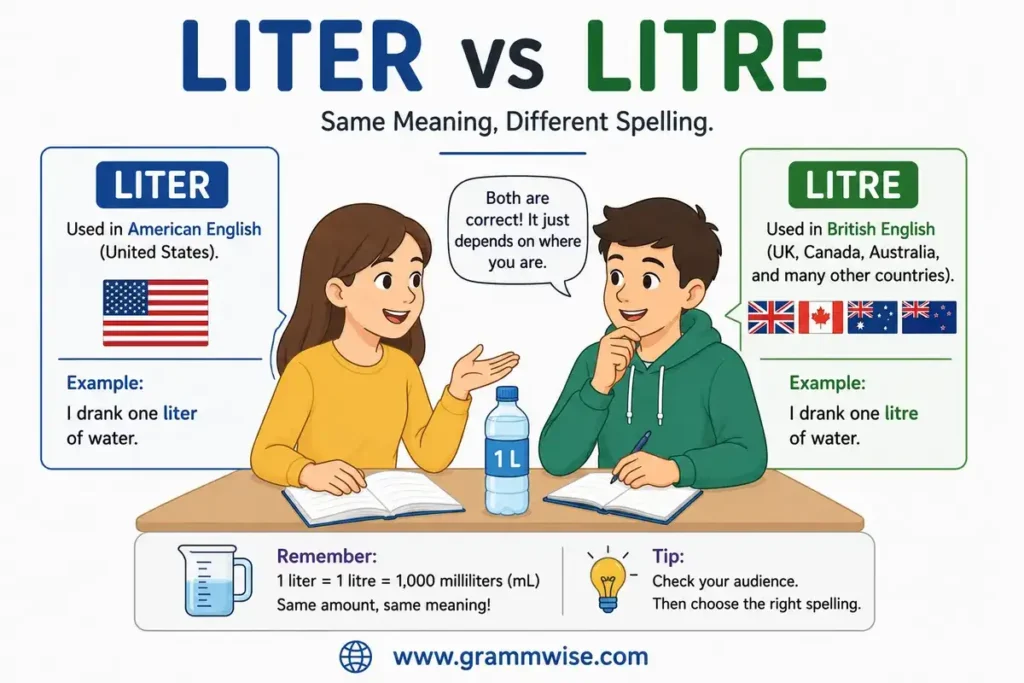
Use of “Liter vs Litre” in Daily English
People use liter and litre every day when talking about liquids.
Here are some natural examples.
- I drink two liters of water every day.
- This bottle holds one liter.
- Please buy a liter of milk.
- The recipe needs half a liter of cream.
- My car used five liters of fuel.
- We bought three liters of juice.
- This bucket can hold ten litres.
- Add one litre of water to the soup.
- The fuel tank holds sixty litres.
- I filled a two-litre bottle with lemonade.
Notice that American English uses liter, while British English uses litre.
The meaning never changes.
Common Mistakes People Make About “Liter vs Litre”
Many learners make simple mistakes when learning liter vs litre.
Here are the most common ones.
Mistake 1: Thinking one spelling is wrong
Some students believe only one spelling is correct.
That is not true.
Both spellings are correct.
Mistake 2: Mixing spellings in one article
If you begin writing with liter, do not suddenly change to litre unless you are comparing the two spellings.
Choose one style and use it throughout your writing.
Mistake 3: Using the wrong spelling for your audience
If you are writing for American readers, use liter.
If you are writing for British readers, use litre.
Mistake 4: Thinking the measurements are different
One liter is exactly the same size as one litre.
Only the spelling changes.
Mistake 5: Forgetting the country difference
Many spelling differences in English depend on the country.
The same happens with:
- Color and colour
- Center and centre
- Meter and metre
Learning this pattern makes English much easier.
Final Teacher Explanation
Imagine you are sitting in my classroom.
You ask,
“Teacher, should I write liter or litre?”
My answer would be simple.
Both are correct.
Now ask another question.
“Who will read my writing?”
If your readers use American English, choose liter.
If they use British English, choose litre.
That is the only difference. You do not need to memorize difficult grammar rules. Just remember that the spelling changes with the type of English. The measurement never changes. One liter equals one litre.
The bottle holds the same amount of water. The recipe uses the same amount of milk. The science experiment measures the same volume. Only the spelling is different.
This is why English learners should not worry when they see both spellings. Instead, think about your audience and stay consistent from beginning to end.
Final Answer “Liter vs Litre”
The answer to liter or litre is easy. Both spellings are correct and both mean the same unit of volume. Use liter for American English and litre for British English and many other countries. Choose one style and use it consistently.
Conclusion
Understanding liter vs litre is simple once you know that both spellings mean the same unit of volume. The only difference is the type of English you are using. Choose liter for American English and litre for British English and many other English-speaking countries.
The best way to avoid mistakes is to think about your audience and use one spelling consistently throughout your writing. With this easy rule, you can write with confidence and use the correct spelling every time.
Frequently Asked Questions (FAQs)
Is liter vs litre correct?
Both are correct. The spelling depends on whether you are using American or British English.
What is the difference between liter and litre?
There is no difference in meaning. Only the spelling changes.
Which spelling does the United States use?
The United States uses liter.
Which countries use litre?
The United Kingdom, Canada, Australia, New Zealand, and many other countries use litre.
Is one liter the same as one litre?
Yes. They both equal 1,000 milliliters.
Should I use both spellings in the same article?
No. Pick one spelling style and use it throughout your writing unless you are explaining the difference.
Why do people get confused about liter vs litre?
They see both spellings on products, websites, books, and labels from different countries.
How can I remember the difference between liter and litre?
Think of this simple rule: Liter = American English. Litre = British English. The measurement is always the same.