
Many English learners get confused about allusion vs illusion because these two words look and sound very similar. Only one letter makes them different, but their meanings are completely different. One word is about mentioning something, while the other is about something that is not real or tricks your mind.
If you have ever searched for allusion vs illusion, you are not alone. Students, writers, and even native English speakers sometimes mix these words up. The good news is that once you understand what each word means, choosing the correct one becomes much easier.
In this guide, you will learn the difference between allusion vs illusion, when to use each word, simple memory tricks, and everyday examples. By the end, you will know exactly which word fits your sentence.
Confused by similar words? Our grammar guides explain them clearly.
Simple Answer in One Look
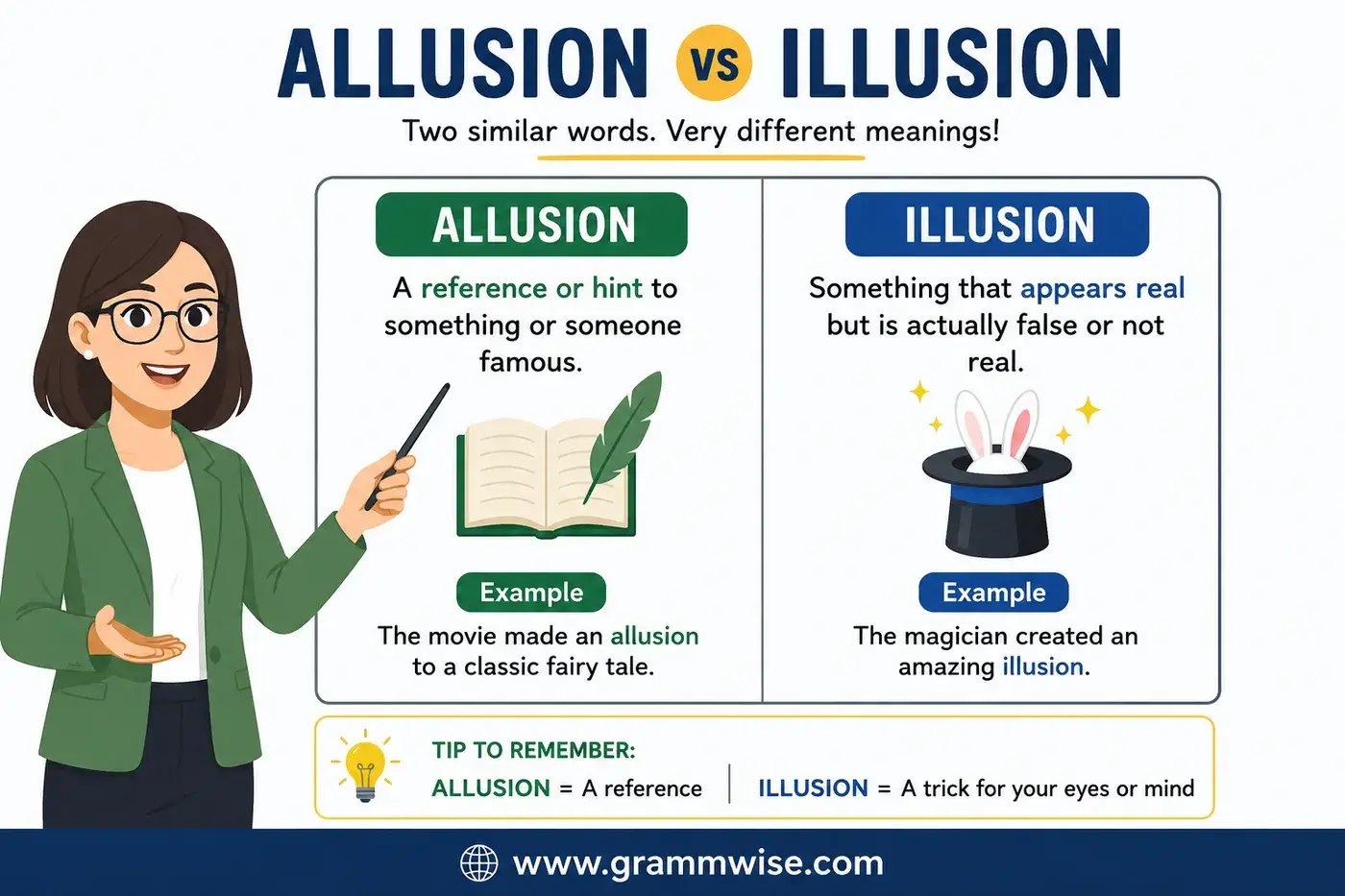
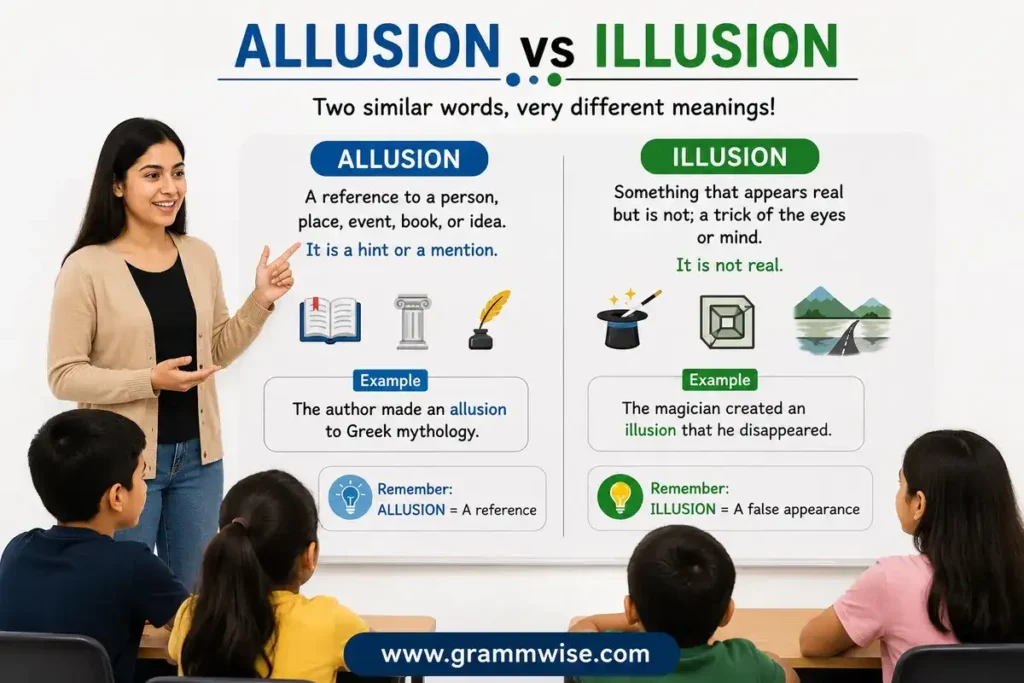
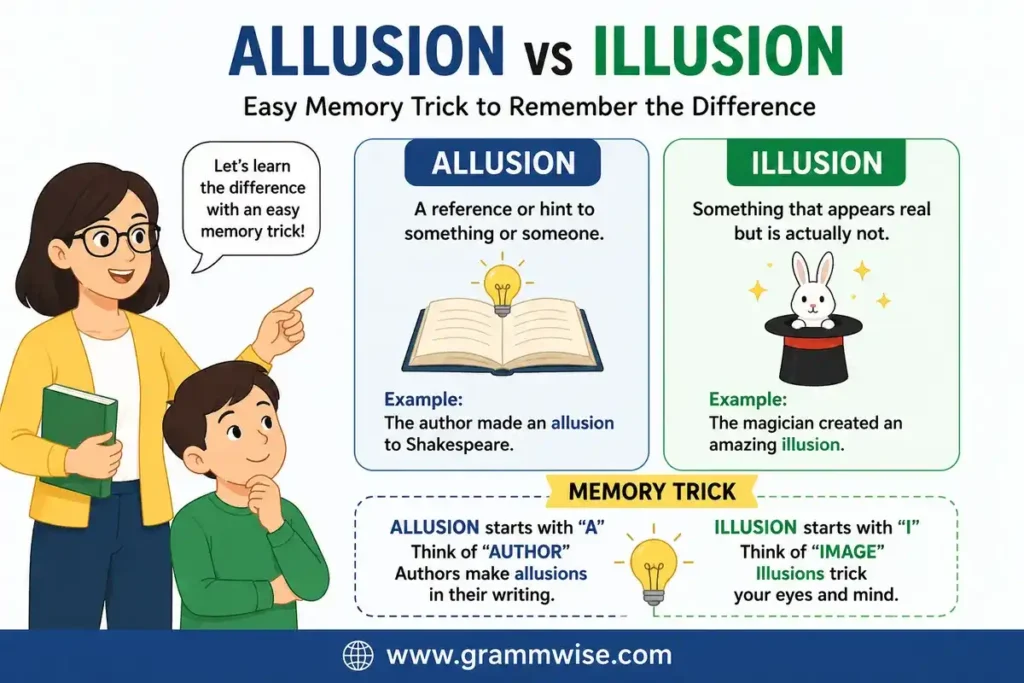
Allusion means an indirect mention or reference to a person, place, book, event, or idea.
Illusion means something that seems real but is actually false or tricks your eyes or mind.
Meaning of “Allusion vs Illusion” in Simple English
Although allusion and illusion look alike, they have very different meanings.
The word allusion is used when someone briefly mentions something without explaining it fully. Think of it as giving a small hint.
For example, a writer may mention a famous story without telling the whole story.
Here is a simple example:
- His speech included an allusion to Cinderella.
This means the speaker mentioned Cinderella, but did not tell the entire fairy tale.
Another example:
- The movie made an allusion to an old superhero.
Again, it is only a short reference.
Now look at illusion.
An illusion is something that looks real but is not. It can trick your eyes or your mind.
For example:
- The magician created the illusion that he disappeared.
The magician did not really disappear.
It only looked that way.
Another example:
- The road looked wet, but it was an illusion caused by the heat.
Your eyes see something that is not really there.
So remember this simple idea.
Allusion = a reference or hint.
Illusion = something that tricks you.
That one idea will help you remember the difference.
Allusion vs Illusion: Why People Mix These Words?
Many learners confuse allusion and illusion because the words are almost the same length.
They also sound similar when people speak quickly.
Another reason is that both words are often seen in books, school lessons, and articles.
People sometimes remember the spelling but forget the meaning.
For example:
❌ The magician performed an allusion.
✅ The magician performed an illusion.
A magic trick creates an illusion because it tricks your eyes.
Now look at another example.
❌ The writer made an illusion to the Bible.
✅ The writer made an allusion to the Bible.
Here, the writer is mentioning another work.
That is an allusion.
The easiest way to avoid mistakes is to think about the meaning first.
Ask yourself:
“Am I talking about a reference?”
Or,
“Am I talking about something that is not real?”
The answer tells you which word to choose.
Clear Difference of “Allusion vs Illusion” Explained Simply
The difference between allusion vs illusion becomes easy when you compare them side by side.
Use Allusion
Use allusion when you are talking about a short reference or hint.
It usually points to:
- A famous person
- A book
- A movie
- A historical event
- A myth
- A Bible story
- A popular saying
Example sentences:
- The author made an allusion to Romeo and Juliet.
- Her speech contained an allusion to history.
- The cartoon included an allusion to a famous movie.
In every example, someone is mentioning something without giving all the details.
Use Illusion
Use illusion when something only appears to be real.
Examples include:
- Magic tricks
- Optical illusions
- Mirrors
- Visual effects
- False appearances
Example sentences:
- The magician created an amazing illusion.
- The mirror gave the illusion of a larger room.
- The painting creates an illusion of movement.
In every example, your eyes or your mind are being tricked.
Easy Comparison Table “Allusion vs Illusion”
| Allusion | Illusion |
|---|---|
| A reference or hint | A false appearance |
| Mentions something famous | Tricks your eyes or mind |
| Used in writing and speech | Used in magic and visual effects |
| Connected with books and stories | Connected with seeing something unreal |
| Real reference | Not actually real |
Looking at these examples together makes the difference much easier to understand.
Allusion vs Illusion: Which Form Should You Use?
Choosing between allusion and illusion becomes simple when you ask one question.
Am I talking about mentioning something, or about something that is not real?
If you are mentioning a famous person, book, event, or story, use allusion.
Examples:
- The teacher made an allusion to Greek mythology.
- The song includes an allusion to childhood memories.
- The writer made an allusion to a famous novel.
If something only looks real or tricks your mind, use illusion.
Examples:
- The magician created an illusion.
- The mirror gives the illusion of more space.
- The heat creates the illusion of water on the road.
Here is a simple memory trick.
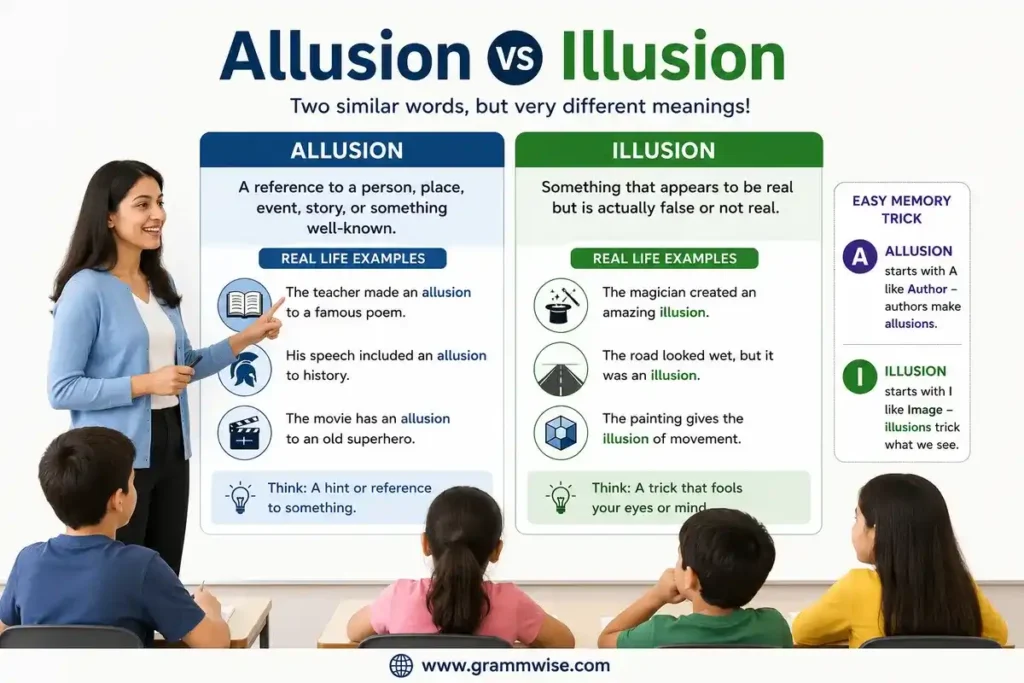
Allusion begins with “A” for “Author” because writers make allusions.
Illusion begins with “I” for “Image” because illusions trick what you see.
This easy trick helps many students remember the correct word.
Easy Real-Life Sentences on “Allusion vs Illusion”
The best way to remember allusion vs illusion is to see both words in everyday sentences. Read each example slowly and notice how the meaning changes.
Examples Using Allusion
- The teacher made an allusion to a famous fairy tale.
- The writer included an allusion to Greek mythology.
- His speech contained an allusion to history.
- The movie makes an allusion to an old superhero.
- The song has an allusion to childhood memories.
- She smiled after making an allusion to her favorite book.
- The cartoon included an allusion to a classic film.
- The article makes an allusion to an important event.
In every sentence, allusion means a short reference or hint.
Examples Using Illusion
- The magician created an amazing illusion.
- The mirror gives the illusion of a bigger room.
- The artist painted an illusion that looks real.
- The heat creates the illusion of water on the road.
- The special effects create an illusion of flying.
- The lights gave the illusion that the room was moving.
- The painting creates an illusion of depth.
- The audience loved every illusion in the magic show.
In every sentence, illusion means something that tricks your eyes or your mind.
Here is another easy comparison.
Allusion
- The writer mentioned Cinderella.
- The speaker referred to a famous president.
- The teacher talked about a Bible story without explaining it fully.
Illusion
- A rabbit seems to disappear.
- A mirror makes a room look larger.
- A drawing looks like it is moving.
The meanings are very different, even though the words look similar.
Allusion vs Illusion: Where This Word Comes From?
Knowing where these words come from can also help you remember them.
The word allusion comes from a Latin word that means to refer to or to hint at something. Over time, English speakers used allusion to mean a short mention of a famous person, place, book, or event without explaining everything.
The word illusion also comes from Latin, but it means to deceive or to trick. That is why an illusion makes people believe they are seeing something real when they are not.
Even though these words have similar spellings, they have different histories and different meanings.
Here is an easy way to remember them.
- Allusion = a reference.
- Illusion = a trick.
That simple rule will help you choose the correct word in most situations.
How “Allusion vs Illusion” Is Understood in Culture and Stories
The words allusion and illusion are often found in books, movies, songs, and everyday conversations. Even though they sound similar, they are used in very different ways.
An allusion is common in stories because writers like to give small hints instead of explaining everything. They may mention a famous hero, a fairy tale, or an important event. Readers who know the reference understand the deeper meaning.
For example, a writer may describe a brave child as “another Harry Potter.” This is an allusion because the writer is making a quick reference to a famous character. The story does not stop to explain who Harry Potter is.
Another example is saying someone has “the strength of Hercules.” This is an allusion to a famous character from Greek mythology. It tells readers that the person is very strong.
Movies also use allusions. A superhero movie may include a short reference to another famous movie. A cartoon may mention a popular song. These small references make stories more interesting.
An illusion is different. It is often used in stories about magic, mystery, dreams, or adventure.
For example:
- A magician creates the illusion that a bird disappears.
- A castle may look close, but it is only an illusion.
- A character may believe something is real when it is actually an illusion.
Artists also use illusions. Some paintings look like they are moving. Some drawings appear to have three dimensions even though they are flat. These are called optical illusions because they trick your eyes.
Many children’s books include simple illusions to make readers curious and excited.
So, while allusion helps readers think about another story or idea, illusion makes people question what they are seeing.
Biblical and Mythological Meaning of “Allusion vs Illusion”
The word allusion is often connected with the Bible because many writers make allusions to Bible stories. For example, a writer may mention Noah’s Ark without telling the whole story.
A speaker may say someone has “the patience of Job.” These are biblical allusions.
They help readers understand an idea quickly if they already know the Bible story.
There are also many allusions to Greek mythology.
A writer may mention:
- Hercules
- Achilles
- Medusa
- Pandora
These names help describe a person or situation without giving a long explanation.
The word illusion is not connected to one special Bible meaning. However, the Bible sometimes warns people not to trust false appearances. Something may look true but actually be false. This idea is similar to an illusion because appearances can sometimes fool us.
In mythology, illusions are often created by magic.
- A wizard may create an illusion to hide something.
- A magical creature may appear different from its true form.
These stories remind readers that things are not always what they seem.
Symbolism of “Allusion vs Illusion” Explained in Simple Words
What Allusion Represents?
The word allusion often represents:
- Knowledge
- Learning
- Shared ideas
- History
- Literature
- Culture
- Memory
When a writer uses an allusion, the writer trusts that readers will recognize the reference.
For example, saying someone is “a real Einstein” is an allusion. It quickly tells readers the person is very smart. The writer does not need to explain who Einstein was.
Allusions help writing become richer without using many words. They also connect one story to another. That is why authors enjoy using them.
What Illusion Represents?
The word illusion often represents:
- Imagination
- Mystery
- Magic
- False appearances
- Dreams
- Surprise
- Creativity
An illusion reminds us that our eyes do not always tell the whole truth.
For example, a magician may make a coin disappear. The audience knows it is an illusion, but it still feels exciting.
Artists also use illusions to create beautiful pictures. A drawing may look deep even though it is flat.
Movies use computer effects to create amazing illusions. These effects help people enjoy exciting adventures that would not be possible in real life.
So, while allusion connects ideas, illusion changes what people think they see.
Related Words You Should Know
Learning a few related words will make allusion vs illusion even easier to understand.
Reference
A mention of another person, book, place, or event.
An allusion is a type of reference.
Hint
A small clue that helps someone understand something.
Many allusions work like hints.
Mention
To talk about something briefly.
An allusion is often a short mention.
Symbol
Something that stands for another idea.
Stories often use symbols along with allusions.
Appearance
The way something looks.
Illusions often change appearances.
Optical Illusion
A picture or object that tricks your eyes into seeing something different.
Magic
Special tricks that create the feeling that impossible things are happening.
Many magic shows use illusions.
Mirage
Something that looks like water or another object but is not really there.
A mirage is a natural illusion caused by heat and light.
Use of “Allusion vs Illusion” in Daily English
Even though allusion and illusion are different words, people use both in everyday English. The key is knowing the situation.
Here are some real-life examples using allusion.
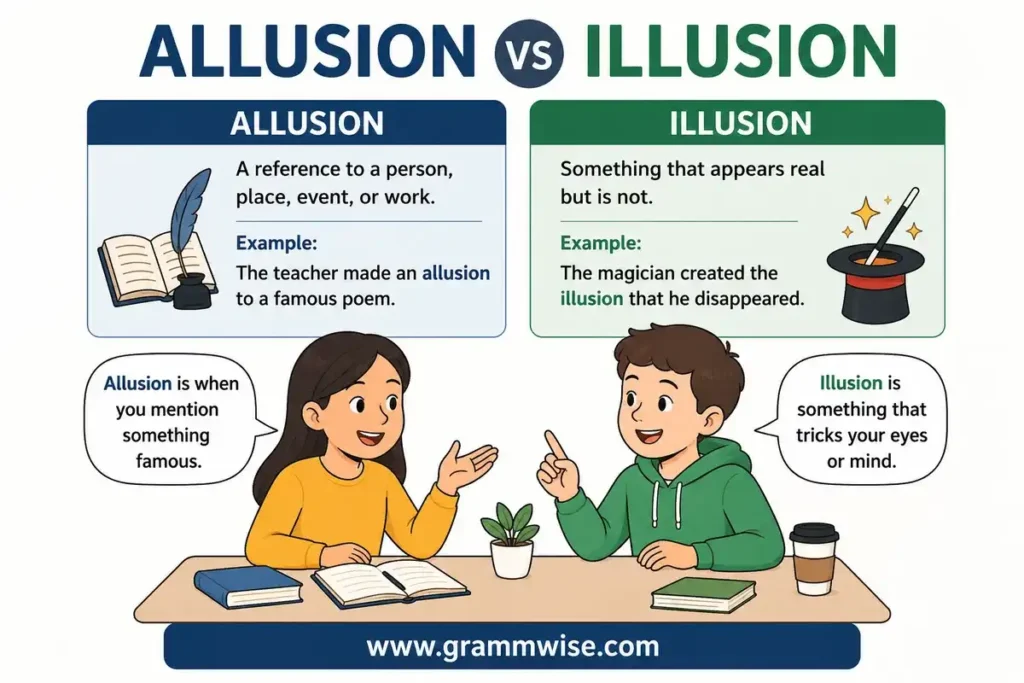
- The teacher made an allusion to a famous poem.
- His speech included an allusion to history.
- The writer made an allusion to Greek mythology.
- The movie has an allusion to an old superhero.
- My friend made an allusion to a popular TV show.
- The article contains an allusion to the Bible.
- The song includes an allusion to childhood memories.
- She smiled after making an allusion to a famous fairy tale.
In each sentence, allusion means a short reference or hint.
Now look at examples using illusion.
- The magician performed an amazing illusion.
- The mirror creates the illusion of a larger room.
- The painting gives the illusion of movement.
- The road looked wet, but it was an illusion.
- The special effects create an illusion of flying.
- The stage lights created an illusion of floating.
- The artist used shadows to create an illusion.
- The audience enjoyed every illusion in the magic show.
In these examples, illusion means something that tricks your eyes or your mind.
The more you read and hear these words in real situations, the easier they become to remember.
Common Mistakes People Make About “Allusion vs Illusion”
Many learners mix up allusion vs illusion because the words look and sound alike.
Here are the mistakes people make most often.
Mistake 1: Using allusion for a magic trick
❌ The magician performed an allusion.
✅ The magician performed an illusion.
A magic trick is an illusion because it creates a false appearance.
Mistake 2: Using illusion for a reference
❌ The author made an illusion to Cinderella.
✅ The author made an allusion to Cinderella.
When a writer mentions another story, it is an allusion.
Mistake 3: Choosing the word because of its spelling
Some people only remember that the words look similar.
Instead, remember their meanings.
Allusion means a reference.
Illusion means something that is not really there.
Mistake 4: Forgetting the context
Before choosing a word, ask yourself:
“Am I talking about mentioning something?”
If yes, use allusion.
Or ask:
“Am I talking about something that tricks people?”
If yes, use illusion.
Mistake 5: Thinking both words mean the same thing
Although they have similar spellings, they are never interchangeable.
Each word has its own meaning and should be used in the correct situation.
Final Teacher Explanation
Imagine we are in class together.
I write two words on the board.
Allusion
Illusion
Now I ask you one simple question.
“Are you talking about a reference?”
If the answer is yes, choose allusion.
Now I ask another question.
“Are you talking about something that tricks your eyes or mind?”
If the answer is yes, choose illusion.
That is the easiest way to remember the difference. You do not need difficult grammar rules. Just remember these two simple ideas.
Allusion = a reference.
Illusion = a trick.
Here is another memory trick.
Think of the first letter.
A in allusion can remind you of Author because authors often make allusions.
I in illusion can remind you of Image because illusions change what you see.
Practice these words in your own sentences. The more you use them, the easier they become. Soon, choosing the correct word will feel natural.
Final Thought “Allusion vs Illusion”
If you are choosing between allusion vs illusion, remember this easy rule.
Use allusion when you are making a short reference to a famous person, story, place, or event. Use illusion when something looks real but is actually false or tricks your eyes or mind. Keeping this simple difference in mind will help you use both words correctly every time.
Conclusion
Understanding allusion vs illusion is easy once you know what each word means. Use allusion when you are making a short reference to a famous person, story, or event. Use illusion when something appears real but actually tricks your eyes or mind. Remembering this simple rule will help you choose the correct word with confidence.
The best way to master these words is to practice them in everyday reading and writing. Focus on the meaning instead of the spelling, and you will use both words naturally and accurately in your English.
Frequently Asked Questions (FAQs)
What is the difference between allusion and illusion?
Allusion is a short reference to something well known. Illusion is something that appears real but is not.
Which is correct: allusion vs illusion?
Both words are correct. The right choice depends on the meaning of your sentence.
When should I use allusion?
Use allusion when mentioning a famous person, book, movie, event, or story without explaining it fully.
When should I use illusion?
Use illusion when talking about something that tricks your eyes or your mind.
Why do people confuse allusion vs illusion?
The words have similar spellings and pronunciations, but their meanings are completely different.
Can allusion and illusion be used in the same sentence?
Yes. For example: The author’s allusion to the magician made readers think about the amazing illusion in the story.
How can I remember the difference between allusion vs illusion?
Remember this simple trick: Allusion = Author’s reference. Illusion = Image that tricks you.
Do native English speakers confuse allusion and illusion?
Yes. Because the words look and sound similar, even native speakers sometimes mix them up. Thinking about the meaning first will help you choose the correct word.