
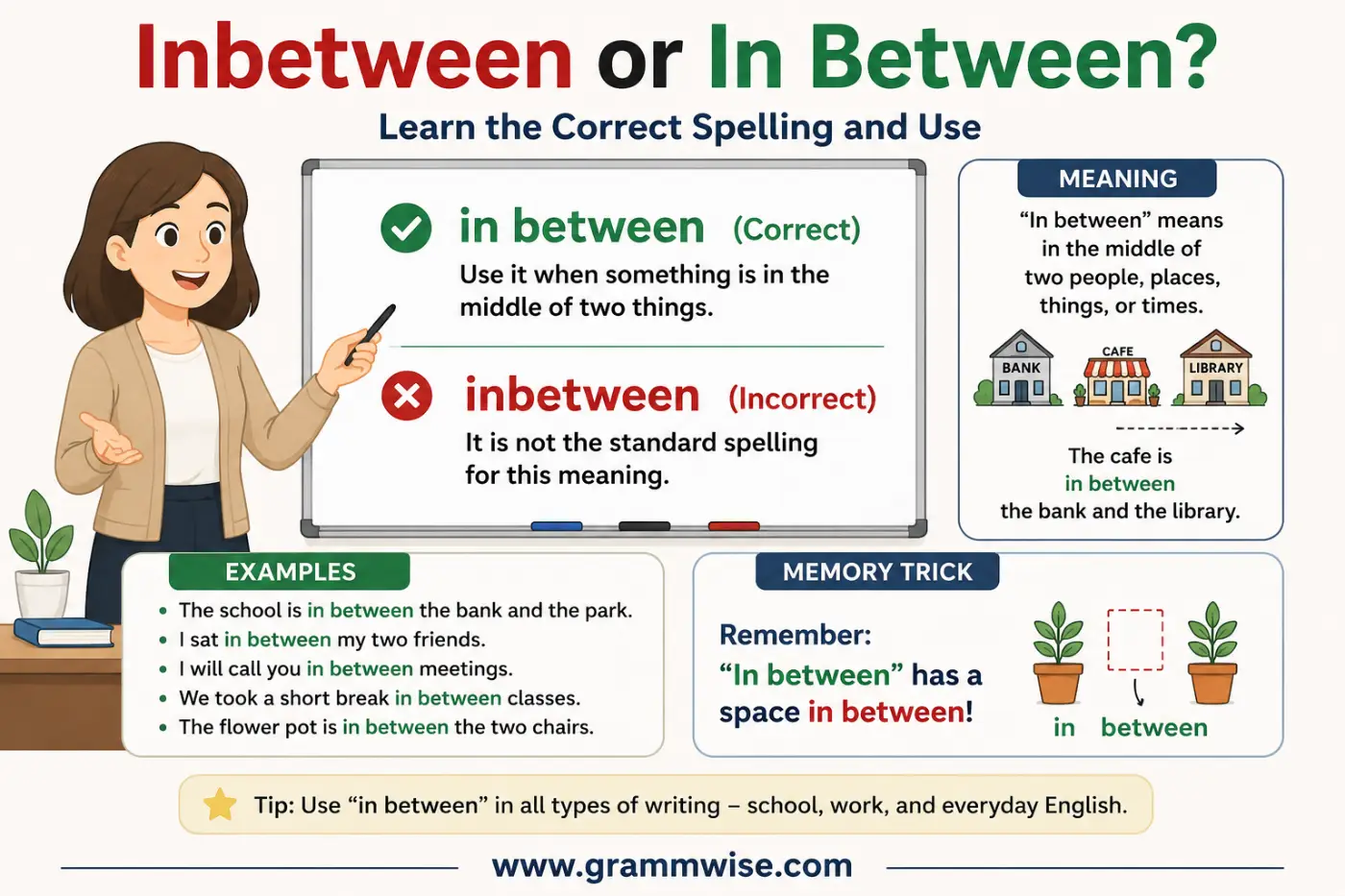
Many English learners wonder whether inbetween or in between is the correct form. The simple answer is clear: in between is the standard and correct spelling when you mean “in the space separating two things” or “between two points, people, places, or times.” The two words should normally be written separately.
For example, you can say, “The school is in between the bank and the library.” You can also say, “I will call you in between meetings.” In both sentences, in between is written as two words.
The form inbetween is generally considered incorrect in standard English when it is used to mean “in between.” You may sometimes see it online or in informal writing, but that does not make it the standard spelling. If you are writing an essay, school assignment, website article, email, or professional document, choose in between.
If spelling mistakes confuse you, our guide on common spelling errors in English can help like verbage or verbiage.
Simple Answer in One Look
In between is the correct standard form.
✅ in between
❌ inbetween
Use in between when something is located, happens, or exists between two things.
Example: The café is in between the bookstore and the bank.

What Does In Between Mean in Simple English?
Think about two objects sitting on a table.
There is a red book on the left. And there is a blue book on the right. A small pencil is sitting between them.
You could say:
“The pencil is in between the two books.”
The phrase tells us where the pencil is.
It is neither on the left nor on the right. It is in the middle area separating the two books.
That is the basic idea behind in between. The phrase can describe a place, a position, a time, or even a situation.
In Between Two Places
You can use in between when talking about locations.
For example:
- The pharmacy is in between the bank and the grocery store.
- Our house is in between two large buildings.
- The restaurant is in between the hotel and the theater.
- She sat in between her two friends.
In each sentence, something is located between two other things.
In Between Two Times
You can also use in between when talking about time.
For example:
- I read a book in between classes.
- He called me in between meetings.
- We had lunch in between the two events.
- She took a short break in between lessons.
Here, the phrase means something happens during the time separating two events.
In Between Two Choices
The phrase can also describe a position between two choices or ideas.
For example:
- I am in between two jobs right now.
- She feels in between childhood and adulthood.
- He could not decide because he was in between two choices.
The idea is still the same.
Something is not completely on one side or the other.
It is somewhere in the middle.
Why Do People Mix Up Inbetween or In Between?
The confusion is easy to understand.
English has many words that were once separate but later became one word.
For example:
- into
- inside
- without
- another
- everyone
Because of this, learners sometimes assume that in between should also be written as one word. But English does not work that way for every phrase. Some word combinations stay separate. In between is one of them in standard English.
People Say It as One Smooth Sound
When we speak naturally, we often connect words. “In between” can sound almost like one word when spoken quickly. That can make learners think the written form should also be one word.
But pronunciation does not always tell us how words should be written.
For example, we say:
- a lot of
as several words, even though the words can sound connected in fast speech.
The same idea applies to in between.
People See “Inbetween” Online
You may occasionally find inbetween on websites, social media, signs, or informal posts. That can make the spelling look acceptable. But online writing is not always carefully edited.
People make spelling mistakes. They also create informal forms.
If you are unsure, use the standard form:
in between
“Between” Already Has a Clear Meaning
The word between means that something is in the middle of two people, things, places, or points.
For example:
- The ball is between the chairs.
- The school is between two buildings.
Adding in gives us the phrase in between, which can often make the position or middle area feel more specific.
For example:
- She stood in between her parents.
- I sat in between two students.
The phrase is very common in everyday English.
Clear Difference Explained Simply
There is no real meaning difference between inbetween and in between because inbetween is not the standard spelling of this phrase.
The correct form is:
in between
Think of it as two separate pieces:
in + between = in between
You should normally keep the words separate.
Correct Examples
- The ball is in between the chairs.
- I sat in between my brothers.
- The store is in between the bank and the café.
- We met in between lunch and dinner.
- She stood in between two trees.
- He took a break in between classes.
Incorrect Examples
- The ball is inbetween the chairs.
- I sat inbetween my brothers.
- The store is inbetween the bank and the café.
- We met inbetween lunch and dinner.
For standard English, change inbetween to in between.

Inbetween or In Between: Which Form Should You Use?
If you are asking, “Which is correct, inbetween or in between?” the answer is in between.
Use the two-word form in your normal writing.
This is especially important when you are writing:
- School assignments
- Essays
- Articles
- Business emails
- Reports
- Professional documents
- Formal messages
- Website content
Use In Between for Location
When something is in the middle of two places or objects, use in between.
Example:
“The lamp is in between the two chairs.”
Use In Between for People
When someone is sitting, standing, or positioned between two people, use in between.
Example:
“Tom sat in between his parents.”
Use In Between for Time
When something happens between two events, use in between.
Example:
“I checked my phone in between classes.”
Use In Between for Situations
You can also use the phrase when someone or something is in a middle position.
Example:
“She is in between two important decisions.”
The phrase works naturally in all these situations.
In Between vs Between
A useful question is whether you should say between or in between.
Both can be correct, but they can sound slightly different.
Look at these examples:
- The park is between the school and the library.
- The park is in between the school and the library.
Both sentences tell us that the park is located in the middle of the two places.
The first sentence is shorter.
The second sentence sounds a little more conversational in some situations.
Another example:
- She sat between John and Mary.
- She sat in between John and Mary.
Both can be heard in everyday English.
However, when you specifically want to use the phrase containing in, remember that it is written as two words:
in between
Easy Real-Life Sentences on Inbetween or In Between
Here are some simple sentences you can use in everyday English.
- The school is in between the park and the library.
- I sat in between my two friends.
- We stopped in between the two cities.
- She called me in between classes.
- The small shop is in between two restaurants.
- He stood in between his parents for the photo.
- I usually drink coffee in between meals.
- There is a small road in between the two houses.
These examples show how useful the phrase is.
You can use in between when talking about places, people, objects, times, and situations.
How to Remember the Correct Spelling?
Here is a simple classroom trick.
Imagine your teacher writes this on the board:
IN + BETWEEN
Then the teacher draws a small space between the two words. That space is your memory trick.
In between = two words with space between them.
You can also remember this sentence:
“There is space in between the words.”
That sentence itself shows you the correct spelling.
Do not squeeze the words together.
Write:
✅ in between
Not:
❌ inbetween
Another easy trick is to focus on the word between. You already know between is one word. When you add in, simply place it before between:
in + between
That gives you:
in between
Common Expressions With In Between
You will often see in between in common phrases.
In Between Classes
This means during the time separating two classes.
Example:
“I usually eat a snack in between classes.”
In Between Meals
This means during the time separating meals.
Example:
“Try not to eat too many sweets in between meals.”
In Between Jobs
This means someone has left one job and has not started another yet.
Example:
“She is in between jobs right now.”
In Between Two Places
This describes something located between two locations.
Example:
“The hotel is in between the airport and downtown.”
In Between Two People
This describes a position between two people.
Example:
“The child stood in between his parents.”
These expressions are common and useful.
Is In Between One Word or Two Words?
This is one of the most common questions about the phrase.
The answer is simple:
In between is normally written as two words.
The word in stays separate from between.
So write:
✅ in between
Not:
❌ inbetween
You may see the one-word form in some informal or nonstandard writing, but it is not the spelling you should choose in standard English.
If you are writing for school, work, or a public website, in between is the safe and correct choice.
In Between as a Phrase
It can help to think of in between as a small phrase rather than as one word.
For example:
- in front of
- in back of
- in the middle of
- in between
English has many expressions made from several words.
We do not join all of them together.
You would not normally write:
❌ infrontof
You write:
✅ in front of
The same idea applies to in between.
Keeping the words separate makes your writing clear and standard.
Where Does In Between Come From?
The word between has a very old history in English. It comes from an older English expression that described a position involving two sides or points. Over many years, the form became between. The word in is also very old and is used to describe a position inside or within something.
When the two words are used together, in between gives the idea of being in the middle or separating two things. English has kept these words separate in standard writing.
That is why we write in between, not inbetween.
You do not need to remember the history to use the phrase correctly. The simple spelling rule is much more useful:
Write “in between” as two words.
A Final Memory Trick Before We Go Deeper
Picture two chairs.
One chair is on the left.
One chair is on the right.
There is a student sitting in between them.
Now look at the words:
in between
There is a space between the two words, just as there is space between the two chairs.
So remember:
In between has a space in between.
That is an easy trick you can use whenever you are unsure.
The main question is no longer difficult. If you are choosing between inbetween or in between, choose in between for standard English. It is the normal two-word form used when you mean “in the middle of” or “between two things.”
How In Between Is Understood in Culture and Stories?
The phrase in between is more than a way to describe where something is located. In stories, conversations, and everyday life, it can also describe a person who feels caught between two places, choices, ages, or situations.
Think about a child who is growing up. The child may not feel like a little kid anymore, but may not feel like an adult either. We can describe this as being in between childhood and adulthood.
For example:
“She feels like she is in between childhood and adulthood.”
Here, in between does not describe a physical place. It describes a stage of life.
Writers often use the phrase this way because it is easy for readers to understand. Being in between means that something is not fully on one side or the other.
You may see this idea in stories about:
- Growing up
- Moving to a new place
- Changing schools
- Starting a new job
- Making an important choice
- Leaving the past behind
- Waiting for something new to begin
For example, a character in a story might say, “I feel stuck in between two worlds.”
This does not mean the character is literally standing between two worlds. It means the person feels connected to two different ways of life.
The phrase can also describe cultural experiences.
Someone who moves from one country to another may feel in between two cultures. They may enjoy parts of both cultures and feel connected to both.
That gives the phrase an emotional meaning.
It can suggest uncertainty, change, or even opportunity.
Being in between is not always a bad thing. Sometimes it means you are growing and preparing for something new.
Biblical and Mythological Meaning
In between does not have a special biblical or mythological meaning by itself. The phrase is a normal English expression. It is used to describe a position, time, or situation between two things. However, the idea of being between two places or choices appears in many old stories.
For example, stories often describe heroes who must choose between two paths. A character may stand between safety and danger, loyalty and freedom, or the past and the future.
Modern English writers may describe such a character as being in between two choices.
For example:
“The hero was caught in between two sides.”
The phrase itself is not a religious symbol. The meaning comes from the story.
The same idea appears in mythology. A character may be placed between two groups or two worlds. This can represent a difficult choice or a change in life.
So, if you see in between in a religious, historical, or mythological story, understand it first in its normal English sense. Do not assume that the phrase has a special hidden meaning.
Symbolism Explained in Simple Words
The phrase in between can have a simple symbolic meaning when writers use it to describe feelings or life situations.
What In Between Represents
There is not a second spelling that has a different symbolic meaning.
In between is the standard form.
When writers use it symbolically, it can represent a middle stage.
For example:
- Between childhood and adulthood
- Between the past and the future
- Between two choices
- Between two cultures
- Between success and failure
- Between leaving and staying
This can represent change.
A person who is in between may not know exactly what will happen next.
For example:
“I am in between two important decisions.”
The person is not saying that they are physically in the middle of two objects. They are talking about a difficult situation.
What Inbetween Represents
Inbetween does not represent a different meaning. It is generally not the standard spelling when you mean the phrase in between.
So you should not use the two spellings to show different meanings.
For example:
❌ She is inbetween two choices.
✅ She is in between two choices.
The correct form remains two words even when the phrase has an emotional or symbolic meaning.
Related Words You Should Know
Learning related words can help you understand and use in between more naturally.
Between
Between means in the space separating two people or things.
Example: The school is between the bank and the library.
Middle
Middle means the central part of something.
Example: She sat in the middle of the room.
Among
Among is usually used when something is surrounded by several people or things.
Example: He was standing among his friends.
In the Middle
This phrase has a meaning close to in between.
Example: The store is in the middle of the two buildings.
In the Center
This means in the central part of something.
Example: The table is in the center of the room.
Between Two
This is useful when you are comparing or describing two things.
Example: I cannot choose between two options.
In Between Jobs
This means someone has left one job and has not started another yet.
Example: He is in between jobs.
In Between Classes
This means during the time separating two classes.
Example: I usually talk to my friends in between classes.
In Between Meals
This means during the time separating meals.
Example: Try not to eat too many snacks in between meals.

How People Actually Use In Between in Daily English?
You will hear in between often in normal conversations.
1. Talking About Places
“The bank is in between the school and the grocery store.”
This tells us where the bank is located.
2. Talking About People
“Please sit in between Sarah and Mike.”
The person should sit in the middle of Sarah and Mike.
3. Talking About Time
“I will finish the work in between meetings.”
The work will happen during the time separating the meetings.
4. Talking About Meals
“I usually have fruit in between meals.”
The fruit is eaten during the time between regular meals.
5. Talking About Classes
“We talked in between classes.”
The conversation happened after one class and before the next one.
6. Talking About Jobs
“She is in between jobs right now.”
This means she does not currently have a job but may be looking for or preparing for another one.
7. Talking About Choices
“I am stuck in between two choices.”
The person cannot easily choose one option.
8. Talking About Ages
“He is in between being a child and a teenager.”
The person is going through a stage of growing up.
9. Talking About Houses
“There is a small garden in between the two houses.”
The garden is located in the space separating the houses.
10. Talking About Travel
“We stopped in between the two cities.”
The travelers stopped somewhere during their journey.
These examples show why in between is such a useful phrase. It works in many different situations.
Common Mistakes People Make
Mistake 1: Writing Inbetween as One Word
This is the most common mistake.
❌ The shop is inbetween the bank and the school.
✅ The shop is in between the bank and the school.
Always use the two-word form in standard English.
Mistake 2: Thinking Inbetween Is a Different Word
Some learners believe that inbetween and in between have different meanings.
They do not.
The standard phrase is in between.
Mistake 3: Forgetting the Space
The space matters.
Write:
in between
Not:
inbetween
A simple way to remember this is:
There is a space in between the words “in” and “between.”
Mistake 4: Mixing Up Between and In Between
Both can be correct depending on the sentence.
For example:
“She sat between her parents.”
“She sat in between her parents.”
Both are commonly used.
But if you choose the phrase in between, keep it as two words.
Mistake 5: Using It When “Among” Is Better
Between is commonly connected with two things, while among is often used with a group.
For example:
“She stood between John and Mary.”
“She stood among her classmates.”
This is a useful distinction to remember.
Mistake 6: Thinking Informal Online Writing Makes Inbetween Standard
You may see inbetween on social media or other informal websites.
That does not make it the preferred standard spelling.
For school, work, articles, and professional writing, use in between.
A Quick Practice Test
Let’s see if you can choose the correct form.
Question 1
The library is ___ the school and the park.
A. inbetween
B. in between
Answer: B. in between
Question 2
I ate a snack ___ lunch and dinner.
A. in between
B. inbetween
Answer: A. in between
Question 3
She sat ___ her two brothers.
A. inbetween
B. in between
Answer: B. in between
Question 4
Which spelling is standard?
A. inbetween
B. in between
Answer: B. in between
If you chose in between every time, you have the main rule.
Final Teacher Explanation
Imagine we are back in the classroom. I write this sentence on the board:
“The ball is inbetween the two chairs.”
I ask the class, “Does anything look wrong?”
A student raises a hand.
“The words in and between need a space.”
Exactly.
So I change the sentence:
“The ball is in between the two chairs.”
Now the sentence is correct.
Then I ask another question.
“What does in between mean?”
The answer is simple.
It means in the middle of two things or during the time separating two things.
We can use it for places:
“The café is in between the bank and the library.”
We can use it for people:
“She sat in between her friends.”
We can use it for time:
“I called him in between meetings.”
We can even use it for life situations:
“He is in between jobs.”
The spelling does not change.
It is always normally written as two words.
So if you ever wonder, “Is it inbetween or in between?”, stop and remember the classroom trick.
In between has a space in between.
That one sentence can help you remember the correct spelling.
Quick Recap Inbetween or In Between
In between is the correct standard spelling. Write it as two separate words when you mean “in the middle of” or “between two things.”
The form inbetween is generally not used in standard English. Remember: in + between = in between.

Conclusion
Knowing inbetween or in between is simple once you remember that in between is the standard spelling. Use it when you mean something is in the middle of two things, people, places, times, or situations. The words should be written separately.
A useful memory trick is to remember that “in between” has a space in between. If you are writing for school, work, or a website, choose in between rather than inbetween.
Frequently Asked Questions
Is it inbetween or in between?
In between is the correct standard form. Write the words separately.
Is inbetween one word?
No. When you mean the usual phrase meaning “between” or “in the middle,” use in between as two words.
What does in between mean?
It means being in the middle of two things, people, places, times, or situations.
Can I say in between two people?
Yes. For example: “She sat in between her two friends.”
Is in between correct in formal writing?
Yes. In between is perfectly acceptable in formal and informal writing.
Can I use between instead of in between?
Often, yes. For example, “She sat between her parents” and “She sat in between her parents” are both natural sentences.
Why do people write inbetween?
People may join the words because they sound connected when spoken quickly, or because they see the nonstandard form online.
How can I remember the spelling?
Use this simple trick: “In between has a space in between.” This reminds you to keep in and between separate.