
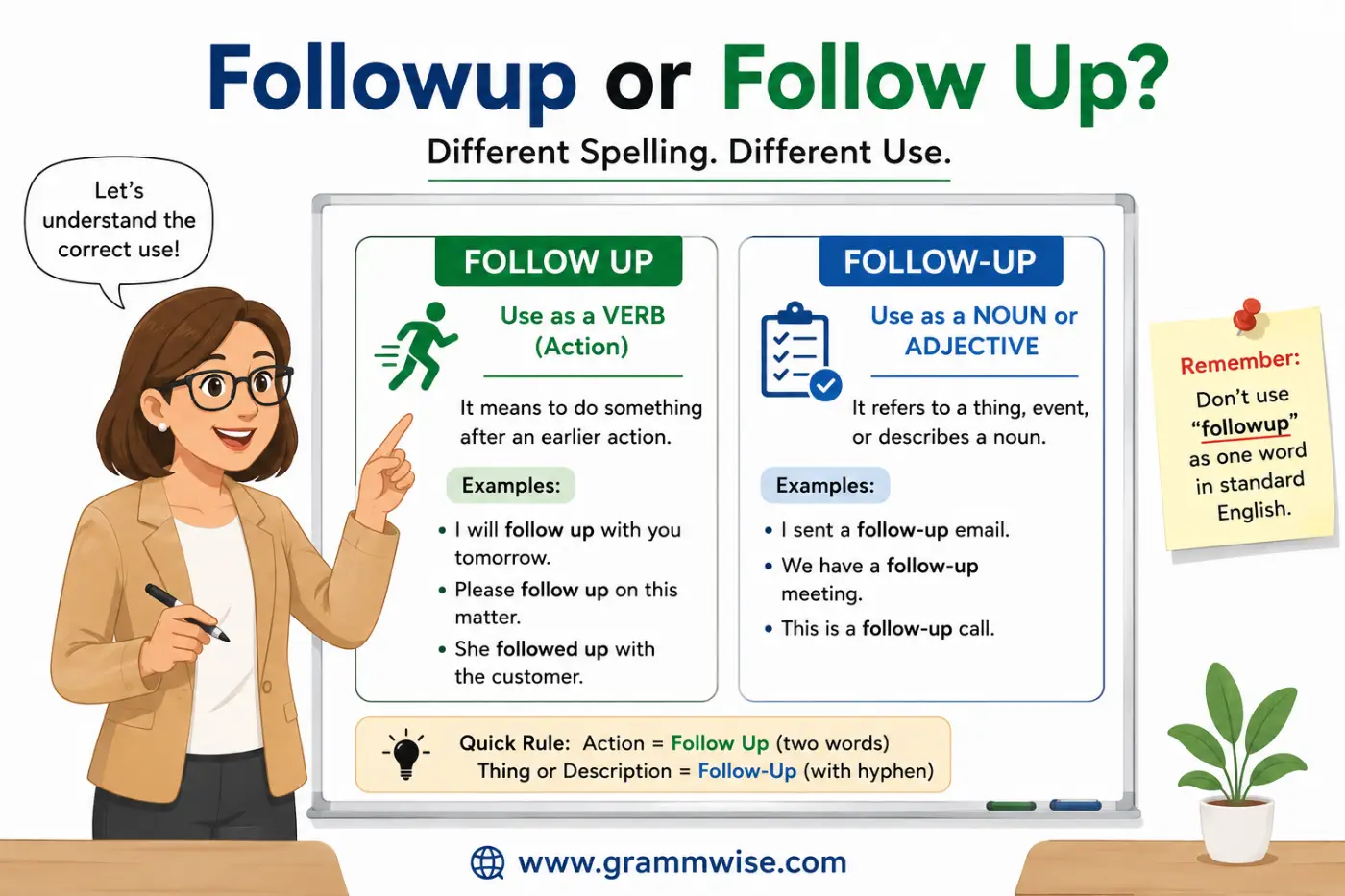
Followup or Follow Up is a common English spelling question. Many people wonder if these words should be written as one word, two words, or with a hyphen. The answer depends on how you use the expression in a sentence.
In most everyday American English, follow up is written as two words when it is a verb. For example, you can say, “I will follow up with the customer tomorrow.” When the expression is used as a noun or adjective, follow-up with a hyphen is usually the correct form. “I sent a follow-up email.” The one-word form followup is generally not the standard choice.
This guide explains the difference between followup or follow up in very simple English. You will learn which form is correct, when to use each form, common mistakes, real-life examples, and an easy trick to remember the rule.
Many learners struggle with spelling patterns. You may also like our article on inbetween or in between.
Simple Answer in One Look
Use follow up as a verb.
Use follow-up as a noun or adjective.
Followup as one word is generally not the standard form in normal English writing.
Examples:
- I will follow up with you tomorrow.
- She made a follow-up call.
- We have a follow-up meeting next week.

What This Means in Simple English?
The expression follow up means to do something after an earlier event, conversation, question, or action.
Think about this simple situation.
You send your teacher an email asking about your homework. The teacher does not answer. The next day, you send another message. You are following up on your first message.
Another example:
You visit a doctor. The doctor asks you to come back in two weeks to check your progress. That next visit is a follow-up appointment.
The basic idea is always the same:
Something happens first, and then you do something later because of it.
That is why we use the word “follow.” You continue with something that came before.
The form changes depending on the job the expression does in the sentence.
Follow up = action
When you are talking about the action, use two words.
- I will follow up tomorrow.
- Please follow up with the client.
- She needs to follow up on the request.
Follow-up = thing, event, or description
When you use it as a noun or before another noun, use a hyphen.
- I sent a follow-up email.
- We scheduled a follow-up meeting.
- The doctor ordered a follow-up visit.
This is the main rule you need to remember.
Why People Mix These Words Followup or Follow Up?
People often get confused by followup or follow up because English has many expressions that change form depending on how they are used.
For example, English has:
- log in
- login
- log-in
- check up
- checkup
- check-in
- check in
- follow up
- follow-up
These small spelling changes can be confusing.
Another reason is that people see different forms online. A person may write “followup” in an informal message, while a professional website may use “follow-up.” Seeing different versions can make learners wonder which one is correct.
The easiest answer is to look at the role of the expression.
Ask yourself:
Am I describing an action?
Use follow up.
Am I naming a thing, event, or type of message?
Use follow-up.
This rule works in most normal situations.
Clear Difference Explained Simply
Here is the difference between followup or follow up in a simple table.
| Form | Main Use | Example |
|---|---|---|
| follow up | Verb/action | I will follow up tomorrow. |
| follow-up | Noun | We had a follow-up. |
| follow-up | Adjective | I sent a follow-up email. |
| followup | Usually not preferred | Avoid it in standard writing. |
Follow up
Use follow up when someone is doing something.
Examples:
- I will follow up with him.
- Please follow up next week.
- She followed up on my question.
- They are following up with the customer.
Here, follow up describes an action.
Follow-up
Use follow-up when the expression names something or describes something.
Examples:
- I received a follow-up email.
- The doctor scheduled a follow-up appointment.
- We had a follow-up meeting.
- He made a follow-up call.
Here, follow-up is connected to a thing or event.
Followup
The one-word spelling followup is generally not the standard form in careful English writing.
You may see it in informal writing, company names, software labels, or other special uses. But if you are writing an email, school assignment, article, report, or professional message, follow up or follow-up is the safer choice.
Followup or Follow Up: Which Form Should You Use?
Use this simple three-step rule.
Step 1: Is it an action?
Use follow up.
Example:
I will follow up with the teacher tomorrow.
The person is doing something.
So we write it as two words.
Step 2: Is it a thing?
Use follow-up.
Example:
The teacher sent a follow-up email.
The email is a thing.
So we use the hyphen.
Step 3: Is it describing another noun?
Use follow-up.
Example:
We have a follow-up meeting.
The word describes the meeting.
So we use the hyphen.
A quick rule is:
Action = follow up
Thing or description = follow-up

Easy Real-Life Sentences on Followup or Follow Up
Here are simple examples from everyday life.
At school
- I will follow up with my teacher tomorrow.
- The teacher sent a follow-up message.
- We have a follow-up discussion on Friday.
- I need to follow up about my homework.
At work
- I will follow up with the customer.
- Please follow up with the sales team.
- She sent a follow-up email.
- We scheduled a follow-up meeting.
And at the doctor’s office
- The doctor asked me to follow up next month.
- I have a follow-up appointment on Monday.
- The nurse called for a follow-up visit.
In daily life
- I’ll follow up with you later.
- Can you follow up on this?
- Thanks for the follow-up message.
- We need a follow-up conversation.
These examples show how naturally the expression appears in real English.
How Do You Use “Follow Up” as a Verb?
When follow up is a verb, it usually means to take another action after something has already happened.
It often appears with words such as:
- with
- on
- about
- after
Follow up with someone
Use this when you contact a person again.
Example:
I will follow up with Sarah tomorrow.
This means you will contact Sarah again.
Follow up on something
Use this when you continue working on a matter.
Example:
I need to follow up on your request.
This means you will check what is happening with the request.
Follow up about something
Use this when you contact someone again about a particular subject.
Example:
I am following up about my application.
This means you are contacting someone again about your application.
What Does “Follow-Up” Mean as a Noun?
A follow-up is something that happens after an earlier event or action.
For example, imagine you have a job interview. The company sends you an email after the interview. That email may be called a follow-up email.
Or imagine you visit a doctor.
The doctor asks you to return later. That next visit is a follow-up appointment.
A follow-up is basically a second step.
First event → Follow-up action or event
For example:
Interview → follow-up email
Doctor visit → follow-up appointment
Meeting → follow-up meeting
Question → follow-up question
This pattern makes the meaning easy to understand.
What Does “Follow-Up” Mean as an Adjective?
Sometimes follow-up comes before another noun and describes it.
Examples:
- follow-up email
- follow-up question
- follow-up meeting
- follow-up call
- follow-up visit
- follow-up appointment
- follow-up report
In these examples, the hyphen helps show that the two words work together to describe the noun.
For example:
I sent a follow-up email.
The word “follow-up” tells us what kind of email it was. It was an email sent after an earlier conversation or message.
Is “Followup” One Word Correct?
This is one of the most common questions about followup or follow up.
In standard English, followup as one word is generally not the form you should choose.
Use:
follow up for the verb.
Use:
follow-up for the noun or adjective.
For example:
❌ I will followup with you tomorrow.
✅ I will follow up with you tomorrow.
And:
❌ I sent a followup email.
✅ I sent a follow-up email.
Using the standard forms makes your writing clearer and more professional.
Common Mistakes People Make
Mistake 1: Writing “followup” as a verb
Incorrect:
❌ I will followup with you tomorrow.
Correct:
✅ I will follow up with you tomorrow.
The phrase is an action here, so use two words.
Mistake 2: Leaving out the hyphen before a noun
Incorrect:
❌ I sent a follow up email.
Correct:
✅ I sent a follow-up email.
Here, “follow-up” describes the email, so the hyphen is useful.
Mistake 3: Using “follow-up” as the verb
Incorrect:
❌ I will follow-up with you tomorrow.
Correct:
✅ I will follow up with you tomorrow.
When the expression is the action, do not use the hyphen.
Mistake 4: Thinking “followup” is always acceptable
You may see “followup” online, but that does not mean it is the best choice for standard writing.
When you want your writing to look clear and professional, choose follow up or follow-up.
Follow Up vs Follow-Up: Easy Examples
Look at these pairs.
Verb
I will follow up with the customer.
The person will take an action.
Adjective
I will send a follow-up email.
The word describes the email.
Here is another pair.
Please follow up on the problem.
Action.
We had a follow-up discussion.
Thing or event.
One small hyphen changes how the phrase works.
Follow Up With or Follow Up On?
Both forms are correct, but they are used in slightly different ways.
Follow up with
Use with when you mean contacting or communicating with a person or group.
Example:
I will follow up with the manager.
You are going to contact the manager again.
Follow up on
Use on when you mean checking or continuing something.
Example:
I will follow up on the complaint.
You are going to check what is happening with the complaint.
Compare these:
I will follow up with John.
You will contact John.
I will follow up on John’s request.
You will check the request.
Both are useful in workplace English.

How People Actually Use It in Daily English?
The phrase follow up is especially common in work, school, customer service, health care, and email communication.
Example 1: After an interview
“I wanted to follow up after our interview.”
This is a polite way to contact someone again.
Example 2: After sending an email
“I’ll follow up if I don’t hear back.”
This means the speaker will contact the person again.
Example 3: At work
“Can you follow up with the client?”
This means contact the client again.
Example 4: Customer service
“Thank you for your message. We will follow up shortly.”
The company will take another action after receiving the message.
Example 5: At school
“I need to follow up with my teacher about the assignment.”
The student plans to speak to the teacher again.
Example 6: At a doctor’s office
“You need a follow-up appointment in two weeks.”
The second appointment comes after the first visit.
Example 7: In a meeting
“We will have a follow-up meeting next Monday.”
The next meeting continues the work from the earlier meeting.
Example 8: Asking for an update
“I am following up on my application.”
The speaker wants an update about an earlier application.
These are all natural uses of the expression.
Related Words You Should Know
Learning related expressions can make the main rule easier.
Check back
To contact someone or look again later.
Example: I’ll check back with you tomorrow.
Contact
To communicate with someone.
Example: Please contact me if you have questions.
Respond
To answer someone.
Example: She responded to my email.
Reply
To answer a message.
Example: I will reply later today.
Update
New information about something.
Example: Please send me an update.
Reminder
A message that helps someone remember something.
Example: I sent a reminder about the meeting.
Continue
To keep doing something.
Example: We will continue the discussion tomorrow.
Check
To look at something carefully.
Example: I will check on the order.
Reconnect
To communicate with someone again after some time.
Example: I hope we can reconnect soon.
Next step
Something that should happen after the current action.
Example: What is the next step?
These words often appear near follow up in natural English.
How “Follow Up” Is Used in Polite English?
Follow up is especially useful when you want to sound polite.
Compare:
“Why haven’t you answered?”
This can sound demanding.
Now compare:
“I am following up on my previous email.”
This sounds more professional and calm.
Another example:
“Just following up to see if you had a chance to review the document.”
This is a common polite way to ask for an update.
The expression does not always mean that someone did something wrong. It can simply mean that you are continuing a conversation.
Is “Follow Up” Formal or Informal?
Follow up works in both everyday and professional English.
You can use it with friends:
“I’ll follow up with you later.”
You can also use it at work:
“I will follow up with the client tomorrow.”
It is especially common in emails and business communication.
The noun follow-up is also very common in professional writing.
A Simple Memory Trick
Here is the easiest trick.
Think:
Follow up = DO something again.
Follow-up = a THING that comes next.
For example:
I will follow up.
You are doing something.
I sent a follow-up email.
The email is the thing.
You can also remember:
Verb → two words
Noun/adjective → hyphen
This gives you a quick answer whenever you are unsure.
Mini Practice Quiz
Choose the correct form.
- I will _____ with you tomorrow.
- She sent a _____ email.
- We need to _____ on this issue.
- I have a _____ appointment next week.
- Please _____ with the customer.
- He asked a _____ question.
- I am writing to _____ on my previous message.
- We scheduled a _____ meeting.
Answers
- follow up
- follow-up
- follow up
- follow-up
- follow up
- follow-up
- follow up
- follow-up
Notice the pattern.
The action uses follow up.
The noun or describing form uses follow-up.
Final Teacher Explanation
If I were teaching this in a classroom, I would put three forms on the board:
follow up
follow-up
followup
Then I would tell my students to focus on the first two.
When you are talking about an action, use follow up.
I will follow up with you.
When you are talking about a thing or describing a thing, use follow-up.
I sent a follow-up email.
The one-word form followup is generally not the standard choice in normal English writing.
So you do not need to worry about memorizing a long grammar rule.
Just ask:
Is someone doing the action?
→ follow up
Is it a thing or is it describing a thing?
→ follow-up
That is the simple rule.
Think about a phone call.
You call someone today.
Tomorrow, you call again.
You follow up.
Now think about the second call itself.
It is a follow-up call.
The meaning is connected, but the spelling changes because the words have different jobs.
Quick Recap of Followup or Follow Up
For followup or follow up, the standard choices are follow up and follow-up. Use follow up when it is a verb: “I will follow up tomorrow.” Use follow-up as a noun or adjective: “I sent a follow-up email.”
Avoid writing followup as one word in standard English unless you are following a specific name or style that uses it. The easiest memory trick is: action = follow up; thing or description = follow-up.

Conclusion
Understanding followup or follow up becomes easy when you remember the two main forms. Use follow up when someone is doing the action, such as “I will follow up with you.” Use follow-up when you are talking about a thing or describing a noun, such as “a follow-up email.” The one-word form followup is generally not the standard choice.
The best way to remember the rule is simple: action = follow up; noun or adjective = follow-up. Use this rule in emails, school writing, workplace messages, and everyday English, and you will be able to choose the correct form with confidence.
Frequently Asked Questions
Is it followup or follow up?
For the verb, the correct standard form is follow up. Do not normally write it as one word.
Is it follow up or follow-up?
Use follow up as a verb and follow-up as a noun or adjective.
Is “followup” one word correct?
Followup is generally not the standard form in normal English writing. Use follow up or follow-up instead.
Is “follow up” a verb?
Yes. Follow up is a verb phrase meaning to take another action after something earlier.
Example: “I will follow up with you tomorrow.”
Is “follow-up” a noun?
Yes. A follow-up is something that happens after an earlier event or action.
Example: “We had a follow-up after the meeting.”
Is it “follow up email” or “follow-up email”?
The standard form is follow-up email because “follow-up” describes the noun “email.”
Is it “follow up meeting” or “follow-up meeting”?
Use follow-up meeting.
Example: “We have a follow-up meeting next week.”
How do I remember the difference?
Remember: follow up = action, while follow-up = thing or description.