
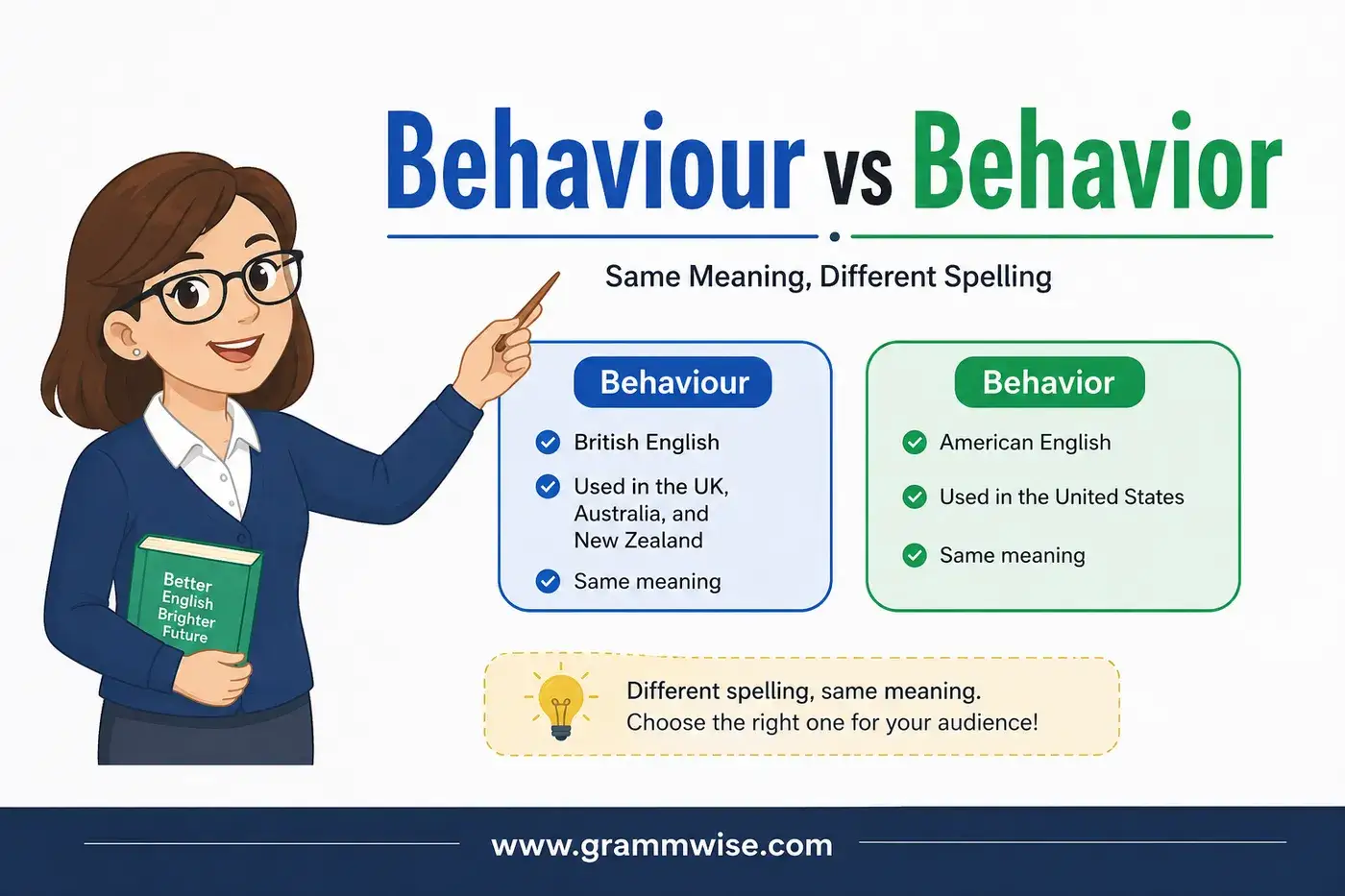
Many English learners wonder about Behaviour vs Behavior because both spellings look almost the same. The good news is that both are correct. The only real difference is the type of English you are using. Behaviour is the British English spelling, while Behavior is the American English spelling.
If you write for a school, business, or website, using the correct spelling is important. In this lesson, you will learn the difference between Behaviour vs Behavior, when to use each one, and how to remember them with easy examples. By the end, you will know exactly which spelling fits your writing.
Check related articles to strengthen your English writing skills.
Simple Answer in One Look
Behaviour is the British English spelling.
Behavior is the American English spelling.
They have the same meaning. Only the spelling is different.
Meaning of “Behaviour vs Behavior” in Simple English
The words behaviour and behavior both mean the way a person or animal acts. They describe actions, manners, or the way someone behaves in different situations.
Think about a classroom.
A teacher may say:
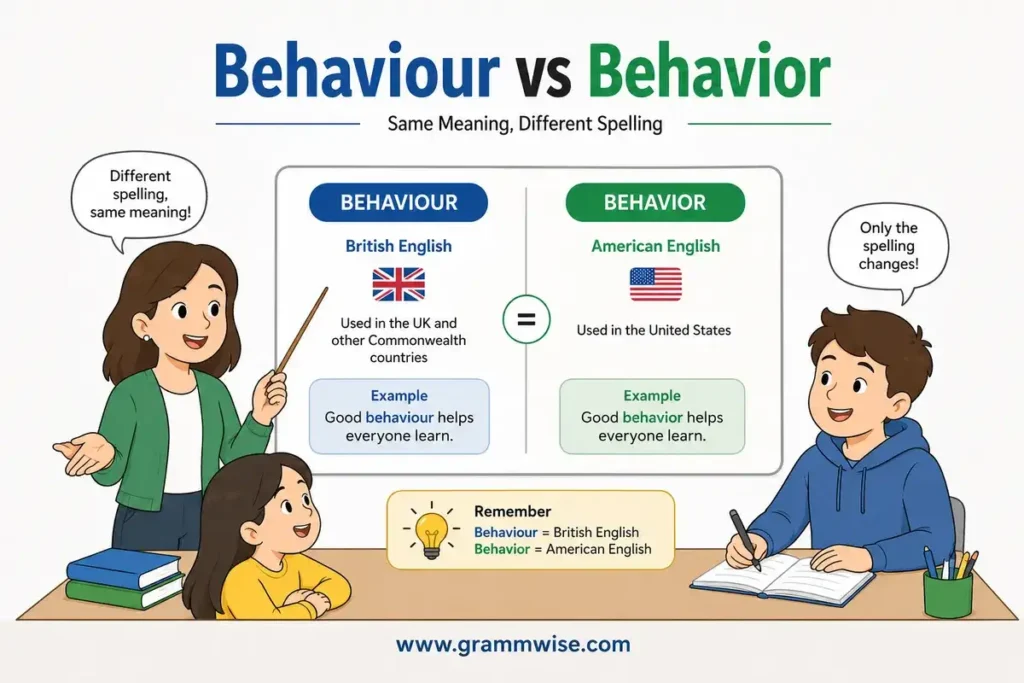
“Good behavior helps everyone learn.”
A teacher in the UK may write:
“Good behaviour helps everyone learn.”
The meaning does not change. Only the spelling changes.
Here are more simple examples.
- Her behavior was kind.
- Her behaviour was kind.
- The dog’s behavior made us laugh.
- The dog’s behaviour made us laugh.
All four sentences mean exactly the same thing.
When you see Behaviour vs Behavior, remember that you are choosing between British and American spelling, not different meanings.
Behaviour vs Behavior: Why People Mix These Words?
Many learners get confused because the words look almost identical. There is only one small spelling change.
British English uses our.
American English uses or.
This spelling pattern appears in many English words.
For example:
| British English | American English |
|---|---|
| Behaviour | Behavior |
| Colour | Color |
| Favourite | Favorite |
| Honour | Honor |
| Labour | Labor |
| Neighbour | Neighbor |
When learners notice these patterns, they understand Behaviour vs Behavior much faster.
Another reason people mix them is that both spellings appear online.
You may read an article from the United States using behavior.
Then you may read a book from the United Kingdom using behaviour.
Both are correct because they follow different English styles.
Clear Difference Between “Behaviour vs Behavior”
Here is the easiest way to understand Behaviour vs Behavior.
Behaviour
- British English spelling
- Used in the UK
- Also common in Australia, New Zealand, and many Commonwealth countries
Behavior
- American English spelling
- Used in the United States
- Also common in American books, websites, and schools
The meaning is always the same. Only the spelling changes.
Here are two matching examples.
British English:
- The child’s behaviour was excellent.
American English:
- The child’s behavior was excellent.
Both sentences describe the same action.
Here is another example.
British English:
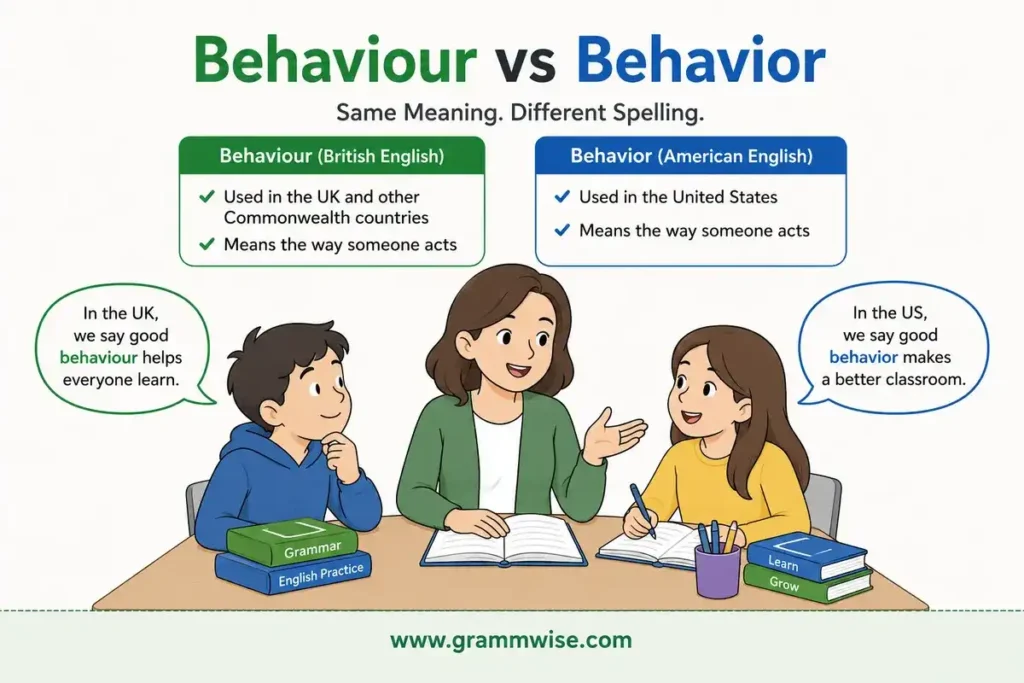
- Good behaviour makes a classroom peaceful.
American English:
- Good behavior makes a classroom peaceful.
Again, the meaning stays the same.
Behaviour vs Behavior: Which Form Should You Use?
The answer depends on who will read your writing.
Use behaviour if you are writing for:
- Schools in the United Kingdom
- British newspapers
- UK companies
- Australian readers
- New Zealand readers
Use behavior if you are writing for:
- Schools in the United States
- American companies
- US websites
- American teachers
- American readers
If you are taking an English exam, follow the spelling style your school asks for.
The most important rule is simple.
Do not mix both spellings in the same piece of writing.
For example, this is incorrect:
❌ Good behaviour is important because positive behavior helps everyone.
Choose one spelling and use it from beginning to end.
Correct British style:
✅ Good behaviour is important because positive behaviour helps everyone.
Correct American style:
✅ Good behavior is important because positive behavior helps everyone.
Being consistent makes your writing look professional.
Easy Real-Life Sentences on “Behaviour vs Behavior”
Here are everyday examples using both spellings.
British English
- Your behaviour was polite today.
- Good behaviour earns rewards.
- The teacher praised her behaviour.
- His behaviour surprised everyone.
- Children learn good behaviour at home.
American English
- Your behavior was polite today.
- Good behavior earns rewards.
- The teacher praised her behavior.
- His behavior surprised everyone.
- Children learn good behavior at home.
Notice that every sentence has the same meaning.
Only the spelling changes.
Behaviour vs Behavior: Where This Word Comes From?
The word comes from the old verb behave. People have used this word for hundreds of years to describe how someone acts.
As English spread to different countries, spelling changed in some places.
British English kept the spelling behaviour.
American English simplified many words ending in -our to -or.
That is why we now have:
- Behaviour → Behavior
- Colour → Color
- Honour → Honor
- Favourite → Favorite
The meaning never changed. Only the spelling became different. Today, millions of people use both spellings every day.
That is why you will continue seeing Behaviour vs Behavior in books, newspapers, websites, schools, and workplaces around the world.
Quick Comparison Table
| Feature | Behaviour | Behavior |
|---|---|---|
| Meaning | The way someone acts | The way someone acts |
| English Style | British English | American English |
| Used In | UK, Australia, New Zealand, Commonwealth countries | United States |
| Correct? | Yes | Yes |
| Pronunciation | Same | Same |
Common Situations Where “Behaviour vs Behavior” Is Used
School Report
British:
- Excellent behaviour in class.
American:
- Excellent behavior in class.
Office Email
British:
- Professional behaviour is expected.
American:
- Professional behavior is expected.
Parent Talking About a Child
British:
- His behaviour has improved.
American:
- His behavior has improved.
These are real situations where the spelling changes but the meaning stays exactly the same.
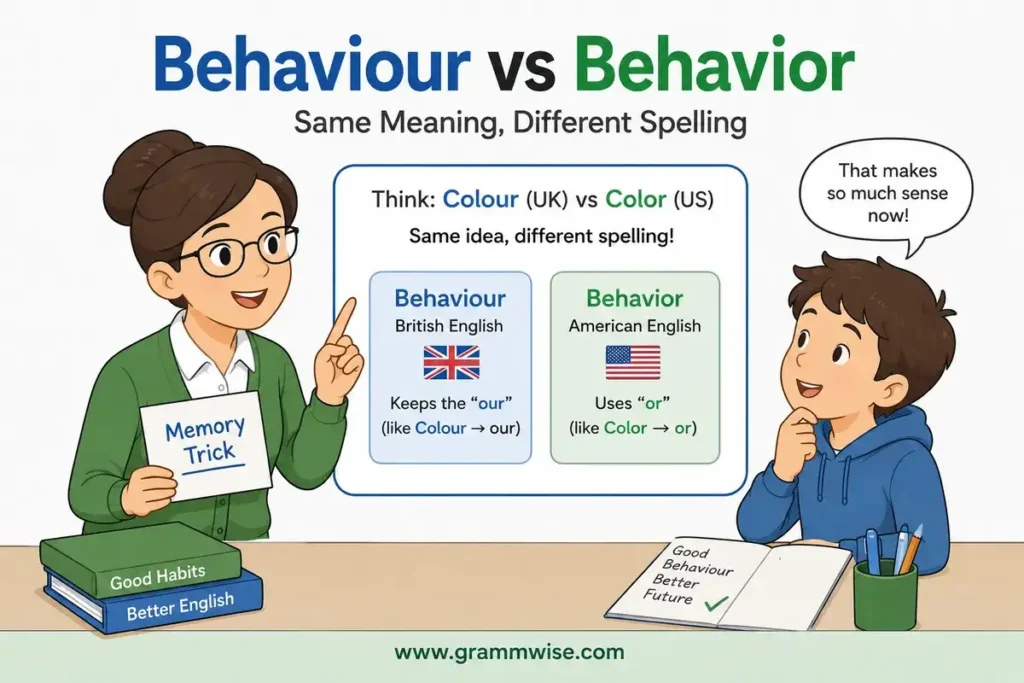
Easy Memory Trick
Think about the word colour.
British English keeps our.
American English changes it to or.
The same idea works here.
Behaviour → British → our
Behavior → American → or
If you remember colour and color, you can easily remember Behaviour vs Behavior.
Which Countries Use Behavior?
Mostly:
- United States
- American schools
- American businesses
- Most American websites
Which Countries Use Behaviour?
Mostly:
- United Kingdom
- Australia
- New Zealand
- Ireland
- South Africa
- Many Commonwealth countries
Practice Quiz
Choose the correct spelling.
- Good ______ is important in school.
- The teacher praised her ______ yesterday.
- American books usually write ______.
- British schools usually write ______.
- His ______ was respectful all day.
Answers
- Behaviour (British) / Behavior (American)
- Behaviour (British) / Behavior (American)
- Behavior
- Behaviour
- Behaviour (British) / Behavior (American)
How “Behaviour vs Behavior” Is Understood in Culture and Stories
The words behaviour and behavior are used every day in many countries. They are common in schools, homes, offices, books, movies, and news stories.
When people talk about someone’s behaviour or behavior, they are talking about the way that person acts.
Parents may say:
“Good behavior starts at home.”
A British parent may say:
“Good behaviour starts at home.”
The message is exactly the same.
Teachers often use these words when talking about students.
For example:
- Your behavior has improved this week.
- Your behaviour has improved this week.
These sentences praise a student’s actions.
Stories also use these words to help readers understand a character.
A kind character shows good behavior.
A rude character shows bad behavior.
You can often guess what a person is like by reading about their behavior.
Movies use this idea too.
A hero usually shows brave and caring behavior.
A villain often shows selfish or harmful behavior.
The spelling changes from country to country, but the meaning never changes.
That is why understanding Behaviour vs Behavior is useful no matter where you read English.
Biblical and Mythological Meaning of “Behaviour vs Behavior”
The Bible does not teach the spelling difference between behaviour and behavior.
However, it often teaches people to show good actions. It encourages kindness, honesty and respect. These good actions can be called good behavior or good behaviour, depending on the English style being used.
Many Bible translations printed in the United Kingdom use behaviour. While American Bible study books use behavior.
The spelling is different, but the lesson stays the same.
Old myths and legends also teach people about actions. Heroes are remembered for brave behavior. Wise leaders are remembered for fair behavior.
Greedy or dishonest characters often face problems because of their bad behavior.
These stories remind us that actions matter more than words.
Symbolism of “Behaviour vs Behavior” Explained in Simple Words
What Behaviour Represents?
The British spelling behaviour often reminds readers of British English and countries that follow British spelling.
It represents:
- Good manners
- Respect
- Actions
- Character
- Daily habits
The word itself does not have a special emotional meaning.
It simply follows British spelling rules.
What Behavior Represents?
The American spelling behavior represents exactly the same ideas.
It stands for:
- Actions
- Manners
- Character
- Habits
- The way people act
The only difference is the spelling.
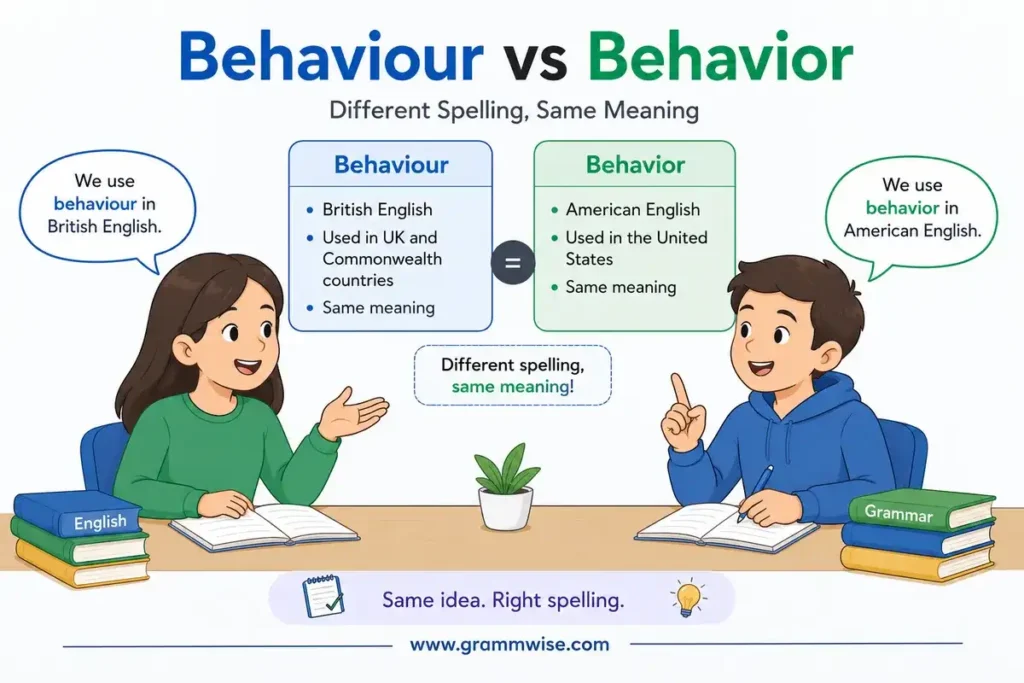
When comparing Behaviour vs Behavior, remember that they represent the same idea in English.
One is not better than the other.
The right choice depends on the type of English you are writing.
Related Words to “Behaviour vs Behavior” You Should Know
Learning related words makes your vocabulary stronger.
Behave
This is the action word.
Example:
Please behave during class.
Behavioral
This describes something connected to behavior.
Example:
The school offers behavioral support.
Behavioural
This is the British spelling of behavioral.
Example:
The teacher discussed behavioural skills.
Manners
Manners are polite ways of acting.
Example:
Good manners make a good first impression.
Conduct
Conduct means the way someone behaves.
Example:
His conduct was respectful.
Attitude
Attitude means the way someone thinks or feels.
A positive attitude often leads to good behavior.
Character
Character means the qualities that make a person who they are.
Good character usually leads to kind behavior.
Habit
A habit is something you do again and again.
Good habits often create good behavior.
How People Actually Use “Behaviour vs Behavior” in Daily English
Here are natural examples that people really use.
- Good behavior makes learning easier.
- Good behaviour makes learning easier.
- Thank you for your good behavior today.
- Her behaviour impressed the teacher.
- His behavior changed after the meeting.
- My dog’s behavior has improved.
- Their behaviour made everyone smile.
- Professional behavior is expected at work.
- Children’s behaviour often improves with practice.
- We should always show respectful behavior.
These examples sound natural because people use them every day.
Common Mistakes People Make About “Behaviour vs Behavior”
Many learners make the same mistakes.
Mistake 1
❌ Behaviour is wrong in American English.
✅ Behaviour is correct in British English.
Mistake 2
❌ Behavior is wrong in British English.
✅ Behavior is correct in American English.
Mistake 3
❌ Mixing both spellings in one article.
Example:
Good behaviour helps students because positive behavior creates better classrooms.
This looks inconsistent.
Choose one style and keep it throughout your writing.
Mistake 4
Thinking the meanings are different.
They are not.
Both words mean the way someone acts.
Mistake 5
Trying to pronounce them differently.
They are pronounced the same.
Only the spelling changes.
Final Teacher Explanation
Imagine I am standing in front of a classroom. A student raises a hand and asks,
“Teacher, which one is correct—behaviour or behavior?”
My answer is simple. Both are correct.
- If you are writing British English, use behaviour.
- If you are writing American English, use behavior.
Do not worry about changing the meaning. The meaning never changes. The only thing that changes is the spelling.
Remember another easy example.
British English writes colour.
American English writes color.
The same idea works with behaviour and behavior.
When you know who will read your writing, choosing the correct spelling becomes easy.
That is the whole secret behind Behaviour vs Behavior.
Final Answer “Behaviour vs Behavior”
Behaviour is the British English spelling.
Behavior is the American English spelling.
Both mean the way someone acts. Choose the spelling that matches your audience and use it consistently throughout your writing.
Conclusion
Behaviour vs Behavior is an easy difference to understand once you know that both words have the same meaning. The only change is the spelling. Use behaviour for British English and behavior for American English, and stay consistent in your writing.
When you match your spelling to your audience, your English becomes clearer and more professional. Keep practicing with real-life examples, and soon choosing the correct spelling will become a natural habit.
Frequently Asked Questions (FAQs)
What does Behaviour vs Behavior mean?
Both words mean the way a person or animal acts. The only difference is the spelling.
Is behaviour or behavior correct?
Both are correct. Use behaviour in British English and behavior in American English.
Which spelling should I use in school?
Use the spelling your school or teacher prefers.
Why do people confuse Behaviour vs Behavior?
They have the same meaning, the same pronunciation, and almost the same spelling.
Can I use both spellings in one article?
No. Choose one spelling style and use it consistently.
Is behavior used in the United States?
Yes. Behavior is the standard American English spelling.
Is behaviour used outside the UK?
Yes. It is also common in Australia, New Zealand, and many other countries that use British English.
How can I remember the difference?
Think of colour and color. If you remember that pattern, you can also remember Behaviour vs Behavior.