
Many English learners ask about all right vs alright because both forms appear in books, websites, and everyday writing. They look similar, but they are not always used in the same way. The good news is that the difference is easy to understand. In most formal writing, all right is the preferred choice, while alright is accepted in many informal situations.
In this lesson, you will learn the difference between all right vs alright with simple explanations, easy examples, and helpful tips. By the end, you will know which form to use in school, work, emails, and daily conversations.
Want to improve your grammar further? Explore more guides on Grammwise.
Simple Answer in One Look
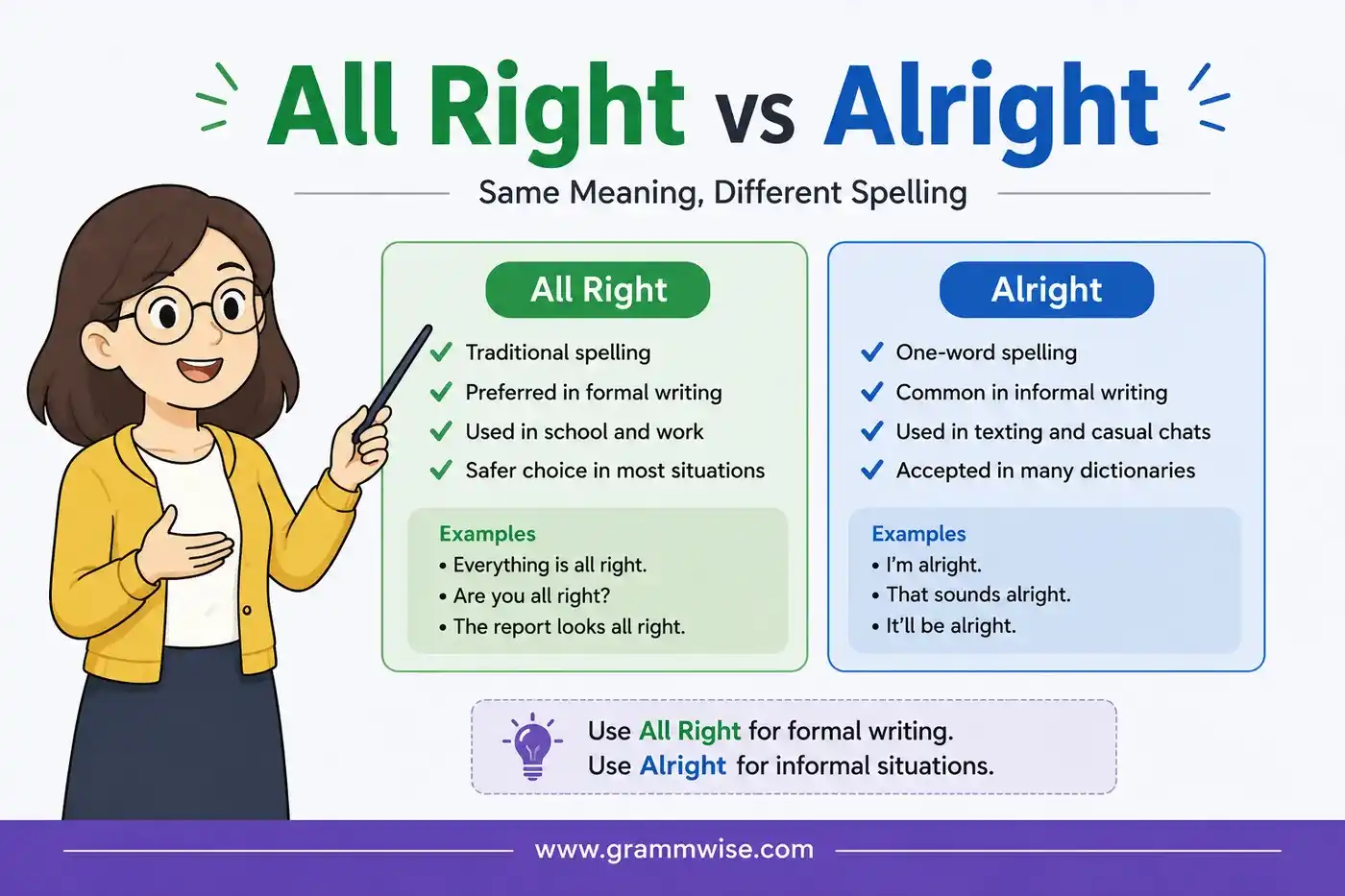
All right is the traditional and preferred spelling, especially in formal writing.
Alright is accepted by many dictionaries but is mostly used in informal English.
Meaning of “All Right vs Alright” in Simple English
Both all right and alright usually mean the same thing.
They can mean:
- Fine
- Okay
- Safe
- Correct
- Acceptable
For example:
- I am all right.
- I am alright.
Both sentences mean the speaker is fine.
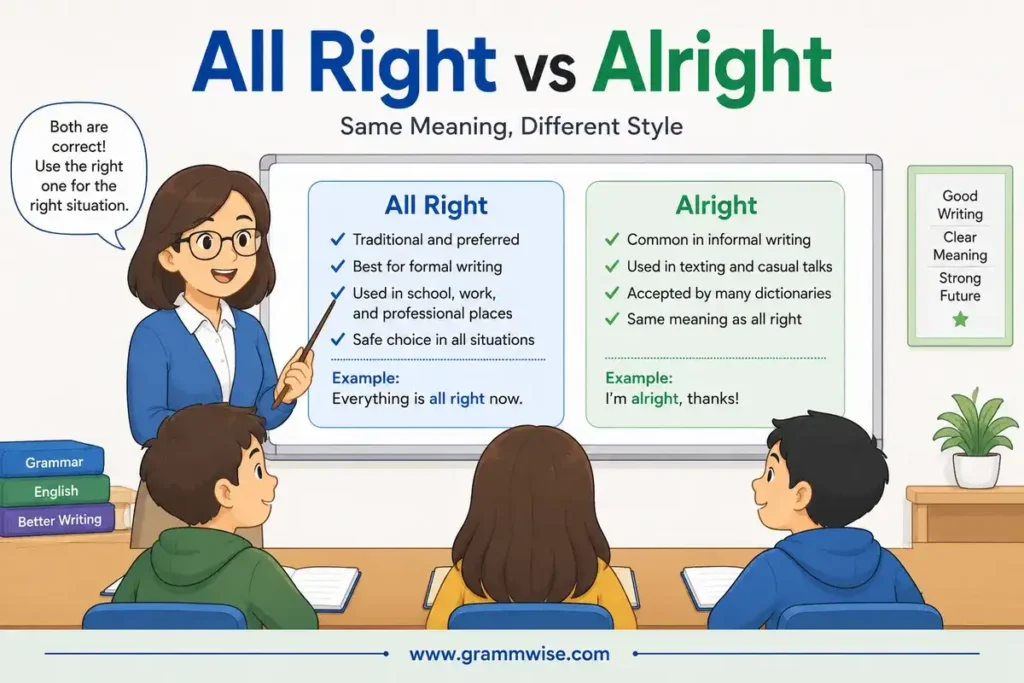
However, many teachers, editors, and schools still prefer all right, especially in formal writing.
That is why understanding all right vs alright is important.
When do people use all right?
People use all right in:
- School assignments
- Business emails
- Books
- Newspapers
- Formal writing
Examples:
- Everything is all right now.
- Is your homework all right?
- She said everything would be all right.
- The food was all right.
When do people use alright?
People often use alright in:
- Text messages
- Social media
- Informal conversations
- Personal notes
Examples:
- I’m alright now.
- It’s alright with me.
- Are you alright?
- Everything will be alright.
The meaning stays the same.
The biggest difference is the writing style.
Why People Mix These Words “All Right vs Alright”?
Many learners become confused because they see both spellings online.
One website writes all right.
Another writes alright.
Both seem correct.
This happens because English changes over time.
Many modern dictionaries now include alright as an accepted spelling.
But many teachers and editors still recommend all right.
Another reason for the confusion is that English has many words that joined together over time.
For example:
- Already
- Altogether
- Always
People sometimes think all right should become one word too.
That is why they write alright.
Understanding this history makes all right or alright much easier to remember.
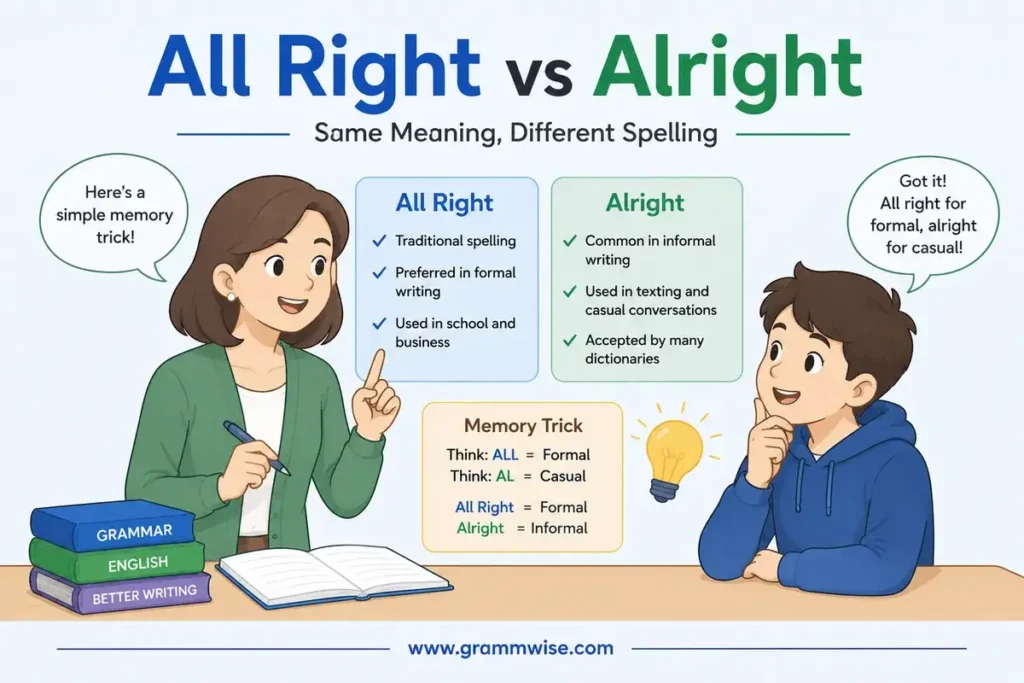
Clear Difference Between “All Right vs Alright” Explained Simply
Here is the easiest comparison.
All Right
- Traditional spelling
- Preferred in formal English
- Common in schools
- Used in business writing
- Accepted everywhere
Examples:
- Everything is all right.
- The report looks all right.
- Are you all right?
Alright
- One-word spelling
- Common in informal writing
- Seen in texting
- Used in casual conversations
- Accepted by many modern dictionaries
Examples:
- I’m alright.
- That’s alright.
- It’ll be alright.
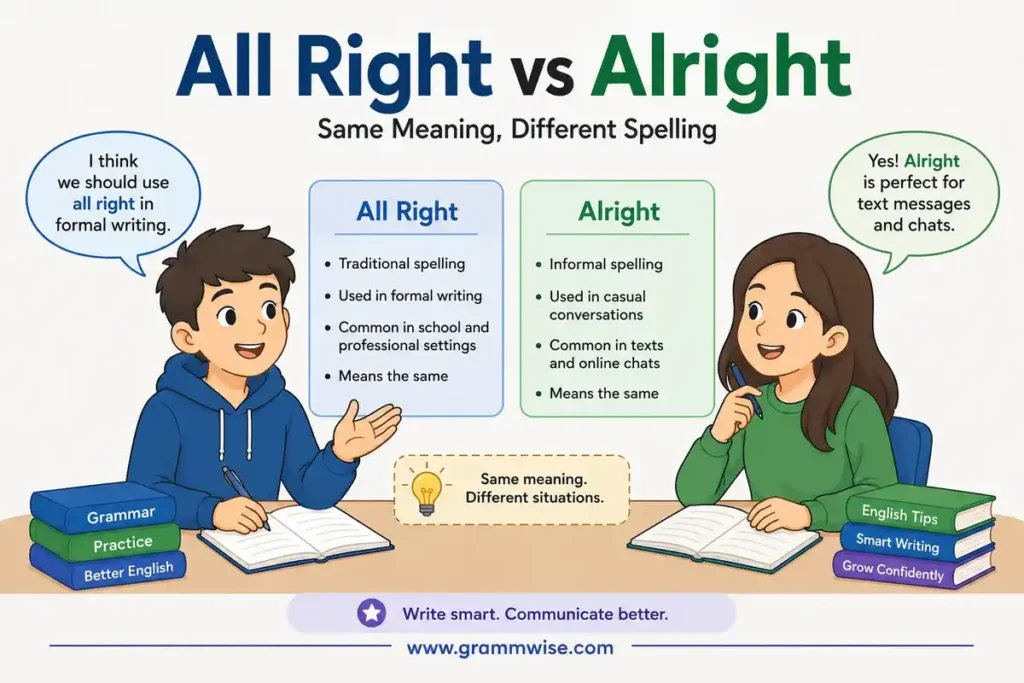
Both forms have the same meaning.
The biggest difference is the level of formality.
Which Form Should You Use “All Right vs Alright”?
The safest choice is all right.
If you are writing:
- School homework
- College papers
- Business emails
- Job applications
- Reports
- Professional documents
Use all right.
If you are writing:
- Text messages
- Social media posts
- Friendly chats
- Personal journals
Many people use alright, although all right is still correct.
When you are unsure, choose all right.
You will never be wrong.
Easy Real-Life Sentences on “All Right vs Alright”
Here are simple everyday examples.
Using all right
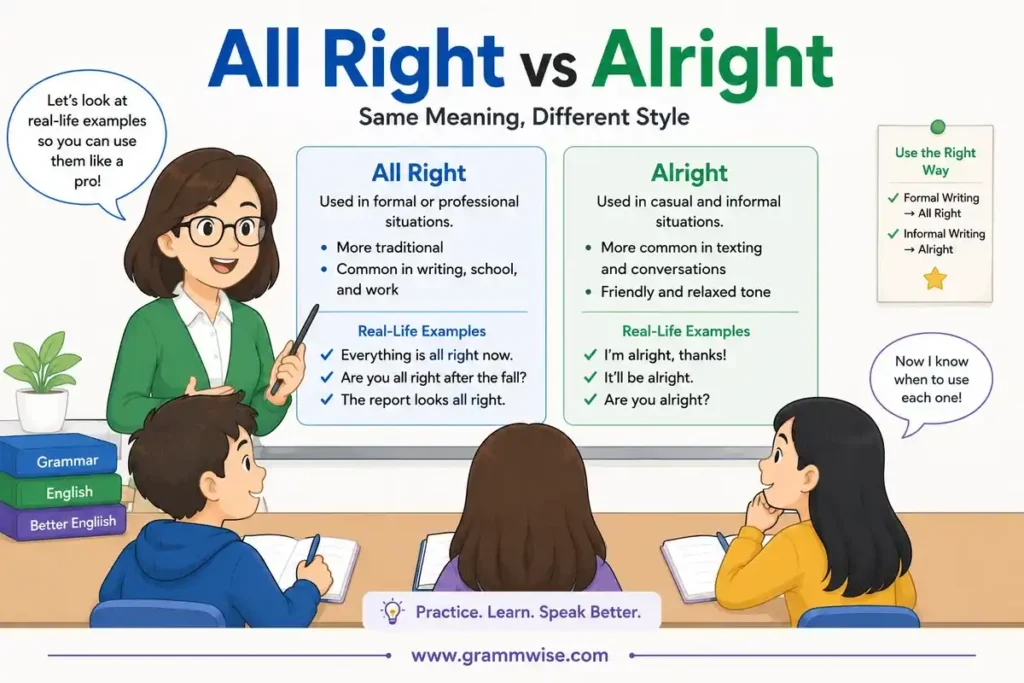
- Are you all right?
- Everything is all right now.
- The food tastes all right.
- Your answer is all right.
- We are all right after the storm.
Using alright
- I’m alright today.
- That’s alright with me.
- She feels alright now.
- It’ll be alright.
- You look alright.
Both groups of sentences sound natural.
The only difference is the writing style.
All Right vs Alright: Where This Expression Comes From?
The expression all right has been part of English for hundreds of years.
It was originally written as two separate words.
People used it to mean “everything is correct” or “everything is fine.”
As English changed, some writers began using alright as one word.
This happened in the same way that some other English words became shorter over time.
Even today, many style guides still recommend all right because it is the older and more traditional spelling.
Modern dictionaries often include alright, but they usually label it as informal.
That is why both forms appear in books, websites, and conversations today.
Quick Comparison Table
| Feature | All Right | Alright |
|---|---|---|
| Meaning | Fine, okay, correct | Fine, okay, correct |
| Formal Writing | Yes | Usually no |
| Informal Writing | Yes | Yes |
| Traditional Spelling | Yes | No |
| Safest Choice | Yes | No |
Common Situations
Teacher Talking to a Student
- Your work is all right.
Parent Asking a Child
- Are you all right?
Friend Sending a Text
- I’m alright.
Business Email
- Everything looks all right.
Social Media Post
- Don’t worry. It’ll be alright.
These examples show where each form is commonly used.
Easy Memory Trick for All Right vs Alright
Think about the word all.
If you are writing something important, keep all and right as two separate words.
All right = formal and safe.
If you see alright, remember that many people use it in casual writing.
But when you are not sure, always choose all right.
It works in every situation.
Practice Quiz
Choose the best answer.
- Are you ______ after the game?
- Everything will be ______.
- My homework is ______.
- She said she was ______ in her text message.
- For a business report, which spelling is the safest?
Answers
- all right (or alright in informal writing)
- all right (or alright in informal writing)
- all right
- alright
- all right
How This Expression “All Right vs Alright” Is Understood in Culture and Stories?
The words all right and alright are used every day in English-speaking countries. You can hear them in conversations, movies, TV shows, songs, and books.
When someone asks, “Are you all right?” they are usually checking if another person is safe, healthy, or feeling okay.
For example:
- Are you all right after the fall?
- Is everything all right at home?
These questions show care and kindness.
You will also hear people say:
- It’s all right.
- That’s all right.
These expressions can mean:
- It’s okay.
- Don’t worry.
- No problem.
In casual conversations, many people also write:
- It’s alright.
- I’m alright.
The meaning stays the same.
In stories, characters often say these expressions after something surprising happens.
For example:
- “Are you all right?” asked the doctor.
- “I’m alright,” the boy replied.
Even though the spellings are different, readers understand the same message.
That is why learning all right vs alright helps you understand books, movies, and daily conversations.
Biblical and Mythological Meaning of “All Right vs Alright”
The Bible does not teach the spelling difference between all right and alright.
However, many Bible translations use the idea of being “all right” to describe peace, safety, or well-being.
For example, people ask if someone is well or safe after a difficult event.
The idea is simple.
Everything is fine.
Everything is okay.
Old stories and myths also show this idea.
After danger has passed, characters often ask if everyone is all right.
The focus is on safety and care, not spelling.
Whether a modern writer chooses all right vs alright, the meaning remains the same.
Symbolism of “All Right vs Alright” Explained in Simple Words
What All Right Represents?
All right often represents:
- Safety
- Peace
- Comfort
- Approval
- Everything being okay
Many teachers and editors also see it as careful and formal writing.
Because it is the traditional spelling, it often gives a more professional feeling.
What Alright Represents?
Alright represents the same ideas:
- Feeling okay
- Being safe
- Accepting something
- Casual conversation
The difference is that it usually feels more relaxed and informal.
People often use it in text messages, online chats, and friendly conversations.
When thinking about all right or alright, remember that the meaning stays the same while the writing style changes.
Related Words You Should Know
Learning these words will make your English stronger.
Okay: Means fine or acceptable.
Example: Everything is okay.
Fine: Means healthy or doing well.
Example: I’m fine today.
Well: Means healthy or in good condition.
Example: She is feeling well.
Acceptable: Means good enough.
Example: Your work is acceptable.
Safe: Means free from danger.
Example: Everyone is safe now.
Correct: Means without mistakes.
Example: Your answer is correct.
Good: Means pleasing or satisfactory.
Example: The food was good.
These words are often used instead of all right in different situations.
How People Actually Use “All Right vs Alright” in Daily English
Here are natural examples that native speakers use every day.
- Are you all right?
- Everything is all right now.
- That’s all right.
- I’m alright, thanks.
- It’ll be alright.
- Is your family all right?
- Don’t worry. Everything is all right.
- She said she was alright after the trip.
- Your answer is all right.
- It’s alright if you’re late.
These examples show how common both forms are in everyday English.
Common Mistakes People Make About “All Right vs Alright”
Many learners make the same mistakes.
Mistake 1
❌ Thinking alright is always wrong.
✅ Many modern dictionaries accept alright, especially in informal writing.
Mistake 2
❌ Using alright in formal school or business writing.
✅ Use all right for formal writing.
Mistake 3
❌ Believing the meanings are different.
✅ They have the same meaning.
Only the spelling style is different.
Mistake 4
❌ Mixing both spellings in the same article.
Example:
Everything is all right because everything is alright now.
Choose one spelling style and stay consistent.
Mistake 5
❌ Thinking one spelling changes pronunciation.
Both forms are pronounced exactly the same.
Final Teacher Explanation
Imagine we are in class together.
A student asks,
“Teacher, should I write all right or alright?”
My answer is simple.
If you are writing for school, work, or anything professional, choose all right.
It is the safest and most widely accepted spelling.
If you are chatting with friends or posting on social media, you may also see alright.
Many people use it in informal writing.
The meanings are the same.
The difference is the style.
Remember this easy classroom rule:
Formal writing → all right
Informal writing → all right or alright
If you cannot decide, choose all right.
It is always a safe choice.
Quick Recap “All Right vs Alright”
All right is the traditional and preferred spelling for formal writing.
Alright is accepted in many informal situations.
Both mean “okay” or “fine.” Choose the spelling that matches your audience and keep it consistent.
Conclusion
All right or alright can seem confusing at first, but the meaning is the same. All right is the traditional and preferred spelling for formal writing, while alright is widely accepted in informal writing and everyday conversations.
The best choice depends on your audience and writing style. When you want to be safe in school, business, or professional writing, use all right. With regular practice, choosing the correct form will become natural and easy.
Frequently Asked Questions (FAQs)
What is the difference between all right or alright?
Both have the same meaning. All right is preferred in formal writing, while alright is more common in informal writing.
Is alright a real word?
Yes. Many modern dictionaries recognize alright, but it is usually considered informal.
Which spelling should I use in school?
Use all right because teachers and schools usually prefer it.
Can I use alright in a business email?
It is better to use all right in professional writing.
Why do people get confused between all right or alright?
Both spellings have the same meaning and are used in everyday English, so learners often see both.
Do all right and alright sound different?
No. They are pronounced the same.
Which spelling is safer to use?
All right is the safest choice because it is accepted in both formal and informal writing.
Can I use alright in text messages?
Yes. Alright is common in casual messages and friendly conversations.