
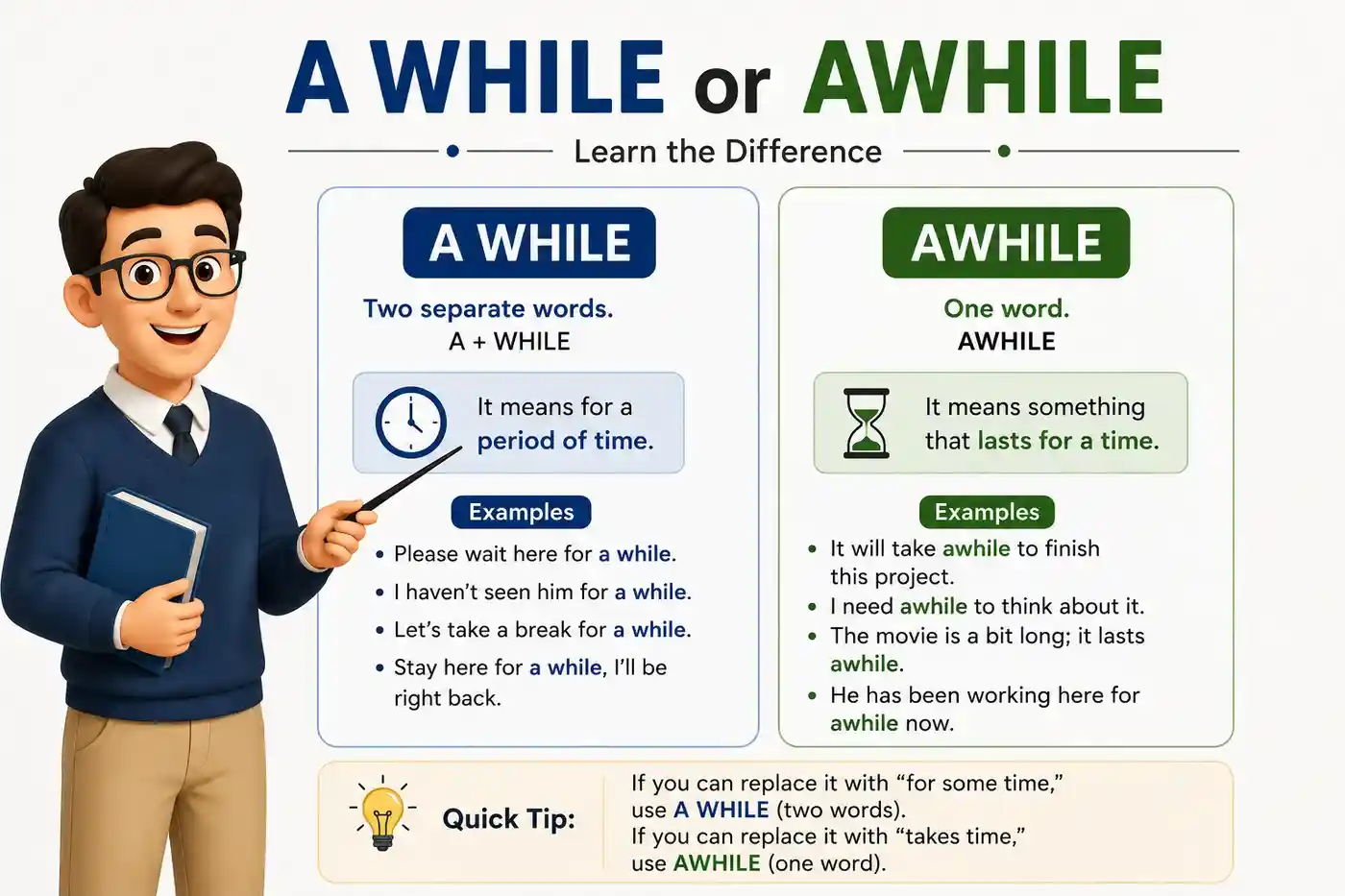
Many English learners get confused about a while vs awhile because both forms look almost the same. The only visible difference is a space, but that small space changes how the words are used in a sentence.
The good news is that the difference between a while vs awhile is simple once you understand the basic rule. Both relate to time, but they do not always fit in the same place in a sentence.
If you are wondering which form is correct, this guide explains the meaning, usage, examples, spelling, and difference between these two words in very simple English.
You might also find our comparison of similar confusing word pairs useful.
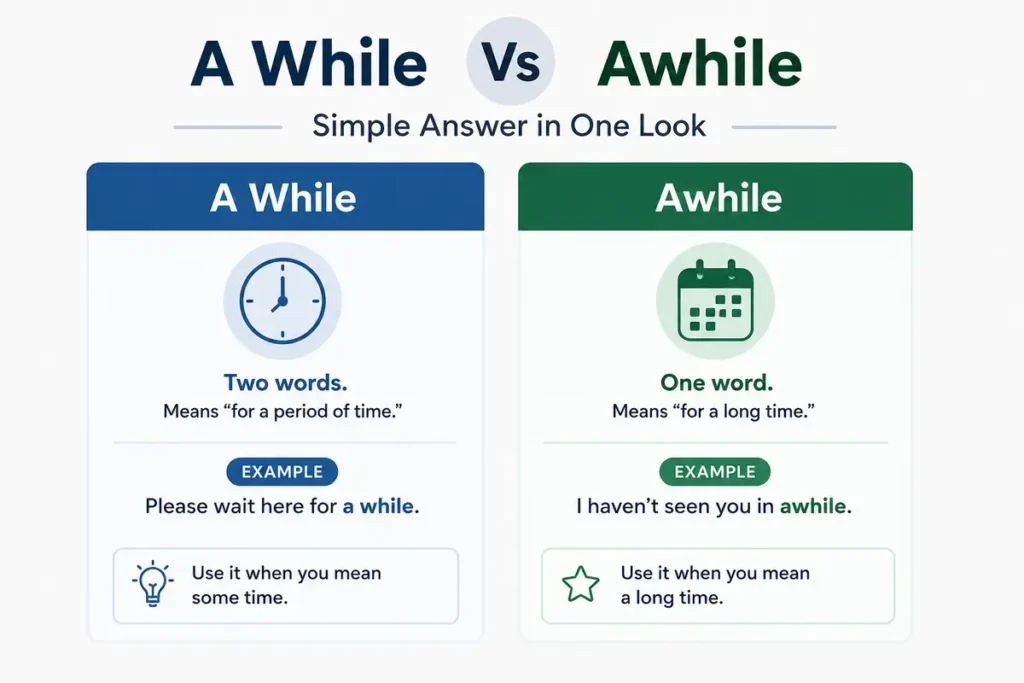
Simple Answer in One Look
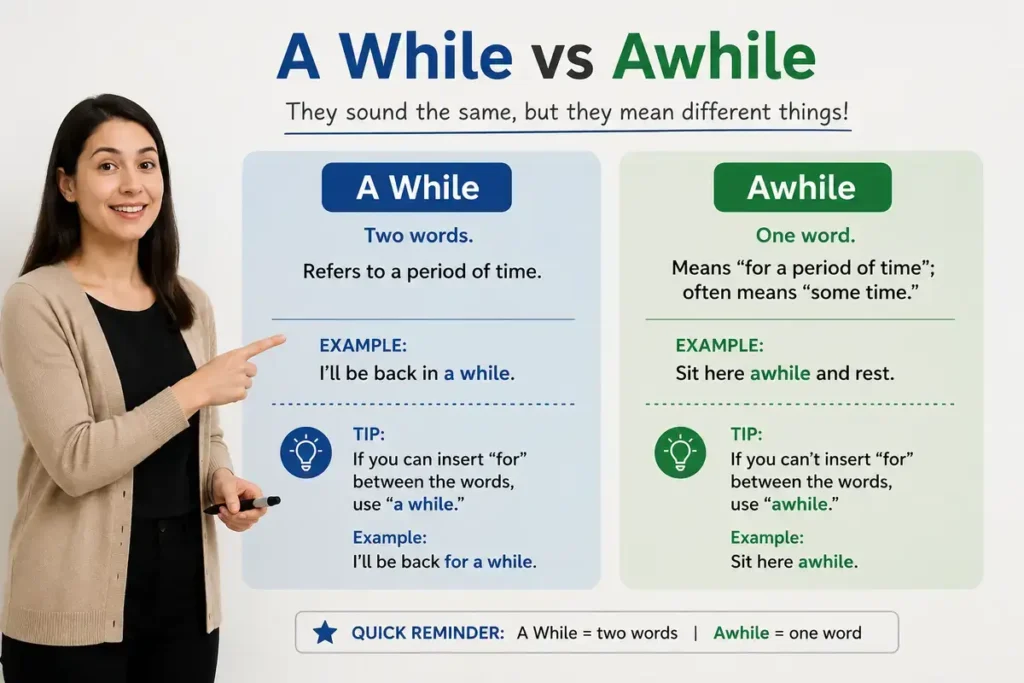
A while is a two-word phrase that means “a period of time.”
Awhile is a one-word adverb that means “for a short time.”
Means of A While Vs Awhile in Simple English
The easiest way to understand these words is to learn what each form means.
Meaning of “A While”
It means a period of time. It refers to some amount of time, usually not exact.
Examples:
- I waited for a while.
- We talked for a while.
- Sit here for a while.
In these examples, a while means a period of time.
Simple meaning:
A while = some time.
Meaning of “Awhile”
It means for a short time.
Examples:
- Stay awhile.
- Rest awhile.
In these examples, awhile already includes the idea of “for a while.”
Simple meaning:
Awhile = for a short time.
Quick Example A While Vs Awhile
Correct:
- Stay awhile.
Also correct:
- Stay for a while.
Both have similar meanings.
Reasons of People Mix A While Vs Awhile
Many people confuse a while vs awhile because they sound exactly the same when spoken.
Same Pronunciation
When people talk, both forms sound alike.
Examples:
- Stay awhile.
- Stay for a while.
You hear almost no difference.
Similar Meaning
Both forms relate to time. Both suggest a short period. This makes the confusion even more common.
Small Spelling Difference
The only visible difference is the space.
- A while
- Awhile
Many learners think the space does not matter. In English, it does matter.
Clear Difference of A While vs Awhile Explained Simply
The easiest way to remember the difference is to look at what comes before the words.
Use “A While” After a Preposition
Words like:
- for
- after
- in
- during
often need a while.
Examples:
- Wait for a while.
- After a while, it stopped raining.
- We stayed for a while.
Use “Awhile” Without a Preposition
Examples:
- Stay awhile.
- Rest awhile.
- Sit awhile.
Easy Comparison Table A While Vs Awhile
| Form | Meaning | Example |
|---|---|---|
| A while | A period of time | Wait for a while. |
| Awhile | For a short time | Stay awhile. |
Memory Trick
If the word for appears, use:
✅ for a while
❌ for awhile
This simple trick solves most mistakes.
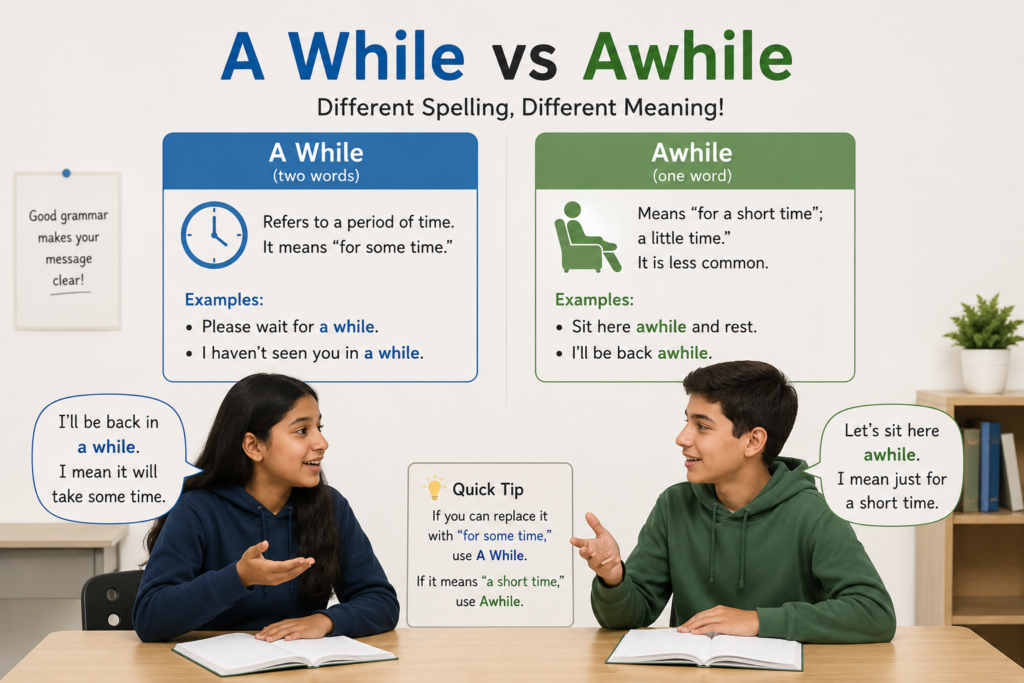
The Form We Should Use A While Vs Awhile
Ask yourself one simple question.
If Is There a Preposition Before It
Examples:
- for
- after
- during
- in
If yes, use a while.
Examples:
- We talked for a while.
- After a while, she left.
- I waited for a while.
If There Is No Preposition Before
Use awhile.
Examples:
- Stay awhile.
- Relax awhile.
- Rest awhile.
Quick Rule of A While vs Awhile
Preposition before it?
Use:
a while
No preposition?
Use:
awhile
Easy Real-Life Sentences of A While vs Awhile
Examples With A While
- We talked for a while.
- I waited for a while.
- After a while, the bus arrived.
- She stayed for a while.
- The children played for a while.
- We rested for a while.
- I have not seen him in a while.
- After a while, everyone laughed.
Examples With Awhile
- Stay awhile.
- Sit awhile.
- Rest awhile.
- Relax awhile.
- Wait awhile.
- Talk awhile.
- Sleep awhile.
- Visit awhile.
These examples show how each form naturally fits into a sentence.
Common Situations Where You Use A While
You will often see a while in everyday conversations.
Talking About Waiting
- I waited for a while.
Talking About Time
- It took a while.
Talking About Delays
- After a while, things improved.
Talking About Absence
- I have not seen her in a while.
These are very common English expressions.
Common Situations Where You Use Awhile
You will often see awhile after action words.
Examples:
- Stay awhile.
- Rest awhile.
- Sit awhile.
- Relax awhile.
These sentences sound natural and smooth.
Expressions You Will Hear Often
English speakers use many common expressions with these words.
For a While
Meaning:
For some time.
Example:
“We chatted for a while.”
In a While
Meaning:
Soon or after some time.
Example:
“I will call you in a while.”
After a While
Meaning:
After some time passes.
Example:
“After a while, the rain stopped.”
Stay Awhile
Meaning:
Remain for a short time.
Example:
“Please stay awhile.”
These expressions appear frequently in spoken English.
Origin of These Words A While Vs Awhile
Learning a little history can help you understand the difference.
Origin of While
The word while has been used in English for hundreds of years. It was in fact referred to a period of time.
Development of A While
People often used “a” plus “while” to mean:
“a period of time.”
This usage remains common today.
Development of Awhile
Over time, English speakers combined the words. The combined form became:
awhile
This newer form developed the meaning:
“for a short time.”
That is why both forms still exist today.
Deep Meaning, Culture, and Practical Use of A While vs Awhile
The expressions a while and awhile are common in everyday English. They appear in books, movies, songs, conversations, and stories because people often talk about time. Time is something everyone understands. Because of this, writers frequently use these expressions to make situations experience natural and realistic.
A While in Stories
Writers often use a while when describing a period of time.
Examples:
- After a while, the hero found the answer.
- They waited for a while before leaving.
- We talked for a while under the stars.
In these examples, a while helps show that time has passed.
Awhile in Stories
Writers often use this word when inviting someone to stay or rest.
Examples:
- Sit awhile and listen.
- Stay awhile with us.
- Rest awhile before your journey.
These sentences sound friendly and welcoming.
Writers Use These Expressions
These expressions help stories sense natural. People do not always talk about exact times like ten minutes or one hour. Instead, they often say:
- for a while
- after a while
- stay awhile
This sounds more conversational and human.
Biblical and Mythological Meaning A While Vs Awhile
Both words do not have special religious meanings. However, the idea of waiting for a period of time appears in many religious and mythological stories.
Time in Religious Stories
Many stories involve waiting. People may wait:
- For guidance
- For answers
- For help
- For change
Expressions like “after a while” fit naturally into these situations.
Time in Mythological Stories
Many myths include long journeys and periods of waiting. Heroes often spend a while searching for:
- Wisdom
- Treasure
- Knowledge
- Adventure
The concept of time passing is important in these stories.
Simple Lesson
In religion, mythology, or everyday life, patience often requires waiting for a while.
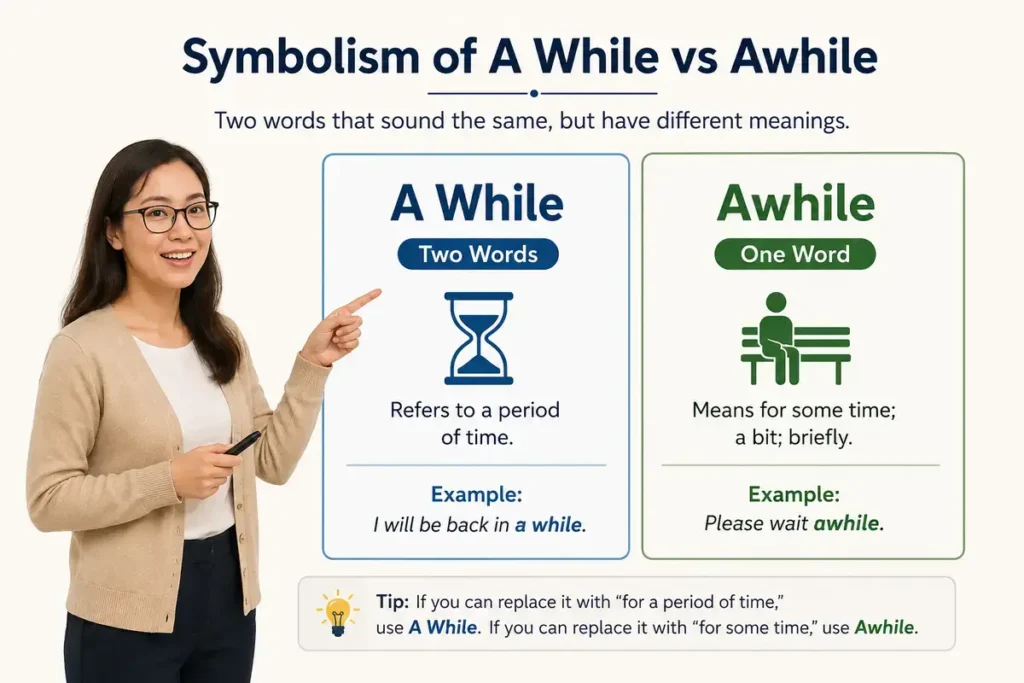
Symbolism of A While vs Awhile
Time often carries symbolic meaning. The expressions of these words can symbolize different ideas.
“A While” Represents
The phrase a while often represents the passage of time.
Patience
Sometimes good things take a while.
Growth
People grow and learn over time.
Change
Many changes happen after a while.
Experience
Life experiences build over a period of time.
“Awhile” Represents
The word awhile often represents a pause.
Rest
People sometimes need to stop and rest awhile.
Comfort
The word often sounds warm and welcoming.
Slowing Down
It encourages people to take their time.
Connection
When someone says “stay awhile,” they often want company.
Quick Symbolism Comparison of A While vs Awhile
| Expression | Symbolic Meaning |
|---|---|
| A while | Time passing, patience, growth |
| Awhile | Rest, comfort, pause, connection |
These symbolic meanings help explain why both expressions are common in literature and conversation.
Related Words to A While Vs Awhile You Should Know
Learning related vocabulary makes understanding easier.
Time
The ongoing passage of moments.
Example:
“Time moves quickly.”
Period
A length of time.
Example:
“It was a short period.”
Moment
A very short amount of time.
Example:
“Wait a moment.”
Duration
The length of time something lasts.
Example:
“The duration was one hour.”
Pause
A short stop.
Example:
“Take a pause.”
Rest
Time spent relaxing.
Example:
“We need some rest.”
Wait
To remain until something happens.
Example:
“Please wait here.”
Soon
In a short amount of time.
Example:
“I’ll be back soon.”
These words often appear in conversations about time and waiting.
Use of A While vs Awhile in Daily English
Native English speakers use these expressions every day.
Examples With A While
- I waited for a while.
- We talked for a while.
- After a while, the rain stopped.
- It took a while to finish.
- I have not seen him in a while.
Examples With Awhile
- Stay awhile.
- Sit awhile and relax.
- Rest awhile before leaving.
- Wait awhile and see.
- Talk awhile with your friends.
Common Spoken Expressions A While Vs Awhile
People often say:
- See you in a while.
- Stay awhile.
- Wait a while.
- It may take a while.
- After a while.
These expressions are very common in daily English.
Common Mistakes People Make about A While Vs Awhile
Many learners make similar mistakes when comparing a while or awhile.
Mistake 1: Writing “For Awhile”
Incorrect:
❌ We talked for awhile.
Correct:
✅ We talked for a while.
The word “for” usually requires a while.
Mistake 2: Writing “After Awhile”
Incorrect:
❌ After awhile, she arrived.
Correct:
✅ After a while, she arrived.
Mistake 3: Using A While Everywhere
Some learners use a while in every sentence.
Example:
Less natural:
❌ Stay a while.
More natural:
✅ Stay awhile.
Mistake 4: Thinking A While Vs Awhile Mean Different Lengths of Time
Both can refer to similar amounts of time.
The difference is mainly sentence structure and usage.
Easy Correction Rule
If you can replace the expression with “for some time,” use a while.
If there is no preposition before it, awhile may work.
Quick Practice of A While Vs Awhile
Choose the correct form.
- Wait _____.
- We talked for _____.
- After _____, the movie started.
- Stay _____.
Answers:
- awhile
- awhile
- a while
- a while
Popularity of These Expressions A While Vs Awhile
English speakers like simple ways to talk about time. Not every situation needs exact numbers. Instead of saying:
“I waited twenty-three minutes.”
People often say:
“I waited for a while.”
This sounds natural and conversational. Similarly, saying:
“Stay awhile.”
Sounds warmer than:
“Remain here for a short period.”
Simple expressions often survive because they are easy and useful.
Final Teacher Explanation A While Vs Awhile
Imagine a student asks:
“Teacher, what is the difference between a while and awhile?”
My answer would be simple.
A while is a two-word phrase meaning a period of time.
Awhile is a one-word word meaning for a short time.
The easiest rule is to look for words like:
- for
- after
- in
If one of these comes before it, use a while.
Examples:
- for a while
- after a while
- in a while
If there is no preposition, awhile often works.
Examples:
- Stay awhile.
- Rest awhile.
Remember:
For a while. Stay awhile.
That simple memory trick helps most learners choose correctly.
Quick Recap A While Vs Awhile
When comparing these words, both relate to time, but they are used differently.
A while is a two-word phrase meaning a period of time. Awhile is a one-word form meaning for a short time.
Remember: for a while, stay awhile.
Conclusion
When comparing a while vs awhile, the difference is mainly in usage and sentence structure. A while means a period of time and usually follows words like for, after, or in, while awhile means for a short time and is often used without a preposition. Understanding this meaning, usage, and word choice helps improve your vocabulary and writing accuracy.
A simple way to remember the rule is: for a while, stay awhile. By paying attention to context and sentence patterns, you can choose the correct form confidently and avoid common grammar, spelling, and communication mistakes in everyday English.
Frequently Asked Questions
What is the difference between a while and awhile?
A while is a phrase meaning a period of time. Awhile means for a short time.
Which is correct, a while or awhile?
Both are correct. The correct choice depends on how the sentence is written.
When should I use a while?
Use a while after words such as for, after, and in.
When should I use awhile?
Use awhile when no preposition comes before it.
Is “for awhile” correct?
No. Standard English prefers “for a while.”
Is “stay awhile” correct?
Yes. This is a common and correct expression.
Why do people confuse a while and awhile?
They sound the same and have similar meanings related to time.
Can I use both in formal writing?
Yes. Both are correct when used in the right context.