
Many English learners get confused about Look, See and Watch because all three words are about using your eyes. They seem similar, but they are used in different situations. The good news is that the difference is easy to learn. Once you understand the meaning of each word, you will know exactly which one to use.
In this lesson, you will learn the difference between Look, See and Watch with simple explanations, easy rules, and real-life examples. By the end, you will feel confident using these words in everyday English.
If you enjoy learning word differences, you may also like our guide on commonly confused words.
Simple Answer in One Look
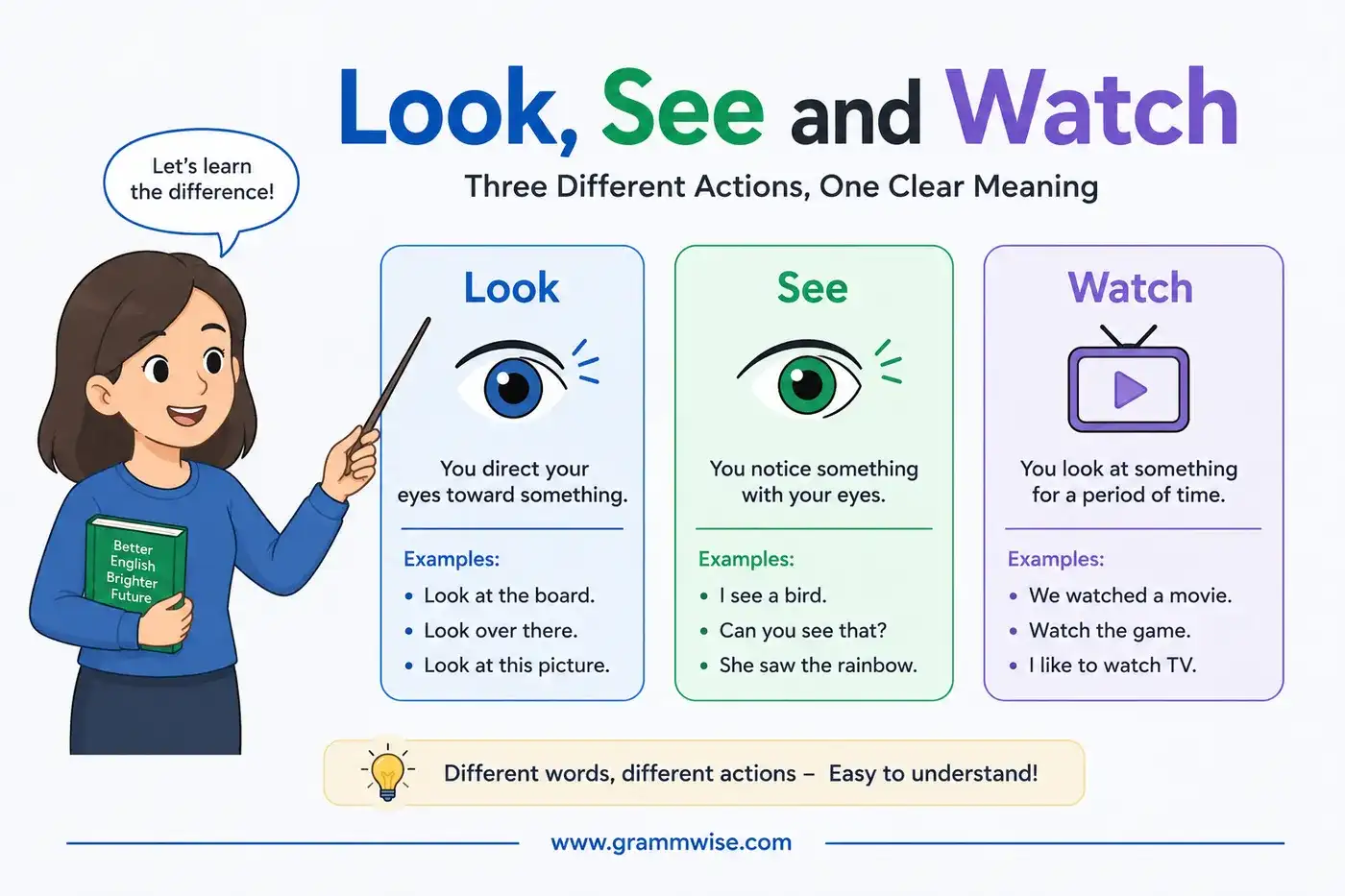
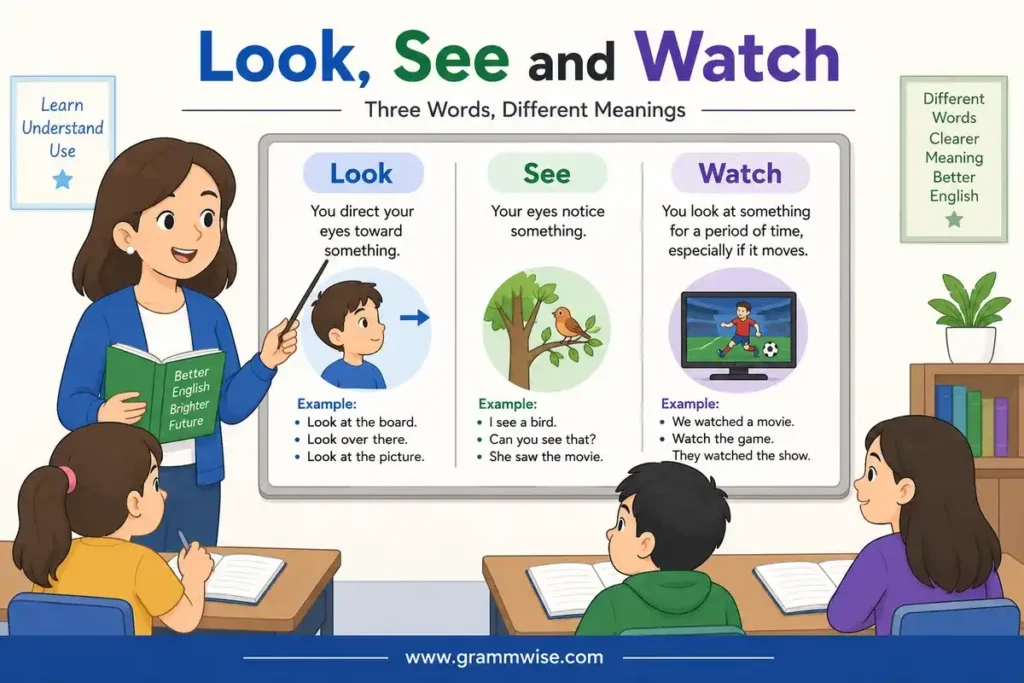
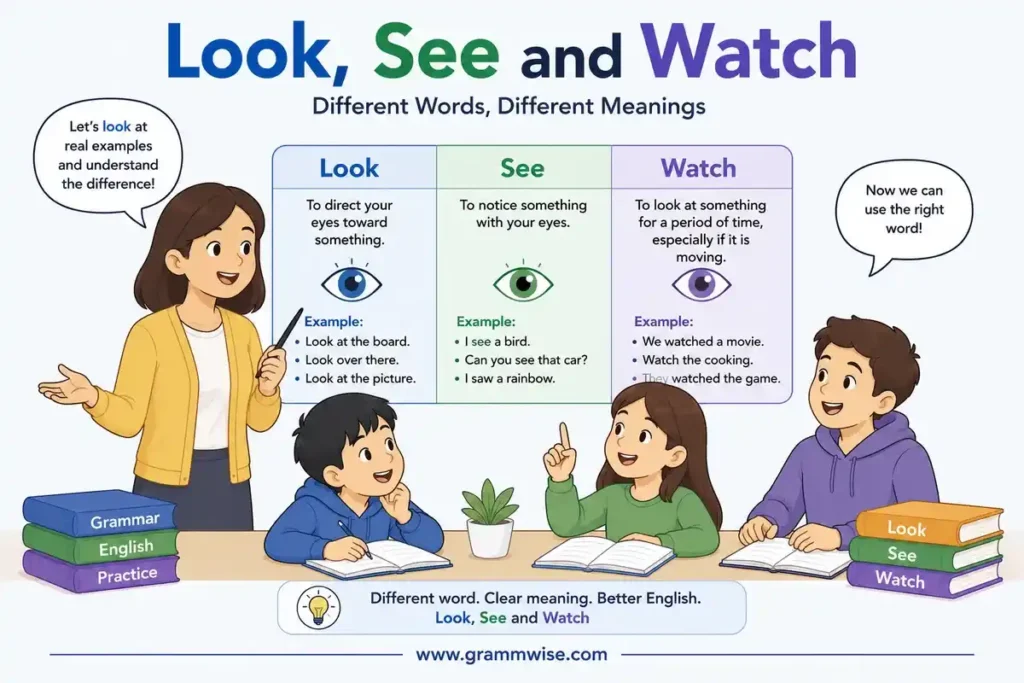
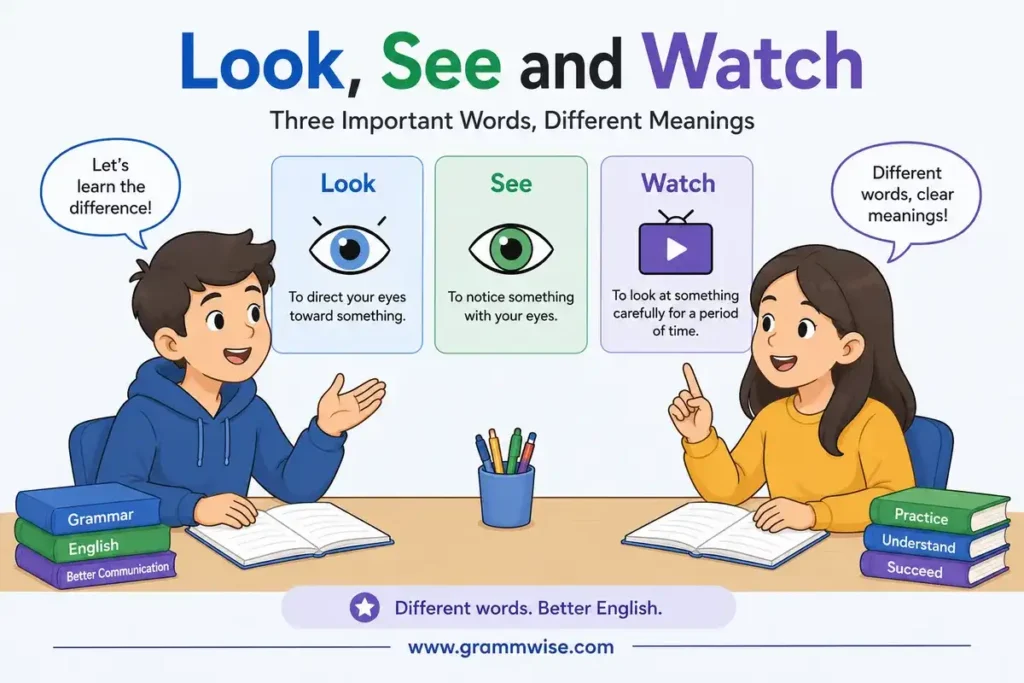
Look means to turn your eyes toward something.
See means to notice something with your eyes.
Watch means to look at something carefully for some time, usually because it is moving or changing.
Meaning of “Look, See and Watch” in Simple English
These three words all use your eyes, but they do different jobs.
What does look mean?
Look means you choose to move your eyes toward something.
You make an effort to see it.
Examples:
- Look at the sky.
- Please look at me.
- Look out the window.
- Look at this picture.
In every example, someone is choosing where to look.
What does see mean?
See means your eyes notice something.
You do not always plan it.
Sometimes it happens naturally.
Examples:
- I can see a bird.
- Did you see my keys?
- She saw a rainbow.
- We can see the mountains.
You are simply noticing something with your eyes.
What does watch mean?
Watch means you keep looking at something for a period of time.
Usually, the thing is moving or changing.
Examples:
- We watched a movie.
- They watched the football game.
- Watch the baby carefully.
- I like to watch birds.
Watching takes more time than looking.
When learning Look, See and Watch, remember this simple idea:
- Look = turn your eyes.
- See = notice with your eyes.
- Watch = keep looking for some time.
Look, See and Watch: Why People Mix These Words?
Many learners mix up Look, See and Watch because all three are connected to vision.
They also appear in many everyday conversations.
For example:
Someone says,
“Look!”
A few seconds later, another person says,
“I see it!”
Then everyone says,
“Let’s watch it.”
All three words can appear in the same situation, but each one has a different meaning.
Another reason for the confusion is that many languages use one word where English uses three.
So learners often translate directly from their first language.
That creates mistakes.
The easiest solution is to think about what your eyes are doing.
- Are you choosing?
- Are you noticing?
- Are you following something?
The answer tells you which word to use.
Clear Difference Between “Look, See and Watch”
Here is the easiest comparison.
Look
- You choose where to move your eyes.
- Usually followed by at.
- Starts the action.
Examples:
- Look at the stars.
- Look at your book.
- Look over there.
See
- Your eyes notice something.
- No special effort is needed.
- It often happens naturally.
Examples:
- I see a butterfly.
- Can you see the moon?
- She saw her friend.
Watch
- You look carefully for a longer time.
- Usually used for moving things.
- Shows attention.
Examples:
- Watch TV.
- Watch the children.
- Watch the game.
Here is a quick comparison table.
| Word | Meaning | Example |
|---|---|---|
| Look | Turn your eyes toward something | Look at the board. |
| See | Notice something with your eyes | I see a bird. |
| Watch | Look carefully for some time | We watched a movie. |
This simple table helps many students remember Look, See and Watch.
Look, See and Watch: Which Form Should You Use?
Ask yourself one question.
“What are my eyes doing?”
If you are moving your eyes toward something, use look.
Example:
- Look at that tree.
If you simply notice something, use see.
Example:
- I can see the tree.
If you spend time looking because something is happening, use watch.
Example:
- Watch the birds flying.
Here are more examples.
Situation:
Your teacher points to the board.
You say:
- I am looking at the board.
After reading it, you say:
- I see the answer.
Then your teacher starts a science experiment.
You say:
- We are watching the experiment.
Every word fits a different moment.
Easy Real-Life Sentences on “Look, See and Watch”
These are natural sentences you can use every day.
- Look at this photo.
- Look over there.
- Please look at the screen.
- I can see your house.
- Can you see the bus?
- I saw my teacher yesterday.
- We watched a movie last night.
- They watched the sunset together.
- Watch where you are walking.
- I love to watch birds in the park.
These examples sound natural because native speakers use them all the time.
Look, See and Watch: Where These Words Come From?
The words look, see, and watch have been part of English for hundreds of years.
The word see is one of the oldest words in English.
It has always meant noticing something with your eyes.
The word look has long meant directing your eyes toward something.
People used it when asking others to pay attention.
The word watch first meant staying awake and paying careful attention.
Long ago, guards watched cities at night.
Over time, the meaning became wider.
Now we watch movies, sports, animals, children, and many other things.
Although these words have old histories, their meanings are still easy to understand today.
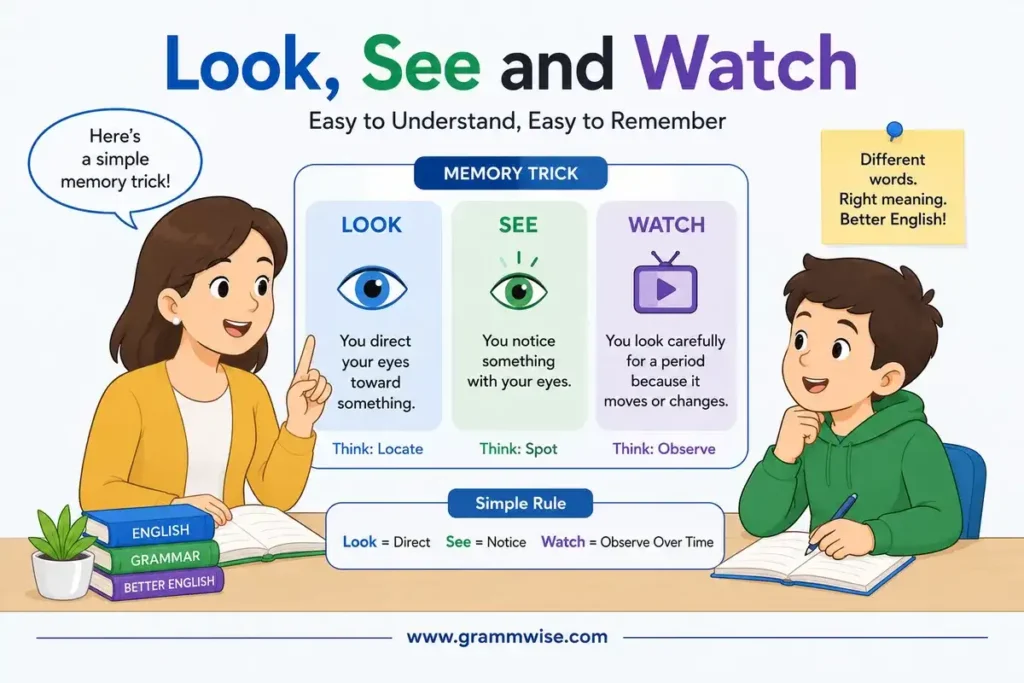
Easy Memory Trick
Here is a simple classroom trick.
Look starts with L.
Think of L for Locate.
You first locate something.
See starts with S.
Think of S for Spot.
You spot something with your eyes.
Watch means you stay and keep looking.
Think of watching a movie.
It takes time.
Remember this:
Look → See → Watch
First, you look.
Then you see.
Then you watch if it keeps moving.
Practice Quiz
Choose the correct word.
- Please ______ at the map.
- I can ______ the mountains.
- We ______ a funny movie last night.
- Can you ______ my glasses?
- ______ the baby while I cook.
- I ______ a rainbow after the rain.
Answers
- Look
- See
- Watched
- See
- Watch
- Saw
Look, See and Watch: How These Words Are Understood in Culture and Stories?
The words Look, See and Watch are used in books, movies, songs, and everyday conversations. They help people describe how they use their eyes and pay attention to the world around them.
In stories, look is often used when a character is asked to pay attention.
Examples:
- “Look behind you!”
- “Look at the treasure!”
- “Look at the beautiful castle!”
The word creates action. It tells someone to turn their eyes toward something important.
The word see is different.
It is often used when someone notices or discovers something.
Examples:
- “I see the answer now.”
- “Can you see the problem?”
- “She saw a light in the distance.”
In stories, see often shows understanding or discovery.
The word watch is commonly used when people observe something for a period of time.
Examples:
- “They watched the stars all night.”
- “We watched the race together.”
- “The children watched the magician.”
In movies and books, watching usually means paying close attention.
When you understand Look, See and Watch, you begin to notice how often they appear in stories and conversations.
Biblical and Mythological Meaning of “Look, See and Watch”
These words are not special religious words, but they appear often in religious and mythological stories.
The word look is sometimes used when someone is told to pay attention to an important event.
Example:
- Look at the signs.
- Look toward the future.
The word see is often connected to understanding.
Many stories use “see” to mean both noticing and understanding.
Examples:
- I see the truth.
- They could see God’s work.
The word watch often suggests staying alert.
Examples:
- Watch and be ready.
- Watch carefully.
In myths and legends, heroes often watch for danger, see important signs, and look toward their goals.
These ideas make the words easy to remember.
Symbolism of “Look, See and Watch” Explained in Simple Words
What Look Represents
Look represents attention.
It means choosing to focus on something.
It often symbolizes curiosity, learning, and interest.
Examples:
- Looking for answers
- Looking for clues
- Looking toward a goal
When someone says “look,” they are asking for attention.
What See Represents
See represents understanding and awareness.
It often symbolizes discovery.
Examples:
- Seeing the truth
- Seeing a solution
- Seeing a new opportunity
People sometimes say:
“I see what you mean.”
They are not talking about their eyes. They mean they understand.
What Watch Represents
Watch represents patience and attention over time.
It often symbolizes care and observation.
Examples:
- Watching a child
- Watching the weather
- Watching progress
Watching means staying focused instead of looking for only a moment.
This is the biggest difference in Look, See and Watch.
Related Words You Should Know
Learning related words helps you use English more naturally.
Observe
Observe means to watch carefully.
Example:
The scientist observed the animals.
Notice
Notice means to see something and become aware of it.
Example:
Did you notice the new sign?
Glance
A glance is a very quick look.
Example:
She took a glance at her phone.
Stare
Stare means to look for a long time.
Example:
Don’t stare at people.
View
View means what you can see or observe.
Example:
The mountain view was beautiful.
Gaze
Gaze means to look steadily, often with admiration.
Example:
He gazed at the stars.
Spot
Spot means to see or find something.
Example:
I spotted a rabbit in the field.
These words are useful because they are closely connected to Look, See and Watch.
How People Actually Use “Look, See and Watch” in Daily English
Here are natural examples that people use every day.
- Look at this picture.
- Can you see that bird?
- We watched a movie after dinner.
- Look at the menu.
- I see a mistake in the report.
- Watch the road carefully.
- Did you see my message?
- Look over there.
- We watched the football game together.
- I can see your house from here.
These examples sound natural because they are common in real conversations.
Common Mistakes People Make About “Look, See and Watch”
Many learners make the same mistakes with Look, See and Watch.
Mistake 1
❌ See at the board.
✅ Look at the board.
You choose where to move your eyes, so use look.
Mistake 2
❌ I watched a photo.
✅ I looked at a photo.
Photos do not move.
Mistake 3
❌ Look television every night.
✅ Watch television every night.
TV programs move and change.
Mistake 4
❌ I looked a bird.
✅ I saw a bird.
You noticed it with your eyes.
Mistake 5
❌ Watch this mountain.
✅ Look at this mountain.
The mountain is not moving.
A simple rule helps:
- Use look for directing your eyes.
- Use see for noticing.
- Use watch for observing something over time.
Final Teacher Explanation
Imagine we are in class together.
A student asks,
“Teacher, how do I know whether to use look, see, or watch?”
My answer is simple.
Think about what your eyes are doing.
- If you turn your eyes toward something, use look.
- If your eyes notice something, use see.
- If you keep paying attention for some time, use watch.
Remember this classroom sentence:
Look at it.
See it.
Watch it.
First, you direct your eyes.
Then, you notice it.
Finally, you keep observing it.
That simple idea solves most problems with Look, See and Watch.
Do not try to memorize long grammar rules.
Focus on meaning.
When you understand the meaning, choosing the correct word becomes easy.
Quick Recap “Look, See and Watch”
Look means to direct your eyes toward something.
See means to notice something with your eyes.
Watch means to look at something carefully for a period of time, usually because it moves or changes.
Remember: Look = direct your eyes, See = notice, Watch = observe for some time.
Conclusion
Look, See and Watch are easy to use once you understand what each word means. Use look when you direct your eyes, see when you notice something, and watch when you observe something for a period of time.
Keep practicing these words in real conversations, books, and everyday situations. The more you use them, the more natural they will become, helping you speak and write English with confidence and accuracy.
Frequently Asked Questions (FAQs)
What is the difference between Look, See and Watch?
Look means direct your eyes, see means notice something, and watch means observe something for a period of time.
When should I use look?
Use look when you intentionally move your eyes toward something.
When should I use see?
Use see when you notice something with your eyes.
When should I use watch?
Use watch when you observe something moving or changing over time.
Do I watch or look at TV?
Use watch TV because television programs move and change.
Do I look at or watch a picture?
Use look at a picture because a picture does not move.
Why do learners confuse Look, See and Watch?
All three words are related to vision, so they seem similar at first.
Can I use these words in everyday English?
Yes. They are among the most common verbs in English and are used every day in speaking and writing.