
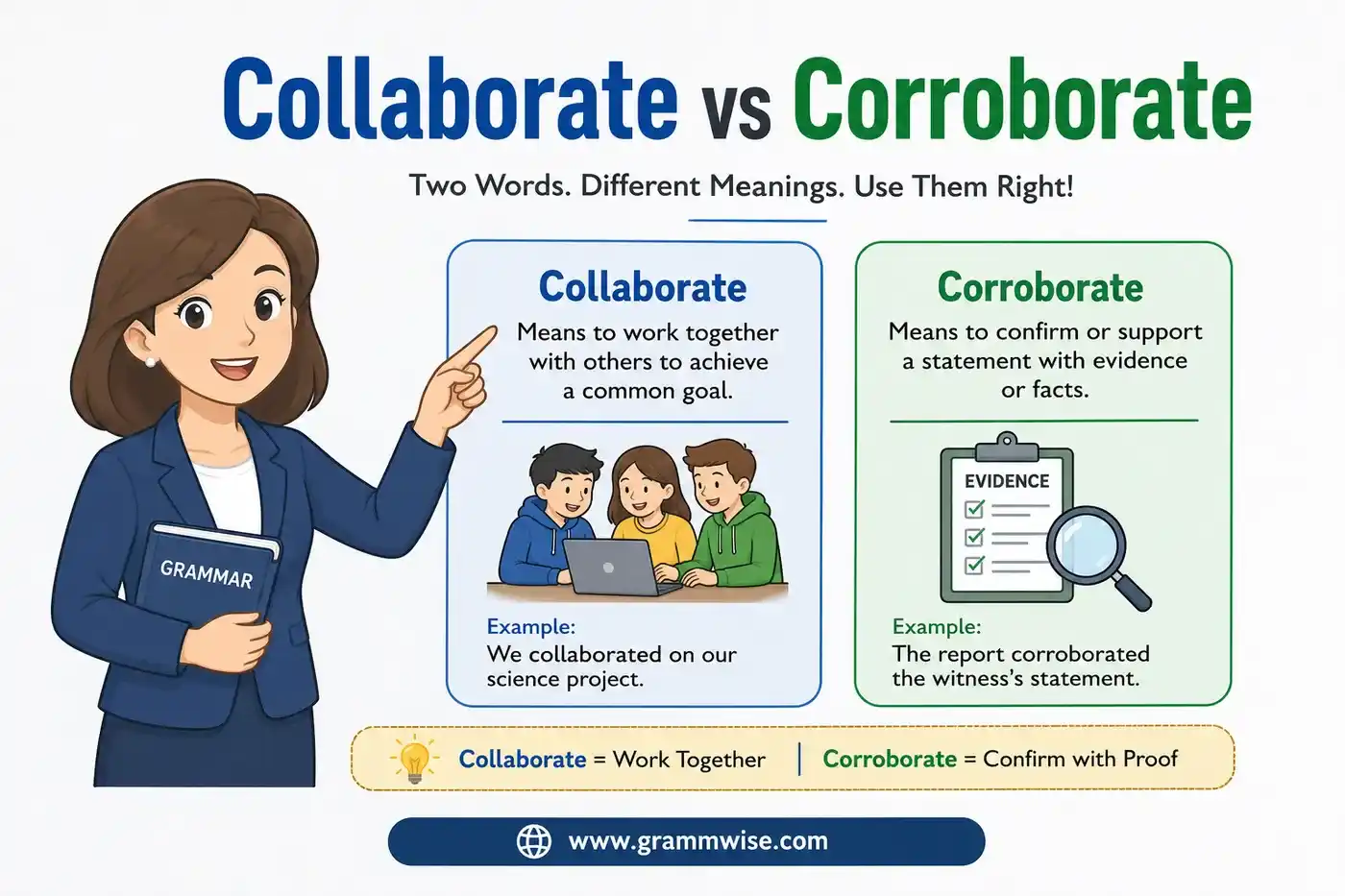
Many English learners get confused about Collaborate vs Corroborate because the words look a little alike. They also have similar endings, which makes them easy to mix up. However, they have very different meanings and are used in different situations.
If you have ever wondered which word is correct, you are not alone. One word is about working together, while the other is about proving that something is true. Knowing the difference will help you speak and write English more clearly.
In this guide, I will explain Collaborate vs Corroborate in simple English. You will learn what each word means, why people confuse them, when to use each one, and how to remember the difference with easy examples.
Understanding word differences improves writing clarity and communication.
Simple Answer in One Look
- Collaborate means to work together with other people to reach a shared goal.
- Corroborate means to confirm or support that something is true with evidence.
Easy rule:
- Collaborate = Work together
- Corroborate = Confirm with proof
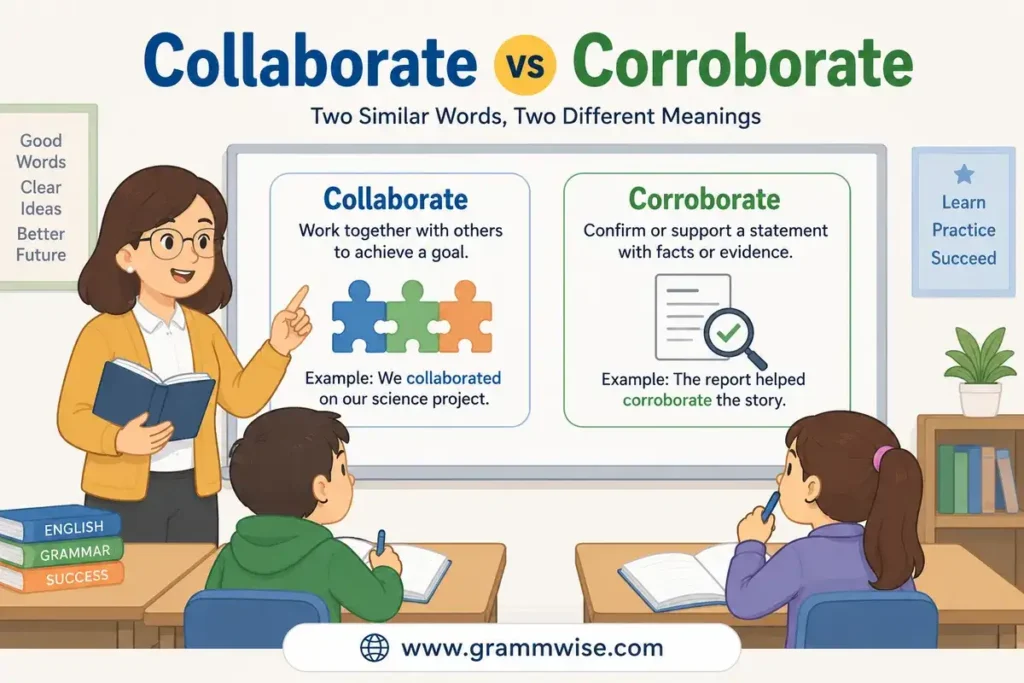
Meaning of “Collaborate vs Corroborate” in Simple English
These two words may look similar, but they have different jobs in English.
What does “collaborate” mean?
Collaborate means working together with another person or a group.
Everyone helps each other to finish the same task.
People collaborate at school, at work, in sports, and even at home.
For example:
- We collaborated on our science project.
- The teachers collaborated to plan the school event.
- Two artists collaborated to create a beautiful painting.
In each example, people are working together.
What does “corroborate” mean?
Corroborate means proving or confirming that something is true.
You do this by showing facts, evidence, or another person’s statement.
For example:
- The video helped corroborate her story.
- The witness could corroborate what happened.
- The doctor’s report corroborated the patient’s statement.
In these examples, evidence supports the truth.
Collaborate vs Corroborate: Why People Mix These Words?
Many people confuse these words for a few simple reasons.
1. They look similar.
Both words begin with co- and end with -ate.
Compare them:
- Collaborate
- Corroborate
At first glance, they seem almost the same.
2. They sound a little alike.
Although the middle sounds are different, many English learners hear only the beginning and ending.
This makes the words easy to confuse during conversation.
3. Both involve more than one person.
When people collaborate, they work together.
When someone corroborates a story, another person or piece of evidence helps confirm it.
Since both often involve several people, learners sometimes think the meanings are the same.
4. They are often used in formal English.
You may see both words in school books, news articles, reports, and business writing.
Because they appear in similar places, some writers accidentally choose the wrong one.
Clear Difference Between “Collaborate vs Corroborate”
Here is the easiest way to understand the difference.
| Collaborate | Corroborate |
|---|---|
| Means to work together | Means to confirm with evidence |
| Used for teamwork | Used for proof or support |
| People cooperate on a task | Facts or people support a statement |
| Focuses on working together | Focuses on showing something is true |
Think about these questions.
Are people working together?
If yes, use collaborate.
Are facts, evidence, or witnesses proving something?
If yes, use corroborate.
A quick comparison
Collaborate
- classmates
- coworkers
- artists
- musicians
- scientists
- teammates
Corroborate
- witness
- evidence
- report
- document
- photograph
- video recording
Collaborate vs Corroborate: Which Form Should You Use?
Ask yourself one simple question.
Are people working together?
If yes, choose collaborate.
Examples:
- Our team collaborated on the project.
- The students collaborated during class.
- The engineers collaborated to solve the problem.
Are you confirming something with proof?
If yes, choose corroborate.
Examples:
- The photos corroborated his story.
- The report corroborated the witness’s statement.
- The security camera corroborated the police report.
A simple memory trick for “Collaborate vs Corroborate”
Remember these easy clues.
Collaborate contains “labor.”
People work together during labor or work.
So:
Collaborate = Work together
Now think about corroborate.
The word contains “robor,” which comes from an old word meaning strength.
Evidence makes a statement stronger.
So:
Corroborate = Strengthen with evidence
You do not have to remember the history of the word.
Just remember this simple idea:
Collaborate = Teamwork
Corroborate = Proof
Easy Real-Life Sentences on “Collaborate vs Corroborate”
Here are some everyday examples.
Using “collaborate”
- We collaborated on our homework after school.
- The designers collaborated on the new logo.
- Our class collaborated to clean the playground.
- Two musicians collaborated on a new song.
- The teachers collaborated to improve the lesson plan.
- Scientists from different countries collaborated on the research.
- My friends and I collaborated to organize the party.
Using “corroborate”
- The video corroborated his explanation.
- The witness corroborated the driver’s story.
- The doctor’s report corroborated the test results.
- The photos helped corroborate the news report.
- New evidence corroborated her claim.
- The email corroborated what the manager had said.
- Several documents corroborated the company’s records.
Everyday conversation examples
Correct
“We collaborated to finish the presentation.”
“The security camera corroborated the witness’s statement.”
“Our teachers collaborated on the new school program.”
“The report corroborated everything he told us.”
“The volunteers collaborated to prepare food for the event.”
These examples show that one word is about working together, while the other is about supporting the truth with evidence.
Collaborate vs Corroborate: Where These Words Come From?
The words collaborate and corroborate have different histories.
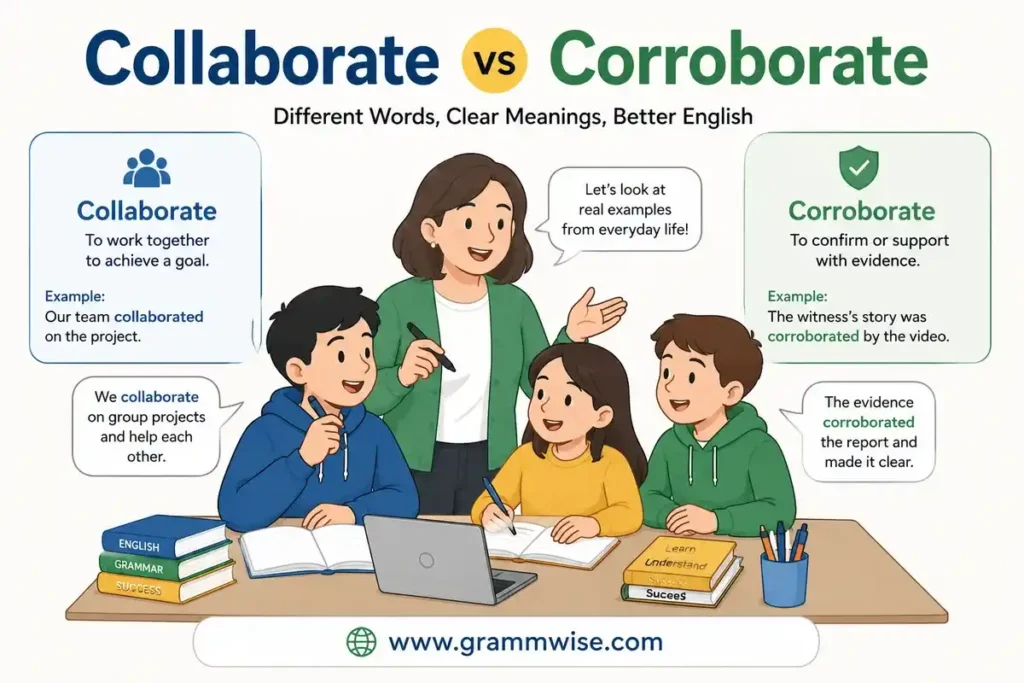
The word collaborate comes from a Latin word that means to work together. Over time, English kept this meaning. Today, people collaborate when they share ideas and work toward the same goal.
The word corroborate also comes from Latin. It originally meant to make stronger. In modern English, we use it when evidence, facts, or another person makes a statement stronger by showing that it is true.
Although these words begin with the same letters, they grew into two different meanings.
One is about teamwork.
The other is about proof.
Learning this simple difference makes it much easier to choose the correct word.
Collaborate vs Corroborate: How These Words Are Understood in Culture and Stories?
The words Collaborate and Corroborate are used in different ways, but both are important in everyday life.
The word collaborate often gives people a positive feeling. It reminds us of teamwork, friendship, and helping each other. Schools encourage students to collaborate on group projects. Businesses ask employees to collaborate to solve problems. Sports teams collaborate to win games.
Many stories also show the power of collaboration. A group of friends may work together to save their town. A family may collaborate to overcome a challenge. These stories teach that people can often do more together than alone.
The word corroborate is connected with truth and trust. It is common in news stories, police reports, court cases, science, and history.
When someone makes a claim, other people often look for facts to corroborate it. This helps people know whether something is true.
For example, a news reporter may interview several people to corroborate a story. A scientist may repeat an experiment to corroborate the results. A teacher may ask for evidence to corroborate a student’s answer.
Although these words have different meanings, both help people communicate clearly. One builds teamwork. The other builds trust.
Biblical and Mythological Meaning of “Collaborate vs Corroborate”
Neither collaborate nor corroborate has a special Biblical or mythological meaning.
However, the ideas behind these words appear in many stories.
The Bible often shows people collaborating to complete important work. Families, leaders, and communities worked together to build, travel, and help others.
The Bible also shows the importance of corroborating the truth. Important events were often confirmed by more than one witness. This helped people trust what they heard.
In mythology, heroes often collaborate with friends or helpers before completing a difficult journey. Their actions are sometimes corroborated by signs, messages, or other characters.
These are simple examples of the ideas behind the words, not official meanings.
Symbolism of “Collaborate vs Corroborate”
What “Collaborate” Represents
The word collaborate often represents:
- teamwork
- friendship
- cooperation
- sharing ideas
- helping others
- trust
- unity
- success
When people collaborate, they combine their skills. Each person helps the group move toward the same goal.
Many schools teach collaboration because it helps students learn from one another.
What “Corroborate” Represents
The word corroborate often represents:
- truth
- honesty
- evidence
- proof
- trust
- confidence
- accuracy
- fairness
When evidence corroborates a statement, people feel more confident that it is true.
Corroboration helps people make fair decisions instead of guessing.
Related Words You Should Know
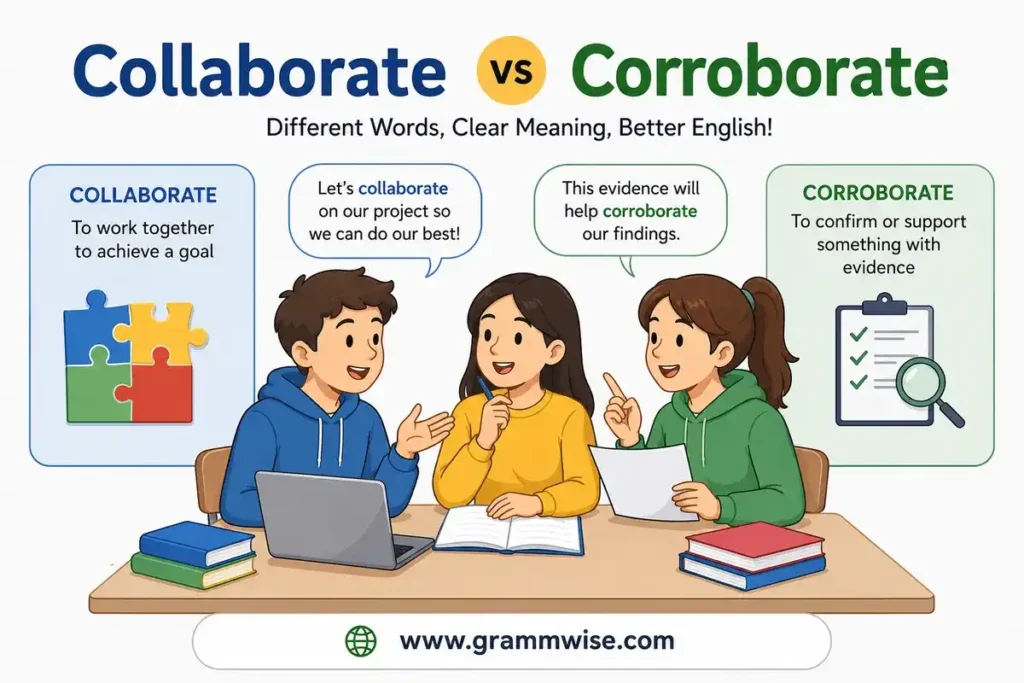
Learning related words makes it easier to remember Collaborate vs Corroborate.
Cooperate
To work together politely toward the same goal.
Teamwork
People helping one another to finish a task.
Partnership
Two or more people working together.
Support
To help another person or idea.
Confirm
To show that something is true.
Verify
To check whether information is correct.
Evidence
Facts that help prove something.
Witness
A person who sees an event happen.
Proof
Information that shows something is true.
Testimony
A statement given by a witness.
These words often appear in the same situations as collaborate or corroborate.
How People Actually Use “Collaborate vs Corroborate” in Daily English
Here are some real-life examples.
Using “Collaborate”
- Our class collaborated on the science fair project.
- The doctors collaborated to help the patient.
- My brother and I collaborated on building the treehouse.
- The artists collaborated on a beautiful mural.
- Several companies collaborated to create a new product.
Using “Corroborate”
- The video corroborated the witness’s story.
- The police found evidence that corroborated his statement.
- The doctor’s report corroborated the test results.
- The email corroborated everything she said.
- Several photos corroborated the newspaper article.
Everyday Conversations
“We collaborated to finish the school project.”
“Can anyone corroborate what he just said?”
“The engineers collaborated on the new bridge.”
“The security cameras corroborated the manager’s report.”
“Our family collaborated to prepare dinner.”
These examples show how naturally the two words are used in spoken and written English.
Common Mistakes People Make About “Collaborate vs Corroborate”
Many learners accidentally choose the wrong word because both begin with co- and end with -ate.
Here are some common mistakes.
Mistake 1
❌ We corroborated on the class project.
✅ We collaborated on the class project.
People work together on projects.
Mistake 2
❌ The witness collaborated his story.
✅ The witness corroborated his story.
A witness confirms information with evidence.
Mistake 3
❌ The teachers corroborated to improve the lesson.
✅ The teachers collaborated to improve the lesson.
Teachers work together.
Mistake 4
❌ The photos collaborated his claim.
✅ The photos corroborated his claim.
Photos provide proof.
The easiest way to avoid mistakes is to ask yourself one simple question.
Are people working together?
If yes, use collaborate.
Are facts or evidence proving something?
If yes, use corroborate.
Final Teacher Explanation
Now imagine we are finishing today’s English lesson. Here is the easiest way to remember Collaborate vs Corroborate. If people are working together, use collaborate.
Think about classmates, coworkers, friends, musicians, or scientists. They collaborate when they share ideas and help each other reach the same goal.
If you are talking about proof, facts, or evidence, use corroborate.
Think about a witness, a report, a photograph, a video, or a document. These things corroborate a story because they help prove that it is true.
A simple memory trick makes this easy.
Collaborate = Teamwork
Corroborate = Proof
Before choosing the word, ask yourself one question.
“Are people working together, or is someone proving that something is true?”
The answer will guide you to the correct word every time.
Practice using both words in your own sentences. The more you read and write them, the more natural they will become.
Quick Recap “Collaborate vs Corroborate”
The difference between Collaborate vs Corroborate is easy.
Use collaborate when people work together.
Use corroborate when facts, evidence, or witnesses confirm that something is true.
Just remember:
Collaborate = Work Together
Corroborate = Confirm with Proof

Conclusion
Understanding Collaborate vs Corroborate is easier once you know what each word means. Collaborate means to work together with others, while corroborate means to confirm something with facts or evidence. Remembering this simple difference will help you choose the correct word in speaking and writing.
Keep practicing these words in real-life sentences, and they will soon become natural to use. A simple memory trick can help too: Collaborate = Work Together and Corroborate = Confirm with Proof. With regular practice, you will avoid common mistakes and use both words with confidence.
Frequently Asked Questions (FAQs)
What does collaborate mean in simple words?
Collaborate means to work together with another person or a group to reach the same goal.
What does corroborate mean?
Corroborate means to confirm or support a statement with facts, evidence, or another person’s words.
What is the difference between collaborate vs corroborate?
Collaborate is about teamwork. Corroborate is about proving that something is true.
Why do people confuse collaborate vs corroborate?
They look and sound similar, but they have different meanings and are used in different situations.
When should I use collaborate?
Use collaborate when people share ideas or work together on a project or task.
When should I use corroborate?
Use corroborate when evidence, documents, or witnesses help confirm information.
Can a person corroborate a story?
Yes. A witness or another person can corroborate a story if they provide information that supports it.
Can people collaborate on a project?
Yes. Students, coworkers, artists, scientists, and many other groups collaborate on projects every day.