
Many English learners get confused by eminent vs imminent because the two words look and sound almost the same. They share many of the same letters, but they have very different meanings. This small spelling difference changes the whole meaning of a sentence.
The good news is that once you understand the basic idea behind each word, remembering the difference becomes much easier. You do not need to memorize long grammar rules. You only need to know what each word is talking about.
This guide explains eminent vs imminent in very simple English. You will learn the meaning of each word, why people confuse them, when to use them, and easy ways to remember them. By the end, you will be able to choose the correct word with confidence.
You might also find our comparison of similar confusing word pairs useful such as breath vs breathe.
Simple Answer in One Look
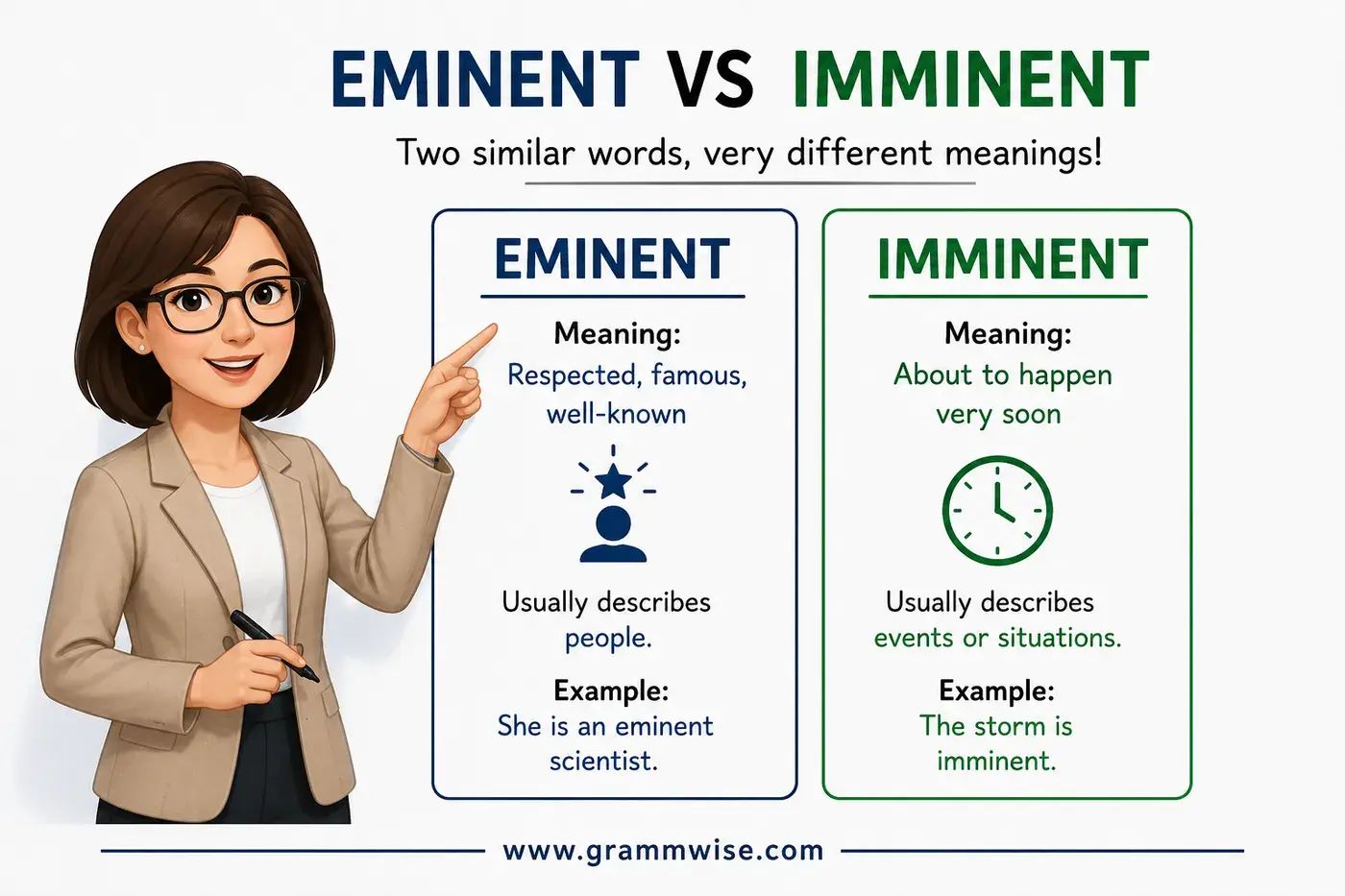
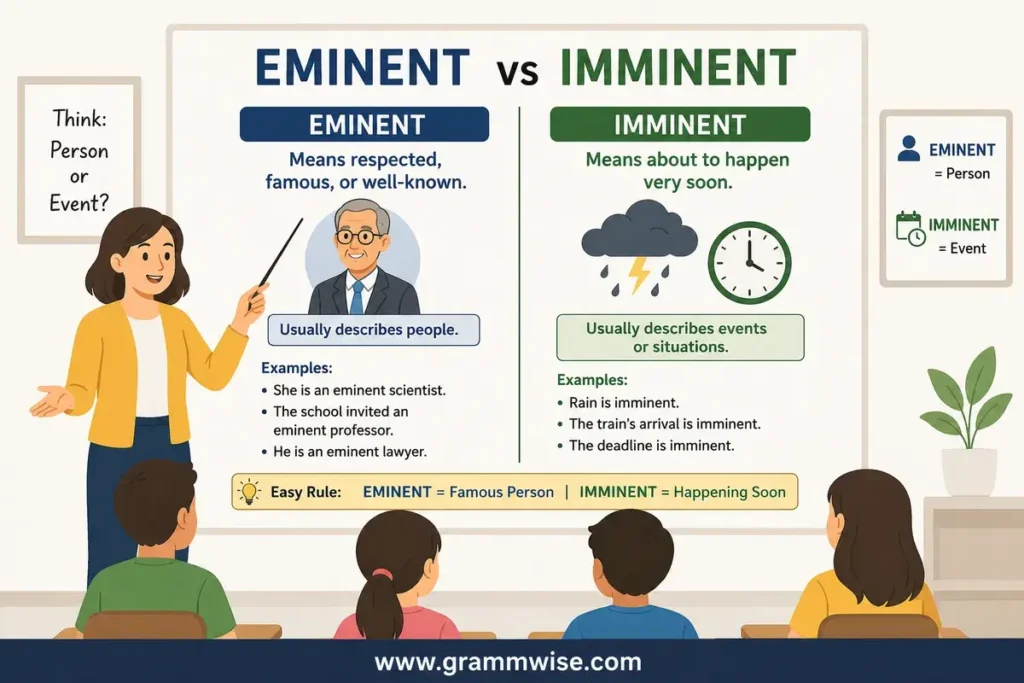
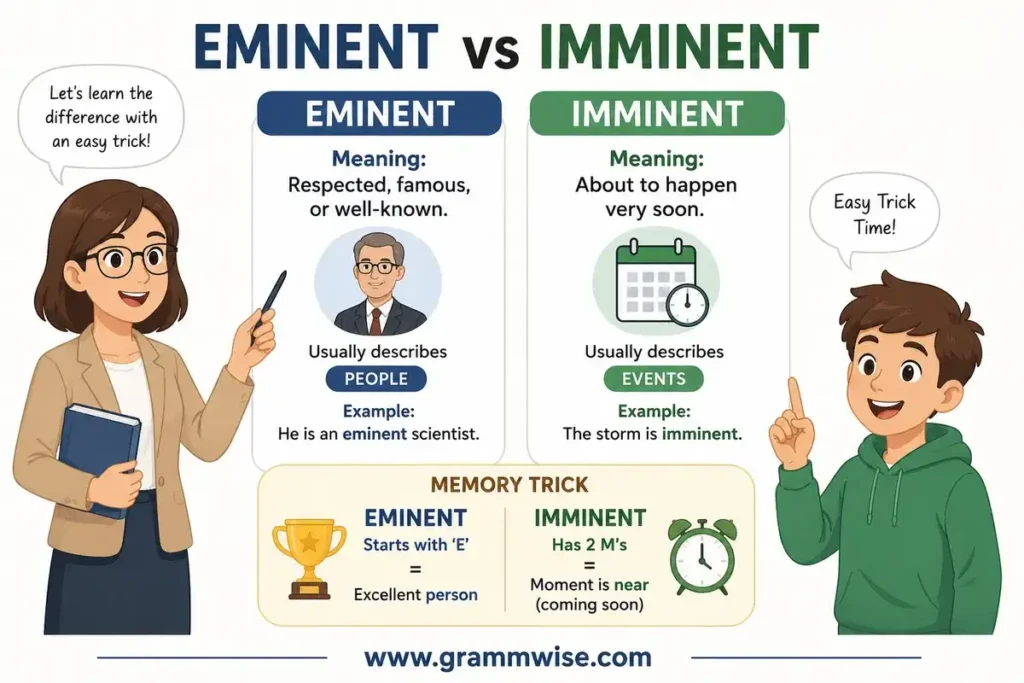
Eminent means well-known, respected, or famous because of great achievements.
Imminent means about to happen very soon.
Easy rule:
- Eminent = famous person
- Imminent = happening soon
Meaning of Eminent vs Imminent in Simple English
The easiest way to learn new words is to imagine real people and real situations.
What Does “Eminent” Mean?
Eminent describes a person who is respected because they are excellent at something.
They have worked hard for many years. Other people know and admire them.
Think about someone who is a famous doctor, teacher, scientist, artist, or writer. If people respect that person’s work, they may be called eminent.
Simple meaning:
Eminent = respected and well-known.
Examples:
- She is an eminent scientist.
- The hospital invited an eminent doctor.
- An eminent judge spoke at the event.
- He became an eminent author after writing many books.
- The school welcomed an eminent professor.
Notice something important.
The word eminent usually describes people. Sometimes it can describe a person’s work or position, but most often it refers to respected people.
What Does “Imminent” Mean?
Imminent means something is going to happen very soon.
The event has not happened yet.
But it is expected to happen almost immediately.
Simple meaning:
Imminent = about to happen.
Examples:
- Rain is imminent.
- The train’s arrival is imminent.
- The danger is imminent.
- The storm is imminent.
- A decision is imminent.
Notice another important point.
Imminent usually describes events, actions, or situations, not people.
Compare the Meanings Eminent vs Imminent
Read these two sentences.
The eminent doctor gave a speech.
Here, the doctor is famous and respected.
Now read this one.
The doctor’s arrival is imminent.
Here, the arrival will happen very soon.
The first sentence talks about who someone is.
The second sentence talks about when something will happen.
That is the biggest difference between eminent vs imminent.
Eminent vs Imminent: Why People Mix These Words?
Many students confuse these words for several simple reasons.
They Look Almost the Same
Look carefully.
Eminent
Imminent
Both words:
- have eight letters
- end with -nent
- begin with im or em
- are pronounced in a similar way
When people read quickly, they often miss the small spelling difference.
They Sound Similar
When spoken in normal conversation, these words can sound close to each other.
If you are still learning English, your ears may hear them as almost identical.
That makes it easy to choose the wrong word while writing.
Both Are Formal Words
You probably do not hear these words every day.
Instead, they often appear in:
- newspapers
- books
- speeches
- news reports
- business writing
- academic writing
Since learners do not see them often, remembering the meanings takes practice.
They Both Describe Something Important
Another reason for confusion is that both words often appear in serious situations.
Examples:
- an eminent scientist
- an eminent lawyer
- imminent danger
- imminent changes
- imminent attack
Because they appear in important topics, some learners think they have similar meanings.
They do not.
One Small Letter Changes Everything
Compare them again.
Eminent
Imminent
Only one extra m makes the meanings completely different.
That tiny spelling change is easy to miss.
Clear Difference of “Eminent vs Imminent” Explained Simply
Here is the easiest way to compare eminent vs imminent.
| Eminent | Imminent |
|---|---|
| Means respected or famous | Means about to happen |
| Usually describes people | Usually describes events |
| Talks about reputation | Talks about time |
| Refers to achievement | Refers to something coming soon |
| Positive meaning | Neutral meaning |
Another easy comparison:
Eminent asks: “Who is this person?”
Imminent asks: “When will this happen?”
Picture It in Your Mind “Eminent vs Imminent”
Imagine you are standing outside a hospital.
A famous surgeon walks inside.
You could say:
An eminent surgeon has arrived.
Now dark clouds fill the sky.
You could say:
Heavy rain is imminent.
One sentence describes the surgeon.
The other describes an event that will happen soon.
More Quick Comparisons
Eminent teacher
The teacher is respected.
Imminent exam
The exam is coming very soon.
Eminent artist
The artist is famous.
Imminent deadline
The deadline is almost here.
Eminent lawyer
The lawyer has a great reputation.
Imminent decision
The decision will happen shortly.
One Easy Memory Trick
Think about the letter M.
Imminent has two Ms.
Imagine those two Ms as two clocks standing together.
Clocks remind you of time.
Time reminds you that something is coming soon.
Now think about eminent.
Picture a respected person standing on a high stage while people clap.
That person is eminent because they are admired.
Eminent vs Imminent: Which Form Should You Use?
When choosing between eminent vs imminent, ask yourself one simple question.
Are You Talking About a Person?
If yes, use eminent.
Examples:
- an eminent professor
- an eminent engineer
- an eminent musician
- an eminent writer
- an eminent scientist
All of these describe respected people.
Are You Talking About Something That Will Happen Soon?
If yes, use imminent.
Examples:
- imminent danger
- imminent arrival
- imminent victory
- imminent storm
- imminent change
All of these describe events or situations.
Quick Decision Guide
Choose eminent if you mean:
- respected
- famous
- admired
- highly skilled
- well-known
Choose imminent if you mean:
- coming soon
- almost here
- about to happen
- expected very shortly
- close in time
Check the Sentence
Read the sentence.
“The ____ doctor spoke at the conference.”
The sentence describes the doctor.
Choose:
eminent
Now read this one.
“The storm is ____.”
The sentence describes an event.
Choose:
imminent
Common Mistakes
Incorrect:
The eminent storm is moving closer.
Correct:
The imminent storm is moving closer.
Incorrect:
An imminent scientist won the award.
Correct:
An eminent scientist won the award.
Incorrect:
The eminent deadline is tomorrow.
Correct:
The imminent deadline is tomorrow.
Incorrect:
The imminent professor wrote many books.
Correct:
The eminent professor wrote many books.
Easy Real-Life Sentences on “Eminent vs Imminent”
Reading real examples is one of the fastest ways to remember new words.
Sentences with “Eminent”
- Our town welcomed an eminent doctor.
- She became an eminent lawyer after many years of work.
- The school invited an eminent author to speak.
- Everyone admired the eminent scientist.
- He learned from an eminent teacher.
- The award honored an eminent artist.
- Many students wanted to meet the eminent professor.
- The magazine interviewed an eminent historian.
Sentences with “Imminent”
- Rain is imminent.
- The bus is imminent.
- The meeting is imminent.
- The deadline is imminent.
- The team’s victory seemed imminent.
- The rescue was imminent.
- A big announcement is imminent.
- The baby’s arrival is imminent.
Everyday Conversation
Friend:
“When is the train coming?”
Answer:
“I think its arrival is imminent.”
Teacher:
“Who is giving today’s speech?”
Student:
“An eminent scientist.”
Parent:
“The clouds look dark.”
Child:
“Does that mean rain is imminent?”
News Reporter:
“Officials believe more changes are imminent.”
Conference Host:
“We are honored to welcome an eminent professor.”
Mini Practice “Eminent vs Imminent”
Choose the correct word.
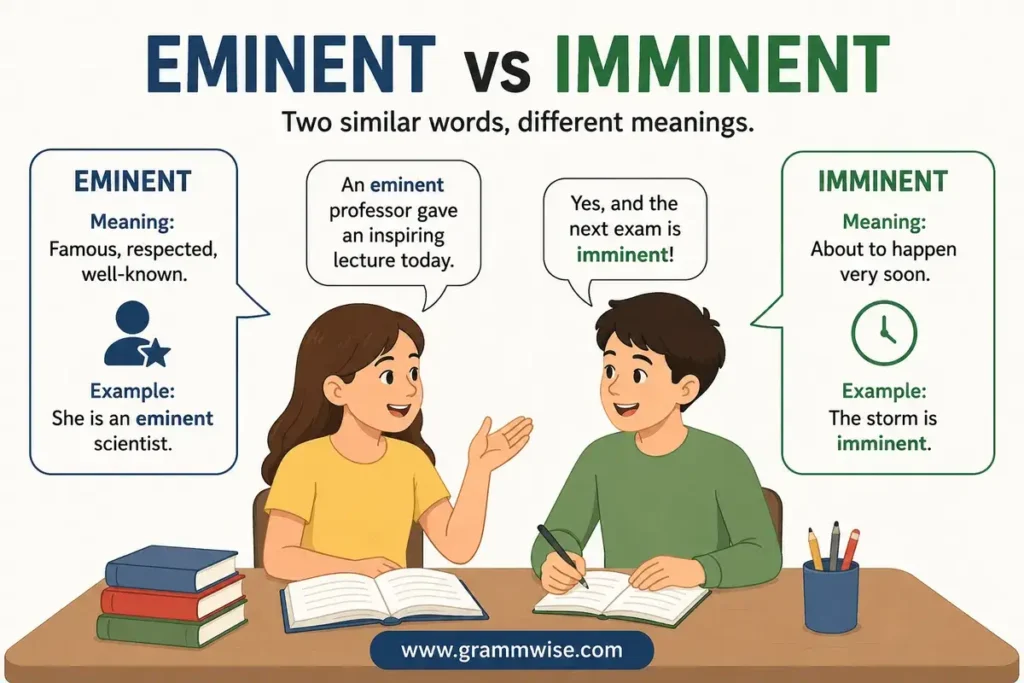
- The _____ judge gave an excellent speech.
- Answer: eminent
- The storm is _____.
- Answer: imminent
- She is an _____ writer.
- Answer: eminent
- The company’s decision is _____.
- Answer: imminent
- An _____ engineer designed the bridge.
- Answer: eminent
- Heavy snowfall is _____.
- Answer: imminent
- We listened to an _____ professor.
- Answer: eminent
- The final results are _____.
- Answer: imminent
Eminent vs Imminent: Where This Word Comes From?
Knowing a little history can make words easier to remember.
The Story Behind “Eminent”
The word eminent comes from an old Latin word that means standing out or rising above others.
Over many years, English speakers began using it for people who stand above others because of their knowledge, skill, or success.
Today, the meaning is still almost the same. An eminent person stands out because people respect them.
The Story Behind “Imminent”
The word imminent also comes from Latin.
It meant leaning over or hanging above.
People imagined something hanging over them and ready to happen.
That idea slowly became the modern meaning:
about to happen very soon.
Why Their History Helps
Although both words come from Latin and look similar, they traveled in different directions.
One became connected with great people.
The other became connected with events that are coming soon.
Remembering this small piece of history makes the difference between eminent vs imminent much easier to understand.
How “Eminent vs Imminent” Is Understood in Culture and Stories
Words often become easier to remember when we see how they are used in stories, books, movies, and everyday life. The same is true for eminent vs imminent.
How “Eminent” Is Used
The word eminent is often used to describe people who have earned respect through hard work. These people are known for their knowledge, talent, or service.
You may read about:
- an eminent scientist who discovers a new medicine
- an eminent judge who makes fair decisions
- an eminent writer whose books inspire people
- an eminent teacher who helps many students learn
- an eminent artist whose work is admired around the world
In stories, an eminent person is usually someone others trust and respect. They often guide younger people or help solve difficult problems.
Being eminent does not mean someone is perfect. It simply means they have earned a good reputation through their work.
How “Imminent” Is Used
The word imminent usually appears when something important is about to happen.
You may see it in stories like these:
- A storm is imminent before the heroes begin their journey.
- The king knows an attack is imminent.
- A big celebration is imminent after years of hard work.
- The family knows the baby’s arrival is imminent.
- A difficult decision is imminent for the main character.
In these examples, imminent creates a feeling that readers should be ready because something will happen very soon.
Why Writers Use These Words “Eminent vs Imminent”
Writers choose eminent to show that someone deserves respect.
They choose imminent to build excitement or suspense.
One word describes people.
The other describes events.
That simple difference appears again and again in books, newspapers, speeches, and movies.
Biblical and Mythological Meaning of “Eminent vs Imminent”
Neither eminent nor imminent has a special meaning in the Bible or in mythology. They are regular English words.
Still, both ideas appear in many religious and traditional stories.
Eminent in Religious or Historical Stories
Many religious books and historical stories describe people who are greatly respected.
Although they may not always use the exact word eminent, modern writers often describe these people as eminent because they are known for wisdom, courage, or leadership.
For example, respected teachers, wise leaders, and faithful servants may all be called eminent in modern English.
Imminent in Religious or Historical Stories
The idea of imminent appears whenever a major event is about to happen.
Examples include:
- an imminent battle
- an imminent rescue
- an imminent celebration
- an imminent change in a kingdom
Again, the word simply means that something is very close to happening.
There is no special religious meaning. It keeps the same simple definition: about to happen soon.
Symbolism of “Eminent vs Imminent” Explained in Simple Words
Sometimes words carry ideas beyond their dictionary meaning. These ideas help people remember them more easily.
What Eminent Represents?
Eminent often represents:
- wisdom
- success
- experience
- respect
- leadership
- excellence
- achievement
When someone is called eminent, people often think of years of learning, helping others, and doing excellent work.
An eminent person becomes a role model because others admire what they have done.
What Imminent Represents?
Imminent often represents:
- waiting
- change
- expectation
- urgency
- excitement
- warning
- preparation
When something is imminent, people know they should be ready.
Sometimes the coming event is good.
For example:
- an imminent wedding
- an imminent graduation
- an imminent promotion
Sometimes it is bad.
For example:
- imminent danger
- imminent flooding
- imminent failure
The word itself is not positive or negative. It only tells us that something will happen soon.
An Easy Way to Remember the Symbolism
Think of eminent as a person standing proudly on a stage after years of success.
Think of imminent as a clock counting down to an important event.
One shows achievement.
The other shows time.
Related Words You Should Know
Learning related words helps you build a stronger English vocabulary.
Famous: Someone known by many people.
Example:
She is a famous singer.
Respected: Someone whom people admire.
Example:
He is a respected teacher.
Distinguished: A person who is highly honored because of excellent work.
Example:
The university welcomed a distinguished guest.
Well-known: Known by many people.
Example:
He is a well-known author.
Outstanding: Much better than average.
Example:
She did an outstanding job.
Renowned: Very famous because of great achievements.
Example:
The museum displayed work by a renowned artist.
Approaching: Coming closer in time or distance.
Example:
Winter is approaching.
Near: Not far away in place or time.
Example:
The holidays are near.
Upcoming: Something that will happen soon.
Example:
The upcoming event begins next week.
Expected: Something people believe will happen.
Example:
The expected delivery is tomorrow.
These words are not exact replacements for eminent or imminent, but they are closely related and often appear in similar situations.
Use of “Eminent vs Imminent” in Daily English
Although these words are a little formal, people still use them in conversations, news reports, schools, and workplaces.
Here are some natural examples.
- “My interview is tomorrow, so the result is imminent.”
- “The weather report says heavy rain is imminent.”
- “Our town welcomed an eminent doctor.”
- “She studied under an eminent professor.”
- “The company’s announcement is imminent.”
- “Everyone wanted to hear the eminent speaker.”
- “The police warned that flooding was imminent.”
- “My grandparents met an eminent scientist many years ago.”
- “The exam is imminent, so I need to study.”
- “The hospital invited an eminent surgeon to train young doctors.”
You may also hear these common phrases:
- imminent danger
- imminent arrival
- imminent threat
- imminent decision
- eminent scholar
- eminent lawyer
- eminent physician
- eminent leader
The more you read these expressions, the easier they become to remember.
Common Mistakes People Make About “Eminent vs Imminent”
Many English learners make the same mistakes when using eminent vs imminent.
Mistake 1: Using “Eminent” for Something Happening Soon
Incorrect:
The eminent storm is coming.
Correct:
The imminent storm is coming.
Remember:
Storms happen.
People become eminent.
Mistake 2: Using “Imminent” for a Person
Incorrect:
She is an imminent doctor.
Correct:
She is an eminent doctor.
A doctor can be respected.
A doctor cannot be “about to happen.”
Mistake 3: Choosing the Word Because It Sounds Right
Many learners remember the sound but forget the meaning.
Always ask yourself:
“Am I talking about a person or an event?”
If it is a respected person, choose eminent.
If it is an event happening soon, choose imminent.
Mistake 4: Thinking the Words Mean the Same Thing
Because the spellings are so similar, some learners think they are interchangeable.
They are not.
Compare these sentences:
The eminent scientist won an award.
The scientist’s speech is imminent.
Both sentences are correct, but they talk about different things.
Mistake 5: Forgetting the Memory Trick
A simple memory trick can save you from mistakes.
Eminent = Excellent person.
Both words begin with the letter E.
Imminent = Immediate event.
Both ideas remind you that something is coming very soon.
Final Teacher Explanation
Imagine you are sitting in my classroom, and you ask me how to remember eminent vs imminent forever.
I would tell you not to worry about the similar spelling.
Instead, ask only one question.
“What is this sentence talking about?”
If the sentence is talking about a respected person, choose eminent.
If the sentence is talking about something that will happen soon, choose imminent.
That is all you need. Do not try to memorize long grammar rules. Practice with real sentences.
Read books.
Listen to the news.
Notice how these words are used.
After seeing them a few times, your brain will naturally remember the difference. Most students only confuse these words because they look alike.
Once you connect eminent with respected people and imminent with events that are about to happen, the confusion almost disappears.
With a little practice, choosing the correct word will become automatic.
Final Thought on “Eminent vs Imminent”
The difference between eminent vs imminent is simple.
Eminent means famous, respected, or highly admired, and it usually describes people.
Imminent means about to happen very soon, and it usually describes events or situations.
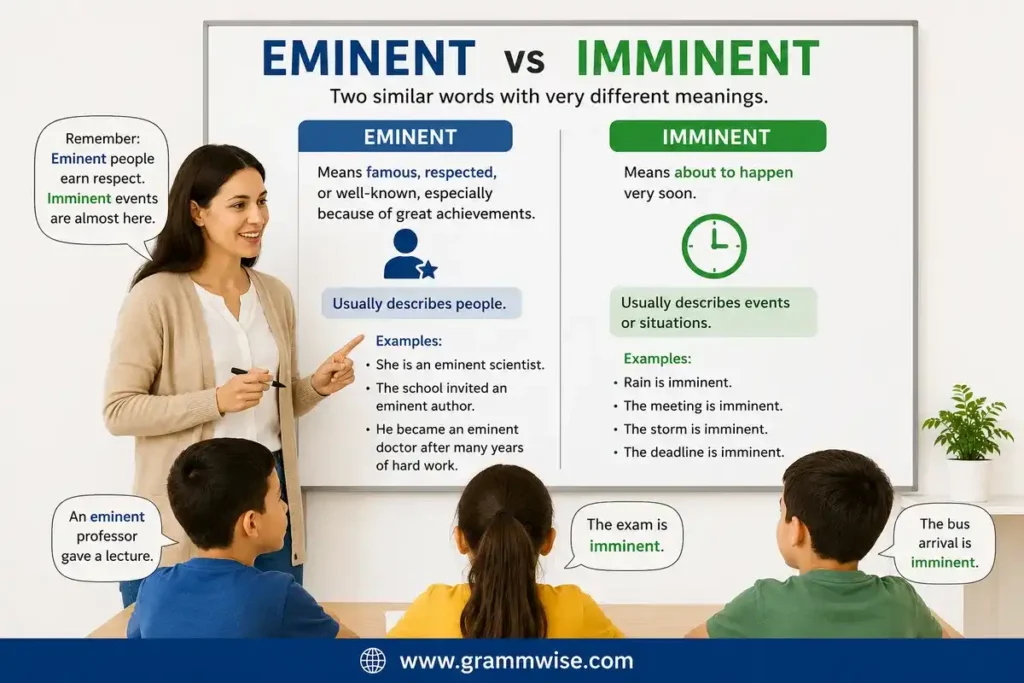
Remember this simple rule: Eminent people earn respect. Imminent events are almost here.
Conclusion
Understanding eminent vs imminent is easy once you know what each word means. Eminent describes a respected or well-known person, while imminent describes something that is about to happen very soon. Remembering this simple difference will help you choose the correct word in both speaking and writing.
Keep practicing with real-life examples, and ask yourself if the sentence is talking about a person or an event. With this simple habit, you will avoid common mistakes and use both words naturally and confidently in everyday English.
Frequently Asked Questions (FAQs)
What does eminent mean in simple words?
Eminent means respected, famous, or admired because of great knowledge, skill, or achievements.
What does imminent mean in simple words?
Imminent means something is going to happen very soon.
What is the main difference between eminent vs imminent?
Eminent describes respected people, while imminent describes events that are about to happen.
Why do people confuse eminent vs imminent?
People confuse them because they look and sound very similar, but their meanings are completely different.
Is it correct to say “an imminent doctor”?
No. A doctor can be eminent if they are respected. Imminent is used for events, not people.
Can I use both words in formal writing?
Yes. Both words are correct in formal English when they are used with the right meaning.
Which word is used with “danger”?
Use imminent. For example, imminent danger means danger that is about to happen.
How can I remember the difference easily?
Remember this simple rule: Eminent = excellent and respected person. Imminent = immediate event coming soon.