
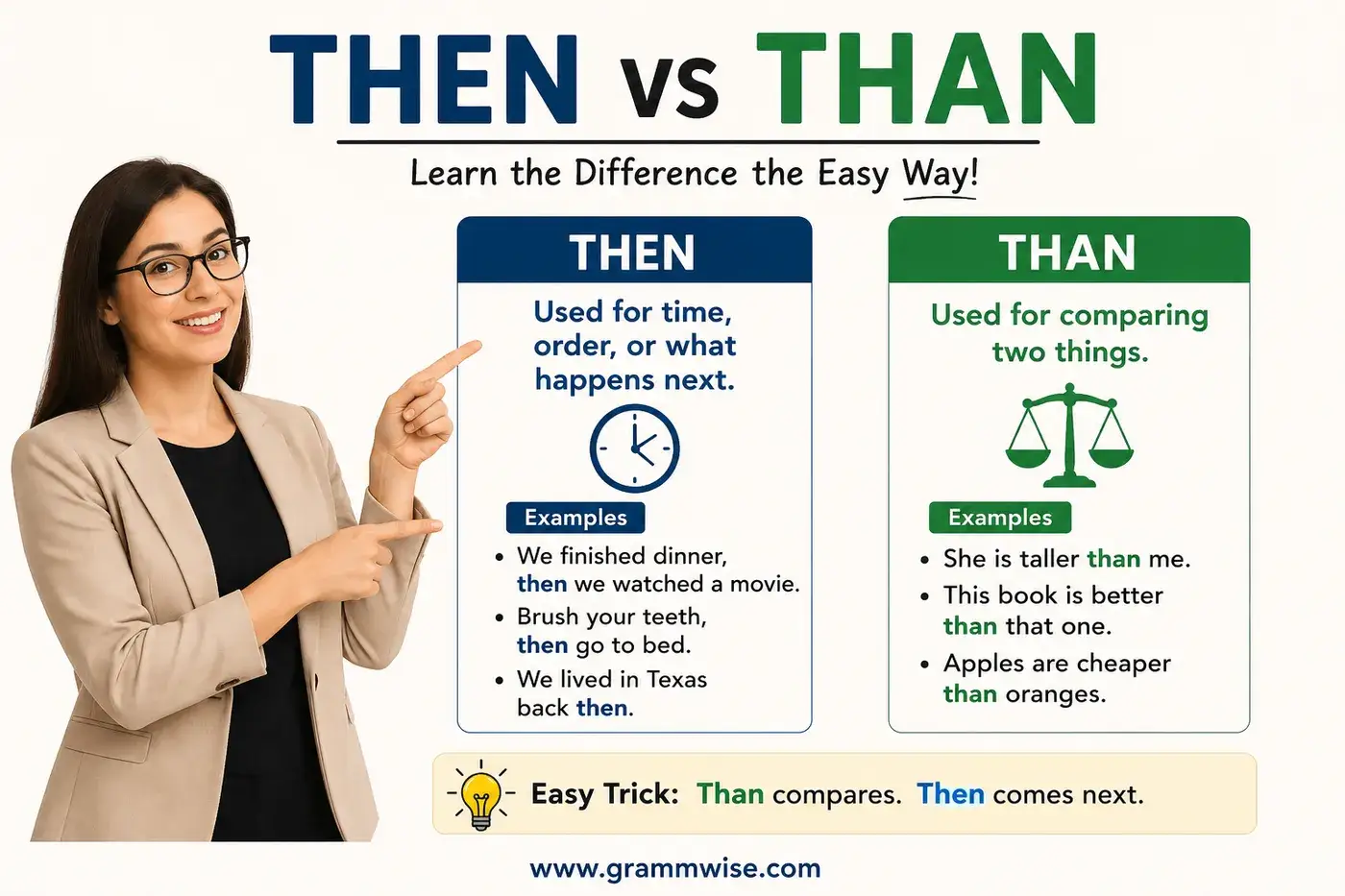
Many English learners get confused about then vs than because the words look and sound almost the same. The good news is that they have very different jobs. Once you learn one simple rule, you will know which one to use every time.
If you are wondering about the difference between then vs than, you are not alone. Many students, writers, and even native English speakers sometimes mix them up when writing quickly. This guide explains each word in simple English with clear examples that you can use in daily life.
After reading this lesson, you will know which is correct, how to use then and than, and how to avoid one of the most common English mistakes.
Many English learners mix up similar-looking words such as desert vs dessert.
Simple Answer in One Look
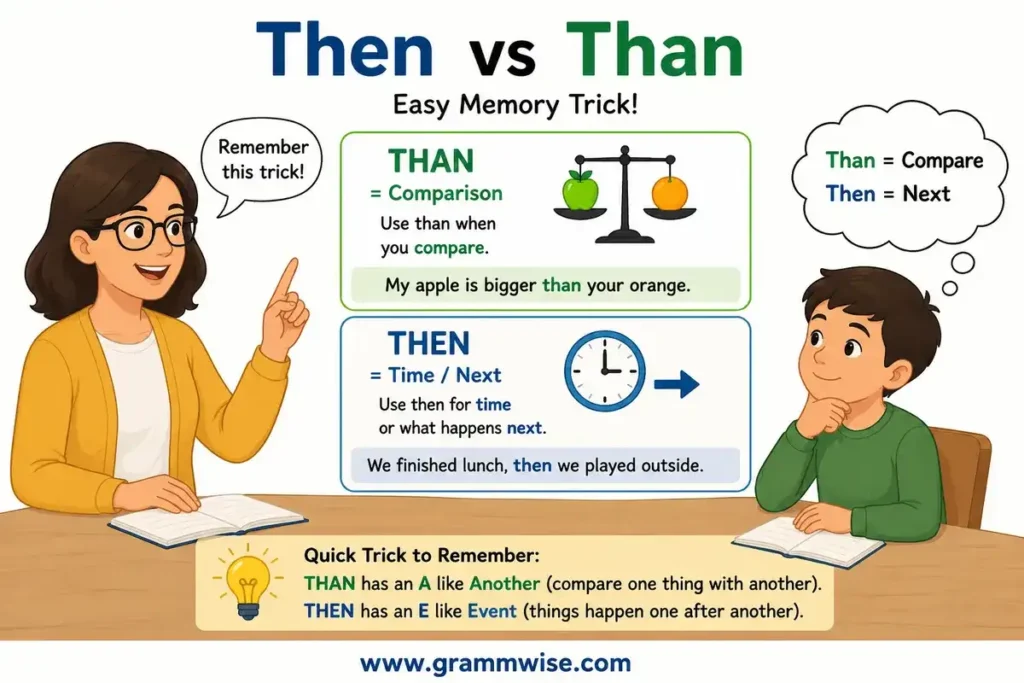
Than is used when you compare two things.
Then is used when talking about time, order, or what happens next.
Easy trick:
- Than = Comparison
- Then = Time or Next
Examples:
- Emma is taller than Jake.
- We ate dinner, then we watched a movie.
Then vs Than: Means in Simple English
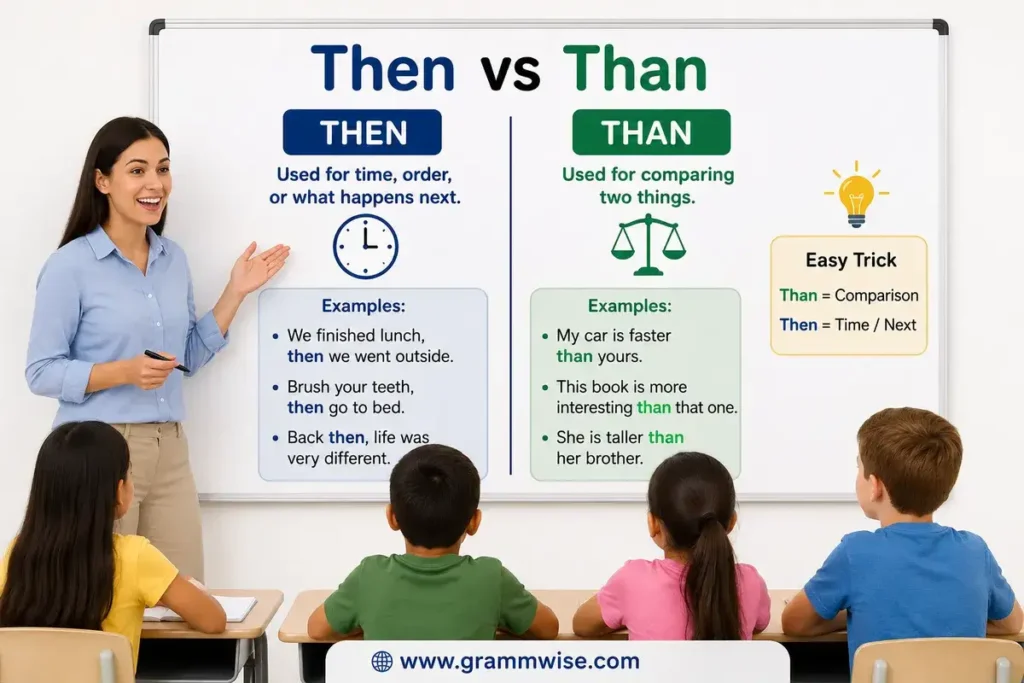
The words then and than may look almost the same, but they do different jobs.
Think of than as the comparison word.
Whenever you compare one thing with another, use than.
Examples:
- My bike is faster than yours.
- This test is easier than the last one.
- I like apples more than oranges.
Now think of then as the time word.
It tells us what happens next or talks about a certain time.
Examples:
- Finish your homework. Then you can play.
- We got on the bus, then we sat down.
- Back then, phones were very different.
Here is another simple way to remember them.
Imagine you are following a recipe.
- Wash the vegetables.
- Then cut them.
- Then cook them.
You would never use than because nothing is being compared.
Now imagine you are buying fruit.
- Apples are cheaper than peaches.
Here you are comparing prices, so than is correct.
Once you remember this simple idea, choosing the right word becomes much easier.
Then vs Than: Why People Mix These Words?
Many people confuse then and than for several reasons.
They look almost the same.
Only one letter is different.
- then
- than
When reading quickly, your eyes may not notice the difference.
They sound very similar “Then vs Than”
In everyday speech, these words can sound alike, especially when people speak fast.
Typing quickly causes mistakes.
Many people know the correct word but accidentally type the other one.
For example:
❌ I am taller then my brother.
The writer probably knew the rule but made a typing mistake.
Spell check does not always help.
Both words are real English words.
Because of that, your computer may not warn you if you choose the wrong one.
Students remember the spelling but forget the meaning.
Instead of remembering only the letters, remember the job each word does.
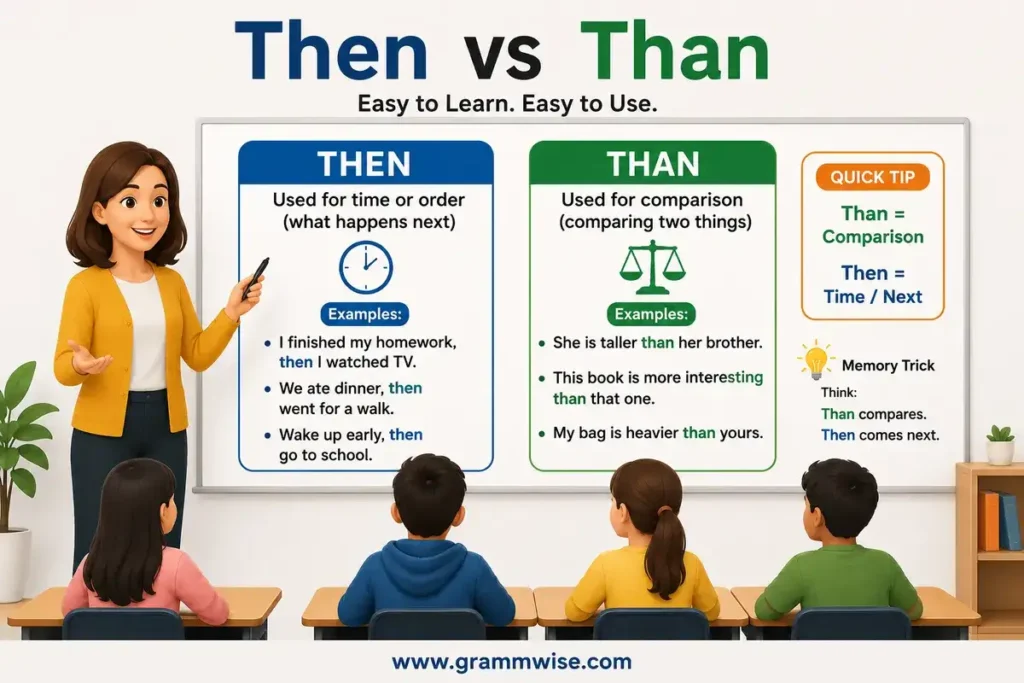
- Than compares.
- Then shows time or order.
That simple rule works almost every time.
Clear Difference of Then vs Than Explained Simply
Here is an easy comparison.
| Than | Then |
|---|---|
| Used for comparing | Used for time |
| Shows differences | Shows what happens next |
| Often comes after words like more, less, better, worse | Often comes after one action before another |
| Answers “Compared with what?” | Answers “What happened next?” |
Use than when you compare.
Examples:
- My house is bigger than yours.
- Ice cream tastes better than cake.
- Today is warmer than yesterday.
- She runs faster than I do.
Use then when talking about time.
Examples:
- Brush your teeth, then go to bed.
- We finished lunch, then went shopping.
- Life was different back then.
- Read the first chapter. Then answer the questions.
Quick Memory Trick for Then vs Than
Than has the letter A.
Think:
A = Compare one thing with Another.
Then has the letter E.
Think:
E = Events happen one after another.
This little memory trick helps many students remember the difference.
Then vs Than: Which Form Should You Use?
If you are not sure which word to write, ask yourself one question.
Am I comparing two things?
If the answer is yes, use than.
Examples:
- My sister is younger than me.
- This road is shorter than the other one.
- Coffee is stronger than tea.
Am I talking about time or what happens next?
If the answer is yes, use then.
Examples:
- Finish your work, then call me.
- We arrived early. Then it started to rain.
- I was a child back then.
A Simple Test
Replace the word with next.
If the sentence still makes sense, use then.
Example:
- Eat breakfast, then leave.
- Eat breakfast, next leave.
The meaning is close, so then is correct.
Now try this.
- Cats are smarter than dogs.
Would “next” fit here?
No.
So than is correct.
This quick test helps when you feel unsure.
Easy Real-Life Sentences on Then vs Than
Here are some everyday examples.
Using than
- My backpack is heavier than yours.
- Sarah studies harder than I do.
- Winter is colder than summer.
- This chair is more comfortable than that one.
- My dog is friendlier than our neighbor’s dog.
Using then
- Wake up early, then eat breakfast.
- We cleaned the room, then watched TV.
- Finish this page, then start the next one.
- I lived in Texas back then.
- He smiled, then opened the door.
Practice saying these sentences out loud. Hearing the words in real situations makes them easier to remember.
Then vs Than: Where This Word Expression Comes From?
Both then and than come from very old English.
Hundreds of years ago, people sometimes used the words in similar ways. As English changed over time, each word slowly got its own special job.
Today, English follows a clear rule.
- Than is used for comparisons.
- Then is used for time, order, or the next step.
That is why modern English keeps the two words separate.
Even though they have a shared history, their meanings are now very different.
How “Then vs Than” Is Understood in Culture and Stories
The words then and than do not have special cultural meanings by themselves. Instead, people use them every day to tell stories, compare ideas, and explain events.
When someone tells a story, then helps the story move from one event to the next. It shows the order of what happened.
For example:
- We woke up early. Then we packed our bags.
- The rain stopped. Then the sun came out.
- The little girl smiled. Then she hugged her mother.
Without then, stories can sound confusing because readers may not know what happened next.
The word than is different. It helps people compare people, places, objects, and ideas.
For example:
- The lion is stronger than the wolf.
- This movie is funnier than the last one.
- My new shoes are more comfortable than my old ones.
Stories often use comparisons to help readers imagine things better. A writer may say one character is kinder than another or one mountain is taller than another.
That is why both words are useful in books, movies, conversations, and everyday life. One moves the story forward, while the other helps compare things.
Biblical and Mythological Meaning of Then vs Than
There is no special biblical or mythological meaning for then or than. These words are simply part of everyday English. However, many Bible translations use then because they tell events in order.
For example:
- Moses spoke to the people. Then they continued their journey.
- Jesus taught the crowd. Then He went to another town.
Here, then shows what happened next.
The word than also appears in many Bible translations when people compare things.
Examples include ideas like:
- Wisdom is better than riches.
- Peace is greater than anger.
The same is true in myths and old stories. Writers use then to show the next event and than to compare people, heroes, or places.
These words do not have hidden meanings. They simply help readers understand the story clearly.
Symbolism of “Then vs Than” Explained in Simple Words
What Then Represents?
The word then often makes people think about movement, progress, and time. It reminds us that life keeps moving forward. One thing happens. Then another thing happens.
It can also remind people of memories. When someone says, “Back then,” they are talking about the past.
Examples:
- Back then, life was much simpler.
- Things were different then.
- We were children back then.
In stories, then often represents a journey from one moment to another.
What Than Represents
The word than reminds us of comparison. People compare almost everything.
They compare:
- Sizes
- Prices
- Speeds
- Skills
- Ideas
- Feelings
Comparison helps people make choices.
For example:
- This phone costs less than that one.
- Summer is hotter than winter.
- Walking is healthier than sitting all day.
Unlike then, than does not talk about time. It simply helps us see differences between two things.
The easiest way to remember them is this:
- Then represents time and order.
- Than represents comparison.
Related Words to “Then vs Than” You Should Know
Learning a few related words can make then vs than even easier.
Next
This word means the thing that comes after something else.
Example:
Next, wash your hands.
It has a meaning similar to then.
After
This word tells us something happens later.
Example:
After dinner, we watched TV.
Like then, it talks about time.
Before
This means something happens earlier.
Example:
Brush your teeth before bed.
It is the opposite idea of “after.”
More
This word is often used with than.
Example:
This book is more interesting than that one.
Less
This word also works with than.
Example:
My bag weighs less than yours.
Better
People often compare using “better than.”
Example:
Practice is better than giving up.
Worse
This is another common comparison word.
Example:
Today feels worse than yesterday.
Similar
This means almost the same.
Example:
Our ideas are similar.
Unlike than, this word does not directly compare with a sentence pattern.
Use of “Then vs Than” in Daily English
People use then and than every single day.
Here are some real conversations you might hear.
At school
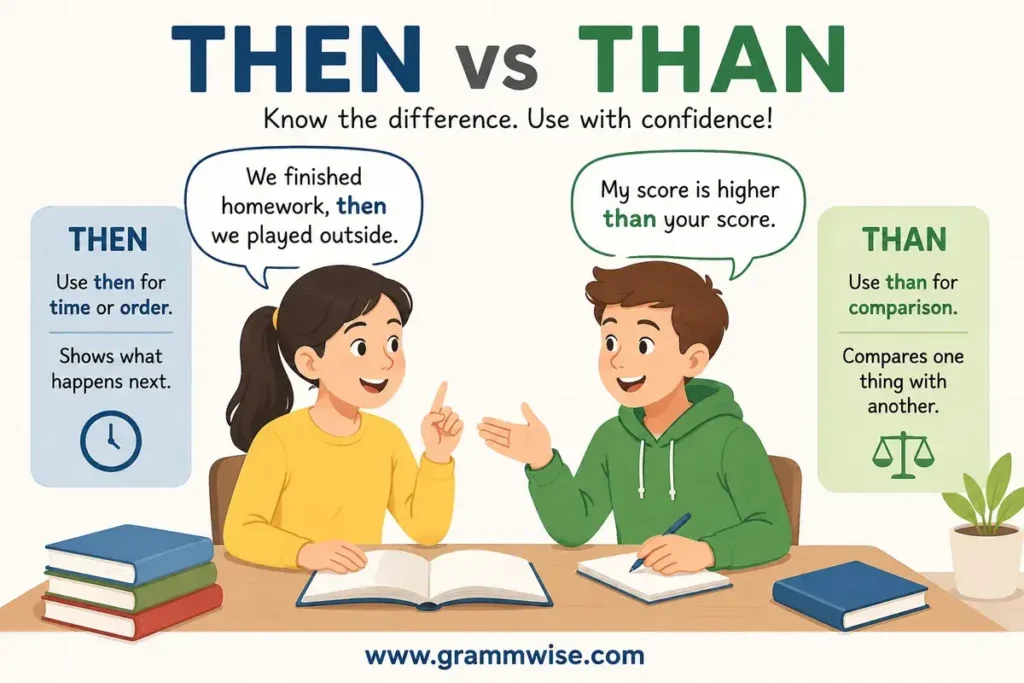
“I finished my homework, then I played outside.”
“My score was higher than yours.”
At home
“Wash your hands, then come eat.”
“This chair is softer than the old one.”
Shopping
“These shoes are cheaper than those.”
“Pay first, then take your receipt.”
Travel
“We reached the airport, then checked in.”
“The train is faster than the bus.”
Cooking
“Mix the flour, then add the milk.”
“This recipe tastes better than the last one.”
Sports
“My team played better than last week.”
“The coach spoke to us, then the game started.”
Talking with friends
“I was nervous then, but I’m fine now.”
“Your drawing looks better than mine.”
The more you read and listen to English, the more naturally these words will become part of your vocabulary.
Common Mistakes People Make About “Then vs Than”
Many learners make the same mistakes when using then vs than.
The good news is that they are easy to fix.
Mistake 1: Using “then” for comparison
❌ My sister is taller then me.
✅ My sister is taller than me.
Remember, comparisons always use than.
Mistake 2: Using “than” for time
❌ Finish your work, than go outside.
✅ Finish your work, then go outside.
Time and order always use then.
Mistake 3: Typing too quickly
Many writers know the rule but accidentally type the wrong word.
Always read your sentence one more time before sending it.
Mistake 4: Guessing instead of checking
If you are unsure, ask yourself one question.
“Am I comparing something?”
If yes, use than.
If not, ask another question.
“Am I talking about time or what happens next?”
If yes, use then.
Mistake 5: Depending only on spell check
Spell check may not catch this mistake because both words are spelled correctly.
That is why understanding the meaning is much better than memorizing the spelling alone.
Final Teacher Explanation
Think of these two words as two friends with different jobs.
The first friend is than. This friend loves comparisons. Whenever you compare two people, places, things, or ideas, call on than.
The second friend is then. This friend loves time. Whenever something happens next or you talk about the past, use then.
You do not need to remember difficult grammar rules. Just remember these two simple questions.
Are you comparing?
Use than.
Are you talking about time or the next step?
Use then.
If you practice with a few sentences every day, you will stop mixing these words very quickly. Even many native English speakers make this mistake sometimes, so do not worry if it takes a little practice.
The more you read, write, and speak English, the easier then vs than will become.
Final Thought “Then vs Than”
The difference between then vs than is very simple.
Use than when comparing two things.
Use then when talking about time, order, or what happens next.
Remember this easy rule: Than compares. Then comes next.
Conclusion
Understanding then vs than is easier than it first seems. Just remember one simple rule: use than when comparing two things, and use then when talking about time or what happens next. With a little practice, you will choose the correct word naturally in both speaking and writing.
Keep reading, writing, and using these words in everyday sentences. The more you practice, the more confident you will become, and this common English mistake will soon disappear from your writing.
Frequently Asked Questions (FAQs)
What is the difference between then vs than?
Than is used for comparisons. Then is used for time, order, or the next event.
Which is correct, then or than?
Both are correct. The right choice depends on your sentence. Use than for comparisons and then for time.
Why do people confuse then vs than?
They look almost the same and sound similar when spoken quickly. That is why many people accidentally use the wrong one.
Can I use then instead of than?
No. These words have different meanings. Using the wrong one changes the meaning of your sentence.
How do I remember the difference?
Think of this simple rule: Than compares. Then comes next.
Is “better then” correct?
Usually, no. The correct phrase is better than because you are making a comparison.
Can I use then in formal writing?
Yes. Then is correct in both formal and informal writing whenever you are talking about time or sequence.
Is then vs than a common grammar mistake?
Yes. It is one of the most common English writing mistakes, but it is easy to avoid once you remember what each word means.