
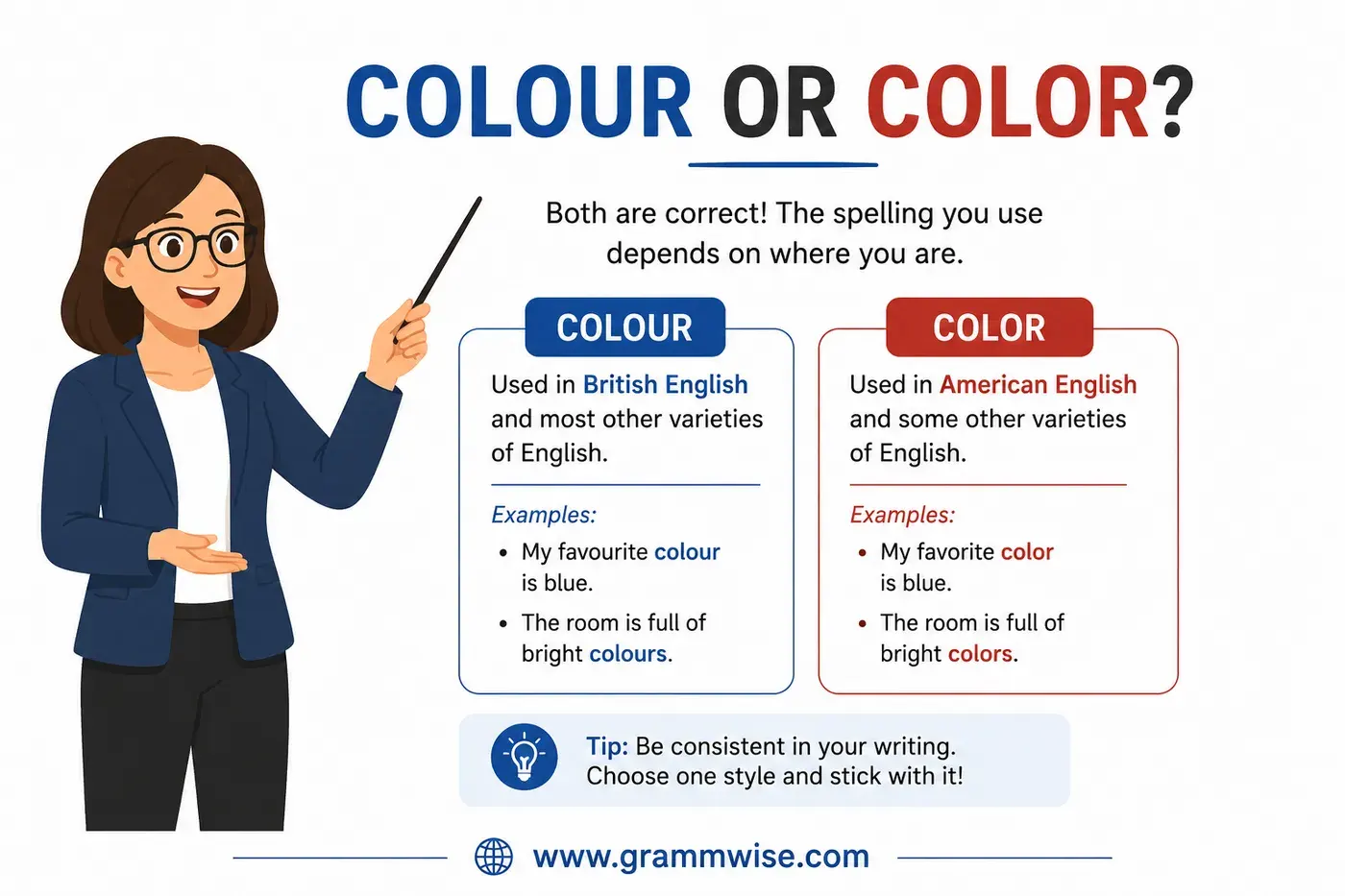
Many English learners ask whether they should write colour or color. The answer is simple. Both spellings are correct, but the right choice depends on the type of English you are using. This small spelling difference often confuses students, writers, and even native speakers.
If you have ever wondered about colour or color, you are not alone. One spelling is used in American English, while the other is used in British English. The meaning stays exactly the same. Only the spelling changes.
In this guide, you will learn the difference between colour and color, why both spellings exist, when to use each one, and how to avoid common mistakes. By the end, choosing the correct spelling will feel easy.
Similar confusion happens in other word pairs such as liter vs litre.
Simple Answer in One Look
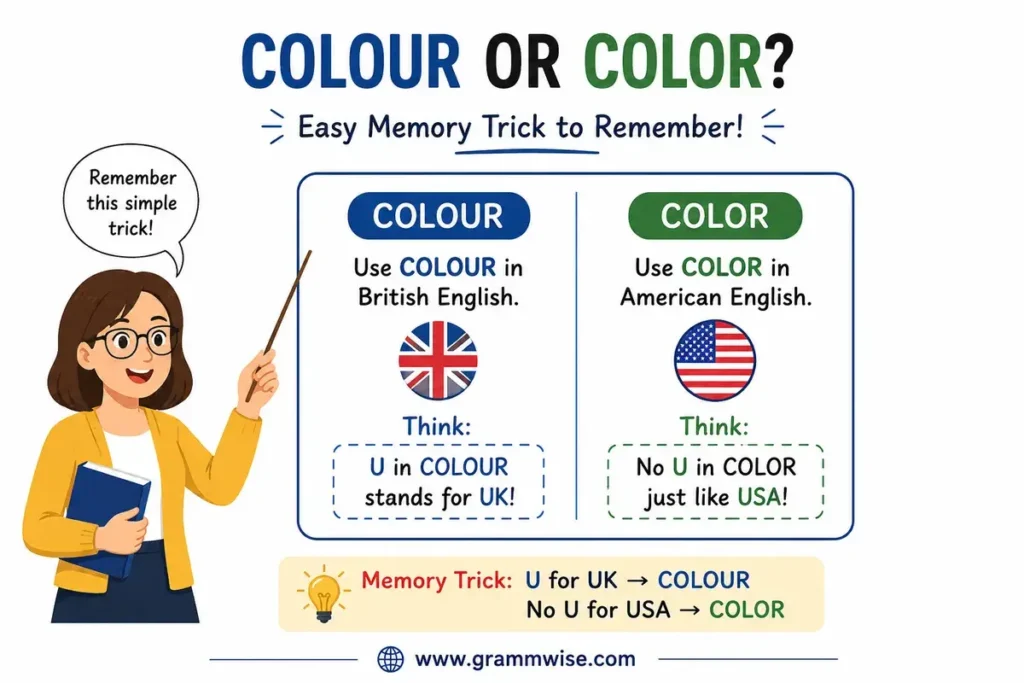
Color is the correct spelling in American English.
Colour is the correct spelling in British English and many other English-speaking countries.
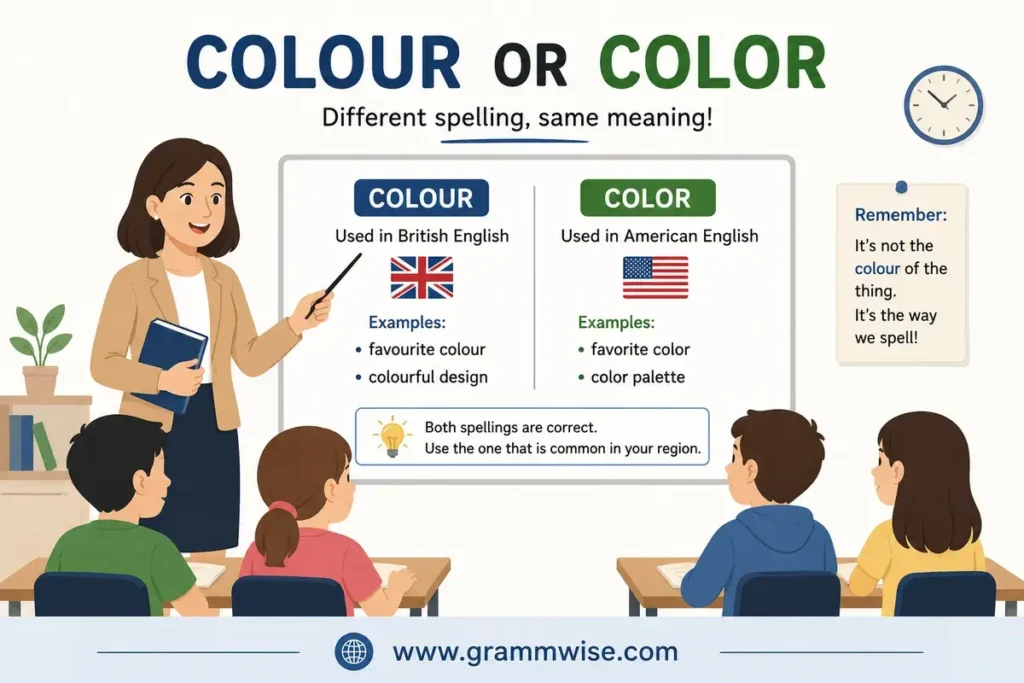
Meaning of Colour or Color in Simple English
The word color or colour means the way something looks because of light. It describes what we see with our eyes.
For example,
- The sky looks blue.
- Grass looks green.
- Snow looks white.
- A rose can be red.
These are all colors.
Whether you write color or colour, you are talking about the same thing. The meaning never changes. The only difference is the spelling.
Think about these examples.
- My favorite color is blue.
- My favourite colour is blue.
Both sentences have the same meaning. The first one uses American English. The second one uses British English.
You do not need to learn two different meanings because there is only one meaning. The spelling changes because different English-speaking countries follow different writing styles.
Colour or Color: Why People Mix These Words?
Many people become confused because they learn English from different places.
For example, a student may watch American movies, read British books, and use Canadian websites. That means they see both spellings every week.
Computers also add to the confusion. If your phone is set to American English, it may underline colour and suggest color. If your computer is set to British English, it may do the opposite.
School books can also be different. Some countries teach British English. Others teach American English.
That is why students often ask which spelling is correct.
The simple answer is that both are correct. You only need to use the spelling that matches your type of English.
Another reason people get confused is because many English words ending in -our in British English become -or in American English.
Here are a few examples.
- Colour → Color
- Favourite → Favorite
- Honour → Honor
- Neighbour → Neighbor
- Behaviour → Behavior
Once you notice this pattern, many spelling differences become easier to remember.
Clear Difference Explained Simply
The meaning is exactly the same. The spelling depends on where the English is used.
Use Color When:
- You are writing American English.
- Your school follows American English.
- Your readers are mostly in the United States.
- Your website uses American spelling.
Examples:
- What is your favorite color?
- The color of the car is black.
- This paint comes in many colors.
Use Colour When:
- You are writing British English.
- Your school teaches British English.
- Your readers are in the United Kingdom.
- Your writing follows British spelling.
Examples:
- What is your favourite colour?
- The colour of the car is black.
- This paint comes in many colours.
Here is a simple comparison.
| American English | British English |
|---|---|
| Color | Colour |
| Favorite | Favourite |
| Honor | Honour |
| Neighbor | Neighbour |
| Behavior | Behaviour |
The spelling changes, but the meaning stays the same.
Colour or Color: Which Form Should You Use?
The best spelling depends on your audience.
- If you are writing for people in the United States, use color.
- If you are writing for people in the United Kingdom, Australia, New Zealand, or many other countries that follow British English, use colour.
If your school or workplace has a style guide, always follow it.
One important rule is to stay consistent.
Do not mix both spellings in the same article unless you are explaining the difference.
For example, this is not a good idea.
❌ My favorite colour is blue.
Instead, choose one style.
American English:
✅ My favorite color is blue.
British English:
✅ My favourite colour is blue.
Consistency makes your writing look more professional and easier to read.
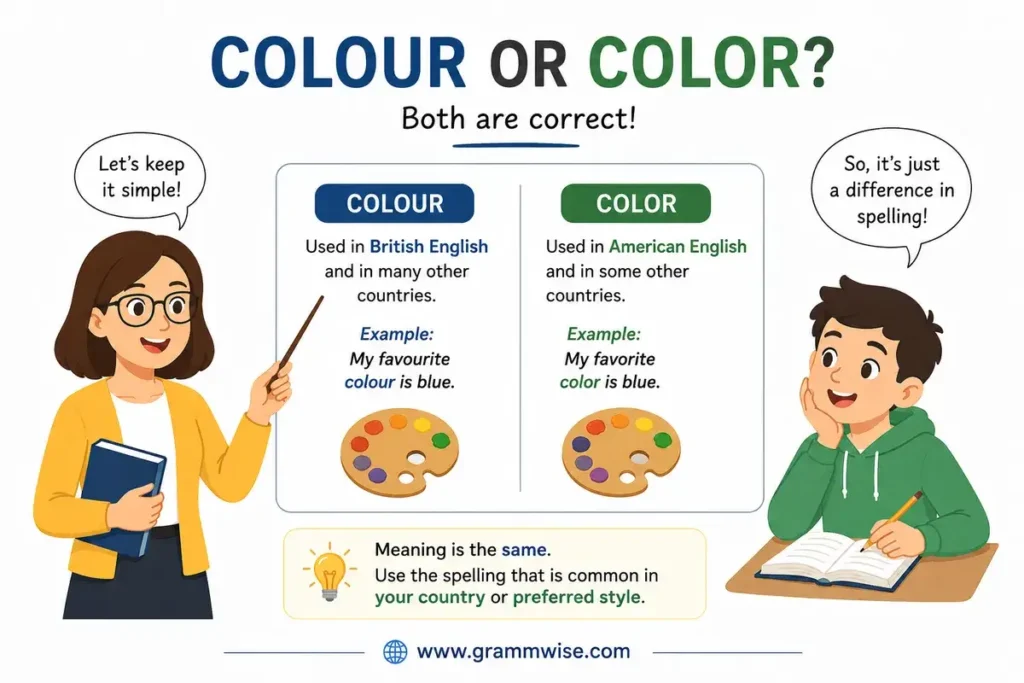
Easy Real-Life Sentences on Colour or Color
Here are some everyday examples using American English.
- My favorite color is green.
- What color is your backpack?
- She painted the wall blue.
- I like bright colors.
- This flower has a beautiful color.
- The sky changes color at sunset.
- We chose a new color for the kitchen.
Here are the same ideas in British English.
- My favourite colour is green.
- What colour is your backpack?
- She painted the wall blue.
- I like bright colours.
- This flower has a beautiful colour.
- The sky changes colour at sunset.
- We chose a new colour for the kitchen.
Notice that only the spelling changes.
Everything else stays the same.
Colour or Color: Where This Word Comes From?
The word comes from an old Latin word called color. Later, the word entered Old French before becoming part of English. For many years, English writers used different spellings.
In the early 1800s, American dictionary writer Noah Webster wanted American English spelling to be simpler. He removed the letter u from many words.
That is why American English uses color, honor, and favor.
British English kept the older spellings colour, honour, and favour.
Today, both spellings are accepted around the world. They simply belong to different types of English. As long as you stay consistent, either spelling is correct.
How “Colour or Color” Is Understood in Culture and Stories?
The words colour and color have the same meaning everywhere. They both describe the different shades we see around us. The only difference is the spelling.
People in different countries grow up using different spellings. Someone in the United States learns to write color in school. Someone in the United Kingdom learns to write colour. Both people are correct because they are following the spelling rules used in their country.
You will also notice this difference in books, newspapers, magazines, and websites.
An American novel will usually use color.
A British novel will usually use colour.
Movies and TV shows may also show both spellings. For example, a sign in an American movie may say “Favorite Colors,” while a British TV show may use “Favourite Colours.”
This spelling difference is part of English culture. It shows how the language has grown in different parts of the world. Even though the spellings are different, people from both countries understand each other without any problem.
That is why you should never think one spelling is better than the other. They are simply different versions of English.
Biblical and Mythological Meaning of Colour or Color
The words colour and color appear in many English translations of the Bible. Both spellings have the same meaning. The spelling depends on whether the Bible uses British English or American English.
In the Bible, colors often have special meanings.
For example:
- White often stands for purity or peace.
- Green can remind people of life and growth.
- Gold may represent honor or great value.
- Purple is sometimes linked with kings and royalty.
These meanings come from the colors themselves, not from the spelling.
The same idea is true in many old myths and stories. Different colors can represent different feelings or ideas, but the spelling colour or color does not change the meaning.
Symbolism of Colour or Color Explained in Simple Words
What Color Represents?
In American English, color can represent many ideas.
People often connect colors with:
- Happiness
- Creativity
- Beauty
- Nature
- Feelings
- Art
- Celebration
For example, bright colors can make a room feel cheerful. Soft colors can make people feel calm. Dark colors can create a serious mood.
The spelling color simply follows American English.
What Colour Represents?
In British English, colour represents the very same ideas.
It can remind people of:
- Beauty
- Nature
- Art
- Emotions
- Seasons
- Culture
- Personal style
The only difference is the extra letter u.
Whether someone writes colour or color, readers understand the same message.
The spelling changes.
The meaning never does.
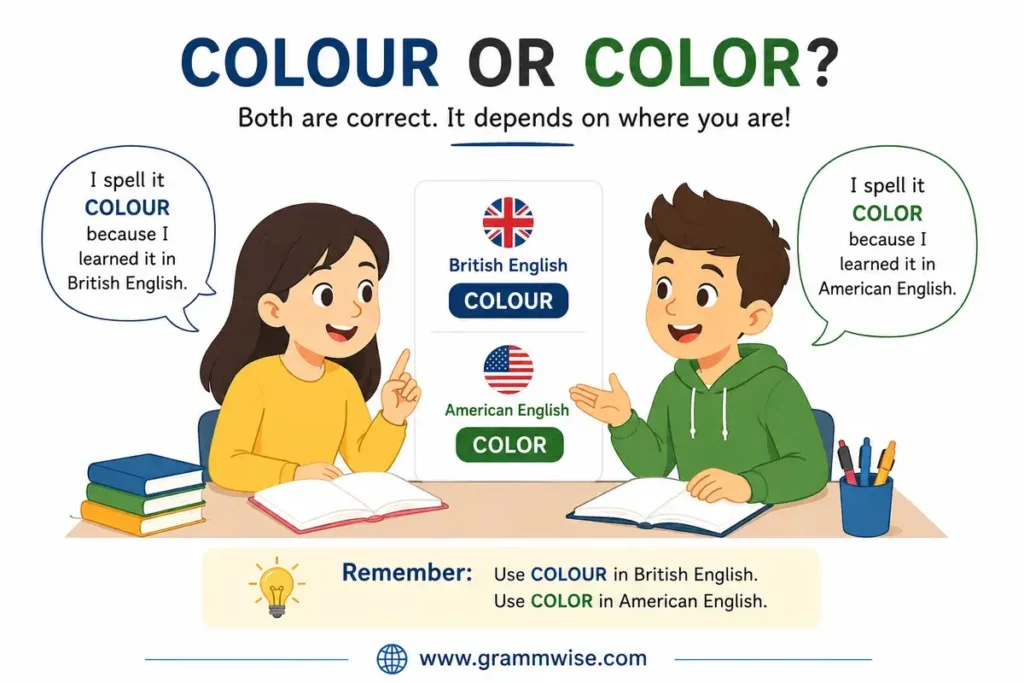
Related Words to “Colour or Color” You Should Know
Learning similar words will help you understand colour or color even better.
Colourful / Colorful
This means full of many bright colors or full of excitement.
Colouring / Coloring
This means adding colors to a picture or drawing.
Colourless / Colorless
This means having no color.
Favourite / Favorite
Another British and American spelling difference.
Honour / Honor
These words have the same meaning but different spellings.
Neighbour / Neighbor
A person who lives near you. The spelling changes just like colour and color.
Behaviour / Behavior
This means the way someone acts.
Grey / Gray
Both spellings are correct. Gray is American English, while grey is more common in British English.
Use of Colour or Color in Daily English
People use this word every day when talking about clothes, food, art, cars, nature, and many other things.
Here are some real-life examples in American English.
- What color is your new bike?
- I love the blue color of the ocean.
- Her favorite color is purple.
- This room needs a brighter color.
- The leaves change color every fall.
- We picked a new color for the walls.
- That shirt comes in many colors.
- Which color do you like best?
Here are similar examples in British English.
- What colour is your new bike?
- I love the blue colour of the ocean.
- Her favourite colour is purple.
- This room needs a brighter colour.
- The leaves change colour every autumn.
- We picked a new colour for the walls.
- That shirt comes in many colours.
- Which colour do you like best?
In everyday conversation, people usually do not notice the spelling because they are speaking, not writing.
The difference only matters when you write.
Common Mistakes People Make About Colour or Color
Many learners make small spelling mistakes with colour or color.
The good news is that they are easy to fix.
Mistake 1: Mixing both spellings in one article
❌ My favorite colour is blue.
✅ My favorite color is blue. (American English)
✅ My favourite colour is blue. (British English)
Choose one style and use it all the way through.
Mistake 2: Thinking one spelling is wrong
Some people believe only one spelling is correct.
That is not true.
Both spellings are correct in standard English.
Mistake 3: Changing only one word
Many learners write:
❌ My favourite color.
This mixes British and American spelling.
Instead, keep the spelling style the same.
Mistake 4: Letting spell check confuse you
Your computer may suggest changing the spelling.
This usually happens because your language setting is American English or British English.
Always check which English style you are using before accepting the suggestion.
Mistake 5: Forgetting your audience
If you are writing for American readers, use color.
If you are writing for British readers, use colour.
Thinking about your readers helps you choose the right spelling every time.
Final Teacher Explanation
Imagine you are in my classroom.
I write two words on the board.
Color
Colour
Then I ask the class one simple question.
“Do these words have different meanings?”
The answer is no.
They mean exactly the same thing.
Next, I ask another question.
“Which country is your English following?”
If the answer is American English, write color.
If the answer is British English, write colour.
That is the whole lesson. There is no hidden grammar rule. There is no change in meaning. You only need to match the spelling with the type of English you are using.
Once you remember this simple idea, you will never be confused about colour or color again.
Final Thought Colour or Color
If you are choosing between colour or color, remember this simple rule.
Use color in American English and colour in British English. Both spellings have the same meaning, so choose one style and use it consistently throughout your writing.
Conclusion
Choosing between colour or color is simple once you know your audience. Use color in American English and colour in British English. Both spellings have the same meaning, so the key is to stay consistent throughout your writing.
Whether you are writing for school, work, or your website, using the correct spelling helps your writing look clear and professional. Remember the simple rule, and you’ll never be confused by these two spellings again.
Frequently Asked Questions (FAQs)
Which is correct: colour or color?
Both are correct. Color is American English, and colour is British English.
What is the difference between colour and color?
The only difference is the spelling. The meaning is exactly the same.
Should I use color or colour in school?
Use the spelling your school or teacher asks you to use.
Why do Americans write color instead of colour?
American English follows spelling changes introduced by Noah Webster, who removed the extra u from some words.
Can I use both colour and color in one article?
It is better not to. Pick one spelling style and use it consistently.
Which spelling is more common around the world?
Both spellings are common. Color is used in the United States, while colour is widely used in the United Kingdom, Australia, New Zealand, and many other countries.
Why does my computer say colour is wrong?
Your device is probably set to American English. Changing the language setting will change the spelling suggestions.
How can I remember the difference between colour or color?
Think about your audience. If you are writing American English, use color. If you are writing British English, use colour.