
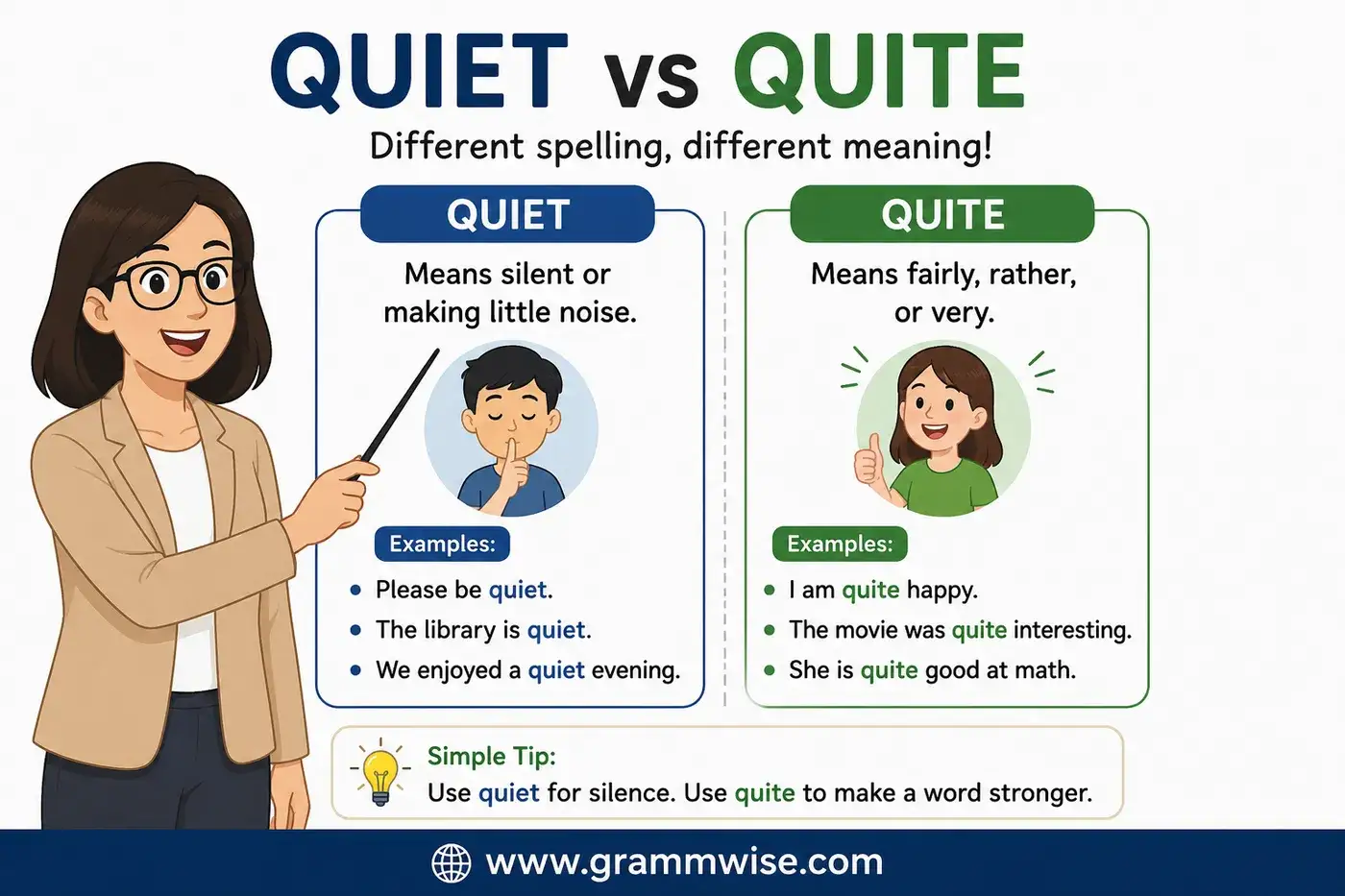
Many English learners get confused about quiet vs quite because these two words look almost the same. Only one letter changes, but their meanings are completely different. One word talks about silence, while the other means “fairly” or “very.” Learning the difference is easier than you might think.
If you have ever searched for quiet vs quite, you are not alone. Students often mix them up when writing because the words are spelled similarly and sound almost alike. A small spelling mistake can completely change the meaning of a sentence.
In this guide, you will learn the difference between quiet vs quite, when to use each word, simple memory tricks, and real-life examples. By the end, you will know exactly which word belongs in your sentence.
You might also find our comparison of similar confusing word pairs useful such as hanged or hung.
Simple Answer in One Look
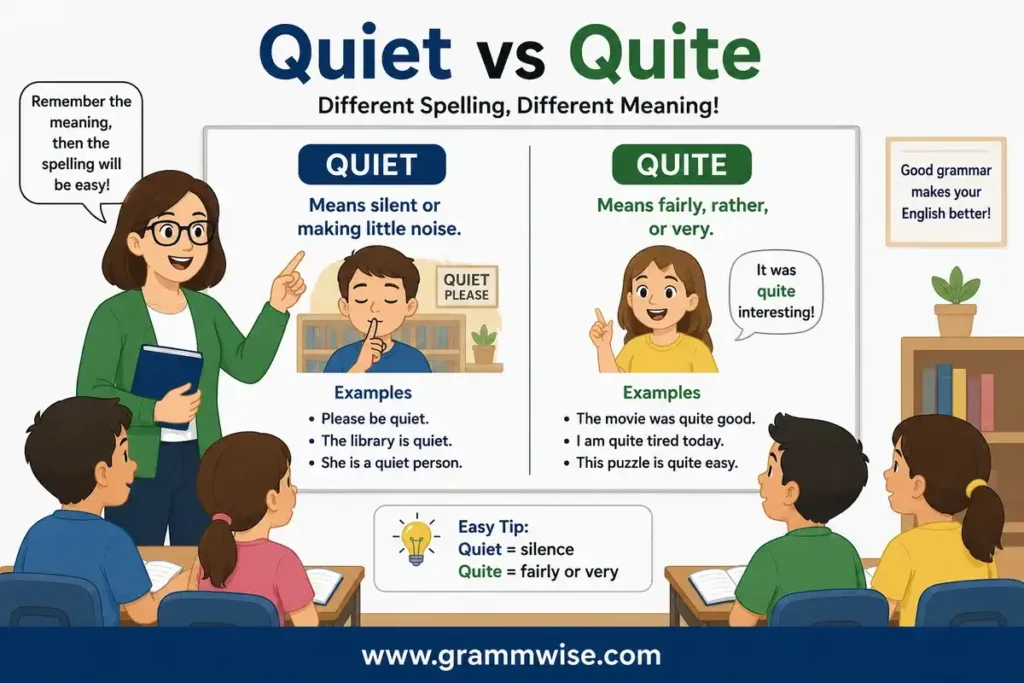
Quiet means calm, silent, or making very little noise.
Quite means fairly, completely, or very, depending on the sentence.
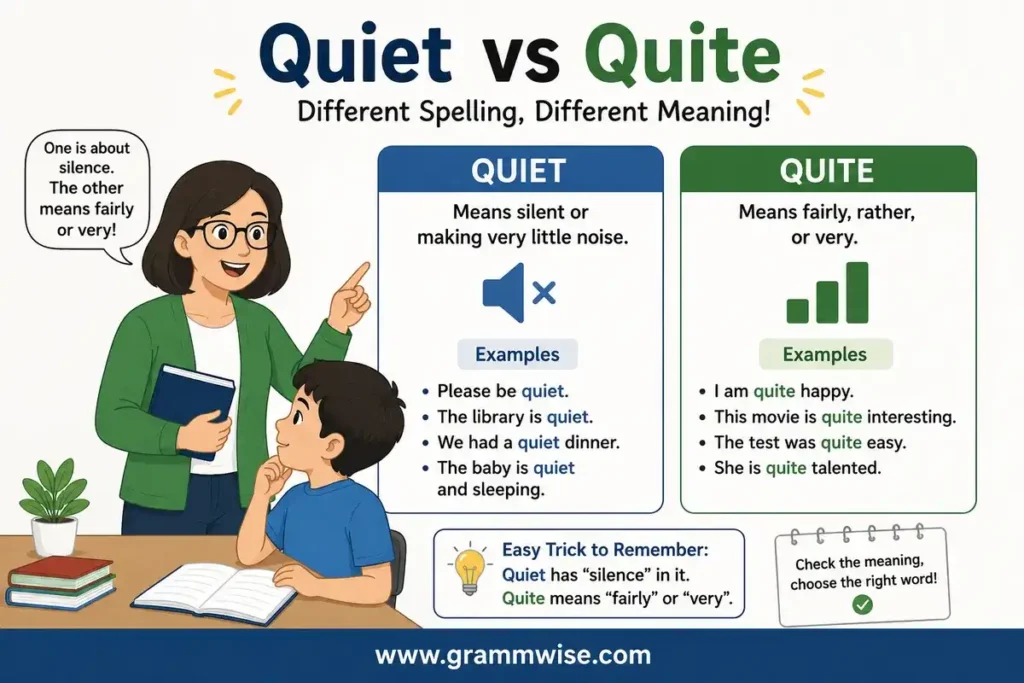
Meaning of Quiet vs Quite in Simple English
The word quiet describes a person, place, or thing with little or no noise.
For example:
- The library is quiet.
- Please be quiet.
- The baby is sleeping because the room is quiet.
Whenever you talk about silence or peace, you use quiet.
The word quite has a different job. It means fairly, rather, completely, or very, depending on the sentence.
For example:
- The movie was quite funny.
- I am quite happy today.
- The test was quite easy.
Here, quite adds strength to another word. It tells us how much or how strongly something is true.
Think about these two sentences.
- The classroom is quiet.
- The classroom is quite clean.
In the first sentence, quiet tells us there is little noise.
In the second sentence, quite tells us the classroom is fairly clean.
The meanings are completely different.
Quiet vs Quite: Why People Mix These Words?
Many learners confuse quiet and quite because they are almost spelled the same.
The only difference is one extra letter. When writing quickly, it is easy to type the wrong word.
The pronunciation also causes confusion. The words sound similar, especially when spoken quickly.
Another reason is that both words are very common.
People see quiet in school, libraries, and hospitals.
They see quite in books, emails, conversations, and everyday writing.
For example:
❌ The classroom is quite.
✅ The classroom is quiet.
Another example:
❌ I am quiet happy.
✅ I am quite happy.
One small spelling mistake changes the whole meaning.
That is why understanding the meaning is much more helpful than simply memorizing the spelling.
Clear Difference of Quiet vs Quite Explained Simply
Here is the easiest way to remember the difference.
Use Quiet
Use quiet when talking about silence or very little noise.
Examples include:
- A quiet room
- A quiet street
- A quiet child
- A quiet morning
- A quiet library
Example sentences:
- Please stay quiet.
- The park was quiet today.
- We enjoyed a quiet evening.
Use Quite
Use quite when you want to make another word stronger.
It often means:
- Fairly
- Rather
- Very
- Completely
Example sentences:
- She is quite smart.
- The soup is quite hot.
- It was quite interesting.
Easy Comparison Table Quiet vs Quite
| Quiet | Quite |
|---|---|
| Means silent | Means fairly or very |
| Describes little noise | Makes another word stronger |
| An adjective | An adverb |
| Quiet room | Quite happy |
| Quiet child | Quite easy |
The easiest question to ask is:
Are you talking about noise?
If yes, use quiet.
If not, and you want to make another word stronger, use quite.
Quiet vs Quite: Which Form Should You Use?
Choosing the correct word is simple.
Ask yourself this question.
Am I talking about silence?
If the answer is yes, use quiet.
Examples:
- The classroom is quiet.
- Please be quiet.
- We enjoyed a quiet afternoon.
Now ask another question.
Am I describing how much or how strongly something is true?
If yes, use quite.
Examples:
- The movie was quite funny.
- She is quite busy.
- The food tastes quite good.
A simple memory trick can help.
Quiet has the word “quiet” inside your mind when you think of silence.
Quite means “fairly” or “very.”
Whenever you see quite, look at the next word. If it is making another word stronger, then quite is correct.
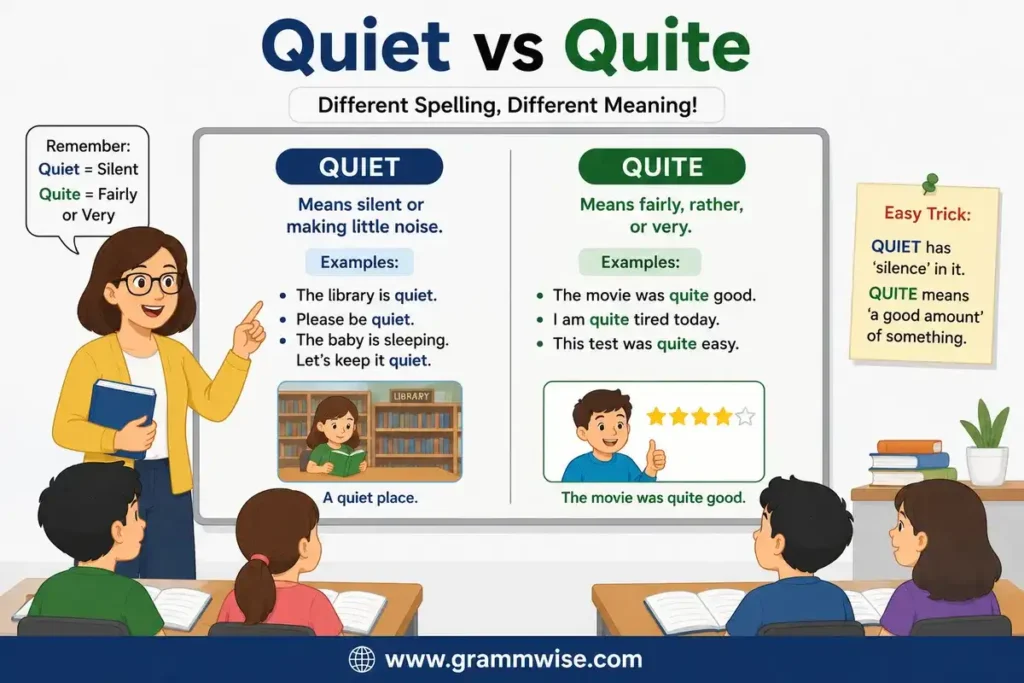
Easy Real-Life Sentences on Quiet vs Quite
Here are simple examples using quiet.
- Please keep quiet during the test.
- The baby is sleeping, so be quiet.
- Our neighborhood is very quiet.
- We had a quiet dinner at home.
- The classroom became quiet.
- She enjoys quiet places.
- The park was quiet early in the morning.
Now look at examples using quite.
- I am quite tired today.
- That book is quite interesting.
- The cake tastes quite sweet.
- He is quite friendly.
- The weather is quite warm.
- The answer is quite simple.
- She speaks English quite well.
Reading these sentences will help you remember the difference.
Quiet vs Quite: Where This Word Comes From?
Both words have been part of English for hundreds of years.
The word quiet comes from an old Latin word meaning calm, peaceful, or still. Over time, English speakers used it to describe places, people, and situations with little noise.
The word quite developed from an older English word that meant completely or fully. As English changed over the years, people also began using quite to mean fairly or rather in everyday conversation.
Although the words have different histories, their similar spelling causes many learners to confuse them today.
How “Quiet vs Quite” Is Understood in Culture and Stories
The words quiet and quite appear in many books, movies, and everyday conversations. Even though they look similar, they create very different meanings.
The word quiet often describes peaceful places and calm moments. In stories, a quiet forest may feel relaxing. A quiet village may show a simple and happy life. Writers also use the word to describe a person who does not talk very much.
For example:
- The children became quiet when the teacher entered the room.
- The lake was quiet in the early morning.
The word quite is different. It helps describe how strong or true something is.
For example:
- The movie was quite exciting.
- She was quite surprised by the gift.
You will often see quite in books because it makes descriptions clearer. It tells readers that something is more than a little but not always the strongest possible.
Knowing the difference helps you understand stories better and avoid confusing one word with the other.
Biblical and Mythological Meaning of Quiet vs Quite
The word quiet appears in many Bible translations. It often describes a peaceful life, a calm heart, or a time without trouble. The Bible encourages people to live quiet and peaceful lives whenever possible.
For example, a quiet spirit is often connected with kindness, patience, and humility.
The word quite does not have a special biblical meaning. It is simply an everyday English word that helps describe something.
In myths and old stories, heroes sometimes find quiet places to rest, think, or prepare for their next journey. These peaceful places often help them become wiser or stronger.
Symbolism of Quiet vs Quite Explained in Simple Words
What Quiet Represents?
The word quiet often represents:
- Peace
- Calmness
- Rest
- Patience
- Safety
- Thinking
- Relaxation
Many people enjoy quiet places because they help them feel peaceful and focused.
- A quiet library helps students study.
- A quiet park helps people relax.
- A quiet morning can help someone start the day with a clear mind.
What Quite Represents?
The word quite does not usually represent an emotion or object. Instead, it helps make another word stronger.
For example:
- Quite happy
- Quite busy
- Quite beautiful
- Quite easy
It helps people describe things more clearly.
Instead of saying something is only good, you can say it is quite good.
Instead of saying someone is only tired, you can say they are quite tired.
This makes your English sound more natural.
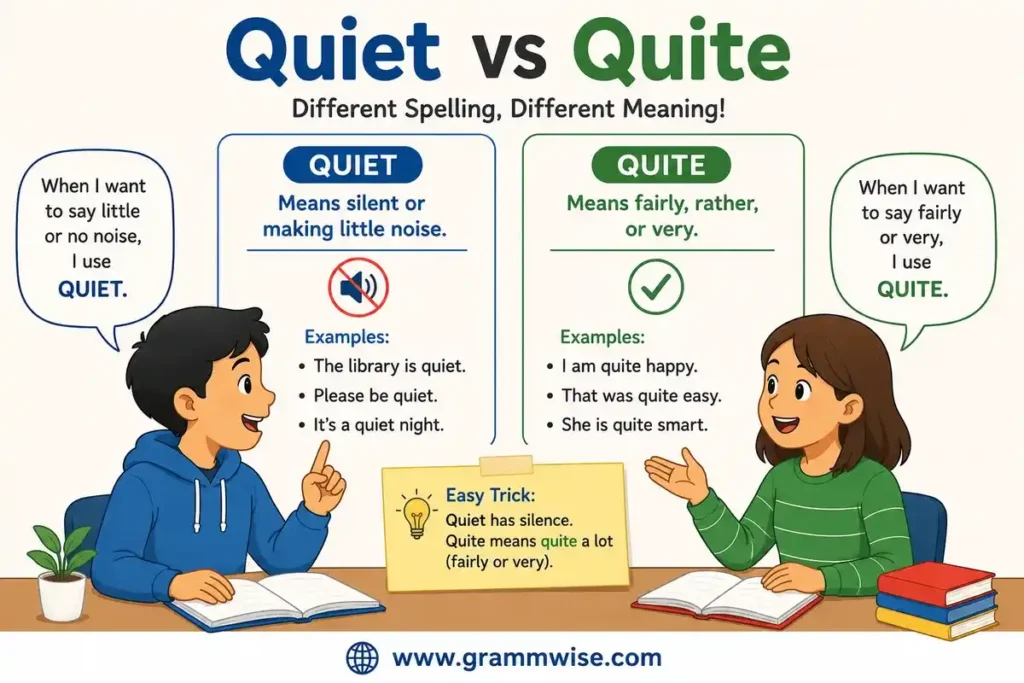
Related Words to Quiet vs Quite You Should Know
Learning similar words makes quiet vs quite much easier.
Silence
The complete absence of sound.
Calm
Peaceful and relaxed without stress or noise.
Peaceful
A place or feeling with little noise and no trouble.
Loud
The opposite of quiet. It means making a lot of noise.
Rather
A word that often means almost the same as quite.
Fairly
Another word that can replace quite in many sentences.
Very
A stronger word that sometimes has a similar meaning to quite, depending on the sentence.
Extremely
A much stronger word than quite.
Use of Quiet vs Quite in Daily English
Here are real-life examples using quiet.
- Please be quiet during the meeting.
- The baby is finally quiet.
- Our street is quiet at night.
- I enjoy quiet mornings.
- The classroom became quiet after the bell rang.
- This café is nice and quiet.
- We found a quiet place to read.
- The dog stayed quiet all afternoon.
Now look at examples using quite.
- I’m quite busy today.
- That pizza was quite delicious.
- She is quite friendly.
- The homework was quite easy.
- Your idea is quite good.
- The weather is quite cold this morning.
- He speaks English quite well.
- The movie was quite funny.
These examples show how different the two words really are.
Common Mistakes People Make About Quiet vs Quite
Many learners make the same mistakes with quiet and quite.
Here are the most common ones.
Mistake 1: Using quiet instead of quite
❌ I am quiet happy.
✅ I am quite happy.
When you mean fairly or very, use quite.
Mistake 2: Using quite instead of quiet
❌ Please stay quite.
✅ Please stay quiet.
When talking about little or no noise, always use quiet.
Mistake 3: Thinking the words have similar meanings
Although they look alike, they do not mean the same thing.
Always think about the meaning before choosing the spelling.
Mistake 4: Reading too quickly
Many people miss the extra letter when reading or writing.
Take a second look before you finish your sentence.
Mistake 5: Depending only on spell check
Both words are correct English words.
Spell check may not notice if you choose the wrong one.
Always check whether your sentence is talking about silence or about making another word stronger.
Final Teacher Explanation
Imagine we are in a classroom.
I write two words on the board.
Quiet
Quite
Then I ask one easy question.
“Are we talking about silence?”
If the answer is yes, choose quiet.
If the answer is no, ask another question.
“Am I making another word stronger?”
If the answer is yes, choose quite.
That is the easiest way to remember the difference. You do not need long grammar rules.
Just remember:
Quiet = little or no noise.
Quite = fairly or very.
Once you practice this a few times, choosing the correct word becomes natural.
Final Thought Quiet vs Quite
If you are choosing between quiet vs quite, remember this simple rule.
Use quiet when talking about silence or calm places. Use quite when you mean fairly, rather, or very. Thinking about the meaning first will help you choose the correct word every time.
Conclusion
Understanding quiet vs quite becomes easy once you know what each word means. Use quiet when talking about silence or little noise, and use quite when you mean fairly, rather, or very. Keeping this simple rule in mind will help you avoid common mistakes in speaking and writing.
The best way to remember these words is to practice them in everyday sentences. Focus on the meaning instead of the spelling, and you will use both words correctly and confidently in your English.
Frequently Asked Questions (FAQs)
What is the difference between quiet and quite?
Quiet means calm or making little noise. Quite means fairly, rather, or very.
Which is correct: quiet or quite?
Both are correct. The right word depends on what you want to say.
Why do people confuse quiet vs quite?
They look and sound similar, so many people accidentally spell one instead of the other.
When should I use quiet?
Use quiet when talking about silence, peace, or very little noise.
When should I use quite?
Use quite when making another word stronger, such as quite happy or quite easy.
Can I use quiet and quite in the same sentence?
Yes. For example: “The classroom was quiet, and the lesson was quite interesting.”
How can I remember the difference between quiet vs quite?
Remember this simple rule: Quiet means silence. Quite means fairly or very.
Does spell check always catch mistakes between quiet and quite?
No. Both words are correct English words, so spell check may not notice if you use the wrong one in a sentence.