
Many people get confused about affect vs effect because the words look similar and sound alike. This is one of the most common word mix-ups in English. If you have ever stopped while writing and wondered which word is correct, you are not alone.
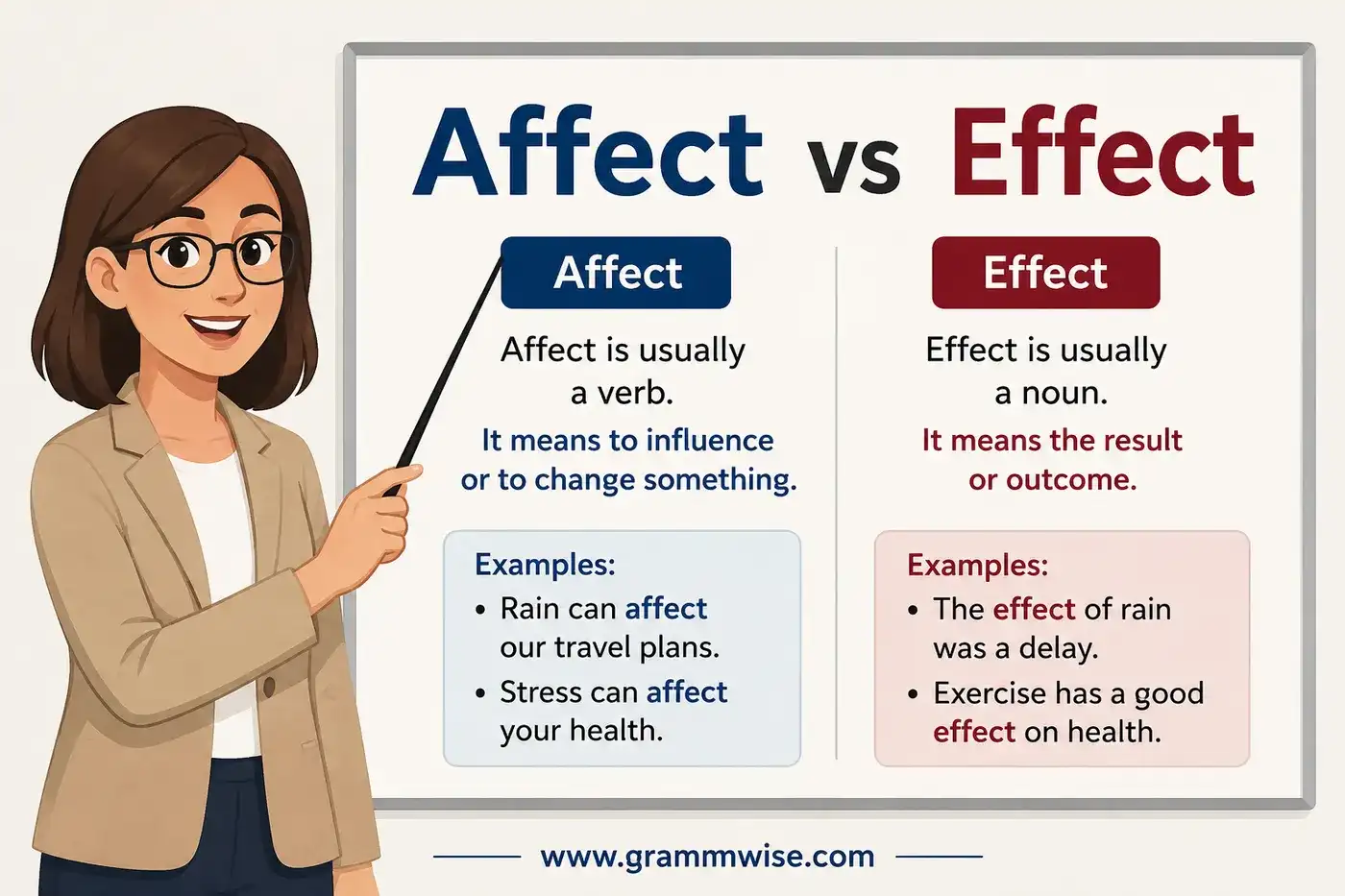
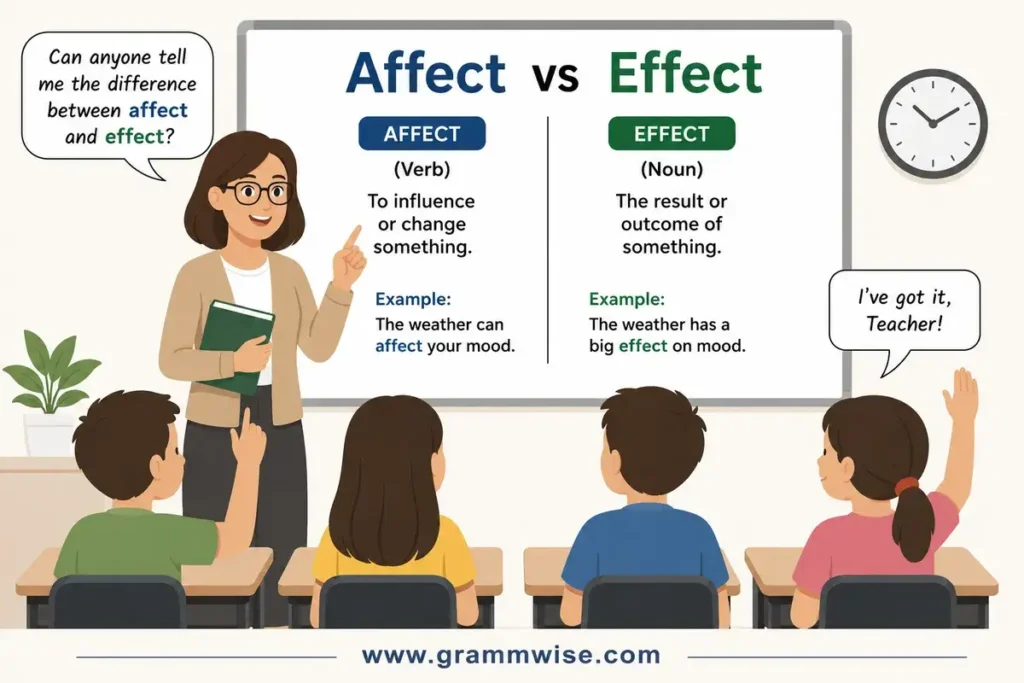
The simple answer is this: affect is usually a verb (an action word), and effect is usually a noun (a thing or result). In short, affect means to influence something, while effect means the result of that influence.
In this guide, you will learn the difference between affect vs effect, their meaning, spelling, usage, and easy tricks to remember them in daily English.
You might also find our comparison of similar confusing word pairs useful.
Simple Answer in One Look
Affect usually means to change or influence something.
Effect usually means the result or outcome of a change.
Meaning of Affect vs Effect in Simple English
Let’s make this very easy.
What Is Affect?
Affect usually means to influence, change, or impact something.
It describes an action.
Examples:
- Rain can affect travel plans.
- Stress can affect your sleep.
- Bad weather affected the game.
In simple words, affect is something doing the changing.
What Is Effect?
Effect usually means the result of a change.
It describes an outcome.
Examples:
- The medicine had a good effect.
- The new rule had a positive effect.
- Lack of sleep has serious effects.
In simple words, effect is what happens after the change.
Affect vs Effect As a Verb And Noun
Use Affect as a Verb
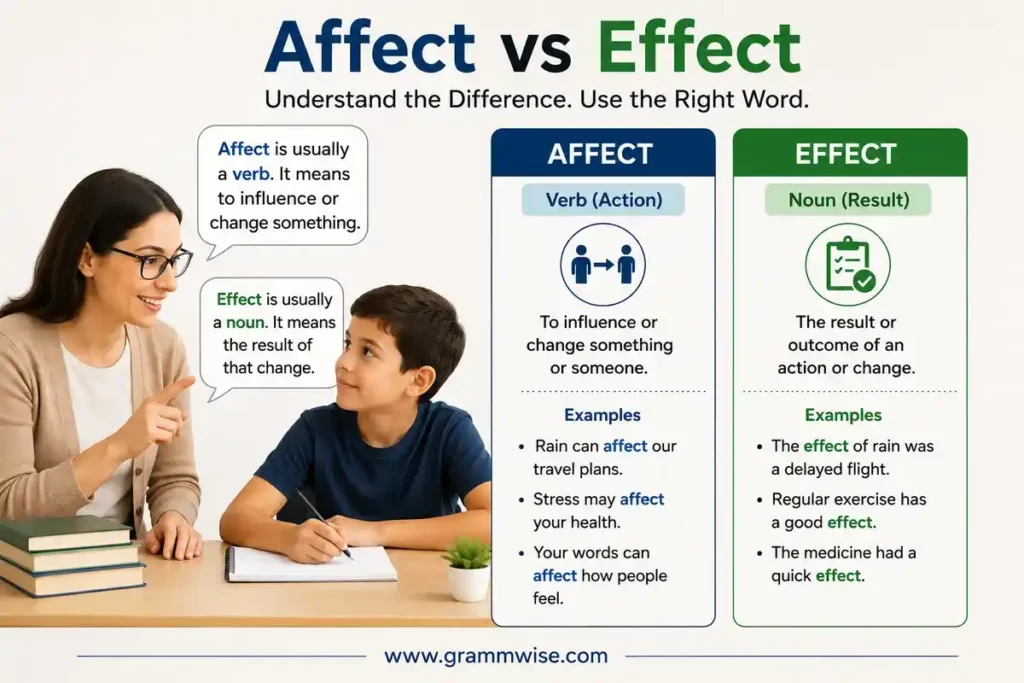
Use affect as a verb when you want to show that something changes, influences, or impacts someone or something. It describes an action happening to a person, object, or situation.
For example,
- Cold weather can affect your health
- Stress may affect your sleep and mood during exams or busy workdays.
How to Use Effect as a Noun
Use effect as a noun when talking about the result, outcome, or consequence of something. It names what happened after an action or event.
For example,
- The effect of regular exercise is better health
- The medicine had a calming effect on the patient after treatment.
Why People Mix These Words Affect vs Effect?
There are three main reasons.
1. They Look Similar
Only the first vowel changes.
- affect
- effect
That small change confuses many writers.
2. They Sound Similar Affect vs Effect
In fast speech, many people pronounce them almost the same.
That makes listening and spelling harder.
3. Both Relate to Change
Both words talk about change.
That makes them feel connected.
But they play different roles.
Clear Difference of Affect vs Effect Explained Simply
Here is the easiest way to remember affect vs effect.
| Word | Meaning | Usually Used As |
|---|---|---|
| Affect | To influence or change | Verb |
| Effect | Result or outcome | Noun |
Use Affect When Talking About Action
Think of affect as doing something.
Examples:
- Heat affects plants.
- Noise affects concentration.
- Pollution affects health.
Something is causing change.
Use Effect When Talking About Results
Think of effect as the result.
Examples:
- Heat has an effect on plants.
- Noise has a negative effect.
- Pollution causes harmful effects.
Now you see the outcome.
Which Form Should You Use Affect vs Effect?
Use this simple rule.
Ask yourself:
Am I describing an action or a result?
If the answer is:
- Action / influence → use affect
- Result / outcome → use effect
That rule solves most cases.
Easy Real-Life Sentences on Affect vs Effect You Can Use
Here are simple examples.
- Lack of sleep affects mood.
- Exercise affects energy levels.
- Stress affects memory.
- The medicine had a quick effect.
- Sunlight has a positive effect on mood.
- The policy had little effect.
- Money problems affect families.
- The change produced a good effect.
Origin of The Word Affect vs Effect
These words come from Latin.
Both come from a root related to doing or making.
Origin of Affect
Affect comes from a Latin word meaning to act on or influence.
That explains why affect usually shows action.
Origin of Effect
Effect comes from a Latin word meaning to complete or produce.
That explains why effect often means result.
Even their history shows the difference.
How This Word Affect vs Effect Is Understood in Culture and Stories?
Words about change matter a lot in stories. Stories often show how actions create results. That is exactly what affect and effect represent.
A hero’s decision may affect many people.
The final outcome becomes the effect of that decision.
In movies, books, and daily life, this pattern appears again and again. The Butterfly Effect. A small action can create a huge result. That idea is powerful in culture.
Biblical and Mythological Meaning of Affect vs Effect
The words affect and effect do not appear as special symbolic terms in religious texts.
But the idea behind them appears often. Actions create consequences. Good actions bring good results. Bad actions may bring harm. Many religious stories teach this cause-and-effect lesson.
In mythology too, choices often create big outcomes. A small decision can change fate. That is the deeper meaning behind affect and effect.
Symbolism of Affect vs Effect Explained in Simple Words
What Affect Represents?
Affect often represents:
- influence
- action
- power
- change
It symbolizes the force that causes movement.
Affect is the push.
It starts something.
What Effect Represents?
Effect often represents:
- result
- outcome
- consequence
- impact
It symbolizes what comes after action.
Effect is the ending or result.
It shows what change produced.
Related Words You Should Know
Impact
A strong influence or result.
Influence
The power to change something.
Consequence
Something that happens because of an action.
Outcome
The final result.
Cause
The reason something happens.
Result
The thing produced after change.
Use of Affect vs Effect in Daily English
Here are natural examples.
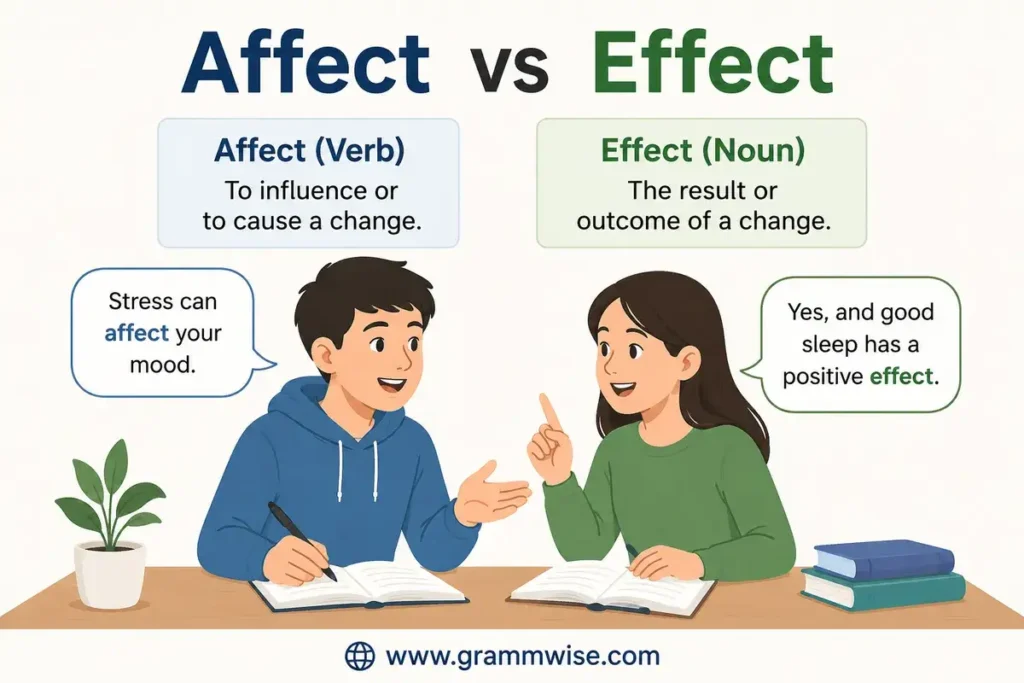
- Weather affects travel plans.
- Your words affect people.
- Stress affects focus.
- The medicine had a fast effect.
- The law had little effect.
- Music affects my mood.
- The change created a positive effect.
- Exercise has a good effect on health.
These are common everyday examples.
Common Mistakes People Make About Affect vs Effect
Mistake 1: Using Effect as a Verb
Wrong: Weather effects travel plans.
Correct: Weather affects travel plans.
Use affect for action.
Mistake 2: Using Affect as a Noun
Wrong: The medicine had a good affect.
Correct: The medicine had a good effect.
Use effect for results.
Mistake 3: Forgetting the Simple Rule
People often overthink this pair.
Easy Tricks to Remember How to Use Affect and Effect:
To avoid confusion and easily choose between the two, let’s resort to mnemonics:
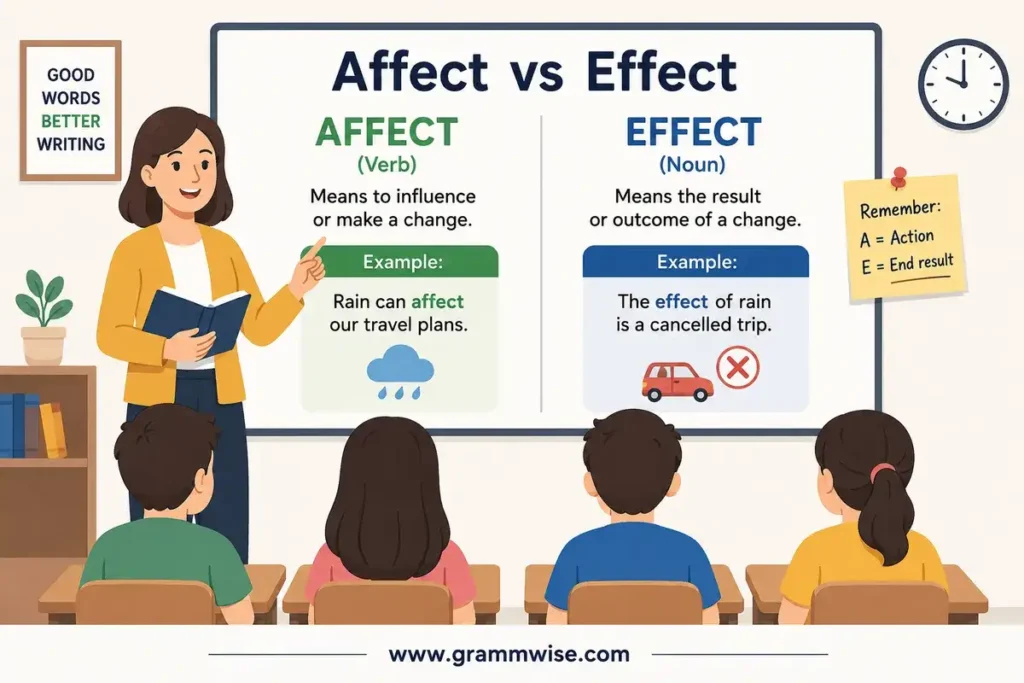
- Memorize the first letters of each word: A for Affect and E for Effect
A = Affect = Action word or a behavior
while E = Effect = End (an End or a result of a behavior).
- Remember the cause-effect relationship of the two words:
To affect something means to have an effect on it. Remember that A causes E.
So now remember the easy rule.
Affect = Action
Effect = End Result
That helps most of the time.
Practice Test: Affect vs Effect
Choose the correct word (affect or effect) to complete each sentence.
- Lack of sleep can ______ your mood and focus during the day.
- The new school rules had a positive ______ on student behavior.
- Heavy rain may ______ travel plans this weekend.
- The medicine produced a quick ______ after only one hour.
- Loud noise can ______ a baby’s sleep.
Answers
- affect
- effect
- affect
- effect
- affect
Final Teacher Explanation
Here is the easiest classroom explanation.
When comparing affect vs effect, focus on what the sentence is doing.
If something is changing or influencing something else, use affect.
If you are talking about the result of that change, use effect.
Think of it this way:
Affect starts change. Effect shows the result.
That simple rule will help you almost every time.
Quick Recap Affect vs Effect
Affect usually means to influence or change something.
Effect usually means the result of that change.
Use affect for action and effect for result.
Conclusion
Understanding affect vs effect becomes easy once you remember the core difference. Affect is about action and influence, while effect is about the result or outcome.
Knowing this improves spelling, vocabulary, word choice, and communication. When you focus on meaning and context, choosing the right word becomes much easier.
Frequently Asked Questions (FAQs)
Is affect or effect correct?
Both are correct. Use the one that matches the sentence meaning.
What is the easiest way to remember affect vs effect?
Remember: Affect = Action, Effect = End result.
Is affect a verb?
Usually yes. It often acts as a verb.
Is effect a noun?
Usually yes. It often means result.
Why do people confuse affect vs effect?
Because they look and sound very similar.
Can affect be a noun?
Yes, but that usage is rare in everyday English.