
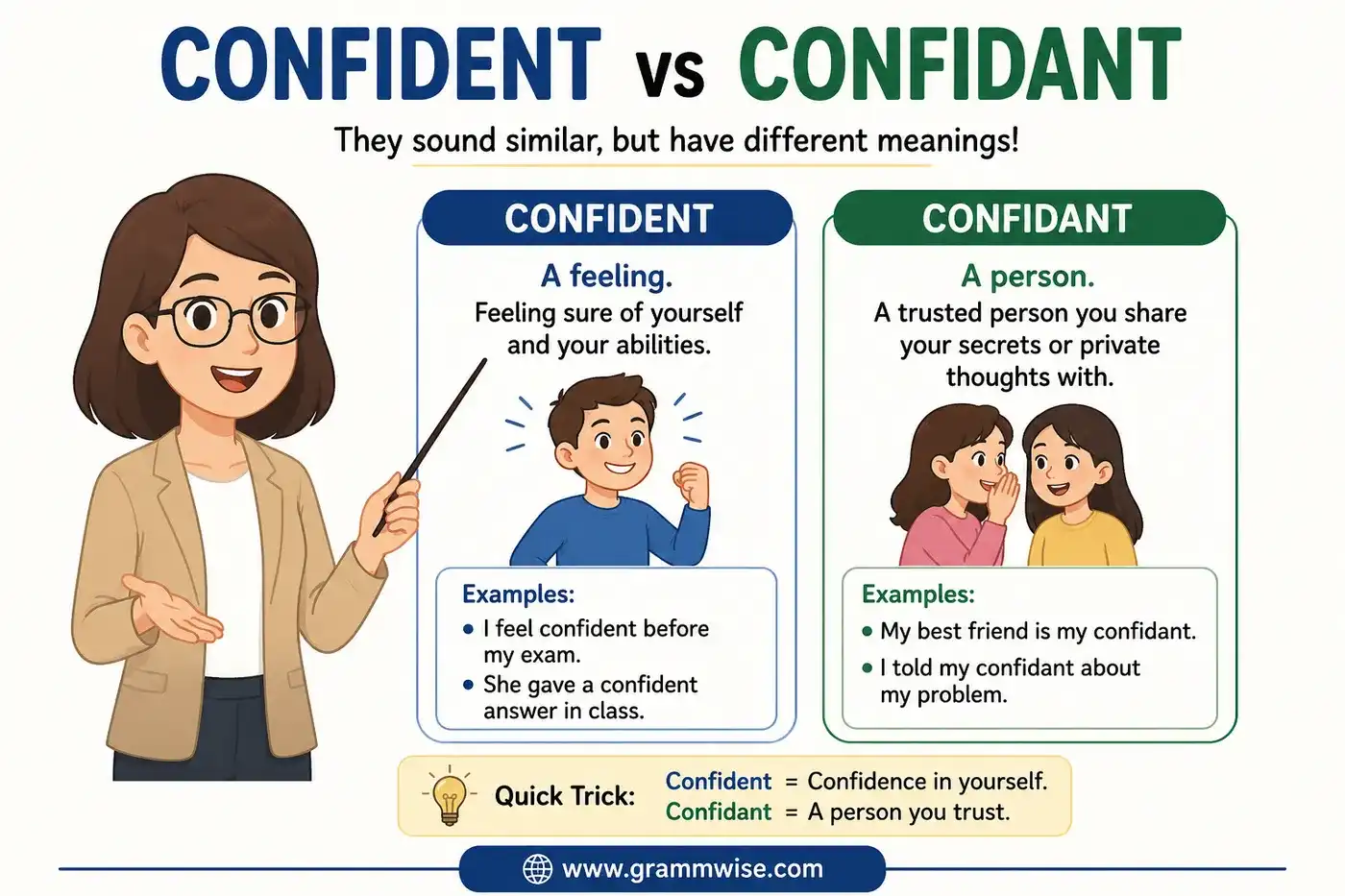
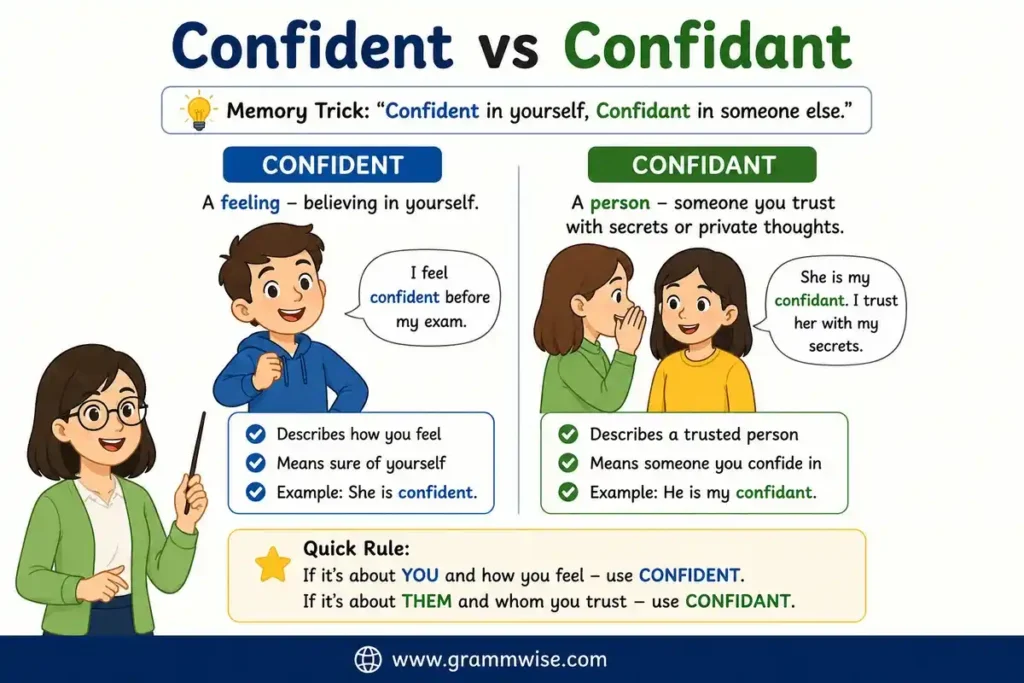
Many English learners get confused about Confident vs Confidant because the two words look and sound almost the same. However, they have very different meanings. Confident describes how someone feels, while confidant is a person you trust with your private thoughts and secrets.
If you have ever wondered about Confident vs Confidant, you are not alone. These words are often mixed up in writing and conversation. Once you learn one simple rule, it becomes easy to remember which word to use.
In this guide, you will learn the difference between Confident vs Confidant, their meanings, simple memory tricks, real-life examples, and the correct way to use each word in everyday English.
You might also find our comparison of similar confusing word pairs useful.
Simple Answer in One Look
Confident means feeling sure of yourself.
Confidant means a trusted person you share your private thoughts or secrets with.
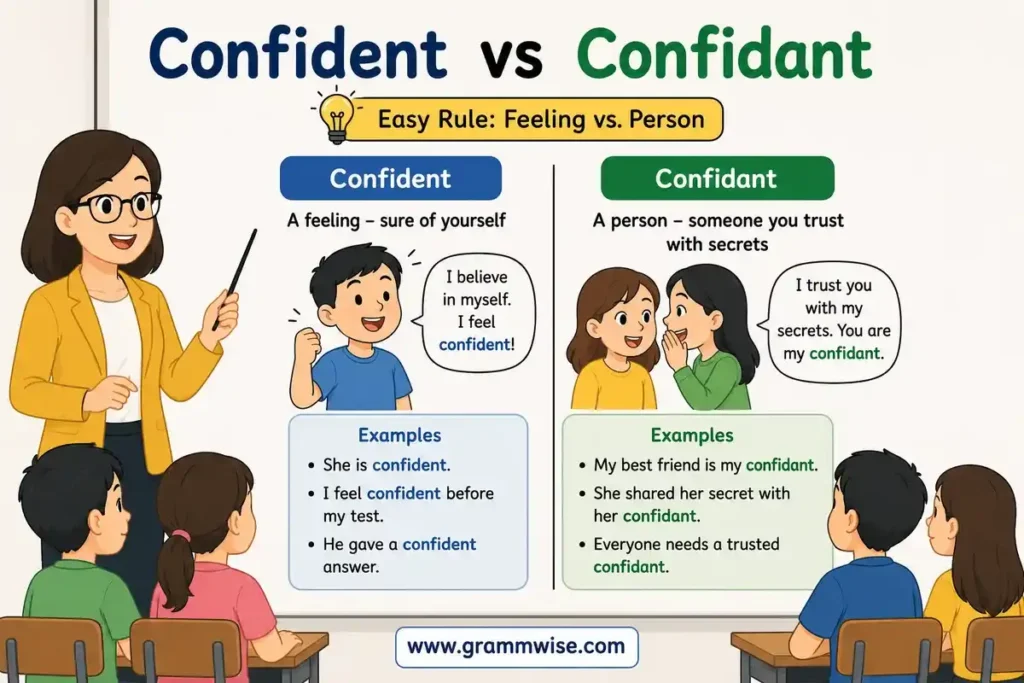
Meaning of “Confident vs Confidant” in Simple English
Imagine you are getting ready to give a speech in front of your class. You have practiced many times and believe you will do well. You feel calm and confident instead of nervous.
Being confident means believing in yourself. It means you trust your own skills and abilities.
People can feel confident before:
- A school test
- A job interview
- A sports game
- A speech
- A performance
Now think about a different situation.
You have a secret, and don’t want everyone to know it. You tell it to one person because you trust him.
That trusted person is your confidant.
A confidant is someone who listens, understands, and keeps your private information safe.
For example:
- A best friend
- A parent
- A brother or sister
- A husband or wife
- A trusted teacher
These people can all be your confidant if you share your private thoughts with them.
Here is the easiest way to remember.
Confident = Believe in yourself.
Confidant = Believe in another person with your secrets.
This simple memory trick helps many students remember the difference.
Confident vs Confidant: Why People Mix These Words?
People often confuse Confident vs Confidant because they are almost spelled the same.
They also sound very similar. When speaking quickly, many people cannot hear the small difference.
Another reason is that both words come from the same old root word related to trust. Because of this, they look connected.
However, they are used in different ways.
One describes a feeling.
The other names a person.
Here are some common mistakes.
Someone writes:
“I feel confidant before my exam.”
This is incorrect.
The correct sentence is:
“I feel confident before my exam.”
Another example:
“She is my confident.”
This is also incorrect.
The correct sentence is:
“She is my confidant.”
Sometimes people know the meanings but accidentally type the wrong spelling. This happens because there is only one letter that changes.
Reading many examples helps you remember which spelling matches which meaning.
Clear Difference of “Confident vs Confidant” Explained Simply
The easiest way to understand Confident vs Confidant is to compare them side by side.
Confident
Use confident when talking about feelings.
Someone who is confident:
- Believes in themselves.
- Feels sure about what they can do.
- Is ready to face a challenge.
- Does not easily give up.
- Trusts their own abilities.
Examples:
- She is confident before every game.
- I feel confident about my homework.
- He gave a confident answer.
- Our team feels confident today.
- You look confident in your new job.
Confidant
Use confidant when talking about a trusted person.
A confidant is someone who:
- Keeps your secrets.
- Listens carefully.
- Gives advice.
- Understands your feelings.
- Supports you during difficult times.
Examples:
- My sister is my closest confidant.
- He became her trusted confidant.
- I tell my confidant everything.
- She talked to her confidant after school.
- A good confidant never shares your secrets.
Easy Comparison Table
| Confident | Confidant |
|---|---|
| A feeling | A person |
| Means sure of yourself | Means someone you trust |
| Describes confidence | Describes a trusted friend |
| Used as an adjective | Used as a noun |
| “I feel confident.” | “She is my confidant.” |
Looking at both words together makes the difference much easier to remember.
Confident vs Confidant: Which Form Should You Use?
Choosing between Confident vs Confidant is simple.
Ask yourself one question.
Am I talking about a feeling or a person?
If you are talking about feeling sure of yourself, use confident.
Examples:
- I am confident about the test.
- She feels confident today.
- They sounded confident during the meeting.
If you are talking about someone you trust with private thoughts or secrets, use confidant.
Examples:
- My best friend is my confidant.
- He has been her confidant for many years.
- Everyone needs a trusted confidant.
Here is another easy memory trick.
Think of confident as confidence.
Both words are about believing in yourself.
Think of confidant as your trusted friend.
That person keeps your secrets safe.
Whenever you are unsure, ask yourself, “Is this about me feeling sure, or is it about a trusted person?” The answer will tell you which word to choose.
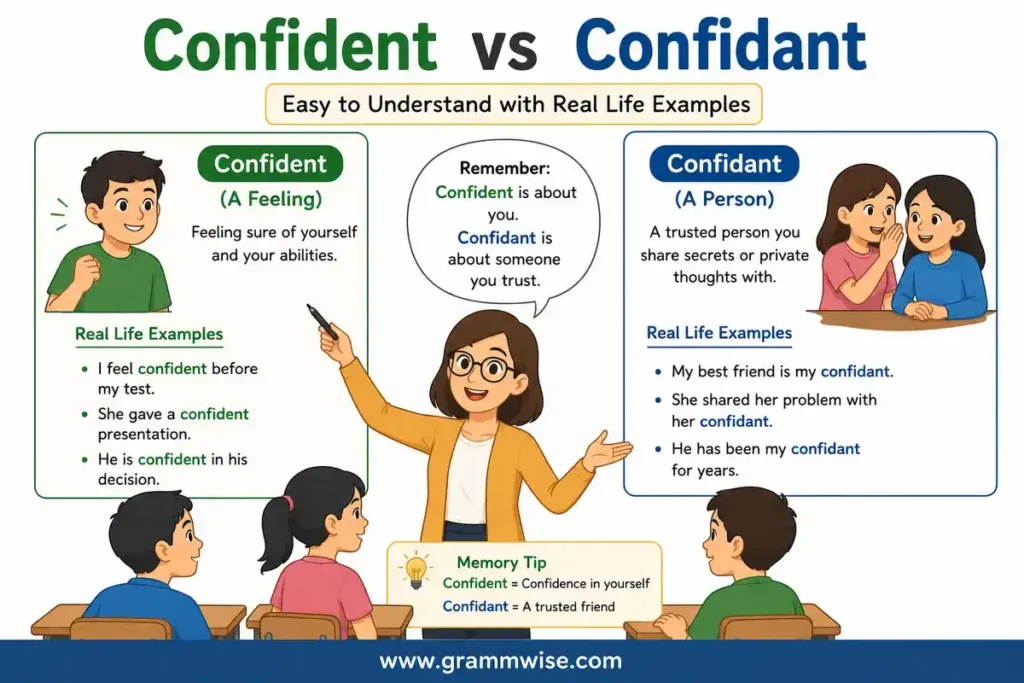
Easy Real-Life Sentences on “Confident vs Confidant”
One of the best ways to remember Confident vs Confidant is to see the words in everyday sentences. Read these examples carefully and notice how each word is used.
Examples Using Confident
- I feel confident before my math test.
- She is confident when she speaks in class.
- He gave a confident smile before the game.
- We are confident that our team will do well.
- The teacher sounded confident during the lesson.
- You should be confident in your abilities.
- Emma became more confident after practicing every day.
- They felt confident about their science project.
In all of these examples, confident describes how someone feels.
Examples Using Confidant
- My best friend is my confidant.
- I shared my secret with my confidant.
- Her mother has always been her trusted confidant.
- Jake became his brother’s confidant.
- Everyone needs a confidant they can trust.
- She called her confidant when she needed advice.
- His grandfather was his closest confidant.
- A good confidant listens without judging.
In these examples, confidant means a trusted person.
Here is one more easy comparison.
Confident
- Describes a feeling.
- Shows self-belief.
- Talks about your attitude.
Confidant
- Names a person.
- Shows trust.
- Talks about someone who keeps your secrets.
When you remember whether the word is talking about a feeling or a person, choosing the correct one becomes much easier.
Confident vs Confidant: Where This Word Comes From?
The words confident and confidant both come from the Latin word confidere, which means to trust or to have faith.
Although they started from the same root, their meanings changed over time.
The word confident came to describe someone who trusts themselves. It is about believing in your own skills, ideas, or decisions. For example, a student who studies well before an exam may feel confident because they believe they are prepared.
The word confidant came to describe a person whom you trust. Instead of believing in yourself, you believe that another person will keep your private thoughts safe. For example, many people have one close friend who is their confidant.
Today, both words are common in English, but they are used in very different situations.
Remember this simple idea.
Confident means you trust yourself.
Confidant means you trust someone else.
Even though the words look almost the same, this small difference changes the meaning completely.
Here is another memory trick.
The ending -ent in confident can remind you of your own confidence.
The ending -ant in confidant can remind you of another person who stands by your side.
You do not have to memorize difficult grammar rules. Just remember these two easy questions.
- Am I talking about a feeling? Use confident.
- Am I talking about a trusted person? Use confidant.
With a little practice, you will be able to choose the correct word every time.
How “Confident vs Confidant” Is Understood in Culture and Stories?
The words confident and confidant appear in many books, movies, TV shows, and real-life conversations. Even though they are different, both words are connected to trust.
A confident person is often shown as brave, calm, and ready to face challenges. In many stories, the main character starts out feeling unsure but becomes more confident as the story moves forward.
For example, a student may be afraid to speak in front of the class. After practicing and believing in themselves, they become confident and give a great speech.
Sports stories also show confident people. A player may train every day until they feel confident before an important game.
In movies, a confident hero often stays calm during difficult situations. Their confidence helps others believe that everything will be okay.
A confidant is different.
A confidant is usually the person who listens when the main character is worried or confused. This trusted person gives advice, offers support, and keeps private conversations secret.
For example, a young girl in a story may tell her best friend about her dreams and fears. That friend becomes her confidant.
Many famous stories include a confidant because everyone needs someone they can trust. Parents, grandparents, close friends, brothers, sisters, and teachers often play the role of a confidant. These characters help the story feel more real because trust is an important part of life.
Although confident and confidant have different meanings, both remind us that trust is valuable.
One is about trusting yourself.
The other is about trusting someone else.
Biblical and Mythological Meaning of “Confident vs Confidant”
The words confident and confidant do not have special meanings in the Bible, but the ideas behind them appear many times.
The Bible often encourages people to have confidence in God and to do what is right. Many well-known people in the Bible showed confidence because they believed God would help them.
For example, David showed confidence when he faced Goliath. He believed he could overcome a much stronger enemy.
The Bible also teaches people to choose trusted friends wisely. A good friend listens, helps, and keeps private matters private. This is similar to the idea of a confidant. In many cultures, having one trusted person to talk to is seen as a blessing.
In mythology, heroes often have a trusted companion who listens and gives advice. Although that person may not be called a confidant, they play the same role.
These stories remind us that confidence helps us grow, while trusted friendships help us through difficult times.
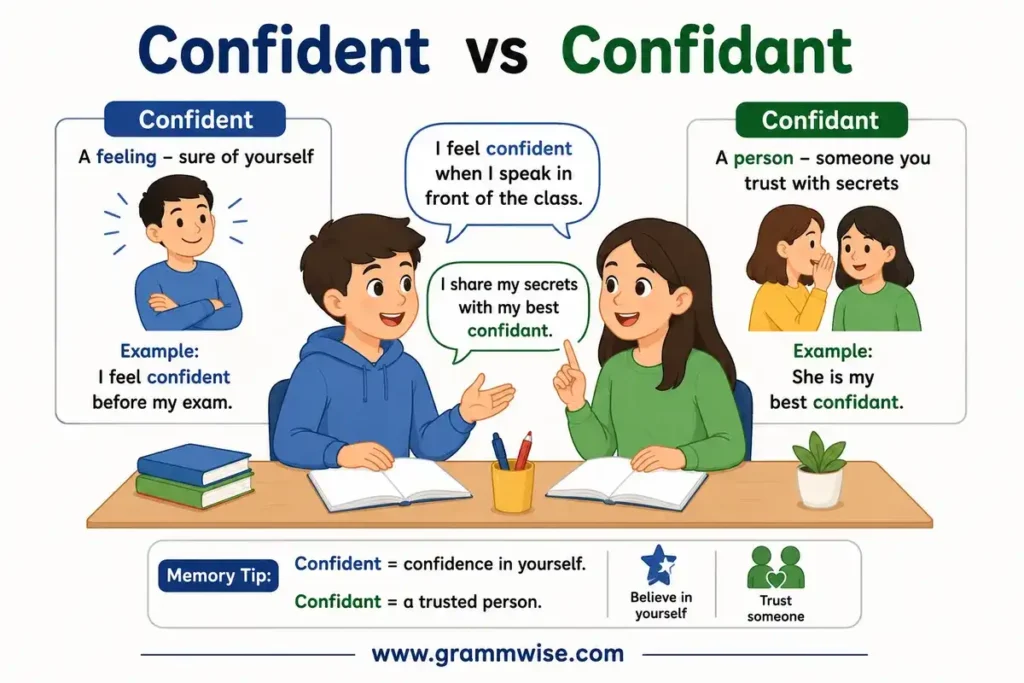
Symbolism of “Confident vs Confidant” Explained in Simple Words
What Confident Represents?
The word confident often represents:
- Courage
- Self-belief
- Hope
- Strength
- Positive thinking
- Growth
- Success
When someone is confident, they believe they can learn, improve, and solve problems.
Confidence does not mean thinking you are perfect. It means believing you can keep trying even when something is difficult.
That is why confidence is often connected with success in school, sports, and everyday life.
What Confidant Represents?
The word confidant often represents:
- Trust
- Friendship
- Loyalty
- Honesty
- Support
- Care
- Understanding
A confidant is someone who makes you feel safe.
You know they will listen without laughing at you or sharing your secrets. Many people feel stronger because they have a trusted confidant in their lives.
A good confidant gives advice, encourages you, and stays by your side during both happy and difficult times.
Related Words You Should Know
Learning a few related words will make Confident vs Confidant even easier to understand.
Confidence
The belief that you can do something well.
A confident person has confidence.
Trust
Believing that someone is honest and reliable.
Trust is the foundation of a good confidant.
Courage
Being brave even when something feels difficult.
Confidence often grows with courage.
Friend
Someone who cares about you.
A close friend may also become your confidant.
Support
Helping another person during good and bad times.
A confidant gives support when it is needed.
Advice
Helpful ideas or suggestions.
People often ask their confidant for advice.
Self-Belief
Believing in your own abilities.
This is another way to describe confidence.
Loyalty
Staying true to someone and keeping their trust.
A loyal person can become a wonderful confidant.
Use of “Confident vs Confidant” in Daily English
People use confident and confidant in many everyday situations. You may hear these words at school, at work, at home, or while talking with friends. The key is remembering that one word describes a feeling, while the other names a person.
Here are some real-life examples using confident.
- I feel confident before my driving test.
- She is confident about her presentation.
- He gave a confident answer in class.
- Our team feels confident before the match.
- You should be confident in your skills.
- Mia became more confident after practicing every day.
- The speaker sounded confident during the meeting.
- We are confident that everything will go well.
In all of these examples, confident describes someone who believes in themselves.
Now look at examples using confidant.
- My sister is my closest confidant.
- He shared his worries with his confidant.
- Her best friend has always been her confidant.
- I trust my confidant with my biggest secrets.
- Everyone needs a confidant who will listen.
- His grandfather became his trusted confidant.
- She called her confidant for advice.
- A good confidant keeps private conversations private.
In these examples, confidant means a trusted person.
The more you read and use these words, the easier they become to remember.
Common Mistakes People Make About “Confident vs Confidant”
Many learners confuse Confident vs Confidant because the spellings are almost the same.
Here are the most common mistakes.
Mistake 1: Using confident for a person
❌ She is my confident.
✅ She is my confidant.
A trusted person is a confidant, not confident.
Mistake 2: Using confidant for a feeling
❌ I feel confidant before the exam.
✅ I feel confident before the exam.
When talking about your feelings, always use confident.
Mistake 3: Thinking both words have the same meaning
Although they come from the same root word, they have different meanings.
Confident describes a feeling.
Confidant names a trusted person.
Mistake 4: Forgetting the context
Before choosing a word, ask yourself one simple question.
“Am I talking about a feeling?”
If the answer is yes, use confident.
If you are talking about someone you trust, use confidant.
Mistake 5: Relying only on spelling
Because only one letter changes, people often choose the wrong word.
Instead of looking only at the spelling, think about the meaning first.
That simple habit will help you avoid mistakes.
Final Teacher Explanation
Imagine we are in class together.
I write two words on the board.
Confident
Confidant
Then I ask you one easy question.
“Are you talking about yourself?”
If you mean you believe in yourself, choose confident.
Now I ask another question.
“Are you talking about someone you trust?”
If the answer is yes, choose confidant.
That is the easiest way to remember the difference.
You do not need long grammar rules. You only need two simple ideas.
Confident = believing in yourself.
Confidant = trusting another person with your secrets.
Here is another memory trick.
Think about the word confidence.
It helps you remember confident.
Now think about your best friend.
That trusted person can be your confidant.
Practice these words in your own sentences. Soon, you will know the correct word without stopping to think.
Final Answer “Confident vs Confidant”
If you are choosing between Confident vs Confidant, remember this easy rule. Use confident when talking about feeling sure of yourself. Use confidant when talking about a trusted person who keeps your private thoughts or secrets. This simple difference will help you use both words correctly every time.
Conclusion
Understanding Confident vs Confidant is easy when you remember one simple rule. Confident describes a person who believes in themselves, while confidant is someone you trust with your private thoughts and secrets. Keeping this difference in mind will help you choose the correct word every time.
The best way to master these words is to practice using them in real-life conversations and writing. Focus on the meaning instead of the spelling, and you will use both words naturally and with confidence.
Frequently Asked Questions (FAQs)
What is the difference between confident and confidant?
Confident means feeling sure of yourself. Confidant means a trusted person you share your private thoughts or secrets with.
Which is correct: confident or confidant?
Both words are correct. Choose the one that matches the meaning of your sentence.
When should I use confident?
Use confident when talking about self-belief or feeling sure about your abilities.
When should I use confidant?
Use confidant when talking about someone you trust with personal information.
Why do people confuse Confident vs Confidant?
The words look and sound very similar, but they have different meanings and different uses.
Can a friend be a confidant?
Yes. A close friend, family member, or anyone you trust can be your confidant.
Is confident an adjective?
Yes. Confident is an adjective because it describes how someone feels.
How can I remember the difference between Confident vs Confidant?
Remember this simple trick: Confident = confidence in yourself. Confidant = a trusted friend who keeps your secrets.