
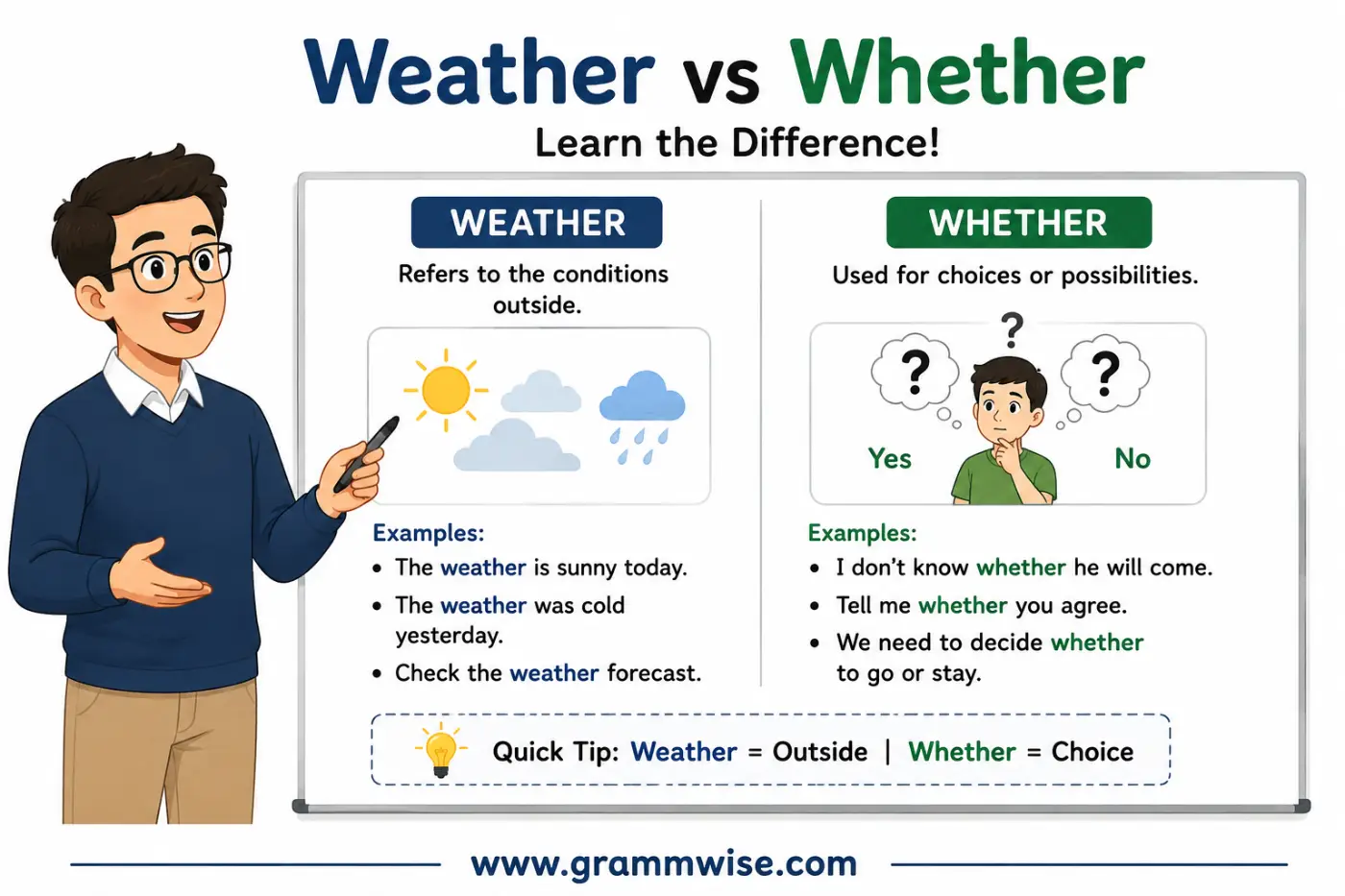
Many English learners confuse weather vs whether because these two words sound almost the same when spoken. However, they have completely different meanings and uses. Weather is about conditions outside, such as rain, wind, heat, or snow. Whether is used when talking about a choice, possibility, or two different options.
The difference between weather or whether becomes easy once you connect each word with its meaning. Think of weather as something you check before leaving home. Think of whether as a word you use when you are not sure about two choices.
If you have ever wondered which is correct, weather vs whether, this guide will help. You will learn the simple difference, see real-life examples, learn common mistakes, and discover an easy memory trick that will help you remember the correct word.
Is shiney correct? Learn the correct spelling shiny and why it drops the “e.”
Simple Answer in One Look
Weather = the conditions outside.
Whether = used when talking about a choice or possibility.
Quick examples:
The weather is cold today. ✅
I don’t know whether he will come. ✅
A simple memory trick is:
Weather has to do with the outside. Whether has to do with choices.
What Does Weather vs Whether Means in Simple English?
Let’s make both words very simple.
What does “weather” mean?
Weather describes what the air and sky are like at a particular time.
It can include:
- rain
- sunshine
- wind
- snow
- clouds
- heat
- cold
- storms
For example:
The weather is beautiful today.
This means the conditions outside are pleasant.
You can also say:
What is the weather like today?
This asks about the conditions outside.
What does “whether” mean?
Whether is used when there is a choice or possibility.
For example:
I don’t know whether she will come.
This means you are unsure if she will come or not.
Another example:
Tell me whether you want tea or coffee.
There are two choices: tea or coffee.
So remember:
Weather = outside conditions.
Whether = choice or possibility.

Why People Mix Up These Words Weather vs Whether?
The biggest reason is pronunciation.
In many types of English, weather and whether sound very similar. Some speakers pronounce them almost exactly the same.
This creates a problem when people are writing.
You may know exactly what you want to say, but you may not know which spelling to type.
For example, someone may think:
I don’t know weather he is coming.
The sentence sounds understandable when spoken, but the spelling is wrong.
The correct sentence is:
I don’t know whether he is coming.
The meaning tells you which word to choose.
If you are talking about rain, sunshine, temperature, or storms, use weather.
If you are talking about a choice or uncertainty, use whether.
Clear Difference Between Weather vs Whether
Here is the easiest comparison.
| Word | Meaning | Example |
|---|---|---|
| Weather | Conditions outside | The weather is rainy. |
| Whether | A choice or possibility | I don’t know whether he will come. |
Remember the main difference
Weather is about what is happening outside.
Whether is about which possibility is true.
Compare these sentences
The weather is getting colder.
This talks about temperature.
I don’t know whether it will get colder.
This talks about uncertainty.
The two words may sound similar, but their meanings are completely different.
Weather vs Whether: Which Form Should You Use?
Use weather when you are talking about the atmosphere or conditions outside.
Examples:
The weather is hot.
The weather changed suddenly.
We checked the weather before leaving.
Use whether when you are talking about a choice, question, or possibility.
Examples:
I don’t know whether she is home.
Tell me whether you agree.
We need to decide whether to stay.
The easiest rule
Ask yourself:
“Am I talking about rain, sun, wind, temperature, or conditions outside?”
If yes, use:
weather
If you are talking about:
- a choice
- two possibilities
- uncertainty
- “if something is true or not”
use:
whether
Easy Real-Life Sentences On Weather vs Whether
Weather
- The weather is nice today.
- The weather looks bad.
- I checked the weather this morning.
- The weather is getting colder.
- We stayed home because of the weather.
Whether
- I don’t know whether he is coming.
- She asked whether I was ready.
- We need to decide whether to go.
- I wonder whether they know.
- Tell me whether you want tea or coffee.
These examples show the difference clearly.
Weather: More Than Just Rain
Many people think weather only means rain.
That is not true.
Weather includes many conditions.
Temperature
The weather is very hot today.
Rain
The weather is rainy this morning.
Wind
The windy weather made it difficult to walk.
Snow
The cold weather brought snow.
Sunshine
We enjoyed the warm weather.
Storms
The stormy weather kept us indoors.
So, whenever you talk about outdoor conditions, weather is usually the word you need.
Whether: Talking About Choices
The word whether is often used when a person has two possibilities.
For example:
I don’t know whether to stay or leave.
There are two choices.
Another example:
She asked whether I wanted pizza or pasta.
Again, there are two choices.
You can also use whether when the second choice is not directly stated.
I don’t know whether he will come.
The hidden meaning is:
I don’t know if he will come or not.
This is why whether is closely connected to choices and uncertainty.
Whether and “If”
One reason learners get confused is that whether and if can sometimes be used in similar sentences.
For example:
I don’t know whether she will come.
You can often say:
I don’t know if she will come.
Both sentences express uncertainty.
But whether is especially useful when you are talking about two alternatives.
For example:
I don’t know whether to take the bus or the train.
The two choices are clear:
- bus
- train
You can also use whether … or …
Tell me whether you want tea or coffee.
This makes the choice very clear.
Common Pattern: Whether or Not
One very common expression is:
whether or not
It means the result is the same regardless of the situation.
Example:
I will go whether or not it rains.
This means:
I will go if it rains, and I will also go if it does not rain.
Another example:
She will attend whether or not you invite her.
The decision does not depend on the invitation.
More examples
I will finish the job whether or not you help me.
He plans to travel whether or not the weather is good.
Notice something interesting in this sentence:
He plans to travel whether or not the weather is good.
Both words appear together, but they have different jobs.
- whether = possibility
- weather = outdoor conditions
This is an excellent sentence for remembering the difference.
Weather and Whether in the Same Sentence
Sometimes both words can appear in one sentence.
This is a great way to practice.
I don’t know whether the weather will improve.
Here:
whether = uncertainty
weather = outdoor conditions
Another example:
We will decide whether to go after checking the weather.
Again:
whether = choice
weather = conditions outside
One more:
She asked whether the weather would be warm enough for a picnic.
This sentence uses both words correctly.
Weather Forecast
A weather forecast is information about expected weather.
You may hear:
The weather forecast says it will rain tomorrow.
People check weather forecasts before:
- traveling
- driving
- hiking
- having a picnic
- going to the beach
- playing sports
- planning outdoor events
For example:
Let’s check the weather forecast before we leave.
This is a very common expression.

Weather in Daily Conversation
Here are some questions people commonly ask.
How’s the weather?
What’s the weather like today?
Is the weather going to be cold tomorrow?
Did you check the weather?
What does the weather forecast say?
These all use weather because they are about outdoor conditions.
Whether in Daily Conversation
Here are some natural examples.
I don’t know whether I should go.
Do you know whether she is home?
I’m not sure whether this is correct.
Let’s see whether it works.
He asked whether I needed help.
These examples all deal with uncertainty, choices, or questions.
Common Mistakes People Make
Mistake 1: Using weather for a choice
❌ I don’t know weather she is coming.
✅ I don’t know whether she is coming.
You are not talking about rain or temperature.
You are talking about uncertainty.
So use whether.
Mistake 2: Using whether for outdoor conditions
❌ The whether is cold today.
✅ The weather is cold today.
You are describing the conditions outside.
So use weather.
Mistake 3: Writing weather or whether based only on sound
Because the words can sound alike, listening is not enough.
Think about the meaning.
Ask:
Is this about outside conditions?
→ weather
Is this about a choice or possibility?
→ whether
Mistake 4: Forgetting “whether or not”
Some learners write:
❌ I will go weather or not you come.
The correct sentence is:
✅ I will go whether or not you come.
The expression is:
whether or not
Mistake 5: Confusing whether with “if”
In many situations, if and whether can both work.
But when you clearly present two choices, whether is often the better choice.
Example:
I don’t know whether to walk or take the bus.
This clearly shows two options.
Word Family and Related Forms
Weather
Related words include:
- weather forecast
- weather report
- weather conditions
- weather station
- weather warning
- weather change
- bad weather
- good weather
- cold weather
- hot weather
Whether
Whether does not have a large word family in the same way as many common nouns, but it appears in useful patterns.
Examples:
- whether or not
- whether to
- whether … or …
- whether or not to
For example:
I don’t know whether to stay.
We need to decide whether to go or wait.
Synonyms and Related Words
Weather-related words
Depending on the situation, you may use:
conditions — the state of the atmosphere outside.
climate — the usual weather of a place over a long period.
forecast — a prediction about future weather.
storm — a period of strong wind, rain, snow, or other bad weather.
temperature — how hot or cold something is.
Be careful with climate and weather.
They are related but not the same.
Weather can change from hour to hour.
Climate describes long-term patterns.
Whether-related words
Words with related ideas include:
if — used to talk about a condition or possibility.
choice — an option between things.
possibility — something that may happen.
uncertainty — not knowing what is true or what will happen.
alternative — another choice.
These words can help you understand why whether is used.
Weather vs Climate
Many English learners also confuse weather with climate.
The difference is simple.
Weather is what is happening now or around a short period.
Climate is the usual weather pattern of a place over many years.
Example:
The weather is rainy today.
This talks about today.
This region has a warm climate.
This talks about the general pattern of the region.
A place can have a warm climate but still have a cold day.
Weather in Stories and Culture
Weather is often used in stories to create a feeling.
For example, writers may describe:
- dark clouds
- heavy rain
- bright sunshine
- cold wind
A sunny day may make a story feel happy. A dark storm may make a scene feel tense or serious. This does not change the basic meaning of weather. It simply shows how writers use weather to create a picture in the reader’s mind.
Weather in everyday culture
People also talk about weather as a simple way to start conversations.
Someone may say:
“It’s really hot today.”
Another person might answer:
“Yes, the weather is much warmer than yesterday.”
Weather is easy to talk about because everyone experiences it.
Biblical and Mythological Meaning of Weather vs Whether
Weather appears in many religious and traditional stories because rain, storms, wind, and sunshine are part of human life. In some traditional stories, storms may represent danger or powerful natural forces. Rain may represent growth, life, or renewal.
However, weather itself does not have one fixed symbolic meaning.
Its meaning depends on the story.
The word whether does not have a special biblical or mythological meaning. It keeps its normal English function of showing uncertainty or alternatives.
Symbolism Explained in Simple Words
What Weather Can Represent
In stories, weather can sometimes represent:
- change
- danger
- peace
- sadness
- hope
- new beginnings
- uncertainty
For example:
A storm may create a feeling of danger.
Sunshine may create a feeling of happiness.
Rain may suggest sadness in one story but new life in another.
The context matters.
What Whether Represents
Whether is different.
It can represent:
- choice
- doubt
- uncertainty
- two possibilities
- decision-making
For example:
She wondered whether she should leave.
The character is facing a decision.
So the comparison is:
| Weather | Whether |
|---|---|
| Outdoor conditions | Choice or possibility |
| Rain, wind, sun, snow | Doubt or alternatives |
| Can be sunny or stormy | Can be yes or no |
| “The weather is cold.” | “I don’t know whether he will come.” |
How People Actually Use Weather vs Whether in Daily English
Here are natural examples with weather.
- “What’s the weather like today?”
- “The weather is beautiful.”
- “The weather looks terrible.”
- “I checked the weather before leaving.”
- “The weather changed suddenly.”
- Now look at whether.
- “I don’t know whether she is coming.”
- “Can you tell me whether this is correct?”
- “We need to decide whether to stay.”
- “I’m not sure whether he knows.”
- “She asked whether I wanted coffee.”
These are common ways people use the words in real conversations.
More Examples Using Both Words
Practice these sentences carefully.
- I don’t know whether the weather will be good tomorrow.
- We will go to the park if the weather is nice.
- She asked whether the weather would affect the trip.
- I checked the weather to decide whether to go hiking.
- Whether we go depends on the weather.
That last sentence is especially useful.
Whether we go = the decision.
the weather = the outdoor conditions.

A Simple Trick for Remembering Weather
Think of the word weather as having weather things around it.
Imagine:
☀️ Sun
🌧️ Rain
❄️ Snow
💨 Wind
☁️ Clouds
If your sentence is about these things, choose:
WEATHER
You can remember:
Weather = what is outside.
A Simple Trick for Remembering Whether
Think of whether as a word standing between two choices.
Imagine:
Tea ☕ OR Coffee ☕
Then say:
I don’t know whether I want tea or coffee.
So remember:
Whether = which choice?
This is a very simple classroom trick.
Practice Test
Choose the correct word.
1. The _____ is beautiful today.
A. whether
B. weather
Answer: B. weather
2. I don’t know _____ he is ready.
A. whether
B. weather
Answer: A. whether
3. We checked the _____ before our trip.
A. weather
B. whether
Answer: A. weather
4. She asked _____ I wanted tea or coffee.
A. weather
B. whether
Answer: B. whether
5. The _____ forecast says it may rain.
A. weather
B. whether
Answer: A. weather
6. I will go _____ or not you come.
A. weather
B. whether
Answer: B. whether
7. We don’t know _____ the game will continue.
A. weather
B. whether
Answer: B. whether
Final Teacher Explanation
If you are sitting in an English class and ask me, “Teacher, how do I know whether to use weather or whether?”, I would give you one simple rule.
Think about the meaning first.
If you are talking about rain, sunshine, wind, snow, temperature, clouds, or storms, use weather.
For example:
The weather is rainy today.
If you are talking about a choice, possibility, or something you are unsure about, use whether.
For example:
I don’t know whether she will come.
Do not choose the word just because it sounds right. These words can sound very similar, so spelling depends on meaning.
Remember these two lines:
Weather = outside conditions.
Whether = choice or possibility.
And remember the useful expression:
whether or not
For example:
I will go whether or not it rains.
Notice how both ideas can appear together:
I don’t know whether the weather will improve.
Here, whether shows uncertainty, while weather describes conditions outside.
Once you connect each word with its meaning, the confusion becomes much easier.
Quick Recap Weather vs Whether
When choosing between weather vs whether, use weather for rain, wind, sunshine, temperature, and other outdoor conditions. Use whether for choices, possibilities, and uncertainty.
Remember: weather = outside and whether = choice. If you can remember those two ideas, you can usually choose the right word.

Conclusion
When deciding between weather vs whether, remember that weather describes conditions outside, while whether introduces a choice, possibility, or uncertainty. If you are talking about rain, sunshine, wind, or temperature, choose weather. If you are talking about a decision or asking which possibility is true, choose whether.
The easiest memory trick is simple: weather = outside, whether = choice. Practice these two words in everyday sentences, and the difference will soon become natural. Once you focus on meaning instead of sound, choosing the correct word becomes much easier.
Frequently Asked Questions
What is the difference between weather vs whether?
Weather means outdoor conditions such as rain or sunshine. Whether is used for choices, possibilities, or uncertainty.
Is it “weather or not” or “whether or not”?
The correct expression is whether or not.
Example: I will go whether or not it rains.
Can weather and whether be used in the same sentence?
Yes.
Example: I don’t know whether the weather will improve.
Is whether the same as if?
Sometimes whether and if can have similar meanings, especially when talking about uncertainty. Whether is especially useful when choices are involved.
How can I remember weather?
Think about the outside: rain, sun, wind, snow, and temperature = weather.
How can I remember whether?
Think about a choice: whether to stay or go. So, whether = choice or possibility.
Which is correct: “I don’t know weather he is coming”?
That sentence is incorrect. Write: I don’t know whether he is coming.
Which is correct: “The whether is nice today”?
That is incorrect. Write: The weather is nice today.