
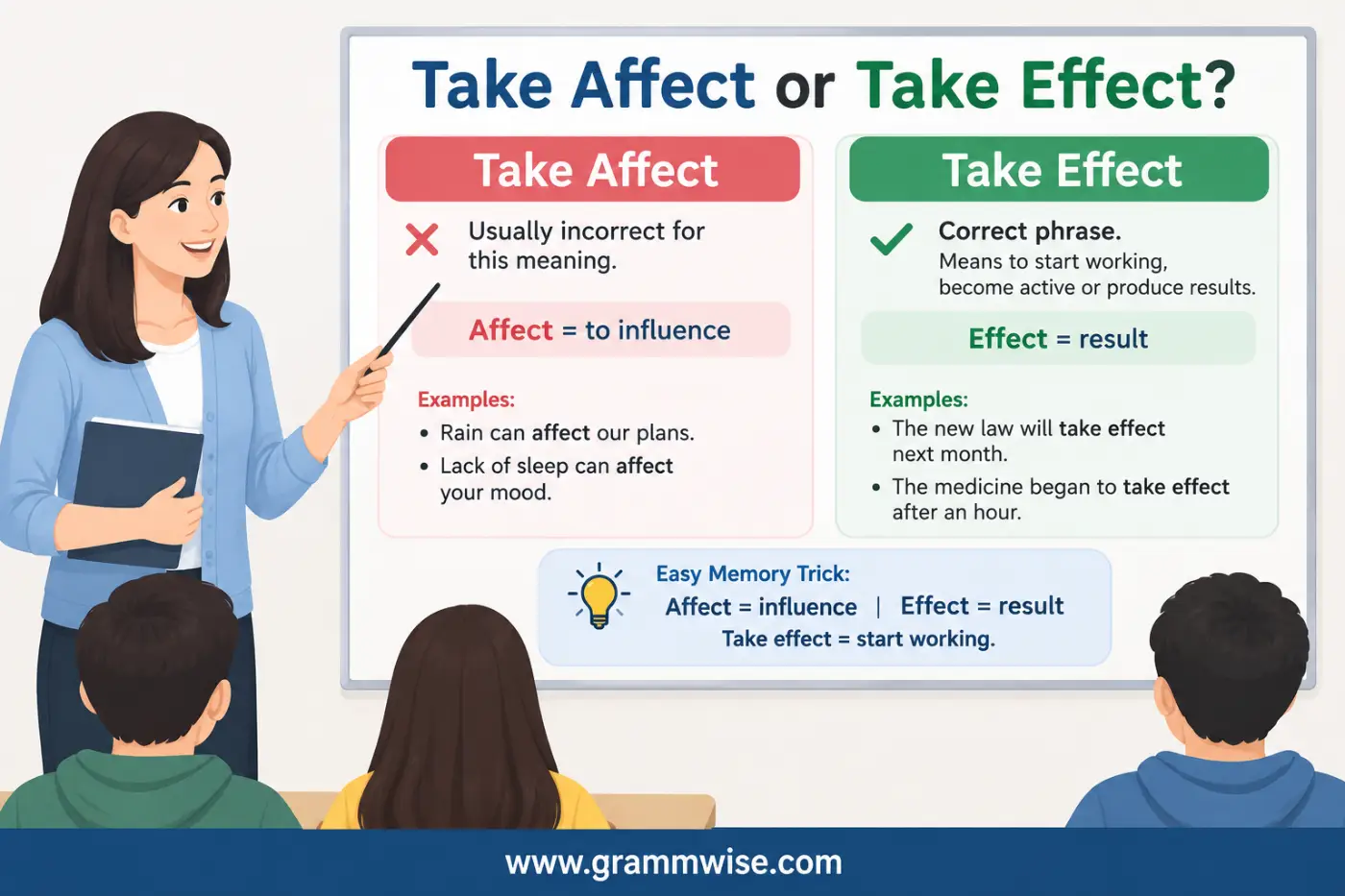
Many English learners feel confused about take affect or take effect because the words affect and effect look and sound very similar. They are also closely connected in meaning. However, when you are talking about something starting to work, becoming active, or beginning to produce results, the correct phrase is take effect.
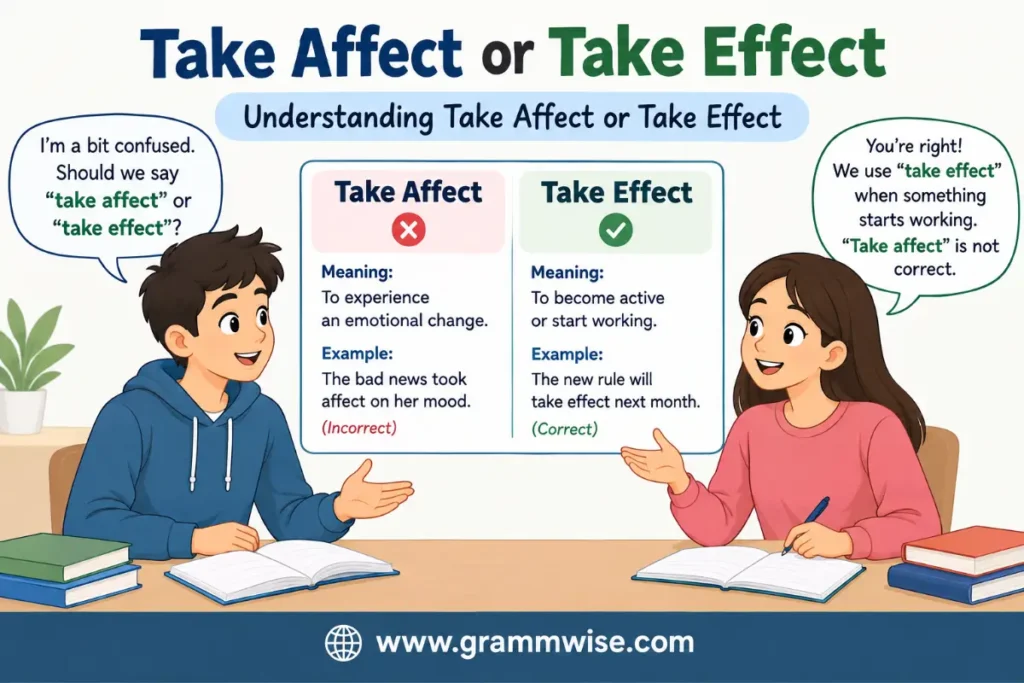
The simple answer is easy to remember: take effect is the correct English phrase. It means that something starts to work or begins to have an influence. Take affect is usually incorrect when you want to express this meaning.
In this guide, you will learn the difference between take affect or take effect in very simple English. You will see clear meanings, easy rules, real-life examples, common mistakes, and a simple memory trick to help you use the correct phrase with confidence.
Talking about rain or making a choice? Learn the difference between weather or whether.
Simple Answer in One Look
The correct phrase is:
Take effect = to start working or start producing a result.
Take affect = usually incorrect for this meaning.
Examples:
- The new law will take effect next month.
- The medicine began to take effect after an hour.
- The new school rules take effect on Monday.
The easiest rule is this:
If something starts working, it takes effect.
What Does “Take Effect” Mean in Simple English?
Take effect means that something starts working, starts happening, or begins to produce a result.
Imagine taking medicine for a headache. You take the medicine, but your headache does not disappear immediately. After some time, the medicine begins to work.
When the medicine starts working, it takes effect.
For example:
- The medicine took effect after thirty minutes.
This means the medicine started working after thirty minutes.
Now imagine a company creates a new rule. The rule is announced today, but employees do not have to follow it until next Monday. On Monday, the rule starts officially working.
The rule takes effect on Monday.
The same idea can be used for many things:
- laws
- rules
- medicines
- plans
- changes
- policies
- treatments
- safety measures
The main idea is always similar.
Something was not active before.
Then it starts working or starts producing results.
That is when it takes effect.
What Does “Effect” Mean in Simple English?
To understand take effect, you first need to understand the word effect.
An effect is usually a result or a change caused by something.
For example, exercise can have a positive effect on your health. This means exercise can produce a positive result.
Rain can have an effect on your travel plans. This means rain can cause changes to your plans.
In the phrase take effect, the word effect is connected with the idea of producing a result.
When something takes effect, it begins to create its result or influence.
Think about it like this:
Before taking effect → not working yet
After taking effect → working or producing results
This is the easiest way to understand the phrase.
What Does “Affect” Mean in Simple English?
The word affect is usually used as a verb.
It means to influence or change something.
For example:
- Rain can affect our plans.
- Lack of sleep can affect your mood.
- The new teacher affected the students in a positive way.
In these examples, something is influencing something else.
Rain influences the plans.
Lack of sleep influences your mood.
A teacher influences the students.
So affect and effect are related, but they do different jobs in a sentence.
A simple way to remember the basic difference is:
Affect = influence
Effect = result
For example:
- The weather can affect the game.
- The weather had an effect on the game.
Both sentences talk about influence, but the words are used differently.
Why Do People Mix Up Take Affect or Take Effect?
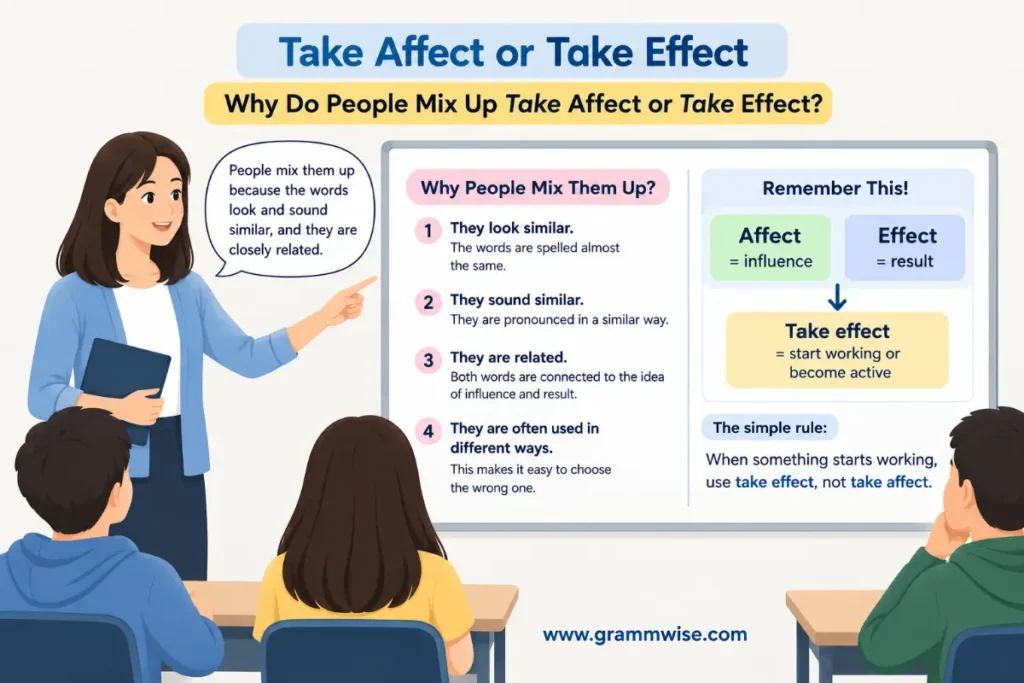
People often confuse these words because they are closely related.
Something can affect another thing by causing an effect.
For example, a new medicine may affect the body.
The changes produced by the medicine are its effects.
Because the words are connected, English learners sometimes choose the wrong one.
They may write:
❌ The medicine will take affect.
But the correct sentence is:
✅ The medicine will take effect.
The reason is simple.
The phrase take effect is a fixed and common English expression.
It means start working or begin producing results.
The phrase take affect does not normally have this meaning.
Take Affect or Take Effect: The Clear Difference
Here is the easiest comparison:
| Affect | Effect |
|---|---|
| Usually means to influence | Usually means a result |
| Often used as a verb | Often used as a noun |
| Rain can affect the trip | Rain had an effect on the trip |
| Not normally used in “take effect” | Used in the phrase “take effect” |
Now look at the main phrase:
Take effect = start working or producing results.
This is the standard and correct expression.
So when you are deciding between take affect or take effect, remember that something starts working by taking effect.
Which Form Should You Use?
Use take effect when something:
- starts working
- becomes active
- starts producing results
- officially begins
- starts influencing a situation
Here are some examples:
- The medicine will take effect soon.
- The new law takes effect in January.
- The changes will take effect next week.
- The treatment took effect quickly.
- The new policy takes effect today.
Do not use take affect when you mean that something starts working.
The simple rule is:
Things take effect.
How Do You Use “Take Effect” with Medicine?
Medicine is one of the most common situations where people use take effect.
When you take medicine, it may need time before it starts working.
For example, you may take a painkiller at 8:00 in the morning.
At first, you may still feel pain.
After some time, the medicine starts working.
You can say:
The medicine took effect after about an hour.
This does not mean that the medicine was taken.
It means the medicine began to work.
Here are more examples:
- The pain medicine took effect quickly.
- The treatment may take time to take effect.
- The sleeping medicine took effect after a short time.
- The medicine did not take effect immediately.
These are natural and common uses of the phrase.
How Do You Use “Take Effect” with Rules and Laws?
Rules and laws can also take effect.
Sometimes a new law is announced before it becomes active.
For example, a government may announce a new law in June.
However, the law may not start until August.
In this situation, the law takes effect in August.
Examples:
- The new law will take effect next year.
- The school rules take effect on Monday.
- The new policy took effect immediately.
- The changes will take effect next month.
This use is very common in news, schools, workplaces, and official writing.
The main meaning remains the same.
The rule or law becomes active.
How Do You Use “Take Effect” in Daily Life?
You can use take effect in many everyday situations.
Imagine your family changes a house rule.
Perhaps everyone must turn off their phones during dinner.
The family agrees on the rule today.
The rule starts tomorrow.
You can say:
The new rule takes effect tomorrow.
Imagine you change your study routine.
You begin studying for two hours every evening.
After a few weeks, you begin seeing better results.
You could say that your new study plan is beginning to take effect.
The phrase can describe official changes and ordinary changes.
It simply means that something has started producing results.
Take Effect at School
Students may hear take effect when schools introduce new rules or changes.
For example:
- A new dress code may take effect next semester.
- New exam rules may take effect next year.
- A new attendance policy may take effect on Monday.
Students may also use the phrase when talking about learning or personal improvement.
For example:
- My new study plan is starting to take effect.
- The teacher’s advice took effect slowly.
- The extra practice began to take effect after a few weeks.
In these examples, something starts producing a result.
That is why take effect is correct.
Take Effect at Work
The phrase is also common in workplaces.
Companies often introduce new rules, policies, or systems.
These changes may not start immediately.
When they officially begin, they take effect.
Examples:
- The new company policy takes effect next month.
- The pay changes will take effect in July.
- The new schedule took effect this week.
- The updated rules will take effect immediately.
You may also hear the phrase when discussing plans and decisions.
For example, a company may make changes to improve customer service.
After some time, the changes begin to produce better results.
The changes are starting to take effect.
Take Effect and “Come into Effect”
Another common expression is come into effect.
It has a very similar meaning to take effect.
Both expressions mean that something starts officially working or becoming active.
For example:
- The new law will take effect in January.
- The new law will come into effect in January.
Both sentences are correct.
However, take effect is often easier and more common in everyday writing.
The two expressions are closely related, so learners may see both.
Remember that they both use effect, not affect.
Take Effect and “Go into Effect”
You may also hear go into effect.
This expression also means that something starts being used or becomes active.
For example:
- The new rule will go into effect tomorrow.
- The new rule will take effect tomorrow.
The meaning is very similar.
These expressions are especially common with:
- laws
- rules
- policies
- official changes
You can remember all three:
Take effect
Come into effect
Go into effect
All of them use effect.
Easy Real-Life Sentences You Can Use
Here are simple examples that show how people use take effect in daily English.
- The medicine will take effect soon.
- The new school rule takes effect on Monday.
- The changes will take effect next month.
- The treatment took effect after a few days.
- The new law will take effect next year.
- My new study routine is starting to take effect.
- The pain medicine did not take effect right away.
- The company’s new policy took effect this morning.
These examples all have one thing in common.
Something begins working or begins producing results.
Common Phrases Related to “Take Effect”
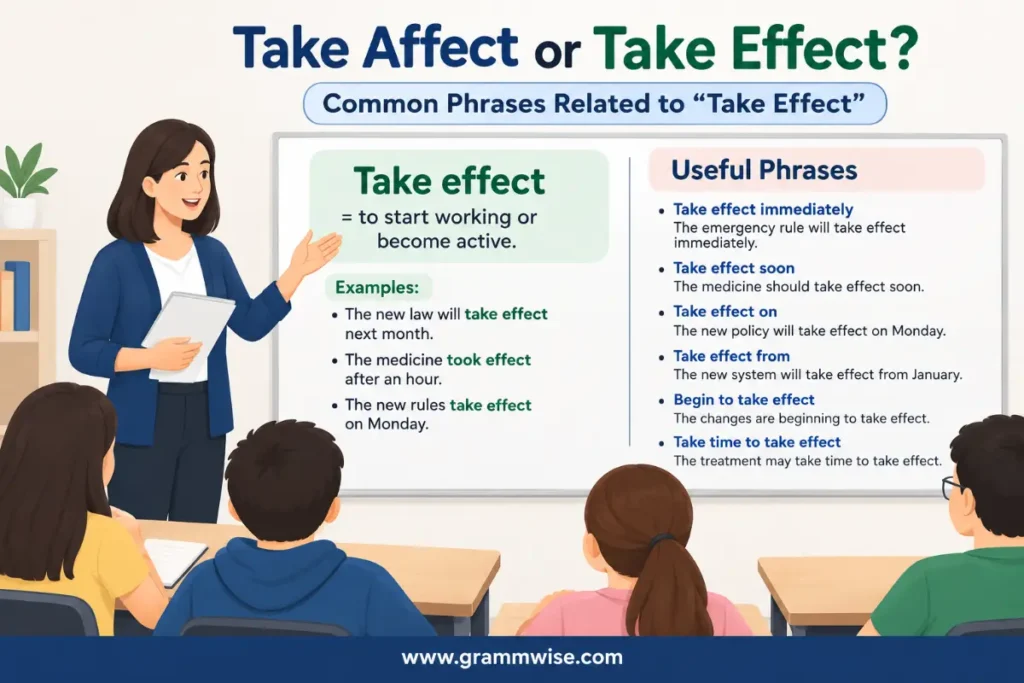
Here are useful phrases you may see with take effect.
Take effect immediately
This means something starts working right away.
Example:
The emergency rule will take effect immediately.
Take effect soon
This means something will start working after a short time.
Example:
The medicine should take effect soon.
Take effect on
This is used with a specific date or day.
Example:
The new rule will take effect on Monday.
Take effect from
This is often used with a starting date.
Example:
The new policy will take effect from January 1.
Begin to take effect
This means something is starting to produce results.
Example:
The changes are beginning to take effect.
Take time to take effect
This means something needs time before it starts working.
Example:
The medicine may take time to take effect.
These phrases are useful in both speaking and writing.
Easy Memory Trick for Affect and Effect
Here is a simple memory trick.
Think of the letter A in affect as:
Affect = Action
Affect usually describes an action of influencing something.
Now think of the letter E in effect as:
Effect = End result
An effect is often the result of something.
Now connect this idea to the main phrase:
Take effect = begin producing a result.
That is why we use effect.
Here is an even shorter memory trick:
Affect = influence
Effect = result
Take effect = start working
This is a useful rule for most everyday situations.
Common Mistakes People Make
Mistake 1: Writing “Take Affect”
This is the main mistake.
❌ The new rule will take affect tomorrow.
✅ The new rule will take effect tomorrow.
Use take effect when something starts working or becoming active.
Mistake 2: Thinking Affect and Effect Mean Exactly the Same Thing
They are connected, but they are not usually used in the same way.
Affect usually means to influence.
Effect usually means a result.
For example:
- Loud noise can affect your sleep.
- Loud noise can have an effect on your sleep.
The meanings are related, but the sentence structure changes.
Mistake 3: Using “Take Effect” When You Mean “Take Action”
These phrases are different.
Take effect means start working.
Take action means do something.
For example:
- The new law takes effect tomorrow.
- The company decided to take action.
Do not mix these expressions.
Mistake 4: Thinking “Take Effect” Always Means Something Good
Something taking effect can produce a good result or a bad result.
For example, medicine may take effect and reduce pain.
But a new tax may also take effect and increase costs.
The phrase simply means something starts working or becoming active.
It does not automatically mean something good.
Mistake 5: Forgetting That Results May Take Time
Some things take effect immediately.
Other things need time.
For example, a new law may take effect on a specific day.
Medicine may take thirty minutes to take effect.
A new exercise routine may take weeks to produce noticeable results.
The phrase can be used for both quick and slow changes.
Where Does “Take Effect” Come From? Simple History
The word effect has been part of English for a long time.
It is connected with the idea of producing a result or bringing something about.
Over time, English developed the phrase take effect to describe something beginning to work or produce results.
The meaning has stayed very clear.
When something takes effect, it moves from being inactive to active.
A law becomes active.
A medicine starts working.
A plan begins producing results.
That is why the phrase is still common in modern English.
Quick Practice
Choose affect or effect.
1. The new rule will take ______ next Monday.
Answer: effect
2. Lack of sleep can ______ your mood.
Answer: affect
3. The medicine began to take ______ after an hour.
Answer: effect
4. The weather can ______ our travel plans.
Answer: affect
5. The new policy will take ______ next month.
Answer: effect
6. Stress can ______ your sleep.
Answer: affect
7. The treatment may take time to take ______.
Answer: effect
If you answered these correctly, you understand the main rule very well.
Teacher’s Classroom Tip
Imagine I write these two ideas on the classroom board:
AFFECT = INFLUENCE
EFFECT = RESULT
Then I add one important phrase:
TAKE EFFECT = START WORKING
This phrase is easy once you understand the meaning.
Something does not take affect when it starts working.
Something takes effect.
Think about medicine.
When the medicine begins to work, it takes effect.
Think about a new school rule.
When the rule officially begins, it takes effect.
Think about a new plan.
When the plan begins producing results, it takes effect.
So the simple rule is:
If something starts working, use take effect.
A Simple Final Rule to Remember
When you are deciding between take affect or take effect, do not make it harder than it needs to be.
Ask yourself:
Does something start working or begin producing a result?
If the answer is yes, use:
take effect
Remember:
Affect = influence.
Effect = result.
Take effect = start working.
That is the key difference.
How Is “Take Effect” Understood in Culture and Stories?
The phrase take effect is not only used in grammar books or official writing. People also use the idea behind this phrase in stories, movies, and everyday conversations.
Many stories show a change that does not happen immediately.
A person may make a decision today, but the results may appear later.
A character may take medicine, start a new job, change a habit, or follow a new plan. At first, nothing may seem different. Then, after some time, the change begins to produce results.
This is the basic idea behind take effect.
Something begins.
Time passes.
Then the result becomes noticeable.
For example, a person may decide to study every day. The first few days may not show much improvement. After several weeks, the extra practice may begin to take effect.
This idea appears in many stories about growth and change.
A small action can create a bigger result later.
That is why take effect is closely connected with patience.
Not every action produces an immediate result.
Sometimes you must wait for something to take effect.
The phrase can also describe an important change.
A new rule may be announced today but become active later.
A decision may be made now but influence people only after it takes effect.
This makes the phrase useful when talking about change, results, and time.
Biblical and Mythological Meaning (If Applicable)
The exact phrase take effect does not have a special biblical or mythological meaning.
However, the idea behind it can be found in many old stories.
People often take actions and later see the results.
A person makes a choice.
The choice affects other people.
Over time, the effects become clear.
This simple idea appears in stories from many cultures.
Good actions may lead to positive results.
Poor decisions may lead to difficult results.
The main lesson is simple:
Actions can create effects.
Sometimes those effects appear quickly.
Sometimes they take time.
This is one reason the difference between affect and effect is useful in English.
One thing can affect another thing.
Then an effect or result may appear.
And when a change begins to work, it can take effect.
Symbolism Explained in Simple Words
The words affect and effect can represent two different parts of change.
What “Affect” Represents
Affect represents influence.
Something affects another thing when it changes or influences it.
Think of it as the action moving from one thing toward another.
For example, rain can affect a picnic.
The rain changes the picnic plans.
Stress can affect sleep.
The stress influences how well someone sleeps.
A new teacher can affect a student’s confidence.
The teacher’s actions may influence how the student feels.
So, in simple words:
Affect = influence or change something.
What “Effect” Represents
Effect represents the result.
After something influences a situation, there may be an effect.
For example, heavy rain may affect traffic.
The effect may be slower travel.
Lack of sleep may affect a student’s focus.
The effect may be poor concentration.
Exercise may affect your body.
The effect may be better strength or energy.
So, in simple words:
Effect = the result of an influence or change.
Now connect this to the main phrase:
Take effect = begin producing the result.
This is why take effect is the correct phrase.
Related Words You Should Know
Learning related words can make take affect or take effect much easier to understand.
Affect
Usually means to influence something.
Example: Stress can affect your sleep.
Effect
Usually means a result or change caused by something.
Example: Stress can have an effect on your sleep.
Influence
To change or guide the way something happens.
Example: Weather can influence travel plans.
Result
What happens because of an action or event.
Example: Practice can bring good results.
Impact
A strong effect or influence.
Example: The new rule had a big impact on students.
Outcome
The final result of an action or situation.
Example: Nobody knew the outcome of the competition.
Change
To become different or make something different.
Example: The new plan created a positive change.
Consequence
Something that happens because of an action.
Example: Missing class can have consequences.
Response
What happens after something causes a reaction.
Example: The body may have a response to medicine.
These words are connected because they all help us talk about actions and results.
How People Actually Use “Take Effect” in Daily English?
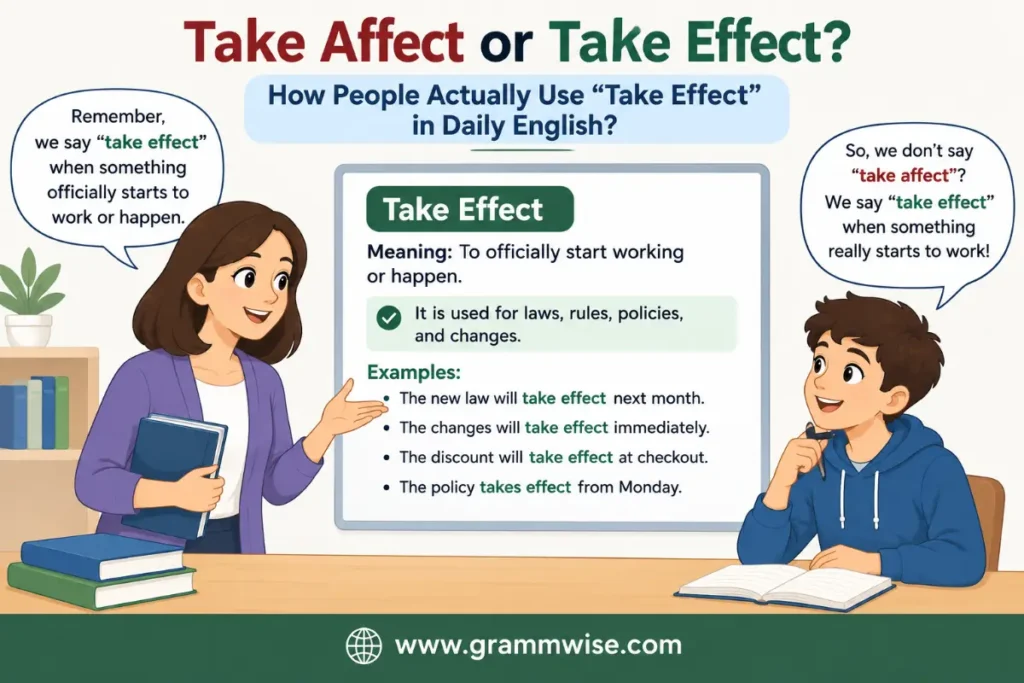
People use take effect whenever something begins working or producing results.
Here are natural examples from daily life.
- The medicine should take effect soon.
- The new rule takes effect tomorrow.
- The changes are starting to take effect.
- The treatment took effect after a few hours.
- The new schedule will take effect next week.
- The pain relief did not take effect immediately.
- The new policy took effect this month.
- My study plan is finally starting to take effect.
- The changes may take time to take effect.
- The new system will take effect on Monday.
These examples show an important pattern.
Something begins.
Then it becomes active or starts producing results.
That is when it takes effect.
How People Use “Affect” in Daily English?
Now look at how affect is used.
- Lack of sleep can affect your mood.
- Rain may affect our plans.
- The news affected everyone in the office.
- Stress can affect your health.
- Loud noise can affect your concentration.
- The delay affected our travel plans.
- Poor weather affected the game.
- The change may affect students.
- The new rule could affect employees.
- Her words affected my decision.
In these examples, affect means influence.
Something causes a change in something else.
This is different from take effect.
Remember:
Affect = influence.
Take effect = start working.
Take Affect or Take Effect at School
Students may see these words in different situations.
A teacher may explain that lack of sleep can affect a student’s ability to focus.
Here, lack of sleep influences the student’s focus.
A school may also introduce a new rule.
The rule may start on a specific date.
The new rule will take effect at that time.
Here are some examples:
- The new attendance rule takes effect next semester.
- Too much noise can affect students’ learning.
- The new exam policy will take effect next year.
- Missing sleep can affect your performance.
- The new classroom system took effect this week.
The simple difference remains the same.
Something can affect students.
A rule can take effect.
Take Affect or Take Effect at Work
These words are also useful at work.
Companies often make changes that affect employees.
For example, a company may change working hours.
The change may affect employees’ schedules.
The new working hours may take effect next month.
These two ideas are connected but different.
The change can affect employees.
The change can also take effect on a certain date.
Here are more examples:
- The new policy will affect all employees.
- The policy will take effect in January.
- The price increase may affect customers.
- The new system takes effect next week.
- The changes affected the company’s results.
- The updated rules took effect immediately.
This is a very common pattern in professional English.
Take Effect in Laws, Rules, and Policies
One of the most common uses of take effect is with official changes.
A law can be announced before it becomes active.
A policy can be approved before people must follow it.
A rule can be written before it officially begins.
When the change becomes active, it takes effect.
For example:
- The law will take effect next year.
- The policy takes effect on July 1.
- The new rules took effect immediately.
The phrase is useful because it clearly tells us when something starts officially working.
You may also see:
effective from
effective on
These phrases are related.
For example:
The new policy is effective from Monday.
This means the policy starts working on Monday.
Take Effect with Medicine and Treatment
Medicine is another very common use.
When you take medicine, it may need time before you feel a difference.
The medicine may be in your body, but it may not be working fully yet.
After some time, it begins to produce its result.
Then it takes effect.
Examples:
- The medicine took effect quickly.
- The treatment may take time to take effect.
- The pain relief began to take effect after an hour.
- The medicine did not take effect right away.
This phrase is useful because it describes the moment when the result begins.
It does not mean the medicine has finished working.
It means the medicine has started working.
Take Effect and “Have an Effect”
Learners sometimes confuse these two expressions.
Take effect means to start working.
Have an effect means to produce or create a result.
For example:
A new study plan may take effect after a few weeks.
The same study plan may have a positive effect on grades.
The first sentence talks about the plan starting to produce results.
The second sentence talks about the result it produces.
Here is another example:
Medicine can take effect after thirty minutes.
The medicine can have an effect on pain.
Both use effect, but the meaning is slightly different.
Take Effect and “Affect”
The words can also appear in the same situation.
For example:
A new rule can take effect on Monday.
After it takes effect, the rule may affect students.
This shows the connection clearly.
First, the rule becomes active.
Then, it influences people.
So:
The rule takes effect.
The rule affects people.
The first sentence talks about the rule starting.
The second sentence talks about the rule’s influence.
Common Mistakes People Make
Mistake 1: Using “Take Affect”
This is the most common mistake.
❌ The new policy will take affect next month.
✅ The new policy will take effect next month.
When something starts working or becomes active, use take effect.
Mistake 2: Using “Affect” as a Result
Many learners use affect when they need a word for a result.
❌ The weather had a strong affect on the game.
✅ The weather had a strong effect on the game.
After had a, you usually need effect when talking about a result.
Mistake 3: Using “Effect” When You Mean Influence
❌ Stress can effect your sleep.
✅ Stress can affect your sleep.
Here, stress is influencing sleep.
So affect is the better word.
Mistake 4: Thinking “Take Effect” Means Something Good
Something can take effect and create either a good or bad result.
A medicine may take effect and reduce pain.
A price increase may take effect and make something more expensive.
The phrase simply means that something starts working.
Mistake 5: Thinking “Take Effect” Always Means Immediate Results
Some things take effect immediately.
Other things need time.
A law may take effect at midnight.
A medicine may take effect after an hour.
A new exercise routine may take weeks to show results.
The amount of time does not change the meaning of the phrase.
Easy Memory Trick
Here is a simple way to remember the difference.
Think:
Affect = Action of influencing.
Effect = End result.
The first letters can help you remember:
A = Action
E = End result
Now remember the main phrase:
Take effect = start producing a result.
So if something becomes active or starts working, choose effect.
A short rule is:
Things affect other things.
Things have effects.
Changes take effect.
This simple pattern can help you remember the difference.
Final Teacher Explanation
Imagine two boxes on the classroom board.
The first box says:
AFFECT = INFLUENCE
The second box says:
EFFECT = RESULT
Now imagine a new school rule.
The rule begins on Monday.
On Monday, the rule takes effect.
After the rule takes effect, it may affect students.
This is the easiest way to see the difference.
Take effect tells us when something begins working.
Affect tells us how something influences another thing.
So when you are deciding between take affect or take effect, ask one question:
Does something start working or become active?
If yes, use take effect.
Do not write take affect for this meaning.
Quick Recap
The correct phrase is take effect. It means that something starts working, becomes active, or begins producing results.
Affect usually means to influence. Effect usually means a result. Remember: Changes take effect, while things affect other things.
Conclusion
Understanding take affect or take effect becomes easy when you remember that take effect is the correct phrase for something that starts working, becomes active, or begins producing results. Affect usually means to influence, while effect usually refers to a result.
Remember this simple rule: things affect other things, but rules, medicines, and changes take effect. With this easy memory trick, you can confidently choose the correct phrase in daily English, school, and work.
Frequently Asked Questions
Is it take affect or take effect?
The correct phrase is take effect when something starts working or becomes active.
What does take effect mean?
It means to start working, become active, or begin producing results.
Why is “take affect” incorrect?
Affect usually means to influence something. The standard phrase for something starting to work is take effect.
Can medicine take effect?
Yes. When medicine begins working, it starts to take effect.
Can a new law take effect?
Yes. A law takes effect when it officially becomes active.
What is the difference between affect and effect?
Affect usually means to influence. Effect usually means a result.
Can something affect someone and take effect?
Yes. For example, a new rule can take effect on Monday and then affect students.
How can I remember take affect or take effect?
Remember: Affect = influence. Effect = result. Take effect = start working.