
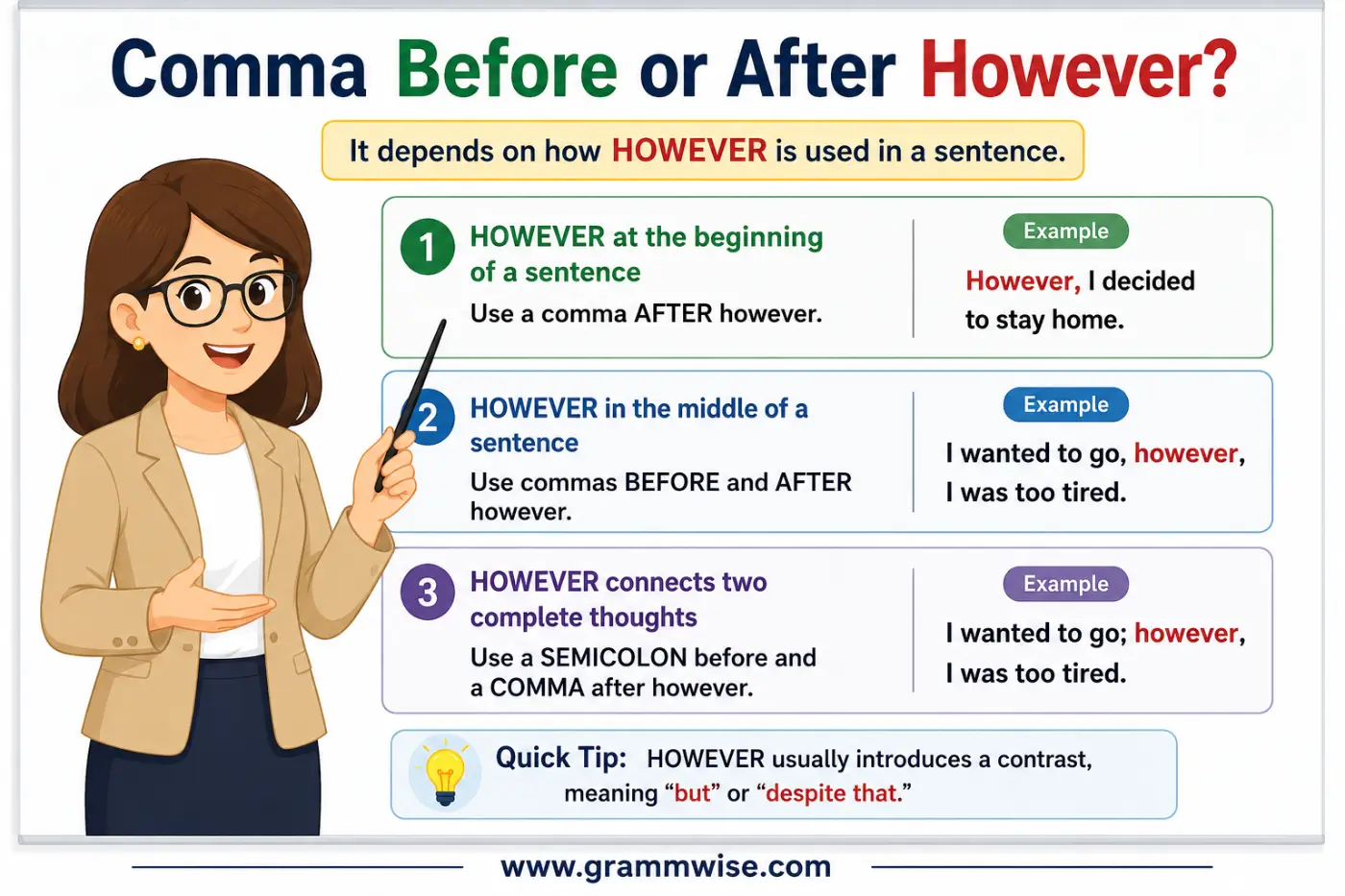
Many English learners wonder whether they should put a comma before or after however. The answer depends on how however is used in the sentence. When however connects two complete thoughts, it usually needs punctuation on both sides or a semicolon before it. When however appears at the beginning of a sentence, a comma usually comes after it. When it means “in whatever way,” it may not need commas at all.
For example, you can write, “I wanted to go; however, I was too tired.” You can also write, “I wanted to go. However, I was too tired.” Notice that the comma comes after however in these examples.
The phrase comma before or after however can seem confusing because however can do different jobs. Once you learn where it appears and what it means, the punctuation becomes much easier. This guide will show you the simple rules, common mistakes, and everyday examples you can use in your own writing.
Keep learning with our easy grammar explanations like followup or follow up.
Simple Answer in One Look
If however comes at the beginning of a sentence, put a comma after it:
However, I decided to stay home.
If however comes in the middle of a sentence as a contrast word, it is usually set off with commas:
I decided, however, to stay home.
If it connects two complete sentences, use a semicolon before it and a comma after it:
I wanted to go; however, I stayed home.
The key point is simple:
However usually takes a comma after it when it begins a sentence.

What Does However Mean in Simple English?
The word however usually means “but,” “in contrast,” or “despite that.”
It tells the reader that the next idea is different from or opposite to the idea before it.
Look at this simple example:
“I wanted to play outside. However, it started raining.”
The first sentence tells us that the person wanted to play. The second sentence gives us a different result. The person wanted to play, but the rain stopped the plan.
That is why however is often similar to but.
However Means “But”
Compare these two sentences:
“I wanted to go, but I was tired.”
“I wanted to go. However, I was tired.”
Both sentences show a contrast.
The word but is shorter and more common in casual speech.
However can sound a little more formal, so you often see it in essays, articles, reports, and careful writing.
However Can Show a Surprising Result
For example:
“Tom studied hard. However, he did not pass the test.”
We expected Tom to do well because he studied hard. The word however tells us that the result was different from what we expected.
Another example:
“The restaurant was expensive. However, the food was excellent.”
The first idea sounds negative. The second idea gives us a positive point.
This is the basic job of however.
Why Do People Get Confused About the Comma?
The confusion usually happens because however can appear in different places in a sentence.
You may see:
However, I went home.
You may also see:
I, however, went home.
And you may see:
I wanted to stay; however, I went home.
All three sentences use however, but the punctuation is different.
The good news is that there is a simple reason.
You need to look at where however appears and what job it is doing.
When However Starts a Sentence
When however starts a sentence and means “but,” a comma usually follows it.
Example:
However, I changed my mind.
However, she decided to stay.
However, we could not find the address.
The pattern is easy:
However, + rest of sentence
When However Appears in the Middle
When however appears in the middle of a sentence and adds a contrast, it is often surrounded by commas.
Example:
I decided, however, to wait.
She was, however, very happy.
The plan was, however, too expensive.
The commas show that however is an extra contrast word placed inside the sentence.
When However Connects Two Complete Thoughts
This is where many learners make a mistake.
You should not normally connect two complete sentences with only a comma and however.
Incorrect:
❌ I wanted to leave, however I stayed.
A better version is:
✅ I wanted to leave; however, I stayed.
Or:
✅ I wanted to leave. However, I stayed.
The semicolon helps separate the two complete thoughts.
Clear Difference Explained Simply
Let’s put the main patterns side by side.
| Position of however | Example |
|---|---|
| Beginning of sentence | However, I stayed home. |
| Middle of sentence | I decided, however, to stay home. |
| After a semicolon | I wanted to leave; however, I stayed. |
| Between two complete sentences with only a comma | ❌ I wanted to leave, however I stayed. |
The most useful rule to remember is this:
If however means “but” and starts a sentence, put a comma after it.
Example:
However, I disagree.
If it appears inside a sentence as an interruption or extra contrast, commas often go around it.
Example:
I, however, disagree.
If it joins two complete thoughts, use a semicolon before it and a comma after it.
Example:
I disagree; however, I understand your point.
Which Is Correct: Comma Before or After However?
This is one of the most common questions.
The answer is:
It can be before, after, or both, depending on the sentence.
There is no single rule saying that the comma must always go before however or always after it.
Comma After However
Use a comma after however when it begins a sentence and means “but.”
Examples:
- However, I did not give up.
- However, she changed her mind.
- However, the answer was different.
- However, we decided to continue.
This is probably the most common pattern learners need to remember.
Commas Before and After However
When however appears in the middle of a sentence, it can be surrounded by commas.
Examples:
- I was, however, too tired to continue.
- She did, however, finish her homework.
- The plan was, however, not successful.
- He is, however, willing to try again.
Here, the commas show that however is inserted into the sentence.
Semicolon Before and Comma After However
When however connects two complete thoughts, use a semicolon before it and a comma after it.
Example:
I wanted to buy the car; however, it was too expensive.
Notice the pattern:
complete thought; however, complete thought
More examples:
- She studied hard; however, she failed the test.
- We arrived early; however, the doors were closed.
- I liked the house; however, I could not afford it.
- He was tired; however, he continued working.
This pattern is especially useful in formal writing.
However at the Beginning of a Sentence
This is the easiest use to understand.
When however begins a sentence and means “but,” put a comma after it.
For example:
However, I do not agree.
However, she still wanted to go.
However, the weather improved later.
However, we found another solution.
Think of however as a small sign that tells the reader:
“Here comes a different idea.”
Then the comma gives the reader a small pause.
A Simple Classroom Example
Imagine your teacher says:
“You studied for the test.”
That sounds positive.
Then the teacher says:
“However, you forgot to read the instructions.”
The second idea changes the direction of the first idea.
So we write:
However, you forgot to read the instructions.
The comma after however makes the sentence easy to read.
However in the Middle of a Sentence
Sometimes a writer wants to place however inside the sentence.
For example:
The test was, however, easier than expected.
Here, the main sentence is:
“The test was easier than expected.”
The word however adds contrast.
Because it is inserted into the sentence, commas are placed around it.
Another example:
My brother, however, does not like football.
The basic sentence is:
“My brother does not like football.”
Adding however tells us that his opinion is different from something mentioned earlier.
For example:
“My parents love football. My brother, however, does not like it.”
This is a natural way to show contrast.
However After a Semicolon
A semicolon can be useful when two complete thoughts are closely connected.
Look at this example:
I wanted to go to the beach; however, it started raining.
There are two complete thoughts:
“I wanted to go to the beach.”
“It started raining.”
The semicolon connects them while keeping them separate.
The comma after however then gives the reader the normal pause.
The pattern is:
Sentence; however, sentence.
Here are more examples:
- The movie was long; however, I enjoyed it.
- The room was small; however, it was comfortable.
- I was nervous; however, I gave the speech.
- She was busy; however, she helped me.
This is an excellent pattern to learn for school and professional writing.
Why You Should Not Use Only a Comma Before However?
A common mistake looks like this:
❌ I wanted to help, however I was too busy.
This sentence has two complete thoughts joined with only a comma.
A better version is:
✅ I wanted to help; however, I was too busy.
Or:
✅ I wanted to help. However, I was too busy.
You can also use but:
✅ I wanted to help, but I was too busy.
This last option is very natural in everyday English.
The important lesson is that however does not work exactly like but when joining two complete sentences.
However vs But
Both words can show contrast, but their punctuation is different.
With But
You can normally use a comma before but when it joins two complete thoughts.
I wanted to go, but I was tired.
With However
Use a semicolon before however when it joins two complete thoughts.
I wanted to go; however, I was tired.
You can also make two separate sentences:
I wanted to go. However, I was tired.
This is one of the most useful differences to remember.

Easy Real-Life Sentences You Can Use
Here are some simple examples.
- However, I decided to stay home.
- However, she did not agree with me.
- I wanted to buy it; however, it was too expensive.
- He was tired; however, he finished his work.
- The food was expensive. However, it tasted great.
- My sister, however, prefers tea.
- We were late; however, we caught the bus.
- The weather was cold. However, we went outside.
These sentences cover the most common ways you will see however used.
A Simple Memory Trick
Here is an easy teacher trick.
When however starts a sentence, imagine that it is carrying a small flag.
The flag says:
“New idea coming!”
Then put a comma after it.
However,
The comma creates a small pause before the new idea.
So remember:
However at the start? Comma after.
For two complete thoughts, remember:
Sentence; however, sentence.
This tiny pattern can help you avoid many punctuation mistakes.
Where Does However Come From?
The word however has been used in English for hundreds of years. It comes from older English expressions connected to the idea of “in whatever way” or “in whatever manner.”
Over time, however developed another common use. It became a way to introduce a contrasting idea, similar to but.
Today, this contrast use is extremely common.
For example:
I was tired. However, I continued.
The word has become an important part of everyday and formal English.
You do not need to memorize its history to use it correctly. The more useful lesson is understanding how its position changes the punctuation.
One More Important Meaning of However
There is another use of however that is easy to miss.
Sometimes however means “in whatever way” or “no matter how.”
For example:
However you solve the problem, show your work.
Here, however does not mean “but.”
It means something like:
“No matter how you solve the problem.”
Another example:
However hard you try, you cannot please everyone.
Here, however hard means “no matter how hard.”
In this use, you should not automatically add a comma after however.
Compare:
However, I decided to stay.
Here, however means “but,” so we use a comma.
However you decide, I will support you.
Here, however means “in whatever way,” so the punctuation works differently.
This is why simply memorizing “always put a comma after however” can cause problems.
The meaning matters.
Quick Practice
Choose the correct punctuation.
1. However I was tired I continued working.
Correct:
However, I was tired. I continued working.
2. I wanted to help however I was busy.
Better:
I wanted to help; however, I was busy.
3. My sister however loves the idea.
Better:
My sister, however, loves the idea.
4. However you choose to solve it I will help.
Here, however means “in whatever way.”
A better version is:
However you choose to solve it, I will help.
Notice that the comma comes after the whole introductory part, not immediately after however.
This last example shows why understanding the meaning is so important.
How However Is Understood in Culture and Stories?
The word however is common in stories, conversations, news reports, and everyday writing. It helps a writer show that one idea is different from another.
Imagine a story about a student named Emma.
Emma studied every night for her exam. She felt ready. However, when she saw the test, she became nervous.
The word however tells us that something unexpected happened. Emma prepared well, but her feelings changed when the test began.
This is why however is useful in storytelling. It can create a small change in the direction of a story.
For example:
“Daniel wanted to move to another city. However, he decided to stay with his family.”
The first sentence makes us expect one thing. The second sentence gives us a different result.
Writers use however to show:
- A different idea
- An unexpected result
- A change of direction
- A contrast
- A surprising detail
You will often see it in stories when a character changes their mind.
For example:
“Sarah planned to leave early. However, her friend asked her to stay.”
The word helps the reader understand the connection between the two ideas.
However can also make writing sound calm and balanced.
For example:
“The job is difficult. However, it is rewarding.”
The writer does not say the job is completely bad. Instead, the writer gives both sides.
This is useful in reviews, essays, articles, and discussions.
Biblical and Mythological Meaning of However
However does not have a special biblical or mythological meaning. It is a normal English word used to connect ideas or show contrast.
You may find the word in modern English translations, religious discussions, or books about mythology, but its basic meaning remains the same.
For example:
“The character wanted to leave. However, he stayed.”
The word simply shows a contrast between the two ideas.
Old stories often contain situations where a person expects one thing but something else happens. Modern writers may use however to connect those ideas.
For example:
“The hero was afraid. However, he entered the cave.”
The word helps show the change from fear to action.
The same pattern can appear in stories from many cultures.
A character may want to run away but stay.
A person may expect failure but succeed.
Someone may think a problem is impossible but find a solution.
However can introduce that change.
It does not carry a special religious meaning. The meaning comes from the story itself.
Symbolism Explained in Simple Words
The word however does not have a fixed symbolic meaning. Still, writers can use it to create certain feelings or ideas.
What However Represents
When however is used to show contrast, it can represent change.
It tells the reader:
“Wait. There is another side to this.”
For example:
“The road was difficult. However, they continued.”
The word introduces hope and determination. The road is difficult, but the people do not stop.
In another sentence:
“He made many mistakes. However, he learned from them.”
Here, however helps move the story from failure to growth.
This is why the word can feel powerful in stories.
It creates a small turn.
It can show:
- Hope after difficulty
- Success after failure
- Change after a decision
- A surprise after an expectation
- A positive point after a negative point
What the Other Version Represents
There is no second spelling of however with a different meaning.
The word is always spelled:
however
You should not write:
❌ how ever
when you mean the normal contrast word.
However, how ever can appear as separate words in a different sentence when ever is being used separately.
For example:
“How ever did you solve that puzzle?”
This is a different construction and is much less common in everyday writing.
For normal contrast, use:
however
Example:
“However, I decided to continue.”
So remember that punctuation and meaning both depend on how the word is being used.
Related Words You Should Know
Learning words related to however can make your writing smoother.
But
But is one of the closest everyday alternatives to however.
Example: I wanted to go, but I was tired.
Yet
Yet can show a contrast or surprising result.
Example: The task was difficult, yet she finished it.
Although
Although introduces a contrast between two ideas.
Example: Although it was raining, we went outside.
Though
Though is often similar to although and can sound more natural in casual speech.
Example: I liked the movie, though it was very long.
Nevertheless
Nevertheless means something similar to “despite that.”
Example: The road was dangerous. Nevertheless, they continued.
Nonetheless
Nonetheless is close in meaning to nevertheless.
Example: The plan was difficult. Nonetheless, we tried.
Still
Still can show that something remains true despite another fact.
Example: It was expensive. Still, I bought it.
In Contrast
This phrase directly tells the reader that two ideas are different.
Example: John likes tea. In contrast, Mary prefers coffee.
On the Other Hand
This phrase is useful when comparing two sides.
Example: The house is small. On the other hand, it is very comfortable.
These words do not always have exactly the same grammar or punctuation as however, but they can help you express contrast.
How People Actually Use However in Daily English?
Although however is common in formal writing, people also use it in everyday speech.
Here are some natural examples.
1. When You Change Your Opinion
“I thought I would go. However, I changed my mind.”
The word shows that the speaker’s decision changed.
2. When Something Is Unexpected
“The restaurant looked small. However, it had plenty of tables.”
The second idea is different from what we expected.
3. When Giving Both Sides
“The phone is expensive. However, it has a very good camera.”
The speaker gives a negative point and then a positive point.
4. When Talking About School
“I studied for the test. However, some questions were difficult.”
The student prepared, but the test was still hard.
5. When Talking About Work
“The job is stressful. However, I enjoy it.”
The speaker gives two sides of the job.
6. When Talking About Weather
“It was raining this morning. However, the sun came out later.”
The weather changed.
7. When Talking About Plans
“We planned to travel on Friday. However, our flight was canceled.”
The second sentence gives an unexpected problem.
8. When Giving an Opinion
“I understand your point. However, I disagree.”
This is a very common way to politely show a different opinion.
9. When Talking About Money
“The house is beautiful. However, it is too expensive for us.”
The speaker likes the house but cannot afford it.
10. When Talking About Food
“The restaurant was crowded. However, the service was fast.”
The writer gives a negative detail and then a positive one.
These examples show how useful however can be.

Common Mistakes People Make
Mistake 1: Using Only a Comma Before However
A very common mistake is:
❌ I wanted to go, however I was tired.
This incorrectly joins two complete thoughts with only a comma.
Use:
✅ I wanted to go; however, I was tired.
Or:
✅ I wanted to go. However, I was tired.
Mistake 2: Forgetting the Comma After However
When however starts a sentence and means “but,” learners sometimes forget the comma.
❌ However I decided to stay.
Better:
✅ However, I decided to stay.
The comma makes the opening easier to read.
Mistake 3: Adding a Comma Before However at the End of a Sentence
Some learners put a comma before however simply because they think the word always needs one.
For example:
❌ I don’t know the answer however.
This is not the normal way to use however when it means “but.”
A better sentence would be:
✅ However, I don’t know the answer.
Or:
✅ I don’t know the answer, though.
Mistake 4: Thinking However Always Means But
Usually, however means “but” when it shows contrast.
But it can have another meaning.
For example:
“However you solve the problem, show your work.”
Here, however means something like “in whatever way.”
So do not automatically put a comma directly after however in every sentence.
Mistake 5: Confusing However With How Ever
When you mean “but” or “in contrast,” use one word:
however
Example:
“However, I decided to stay.”
How ever can appear in special questions or expressions, but it is not the normal spelling of the contrast word.
Mistake 6: Using Too Many However Words
You do not need however in every sentence.
For example:
“The movie was long. However, I enjoyed it. However, my brother disliked it. However, my parents liked it.”
This sounds repetitive.
You can write:
“The movie was long. However, I enjoyed it. My brother disliked it, but my parents liked it.”
Good writing uses different words and sentence patterns.
Final Teacher Explanation
If I were explaining comma before or after however to a class, I would give students three simple patterns.
Pattern One: However at the Beginning
When however starts a sentence and means “but,” use a comma after it.
However, I decided to go.
Remember:
However, + sentence
Pattern Two: However in the Middle
When however is placed inside a sentence as an extra contrast word, commas can surround it.
I, however, decided to go.
Remember:
sentence, however, sentence
Pattern Three: Two Complete Thoughts
When however connects two complete thoughts, use a semicolon before it and a comma after it.
I wanted to go; however, I was tired.
Remember:
sentence; however, sentence
These three patterns will solve most punctuation questions involving however.
There is one more thing to remember.
Do not focus only on the comma.
First ask:
What does however mean in this sentence?
If it means “but”, it is showing contrast.
If it means “in whatever way” or “no matter how,” the punctuation may be different.
That small question can prevent many mistakes.
Quick Recap
When however begins a sentence and means “but,” use a comma after it: “However, I disagree.” When it connects two complete thoughts, use a semicolon before it and a comma after it: “I disagree; however, I understand your point.”
When however appears inside a sentence as an extra contrast word, it can be surrounded by commas: “I, however, disagree.”

Conclusion
Understanding comma before or after however becomes much easier when you look at how the word is used. When however starts a sentence and means “but,” place a comma after it: “However, I disagree.” When it connects two complete thoughts, use a semicolon before it and a comma after it: “I wanted to go; however, I was tired.”
The main rule is simple: However, + sentence and sentence; however, sentence. When however appears in the middle of a sentence, commas may surround it. Learning these patterns will help you use however clearly and correctly in everyday and formal writing.
Frequently Asked Questions
Should there be a comma before or after however?
It depends on its position. At the start of a sentence, use a comma after however: “However, I stayed.”
Do I put a comma after however?
Usually, yes, when however begins a sentence and means “but.”
Can I put a comma before however?
Yes. When however connects two complete thoughts, use a semicolon before it: “I wanted to go; however, I was tired.”
Can I use a comma before and after however?
Yes. When however appears in the middle as an extra contrast word, commas can surround it: “I, however, disagree.”
Is this correct: “I wanted to go, however I was tired”?
No. Use a semicolon or make two sentences: “I wanted to go; however, I was tired.”
Is however the same as but?
They can both show contrast, but their punctuation is different. But can join two complete thoughts with a comma, while however normally needs a semicolon or a new sentence.
Does however always need a comma?
No. When however means “in whatever way,” it may not take a comma immediately after it: “However you decide, I will support you.”
What is the easiest rule for however?
Remember: “However, + sentence” at the beginning, and “sentence; however, sentence” when joining two complete thoughts.